Dario's '$1B with one person' vision now has a real-world match. Unpacking the AI Solo Unicorn phenomenon
Anthropic's CEO predicted a 70-80% probability that a one-person $1B company emerges in 2026, and Medvi posted numbers close to that mark. This piece breaks down the structure, cases, and shadows of the AI Solo Unicorn phenomenon — and gives you a framework for deciding what to hand over to AI in your own work.
What you'll learn in this article
- The key point to grasp before reading the full article
- How the issue changes practical decisions after reading
- Which follow-up article is worth opening next
Bottom line up front.
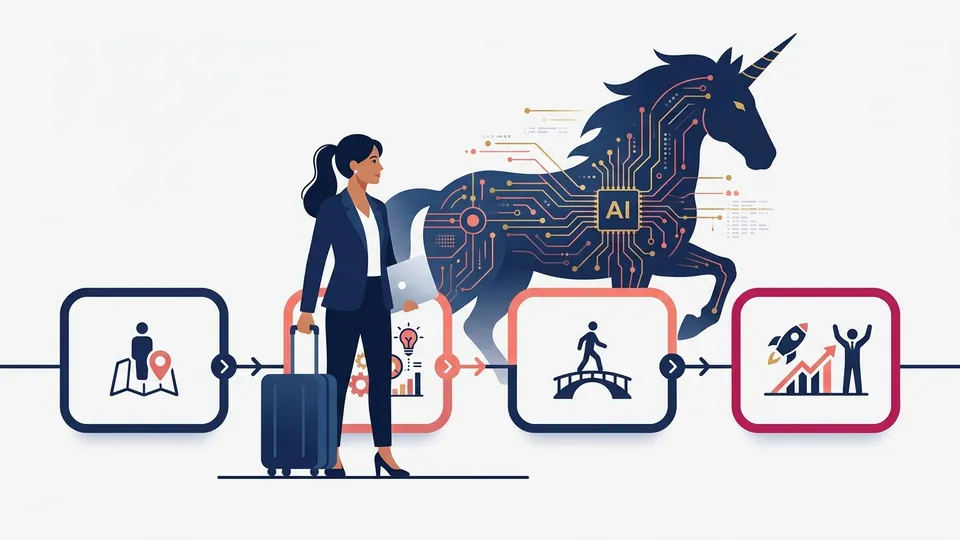
“The era of a single person building a $1B company is coming.” This isn’t sci-fi — it’s a prediction reportedly made in May 2025 by Anthropic CEO Dario Amodei. Inc.com and several other outlets covered it. And in April 2026, a real-world case came close.
In my previous piece I dissected Medvi’s entire operations playbook (previous article). This time I want to zoom out one level and talk about the meta concept itself — the phenomenon being called “AI Solo Unicorn.”
What’s happening? Why now? How can you use it in your own work? Let me walk through it.
What is an “AI Solo Unicorn”? What Dario Amodei said in May 2025
The prediction reportedly made by Anthropic CEO Dario Amodei is the origin point of the “AI Solo Unicorn” concept. The gist: “There’s a 70-80% probability that a $1B company with a single employee will emerge during 2026.”
This was at Anthropic’s Code with Claude conference in May 2025. Multiple outlets reported it as Amodei’s answer to the question “When will the first $1B solo company appear?” I’m treating this as a reported statement via Inc.com and others. Since Anthropic hasn’t released an official transcript, I’ll treat it as “a remark reported in public coverage.” (Inc.com)
The two strong sectors Amodei named in coverage were proprietary trading (investment management with one’s own capital) and developer tools (software for developers). Both are software-centric fields where few processes require human hands.
By the way, OpenAI’s Sam Altman made the same prediction back in 2024. The fact that the top two figures in the AI industry are both talking about “$1B with one person” is significant.
The phrase “AI Solo Unicorn” started circulating in English-language media in 2026 as a convenient label. The definition wobbles by outlet — some articles say “$1B with a one-person company,” others describe “five or fewer people at $1B scale.”
Here’s how I’ll frame it: AI Solo Unicorn = a convenient label used by media. It refers broadly to companies that have placed AI at their core and reached $1B scale (in revenue or valuation) with extremely small headcounts (roughly 10 or fewer). Unlike traditional unicorns (startups valued at $1B or more), these are often described in revenue terms. Dario’s “$1B with one person” is the most extreme version; in practice, teams of 1-5 people are often included.
Why does this concept matter right now? Simple: the limits and the possibilities of “with AI you don’t need to hire” are both being tested at once. Has a near-match really emerged, or are we still on the road there? You can’t judge without looking at concrete cases.
Speaking personally — I’ve been running a one-person company myself, and the “should I hire?” question has been a recurring wall. Outsourcing costs creep up, but I don’t want to grow fixed costs. Meanwhile AI keeps getting smarter, and chunks of work I used to outsource can now go to AI instead. Amodei’s prediction lines up exactly with what I’m feeling. $1B with one person is extreme, sure — but the sense that “what one person can do” keeps expanding is very real.

A near-prediction case has emerged. Medvi and adjacent examples share a structure
Medvi, founded with $20K (about ¥3M), reportedly generated $401M in its first year, with a 2026 run-rate of $1.8B. This is what set English-language coverage buzzing about “the first AI Solo Unicorn.” But Medvi isn’t the only one.
Quick 30-second refresher on Medvi’s basic structure. Matthew Gallagher launched a telehealth company specializing in GLP-1s (obesity medications) in September 2024. Headcount: two, including his brother. ChatGPT, Claude, and Grok handle code, marketing, and CS. Medical compliance is outsourced wholesale to CareValidate and OpenLoop Health. (PYMNTS.com)
Here’s the thing — there are other extremely-small-team startups with a similar shape.
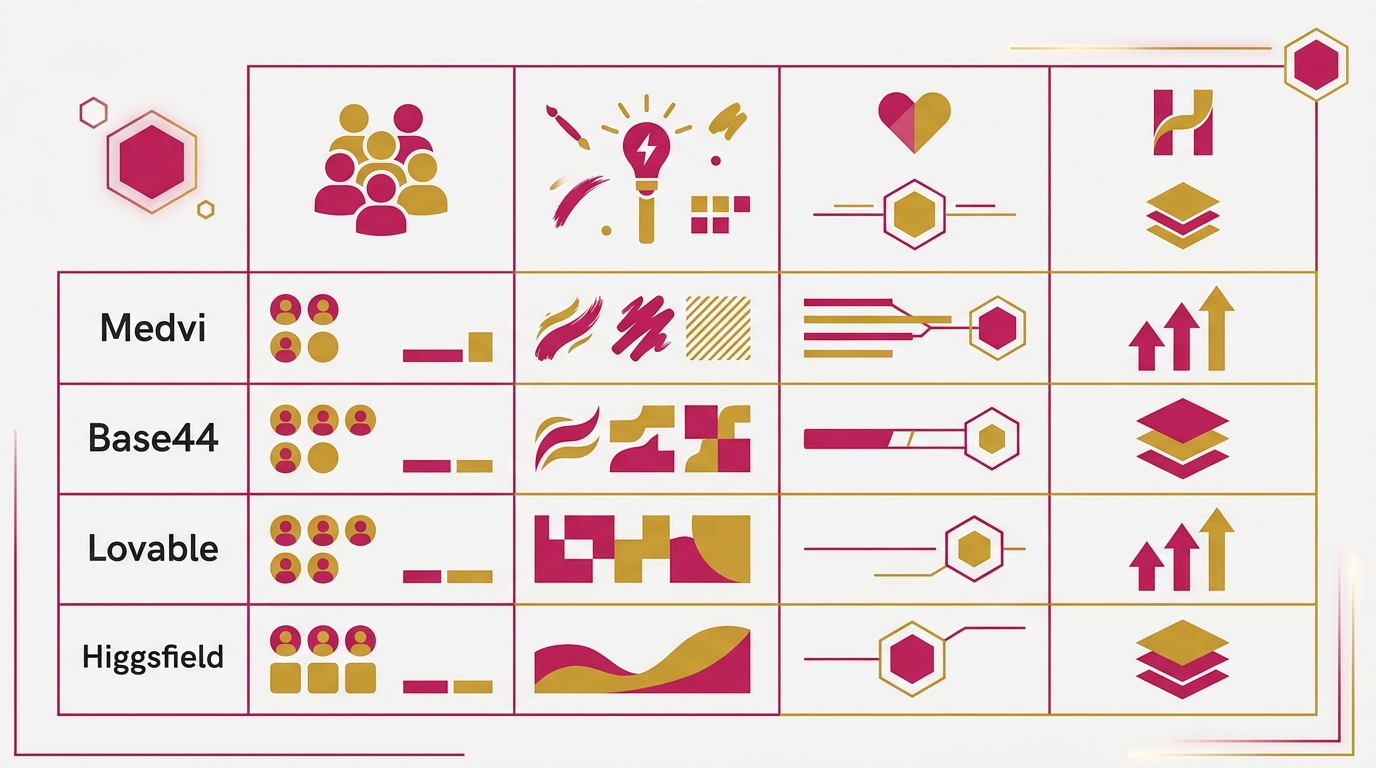
- Base44: Built solo by Maor Shlomo. Reportedly hit 250K users and profitability within six months of launch. Sold to Wix for $80M (about ¥12B).
- Lovable: A Swedish AI coding platform. Coverage suggests it broke $100M ARR in under a year and reached a $6.6B (about ¥1T) valuation.
- Higgsfield: AI video generation. Industry reporting says it hit $10M ARR within weeks and a $1.3B valuation within a year.
Three things in common. Software at the core. AI driving development, marketing, and CS. And the same approach to outsourcing regulation and compliance to external partners.
When those three conditions stack, work that used to need 50 people gets done by five or fewer. Headcount costs are tiny, so margins shoot up. According to coverage, Medvi’s net profit margin was 16.2%. Its competitor Hims & Hers reportedly runs at 5.5% with 2,442 employees. That gap captures the structural difference perfectly.
A caveat. Base44 and Lovable are developer tools — they map cleanly onto the strong sectors Amodei named in coverage. Medvi, on the other hand, stepped into healthcare, a heavily regulated space. How feasible an AI Solo Unicorn is varies a lot by sector. “Can AI run the whole thing?” depends on the business model. There’s no universal answer. (Inc.com)
A 29.8 million-strong solopreneur economy. AI Solo Unicorns are just “one peak”
There are 29.8 million solopreneurs in the US, reportedly forming a combined $1.7 trillion (about ¥255 trillion) economy. AI Solo Unicorns sit at the extreme tip of that economy.
What I really want to share isn’t “look at these flashy cases” — it’s what’s happening across the 29.8 million-person base. (SUCCESS)
Some numbers.
- Solopreneurs make up 82% of all US small businesses
- 77% turn profitable in year one (orders of magnitude higher than traditional startup profitability rates)
- 20% of solopreneurs earn $100K-$300K (about ¥15M-¥45M) annually. 3.6% clear $1M
- Independent workers total 72M and are projected to expand to 86.5M by 2027 (Founder Reports)
Note: SUCCESS and Founder Reports are both secondary aggregation articles and don’t carry the precision of official statistics. I’m citing them here for directional sense, not as hard numbers.
Look at these figures and the $1B-class AI Solo Unicorn is clearly an outlier. The vast majority of solopreneurs run their businesses on realistic monthly revenue between roughly ¥50K and ¥500K.
But — outliers matter precisely because they’re outliers. What Medvi proved isn’t “two people can move $40B.” It’s the structural shift in how AI has changed the criteria for “should I hire?”
That shift hits a freelancer making ¥500K/month the same way it hits a mid-sized business making ¥50M/month. “Of the work I used to ask people to do, which parts can I hand to AI?” The moment that question appears, the AI Solo Unicorn concept becomes relevant to your work.
According to Carta data, the share of solo founders jumped from 31% in 2024 to 36% in 2025. Evidence that “start with one person” is becoming a more realistic option as AI spreads.
What about Japan? Japan’s Ministry of Internal Affairs and Communications “Employment Status Survey” puts the freelancer population at about 4.62M (as of 2022). The scale is small compared to the US’s 29.8M, but with the loosening of side-gig restrictions and the spread of AI tools, the bar to start a “one-person business” is unmistakably dropping. Even among the people around me, more and more are running AI side-content businesses while keeping their day jobs. I know someone who started at ¥30K/month and got to ¥300K/month in six months. The $1B-class AI Solo Unicorn might feel like a distant story. But the design thinking behind it works just as well for a ¥300K/month side hustle.

The shadow side. The reality Forrester and the FDA put on the table
Behind Medvi’s dazzling numbers sit darker realities: an FDA warning letter, fake ads, and a New York Times article correction. You can learn from the AI Solo Unicorn’s design structure. But the ethics need to be faced separately and squarely.
On February 20, 2026, the FDA (US Food and Drug Administration) sent Medvi a warning letter. The findings: language on the website claiming “the same active ingredient as Wegovy® and Ozempic®” misled consumers about FDA approval status. The FDA also flagged that Medvi, despite not compounding the drugs in-house, presented itself as if it were the manufacturer. (Drug Discovery and Development)
The fake-ad problem is serious too. What turned up in Meta’s Ad Library was jarring: over 5,000 ads running under the Medvi name, featuring AI-generated fictional doctor personas. Medvi’s response was that “this was the work of an affiliate ad agency and the company was unaware.” (Futurism)
Forrester also raised the alarm in a blog post titled “Beware The Magical Two-Person, $1 Billion AI-Driven Startup.” AI isn’t magic. The tooling potential is real, but run it without governance and accidents happen. A cool-headed call-out. (Forrester)
Let me state my own position clearly. The Medvi three-layer design philosophy is worth learning. But the what they sold and how they sold it layered on top of that design — that’s the part the FDA has flagged. These two things have to be separated.
The NYT also took the unusual step of publishing a favorable Medvi piece and then substantially correcting it later. Even the media got pulled into the “AI Solo Unicorn” narrative. What we should learn is the structure — not faith in any particular company.
I’m not rejecting the AI Solo Unicorn concept itself. But the moment “AI can run everything” slides into “AI can replace the check function too,” accidents happen. One of the judgments humans must keep is the final check on ethics and compliance. Adding that to what I called “Layer 3: the human layer” in the previous article is where I land right now.

Which type are you? A framework for prioritizing what to hand to AI
“OK, I get the AI Solo Unicorn story. So how do I use it in my own work?” Let me answer that. Here’s a reader-type breakdown of what to do next.
First, figure out which type you are.
Q: How much do you use AI tools in your current work?
- A. Barely at all → Type 1: “Do It All Myself”
- B. ChatGPT for rough drafts, maybe → Type 2: “Testing AI”
- C. AI + outsourcing handles some of my work → Type 3: “Outsourcer”
- D. Clear role-split between AI, outsourcing, and me → Type 4: “Design Complete”
Type 1 “Do It All Myself” → Hand just one thing to AI first
What to do this week: Hand SNS post drafts to Claude or ChatGPT. Tell it the topic and audience, get a 300-character post back. You’ll find the rhythm within a week. Don’t try to change everything at once. Just one thing. “Quality will drop if I hand it all over” is a natural fear. I felt it too. Once you try it, taking a 70%-quality output and editing it yourself is faster than writing from zero. As long as you can muster the courage to ship the first one, the rhythm takes over.
Type 2 “Testing AI” → Add AI tools by “task type”
Take a page from Medvi’s three-AI split. On top of the ChatGPT you already use, add another AI for a different use case. For example, Canva AI for image generation, Perplexity for research. “Don’t throw everything at one AI” is the next step.
Type 3 “Outsourcer” → Decide what stays in the “human layer”
You’re at the stage where AI + outsourcing is starting to handle the work. The next move is to articulate “what work will I absolutely never hand off?” Direction-setting for the business, the final line on customer trust, and ethics and compliance verification — these three stay with the human. Just putting that in writing gives you a reference point when judgment calls get hard. Take the “Layer 3: the human layer” list from my previous article and rewrite it for your own business. One sheet of paper is enough.
Type 4 “Design Complete” → Teach the design to others
If the role split is humming, you can move into producing content yourself. Publish your design and build a community. The essence of the AI Solo Unicorn is “even if you publish the design, it’s hard to copy.” Execution speed and judgment quality are the competitive moat. That’s exactly why I’m writing this article. The very act of articulating your design and handing it over becomes the seed of your next business.
Wrap-up: What matters more than “$1B with one person”
What grabbed everyone’s attention about Dario Amodei’s reported prediction was the impact of the “$1B” number. But I don’t think that’s the part that matters.
What the reported prediction shows us is that “AI has changed the criteria for whether or not you hire.”
- $1B is an outlier. What matters is that across the 29.8M-strong solopreneur economy, the question “what do I hand to AI?” has become universal
- Medvi’s design structure (AI layer, outsourcing layer, human layer) translates across industries. But ethics checks always stay in the human layer
- The shift from “do everything myself” to “run through design” is happening right now
- Diagnose your type and move on just one thing this week. That becomes your first design document
- “$1B may not be reachable, but doubling monthly revenue?” For more than a few people, a design change alone gets them there
To anyone thinking “$1B with one person has nothing to do with me” — I thought the same at first. But even setting $1B aside, just doubling monthly revenue is well within reach via design changes alone. Since I started handing work over to outsourcing and AI, I got back 10 hours a week.
In the AI Solo Unicorn era, the people who start designing get ahead. First mover wins. I’ll go first and pull the playbook together — let’s run together.

女性だからこそ、AIを使いこなさなきゃって思ってる。仕事も、副業も、推し活も、旅行も、全部やりたい。人生一度きりなのに時間は足りないじゃん?だからAIに任せられることは全部任せる。浮いた時間で本当にやりたいことをやる。それがあたしのスタイル。ここにはあたしが実際にやったことをまとめてるだけ。誰かのためになったらいいなって思って書いてるよ。