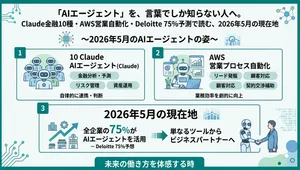
A Japanese IT Company Just Gave Claude Code to Every Engineer and Consultant. Working Backwards from ARI's Decision to Define Your Own Adoption Criteria
TSE Growth-listed AR Advanced Technology has standardized Claude Code across all engineers and consultants. Here are the 5 criteria you need to evaluate before replicating this decision at your own company.
What you'll learn in this article
- Where pricing and adoption questions around Claude Code stand right now
- Which plan or rollout stage fits the reader's situation
- Which follow-up article to open next for setup, cost, or bigger-picture context

What “Giving It to Every Engineer and Every Consultant” Really Means
Not one person. Not two. Every engineer and every consultant gets Claude Code as standard equipment. A Japanese company just made that call.
On April 13, 2026, TSE Growth-listed ARI (AR Advanced Technology, ticker 5578) issued a timely disclosure. The contents: Claude Code is being deployed as standard equipment to every engineer and every consultant.
Not “trial use within a select team.” Not “opt-in for those interested.” Everyone is included.
The moment I saw this news, my first thought wasn’t “amazing.” The question that popped into my head was, “If I were doing this at my own company, what would I check first?”
Why? Because I use Claude Code every day for content production and system operations. From that experience, I can say one thing for certain. The tool’s capabilities are unquestionable. At the same time, it’s also true that how you adopt it can flip your results 180 degrees.
This article won’t treat ARI’s decision as breaking news to be consumed. We’ll convert it into criteria you can use when considering company-wide adoption at your own organization. By the time you finish reading, you should be able to judge for yourself whether “we could do this too.”
In my previous article, “40% of Enterprise Apps Will Embed AI Agents,” I explained the broader corporate trend based on Gartner’s forecast. This article is the concrete case study that follows.

Reading the Context Behind ARI’s “Company-Wide Standard” Decision
ARI’s decision isn’t “because it’s trendy.” Their business structure and market environment made this choice inevitable.
AR Advanced Technology is an IT firm whose core business is cloud integration. Cloud integration means services for migrating and building corporate systems in the cloud. Engineers write code, consultants write proposals. These two pillars are the foundation of the business.
Now consider this. If engineers’ development speed increases 1.5x, how does that change the number of projects they can take on? If consultants can produce a proposal in half the time, what happens to their proposal win rate?
ARI’s official announcement explicitly states “improving development productivity and proposal quality” as the reason for going company-wide. From this point on it’s my own inference, but looking at the business structure, the math must have worked out something like this.
Here’s what gets interesting: “Why Claude Code, and not ChatGPT or GitHub Copilot?”
Claude Code is an AI agent that runs in the terminal (the command-line interface). It autonomously generates code, makes modifications, and runs tests. It’s fundamentally different from chat tools where you say “fix this part.” Its defining characteristic is that it understands the context of the entire project before acting.
The way I categorize it: ChatGPT is a tool that “answers questions,” GitHub Copilot is a tool that “completes code.” Claude Code is the next step beyond — an agent that “takes on entire jobs.” It’s a difference that’s hard to grasp without using it, but I’d compare it to the gap between “a dictionary,” “translation software,” and “a human interpreter.”
For an integration company like ARI, code-completion-level assistance would have produced limited results. It’s precisely because Claude Code is an agent that understands the whole project and acts autonomously that company-wide rollout became feasible. That’s my reading.
According to Anthropic’s official documentation, Claude Code can read and write files, perform Git operations, and run tests. It also supports integration with external services through MCP (Model Context Protocol, a standard for connecting external tools).
Rather than “only a few elite people use it,” they positioned it as a tool to “raise the baseline for everyone.” That, I believe, is the core of ARI’s decision.
Overseas, there are examples of company-wide GitHub Copilot adoption. But making Claude Code standard equipment across an entire company is still a rare approach in Japan.
Five Criteria to Judge Whether You Could Do This Too
The decision to deploy company-wide isn’t determined by how good the tool is — it’s determined by how ready your company is. Walk through these five criteria in order.

Criterion 1: Have You Inventoried Your “Repetitive Work”?
Claude Code delivers the most value on recurring, routine tasks. Test code generation, code review prep, documentation updates, regular report creation — these are the prototypical examples.
Try listing the work your company does every week. If you have three or more recurring tasks that consume 5+ hours per week, the impact of adopting Claude Code will be high.
Conversely, if your work is centered on tasks that require different judgments every time, the benefits will be harder to see. That’s not a bad thing — it just means the timing isn’t right yet.
In my own case, I delegate article quality checks to Claude Code. Checking for repeated sentence endings, counting characters, verifying that links are alive. Work that used to take 15 minutes per article now takes 2 minutes. This kind of “mundane but reliably time-consuming task” is the sweet spot for AI agents.
Criterion 2: Does Your Security Policy Anticipate “AI Use”?
The biggest hurdle for company-wide adoption isn’t technology — it’s security policy.
Claude Code reads code, communicates with external APIs, and rewrites files. If you’re going to open this up to all employees, you need to have three things in place at minimum:
- Scope of target repositories: All projects, or limited to specific projects?
- External communication controls: Which services can MCP connect to?
- Audit logging: Can you record who had AI execute what, and when?
ARI is a TSE Growth-listed company. Once they’ve issued a timely disclosure, it must have gone through at least board-level approval. You can’t make a decision like this without your security policy being in order.
If your company doesn’t yet have an “AI usage policy,” rule-making comes before adoption.
For reference, here are the minimum items you need to nail down:
- Whether AI can be allowed to read internal code (a clear Yes/No line)
- Whether use is permitted on projects containing customer data
- Review obligations for AI-generated code (human eyes, or automated tests?)
- Frequency of usage reporting (monthly or quarterly?)
Just deciding these four items makes it dramatically easier to get the go-ahead for a pilot.
Criterion 3: Can You Tolerate the Gap Between “Those Who Can Use It” and “Those Who Can’t”?
This is probably the most real-world problem of the bunch.
Even if you hand Claude Code to everyone, not everyone will use it equally well. Engineers comfortable with the terminal and people who’ve only ever used a GUI will ramp up at completely different speeds.
ARI’s intent in targeting “all engineers + all consultants” must include boosting consultants’ proposal-writing efficiency too. But for many consultants, opening a terminal will be a first-time experience.
If you’re considering company-wide adoption, I recommend proceeding in three stages:
- Two-week trial run with a pilot team (2–3 people)
- Share the “patterns”: In the first month, create 10 templates that show “this is how to use it”
- Company-wide rollout: Distribute company-wide once templates are in place
“Hand out the tool and you’re done” doesn’t lead to adoption. I use Claude Code every day at Izumo Systems, and even I spent the first two weeks not knowing what to delegate to it. The real work starts once the “patterns” for usage come into view.
Specifically, start with “test code generation,” “code review prep,” and “automated documentation updates” as your first templates. Failures have low impact, and the effects are easy to see in numbers. Whether you can create early success stories will determine the success or failure of your company-wide rollout.

Criterion 4: Can You Calculate Costs Against “Labor Costs”?
Claude Code has two pricing structures. There’s the fixed-rate usage included in plans for individuals and teams (Claude Max/Teams), and there’s metered usage by calling the API directly. According to the official documentation, for team deployments using Sonnet 4, the rough guide is about $100–$200 per developer per month (varying with usage). For the details on pricing structure, see Anthropic’s official page.
You might think “that’s expensive.” But the comparison point isn’t other AI tools — it’s labor costs.
For example, suppose monthly labor cost for one engineer is 800,000 yen. If Claude Code costs 20,000 yen per month and raises that engineer’s productivity by 30%, you’ve effectively gained 240,000 yen worth of additional resource for 20,000 yen.
In ARI’s case, since they’re rolling out to all engineers and all consultants, the monthly tool cost should be substantial. The fact that they decided to adopt it anyway can only mean the ROI calculation pencils out.
When running the numbers for your own company, try this formula:
Monthly tool cost < Target headcount’s monthly labor cost × Productivity improvement rate
If this inequality holds, there’s economic logic for company-wide adoption. If it doesn’t hold, the conservative approach is to start with a small-scale pilot and recalculate using actual measured numbers.
Criterion 5: Have You Decided “When to Stop” in Advance?
I’ve been writing about adoption criteria, but there’s one point that’s surprisingly often overlooked.
Deciding in advance “when we’ll quit if this doesn’t work out.”
I call this a “reversibility check.” It’s a concept I introduced in my previous article “HBR’s Proposal: Treat AI Agents as Team Members.”
- Exit criteria: Scope down if KPIs haven’t improved 10% within 3 months of adoption
- Dependency risk verification: Maintain a workflow that runs without Claude Code
- Regular review: Look back on ROI monthly and revisit if it falls short of the benchmark
Since ARI issued a timely disclosure, they have an obligation to report results to investors. The “mechanism for measuring effectiveness” must be built in from the start.
Even if you’re not a listed company, this stance is worth referencing. “Let’s try it and see if it feels good” carries the risk that no one will be using it six months later. Paradoxically, drawing the exit line first raises your probability of successful adoption.
The Difference in Adoption Patterns, Seen Through Comparison with PeopleX
ARI isn’t alone. PeopleX’s CEO has stated that 80% of all product code is developed with AI (a figure that spread from 2025 X/SNS posts; no official press release has been confirmed, so treat this as an approximate reference number).
Lining up these two companies makes the difference in scale and adoption pattern crystal clear.

| Comparison axis | ARI | PeopleX |
|---|---|---|
| Company scale | TSE Growth-listed | Startup |
| Adoption scope | All engineers + all consultants | All product development |
| Center of gravity | Boosting human productivity | Building the product itself with AI |
| Tools used | Claude Code | Cursor + v0 |
| Aim | Efficiency in existing business | Scaling with a small team |
If your goal is to “power up existing employees,” the ARI model is the better reference. If your goal is to “launch new products fast with a small team,” PeopleX’s model is closer to what you want.
The right answer isn’t one or the other — your choice changes depending on your company’s stage and objectives.
As Gen’s article “Cursor’s CEO Said It Themselves: The Foundation Is Shaking” touches on, the two tools occupy different positions. Cursor complements you in a GUI; Claude Code executes autonomously in the terminal. PeopleX chose Cursor; ARI chose Claude Code. Each is a decision matched to their business characteristics, as I see it.
Which of the Four Types Is Your Company?
Finally, I’ve prepared a framework to help you convert this article’s content into something personal.
Type A: Companies that can move right now. You have lots of repetitive work, and your AI usage policy is already in place. Submit a pilot proposal next week. You should be able to reference the ARI case study directly. Specifically, take these three actions in order:
- Create a list of repetitive work (30 min): Look back on your work this week and write down 5 tasks you do every week. The trick is to separate “thinking work” from “doing work”
- Check with your security lead (5 min): Just ask “Does our company have an AI usage policy?” If yes, read it. If no, you’ll know you “need to create one”
- Draft a one-page pilot proposal (1 hour): Summarize the six items — objective, target, period, cost, success criteria, exit criteria — on a single A4 page. Whether you have this one page completely changes the quality of conversation with your manager
Type B: Companies that need to sort out policy first. You have repetitive work, but no AI usage policy. Start with “rule-making” with your security lead. I recommend coming back to this article in a month.
Type C: Companies still at the “try it individually” stage. It’s too early for organizational adoption, but you want to raise personal productivity. Claude Code works for individuals too. Try it on your own work first, and share with colleagues once you see results. My previous article “40% of Enterprise Apps Will Embed AI Agents” will be useful.
Type D: Companies that should pass for now. You have little repetitive work, and security constraints are tight. There’s no need to force adoption. That said, please re-evaluate this judgment in six months. The preconditions for AI utilization are changing rapidly.
Summary
AR Advanced Technology gave Claude Code to every engineer and every consultant. The real value of this news isn’t “there’s an amazing company out there” — it’s that “you can work backwards from a real example to derive your own criteria for company-wide adoption.”
Let’s recap the five criteria: inventorying repetitive work, putting security policy in place, planning for skill gaps, calculating costs against labor costs, and pre-setting exit criteria. If even one is missing, that’s where to start. If all five are in place, company-wide adoption becomes a realistic option at your company too.
Read this alongside the PeopleX example of “80% of code developed with AI.” Japanese companies’ use of AI is clearly transitioning from the “try it out” stage to the “use it across the company until you’ve extracted everything from it” stage.
Some readers might feel “our industry is special” or “it’s still too early.” I’ve seen many cases of people who said exactly the same words a year ago and are now in a panic. When it comes to AI adoption decisions, once you realize you were “too late,” catching up takes three times the effort.
Next Monday, try starting with creating a “list of repetitive work.” In 30 minutes, you’ll see which type your company is. All the judgment criteria are in this article. The rest is whether you move or not.
References
- ARI Timely Disclosure (April 13, 2026): https://ari-jp.com/news/20260413/16278/
- Anthropic Claude Code Official Documentation: https://docs.anthropic.com/en/docs/claude-code/overview
- Anthropic Claude Code Costs: https://docs.anthropic.com/ja/docs/claude-code/costs
- Anthropic Pricing Page: https://www.anthropic.com/pricing

AIを使いこなせない方は、この先どんどん差がつきます。僕はAIエージェントを毎日動かして、壊して、直して、また動かしてます。そういう泥臭い実践の記録をここに書いてます。理論は他の方にお任せしました。僕は動くものを作ります。朝5時に起きてウォーキングしてからコードを書くのがルーティンです。