72% of Creators Say They Lack Business Skills. The Vacant Seat in the $480B Creator Economy Belongs to Engineers Who Haven't Started Publishing Yet
The creator economy has reached $480 billion (about 76 trillion yen). According to Goldman Sachs forecasts, participants worldwide now exceed 200 million.
What you'll learn in this article
- The key point to grasp before reading the full article
- How the issue changes the way developers should work next
- Which follow-up article is worth opening next

A $480 Billion Industry Still Has a Vacant “Engineer’s Seat”
The creator economy has reached $480 billion (about 76 trillion yen). According to Goldman Sachs forecasts, participants worldwide now exceed 200 million.
When I first heard those numbers, I honestly thought, “That’s not my world.” YouTubers and influencers, right? Not a space engineers needed to step into.
But once I dug into the data, the view changed. Tech and finance creators command rates 2–3x higher than lifestyle creators (The Reelstars 2026 Creator Economy Report). The “expertise × content” combination is the most profitable model out there.
What sealed it for me was a data point that keeps appearing across creator surveys. 72% of full-time creators say they need more business training.
In other words: there’s a $480 billion industry. 200 million participants. And more than 70% of them are struggling with the fundamentals of business.
I want to call this structural gap “the expert’s vacant seat.” And the people closest to that seat? Engineers who haven’t started publishing yet. That’s what I believe.
72% Lack Business Skills. The Creator Economy’s Structural Gap
“You need followers to make money in the creator economy.” That’s what most people think.
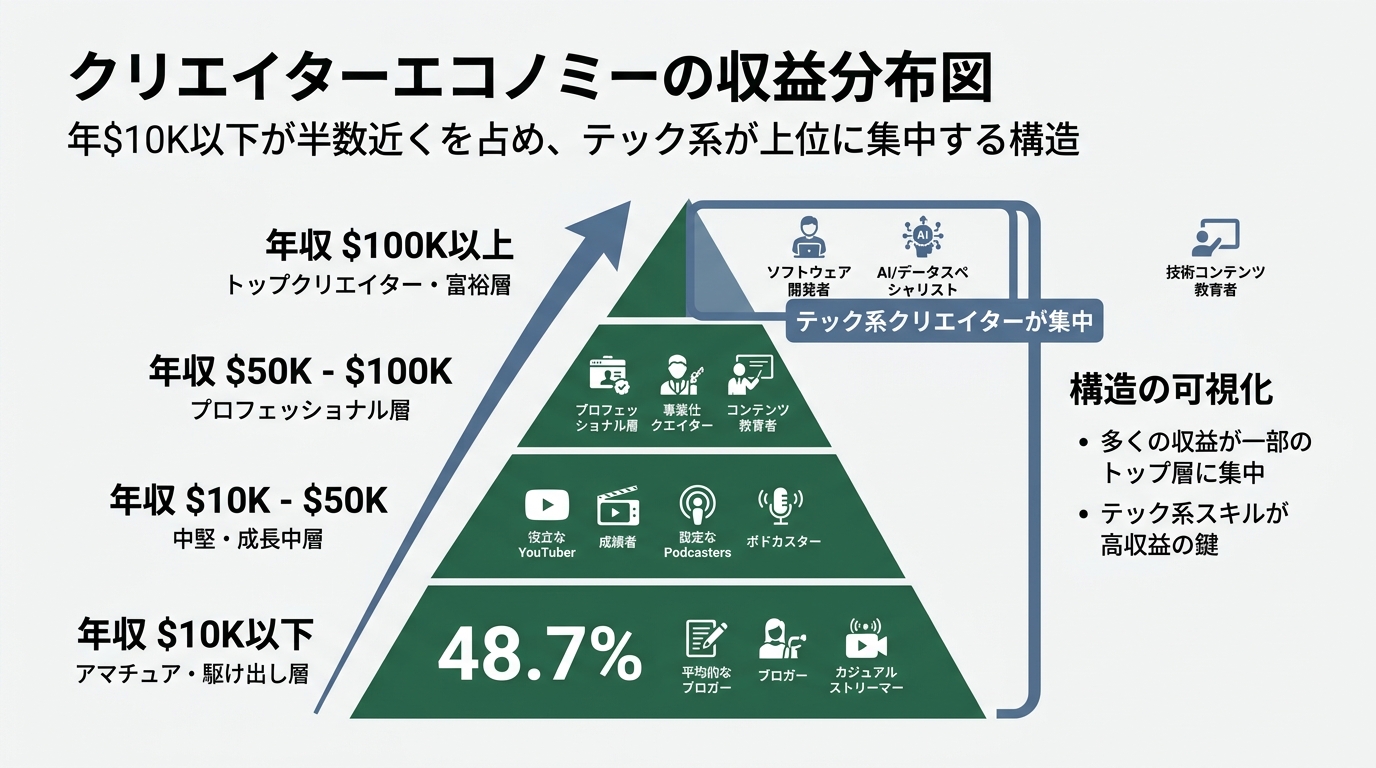
The reality is quite different. 48.7% of creators earn $10,000 (about 1.6 million yen) or less per year (Digital Information World). 200 million participants, and nearly half don’t clear the low-six-figure-yen mark.
Why? The reason is simple: low barriers to entry mean differentiation comes down to what you publish.
Lifestyle content is brutally competitive. Daily routines, café tours, fashion. They’re easy to enter but hard to differentiate. As a result, content value gets buried.
Meanwhile, what that 72% figure points to is a shortage of “business design capability.” They can’t sketch out a monetization mechanism. They don’t know how to structure customer acquisition channels. LTV (lifetime value, the total revenue from one customer) hasn’t even crossed their mind. There’s an overwhelming shortage of creators with these skills.
Let me get more specific. What does that “missing business skill” actually break down into for the 72%? The top items are “revenue model design,” “funnel construction,” and “data analysis.” These are things engineers do as part of their daily job, aren’t they?
Take “funnel construction.” Designing the awareness → interest → consideration → purchase flow uses the same thought process as designing a system’s input → processing → output. As for “data analysis” — being able to write SQL alone puts you in the top 10% of creators.
Here’s what I want you to think about. Engineers do logical design every day. Requirements definition, implementation, verification. This thought process is structurally identical to designing a business model.
I get this precisely because I came from CS. You hear out a customer’s problem, design a solution, implement it. Then you verify and iterate. This cycle is the same whether it’s customer success, product development, or content creation.
In other words, engineers already possess the skill set needed to fill the creator economy’s “business skill gap.” What’s missing isn’t skill — it’s the act of publishing.
Why Tech Creator Rates Are 2–3x Higher Than Lifestyle Creator Rates
When you hear “engineers make money by publishing,” you might feel skeptical. Let me lay out the evidence.
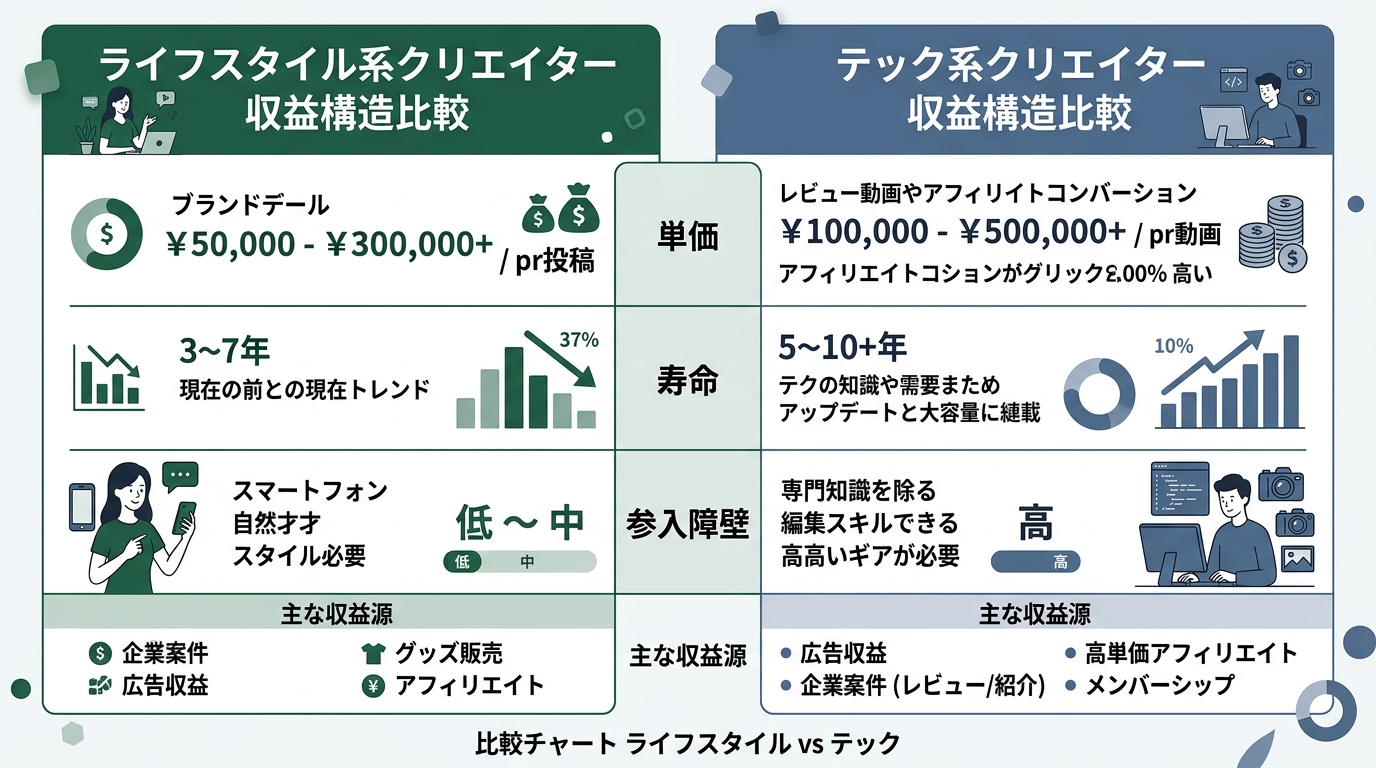
The Reelstars 2026 report makes one thing clear: creator revenue models vary dramatically by genre. Tech and finance creators command per-deal rates 2–3x higher than lifestyle creators.
There are three reasons.
First, corporate sponsor rates are higher. Tech companies and SaaS (Software-as-a-Service) firms value “access to decision-makers” over raw reach. An engineering channel with 10,000 followers can outperform a lifestyle channel with 100,000 in ad value.
Second, information specialization creates entry barriers. “How to use Cursor” and “Today’s café” have radically different imitation costs, even though both are just content. Content that requires technical accuracy becomes its own competitive moat.
Third, content longevity is longer. Technical articles keep pulling search traffic. “Claude Code setup steps” still gets searched six months later. Trend content, on the other hand, is often consumed in 48 hours.
The POSSIBLE Conference held in Miami in April 2026 showed the shift too. The main theme was “Mandatory ROI Measurement” (netinfluencer.com). From “buzz” to “revenue.” This pivot favors people who can speak about outcomes in numbers.
Engineers track KPIs daily and run A/B tests. They have the habit of measuring performance. That habit translates directly into content ROI management.
When I was in customer success, I tracked customer onboarding completion rates constantly. Running content operations has the same structure. The ability to track “which article gets read, where readers drop off, what’s driving search traffic” is a weapon by itself.
What lifestyle creators do on instinct, engineers can reproduce with numbers. That gap will only widen over time.
Three Ways “Being Able to Code” Pays Off in Publishing
“Alright, I get the theory. So what should I actually publish?”
Drawing from my own experience and the tech creators I’ve watched, I’ve sorted this into three patterns.
Pattern 1: “I Tried It” Posts
The lowest barrier. Try a new tool. Write up the places you got stuck and how you solved them, paired together. That alone is valuable.
Let me tell you about when I started writing Cursor articles. The first thing that got traction was a mundane post: “Got an error during environment setup → fixed it with these steps.” Basic stuff from a professional engineer’s perspective. But for someone who didn’t have that information, it saved three hours.
# Example: a common snag during Claude Code setup
# Install fails on older Node.js versions
node --version  # v16 is a no-go
nvm install 20  # bump to v20 or higher
npm install -g @anthropic-ai/claude-code
A single code block like this can solve the problem of whoever lands on it from search. Feel free to skip. The point is: capture the “I got stuck → I fixed it” pair as a record.
The key is not trying to write a “professional-grade article.” Aim for perfection and you’ll never publish. Instead, jot down “what stumped me for three hours last week” in 15 minutes. That’s the right energy. Readers don’t want a correct answer — they want a record of how someone else who got stuck the same way got out.
Pattern 2: “Comparison and Selection Guide” Posts
Last week I wrote back-to-back articles on AWS Kiro and Cursor 3.0. Several readers asked, “So which one should I use?”
Comparison articles answer that need. But what people want isn’t a spec sheet listing every feature. What’s valuable is showing decision criteria: “Given the work you do, start with this one.”
## Example branching logic
- Start a new project from a spec → AWS Kiro
- Fast refactoring on existing code → Cursor
- Build automation flows on CLI → Claude Code
These three lines of branching logic compress the reader’s “research time” from three hours to three minutes.
The strength of comparison articles is their long search lifespan. People are searching “Cursor vs Kiro differences” today, and they’ll be searching it three months from now. Write once and traffic continues for six months or more — it’s a quintessential piece of “stock content.”
Pattern 3: “Real-World Workflow Improvements” Posts
This is the genre someone with a CS background is uniquely positioned to write. Just publish a record of how you automated your own workflow with AI.
“How I cut Slack inquiry handling from 5 hours a week to 30 minutes.” “How I automated spreadsheet busywork.” Articles like these resonate with people doing the same kind of work. Reader empathy comes more from the sharpness of the problem definition than from technical sophistication.
I’ve recently been semi-automating Slack inquiry responses with Claude Code. I organized common question patterns in JSON and have a Slack bot suggest candidate responses. What used to take five hours a week now takes 30 minutes. I turned that experience straight into an article — and got 3x my expected traffic.
Let me flag the pitfall upfront. Pattern 3 carries risk of touching “your company’s confidential information.” Don’t expose specific data or client names. The ironclad rule: abstract the method and flow only.
# Workflow automation article template (example)
# 1. Before: how much time the manual work was taking
# 2. The pain: what was specifically frustrating
# 3. After: how AI changed it (with code)
# 4. Result: how much time was saved (in numbers)
# 5. Pitfalls: where you got stuck along the way
Just follow this structure and you get a practical 2,000–3,000 character article.
What Engineers Should Do This Week: A Starter Plan for “Expert × Content”
I know “I’ll do it someday” is how nothing ever starts. So let me write only “what to do this week.”
Step 1: Pick one publishing platform
Zenn, Qiita, note, personal blog. If you’re torn, go with Zenn. The reason: it already has an engineering audience. You don’t need to gather readers yourself.
Qiita has a more active beginner-focused community. note is better when you want to write on non-technical topics too. A personal blog is for those who want to control SEO themselves. You don’t need to start on multiple platforms. Pick one.
Step 2: Write up “something you got stuck on last week”
You don’t need to write a perfect article. Write 1,000 characters on “an error I hit last week and how I fixed it.” The title can simply be “How to fix the X error.” That’s enough.
What matters here is that “publishing itself” is the goal. Content polish at 70% is fine. The strength of web content is that you can revise endlessly afterward. My first article is embarrassing to read now. But the fact that I published it became the fuel for the next one.
Step 3: Publish and watch what happens
Almost no one will read your first article. That’s the starting line. As you write a second and third, search traffic gradually grows. Technical articles are “accumulation” content. Ten solid articles build longer-term assets than one viral hit.
Set up Google Search Console in the first week. You’ll start seeing what search keywords surface your articles. When you find traffic from “an unexpected keyword,” that’s the seed for your next article.

Step 4: After three months, decide your specialty genre
Write 10 articles and you’ll start seeing which themes flow most naturally for you. Vibe coding? Workflow automation? IDE configuration? From there, specialize and go deep.
A caveat: don’t chase follower count. Tech content runs on search traffic. It’s perfectly normal to have 100 SNS followers and still pull 10,000 monthly PVs (page views) from search.
There’s no need to rush monetization either. Treat the first three months as “the period for finding your genre.” Writing 10 articles and seeing which ones get read teaches you plenty. Ads and sponsorships can come after.
What a Burned-Out Engineer Found in the Creator Economy
Let me be honest. I’m someone who once decided “I’ll never be a top-tier engineer” and walked away from code.
After seeing the brilliant engineers I worked with on multi-hundred-million-dollar projects, I gave up cleanly. I shifted into customer success and started a life keeping my distance from code.
AI changed that. The shock of “it worked” when I first touched Cursor. Watching Claude Code generate high-quality code from my instructions turned that shock into conviction. It felt like a top-tier engineer had come to live inside me.
Now back to the creator economy.
I started creating content because “I wanted to tell my past self.” The day I walked away from code. The day I decided I wasn’t an engineer anymore. I wanted to tell that version of me: “AI is here. You can build again.”
Seriously, this is divine. Who would have thought “the experience of burning out” would become my biggest differentiator?
There are mountains of technical articles written by professional engineers. Architecture design theory, performance tuning, lessons from running large-scale systems. All great content.
But there’s almost nothing on “someone who burned out, left code, then came back through the power of AI.” That angle resonates with people who burned out the same way, or people who gave up on programming. Articles a professional engineer can’t write. Articles like this one.
There must be plenty of people out there who “wanted to write code but gave up.” People who attended a coding bootcamp but couldn’t turn it into a job. People who tried to transition into engineering but pulled back. You’re in a position to tell them, “Want to try again?”
There’s a $480 billion industry with a “vacant seat for experts.” The structure is built so that someone with engineering skills who isn’t publishing can sit right down in that seat. The four steps in this article are enough to take that first move this week.
The technical skills you already have, combined with the problem-solving experience you accumulate at work every day. Just turn that into content, and you’ll stand in an advantageous position inside the creator economy.
I walked away from code once. I don’t regret leaving. But thanks to AI, I got to come back, and now “writing” has become a new weapon for me.
Wait, you still haven’t started publishing? That’s a real waste, honestly.

正直、一度エンジニアは諦めました。新卒で入った開発会社でバケモノみたいに優秀な人たちに囲まれて、「あ、私はこっち側じゃないな」って悟ったんです。その後はカスタマーサクセスに転向して10年。でもCursorとClaude Codeに出会って、全部変わりました。完璧なコードじゃなくていい。自分の仕事を自分で楽にするコードが書ければ、それでいいんですよ。週末はサウナで整いながら次に作るツールのこと考えてます。