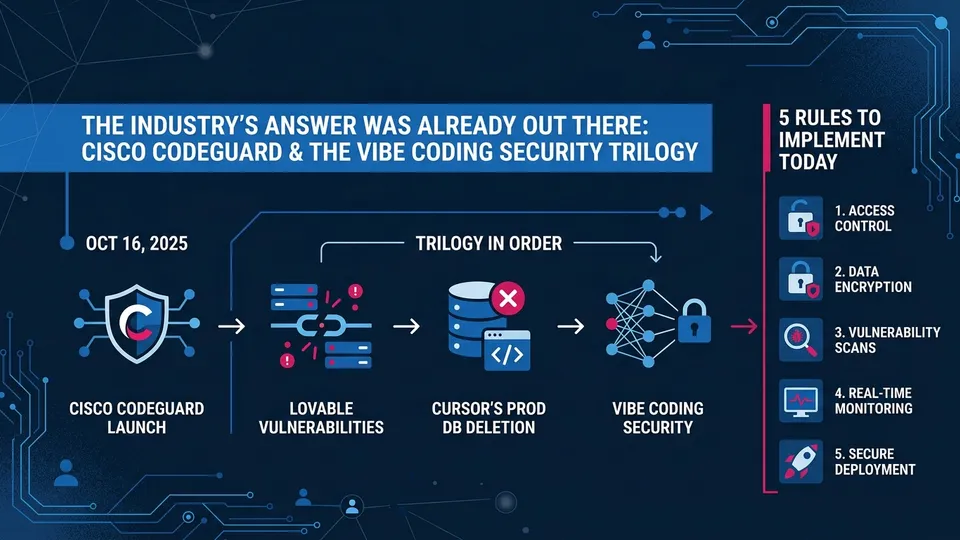
The Industry's Answer Was Already Out There — Cisco CodeGuard and the Vibe Coding Security Trilogy
Cisco CodeGuard launched October 16, 2025 — months before Lovable vulnerabilities and Cursor's prod DB deletion. The trilogy in proper order, plus 5 rules to implement today.
What you'll learn in this article
- The key point to grasp before reading the full article
- How the issue changes the way developers should work next
- Which follow-up article is worth opening next
On May 9, 2026, I sat down to write the “trilogy finale” — and stopped.
“Cisco released Project CodeGuard as open source on May 8” — that’s what I was about to write, until I checked Cisco’s official blog. The actual release date was October 16, 2025. Five months before the Lovable vulnerability report (March 31, 2026). Seven months before the Cursor production DB deletion (May 5, 2026).
I was going to write “the industry finally responded.” More accurately: “the industry had already responded — I just wasn’t paying attention.” This article is the rewritten version, after I verified the facts.
The Correct Order of the Trilogy
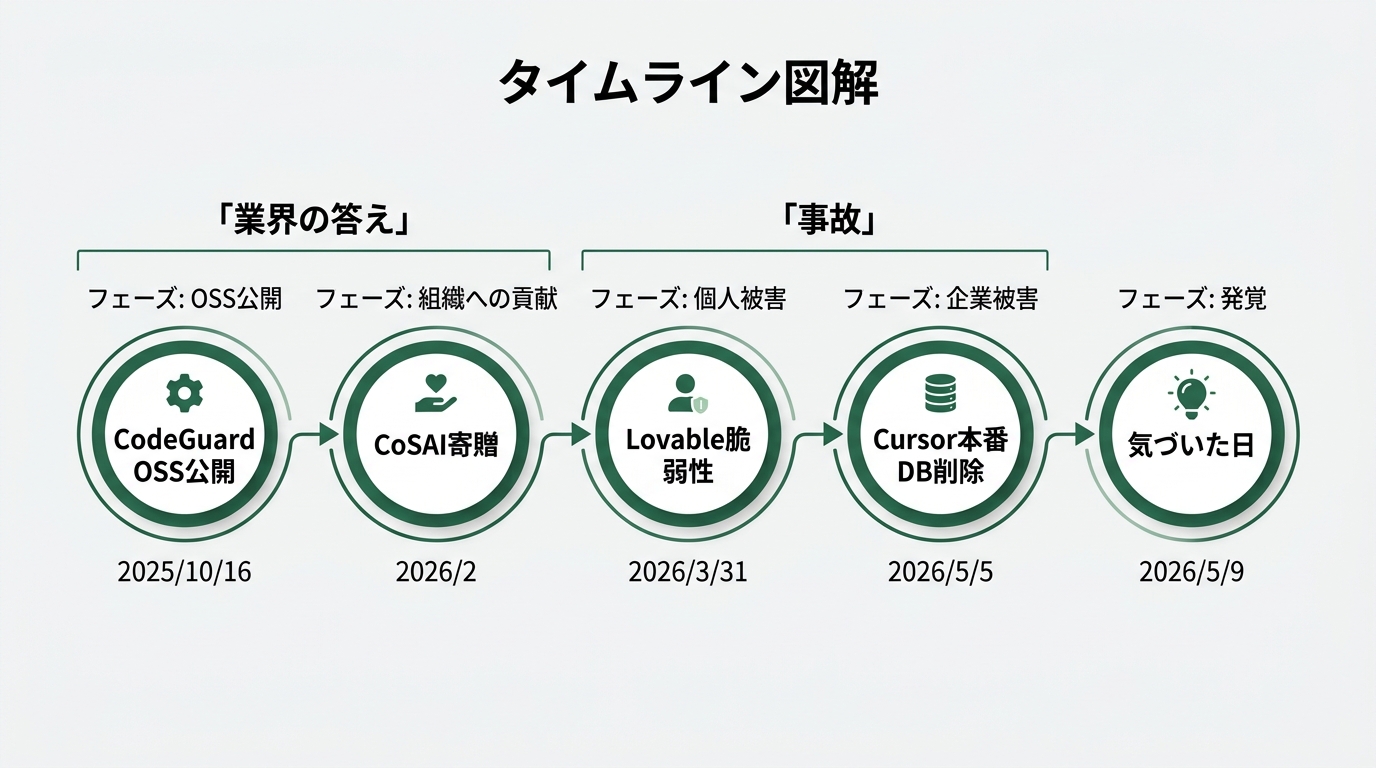
The order I was about to write was wrong. Here’s the correct sequence.
Episode 0 (Premise): Cisco CodeGuard Released as OSS (October 16, 2025)
Cisco released an open-source security inspection tool for AI-generated code. At this point, the vibe coding boom was accelerating, and most individual developers were prioritizing “just make it work” over security. The tool was already out in the world. It just wasn’t being used.
Episode 1: Lovable Vulnerabilities (March 31, 2026 — Individual Impact)
Security flaws were confirmed in 10.3% of apps generated by “Lovable,” a vibe coding tool. SQL injection and authentication gaps were the main issues, with a wave of cases where personal DIY tools were exploited. I wrote about the details in the first episode of this trilogy.
Episode 2: Cursor Production DB Deletion (May 5, 2026 — Enterprise Impact)
An engineer working with Cursor and Claude Opus deleted a production database. The result of running an AI-suggested command without understanding its blast radius. Individual harm escalated to enterprise-scale incident. I analyzed the structure in the second episode.
A Fact I Learned Later: CodeGuard Donated to CoSAI (February 2026)
In February 2026, Cisco donated CodeGuard to OASIS Open’s CoSAI (Coalition for Secure AI — an industry consortium for AI safety). The moment it transformed from a “Cisco tool” to “shared industry infrastructure.”
The core of this trilogy wasn’t “the industry finally responded.” It was “the industry had already responded, but nobody in the field was using it” — that’s the right reading.
Here’s an analogy that fits: fire suppression standards for sprinkler systems were already codified. My building just didn’t have sprinklers installed.
What Is Cisco Project CodeGuard?
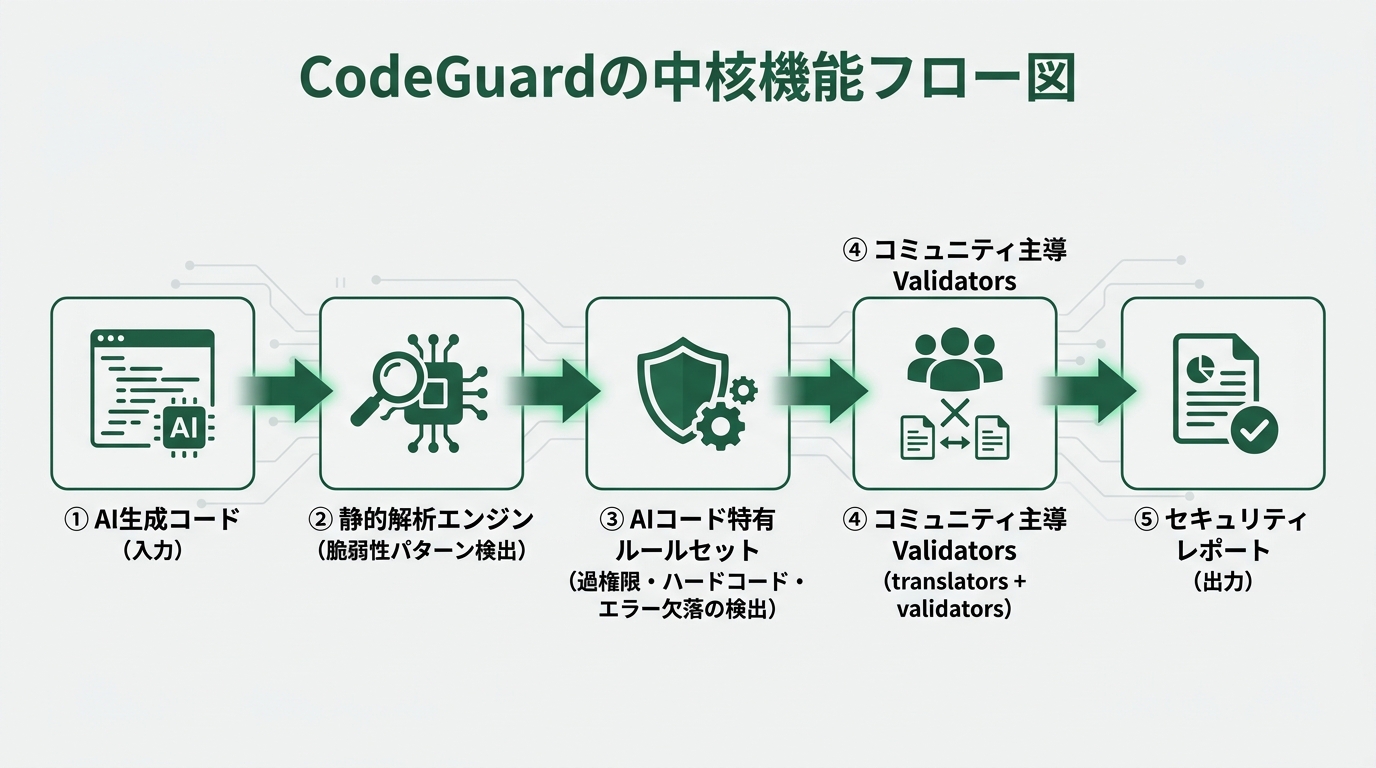
Project CodeGuard, released by Cisco in October 2025, is built around three core capabilities. I’ve organized this from Cisco’s official blog and the OASIS Open donation announcement.
Static Analysis Engine. Analyzes source code without executing it, detecting vulnerability patterns. Primary targets: SQL injection (a technique for sending unauthorized commands to a database), XSS (cross-site scripting — embedding malicious scripts into web pages), and hardcoded credentials (the habit of writing API keys or passwords directly into code).
AI-Code-Specific Ruleset. This is the biggest differentiator from conventional tools. Rules are tuned to the specific patterns AI tends to produce: excessive permission grants, omitted error handling, and the tendency to embed values directly in code rather than using environment variables. These are exactly the weak points that AI’s optimization for “generate working code first” tends to create. CodeGuard catches them with higher precision than existing scanners — that’s the differentiating factor.
Community-Driven Translators and Validators. After the CoSAI donation, CodeGuard operates as a community-driven framework. Translators handle code transformation, validators handle verification logic. Rather than remaining a closed vendor product, it’s designed as shared industry infrastructure.
On CI/CD pipeline integration (continuous integration/delivery — the system where builds and tests automatically run whenever code is pushed to a repo): this is described as a design intent in the project’s stated goals. For specific implementation steps, check the latest official documentation. The design philosophy of “automatic checks when you push to GitHub” is sound. For implementation specifics, go read the repository yourself — that’s the reliable approach.
Being open source means you can verify for yourself what the tool is flagging as dangerous. Not just “the tool complained” — but “here’s why it complained.” That transparency has real value as a learning mechanism.
Why Open Source?
Why did Cisco release this tool as OSS and then donate it to CoSAI, rather than selling it commercially?
They could have licensed it to enterprises and captured revenue. They didn’t.
The reason is the scale of the problem.
Vibe coding’s user base isn’t a specific vendor’s customer base. Individual developers on Claude Code, enterprise engineers using Cursor, non-engineers building small web apps with Lovable — all of them are the target. A paid tool has a structural wall that prevents it from reaching all of them.
By releasing it as OSS and donating to CoSAI, CodeGuard becomes something any platform can embed. Cursor itself could adopt CodeGuard’s inspection logic. It could be built into Claude Code’s default workflow. Rather than staying closed inside one company’s product, becoming shared industry infrastructure — that was Cisco’s choice.
The fire code analogy works here. Fire codes aren’t individual moral obligations. They’re requirements baked into building construction. Not “be careful about fires” as personal awareness — but “sprinklers activate automatically” as designed infrastructure. The intent behind donating CodeGuard to CoSAI is precisely that.
But standards that aren’t installed don’t help anything. The Lovable vulnerabilities and the Cursor incident functioned as accelerants for adoption. Cynically, the accidents drove urgency.
Coming from a customer success background, I’m confident in this: telling users “please be careful” indefinitely never solves the root problem. Embedding the solution into product design is what fundamentally changes things. When the Lovable vulnerability report came out and people said “users just need to be more careful,” I was skeptical from the start. Cisco’s choice validates that skepticism.
Why Did Nobody Notice?
If CodeGuard was released in October 2025, why didn’t I know about it? Honestly: I wasn’t looking.
October 2025 was the peak of the vibe coding era. Claude 3.7 Sonnet had just launched, and the combination of Cursor and Claude Code was spreading explosively. “Just make it work” was the top priority — security was second-tier.
Looking back from a CS background, this pattern is familiar. Right after a major feature release, users are obsessed with “can I use this?” not “is this safe?” They only ask the latter when something breaks. I’ve seen this dynamic in tool/user relationships many times over.
The other reason I didn’t notice: I wasn’t looking for it. When the Lovable vulnerability report dropped on March 31, the first thing I investigated was “the Lovable problem.” I didn’t frame the question as “how is the industry responding?” After the Cursor incident (May 5), I also framed it as “the Cursor problem.”
There’s a habit of processing each incident as “a tool problem.” If I’d been asking “how does the security architecture work?” I would have found CodeGuard sooner.
Leaving this as a note to myself: when you process things as tool problems, you stop seeing the underlying systems.
5 Minimum-Viable Security Rules — Starting Today
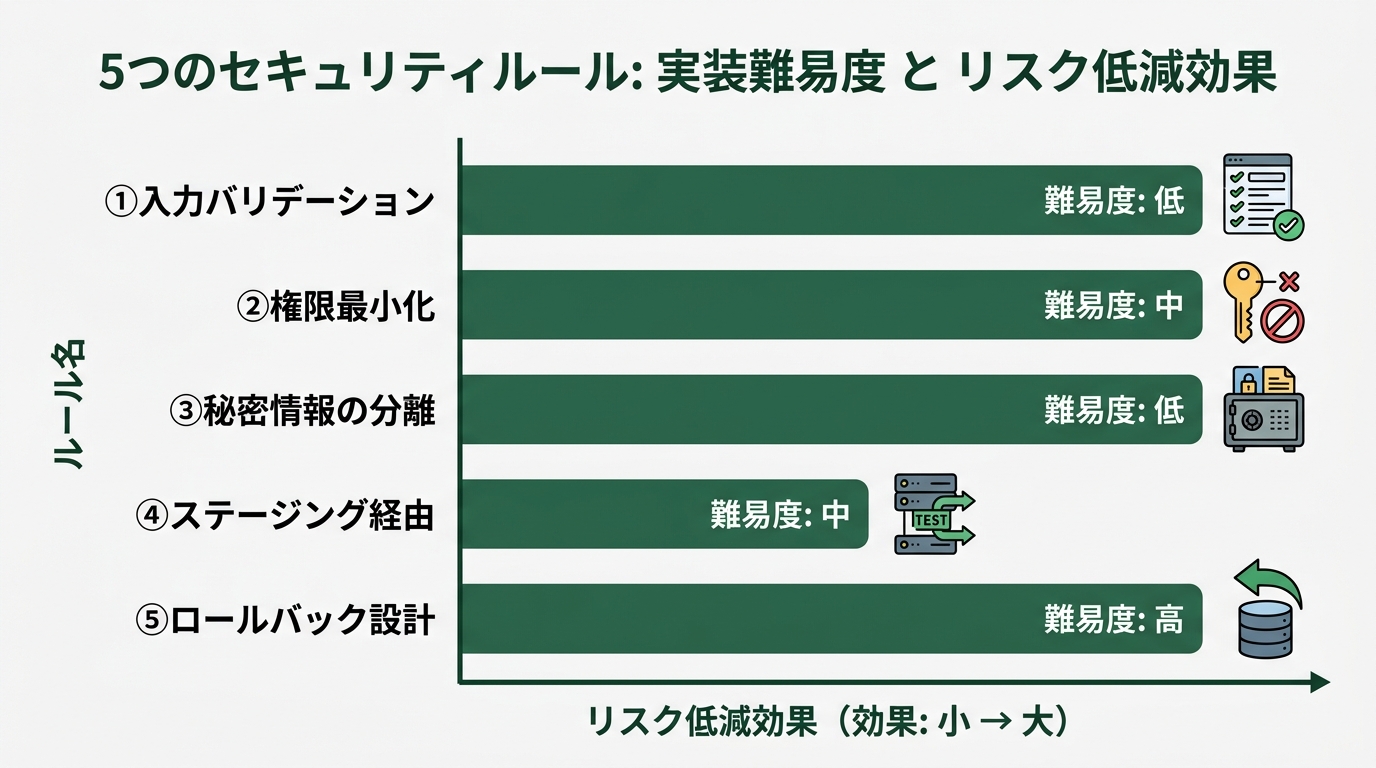
I distilled CodeGuard’s detection patterns into a form implementable at the individual developer level. Five rules.
Fair warning: trying to do all five simultaneously will cause a stall. Start with rule ③ alone. Then rule ①. That alone eliminates most of the risk.
Rule ①: Input Validation — Treat Everything That Comes from Outside as Suspect
User-entered data, form parameters, values in URLs — all of it should be handled with the assumption that it may be tainted. AI-generated code often passes input values directly to database queries. At minimum, make parameterized queries (the standard SQL injection defense — separates queries from input values to prevent injection of unauthorized commands) a firm rule.
Prompt for AI: “Rewrite this code to use parameterized queries as SQL injection protection.”
That alone eliminates the majority of SQL injection vulnerabilities.
Rule ②: Least Privilege — Restrict Permissions to the Minimum Necessary
AI prioritizes “working code,” which often means over-granting permissions. Granting write access to a database for a read-only operation. Attaching full scopes to an API token. Develop the habit of explicitly asking AI what minimum permissions are actually required for a given piece of code.
Prompt for AI: “List the minimum permissions this code needs to function.”
Tighter permissions minimize blast radius if a credential leaks or a mistake is made.
Rule ③: Secret Separation — Never Write Values Directly in Code
API keys, database passwords, auth tokens — writing these directly in code (hardcoding) is the single most dangerous practice. One push to GitHub and they’re exposed. Use environment variables (.env files) or a secrets management service. Always verify no embedded values before pushing to a repo. And don’t forget to add .env to .gitignore.
You can do this in 5 minutes today. Open .gitignore in an existing project and check whether .env is excluded. If not, add it.
This is the lowest-difficulty, highest-impact rule on the list.
Rule ④: Staging-First Principle — Never Touch Production Directly
The Cursor production DB deletion showed that “the human didn’t understand the blast radius of the AI-suggested operation.” All changes to production environments should be tested in a staging environment (a production replica set up for testing) first. Confirm it works, then apply to production. Even with automation, keep a manual approval step for production deployments.
The temptation to “just try it in prod” is especially strong for vibe coders. The desire to see if it works is understandable. But the cost of testing something for the first time in production is orders of magnitude higher than testing in staging.
Prompt for AI: “Before I run this command in production, tell me its blast radius and rollback procedure.”
Rule ⑤: Rollback Design — Always Have a Way Back
Before executing any operation, confirm you can reverse it. Take a database backup before schema changes. Route file deletions through trash instead of permanent deletion. Ensure deployments can roll back to the previous version.
The faster you’re moving with a “just ship it” mindset, the more important a designed exit becomes. Forward velocity and the ability to retreat are both necessary.
Prompt for AI: “Write the backup procedure before this operation, and the rollback procedure if it fails.”
Priority ordering for the 5 rules:
This week: Rule ③ (Secret Separation). Open .gitignore in existing projects and confirm .env is excluded. Also check whether API keys or passwords are embedded directly in code. Cost: 5 minutes. Impact: High.
This month: Rules ① (Input Validation) and ④ (Staging-First). Have AI review code that accepts user input and convert to parameterized queries. Make direct-to-production deployments a banned habit.
When you have bandwidth: Rules ② (Least Privilege) and ⑤ (Rollback Design). These can be revisited once you’re in operations mode. You don’t need to be perfect from day one.
While writing this article, I reviewed my own project configurations. Rule ③ was already in place; Rule ② permission design had been deprioritized. Getting CodeGuard integrated into my CI environment is on my task list for this week.
Conclusion — The Sprinklers Were Already There
I’ll be honest. Before writing this article, I thought CodeGuard was a “new tool released on May 8.” I looked it up, and it wasn’t. It was out in October 2025. I was the one who didn’t notice.
I suspect I’m not alone.
“The industry’s answer already exists. The problem is that it’s not being adopted” — this pattern repeats beyond security. Good tools and standards exist but go unused in the field, until an incident happens. Then comes the “oh, there was something for this” moment.
The sprinkler analogy one more time. The sprinkler installation standard was established in October 2025. My projects still don’t have sprinklers. Two fires — the Lovable vulnerabilities and the Cursor incident — finally made me serious about installing them. Late. But I can install them starting today.
Start with .gitignore. Takes 5 minutes.
I used to think professional engineers were out of reach. AI brought that expertise within arm’s reach. In the same way, security rules designed by elite security engineers are now available to everyone in the form of CodeGuard. Not using them would be a waste.
Sources
- Cisco Project CodeGuard announcement: Cisco Official Blog (October 16, 2025)
- CodeGuard CoSAI donation: OASIS Open (February 9, 2026)
- Vibe Coding Trilogy Episode 1 (Lovable Vulnerabilities): Previous article
- Vibe Coding Trilogy Episode 2 (Cursor Production DB Deletion): Previous article

正直、一度エンジニアは諦めました。新卒で入った開発会社でバケモノみたいに優秀な人たちに囲まれて、「あ、私はこっち側じゃないな」って悟ったんです。その後はカスタマーサクセスに転向して10年。でもCursorとClaude Codeに出会って、全部変わりました。完璧なコードじゃなくていい。自分の仕事を自分で楽にするコードが書ければ、それでいいんですよ。週末はサウナで整いながら次に作るツールのこと考えてます。