Still Paying for Flat-Rate SaaS? The New Rules of Subscription Business: 'Pay-As-You-Go' and 'Designed to Prevent Cancellation'
That $98/month SaaS — are you actually using it fully every month?
What you'll learn in this article
- The key point to grasp before reading the full article
- How the issue changes practical decisions after reading
- Which follow-up article is worth opening next

That $98/month SaaS — are you actually using it fully every month?
Honestly? I wasn’t. I was paying the exact same amount every month for a tool I only logged into half the time.
I went through three SaaS subscriptions I’d been paying for out of inertia since my freelance days. The result? Over $200 a month freed up.
I bet a lot of you are nodding along right now.
In 2026, tectonic shifts are happening in the world of subscriptions (recurring-payment services).
Take a look at Zuora’s 2025 Subscription Economy Index. Subscription companies are growing 11% faster than the S&P 500 (the major US stock index). No question — the market as a whole is expanding.
But here’s the thing: what’s inside that growth is changing dramatically.
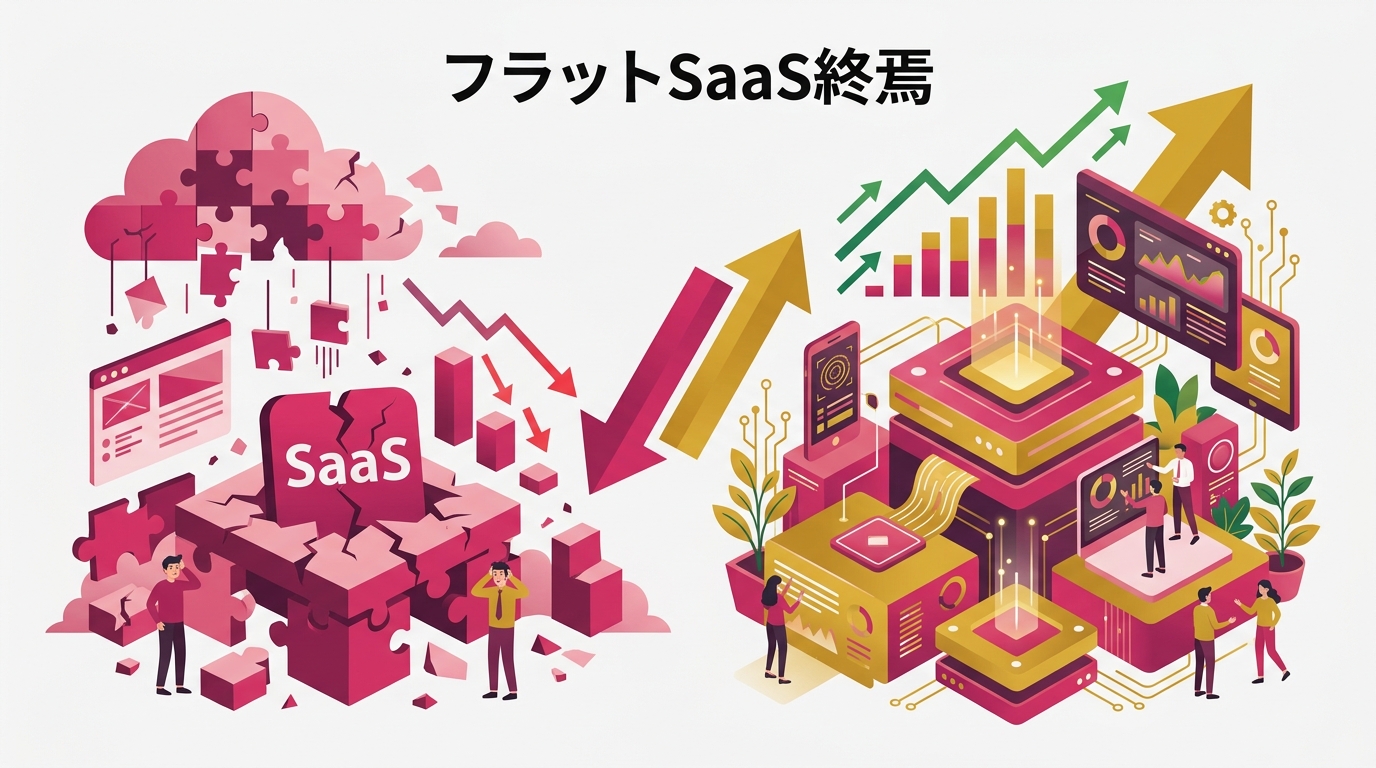
The flat “X dollars a month” pricing model is dead. Pay-as-you-go (usage-based pricing) and behavioral design to prevent cancellations — these two are the new rules of subscription business in 2026.
Let me lay it all out, and you can think about how it applies to your own business as you read.
”The End of Flat SaaS” — Why Monthly Flat-Rate Pricing Is Crumbling
Flexera’s SaaS management report puts it bluntly.
“From seat-based to consumption-based: SaaS pricing has entered its hybrid era.”
Let’s look at the numbers.
46% of SaaS companies have already adopted hybrid models — a combination of subscription plus usage-based pricing (Solvimon survey).
Among major software companies, 77% have incorporated usage-based pricing elements. Companies on “monthly flat-rate only” are now in the minority.
Why did this happen? Two reasons.
AI Made “Pay Only for What You Use” the Norm
Think about ChatGPT. Its API pricing is per-token (units roughly equivalent to characters) — pure usage-based pricing. In the AI world, “pay for what you use” has been the standard from the very beginning.
That mindset is now rippling out across all of SaaS.
According to Metronome’s 2025 report, 85% of SaaS leaders have either already implemented usage-based pricing or are planning to. We’re no longer in the “considering it” phase — we’re in the “executing it” phase.
The workloads AI generates are unpredictable. Tokens, credits, compute time. Trying to price these at “X dollars per seat per month” doesn’t work. So companies have no choice but to shift toward usage-based models.
Here’s an easy example. When I use the Claude API to draft social media posts, my usage varies wildly month to month. During a campaign month I might create 50 posts; in a quiet month, just 10. With flat-rate pricing, that “I’m losing money on the months I didn’t use it” feeling is brutal.
Zuora’s research backs this up. Companies that combine four or more revenue models grow faster. ARPA (Average Revenue Per Account) growth is 4.5% higher than companies using a single model (Zuora SEI 2025). The era of “just one monthly fee” is ending.
Customers Are Starting to Notice They’re Overpaying
Here’s another fascinating data point from Zuora. The top reason for cancellation is “price increases” — accounting for nearly half of all cancellations. In other words, customers don’t feel they’re getting value commensurate with what they’re paying.
Recurly’s 2026 report confirms the same trend. Subscription growth has slowed from 15.4% in 2024 to 12.6% in 2025. They attribute this to market saturation, intensifying competition, and increasing consumer caution.
Precisely because growth is slowing, the importance of “retaining existing customers” outweighs “acquiring new ones.”
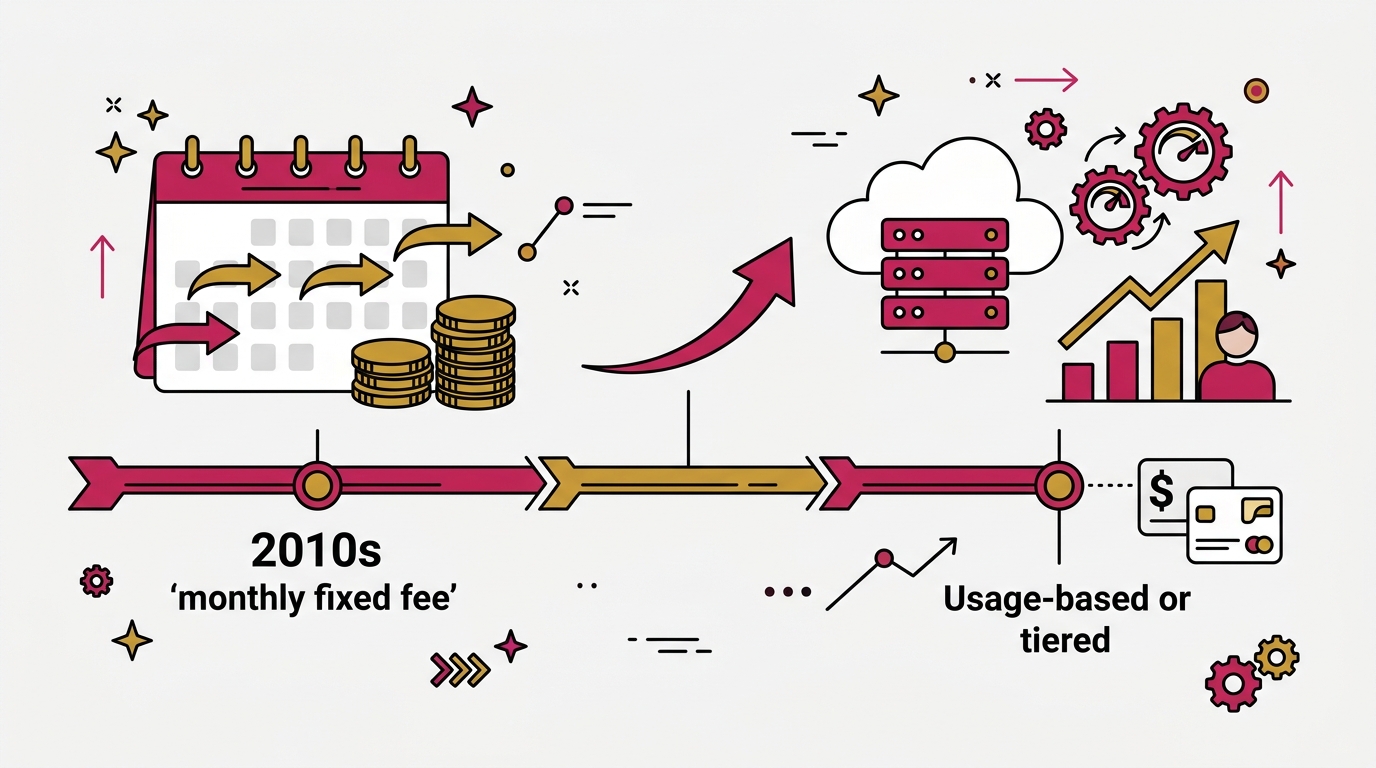
The problem with flat-rate pricing is simple: you pay the same amount even in months you don’t use it. That breeds resentment.
I had a client like this. They were paying $300/month for a marketing tool. The only thing they actually used was the report export — twice a month. They thought “this is expensive” every month, but kept paying because switching felt like too much hassle.
With usage-based pricing, “months you don’t use it cost less.” It’s such an obvious idea, and the SaaS industry is finally catching up.
By the way, the data on GenAI (generative AI) services is interesting too. Check Zuora’s consumer survey. In May 2024, 28% of people were using GenAI services. By January 2025, that had spiked to 40%.
But here’s the kicker: 64% of consumers say they don’t want to pay extra for AI features.
“I want to use AI. Just don’t charge me more for it.” Usage-based pricing solves this contradiction. If you only bill for what’s actually consumed, the psychological hurdle for consumers drops significantly.
”Pause Before Cancel” — The Behavioral Design That’s Transforming Churn Rates
Now for the second main topic: behavioral design to prevent cancellations.
Recurly’s 2026 State of Subscriptions released some incredible data. It’s a massive survey of over 2,200 subscription businesses, analyzing 76 million subscriptions.
The most shocking finding was this:
Simply offering “pause” as an option before cancellation increased pause usage by 337%.
And three out of four people who paused came back within a few months.
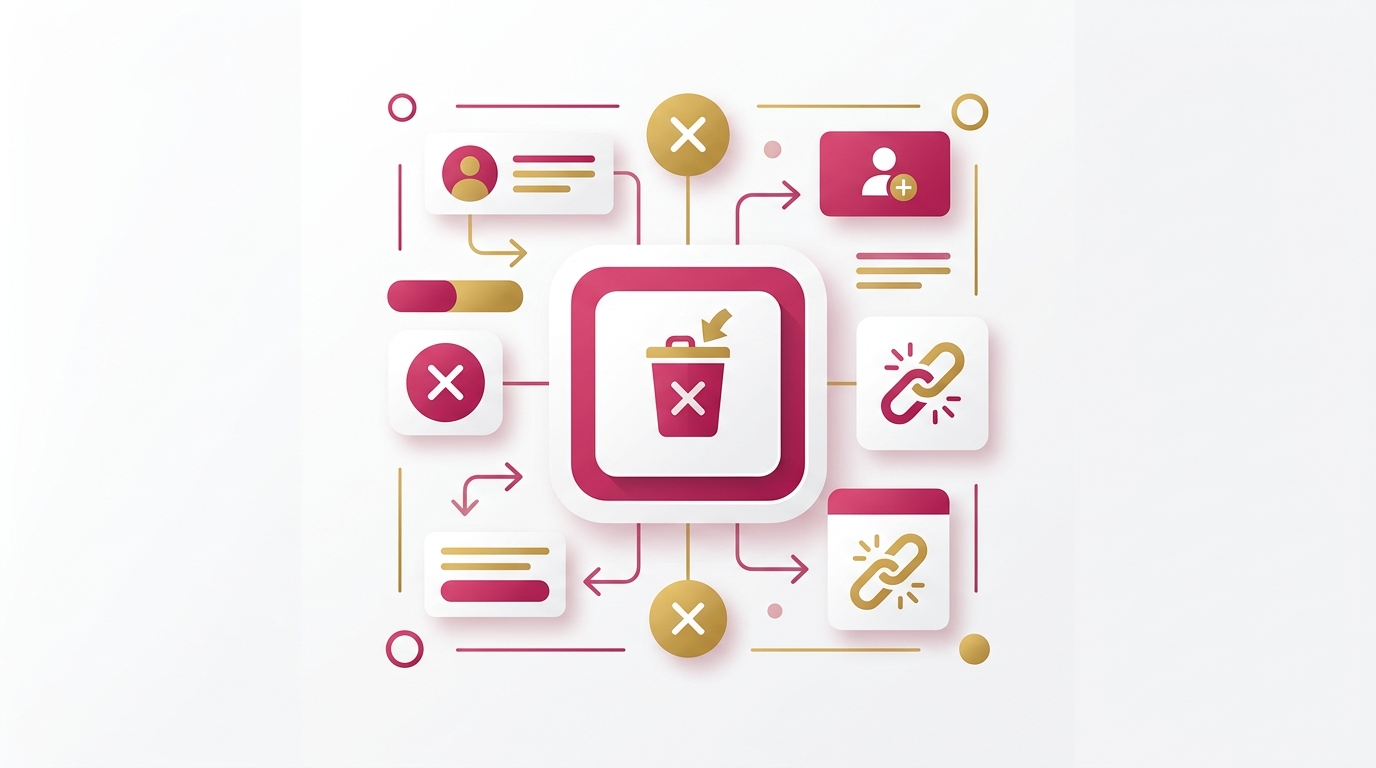
Why “Pause” Works So Well
Think about it. “Cancel” and “take a little break” feel completely different psychologically.
Cancellation is a permanent exit decision. Your data and settings might be reset, and when you come back you’d start from zero. But with pause, there’s that “I can come back anytime” reassurance.
According to Recurly’s data, only 37% of subscriptions offer a pause option. The remaining 63% only give customers a binary choice: cancel or continue.
That’s leaving a ton of money on the table.
I have a consulting client who runs an online school. They had a $50/month subscription with a 5% monthly churn rate. Just by adding a “pause” button, churn dropped to 3% per month. Annualized, that works out to roughly a 24% increase in membership.
The “Four Walls of Cancellation” Recurly Discovered
Recurly’s report has another fascinating insight.
Former subscribers account for roughly a quarter of new signups.
In other words, “customers who canceled coming back” has become a major growth engine for subscription businesses. This is called Win-back, and the acquisition cost is less than half of acquiring brand-new customers.
Here’s another data point worth noting. Micro-subscriptions (daily / weekly / weekend passes) are on the rise. 13% of people who start with a short-term pass convert to a continuing subscription. Compare that to traditional free trial conversion rates, which have dropped to 34%.
Free trials are losing their effectiveness. Instead, “start small, continue if you like it” is what resonates now.
I canceled Netflix myself once. I finished a Korean drama and thought “I’m good for a while.” Then six months later, a new drama got buzz and I re-signed up. A textbook Win-back case. If “pause” had been available back then, I would have just paused instead of canceling outright.
Three Things Every Solo Founder Should Review Right Now
You might think, “This is for big companies, right?”
Wrong. If anything, this matters even more for solo operators.
Point 1: Take Inventory of Every SaaS You’re Paying For
The first thing to do is audit the SaaS subscriptions you’re paying for.
Here’s the method I actually used. Go through your credit card statement and list every monthly/annual recurring charge. Then check “how many times did I log into this tool last month?” If it’s three or fewer, it’s worth reviewing.
Three questions to ask:
- Is there a usage-based plan? Check if the same tool offers a “pay only for what you use” plan. More and more SaaS products are adding switching options
- Can you downgrade? Could you drop from the full-feature plan to a tier that matches what you actually use?
- Can you replace it with an AI tool? That $50/month design tool? You might be able to replace it with Canva’s AI features
In my case, this audit saved me $230 per month. That’s $2,760 a year. Pure profit.
Point 2: If You’re a Seller, Consider Hybrid Pricing
Pay attention if you do consulting, run an online school, or sell content.
Remember how I said 46% of SaaS companies have moved to hybrid models? You can do exactly the same thing in your individual business.
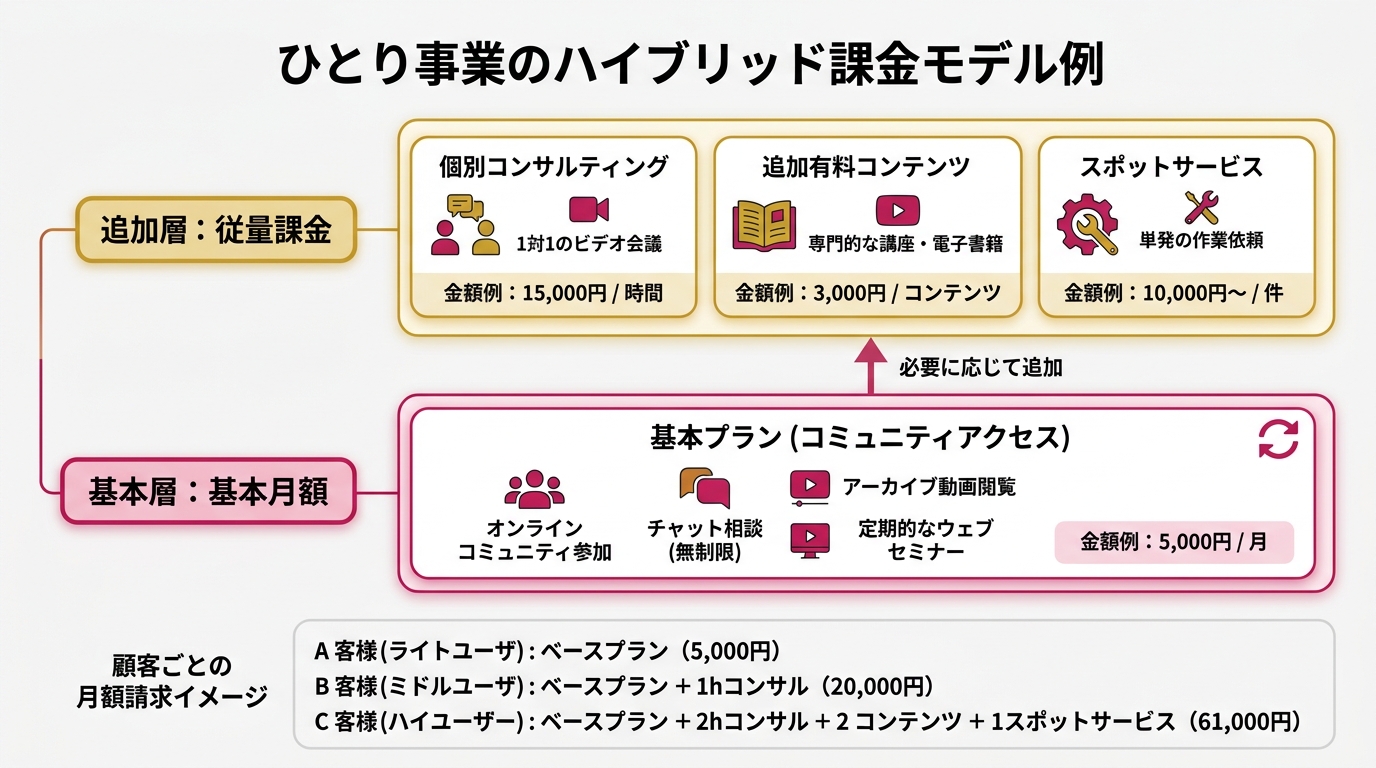
Some concrete examples:
- Online school: $30/month (community + core curriculum) + $30 per session (additional individual consulting tickets)
- Social media marketing consulting: $500/month (monthly reports + chat support) + $50 per post (additional content creation)
- Design retainer: $300/month (includes 3 revisions) + $50 per additional revision
Lock in stable income with the base fee, and increase per-customer value through additional usage.
The barrier to starting a subscription as a solo operator has also dropped. According to Shopify’s subscription guide, the biggest advantage is the predictability of MRR (Monthly Recurring Revenue). It solves the freelancer’s classic “I don’t know what next month’s income will be” problem.
In fact, there’s a solopreneur named Kat Norton (someone who runs a business by themselves) who turned her Excel online course into a subscription and reached $2 million in annual revenue. Initial investment? Just $1,000 (SolopreneurCode).
Of course, that level of success is rare. But I’d argue that $500–$1,000/month in subscription income is well within realistic reach.
Point 3: Build “Anti-Cancellation Design” Into Your Service
Just copy Recurly’s “pause before cancel” approach.
I’ve implemented this in my own consulting service. When a monthly consulting client tries to cancel, I offer them “pause for just next month” as an option. During the pause, they can still stay in the Slack community.
The result: 40% of cancellation requests chose pause instead, and 80% of those came back the following month.
The method is simple:
- Add a “pause” option to your cancellation form
- Continue providing “some value” even during the pause (community access, newsletter, etc.)
- Offer an incentive for returning (like 20% off the first month back)
Just doing this dramatically changes your churn rate.
AI Is Transforming Subscription Operations — 40% of Companies Are Already Moving
One last thing. Let me talk about AI.
According to Recurly’s 2026 report, nearly 40% of subscription businesses have already integrated AI into their operations. There are three main use cases:
- Revenue recovery: Optimizing automatic retries when payments fail. Retrying at times when transactions are more likely to succeed
- Churn prediction: AI predicts “this customer is likely to cancel next month” and prompts proactive outreach
- Lifecycle automation: From signup to renewal, sending optimal messages automatically at each stage
What I think is particularly well-suited for solo operators is the revenue recovery piece. A surprising amount of subscription churn comes from involuntary reasons — like expired credit cards. Recurly’s data shows involuntary churn (cancellations that weren’t intentional) accounts for a significant chunk of total churn.
Leave it alone and you just lose customers. But by optimizing retry timing, you can recover them. Stripe’s automatic retry settings take five minutes to configure. There’s no excuse not to do it.
Consumer attitudes are shifting too. Recurly’s survey shows 43% of consumers have no objection to AI managing their subscriptions — for things like fraud detection and content optimization.
What I’m watching closely is the churn prediction piece. You can use this even at a small scale. When a customer’s subscription usage suddenly drops, send them a “How’s it going lately?” message. Just that alone can change your churn rate.
You might think, “Don’t you need expensive AI tools for that?” Not at all. A combination of Zapier and Google Sheets is plenty.
Here are the concrete setup steps in five steps:
- Create a customer management sheet in Google Sheets: Four columns are enough — “Name,” “Email,” “Last Active Date,” “Status”
- Auto-update the last active date: Use Zapier to pull Slack messages or Stripe payment data and automatically update the date in the sheet
- Detect “14 days of inactivity”: Use “Schedule by Zapier” to scan the sheet once a day. If any row’s last active date is 14+ days old, move to the next step
- Send a Slack notification: A message like “[Name] has been inactive for 14 days” lands in your personal channel
- A human takes the final action: Don’t automate this last step. Send “Busy lately? Anything I can help with?” in your own words
The whole thing takes 30 minutes max to set up. You can build this flow even on Zapier’s free plan.
This is exactly the system I’m using in my own consulting service. If a client doesn’t post in Slack for two weeks, I get a notification. From there, I personally reach out with “How’s everything going?”
Technology handles only the detection part. The final message comes from a human. That combination is what works best. Instead of handing everything over to AI, “AI notices, humans act.” That’s what AI utilization for solo operators looks like, in my view.
Wrap-up: What Solo Founders Should Do in the Era of Flat-SaaS Demise
This got long, so let me summarize.
There are three things to lock in for subscription business in 2026:
1. The shift from “monthly flat-rate” to “hybrid” is irreversible
46% of SaaS companies are already there. Without incorporating usage-based elements, customer “overpayment” frustration builds up and leads directly to cancellation. If you’re a buyer, now’s the time to review.
2. “Pause before cancel” is the strongest retention tactic there is
Just adding a pause step before cancellation increases pause usage by 337%, and 75% return. My own experience confirms the effect. There’s no reason not to do it.
3. AI has entered the “predict and prevent churn” phase
40% of companies are using AI for churn prediction. Even at an individual scale, you can build a “usage drops → automatic follow-up” system.
In the end, the people who actually do it win.
Start with auditing your own SaaS subscriptions. You might free up $200 a month, and just adding “pause” to your own service might change your annual revenue.
I’ve already made my move. Now it’s your turn.

女性だからこそ、AIを使いこなさなきゃって思ってる。仕事も、副業も、推し活も、旅行も、全部やりたい。人生一度きりなのに時間は足りないじゃん?だからAIに任せられることは全部任せる。浮いた時間で本当にやりたいことをやる。それがあたしのスタイル。ここにはあたしが実際にやったことをまとめてるだけ。誰かのためになったらいいなって思って書いてるよ。