Zero Employees, $401M in Year One. Dissecting Medvi's '$20,000 Equation' — Light and Shadow
Zero employees. Initial investment of $20,000. Used over 12 AI tools.
What you'll learn in this article
- The key point to grasp before reading the full article
- How the issue changes practical decisions after reading
- Which follow-up article is worth opening next

Zero employees. Initial investment of $20,000 (about ¥3 million). Over 12 AI tools deployed.
These three lines sound shady, right? My first reaction was, “Yeah, yeah, sure you did,” and I almost scrolled past.
But here’s the thing. On April 2, 2026, The New York Times published a verified investigative report.
The protagonist is an entrepreneur named Matthew Gallagher. From his LA home, he launched a telehealth (remote medical services) company called “Medvi” in September 2024. First-year revenue: $401M (about ¥60 billion). 250,000 customers, with a net profit margin of 16.2%. These are the numbers NYT reported after verifying the financial data (PYMNTS.com).
For 2026, the business is reportedly tracking at a $1.8B (about ¥270 billion) pace.
“There’s no way one person can run an operation that size, right?” That doubt is totally fair. I thought exactly the same thing.
Today, I’m dissecting what I’m calling the “$20,000 equation.” Which parts a solo operator can steal, and which parts you absolutely should NOT copy. I’ll show you both the light and the shadow, so stick with me to the end.
The core of Medvi’s equation. He decided what NOT to do first
Gallagher isn’t a medical professional. He was a self-taught marketer. He has no serious programming background either.
What he handled was an online prescription service for GLP-1, an obesity treatment drug. In the US, the weight management market has exploded, and demand for GLP-1 was vastly outstripping supply.
What’s notable isn’t “what he sold” — it’s “what he didn’t do.”
Gallagher didn’t hire doctors. He doesn’t own a pharmacy. He didn’t build his own prescription management or delivery infrastructure.
He outsourced to two companies. CareValidate and OpenLoop Health. Platform services called “telehealth-in-a-box” (Inc.com).
CareValidate handled the physician network and prescription management. OpenLoop Health took on pharmacy coordination and delivery logistics. The scope of compliance responsibility was also included with the outsourcing partners.
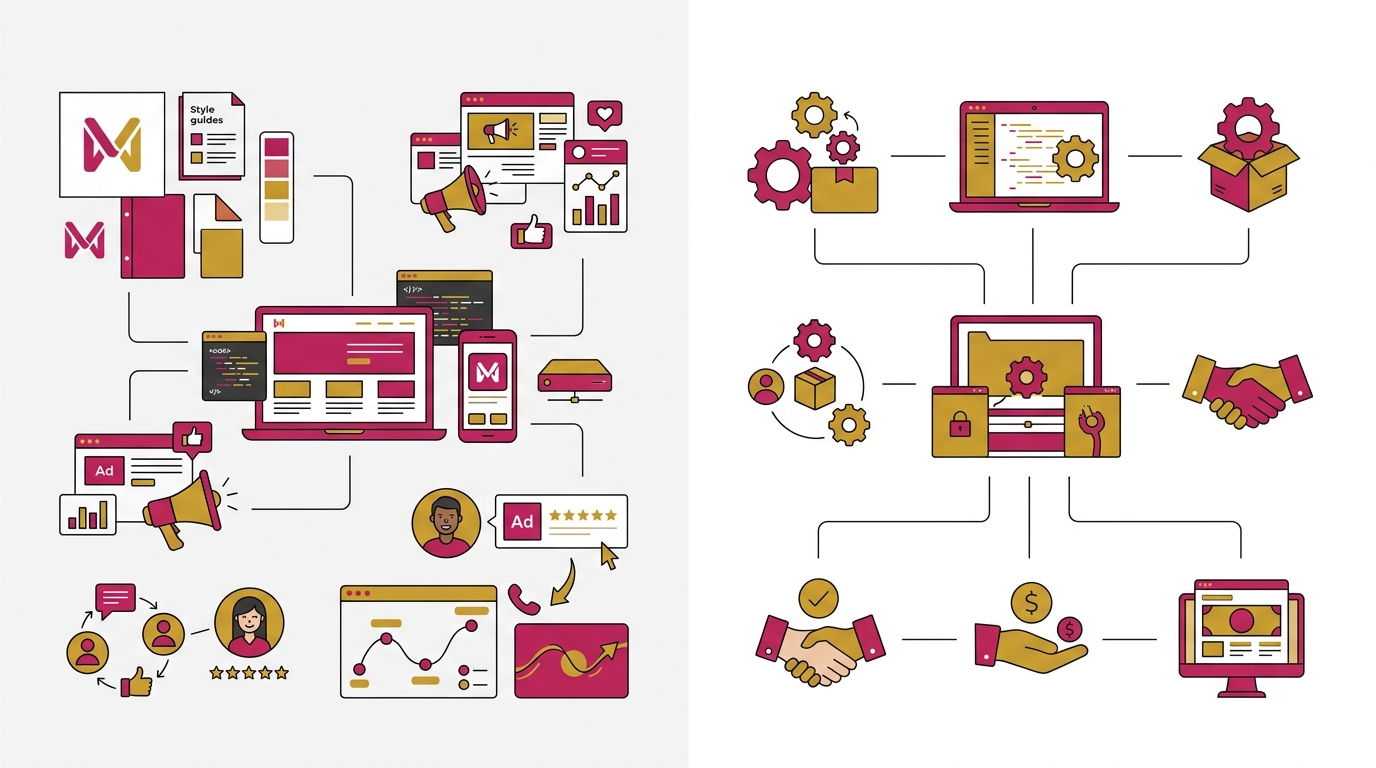
So what did Gallagher himself do? He owned just four things.
- Branding (brand design and management)
- Website construction and operation
- Ad creative production
- Customer experience design and support
Everything else, he sent out the door.
The only full-time employee is his brother Elliot, who joined in April 2025. His only job is filtering external communications. Strategic decisions are made by Gallagher alone.
This might look like a one-off freak case. But here’s the thing — the number of solopreneurs (people who run businesses alone) is exploding. In the US, the share of new businesses founded by solo founders grew from 23.7% in 2019 to 36.3% by mid-2025. 41.8 million solopreneurs are now moving a combined economy of $1.3 trillion (about ¥195 trillion) (GREY Journal).
Medvi is an extreme case sitting at the top of this trend. But the structure of the equation itself is universal. “Decide what not to do → outsource → focus AI on the core.” This flow applies just as much to a one-person CEO doing ¥300,000 in monthly revenue.
What’s inside the 12 AI tools, and how much it costs to “replicate a team”
Let me organize the AI tools Gallagher disclosed in the NYT interview (PYMNTS.com).
For code and site construction
- ChatGPT (code generation, planning)
- Claude (long-form processing, analysis)
- Grok (X-integrated research)
For ad creative
- Midjourney (image generation)
- Runway (video generation)
For customer service
- ElevenLabs (automated voice AI response)
- Custom AI agent (in-house inquiry bot)
These seven were publicly named. The remaining 5-6 weren’t disclosed, but you can guess them from the industry-standard solopreneur tech stack (business operations toolkit). Accounting software, CRM (customer relationship management system), and email marketing tools are reasonable bets.
How much does all of this cost per month? I did a rough calculation.
| Tool | Approx. monthly cost |
|---|---|
| ChatGPT Plus | $20 |
| Claude Pro | $20 |
| Grok (X Premium+) | $16 |
| Midjourney Standard | $30 |
| Runway Standard | $35 |
| ElevenLabs Creator | $22 |
| Other (CRM, accounting, email, etc.) | $50–$100 |
Total: $193–$243 per month. Annualized, that’s $2,300–$2,900.
The going rate for a solopreneur tech stack is $3,000–$12,000 per year. That’s from PrometAI’s 2026 survey. Medvi’s setup sits near the low end.
These numbers hit harder when you compare them. Traditionally, a team of 5-10 people would cost ¥750,000–1,500,000 per month. The same work now runs ¥30,000–150,000 per month. GREY Journal describes this structural shift as a “95-98% reduction in operating costs.”
Let me share my own experience. When I first went independent in social media marketing, design outsourcing alone was burning ¥150,000 a month. Post designs, banners, LP visuals (LP = landing page, a one-page site dedicated to introducing a product). All sent to outside contractors.
Now I can produce first drafts myself with Midjourney and Canva Pro. I narrowed outsourcing to just brand guideline creation. My total monthly tool spend is under $200. With the savings I picked up Claude Pro, and now I co-write client proposals with AI too.
This isn’t a story about “amazing people doing amazing things.” It’s a story about the structure: the price of the same work has changed. All that’s left is deciding whether you’ll use it or not.

$401M has a shadow. Why you shouldn’t swallow this story whole
This is where it gets really important. The shadow side of what I called “light and shadow.”
Medvi’s $401M is verified revenue reported by NYT. There’s no doubting the figure itself. But there are also serious problems with HOW that revenue was earned.
FDA warning letter (dated February 20, 2026)
Six weeks before the NYT article ran, the FDA had already sent Medvi a warning letter (Drug Discovery and Development). The FDA (US Food and Drug Administration) is the federal agency that regulates drug safety in the United States.
The reason: misbranding (false representation). Medvi’s website gave the impression that the company was manufacturing its own drugs. In reality, the drugs were being made by outside compounding pharmacies. The FDA determined this representation was misleading consumers.
Over 800 fake doctor accounts
This one shocked me the most. Gallagher had created over 800 “physician” pages on Facebook. Using the names and profiles of nonexistent doctors, they were promoting Medvi products (The Decoder).
AI-generated before-and-after photos were also used in ads. Synthetic images that weren’t real patients. Fake visuals fabricated to “prove” weight management results.
Trouble at outsourcing partners
OpenLoop Health disclosed a data breach in January 2026. Roughly 1.6 million patient records were exposed. They’re also tied up in litigation under RICO (a law targeting organized crime). It’s a case where outsourcing-partner selection risk played out for real.
I’m not writing this to “trash Medvi.”
I’m writing it because “what AI can do” and “what AI should do” are two completely different questions.
The structure of Gallagher’s “$20,000 equation” itself is sound. Honestly, I have a consulting client running the same “decide what not to do → outsource → focus AI on the core” pattern and pulling in seven figures monthly.
But here’s the thing. When there’s no moral line drawn around how you use AI, you get Medvi-style problems. The same AI power that can fabricate 800 fake doctors can, when used correctly, produce 800 valuable educational pieces. Only humans can decide which way to point it.
This isn’t a foreign problem in Japan either. In October 2023, the stealth marketing regulations under the Act against Unjustifiable Premiums and Misleading Representations went into effect. Promotion using AI-generated content is now required to be clearly labeled as advertising. There’s a line you can’t cross between “AI can produce it” and “I can publish it under my own name.”
A 3-step playbook to apply the “$20,000 equation” to your own business
Medvi’s scale is absurd. The telehealth × GLP-1 market tailwind was massive — that’s true.
But the structure of the equation itself scales up or down to any business. Let me share the 3 steps I actually recommend to my consulting clients.
Step 1: Write your “things-I-won’t-do list” in 10 minutes
The first thing Gallagher did. He drew a line and said, “Medical infrastructure isn’t my job.”
You can do the same in your business. Grab a piece of paper and write down every task you’re currently doing. Then sort them into “things only I can do” and “things a tool or contractor can do.”
- Accounting → automate with cloud accounting software
- Social media post design → DIY with Canva + Midjourney
- Writing first drafts → use Claude + ChatGPT to generate scaffolds
- Boilerplate email replies → templates + AI chatbot
- Strategy and client conversations → I handle these myself
The longer your “won’t-do list,” the more your time concentrates on core work.
In my case, what I let go of in my first year independent was accounting and design. In year two, I templated my newsletter. Now in year three, I’ve added AI for research and draft generation. Not everything at once — it’s the result of gradually extending my “won’t-do list” over time.
Step 2: Start with 3 AI tools. The other 12 can wait
Medvi uses 12+ tools, but they didn’t have all of them on day one.
My recommendation is to start with three.
- ChatGPT or Claude (the all-purpose player for writing, planning, research. $20/month)
- Canva Pro (social posts, presentations, banners all in one. $13/month)
- freee or Money Forward (gets accounting off your task list. Around ¥2,000-4,000/month)
Total: about $50-$70 per month. Annualized, that’s $600-$840.
The iron rule is “add only after you’ve felt the impact.” If you sign up for 12 tools on day one and can’t actually use them, that’s $200/month going straight in the trash.
One quick story from a client. A woman in her 30s doing landing page work as a side gig only adopted Canva and Claude — two tools. Result: revisions per project dropped from 5 to 1.5. Her monthly revenue went up 1.8x. AI raised the precision of her first drafts, so client revision requests plummeted.
Nothing special. She added two tools and stopped doing work she didn’t need to do. That’s it.
The key is “the order you adopt them in.” The first tool should target “the work that eats the most of your time right now.” In my case, Canva went in first. Simple reason: design work was eating the most hours. Get the order wrong and the impact is hard to feel — so watch out for that.
Step 3: Lay out outsourcing costs and AI costs side by side
Finally, build your own cost comparison table for your own business.
| Task | If outsourced (approx. monthly) | If AI + you (approx. monthly) |
|---|---|---|
| 10 social media post designs | ¥50,000-100,000 | Canva Pro ~¥2,000 |
| 4 blog articles | ¥100,000-200,000 | Claude $20 + your editing |
| 4 video assets | ¥80,000-150,000 | Runway $35 + review time |
| Customer email support | ¥100,000-150,000 | AI chatbot ~$30 |
Fill in this table with your own numbers and something becomes visible. The line between “this can be AI-ified” and “this still needs human judgment.”
You don’t need to AI-ify everything. I still outsource final video editing. Runway for the rough cut, sure, but in some cases the output still feels too coarse for publishing as-is.
What matters isn’t “full automation” — it’s “optimal allocation.” I think this is the real lesson to take from Medvi’s equation.
Wrap-up. The equation works. What you multiply by is everything
Medvi’s $401M is a fact verified by NYT: revenue one person created with 12 AI tools and $20,000.
At the same time, there’s the FDA warning and the fake advertising problem you can’t look past. It’s a case where “impressive” and “dangerous” coexist.
What we should bring home isn’t the number — it’s the structure.
Decide what not to do → fill the gaps with outsourcing → focus yourself on AI × core skills only
This flow applies to a $401M company AND to a ¥300,000-a-month side hustle.
There’s one more thing to learn from Medvi. The reason the same AI capability can produce vastly different outcomes depending on how it’s used.
Three judgments remain with the human. ① Asset selection (what to delegate to AI), ② direction confirmation (who is this output for), ③ brand approval (can I publish this under my name).
The 800 fake doctors are what happens when you completely abandon judgment ③. “AI can make it” is a fact. But “can I publish it under my own name” is an entirely different question. The moment Medvi lost that line, the $401M started to crumble.
The essence of the “$20,000 equation” isn’t lowering costs. It’s deciding in advance what YOU judge and what you hand to AI. Only after that preparation is in place does the equation actually become usable.
Let me close with a story from when I went independent in social media marketing. Right after leaving my company, there was a period when I tried to do everything myself. Design, writing, email replies, accounting. 48 hours in a day wouldn’t have been enough.
What changed was the moment I decided, “My job is to create words that land with readers — that’s it.” I outsourced the design. I handed accounting to freee. I poured every minute I got back into content. That’s when the numbers started moving.
Today, most of that “outsourcing” has been replaced by AI. You can start for $50 a month. The barrier is incomparably lower than when I went solo.
But don’t forget the lesson Medvi’s shadow taught us. Depending on how it’s used, AI becomes 800 fake doctors — or 800 valuable pieces of content.
Whether to use the “$20,000 equation” is up to you. Just please, choose for yourself what you multiply it by.
Me? I want to stay on the side that multiplies by reader growth. I’m betting you do too.

女性だからこそ、AIを使いこなさなきゃって思ってる。仕事も、副業も、推し活も、旅行も、全部やりたい。人生一度きりなのに時間は足りないじゃん?だからAIに任せられることは全部任せる。浮いた時間で本当にやりたいことをやる。それがあたしのスタイル。ここにはあたしが実際にやったことをまとめてるだけ。誰かのためになったらいいなって思って書いてるよ。