$300B Flowed Into Startups in 3 Months. Reading VC Investments as a Solopreneur's Entry Map
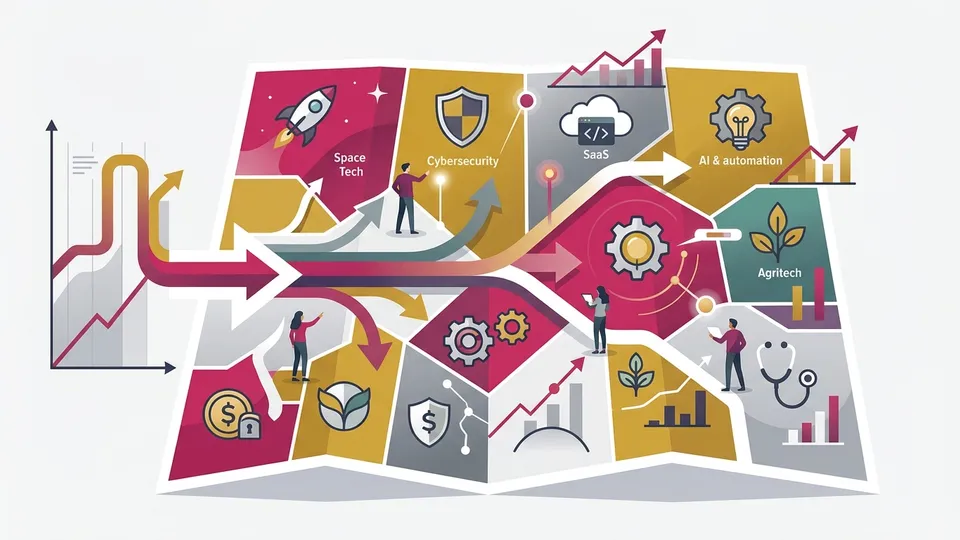
img: An image converting the flow of VC money into a solopreneur's entry map. A composition where a massive river of capital branches into multiple small waterways | type: eyecatch | style: warm gradient, minimal flat illustration, data visualization
What you'll learn in this article
- The key point to grasp before reading the full article
- How the issue changes practical decisions after reading
- Which follow-up article is worth opening next
In the first three months of 2026, $300B (about ¥4.5 trillion) was poured into startups around the world.
The highest amount ever recorded. A 150% jump from the same period last year. A lot of people probably saw the news and just thought “wow, that’s a lot,” and moved on.
But here’s the thing — this number contains incredibly practical information for solopreneurs (people running businesses by themselves). If you read where VCs are placing their bets right now, you can see “markets where demand definitely exists.”
This isn’t an analysis piece for investors. What I want to do this time is translate the $300B investment data into a “solo founder’s entry map.” Which wave should you ride? Where’s your spot? Let’s decode it together.
In my previous piece on the $480B creator economy, I talked about “empty seats for specialists.” This time I’m going one step further. Which industries hold those empty seats? The flow of VC money tells us the answer.
4 Companies Took $188B. The Hint for You Is in the Remaining $112B
Let me lay out the full picture first.
VCs (venture capitalists — specialized funds that invest in startups) invested $300B total. Just four companies accounted for $188B of that (Crunchbase).
Here’s the breakdown.
- OpenAI: $122B (about ¥1.8 trillion)
- Anthropic: $30B (about ¥450B)
- xAI: $20B (about ¥300B)
- Waymo: $16B (about ¥240B)
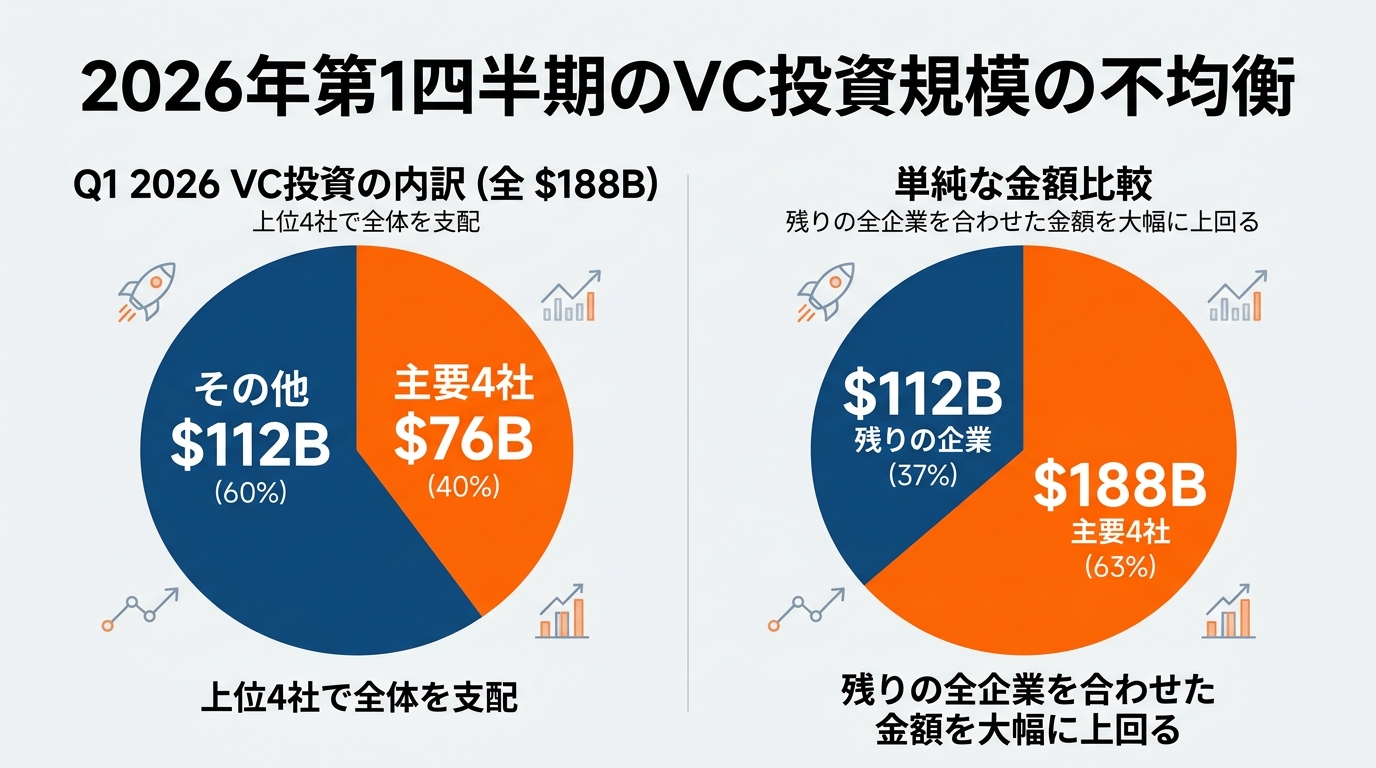
Four companies make up about 65% of the total. Honestly, the scale is so different it doesn’t feel useful as a reference, right?
But what I’m paying attention to is the remaining $112B (about ¥1.7 trillion). That $112B includes close to 6,000 startups. You can’t draw the map without looking at what’s happening in the world outside the giant AI labs.
Within that $112B, there are another 10 companies that raised over $1B. Semiconductors, data centers, robotics, defense, autonomous driving. This might still be too big.
Here’s where it gets interesting. There are over 5,980 startups that raised under $1B. This is the layer we should actually be reading.
Why? Because startups under $1B are built to solve specific problems in specific industries. Not general-purpose AI, but things like “automating appointment management for dental clinics with AI” or “optimizing inventory forecasting for small e-commerce businesses.” In other words, businesses operating at the same eye level as us solopreneurs are getting investor validation that “this will grow.”
The layer we should really watch is this one. Enterprise AI application companies that collectively raised $20B in Series B–D rounds. Healthcare, legal, finance, real estate. There are gaps here that solopreneurs can slip into.
AI Absorbed 80%. “AI × Industry Vertical” Is the Individual’s Entry Ticket
The most striking thing in Q1 2026 was that AI-related companies accounted for 80% of total investment ($242B) (Crunchbase).
We’ve entered an era where “if you don’t do AI, the money won’t come.”
But flip that around and it’s actually a huge opportunity. The fact that VCs are convinced “there’s demand for AI” means buyers for AI-related services definitely exist.
What matters for solopreneurs isn’t being on the “developing AI” side. It’s standing on the “using AI to solve specific industry problems” side.
To be concrete, positions like these.
- AI consultant: Helping small and mid-sized businesses adopt AI. I explained this in detail in my earlier Guide to Entering the $49.1B Market as an Individual
- Industry-specific AI workflow design: Building packages that automate “salon appointments → customer management → repeat visit promotion” with AI
- AI content production: Running social media, blogs, and email newsletters more efficiently with AI as a service to clients
I felt this acutely myself when I went independent in social media marketing. Most clients are in a state of “I know AI is amazing. I just don’t know how to use it.” The tools exist, but they can’t see how to apply them to their own business.
This is where solopreneurs come in. OpenAI and Anthropic are building the foundation for us. We just need to be the “translators” on top of it. Translators who convert technology into solutions for the problems right in front of someone.
There’s a caveat too. With AI swallowing 80% of investment, non-AI areas like biotech and SaaS are getting starved of capital (TechRound). If you’re going to fight in non-AI territory, you should know the reality is harsher than before.
Conversely, just by incorporating AI you’re more likely to catch investors’ eyes. Just adding an “AI” element to your existing business can shift how the market sees you. This isn’t only true for people raising capital — it applies to client pitches too.
In the US, solopreneurs now exceed 41.8 million people, contributing $1.3T (about ¥195 trillion) to the economy (PrometAI). The AI × solopreneur wave is already here.
Healthcare, Legal, Real Estate: Translating $20B of Demand Into Individual-Sized Solutions
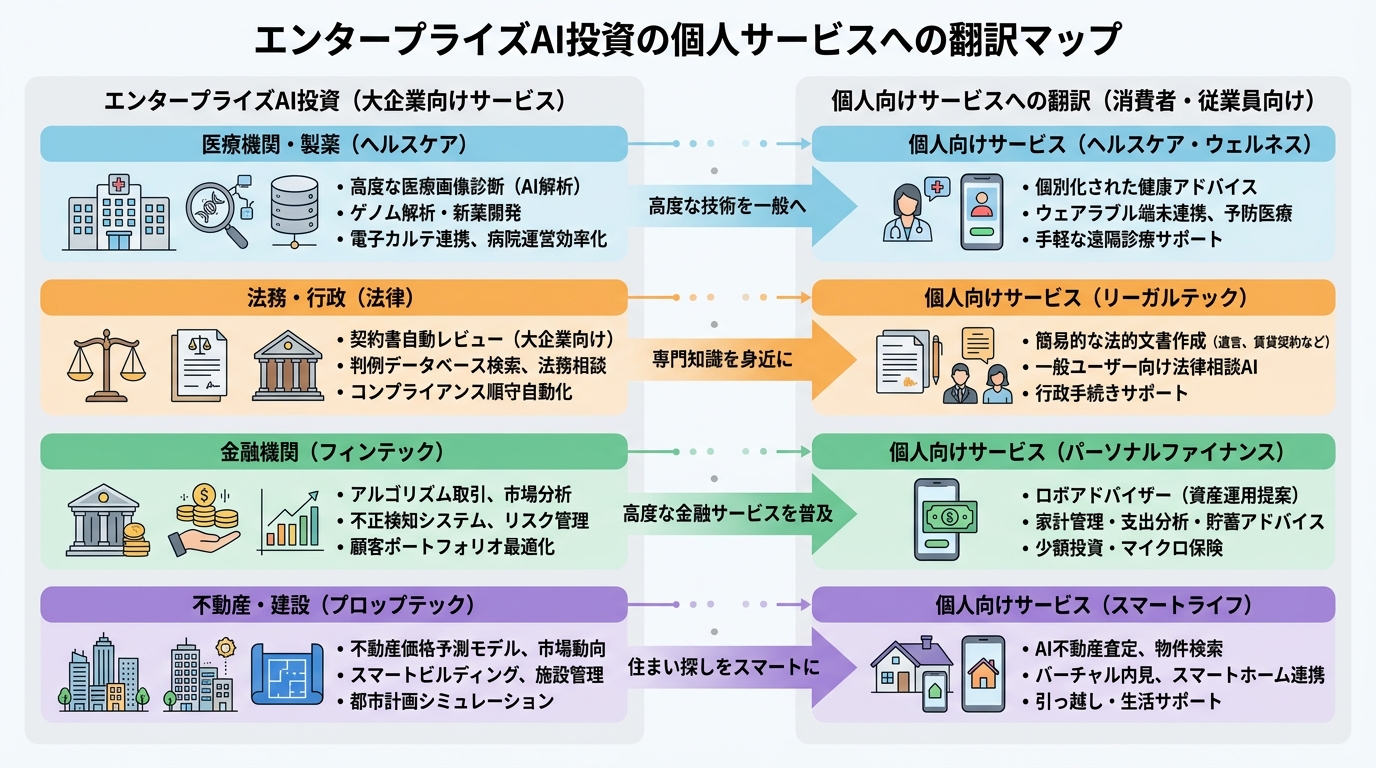
What stood out in Q1 2026 was the concentration of investment in industry-specific AI startups. Series B–D totals across healthcare, legal, finance, and real estate hit $20B.
If you’re thinking “that’s for enterprises, has nothing to do with me,” hold on a second.
When $20B in investment piles up around enterprise-targeted services, it means there are mountains of unsolved problems in those industries. And below them, there are tons of small and mid-sized players who can’t afford those expensive solutions.
Let me translate it.
Healthcare: Ultromics, which does AI-based heart disease detection, raised $55M. Mindoo, which makes AI management tools for hospitals, secured €5M in seed funding. Both are about “automating administrative work in medical settings with AI.”
Translated to the individual level → there’s demand for “consulting that streamlines patient intake, chart management, and patient follow-up at small clinics with AI.” Large hospitals can deploy their own systems. But your local dentist or family clinic doesn’t have that kind of budget. There’s room to come in with a monthly subscription model.
Finance: Upstart, the AI lending platform, raised $50M. Ramp, the expense management company, hit a $22.5B valuation. Within fintech (finance × technology), the “wipe out money-related paperwork with AI” direction is heating up.
Translated to the individual level → “Services that automate expense management and tax filing for freelancers and solo founders using AI.” This is an extension of my earlier piece on freeing accounting with the freee MCP. You know solo founders who break down crying every tax season, right?
Legal: Startups doing AI contract review and legal document drafting are exploding. Translated to the individual level → “Contract templates × AI review services for people working on side gigs or preparing to go independent.” Service agreements, NDAs (non-disclosure agreements), terms of use. The documents you need when going independent are predictable, but hiring a lawyer every time is expensive.
The concrete flow looks like this. Draft an NDA in 5 minutes with AI. Check the risky sections yourself. Get a lawyer just to do a final review (the cost drops substantially compared to normal). Package this as an “independence prep kit” and it’ll genuinely resonate with people transitioning from side gig to full independence.
Real estate: Startups doing AI property valuation and virtual tours are pulling in capital. Translated to the individual level → “AI-generated property analysis reports for beginner real estate investors.” Local market rates, yield calculations, future demographic projections. Bundle this data with AI into reports that beginners can act on. Make it monthly recurring and you’ve got stable income.
You can see the pattern now, I think. Read where enterprise AI investment is going. Deliver the same value, scaled down, to the small and individual players who can’t afford those services. This is how solopreneurs fight.
I call this pattern the “$300B Translation Method.” Read the investments, translate to individual-scale. Once you have this skill, you can use the same method to find entry points when next quarter’s data comes out.
47 New Unicorns Show “What’s Still Missing Right Now”
In Q1 2026, 47 companies joined the unicorn club (private companies valued at $1B / about ¥150B or more). And the pace of reaching that status from seed or early stage is the fastest in history (Crunchbase).
The global unicorn count stands at 1,344 (as of March 2026). Crunchbase’s unicorn board recorded $900B in value gains in just one quarter.
What do we read from this?
Becoming a unicorn in a short time from founding = supply is overwhelmingly insufficient for the market demand.
In AI × defense, AI × healthcare, and AI × data infrastructure, early-stage unicorn-ification is accelerating.
Looking at Japan, Sakana AI became the #1 domestic unicorn just about a year after founding (Geekly). SmartHR and Preferred Networks are still going strong. Existing unicorns are also concentrating in the AI space.
But Japan’s unicorn count is still in single digits against the world’s 1,344. How you read this gap matters.
Actually, this is also an opportunity for solopreneurs.
Few unicorns = not enough startups = unsolved problems are sitting unaddressed. While big companies accelerate AI investment, the front lines of small businesses and sole proprietors are still untouched.
When I ask the solo founders around me, most of them say “I want to use AI but don’t know where to start.” There’s demand here. Not for the grand challenges that unicorns solve, but for everyday problems at the level of “I want to automate this month’s invoicing with AI.”
Think about it. Japan has about 3.6 million small and mid-sized businesses. Of those, the ones that have actually deployed AI in their operations are still a minority. The US has 41.8 million solopreneurs alone, while Japan has about 4.6 million freelancers. Given the gap in market maturity, there’s nothing but growth potential ahead.
About timing — right now we’re in a state of “just before the wave.” What the surge in unicorns shows is “there are many problems still to be solved.” It’ll be too late once everything is solved. The window for solopreneurs to differentiate is open now, while the market is still immature.
I said the same thing in my previous piece on the $1.7 trillion solopreneur economy. What happened in America comes to Japan on a delay. The wave of AI × industry vertical that the VC $300B reveals is nothing but a tailwind for Japan’s solo founders.
The “$300B Entry Map.” Three Questions You Should Tackle This Week
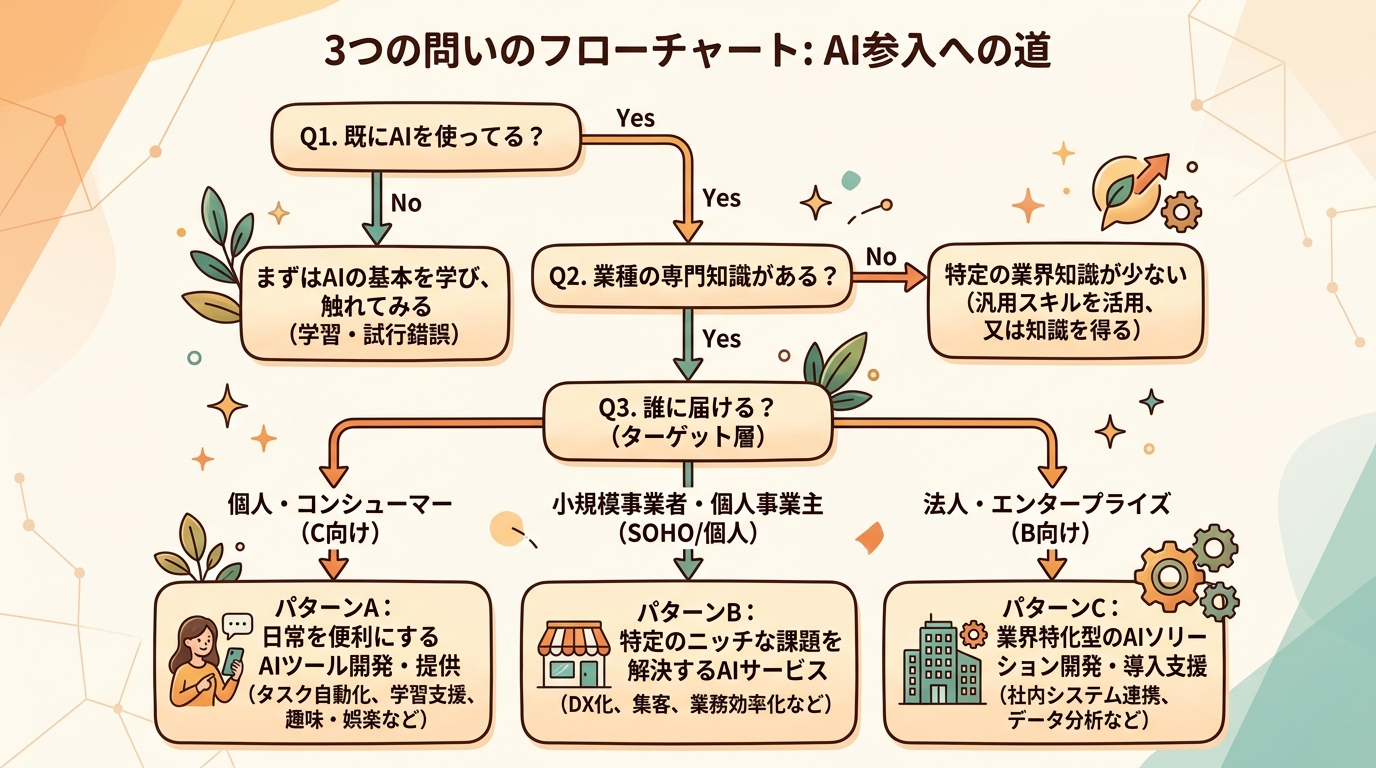
After reading all this, you’re probably thinking “okay, so what should I actually do?”
I’ve distilled the solopreneur entry map from the $300B investment data into three questions.
Question 1: “What industry do you know best right now?”
The sectors VCs are betting on are clear: healthcare, finance, legal, real estate, education. But you don’t need to chase all of them. The industry knowledge you built up in your previous or current job is your strongest entry ticket.
Why is industry knowledge a weapon? Anyone can use AI tools. ChatGPT, Claude — you can start touching them today by creating an account. The differentiator is “what you ask” and “how you use the answer that comes back.” That only makes sense to someone who knows the frontline of the industry.
Former nurse? “AI workflow consulting for clinics.” Former real estate agent? “AI property analysis reports for property investors.” Former accountant? “AI accounting services for solo founders.” Industry knowledge × AI gives you a position no one else can copy.
Question 2: “In that industry, what tasks are people wasting the most time on?”
What $300B in investment is telling us is that the market is moving in the direction of “replacing human work with AI.” Use your industry knowledge to find one place where you think “wait, you’re still doing this manually?”
Here’s a hint. Most of it falls under “copy-paste work,” “data entry,” “creating boilerplate text,” or “searching and organizing information.” When I start a social media marketing consulting engagement, the first thing I do is map the client’s “manual copy-paste hell.” There are still people copying post text from Excel into social media by hand.
It gets concrete when you look industry by industry. Professional services support (tax accountants, judicial scriveners): boilerplate document creation and verification. Hair salons: appointment confirmations and post-visit follow-up messages. Real estate brokers: property data entry and proposal materials. All of this can be semi-automated with AI. Where’s the “copy-paste hell” in your industry?
A solopreneur’s technology stack (the tools needed to run a business) can be built for $3,000–$12,000 per year (PrometAI). The savings compared to traditional labor costs are substantial. That gap becomes your service’s value proposition.
Question 3: “Who’s your first client?”
Staring at the $300B map gets you nowhere if you don’t move. This is what I always say. In the end, the person who acts wins.
Your first one can be a former coworker, a social media follower, or the owner of a shop in your neighborhood. Find one person you can pitch with “I can streamline this task with AI” — this week.
When I went independent, my first client was a former coworker. They said “I don’t have the budget to outsource social media,” and I answered “I’ll do it.” That was the start of everything. The world of $300B and your “first one” are part of the same continuous landscape.
Wrap-up
$300B. Just looking at the number, it can sound like a story from a distant world.
But what I decoded from it was this.
- 4 companies, $188B. The capital war among giant AI labs is building “the foundation” for us
- AI claimed 80%. Demand for AI × industry vertical positions is confirmed fact
- $20B concentrated in healthcare, legal, finance, real estate. Translating enterprise-targeted services into individual-scale offerings is how solopreneurs fight
- 47 new unicorns. Proof that supply isn’t keeping up with demand — now is the time to enter
- The entry map is three questions: industry knowledge × time-wasting tasks × your first client
VC data is “predictions of future demand” themselves. Wherever investors place their money, there’s room for us to slip in.
When I was a corporate employee, I’d see data like this and think “this has nothing to do with me.” The VC world belonged to people in suits, and my place wasn’t there.
But after going independent, something hit me. VCs invest $300B because they’re certain “people are struggling here.” If people are struggling, there’s something we can solve too. The scale is different, but the structure is the same.
OpenAI raising $122B and a solopreneur fighting with a $3,000-a-month tool stack — what they’re doing at the core is the same. “Solve someone’s problem with technology.” The entry point is right there, written in the $300B data.
The “$300B Translation Method” — once you learn it, you can use it over and over. When VC data updates next quarter, you can use the same reading to find entry points. That becomes your sustainable weapon as a solopreneur.
If you’re going to move, move now. If you have time to hesitate, try answering those three questions. Once you have your answers, that becomes your entry map.

女性だからこそ、AIを使いこなさなきゃって思ってる。仕事も、副業も、推し活も、旅行も、全部やりたい。人生一度きりなのに時間は足りないじゃん?だからAIに任せられることは全部任せる。浮いた時間で本当にやりたいことをやる。それがあたしのスタイル。ここにはあたしが実際にやったことをまとめてるだけ。誰かのためになったらいいなって思って書いてるよ。