91% Recouped Their AI Investment Within a Year. Zoom Surveyed 29.8 Million Solopreneurs — Here's the Order They Let Go of Tasks
According to Zoom's latest report, 91% of America's 29.8 million solopreneurs recouped their AI investment within a year. 64% said they couldn't run their business without AI. The real question isn't whether to use AI — it's what to let go of first. I turned it into a priority map.
What you'll learn in this article
- The key point to grasp before reading the full article
- How the issue changes practical decisions after reading
- Which follow-up article is worth opening next
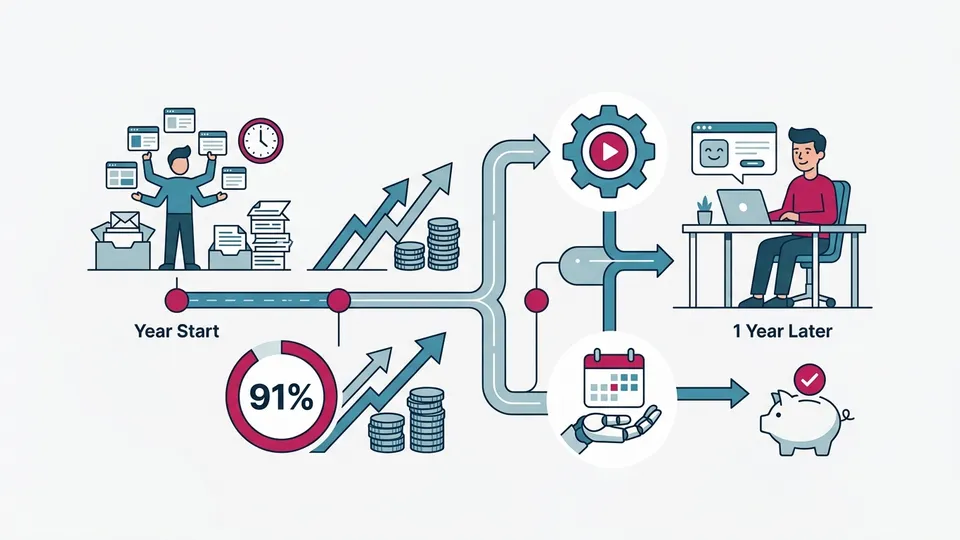
“Use AI and you can run the whole thing solo.” You’ve heard that line dozens of times by now.
But when you actually talk to people who’ve adopted AI, the reaction is lukewarm. “I think it’s kind of useful,” they say. “I use ChatGPT, but dramatic results? Not really.” You can see it on their faces.
Here’s the thing — they’re just doing it in the wrong order.
In 2026, Zoom published a report titled “State of Solopreneurship 2026.” It’s a large-scale survey of over 1,000 small businesses in the US, putting real numbers to how solopreneurs — people who run a business without hiring employees — actually operate.
The data backed up a hunch I’d had.
The gap between people who get results from AI and people who don’t isn’t about tool selection. It’s about designing what to let go of — and in what order.
In this post, I’ll break down what the Zoom report actually shows. Then I’ll share a “priority map for letting go” that I developed from my own hands-on experience supporting clients. The map in the second half isn’t an interpretation of the Zoom report — it’s my own practitioner framework. Read it as such.
If you’ve read my earlier piece on Dario’s “$1B solo” article, think of this as the practical follow-up.
29.8 Million People Moving $1.7 Trillion. Where the Solopreneur Economy Stands Now
Bottom line: Solopreneurs aren’t a niche way of working anymore. They’re a core driver of the US economy, accounting for 6.8% of GDP.
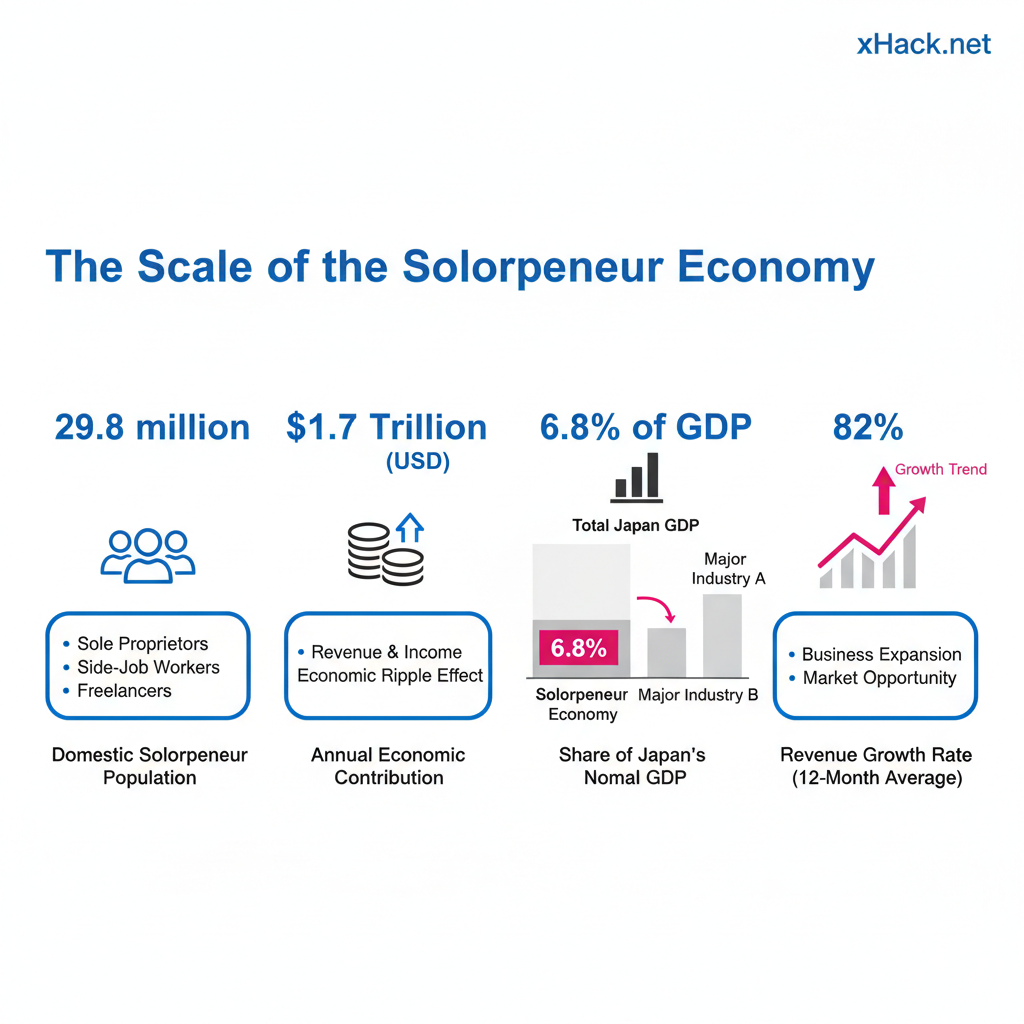
According to Zoom’s report, there are approximately 29.8 million solopreneurs in the US — representing 82% of all small businesses.
(Zoom: State of Solopreneurship 2026)
Raw numbers don’t always land, so here’s the picture:
- US solopreneurs: 29.8 million (82% of all small businesses)
- Economic contribution: $1.7 trillion (approximately 6.8% of US GDP)
- 74% are growing their businesses without hiring a single employee
$1.7 trillion. That’s a scale equivalent to roughly 40% of Japan’s entire GDP — generated by zero-employee solo operations.
Entrepreneur magazine reported that 2026 is set to be a record-breaking year for solopreneurship.
(Entrepreneur: Why Solopreneurship Is Set To Hit a Record High in 2026)
Data from startup investment platforms shows a sharp rise in solo-founded ventures compared to 2019. “Build a team first, then launch” is giving way to “move alone first” — and that shift is clearly accelerating.
What about Japan? A survey by the Ministry of Internal Affairs and Communications puts Japan’s freelance population at approximately 4.62 million (as of 2022) — still a fraction of the US figure, but trending upward amid the loosening of restrictions on side work.
There’s a catch in these numbers, though. Among those 29.8 million, there’s a clear divide between those who are genuinely leveraging AI and those who aren’t. And between those two groups, there’s a sharp fault line.
91% Recouped Their AI Investment Within a Year. 64% Say They “Can’t Run Their Business Without It”
Bottom line: AI has stopped being a “nice to have” and become infrastructure — like electricity or the internet. Without it, the business doesn’t run.
This was the data point in the Zoom report that hit me hardest. The following figures are drawn from the company’s publicly available survey data, including blog posts, the report itself, and related press materials.
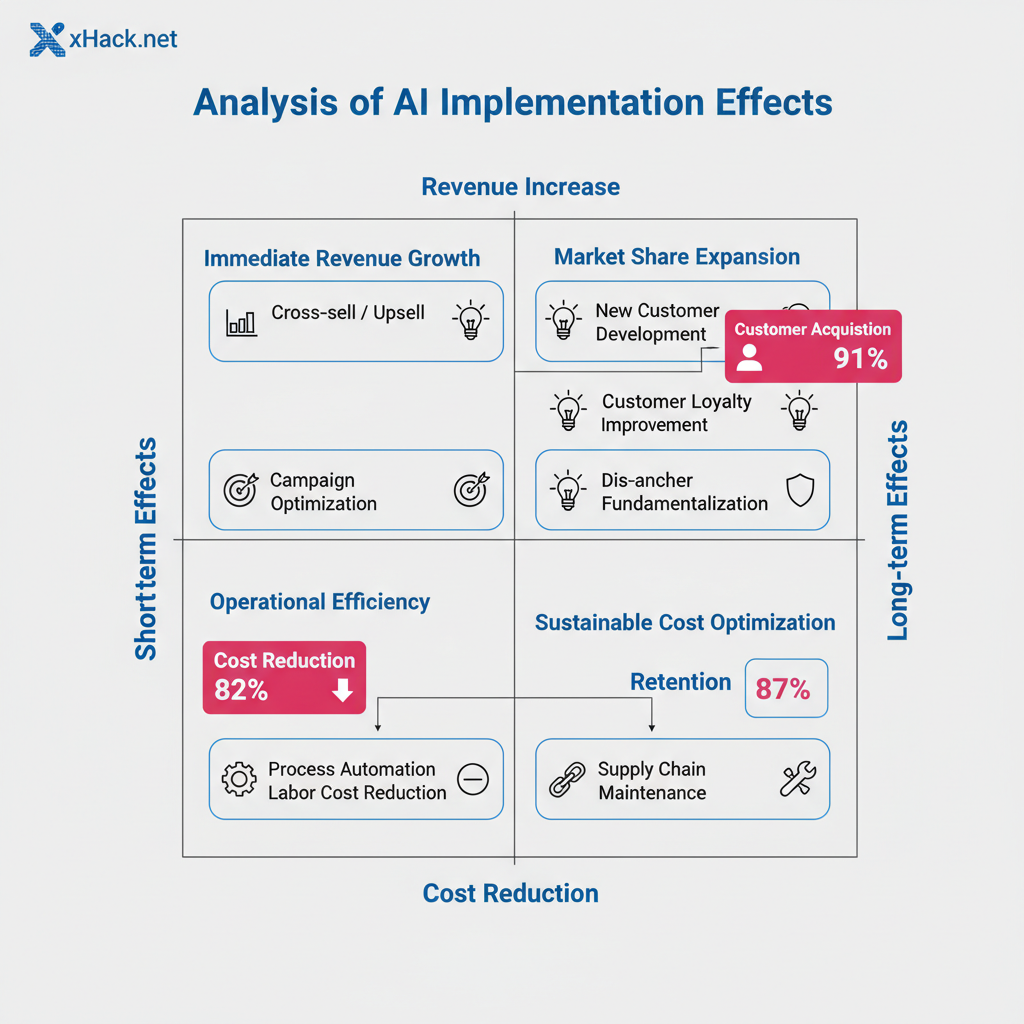
| Metric | Figure | What It Means |
|---|---|---|
| AI investment recouped | 91% | Within one year |
| AI dependency | 64% | “Couldn’t run the business without AI” |
| Cost reduction | 82% | Used AI to reduce business costs |
| Customer acquisition | 91% | AI helped them win more customers |
| Customer retention | 87% | AI improved customer retention rates |
(Source: Zoom: State of Solopreneurship 2026 and related survey materials)
Look closely at what “91% recouped” actually means: 9 out of 10 people broke even within a year. No financial product in the investment world delivers 91% profitability within twelve months. The ROI hit rate on AI is genuinely that high.
And 64% saying “I can’t run my business without AI” — that’s not a luxury anymore. That’s infrastructure, in the same category as electricity and internet access.
There’s another number worth sitting with: 91% saw more customers acquired, and 87% saw improved retention. AI isn’t just a cost-cutting tool — it’s a revenue-generating weapon. The majority of solopreneurs are using it for both at the same time: saving money and growing sales simultaneously.
I see the same pattern with my own clients. A consultant who started delegating her social media management to AI. At first she said, “Five thousand yen a month for a tool feels wasteful.” Three months later: “I can’t remember how I managed without this.”
But here’s what matters. “Just add AI and results will follow” isn’t how it works. What separates the 91% who succeeded from the 9% who didn’t? In my assessment, it comes down to how they designed the order of letting go.
”Hand Everything to AI” Always Fails. The Priority Map for Letting Go
Bottom line: Start with repetitive admin tasks. Then content creation. Finally, decision-making support. Follow this order and you’re unlikely to fail.
What follows is a framework I developed from my own client work — it’s not an interpretation of the Zoom report. If the Zoom data answers “what is happening,” this map answers “what to actually do.”
Here’s the “priority map for letting go” I share with every client.
Level 1: Repetitive Admin Tasks (Let Go of These First)
Specifically, tasks like these:
- Creating and sending invoices
- Logging and categorizing expenses
- Responding to routine emails
- Scheduling and calendar coordination
- Data entry and organization
Why start here? Because these tasks require no judgment, the rules are clear, and mistakes are easy to fix.
The Zoom report also shows that solopreneurs who actively use AI most commonly identified “routine administrative work” as the first thing they automated — the highest-impact category for reclaiming time.
(Zoom: State of Solopreneurship 2026)
When I went independent, the first thing I handed off to AI was invoice creation. Same format every month, same clients, just update the numbers. Doing it manually used to take two hours at the end of every month. Now it takes five minutes.
What did I do with those two hours? I wrote new client proposals. By letting go of two hours of monthly admin, I added one proposal per month. Twelve per year. Three converted to clients — and I covered the cost of the invoice AI tool in the first month.
Level 2: Content Creation (Let Go of This Next)
- First drafts of social media posts
- Blog article outlines
- Newsletter rough cuts
- Proposal templates
At this level, “full automation” shifts to “collaboration.” AI writes the draft; you do the finish work.
The key is not handing it 100% to AI. Let AI take it from 0 to 70%, and you take it from 70 to 100%. I have AI generate my social post drafts. Then I layer in my own experience and real opinions. Since switching to this approach, my posting frequency went from three times a week to daily.
Why does Level 2 come after Level 1? Because of the quality judgment required. Admin tasks in Level 1 have clear right-or-wrong answers — either the invoice amount is correct or it isn’t. Content creation involves subjective evaluation. You need a trained eye to assess what AI produces. Having built up AI collaboration habits through Level 1 makes the quality-checking at Level 2 go much more smoothly.
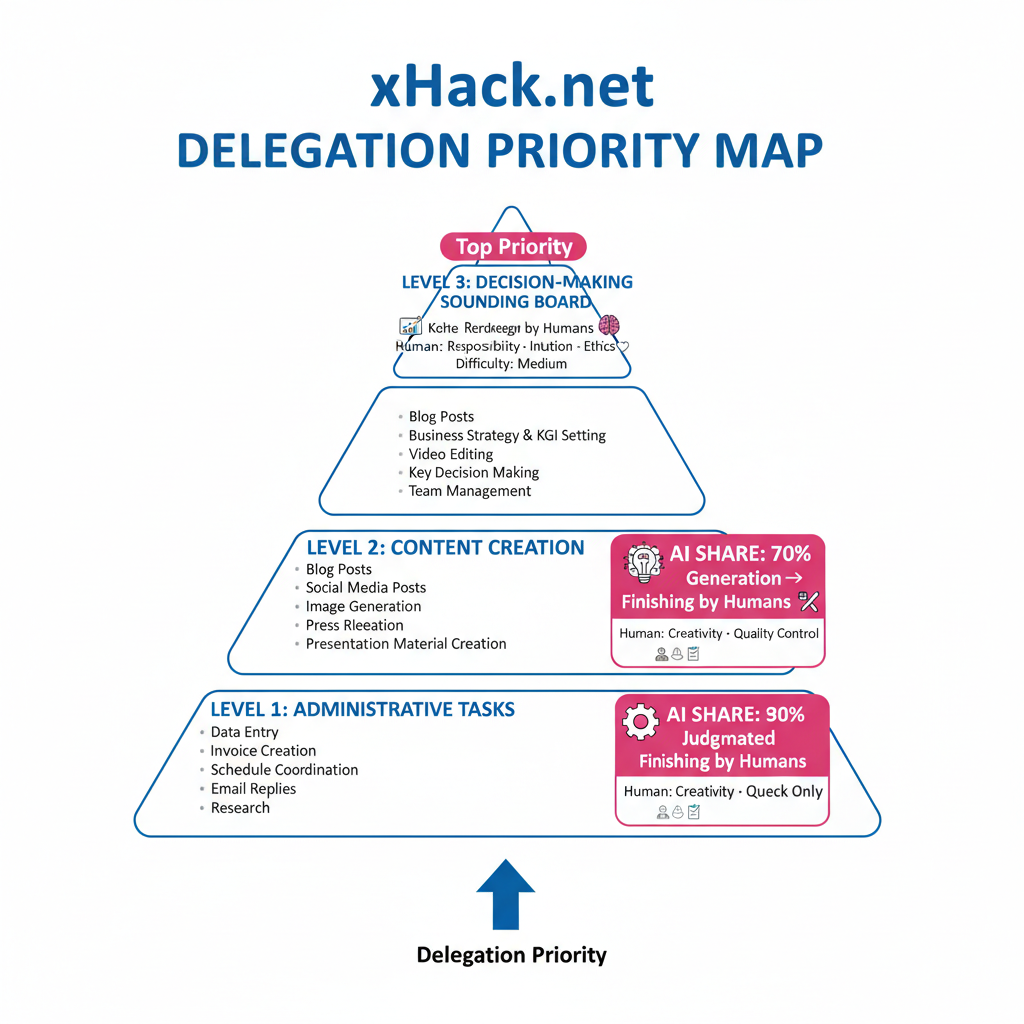
Level 3: Decision-Making as a Sounding Board (Let Go of This Last)
- Pricing simulations
- New service idea brainstorming
- Customer data trend analysis
- Competitive research summaries
This is less about “letting go” and more about “gaining a thinking partner.” The hardest part of being a solopreneur is making every decision alone. No manager, no colleague. No one to ask “is this price right?”
AI becomes your sounding board here. You still make the final call — AI just gathers and organizes the inputs. That alone transforms the speed of your decision-making.
Let me share a client story. Someone who wanted to revise their monthly consulting rates. They’d been agonizing over it for three months: “I want to raise prices, but what if clients leave?”
We asked AI three things: what competitors charge, general data on client churn rates during price increases, and three scenarios for a phased increase. The following week, she announced her new rates. She laughed and said, “What was I even doing for three months?”
The trick with sounding boards is not looking for the right answer. Don’t just adopt AI’s output — hunt for the “oh, I hadn’t considered that angle” moments. When I was setting the price for a new service, I had AI generate five options. Three were off the mark. But the final answer emerged from the remaining two.
Making every decision in isolation carries real mental weight. The Zoom report also found that solopreneurs frequently cite “lonely decision-making” as a challenge to sustaining their business. Level 3 isn’t just an efficiency play — it functions as psychological support too.
Working through these three levels from the bottom up is non-negotiable. Jump straight to Level 3 and AI’s answers will feel irrelevant and you’ll give up. Build confidence with Level 1, then move to 2, then 3. That’s actually the fastest path.
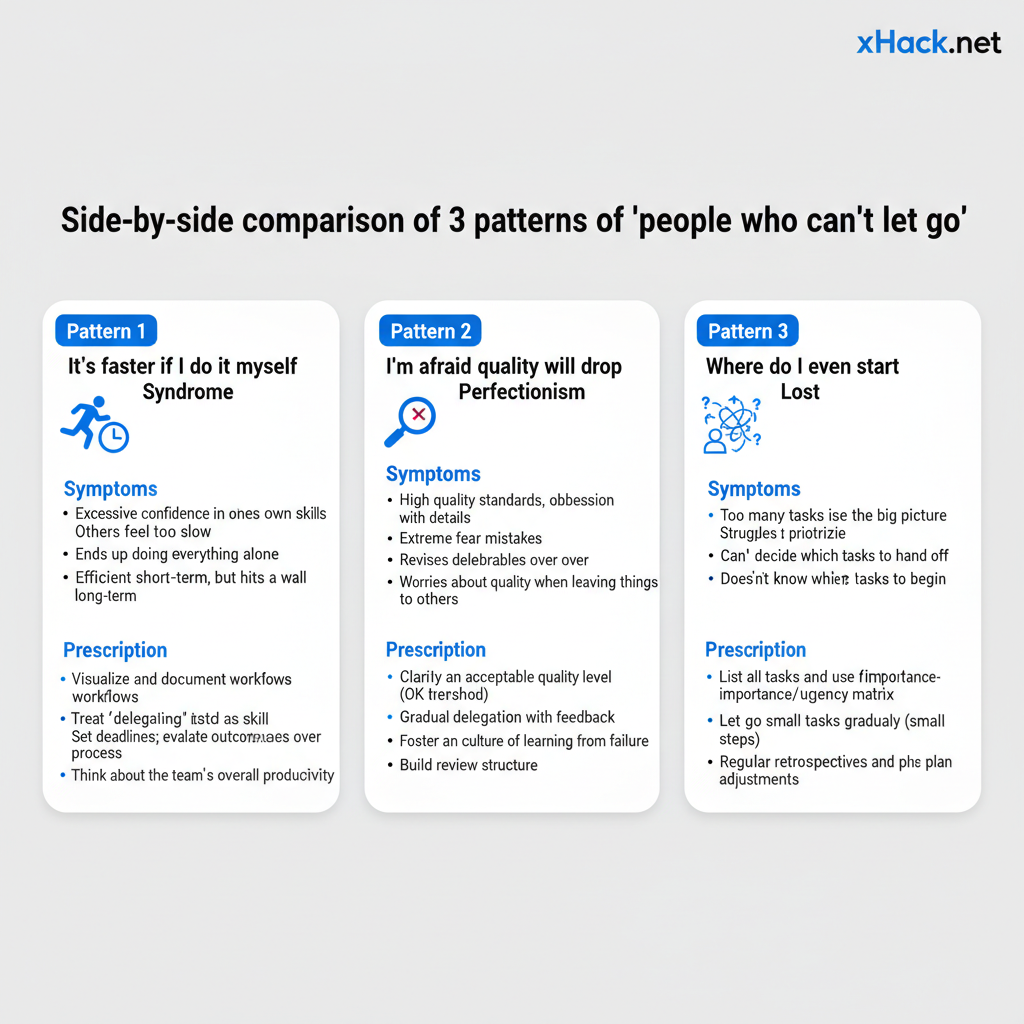
Three Patterns of People Who Can’t Let Go — and the Fix for Each
Bottom line: The inability to let go isn’t a capability problem — it’s a psychology problem. Name the pattern and you can address it.
The Zoom report acknowledges that 9% failed to recoup their AI investment. Among my own clients, some struggle with AI adoption too. Three patterns keep showing up.
Pattern 1: The “It’s Faster If I Do It Myself” Syndrome
The most common one. Especially prevalent among veterans who’ve owned a process for years.
The fix: calculate your effective hourly rate. Divide your monthly revenue by your working hours. If your hourly rate is $50 and you spend two hours a month on invoice creation, you’re burning $100 of time on it monthly. If an AI tool at $10/month compresses that to five minutes, the net gain is $90.
Reframing it as a cost problem — not a speed problem — makes the decision to let go much easier.
Pattern 2: The “I’m Scared Quality Will Drop” Perfectionist
Common with content creation. “AI-written copy isn’t my voice.” They end up rewriting everything from scratch.
The fix: decide the division of labor upfront. AI handles structure and rough draft only. Word choice and polish are yours. That’s what “let AI take it from 0 to 70%” actually means. I had the same resistance to AI’s phrasing at first. But even just using it for outline generation cut my thinking time in half.
One client started by having AI generate only the headline options — no AI-written body copy at all. Her writing time still dropped by 30%. When the headline is decided, the rest flows naturally.
Pattern 3: The “I Don’t Know Where to Start” Wanderer
Too many tools, can’t choose. ChatGPT, Claude, Gemini, Notion AI — tries them all, finishes none. This is the pattern.
The fix: one tool, one task, automate that. I recommend starting with ChatGPT or Claude. Ask it to generate three templates for your most common email replies. That’s it — five minutes, done. The impact is immediate.
Agonizing over tool selection is missing the point entirely. You’ll naturally figure out which tool works best for you once you actually use them. Reading ten comparison articles takes more time than prompting AI with one real task three times — and the latter teaches you far more.
Which Type Are You? Pick One Thing to Let Go of This Week
Bottom line: Know your type and the first step becomes obvious.
Type A: “AI sounds interesting, but I haven’t started yet”
→ You have the most to gain. The 91% in the Zoom report? That could be your number soon. If you haven’t started, now is the earliest you can.
What to do this week: Sign up for the free plan on ChatGPT or Claude. Ask it to draft one email reply you need to send tomorrow. That’s all. Five minutes of experiencing AI’s capability firsthand could change the next few years.
Type B: “I use it, but my work hasn’t really changed”
→ This is where the priority map comes in. Check whether you’ve actually automated Level 1 repetitive admin work. Are you jumping straight to Level 2 or 3?
What to do this week: Write out every task you did this week. Circle the ones you do repeatedly. Pick whichever shows up most often and hand it to AI.
Type C: “Level 1 is done. I want to know what’s next”
→ Move on to Level 2 content creation. The tool stack I outlined in my AI setup for $75/month article is a good reference.
What to do this week: Have AI draft three social posts for next week. Tell it “My business does X and my target audience is Y,” then ask for “three social post ideas for next week.” Add your own experience on top of what it produces — a full week of content, done.
Type D: “I’m doing all of it, but something still feels like it’s not enough”
→ Level 3 decision-making support is your next frontier. What’s the business decision you’re most stuck on right now? Repricing, a new service, a new target audience — anything works.
What to do this week: Put that problem in front of AI. Describe your situation and what you’re torn about. Ask it to “lay out the pros and cons and walk me through three scenarios.” You don’t have to take AI’s output as the answer. Just having the options organized will change how fast you decide.
Takeaway: It’s Not “What Tool to Use” — It’s “What to Let Go Of”
Zoom surveyed 29.8 million solopreneurs. 91% recouped their AI investment within a year. 64% said they couldn’t run their business without it.
What these numbers are really telling us isn’t that AI is impressive technology. It’s that solopreneurs decided to let go of things — and their businesses started working.
The order of letting go is set:
- Repetitive admin tasks first (Level 1)
- Content creation drafts next (Level 2)
- Decision-making support last (Level 3)
Follow this sequence and joining that 91% isn’t out of reach. Skip the order and you end up thinking “AI just doesn’t work for me.”
I used to try to do everything myself. Invoices, social posts, competitive research — all of it. I genuinely believed it was faster that way. Then I started letting go, and I caught myself thinking, “Why was I spending time on this?” The relief was almost anticlimactic.
The statistic from the Zoom report that stuck with me most: 74% scaled their business without hiring a single person. Read between the lines — instead of hiring, they handed work to AI.
Hiring one employee costs $2,000–$3,000 a month at minimum. AI tools start at a few dollars. The cost difference is stark. Of course there are things AI can’t do, and there are domains where humans are irreplaceable. But for a solopreneur deciding between “hire my first employee” or “try AI first,” trying AI is the right call in 2026.
The people who move fastest still win. The shift is just this: “doing everything yourself” has become “designing what to let go of — and in what order.”
So what’s the one thing you’re letting go of this week? Make that decision, and next week’s version of you will have a little more time for the work that actually matters.
That’s why I try it first and write up how it went — so you don’t have to figure it out alone.
Sources
- Zoom: State of Solopreneurship 2026 (source for data including 29.8M solopreneurs, $1.7T economic contribution, 82% no employees, 64% AI dependency, 74% growth without hiring, 91% cost reduction, and related figures)
- Entrepreneur: Why Solopreneurship Is Set To Hit a Record High in 2026

女性だからこそ、AIを使いこなさなきゃって思ってる。仕事も、副業も、推し活も、旅行も、全部やりたい。人生一度きりなのに時間は足りないじゃん?だからAIに任せられることは全部任せる。浮いた時間で本当にやりたいことをやる。それがあたしのスタイル。ここにはあたしが実際にやったことをまとめてるだけ。誰かのためになったらいいなって思って書いてるよ。