Anyone Still Blaming Youth for Others' Success Is Getting Left Behind — How the Age Illusion Is Dissolving in the '25 Is the New 30' Era
Antler's analysis of 1,629 startups shows AI founders average 29 years old versus 33 for non-AI — a 4-year gap that signals age is losing its function as a proxy for competence. The conclusion to a four-part series with a unified map of what's replacing it.
What you'll learn in this article
- The key point to grasp before reading the full article
- How the issue changes practical decisions after reading
- Which follow-up article is worth opening next

If you read my Mercor piece from 5/8 — did you let it end at “wow, impressive story”?
Three people, 22 years old, $10 billion (approximately $10B). The story where I broke down Antler’s “design principles” from 3,512 founders, that one. If it left you with a slight sense of unease — good. Today’s piece is for you.
One reason. Mercor was a single case. That was “anatomy of an outlier.” Today I’m writing about the structure by which outliers stop being outliers.
Fortune ran an article in January 2026 with the headline “25 is the New 30” (Fortune, 2026-01-07). On social media it got consumed as “Gen Z is amazing” and “being young is an advantage” — but read it seriously and a different story emerges. Age isn’t becoming a weapon. The premise of age as a condition is dissolving.
Today I’ll dissect that structure from three angles. And I want this to be the concluding chapter that integrates the four-article series (Mercor design principles · reacting to 22-year-old billionaires · $500M–$999M without VC meetings) into a single map.
Stop hesitating, start moving. But before you move — take this map with you.
Zooming Out One More Level on Those “Mercor Design Principles”
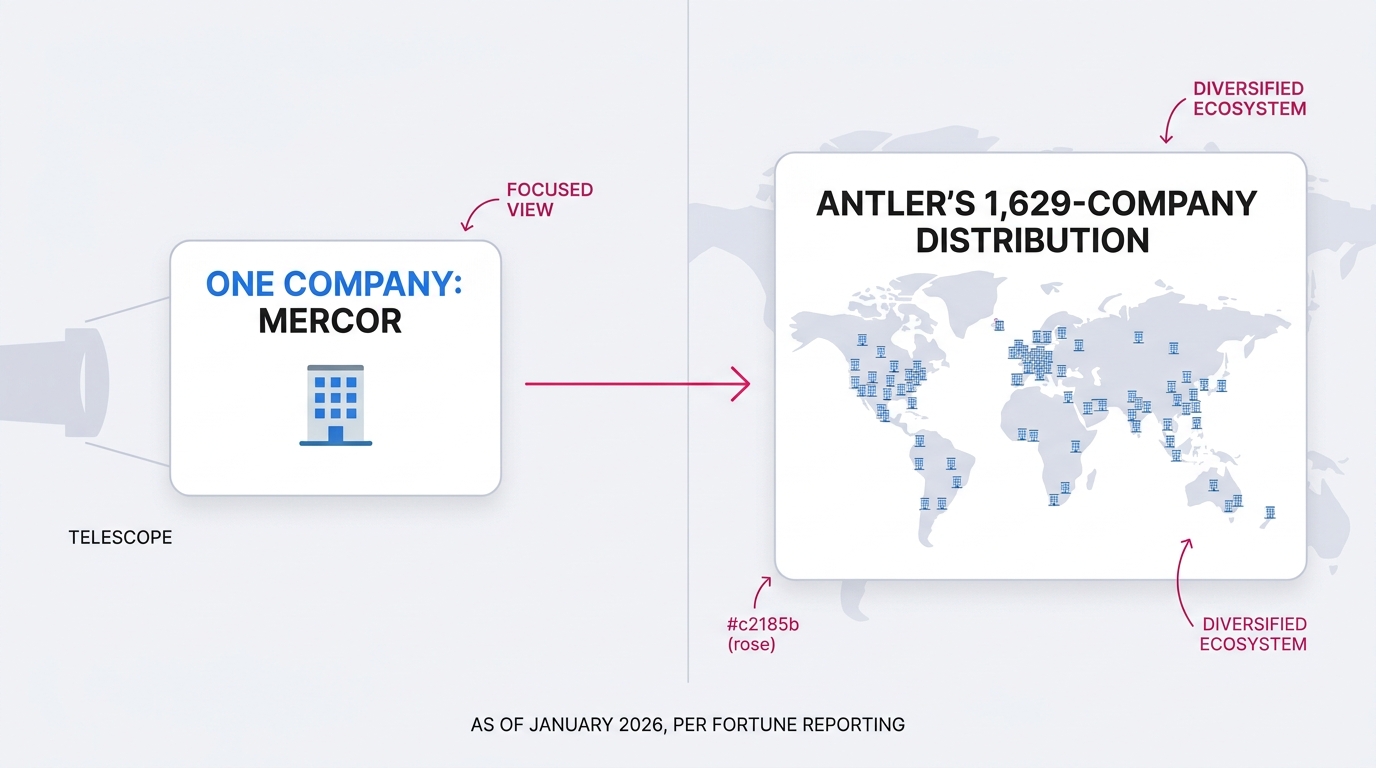
In my 5/8 piece, I dissected the internal workings of Mercor as a single company. Breaking down that pointed example — “3 people at 22, reaching $10B” — into Antler’s design principles. That was a worthwhile exercise. But looking at just one company leaves you with “special case,” “not relevant to me,” and you’re done.
So today, I pull the camera back one more notch.
Fortune’s January 2026 article is grounded in Antler’s analysis of 1,629 startups (3,512 founders — same dataset referenced in the 5/8 piece). Those 1,629 companies include a mix of AI-related and non-AI-related. The numbers that emerged (Fortune, 2026-01-07):
- Average founder age in AI-related startups: 29
- Average founder age in non-AI-related startups: 33
- Difference: approximately 4 years
“Wait, 29 and 33 — that’s only 4 years, right?” Yes, on the surface: 4 years. But that 4 years isn’t pointing at a simple age gap.
The 33 in non-AI domains — this was the inertia value: how many years it took to accumulate the experience needed to launch a business. Enter the workforce, get seasoned in the field, try a side project, go independent. Climb that ladder in order and you land at 33. This lines up almost exactly with the “average optimal founding age” Y Combinator and Sequoia have observed across decades.
The problem is that in the AI domain, that ladder ended at 29. Four rungs disappeared.
What disappeared in those four rungs? “Years of personal coding apprenticeship.” “Time to validate hypothesis through customer access.” “Years of publishing content to build community credibility.” All three were compressed by the advancing ecosystem of AI tools and content infrastructure. Mercor reaching $10B with three 22-year-olds isn’t a unique anomaly — it’s an extreme example of the broader pattern the “average 29” represents.
The Dissolving “Premise of Age” — What It Actually Is
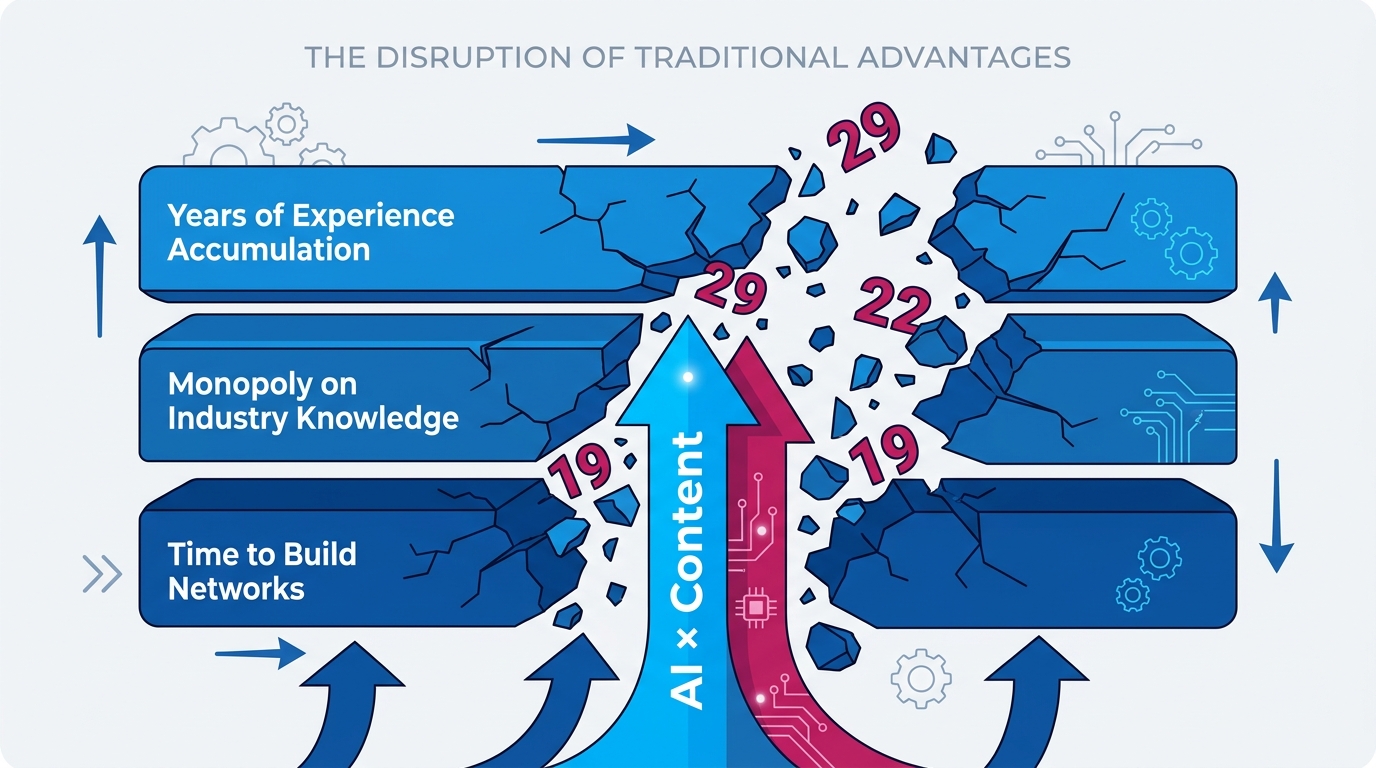
Here’s the most important part.
The real meaning of “25 is the new 30” isn’t “young people are working harder and winning.” It’s: “Age is ceasing to function as a proxy for competence.”
Let me unpack that.
In Japanese society — in business broadly — “age” has been a proxy indicator for “volume of experience.” A 35-year-old marketer versus a 25-year-old marketer: who gets preference? The 35-year-old. The reason is simple — “10 more years in the field.” Knowing someone’s age gave you a rough estimate of their experience. That’s what it meant for age to function as a proxy indicator.
But as the AI environment and content ecosystem changed, this proxy started to drift. Someone 25 who uses AI every day versus someone 35 who touches it a few times a month. The latter should “win” in experience volume — yet there are situations where the output quality reverses. I’ve worked with freelancers in their mid-twenties and thought more than once: “This person’s leverage ratio is higher than mine right now.”
This isn’t “the young person is better.” It’s: “The precision of estimating experience volume from age has dropped.”
Go one level deeper, and this is what we’re seeing:
| Domain | Old age-based assumption | 2026 reality |
|---|---|---|
| Writing code | Practical skill around age 30 | AI pair coding → production-quality work at 22 |
| Understanding customer problems | Industry takes 10 years to reveal them | Community management → first-person access at 19 |
| Meeting investors | Referral-gated, starting at 35 | Crowdfunding / RBF → no age requirement |
| Product design | Veterans only, or you’re lost | Design AI + feedback loops → process compressed |
Four “experience-dependent steps” have been reconstructed into a tech stack that doesn’t depend on age. This is what’s inside the “average of 29.”
One thing to be careful about: this is not saying “so people in their 30s and 40s are finished.” It’s actually the opposite. If age has stopped functioning as a proxy for competence, it’s also wrong to write yourself off because of your age. If 25-year-olds can win, then 35-year-olds can stand on the same field. The premise dissolved — the playing field opened in both directions.
What was liberated was the premise itself. Whether you actually step up is a separate question.
Integrating the Four-Article Series Into One Map
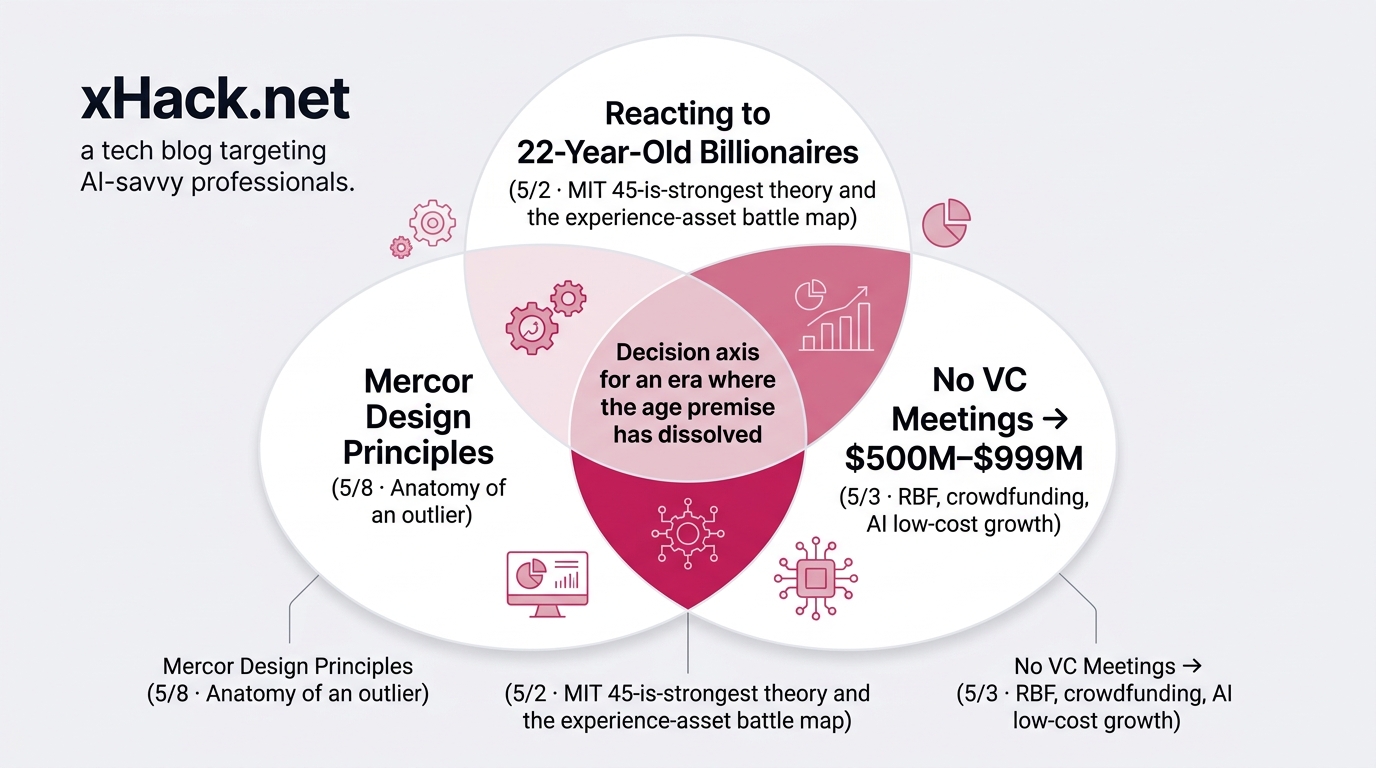
Let me organize the three-article series I wrote over the past two weeks. Each piece alone looks like an isolated story — but overlapping all three reveals the outline of a tectonic shift.
1. To Everyone Who Panicked at the 22-Year-Old Billionaire — MIT’s Analysis of 2.7M Companies and the ‘45-is-Strongest Theory,’ Plus a 3-Map Guide to AI × Experience Assets (published 5/2)
Core thesis: antidote to panic. Using MIT’s “45-is-strongest” analysis of approximately 2.7 million US companies as a counter-narrative for the 30-to-40-something readers overreacting to 22-year-old billionaire headlines. The center was a map showing “three fields where experience assets become leverage.”
2. The Era of Reaching $500M–$999M Without VC Meetings. Translating RBF, Crowdfunding, and AI Low-Cost Growth to the Scale of a Solo Founder (published 5/3)
Core thesis: the premise of fundraising changed. Three routes that get you to $500M–$999M (roughly ¥75B–¥150B) without VCs. Presented the structure: “route design, not age, gets you there.”
Core thesis: translating an outlier’s design principles. Using Mercor as a case study, translating it via Antler’s principles from 3,512 founders. “Youth” wasn’t the split variable — what they chose to give up was.
Stack the three vertically and read them like this:
- 5/2: “Don’t panic — your battlefield is elsewhere.” (Defensive repositioning)
- 5/3: “Fundraising premises changed — more routes are open.” (Expanding offensive options)
- 5/8: “The outlier’s internals were all about what they abandoned.” (Translating success structure)
And today’s piece is the fourth, integrating all three. “What does your decision axis become when the premise of age has dissolved?”
After reading all four, here’s how to move:
- Don’t panic at 22-year-old billionaire headlines (5/2 experience-asset map — verify your own battlefield)
- Don’t write off your funding options by age (5/3 — evaluate RBF, crowdfunding, AI low-cost growth)
- Don’t dismiss success stories as “they were just young” — read the structure (5/8 — copy the abandonment design)
- Remove age from your personal competence proxy framework (today’s article — the premise argument)
This is the full series, completed. The big picture of what I’ve been trying to communicate over two weeks.
How People in Their 30s and 40s Can Restart “Age Capital” Right Now
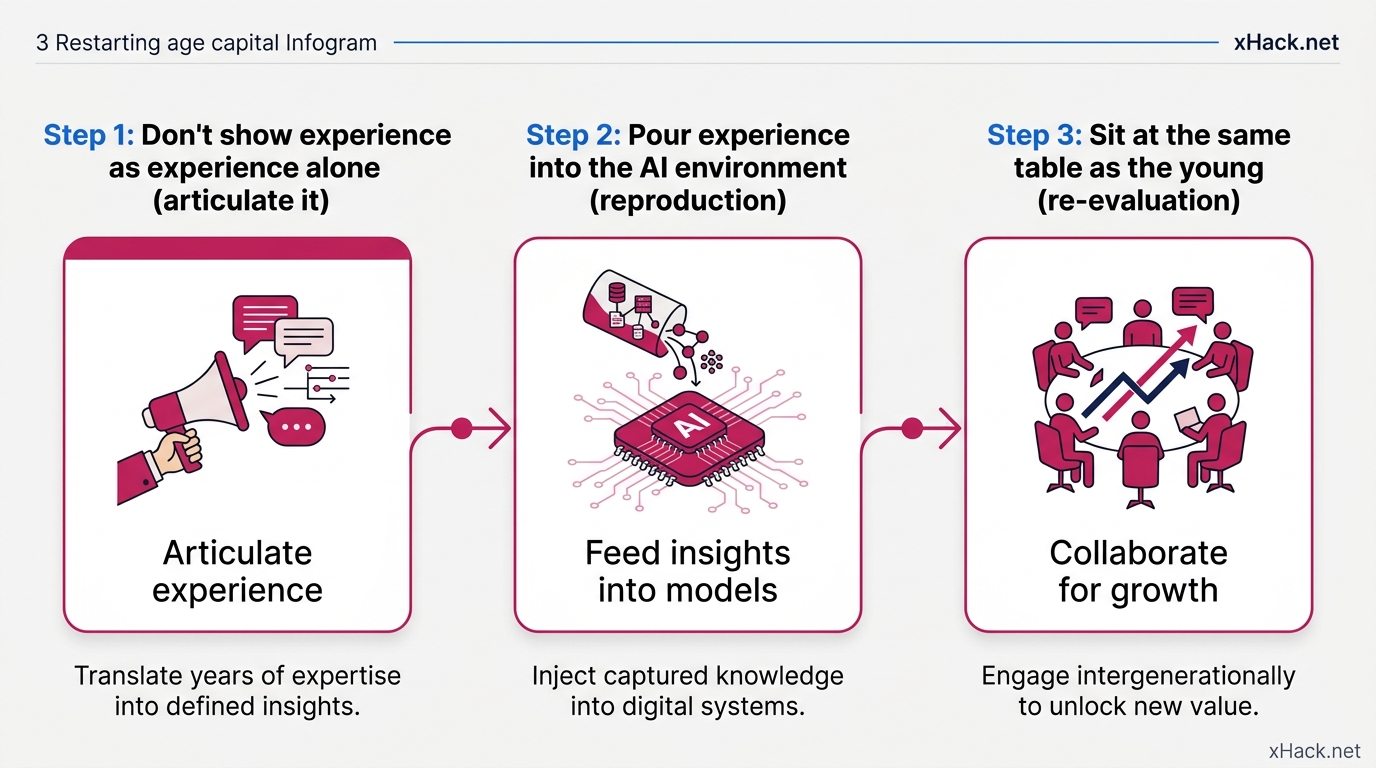
I’ve written that “the premise of age dissolved.” By “age capital” here I mean the totality of trust, experience, and network accumulated and tied to age. The problem is that people aren’t updating how they use it — even as the usage model has changed. So what should readers in their 30s and 40s actually do? I’ve organized it into 3 steps.
Step 1: Don’t Show Experience “As Experience”
“I’ve been doing this for 10 years.” “Five years in the industry.” These land less powerfully than they used to. The reason is simple: in an AI environment, “years” matters less than “output.” Years of tenure don’t stop being credible. But leading with tenure alone makes the listener think: “So what can you actually do?”
What to do instead: articulate experience as “reproducible patterns.” Distill 10 years of field experience into 3 decision frameworks. Organize 5 years of industry experience into the 5 most common failure modes. Do that, and “experience as pattern” — which a 25-year-old power-user doesn’t have — comes to the front.
Step 2: Pour Experience Into the AI Environment
This is the step most people skip. “AI is for young people” — and they keep their distance. But wait. AI is precisely a tool that people with experience can master more deeply.
The reason: evaluating AI output requires asking “Is this wrong? Where is this off?” — and building that judgment comes from field experience. The AI-native 25-year-old outputs faster — that’s real. But the person who holds the judgment axis to verify output quality is the one who’s put in field time.
Concretely: each week, identify one part of your current manual workflow that AI could handle, articulate it in words, and try it. Do that for 3 months, and you’ll see your own productivity in an AI environment clearly.
Step 3: Sit at the Same Table as the Young
What people in their 30s and 40s tend to do isn’t “pull rank by age” or “argue from experience.” It’s the opposite: “It’s exhausting to explain things to young people” or “We’re at different ages, it won’t click” — they create distance.
This is the biggest waste.
When a 25-year-old AI native and a 35-year-old industry veteran sit at the same table, each fills in what the other lacks. The 25-year-old side brings speed and cutting-edge tools. The 35-year-old’s weapons are judgment frameworks and network. Both are needed — so the team holding both wins.
When I work with young freelancers in their 20s, I consciously enter as “the one learning,” not “the one teaching.” When I do, they naturally respond: “Please teach me everything you know about the industry.” The people losing most to age hierarchy are the ones who need to change where they sit first.
The sequence matters: Step 1 articulates the pattern. Step 2 pours it into AI. Step 3 pairs with young people. This order has the highest leverage. Going into AI without a crystallized pattern means no axis to evaluate output against. Sitting with young people without touching AI means no shared language develops.
One more important angle. These 3 steps work equally well for “starting a side business,” “preparing for independence,” or “redesigning your main career.” Even staying as an employee, cycling through the 3 steps has value. For people in their 30s–40s who run this process now — even without going independent — you develop a way of operating in your main career that isn’t constrained by age.
Time estimate: 3–6 months to cycle through the steps. Long? Short? You decide. My view is: spending a month stuck in hesitation teaches less than spending a month from Step 1 and moving.
Why the Startup Age Earthquake Won’t Stop
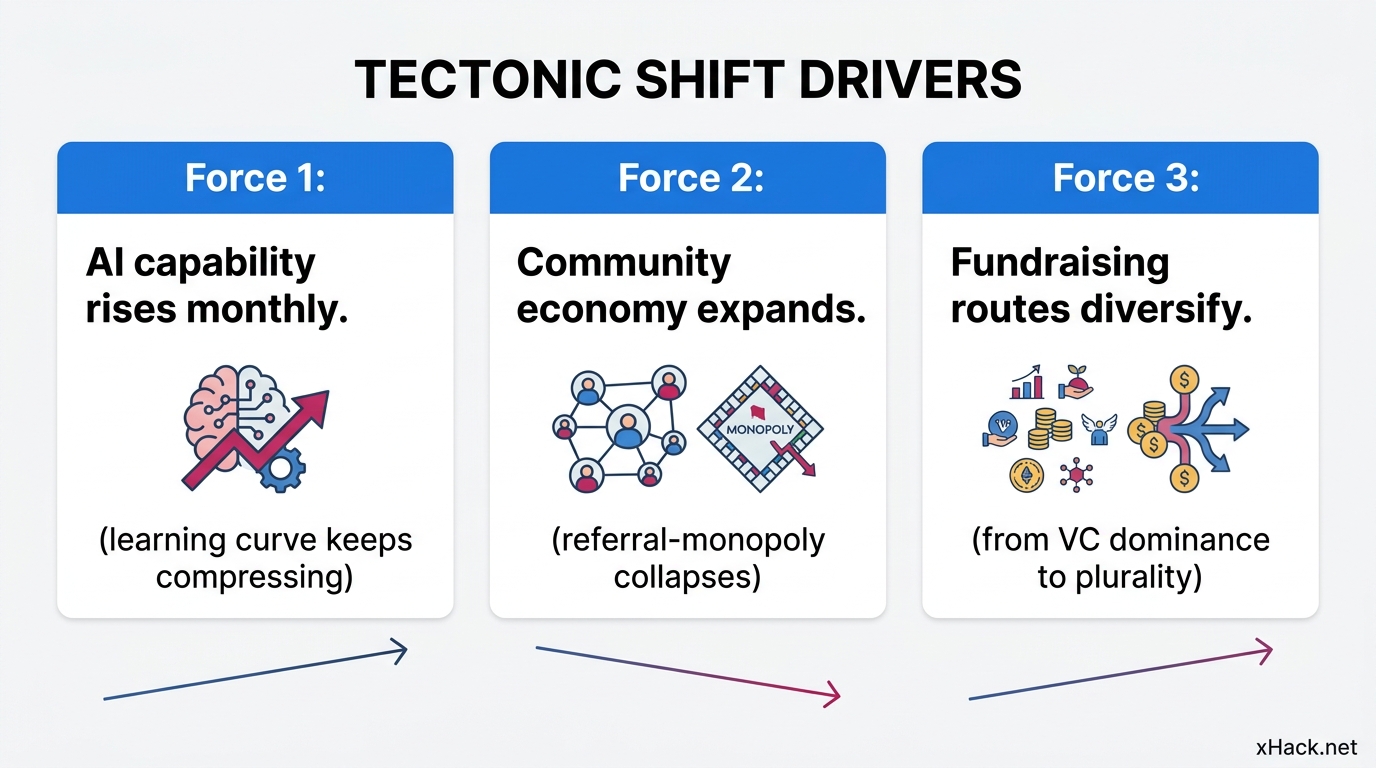
“Isn’t a correction coming soon?” “Isn’t this just a Gen Z bubble?” The skeptics have a point about short-term noise. But I think the structural tectonic shift won’t reverse. Three reasons.
Force 1: AI learning curves keep compressing
From GPT-4 to models at GPT-5 equivalent capability, coding and reasoning ability has been improving every quarter (confirmed via official benchmarks and model update notes from each company). This means the number of years it takes a 22-year-old to write production-quality code will compress even further next year. From what I’ve observed, the speed at which AI compresses “the time it takes to accumulate experience” shows no sign of slowing.
People in their 30s and 40s don’t need to read this as “can’t catch up.” What’s being compressed is “the time to accumulate experience” — not the experience itself being invalidated. People who already have experience: pour it into the AI environment, and leverage (mechanical advantage) amplifies it.
Force 2: Community economy expands
Referral monopolies are breaking down. The routes tied to age-based trust — VC referrals, industry luminary introductions — are being replaced by community-based credibility. At 19, with 20,000 community followers, you can access customers faster than a 35-year-old industry veteran.
This also isn’t “the young have the advantage.” The advantage goes to whoever invested the time and effort to build a community. Age is irrelevant. A 35-year-old who has cultivated 5,000 community members often has deeper relationships than a 19-year-old with 20,000 followers.
Force 3: Fundraising routes diversify
As I wrote in the 5/3 piece, three new routes have opened: RBF (Revenue-Based Financing), crowdfunding, and AI low-cost growth. $500M–$999M is reachable without VC meetings. This is usable by anyone regardless of age. In fact, RBF — which requires revenue history — gives an edge to people in their 30s–40s who already have demonstrable track records.
Combine the three forces: “Age has stopped functioning as a proxy for competence” — and that state will accelerate further over the coming years. Even if short-term corrections come, the structure won’t revert.
So today’s message is the same for both the young and the 30s–40s: don’t make age a reason not to move. Seeing news of a 25-year-old winning and panicking, or seeing 35 as a barrier and giving up — both are the same old thinking of using age to estimate competence.
Getting off that is where it starts.
Conclusion — “Those Who Show Up Win” — What’s Changed Is That Age Is No Longer the Entry Fee
In my 5/8 Mercor piece, I handed readers “translation of design principles.” In the 5/3 zero-VC piece, I offered “expansion of fundraising route options.” In the 5/2 22-year-old billionaire piece, I laid out “the experience asset battle map.”
And today, this piece integrates all three: “Decision axis for an era where the premise of age has dissolved.”
What I’ve been trying to say across four articles comes down to something simple.
“Age” no longer functions as a proxy for competence. If 25-year-olds can win, 35-year-olds can too. If a 35-year-old keeps their distance from AI, they might get overtaken by an AI-native 25-year-old. Age becoming irrelevant doesn’t mean the winner has been decided — it just freed the game up.
“Those who show up win” — that’s what I’ve been saying for years. The core hasn’t changed. It’s just that “age” has been removed from the barrier list.
If you panicked at 22-year-old billionaire headlines, you’re not alone. If you thought “maybe it’s too late” at 35 — not yet. If you’re in your 40s, still on the fence about a side business — with the right axis, you can get there.
If the four articles I wrote give even one person a reason to remove “age” from their “reasons not to move” list — that’s enough.
Stop hesitating, start moving. Failing isn’t the end of anything.
Series complete. When the next tectonic shift comes, I’ll write about it.

女性だからこそ、AIを使いこなさなきゃって思ってる。仕事も、副業も、推し活も、旅行も、全部やりたい。人生一度きりなのに時間は足りないじゃん?だからAIに任せられることは全部任せる。浮いた時間で本当にやりたいことをやる。それがあたしのスタイル。ここにはあたしが実際にやったことをまとめてるだけ。誰かのためになったらいいなって思って書いてるよ。