GEO Series Part 3 | Rewrite Just the Opening to Get Cited by AI: Microsoft's BLUF Format Implementation Guide
Concrete steps for applying Microsoft's recommended BLUF format (conclusion-first design) to existing articles. BLUF-structured content gets 3–4x higher AI citation rates. Includes a 30-minute rewrite worksheet. GEO Series Part 3.
What you'll learn in this article
- What changed in AI search and content discovery
- Which metric or operating rule matters before shipping more content
- Which follow-up article expands the strategy from another angle

This is Part 3 of the GEO Series.
Last time, we previewed the five key debates of GEO Conference 2026 as a “study guide” (GEO Series Part 2). Part 1 explained the “separation of ranking and citation” (GEO Series Part 1).
This time, the theme is “implementation.” You understand the theory. You’ve seen the numbers. So how should you fix your own article today?
Microsoft Advertising provided the answer. Their “GEO Part 2” report was published in April 2026 (Microsoft Advertising Blog).
At its core is the “BLUF format.” Simply changing the structure of an article can boost AI citation probability by 3–4x (Am I Cited).
The structure of this article is simple. (1) Theory (what BLUF is) → (2) Practice (what you can do in 30 minutes today) → (3) Measurement (how to track the effect numerically). At the end, I’ve included a KPI template you can use in the next installment on Share of Synthesis.
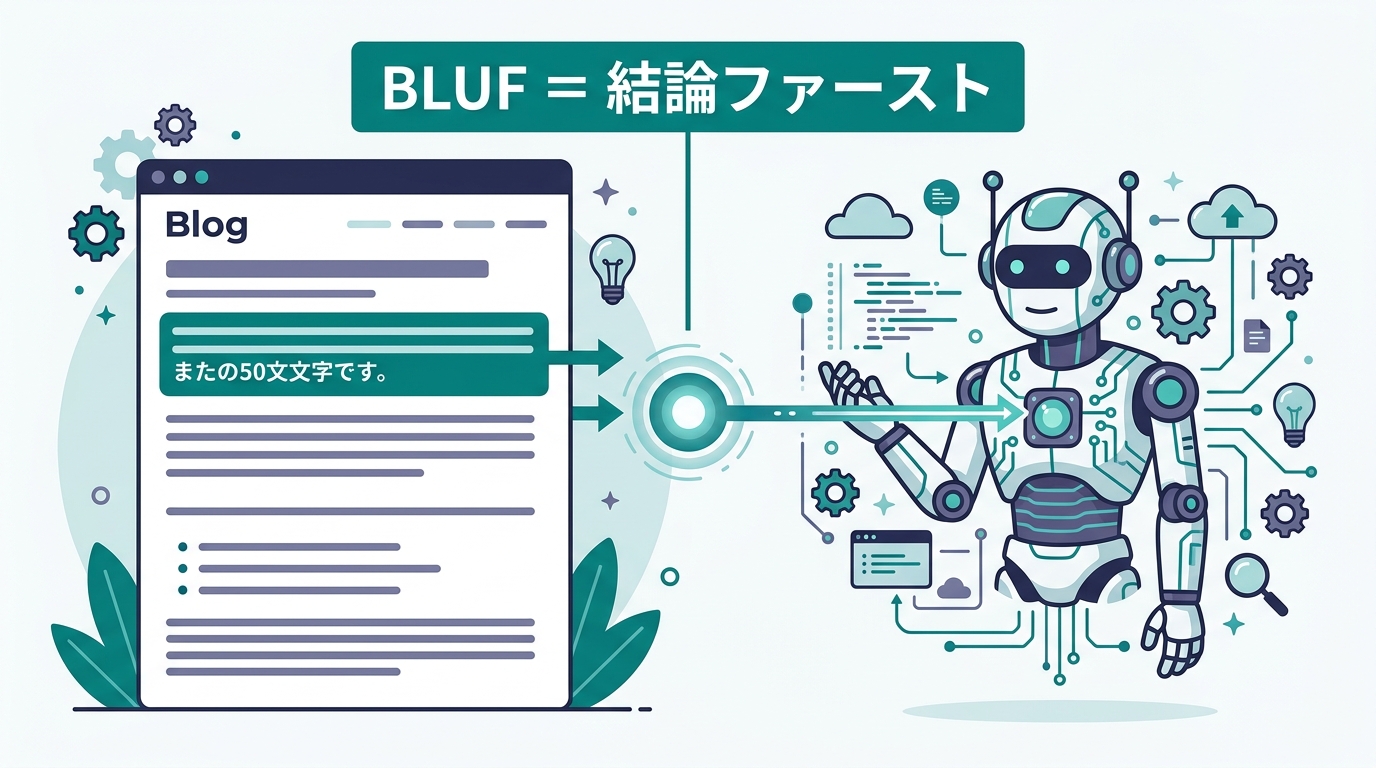
AI decides whether to cite an article based on its first 50 characters
The way AI reads content is fundamentally different from how humans read.
Humans read articles top to bottom, sometimes jumping to headings along the way. LLMs (large language models) process content differently. They heavily evaluate the first 40–60 words of each section, and articles in BLUF format are 3–4x more likely to be cited by AI than those that aren’t (Am I Cited). If there’s no clear answer at the top, that section gets skipped.
Picture a typical Japanese blog post. Most follow this structure: an opening hook → background → examples → and finally, a conclusion. The classic “ki-shō-ten-ketsu” (introduction-development-turn-conclusion) format.
As a piece of reading, it’s polished. But from an AI citation standpoint, it has a fatal flaw: the conclusion sits at the end of the section. The AI gives up before deciding “the answer is here.”
For example, suppose someone asks “What is an AI agent?” In a ki-shō-ten-ketsu article, the opening might read “In recent years, AI has been developing rapidly…” The AI model reads this preamble, judges that “no definition is provided,” and moves on to another page. It never reaches the conclusion in paragraph five.
The data backs this up. Among articles ranking in Google’s top 10, the share that also gets cited in AI Overviews dropped from 75% in mid-2025 to 17–38% by early 2026 (AI Search Citation Monitoring Survey, COSEOM February 2026 report). High ranking no longer guarantees citation. Behind this lies a mismatch between “the structure AI wants” and “the structure humans find readable.”
The answer is the BLUF format.
What Microsoft’s recommended “BLUF format” really is
BLUF stands for “Bottom Line Up Front.” Originally a writing style used in U.S. military documents, it places the conclusion first, followed by supporting evidence and details. That’s the BLUF skeleton.
“GEO Part 2” clearly recommends BLUF (Microsoft Advertising Blog). It’s positioned as a cornerstone of content strategy in the AI search era. The report redefines content “clarity,” and it’s not just about word choice — it’s a concept that includes phrasing and formatting that AI can recognize.
It’s easiest to see with an example.
Traditional opening (ki-shō-ten-ketsu):
Have you been hearing the term “AI agent” a lot lately? Companies began developing them in 2025, and adoption has accelerated in 2026. Gartner forecasts that by the end of 2026, 40% of enterprise apps will have AI agents built in.
BLUF format opening:
By the end of 2026, 40% of enterprise apps will have AI agents built in (Gartner forecast). Full-scale adoption has accelerated since the start of 2026, driven by falling operating costs and API standardization.
The difference is one thing: whether the conclusion comes first or last. When AI scans the former, the opening “Have you been hearing it a lot lately?” may register as “no answer.” With the latter, the number “40%” sits at the top, so it gets evaluated as a citation candidate immediately.
NettPilot also explains BLUF as an essential skill for the AI search era (NettPilot). The “order in which you write” has changed from traditional SEO writing. That recognition is the starting point.

Three structural reasons BLUF boosts AI citation rates
The reason BLUF works isn’t simply that “AI finds conclusions easier when they come first.” There are three structural advantages.
Reason 1: It maximizes “snippability”
AI clips information to use in its answers. In English-speaking circles, this clippability is called “snippability.” With BLUF, you can construct a complete answer just by extracting the first 40–60 characters (MintCopy). For AI, BLUF is positioned as “a high-quality information source with low processing cost.”
Reason 2: 30–40% citation rate boost in combination with structured data
When BLUF is combined with JSON-LD (structured data), AI citation rates rise by 30–40% according to research (Frase.io). The key gain is that AI can mechanically distinguish “which part is the claim and what the evidence is.” BLUF organizes structure for humans, while JSON-LD reinforces structure for machines. This dual design is the current best practice.
Reason 3: 2.5x citation rate when combined with tables
Content that includes tables is roughly 2.5x more likely to be cited by AI than content without (The Ad Firm). The trick is to place a BLUF summary right before the table. AI treats the “summary + table” as a set when picking citation candidates.
Putting all three together, BLUF lifts citation probability along three axes: “processing efficiency,” “machine readability,” and “data presentation strength.”

Five steps to rewrite existing articles in BLUF format
Enough theory. From here, it’s implementation.
I’ve broken the process of converting already-published articles to BLUF into five steps.
Step 1: Re-read each H2 heading as a “question”
Check each H2 heading in your article one by one. What implicit question is each one asking? If the heading is “About the new NISA investment quota,” the reader’s question is “How much is the investment quota?” Verbalize the question behind the heading.
Step 2: Write the “answer” in 40–60 characters directly below the heading
Place the answer to the identified question in the first sentence right after the heading. “The new NISA’s annual investment quota is 3.6 million yen — 1.2 million yen for the accumulation portion and 2.4 million yen for the growth investment portion combined.” Deliver the most important information in the first one or two sentences. It’s kind to readers, and AI can immediately judge “this is the claim.”
You might worry: “If I put the conclusion first, won’t readers leave?” In practice, the opposite happens. When the conclusion comes first, readers want to know “why is that the case,” which creates motivation to keep reading.
Step 3: Place “evidence” after the answer
Right after the conclusion, place the supporting data or source. Clearly cite references like “According to the Financial Services Agency’s official site (URL)…” AI finds it easier to cite content structured in the order of “claim → evidence.”
Step 4: Move background and context to the third position or later
Move the introductory text, background explanation, and conversational hook — the “ki” of “ki-shō-ten-ketsu” — to the third position or later within the section. AI’s citation decision is made at the opening. Be conscious of reordering priorities.
Step 5: Organize each section into 200–400 character blocks
The ideal section length for AI citation is around 200–400 characters (LLMrefs). Beyond that, “where to clip” becomes ambiguous. Split long sections with H3s, or structure them with tables.
These five steps are the exact procedure I tried on the Part 1 article of this GEO Series. Just rewriting the openings takes less than 30 minutes per article.
30-minute BLUF rewrite practice workshop
Here’s a workshop to put knowledge into practice in 30 minutes today.
What you need: One blog article of your own (the one with the most traffic is recommended)
Step 1 (5 minutes): Inventory your H2s Write out all the H2s in your article, and next to each, write “the question the reader wants answered.” This work clarifies what the “conclusion” should be for each section.
Step 2 (15 minutes): Rewrite the opening sentence of each H2 Rewrite the first sentence under each H2 into a direct answer to the question. It doesn’t need to be perfect. Go through all H2s in 15 minutes.
Step 3 (5 minutes): Verify evidence Check that there’s supporting data or a source URL right after each rewritten opening sentence. Any sentence ending in “according to…” must be followed by a link.
Step 4 (5 minutes): Adjust section lengths Roughly check the character count of each section. Mark any section significantly over 400 characters as a candidate for H3 splitting. For now, just marking it is enough.
What not to do: Don’t rewrite the entire article. Don’t worry about SEO keyword density. Don’t aim for perfection. The opening sentence alone is enough.
I’ve been practicing this BLUF rewrite on past Izumo System articles myself. The work was almost anticlimactically simple. The clearest before-and-after difference is “how much information you get when skimming the article.” After applying BLUF, picking up just the lines right under the H2s lets you grasp the article’s main points in 30 seconds.
Measuring BLUF’s effect with Share of Synthesis
Once you’ve applied BLUF, the next step is tracking “whether it actually gets cited by AI” in numbers. That metric is Share of Synthesis.
Share of Synthesis is the percentage of AI-generated answers for a given keyword that cite your own content (Peec.ai “Intro to Share of Synthesis”). Think of it as the AI-era version of traditional SEO’s “search share.”
The detailed measurement method will be covered in the next installment of the GEO Series (Part 4), but here’s a template of KPIs you can track starting today.
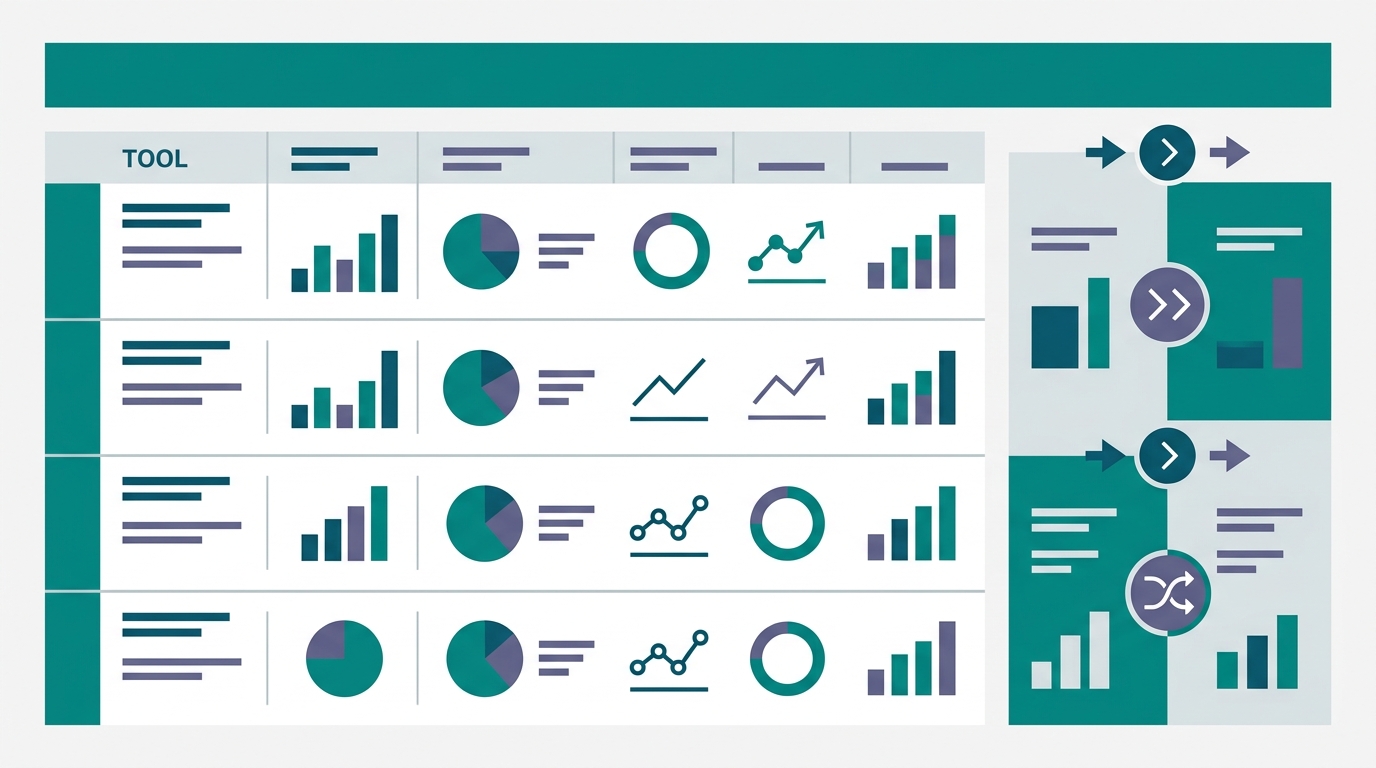
| Metric | Example tool | Check timing |
|---|---|---|
| Citation in AI answers | Perplexity / ChatGPT manual check | One week after BLUF rewrite |
| Share of Synthesis for target article | LLMrefs / Am I Cited | Monthly |
| Character count of cited opening | Manual copy-paste measurement | Recorded at citation check |
| Per-H2 citation rate (section level) | Log which sections AI answers cite | Monthly |
Use this template to compare before and after the BLUF rewrite. Knowing “which sections get cited” lets you design future articles in BLUF from the start.

Once the citation-measurement habit is in place, it becomes the starting point of the “GEO PDCA cycle.”
Conclusion: Theory → Practice → Measurement. Turn GEO into a “cycle that moves”
In Part 3 of the GEO Series, I delivered an implementation guide for Microsoft’s recommended “BLUF format.”
Looking back at the series flow, we’ve moved through three stages.
- Part 1: The fact that “ranking and citation are separating,” with the underlying data
- Part 2: A “study guide” previewing the five key debates of GEO Conference 2026
- Part 3 (this article): BLUF format implementation techniques and a Share of Synthesis measurement template
You’ve learned the theory, grasped the big picture, and are now ready to start working with your hands today. All that’s left is to execute.
What to do today is clear. Pick one of your own articles and try a 30-minute BLUF rewrite. Rewrite the opening sentence. If just that changes citation probability, there’s no reason not to try.
The early-bird ticket deadline for GEO Conference 2026 is April 20 (geo-conference.com). Even if you can’t attend, slide shares and report articles will come out later. The value of a conference isn’t in “attending” — it’s in translating the discussions into your own initiatives.
Next time (Part 4), I’ll cover detailed Share of Synthesis measurement methods and weekly improvement cycle design. It’s the methodology for tracking “how much your BLUF-rewritten articles actually start getting cited by AI.”
Just one article. 30 minutes. That’s all it takes.
References
- Microsoft Advertising “GEO Part 2: From Discovery to Influence” (April 2026)
- Am I Cited “Answer-First Content: The BLUF Technique for AI Visibility”
- NettPilot “Why Bottom Line Up Front is Key for SEO and AI Search in 2026”
- MintCopy “BLUF: The Ski Ramp Content Strategy”
- Frase.io “How to Get Cited by AI Search Engines: The Complete GEO Playbook”
- The Ad Firm “GEO in 2026: Boosting AI Citations & Visibility”
- LLMrefs “Generative Engine Optimization”
- Peec.ai “Intro to Share of Synthesis”
- GEO Series Part 1 “The Separation of Ranking and Citation”
- GEO Series Part 2 “Previewing the Five Key Debates Before GEO Conference 2026”

AIを使いこなせない方は、この先どんどん差がつきます。僕はAIエージェントを毎日動かして、壊して、直して、また動かしてます。そういう泥臭い実践の記録をここに書いてます。理論は他の方にお任せしました。僕は動くものを作ります。朝5時に起きてウォーキングしてからコードを書くのがルーティンです。