AI Has Become the Star of Shopping. Agentic Commerce: A 2026 Practical Guide to Becoming an 'AI-Chosen Store' with 3 Configuration Changes You Can Make This Week
The arrival of the 'Agentic Commerce era' signaled by Shopify and OpenAI Operator. We break down McKinsey's $900B forecast timeline and three specific configuration changes EC operators can implement starting this week.
What you'll learn in this article
- What AI agents mean in plain language and why the term matters now
- Which real-world workflow patterns are already becoming practical
- Which next article deepens pricing, rollout, or implementation context

One day, no humans visited your EC site, yet an order came in.
An AI agent acted on behalf of the consumer. It compared products, picked the best one, and completed the payment. This may sound like science fiction. But as of April 2026, it’s already reality.
Shopify has signaled a direction of treating purchases made through AI agents as a separate independent line. OpenAI’s Operator can handle online shopping on your behalf. Perplexity’s “Buy with Pro” already has a mechanism where AI selects products and walks all the way through to completing a purchase.
This article organizes the essence of Agentic Commerce. We’ll lay out the timeline for the $900B market and present, step by step, three configuration changes EC operators can make this week.
Even if you’re thinking “I’m not sure if my site is affected,” by the time you finish reading, you should have a clear answer to “what to tackle first.”
The “Quiet Turning Point” Signaled by Shopify and OpenAI Operator
AI agent-driven purchasing is beginning to be developed as “official infrastructure.” Continuing to run an EC operation without knowing about this shift leads to structural opportunity loss.
In early 2026, two events quietly took place in the EC industry.
Shopify made a notable move in early 2026, announcing a policy to set up an independent billing category for purchases made through AI agents. Behind the largest platform’s decision that “this should be managed as a separate line” lies a growth projection in traffic that cannot be ignored. It’s no longer a matter of “if you don’t like it, don’t use it”—EC operators have entered an era where they must design “how they appear to AI.”
OpenAI’s Operator autonomously executes everything from web browsing to payment completion based on user instructions. With a single phrase like “Find me a dry red wine for my father’s birthday under 30,000 yen, with gift wrapping,” AI searches across multiple sites for the product. The human only approves the “Is this OK?” confirmation.
I first noticed this shift when I started using AI agents in my own business. When I had Claude’s Computer Use do product research, there was a clear pattern in which pages it referenced and which it ignored. Pages with well-organized structured information were easier to read, while pages where text was embedded in images got skipped by the agent.
Are you running an “unreadable store” for AI? This is the question EC operators need to ask themselves now.
What Is Agentic Commerce? The New Metric of “Agent Readability”
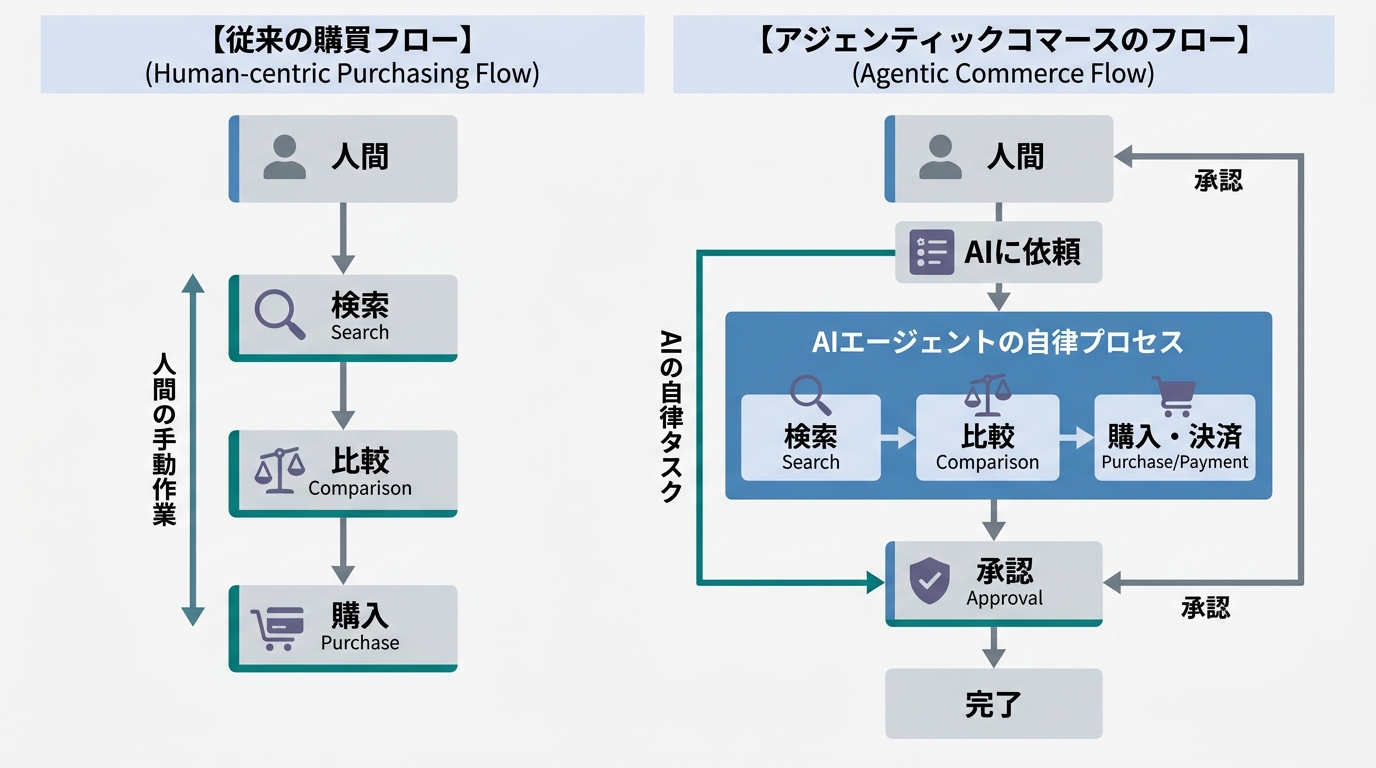
Agentic Commerce is a purchasing process where AI selects, compares, and completes purchases. EC operators now need a design axis of “Is this readable by AI?”
To put Agentic Commerce in a single phrase: it’s “EC where AI becomes the purchasing actor.”
In traditional EC, humans handled everything. They searched for products on search engines, compared multiple sites, read reviews, and made payments. In Agentic Commerce, AI takes over most of this process.
In this flow, there’s a new design axis EC operators should be aware of. I call it “Agent Readability.”
Agent Readability is the degree to which AI can accurately read product information on a site. It’s the same idea as how human-oriented SEO has a metric of “is it easy for search engines to read.”
There’s another concept I’d like to clarify: GEO (Generative Engine Optimization). It’s an optimization method for including your company’s information in AI-generated answers, drawing attention as the next stage after SEO. In the context of Agentic Commerce, incorporating GEO thinking into EC design is essential.
At the GEO Conference on April 20, this integration is also scheduled to be a major topic. The question “What does it take for our product information to be cited by AI?” is no longer just for SEO specialists.
Approaches to improving Agent Readability can be broadly divided into three:
- Information structuring: Describing product information in a machine-readable format (Schema Markup)
- Optimization for natural language: Rewriting text to answer comparison questions and conditional searches
- Accessibility maintenance: Keeping the site programmatically accessible to AI
These three form the backbone of the configuration changes you can implement this week.
Let me add a note on the difference between SEO and Agent Readability. SEO is about optimizing for search engine algorithms. Agent Readability is about information design that lets AI judge “does this match the conditions.” Because the purposes differ, it’s entirely possible to have a site with perfect SEO but low Agent Readability.
The $900B Forecast from Major Research Firms Shows the “Don’t-Miss-the-Boat Timeline”
Multiple research firms forecast the Agentic Commerce market will reach tens of billions to trillions of dollars in scale by the 2030s. What matters more than the forecast numbers is the reality that early movers are already taking action.
Major English-speaking research firms estimate Agentic Commerce will reach $900B (about 130 trillion yen) in scale by 2030. Many will hear this number and feel “the scale is too big to grasp.” Still, what resonated with me was the ongoing momentum rather than the market size itself.
Perplexity’s “Buy with Pro” is already functioning. Amazon’s AI assistant “Rufus” makes purchase recommendations, and OpenAI’s Operator handles actual purchases. What these AI tools reference are sites with high Agent Readability.
The impact on the Japanese market also needs realistic consideration. If you operate an EC on platforms like Rakuten, Amazon Japan, BASE, or STORES, where the platform’s AI features pull product information from already depends on your current settings. Google Merchant Center data is one of the primary sources referenced by Google’s AI shopping features.
The don’t-miss-the-boat timeline is easier to organize when thought of in three stages.
- Stage 1 (2026): Early adopters develop Agent Readability, and AI-driven traffic begins
- Stage 2 (2027–2028): AI agent-driven purchasing becomes one of the major traffic channels
- Stage 3 (2029 and beyond): Sites without Agent Readability become structurally disadvantaged
If you want to prepare for Stages 2 and 3, moving now in Stage 1 is the rational choice. Whether you take action this week will create the difference two years from now.
You can’t necessarily say, “We’re in food, so this doesn’t apply to us yet.” While engagement rates are higher with electronics, books, and daily goods, “products that are easy to filter by conditions” like cookware, meal kits, and skincare are already targets of agent-based search.
Configuration Change 1: Build Product Pages That AI Agents Can Read with Product Schema
Setting up structured data is the top priority for Agentic Commerce readiness. Implementing Schema Markup correctly significantly reduces the risk of AI misreading product information.
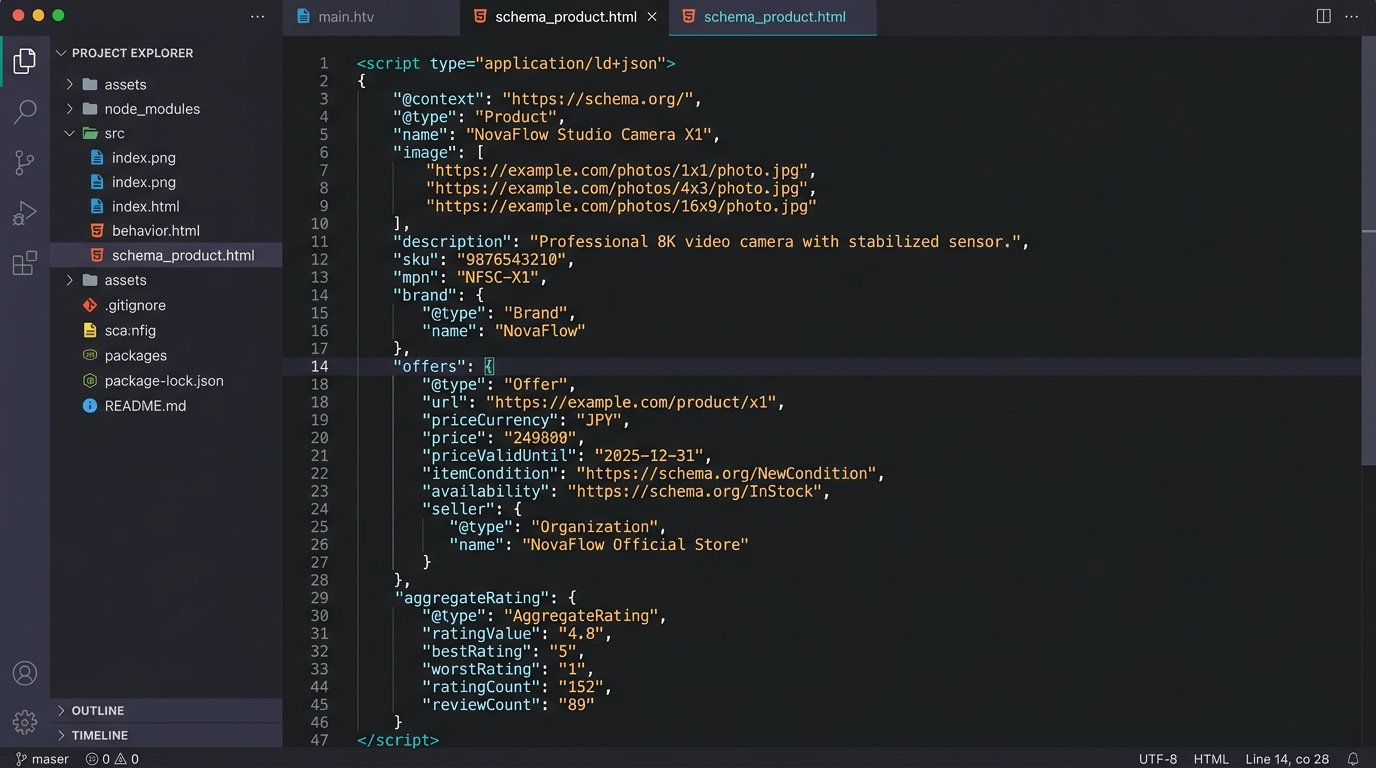
Structured data is a mechanism for describing web page information in a machine-readable format (including AI). It uses a standard format defined by Schema.org, in a format called JSON-LD.
The top priority for EC operators to implement this week is Product Schema on product pages.
The main fields to implement are as follows.
- name (product name): Use the exact product name. Don’t use abbreviations
- price: Indicate tax-inclusive/exclusive prices and attach a currency code (JPY, etc.)
- availability (stock status): Specify clearly with InStock / OutOfStock / PreOrder
- description: Detailed description including specifications needed for comparison
- aggregateRating (review rating): Rating score and number of reviews
- image (product image URL): Link to actual product images
- brand (brand name): Official brand name
After implementation, verify with the Google Rich Results Test. It’s a free tool to check whether everything is being read correctly.
If you’re using Shopify or WooCommerce, you can handle this with a plugin or app. For custom EC sites, add a JSON-LD block to the product page HTML.
One thing to be careful about is the update frequency of inventory information. AI agents exclude out-of-stock items from selection. Make sure real-time stock status is reflected in your Schema Markup by checking the connection with your inventory management system.
For implementation priority, I recommend starting with the top 20% of products by sales. Trying to handle all products at once balloons the workload, and you end up not being able to start at all. First, test with top-tier products and confirm the impact before expanding the scope.
Schema Markup implementation isn’t just for AI. It can also be displayed as rich snippets (highlighted star ratings, price, and stock status) in standard Google search results. It’s a high-ROI move that brings SEO benefits at the same time.
Configuration Change 2: Rewriting Product Descriptions So AI Wants to Cite Them
AI agents search for products using natural language queries like “find me a product suitable for X” or “which is better compared to X.” A text structure that directly answers these questions raises Agent Readability.
The conventional wisdom of web copywriting no longer applies in the Agentic Commerce era.
Traditional product descriptions were written with human purchase psychology in mind. Emotional phrases, brand stories, expressions adorned with adjectives. While these appeal to human eyes, AI agents use different elements as their decision criteria.
AI reads product information for comparison and condition matching. For a request like “find a fragrance-free cream for dry skin under 3,000 yen,” it checks whether “for dry skin,” “fragrance-free,” and “under 3,000 yen” can be clearly read from the product page. “Delivers a smooth and moist feel” may resonate with humans but doesn’t communicate to AI.
Rewriting product descriptions is done from these three perspectives.
Perspective 1: Clearly state “Suitable for these people”
Writing the target user specifically improves AI’s matching accuracy. It’s important to verbalize conditions like “for those in their 30s and beyond who are concerned about dry skin” or “for those who want to use it easily during remote work.”
Perspective 2: Write differentiation axes such as “compared to X”
Clearly state the advantages compared to competing products in the same category. By writing comparison axes clearly—like “compared to commercially available moisturizing creams, we reduced film-forming ingredients by 30%, with less stickiness”—it becomes easier to be cited when AI conducts comparative consideration.
Perspective 3: Make “use scenes” specific
Write the use scenes, like “optimal for moisturizing care during remote work” or “suitable for the pre-bedtime skincare routine.” This makes it easier to match requests like “find me a moisturizing cream I can use at home.”

The rewriting priority is products with high view counts and order volumes. You don’t need to rewrite all products at once. Try the top 10–20 products first.
One additional note: this rewriting isn’t just about AI. Product descriptions that clearly state “who it’s for, what scenes it’s used in, and what makes it different from others” also push human purchase decisions forward. Optimizing for AI and optimizing for humans point in the same direction.
Configuration Change 3: Three-Point Check for Agent Accessibility
Leaving sites in a state where AI agents cannot access them may unintentionally block references. Checking just three points—robots.txt, product data feeds, and review data—handles most cases.
There are cases where AI agents try to reference EC sites but get blocked by technical barriers. This is the issue of “Agent Accessibility.”
Check 1: Review robots.txt
robots.txt is a file that controls crawler behavior. If you’ve fully blocked crawlers as a spam countermeasure, AI agents may be blocked the same way.
If you’ve set Disallow: / under User-agent: *, all crawlers get blocked. Access to product pages requires permission. You can check your current settings by opening https://yourdomain.com/robots.txt in your browser.
Check 2: Keep product data feeds fresh
If you’ve registered a data feed with Google Merchant Center, pay attention. That information may also be referenced by Google’s AI services. If the feed remains outdated, it could lead to AI returning incorrect product information.
The essential fields for a feed are 8 items: product ID, product name, description, URL, image URL, price, stock status, and brand. Include GTIN (Global Trade Item Number) as well. Ideally, prices and stock should be updated daily.
Check 3: Reflect review data in Schema Markup
AI agents take reviews seriously as material for purchase decisions. If Google reviews, your own reviews, and external site data are scattered, the reference information becomes incomplete.
Reflect the latest review aggregation in the aggregateRating of the Schema Markup you implemented in Configuration Change 1. The higher the number of ratings, the higher the probability AI will select it as a “trustworthy product.”
Checking these three points doesn’t require technical expertise. robots.txt just needs to be opened in a browser. Merchant Center is managed via dashboard. Schema Markup can be verified with Google Rich Results Test. Checking these three points within this week is a realistic goal.
Summary: The Next Step to Becoming a Store Chosen by AI Shoppers
Agentic Commerce has moved beyond the stage of “something you should know about.”
Shopify and OpenAI Operator have started moving, and the timeline of the $900B estimate has taken on a sense of reality. The “era when AI shops on your behalf” is not a 2030 story but a 2026 story.
Here’s a summary of the three configuration changes you can start this week.
- Configuration Change 1: Implement Product Schema (JSON-LD format) on product pages and verify with Google Rich Results Test
- Configuration Change 2: Rewrite descriptions of top-selling products from three perspectives: “for these people,” “compared to X,” and “use scenes”
- Configuration Change 3: Check robots.txt, update Merchant Center feeds, and reflect review data in Schema Markup
You don’t need to do everything at once. Start with the Schema Markup check in Configuration Change 1. Once you understand your current state, what to do next will come into view.
The essence of Agentic Commerce isn’t “creating a store that’s easy for AI to buy from.” It’s “creating a store where AI can accurately convey information.” Raising Agent Readability ultimately leads to a “clear store” for human buyers as well.
A store read by AI is a store chosen by humans too.
At the GEO Conference (April 20), more detailed discussions about the integration of Agentic Commerce and GEO are scheduled. I’ll continue to share the latest information after the conference in this note. If you’ve tried these three configuration changes, please let me know your results.

AIを使いこなせない方は、この先どんどん差がつきます。僕はAIエージェントを毎日動かして、壊して、直して、また動かしてます。そういう泥臭い実践の記録をここに書いてます。理論は他の方にお任せしました。僕は動くものを作ります。朝5時に起きてウォーキングしてからコードを書くのがルーティンです。