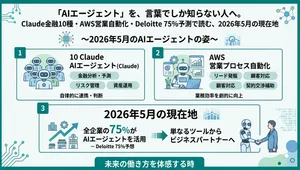
"I can't code, so it's impossible for me" — that excuse is now obsolete. With AI Agent CAMP launching, the entry point for "non-engineer AI entrepreneurship" comes into view
AI Agent CAMP, a Claude Code/Cursor learning service for non-engineers, has launched. Set against Lovable's $6.6B valuation and Base44's $80M acquisition, a moment is emerging where people without technical skills can actually move faster
What you'll learn in this article
- What AI agents mean in plain language and why the term matters now
- Which real-world workflow patterns are already becoming practical
- Which next article deepens pricing, rollout, or implementation context

“I can’t code, so starting an AI business is impossible for me, right?”
These past few months, I’ve genuinely heard this line in consultations more times than I can count. I get it. You know names like Claude Code and Cursor, and you’ve seen the news stories about “one-person unicorns built on AI.” But the moment you try to actually do something yourself, you stumble at the black terminal screen.
That premise has been crumbling in a big way as of April 2026.
In Japan, learning infrastructure built specifically for non-engineers has finally arrived. Globally, the change is moving in the same direction. We’re seeing more and more cases of AI startups founded by non-coders being acquired for hundreds of millions of dollars, or rocketing up to valuations near a trillion yen. The very framing of “no technical skills = falling behind” is becoming a thing of the past.
In this article, I’ll line up the local moves in Japan alongside the global numbers. The structure makes it possible to fully map out where the entry point for “non-engineer AI entrepreneurship” actually sits. By the time you finish reading, let’s get you to a state where you have a map in hand for “where do I start moving from."
"Non-engineer-only” AI learning infrastructure has finally started moving
In April 2026, AI Brain Partners Inc. officially launched “AI Agent CAMP,” a Claude Code/Cursor-focused learning service for non-engineers that the company touts as “Japan’s first” of its kind (PR TIMES, April 2026).
What’s groundbreaking is how they’ve narrowed the target audience. Until now, AI learning services have been a binary choice: implementation courses for engineers, or “Intro to ChatGPT” for white-collar workers. The reality was that the segment of “I want to use Claude Code at work, but I’m not an engineer” was getting squeezed in the middle with nowhere to go.
AI Agent CAMP is designed to fill that gap.
Pulling together the official information: 28 modules, 100+ lessons, all modules accessible for ¥12,800/month (tax included), with 24/7/365 AI tutor support (AI Agent CAMP official). The pricing is set at a level individuals can sustain, and the 24/365 tutor coverage is what I think really matters here.
The reason is simple: where non-engineers get stuck is “environment setup” and “errors that pop up at midnight.” With books and video materials alone, a lot of people stop right there. A service designed on the premise that you have someone to ask questions has finally arrived — that’s how it feels.
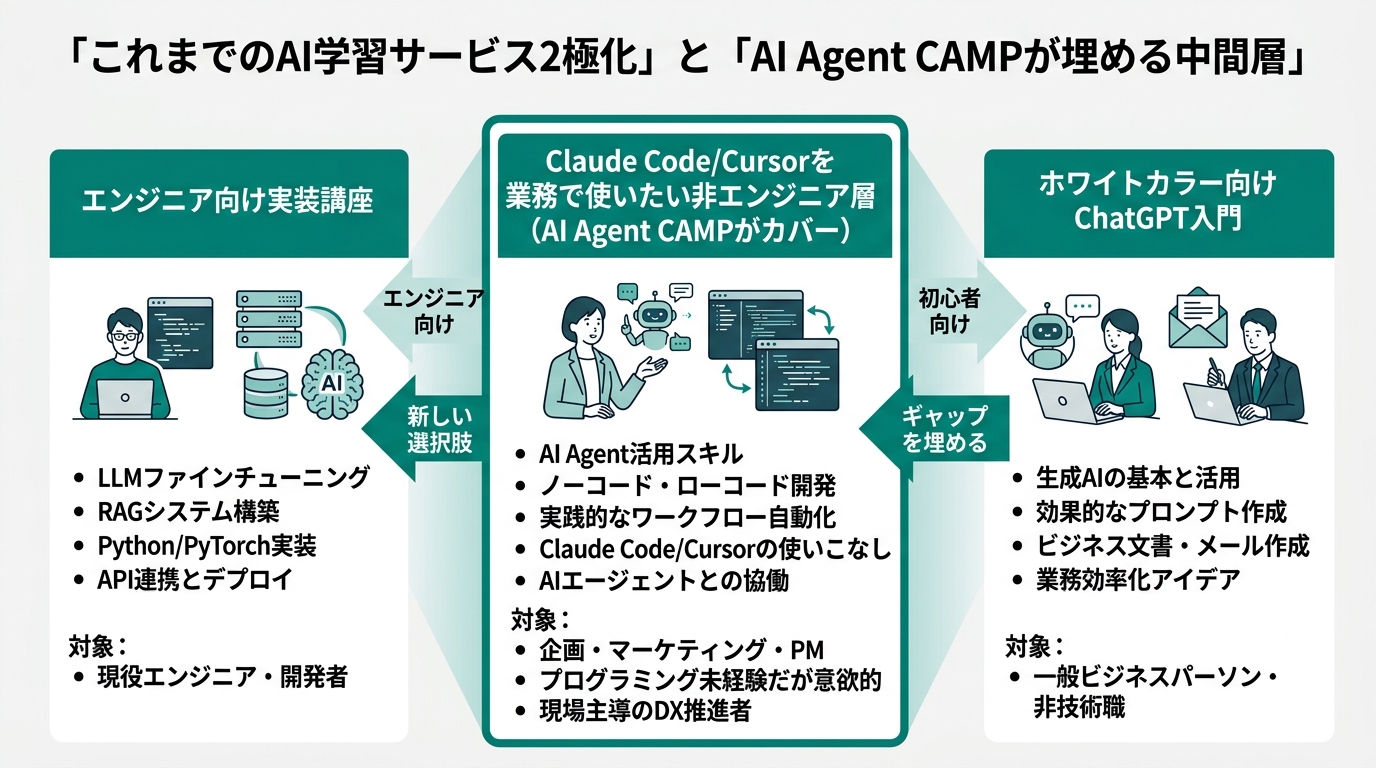
One thing to note: it’s not that everyone can start a business just because this service exists. AI Agent CAMP is positioned strictly as “the entry point where non-engineers begin touching Claude Code/Cursor.” After building the basics here, you need a phase of bumping it up against your own work problems.
That said, the significance of being able to clear that “first wall” in Japanese is huge. I previously wrote about how non-engineers flooded into a Claude Code seminar, and you could say what I described in that article now has a concrete follow-up on the learning-infrastructure side.
Globally, “non-engineer AI entrepreneurship” is already an industry
In parallel with what’s happening in Japan, entrepreneurship by non-engineers is accelerating globally too. Cases of non-coders launching AI startups and pulling off exits in the hundreds of millions are emerging one after another.
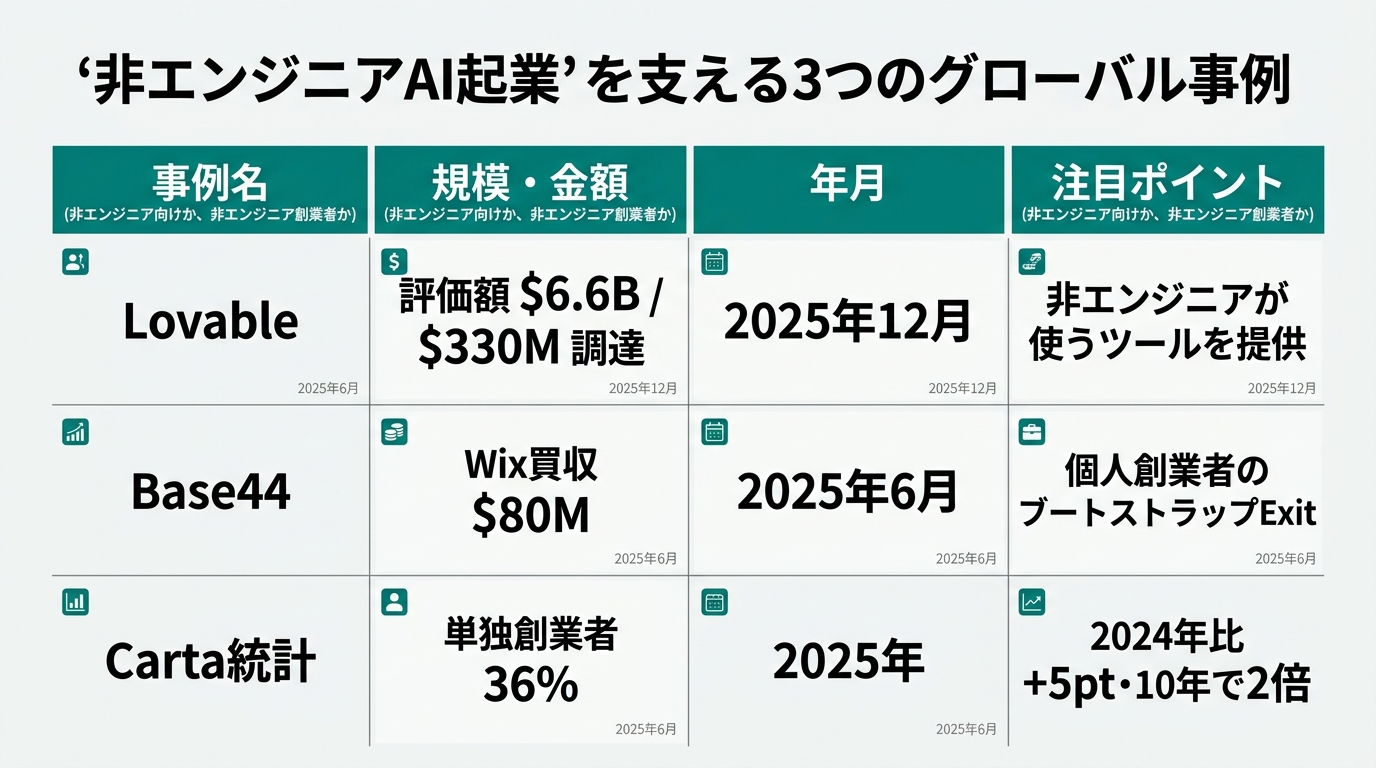
Let me line up just three representative examples.
The first is Lovable. A Sweden-based AI app builder that raised $330M (about ¥50B) in a Series B led by CapitalG and Menlo Ventures in December 2025, reaching a valuation of $6.6B (about ¥1T) (Lovable official, December 2025). It was founded just two years earlier. CEO Anton Osika has stated his mission as “opening up software development to people who can’t write code.”
The second is Base44. An AI app builder bootstrapped in early 2025 by Israeli solo developer Maor Shlomo, it was acquired by Wix for roughly $80M (about ¥12B) in just six months (covered in detail in Mikoto’s April 10, 2026 article, confirmed via Wix’s official press release). There are reports that growth has continued post-acquisition.
The third is a structural number. According to Carta’s 2026 data, of the startups established on its service in 2025, about 36% were by solo founders, up from 31% in 2024 (Carta Founder Ownership Report, 2026). The proportion of solo founders has roughly doubled compared to 10 years ago.
What probably comes to mind here is the question, “Aren’t these just stories of unusual geniuses?”
That concern is half right and half wrong. Lovable’s founder originally has an engineering background, so he can’t be called a pure non-engineer. However, the products they’re building are mechanisms designed so that users who don’t write code can run full-fledged applications. Base44 offers a SaaS-like no-code experience, while Lovable provides automatic generation from natural language.
In other words, the evolution of tools that support “non-engineers starting businesses” and the cases of entrepreneurship using those tools are increasing at the same speed. Supply side and demand side are scaling up simultaneously.
The numbers across the broader industry back this up too. According to Stripe Atlas statistics, startups onboarded in 2025 are showing roughly 50% faster growth rates compared to the previous year. Reports also indicate that the number of companies hitting $10M (about ¥1.5B) in annual revenue within three months of launch has doubled year-over-year (via SaaStr, Stripe data, 2026). It’s data showing that “the speed at which AI businesses get off the ground” is accelerating across the entire industry.
Why people without technical skills can actually “move more easily” right now
Here, let me share a structural observation I’ve come to in these past few years.
For a long time in the startup world, “no technical skills = disadvantage” was conventional wisdom. In fact, 2024 Startup Compass data showed that technical founders raised on average 14% more funding than non-technical ones. Depending on conditions, that gap widens further.
But in 2026, where AI agents have become standard, a different lever is starting to work.
That lever is “the ability to accurately package work problems.”
People who aren’t engineers know, in their bones, the work problems they face every day. Monthly accounting tasks, real estate property tours, document review at professional firms, parent communication for school operations. These are problems where “the contours” are already in their heads.
What’s needed to operate AI agents isn’t the ability to write code, but the ability to verbalize “what to delegate, in what order, and how far.” Claude Code and Cursor will move along quite a way on their own if you give them instructions in natural language. The quality of your instructions becomes, directly, the quality of the output.
In this structure, situations are emerging where the non-engineer who is “the expert on the problem” ends up at an advantage over a generalist engineer. In fact, at the 200-person leisure reservation site Asoview, there’s a report that AI development volume by business roles surpassed that of engineers (Funnel AI, 2026). I read this not as a one-off case but as an early example of the structural shift that’s coming.
To make this concrete: take someone who’s spent 10 years in real estate brokerage. The flow of property tours, the choreography of viewings, the checkpoints for contract review — all of that should already exist as a procedure manual in their head. For an engineer to grasp this from scratch would take months. Meanwhile, the person on the ground can start automating just by “translating the procedures already in their head for the AI.” This short distance is a decisive advantage.
The thing to be careful about is that understanding the problem alone isn’t enough. To operate AI agents, you need to be able to do at least the minimum of “verbalizing task decomposition” and “isolating issues when things fail.” This is territory you can supplement with learning services like AI Agent CAMP, or with books and videos. Conversely, if you have the foundation of business understanding, the technical part is now within reach in about three months of catch-up.
The thinking HBR proposed about “treating AI agents as team members” sits on this same trajectory. If you’re going to design AI not as a tool but as a team member, the designer needs the ability to decide “what to have the team do.” Situations are increasing where business understanding and judgment matter more decisively than the ability to write code.
Claude Code vs. Cursor — which should non-engineers start with?
Just as AI Agent CAMP covers both Claude Code and Cursor, these two have become essential options for non-engineers as well.
But which one should you actually touch first? This is another question I get a lot in consultations.
My answer is: “Cursor first if you’re mostly making small fixes,” “Claude Code first if your goal is delegating work.”
Cursor’s strength lies in being designed to complete everything inside the editor screen. It’s strong for situations where you want to make small tweaks to existing Excel macros or work documents. For “small fixes” like cleaning up report formats, rewriting text, or correcting formulas, Cursor’s feel is just right. The experience of “fixing what you can see on the screen” comes naturally to non-engineers, in my impression.
Claude Code, on the other hand, is designed to run from the terminal. While many people are thrown off by the blackness of the initial screen, its strength lies in being able to “delegate work to AI while granting permissions in stages.” For example, you can configure things like “only operations in this folder are OK” or “ask for confirmation before sending to external APIs.” If you’re going to operate it on the premise of delegating entire work processes, this one can be safely grown into.
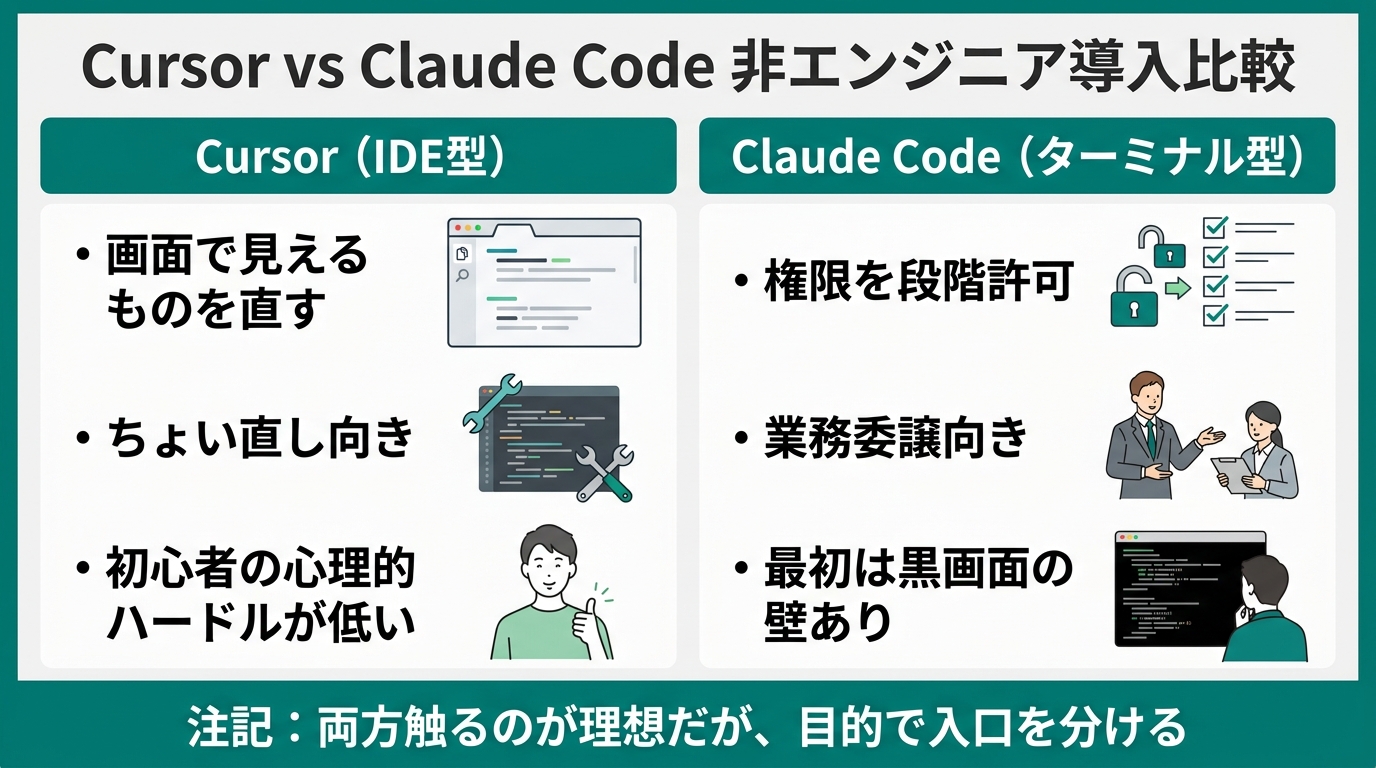
Imagine someone who creates an aggregated report every Friday. With Cursor, they’d open past report files in the editor and ask the AI, “change this format slightly.” With Claude Code, they could specify the entire folder and ask, “auto-generate this every week according to these rules, all the way to posting it on Slack.” The latter is a bigger step in terms of work delegation, but the bar for first contact is also higher.
I wrote separately about the criteria for switching AI agents from experiment to production. For non-engineers, I recommend first spending a week with Cursor to build up the experience of “having AI fix things for you.” Then move on to Claude Code for the experience of “delegating to AI.” I feel this order is the course that has the least friction, both psychologically and practically.
Why “learn while moving” works better than “learn then move”
Reading this far, some of you may be thinking, “Okay, I should learn it systematically first.” I get the feeling. But in the world of AI tools, that order has been inverted.
There are two reasons.
The first is the speed at which the tools evolve. Just in the year between 2025 and 2026, Claude Code has had multiple major updates. It’s a world where “the intro book from six months ago” no longer applies. Even if you study systematically, by the time you finish, the UI and features have likely changed.
The second is that learning with a specific work problem in front of you has retention rates that are orders of magnitude higher. Someone who starts touching it with the problem of “I want to cut my monthly report creation time in half” and someone who studies “in case it’s useful someday” — three months later, their command of the tools is in completely different leagues.
Even if you use a service like AI Agent CAMP, my recommendation is to “go in with one work problem of your own.” For example: “cut monthly report creation time in half,” “automate template-based email replies,” “auto-generate meeting minutes from sales call notes.” Anything works — please go in with one concrete problem in hand.
If you learn through AI Agent CAMP while bumping it against that problem, the “environment setup,” “prompt design,” and “security” topics in the materials all enter your head as your own concerns. Conversely, if you just consume all the modules in order without a problem, you tend to end up in a state of “I gained knowledge but my work didn’t change.”
Dario Amodei has talked about a future of “an era when one person runs a $1B-scale business”. That future will get closer first for people who have not the ability to write code, but “the ability to translate their own work accurately for AI.” The path to winning, for non-engineers, lies right here.
Summary — Three things to do this week
Since this got long, let me organize things at the action level.
Wrapping up the discussion, it comes down to these five points:
- AI Agent CAMP has launched as “non-engineer-only” learning infrastructure (¥12,800/month, 28 modules, the company touts it as “Japan’s first”)
- Globally, AI startups supporting non-coders are becoming an industry, with cases like Lovable ($6.6B valuation) and Base44 ($80M acquisition)
- The non-engineer’s strength is “the ability to package work problems,” and in the AI agent era this can become a competitive advantage
- For your entry point, choose Cursor (small fixes) or Claude Code (work delegation) based on your purpose
- “Learn while moving” raises retention rates more than “learn then move”
On top of that, let me narrow down what I want you to do this week to three things.
The first is to write out one “work you repeat every week” from your own job. Monthly reports, sales call notes, email replies, meeting minutes — anything is fine. Work that takes you more than an hour or two per week is a candidate.
The second is to pick either Cursor or Claude Code and touch it for just 15 minutes on the free tier. At first, “it doesn’t work” and “it doesn’t do what I expected” will keep happening. Even so, the act of touching it itself has meaning.
The third is to peek at a learning service like AI Agent CAMP, or a study group community, “with a problem in hand.” Instead of “learn then move,” be conscious of the order: “go in with your own work problem and learn while solving it.”
“I can’t write code” is no longer an excuse you can use. People who don’t act will likely be in the same place next year. Only the people who do act will be on the side that has “their own AI work stack” six months from now.
I myself didn’t start out from an engineering career. I started touching Claude Code as a marketer, and that’s how the shape of my current work came together. Let’s do this together.

AIを使いこなせない方は、この先どんどん差がつきます。僕はAIエージェントを毎日動かして、壊して、直して、また動かしてます。そういう泥臭い実践の記録をここに書いてます。理論は他の方にお任せしました。僕は動くものを作ります。朝5時に起きてウォーキングしてからコードを書くのがルーティンです。