Claude Code Enterprise Rollout: How to Avoid the 'Nobody Uses It' Trap in the First 30 Days. NEC, Givery, and Digirise Onboarding Blueprints
Whichever of the three vendors you pick, the first 30 days decide whether it sticks. I've designed practical 30-day playbooks for each model — NEC, Givery, and Digirise — along with the common patterns that derail rollouts right out of the gate.
What you'll learn in this article
- Where pricing and adoption questions around Claude Code stand right now
- Which plan or rollout stage fits the reader's situation
- Which follow-up article to open next for setup, cost, or bigger-picture context

“The rollout is approved. Take it from here.”
Since I published the piece on Claude Code’s enterprise market emerging on 5/3, I’ve had a string of practitioners come to me with the exact same question. They’ve decided which of the three vendors to go with. The problem starts the next day.
The day after the decision, what do you actually do?
In my experience, this is the single most dangerous point. The energy peaks the moment the decision is made, and if you don’t design the first 30 days before that energy fades, three months later the board will be asking, “What exactly did we spend that budget on?”
This article is the follow-up to the 5/3 piece. I’ve put together a “first 30-day playbook” that applies regardless of whether you chose the NEC model, the Givery model, or the Digirise model. By the time you finish reading, you should know exactly what to announce at tomorrow’s morning meeting.
The Invisible Race That Starts the Day After “Approval”
The day after approval, what happens on the ground? At most companies, the same script plays out.
The board approves “Claude Code enterprise rollout.” The owning department is either IT or HR. The point person moves to sign the contract and drafts the company-wide announcement email. That’s two or three days of work.
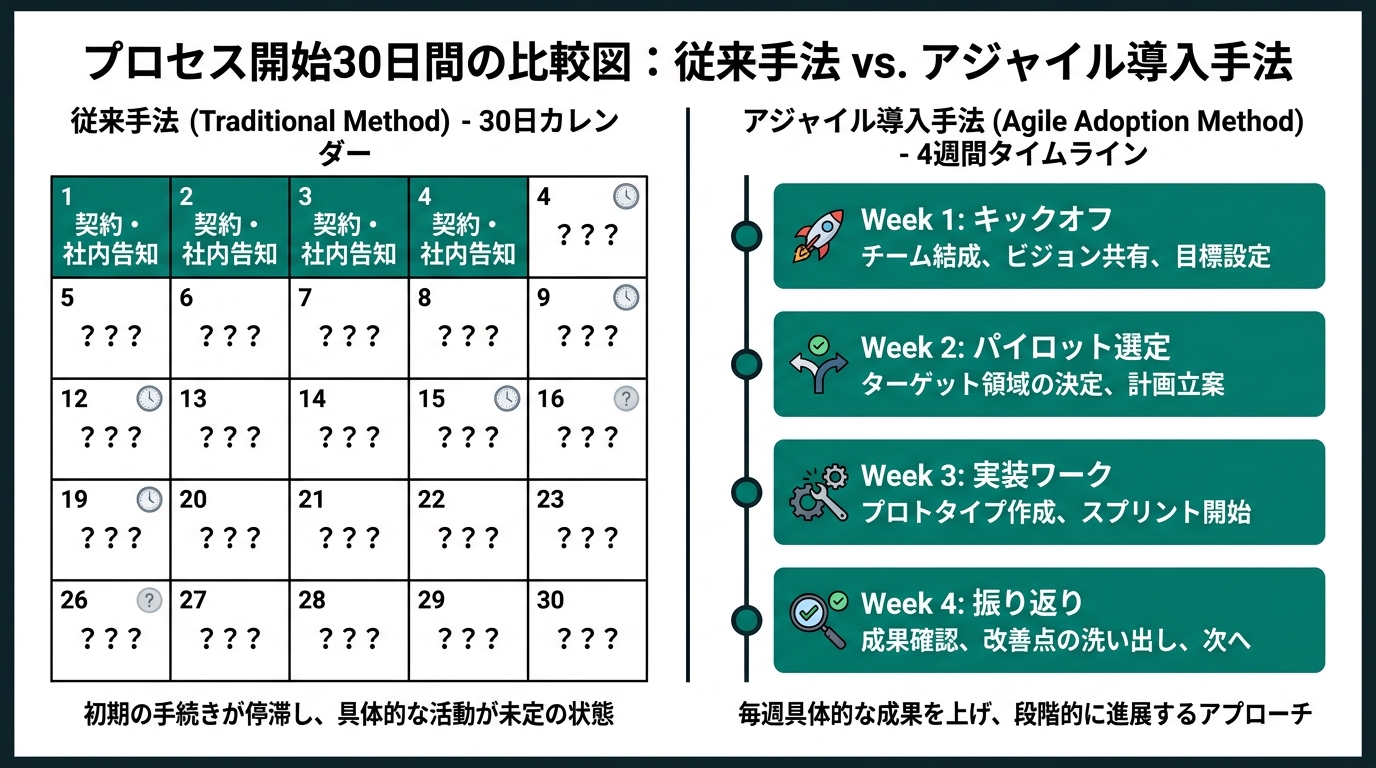
Then, on day four, things stop moving.
The reason is simple: nobody has written down “what to do next.” The contract is signed. Accounts can be distributed. The licenses are there. But the schedule for “who in the field, what tasks, on what timing” remains blank.
At this point, many companies take the convenient escape route: they send a “Please give it a try” email to the entire company and consider the job done.
Of all the consultations I’ve fielded these past two weeks, the most desperate fit this exact pattern. “The board ordered the rollout, we picked a vendor and signed, but nobody on the ground is touching it. I have to report progress at next month’s meeting. What should I do?”
My answer is always the same. Don’t let it end as a “tool rollout.” Run it as a “business transformation project.” This shift in framing is hard to see in the first 30 days, but it’s decisive.
The 5/3 article walked through how to pick “your model” based on the scale and intent of each of the three vendors. Today is the sequel. How do you spend the 30 days after picking? Without designing this, you can’t extract the maximum from the vendor resources you just paid for.
Three Pitfalls Common to All Three Models
NEC, Givery, Digirise. The service offerings differ, but no matter which model you pick, you get stuck in the same places. Watching enterprise AI rollouts in the field, three pitfalls show up consistently.
Pitfall 1: Building the Rollout Plan Without Listening to the Field
This is the most common one. The IT and HR departments that owned the decision build the “company-wide rollout roadmap” by themselves. The plan goes out without grounding in actual field operations, so the people on the receiving end react with, “What part of my job is this even for?”
Among the companies I’ve watched, those with low post-rollout usage rates almost all fit this pattern. Conversely, companies with high usage rates schedule field interviews the week after the decision is made. They go ask, “What’s the most time-consuming task in your department right now?”
Because they reflect what they hear back into the company-wide rollout plan, the people receiving the tool feel “what we said in that meeting actually got reflected.” This is the shortest path through the initial psychological barrier.
Pitfall 2: Rolling Out Wide Before Creating the First Success Story
The second pitfall is rolling out company-wide all at once without setting up a pilot department.
Company-wide simultaneous rollout isn’t inherently bad. At NEC’s scale of 30,000 people, it’s reasonable to distribute licenses to every department from day one. The problem is failing to deliberately design “the department that succeeds first.”
When organizations make big moves, you always need a department that wins first. A reference department where other internal groups can say, “If they can do it, so can we.” If you haven’t created this within 30 days, by month three the board will be rattled by news of “competitors moving faster.”
Pitfall 3: The Tool Gets Distributed Before KPIs Are Designed
The third is when the evaluation framework gets pushed to “later.”
When I ask, “What are the KPIs for the Claude Code enterprise rollout?”, most owners freeze. The most common answer is “usage rate.” But usage rate alone leads to “log in once and that’s it” behavior.
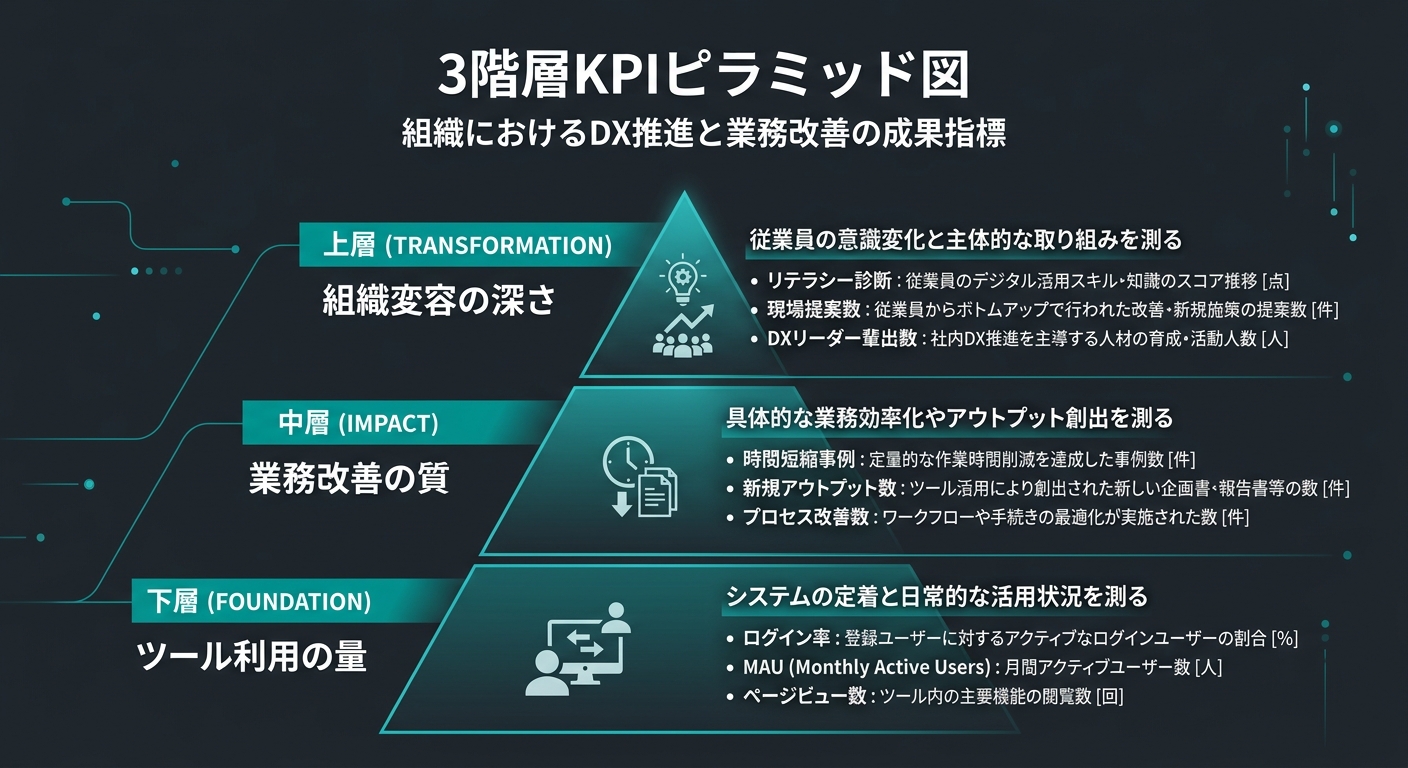
The standard practice is to design evaluation in three layers. Layer 1 is volume of tool usage — login rate and monthly active users. Layer 2 is quality of business improvement — concrete time-savings examples and the number of new outputs. Layer 3 is depth of organizational change — employee AI literacy assessment scores and the number of usage proposals coming from the field. If you don’t lock these three layers in from Day 1, the owner will be at a loss for what to report three months in.
These three pitfalls are ones you have to handle internally regardless of which of the three services you chose. Just because the vendor offers a 30-day program doesn’t mean internal decisions can be outsourced.
If You Picked NEC: Designing 30-Day Onboarding for Large Enterprises
Companies that go with NEC differ from the other two models in scale and decision weight. NEC itself rolls out Claude and Claude Code to roughly 30,000 group employees and operates a Center of Excellence (source: NEC official press release). Here’s the 30-day design for companies operating at similar scale.
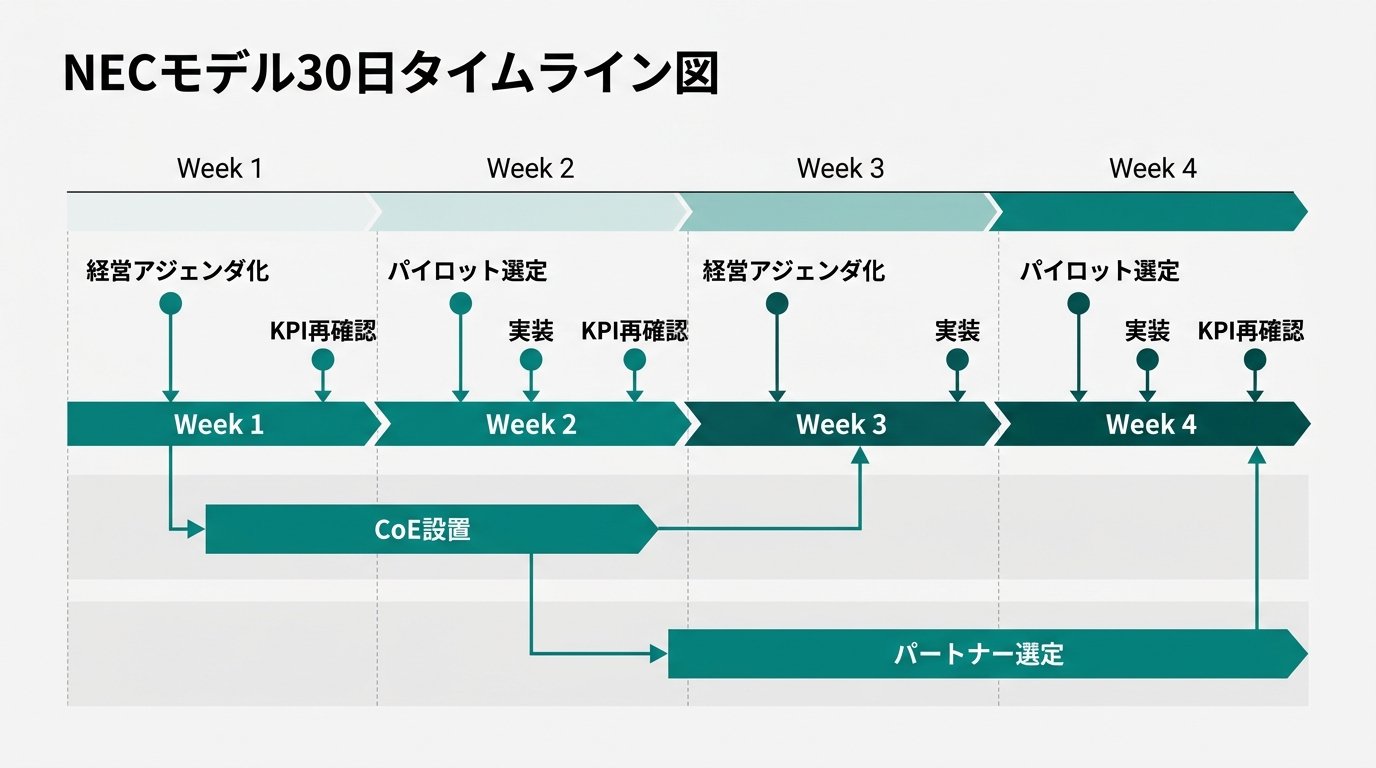
Week 1: Promote AI to a Board Agenda Item and Stand Up the CoE
The first week is about formally embedding AI promotion into the board’s agenda.
Concretely, set up an internal “AI Promotion Office” or “Center of Excellence” with a CIO- or CDO-class executive as the owner. Just as NEC has done, this organization isn’t a mere extension of IT — it’s the command center that integrates company-wide AI strategy. Get “Monthly AI Progress Report” added to the board’s standing agenda, also within this week.
What matters here is a structure for getting outside help. NEC moves with direct technical support from Anthropic. If a company of similar scale wants to do the same, line up partner selection for industry-specific solution development using Claude Cowork during Week 1.
Week 2-3: Pick Pilot Departments and Build the “First Win”
In weeks 2-3, pick three to five departments internally and start pilot operations.
The selection criteria: departments with high business impact and high field motivation. NEC publicly committed to leading with finance, manufacturing, and government. Apply the same logic — pick three to five departments where “results are easy to see” and “the field is forward-leaning.”
Internal AI promotion staff embed directly with pilot departments. Interviews in Week 2, first use case implementations in Week 3. The goal across these two weeks is to produce one example you can point to and say, “Time spent on X dropped by 30% in this department.”
Week 4: Reconfirm KPIs and the Company-Wide Rollout Roadmap
The final week is for inspecting the company-wide rollout roadmap, grounded in pilot department results.
Take the three-tier KPIs you defined on Day 1 and replace them with measured values as of Week 4. What’s the usage rate? How many business improvement cases? How many points did the literacy assessment rise? Plugging in real numbers gives you the foundation for the next monthly board report.
The strength of the NEC model is that the direct partnership with Anthropic provides deep technical backing. That’s exactly why building an internal structure that lets you focus on operational design is the shortest path to extracting maximum vendor value.
If You Picked Givery: Designing 30 Days for Talent Development
What characterizes companies that go with Givery’s “Claude Cowork Adoption Support” is that the target is explicitly stated as “from business roles to engineers” (source: Givery PR TIMES). Design the 30 days assuming you’ll involve non-engineers, not just engineers.
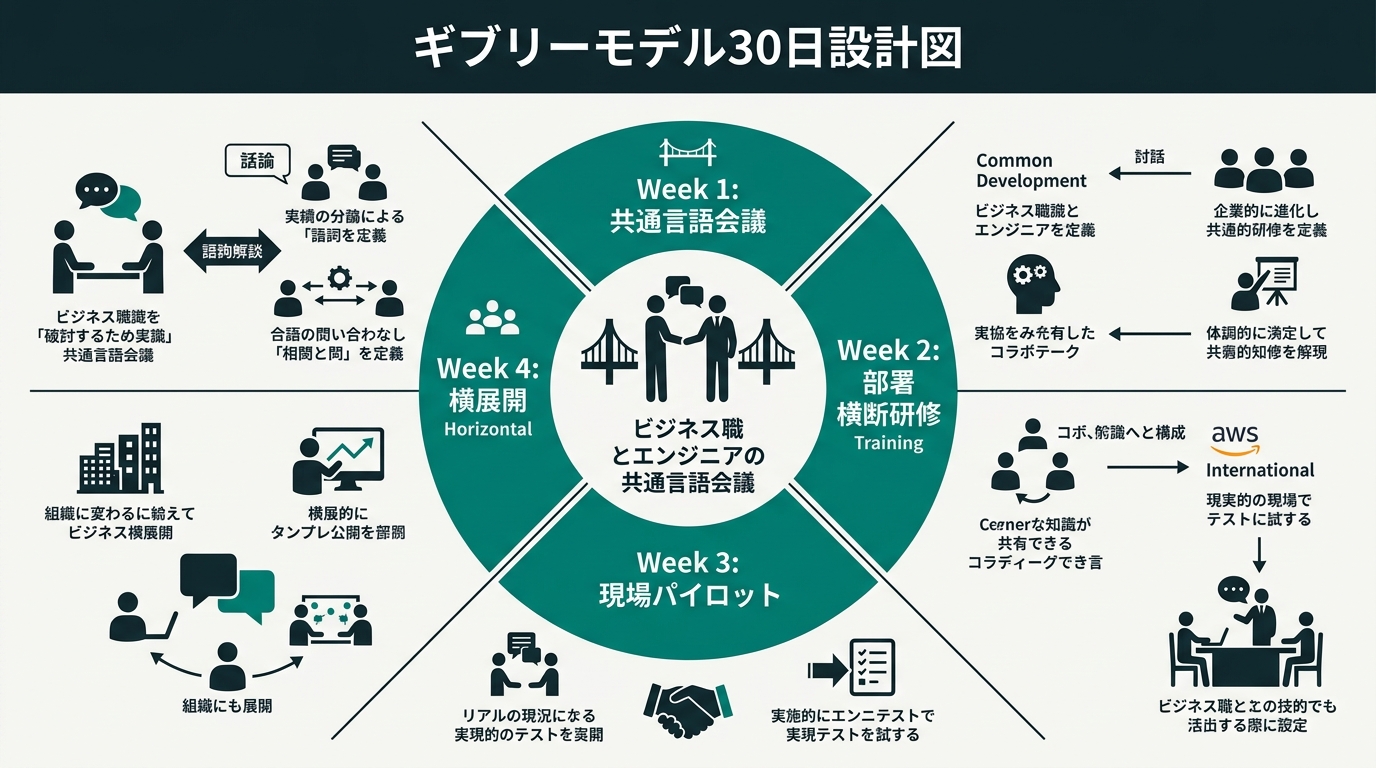
Week 1: Set Up the Common Language Forum
The misunderstanding that crops up first with the Givery model is “leaving the entire training program content up to the vendor.”
The training content will indeed be assembled by the vendor. The problem is that what gets used in the field after training is something you have to decide internally. To fill that gap, the first move in Week 1 is to set up a common language forum between business roles and engineers.
Concretely, set up a weekly standing meeting with representatives from each department (one business role, one engineer). The first agenda item: “What work in our department do we want to delegate to AI agents?” The point of the design is having business roles and engineers answer this question at the same table.
Week 2: Run Training First and Share What’s “Usable”
In week two, run the vendor’s training program intensively.
Givery’s strength is that the same training is designed for both business roles and engineers. To extract maximum value from this, organize cross-departmental training cohorts. Form four- or five-person teams — one from sales, one from development, one from planning, one from HR — take training together, and discuss your own department’s use cases during the training.
Training alone has weak effect. The trick to getting full value out of the Givery model is to assign homework after training: “What will you use this for in your own department?”
Week 3-4: Launch Field Projects and Retrospective
In weeks 3-4, the skills picked up in training get translated into field projects.
In Week 3, an A-player from each department launches one “pilot project to restructure a workflow with Claude Cowork” in their own department. Week 4 is for the implementation retrospective and deciding on horizontal expansion.
In the Givery model, the success pattern I’ve seen most often is a non-engineer manager becoming the first champion. Engineering-led transformations get viewed with suspicion internally, but when an HR or corporate planning manager says, “This cut my meetings in half,” the temperature of the entire organization shifts at once.
If You Picked Digirise: Designing 30 Days for Field-Driven Self-Sufficiency
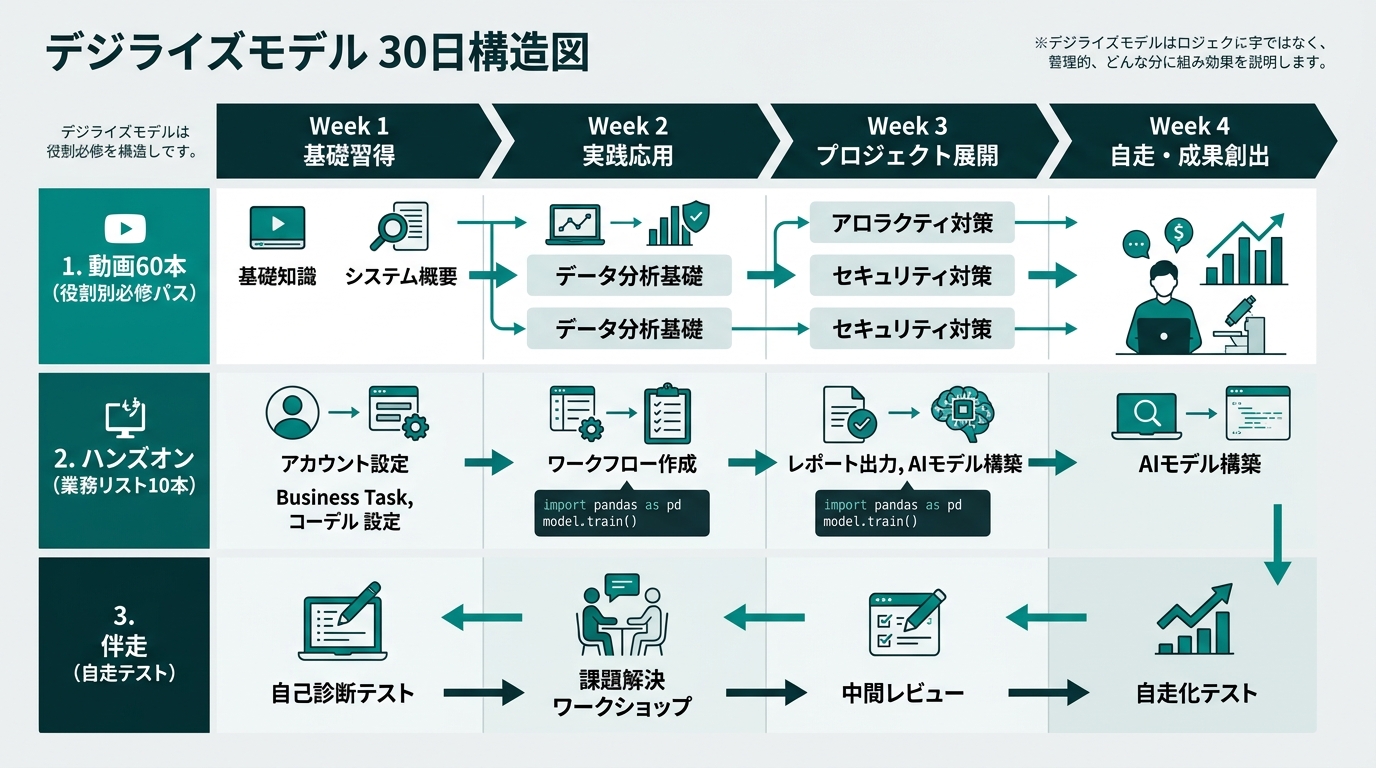
Digirise’s “Claude Code Enterprise Adoption Support” is built on three pillars — 60 videos, hands-on, and walkthrough support — limited to the first 10 companies (source: Digirise PR TIMES). Here’s the design for small- to mid-sized companies that want to build “self-sufficient teams.”
Week 1: A Strategy for Watching the 60 Videos
The first week is about carving the 60-video curriculum into role-specific required paths rather than “everyone watches everything.”
What I want to emphasize here: watching the videos in order from start to finish doesn’t produce results. The videos executives should watch, the ones engineers should watch, and the ones field leaders should watch are all different. In Week 1, decide each member’s “first 10 videos” and distribute them.
Covering the entire curriculum is realistically something to push to after-hours learning from Week 4 onward. Within the 30 days, focusing on “the 10 videos directly tied to your work” produces a faster sense of self-sufficiency.
Week 2-3: Squeeze Maximum Value from Hands-On and Walkthrough Support
In weeks 2-3, hands-on sessions and walkthrough support take center stage.
The pitfall here is “don’t dump everything on the vendor.” The fact that they cap participation at 10 companies tells you Digirise designed this to spend significant time per company. Precisely because of that, if you don’t show up with concrete cases — “this is the workflow we’re stuck on right now” — you’ll waste the walkthrough hours.
At the start of Week 2, draw up a list of 10 “workflows we want to run with Claude Code” internally. Working through these one by one in the Week 2-3 hands-on sessions is the intended use of the field-driven self-sufficiency model.
Week 4: Self-Sufficiency Check and Exit Decision
The final week is time to check whether you’ve built a self-sufficient organization.
Specifically, deliberately set up one week without vendor support. Run the workflows you implemented in Week 2-3 with only your internal team. If they run, you’re good. If they break, document where they broke.
Doing this self-sufficiency test within 30 days is what maximizes the value of choosing the Digirise model. Since you took one of the 10 limited slots, the real goal is to be in a state where you can run things internally after the contract period ends.
KPIs and Exit Criteria: Evaluation Framework Common to All Three Models
Whichever of the three models you pick, deciding the Day 30 evaluation framework upfront is the minimum condition for turning the first 30 days into “30 days you can report progress on.”
Day 30 Three-Tier KPI Measurements
Measure the three-tier KPIs from Pitfall 3 as of Day 30.
Volume of tool usage is measured by login rate and monthly active users. As a benchmark, 60% or more of distributed accounts logging in at least once a week is the passing line. Below 50% is a sign the field has stalled. Consider intervention in Week 4.
Quality of business improvement is measured by the count of concrete time-savings examples. As of Day 30, you want one case per department, five or more across the company. Ideally the cases are number-based: “meeting prep dropped from 2 hours to 30 minutes,” “first-draft sales email generation dropped from 10 minutes to 3 minutes.”
Depth of organizational change is the employee literacy assessment scores plus the number of usage proposals coming from the field. Measure scores before and after rollout and compare. For proposals, getting 10 or more per month into the internal “workflows we want AI to improve” form is the bar.
The Continue-or-Exit Decision Line
Measuring the three-tier KPIs at Day 30 and deciding whether to continue or exit is the last job.
I have a heuristic I use: usage rate at or below 50%, improvement cases at or below 3, proposals at or below 5 — if two or more of these apply, rebuild the structure by Day 60. Treat this not as “exit” but as “redesign.” In most cases, revising the operational design rights the ship.
If all three apply, you need to be prepared to redo vendor selection. This is rare, but not impossible.
Operating to Convert Failure Into Results
Even if the metrics are weak, reporting them honestly at Day 30 saves the next 30 days.
The scariest pattern is reporting “going smoothly” to the board and then collapsing at Day 60. Saying at the Day 30 stage, “We’re below expectations, the causes are X and Y, here’s how we’ll right it by Day 60” — that’s the move that doesn’t damage trust over the long run.
Summary: Three Things to Do This Week
First, put your chosen model’s “Week 1 tasks” on the owner’s calendar. CoE launch for the NEC model, common language forum for the Givery model, role-specific video path design for the Digirise model. Get out of the state where, by this morning’s meeting, no one knows who is moving what.
Second, decide the three-tier KPIs on Day 1. Write down your company’s passing lines for the three layers — usage rate, improvement cases, proposal count — by the end of this week. Deciding later introduces bias, so the trick is to decide before the tool gets distributed.
Third, pick the department that will win first. Even with company-wide rollout, designate three to five departments to win first. Concentrate support on these departments and produce one example by Day 30 that lets other departments say, “If they can do it, so can we.”
As I wrote in the 5/3 article, Claude Code enterprise rollout is designed such that the operation after picking matters 10 times more than the picking itself. Precisely because all three vendors’ services are excellent, the difference comes from internal preparation.
The more your company has been burned by past AI rollouts that fizzled, the more carefully you should design the moves from Day 1 through 30. The moment of decision is the hottest. Before that heat fades, fill in the first 30 days.
I still encounter new patterns every week in these rollout settings. Let’s figure it out together.
Related articles
- The 10 Days When Claude Code Enterprise Rollout “Became a Market.” NEC, Givery, Digirise — The Shortest Path to Picking Your Model from the Three Vendors (Published 5/3 — the predecessor to this article)
- The Last Round Sold Out 300 Seats Fast. Why Non-Engineers Flooded the Claude Code Seminar, and What They Did First (Published 4/18 — how non-engineers approach it)
- A Japanese IT Company Distributed Claude Code to Every Engineer and Consultant. Reverse-Engineering “Internal Adoption Criteria” from AR Advanced Technology’s Decision (Published 4/19 — company-wide rollout case)
Sources
- NEC “NEC and Anthropic Announce Strategic Collaboration”: https://jpn.nec.com/press/202604/20260423_01.html
- Givery “Launch of Claude Cowork Adoption Support Service”: https://prtimes.jp/main/html/rd/p/000000382.000002454.html
- Digirise “Launch of Claude Code Enterprise Adoption Support Service”: https://prtimes.jp/main/html/rd/p/000000077.000126540.html

AIを使いこなせない方は、この先どんどん差がつきます。僕はAIエージェントを毎日動かして、壊して、直して、また動かしてます。そういう泥臭い実践の記録をここに書いてます。理論は他の方にお任せしました。僕は動くものを作ります。朝5時に起きてウォーキングしてからコードを書くのがルーティンです。