Heard of the '10x Founder'? The Harvard VC's Term for Entrepreneurs Multiplying Productivity 10x with AI
Harvard professor and VC Jeff Bussgang's concept of the '10x Founder.' Using Medvi's case—$401M revenue from a $20K start—as a lens, this piece breaks down the reverse-engineering framework: what to 10x with AI, and what to stop doing.
What you'll learn in this article
- The key point to grasp before reading the full article
- How the issue changes practical decisions after reading
- Which follow-up article is worth opening next

Lately, I’ve been meeting tons of people who say, “I want to change with AI, but I don’t even know where to start.”
I get it. New tools drop every week, and the success stories are so flashy they feel unreal. “A one-person company doing $400M? Yeah, yeah, that’s America for you”—honestly, I understand the urge to just shrug it off.
But here’s the thing: since 2026 hit, the air completely changed. Jeff Bussgang—a Harvard professor who also runs a VC (a venture capital firm that invests in startups)—put a new concept into the world.
10x Founder. In Japanese, “10倍創業者.”
It refers to entrepreneurs who use AI to lift their productivity to ten times the old baseline. This isn’t a “remarkable people do remarkable things” story. It’s a “people who decided what to stop ended up 10x-ing as a byproduct” story.
Today I want to break this concept down in my own words. By the time you finish reading, you should be able to see what you should stop doing first.
What the Harvard VC Means by “10x Founder”
Jeff Bussgang has run a VC fund called Flybridge for over twenty years. At Harvard Business School, he teaches a course that one-third of all MBA students take, called “Launching Tech Ventures.” (Flybridge official)
In 2025, he published a book called The Experimentation Machine, which is where he systematized the 10x Founder concept. (Jeff Bussgang’s official site)
The point is simple. “AI doesn’t replace founders. But founders who use AI will replace founders who don’t.”
When you hear “10x,” you might think it means “work 10x harder.” Wrong. It means run 10x the experiments. Bussgang calls this “Search, Prototype, and Learn.” Market research, prototypes, learning loops—all of it gets run by AI agents in parallel. The only thing the human does is decide which experiments to run.
So the essence of a 10x Founder is being an orchestrator (a conductor), not a manager. You’re not managing people—you’re conducting AI agents. That’s the fundamental break from traditional entrepreneurship, isn’t it?
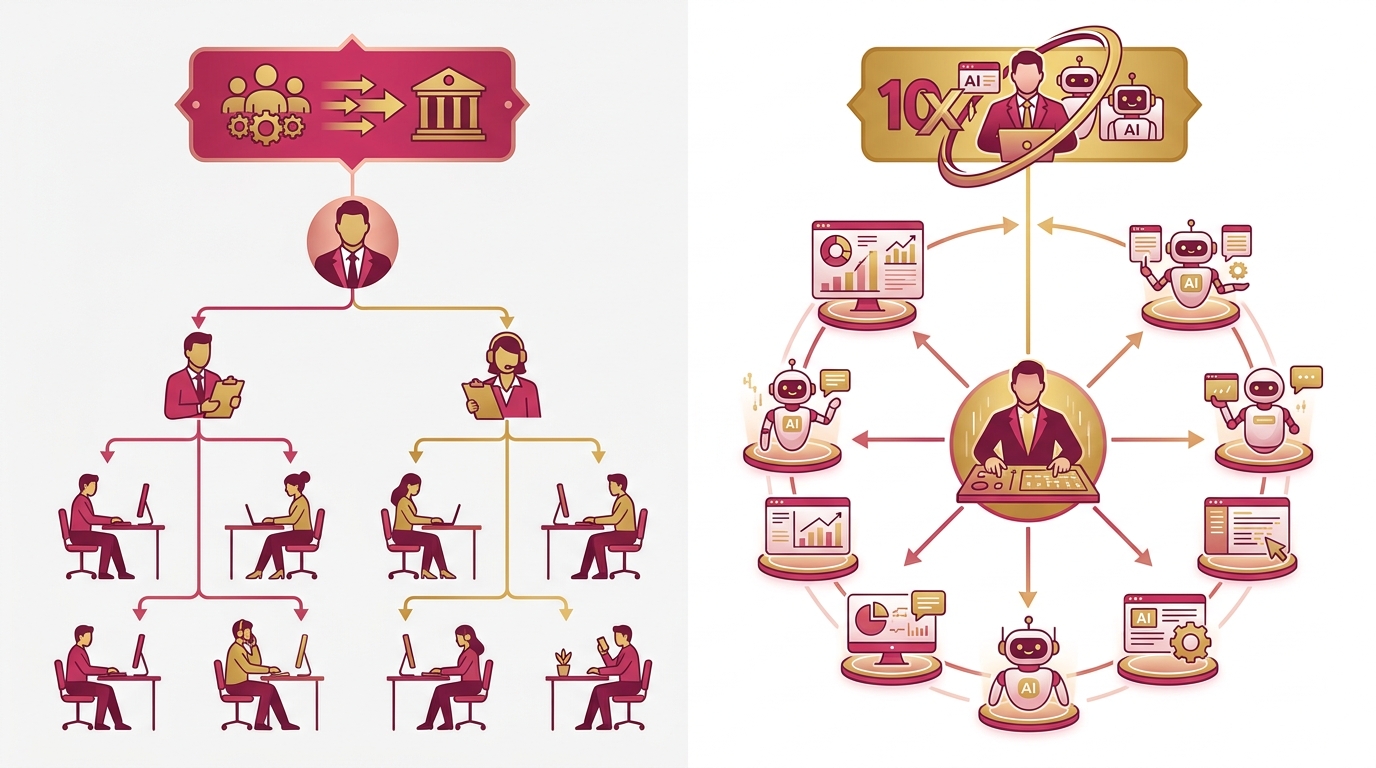
Flybridge’s own investment thesis is fascinating too. They predict that “in 8–12 years, companies will use more AI agents than humans.” That’s why they’re investing in agent management layers (authentication, orchestration, explainability) right now. So Bussgang isn’t just talking theory—he’s putting his own money on it. The walk matches the talk, which is what makes it credible.
What hooked me about this concept is that it focuses on “what to stop doing to become 10x” rather than “how to become 10x.” Don’t add more things to do—add more things to stop doing. For anyone running a business solo, isn’t that the most piercing way to frame it?
$20K and 12 AI Tools, $401M in Revenue. What Medvi Proved
Concepts alone end in a “huh, okay,” so let me give you a real example.
Matthew Gallagher. Started from his Los Angeles home in September 2024. Initial capital: $20,000 (about ¥3 million). He launched Medvi, a telehealth company for GLP-1 (weight-loss medications). Zero employees. (PYMNTS.com)
First-year revenue: $401M (about ¥60 billion). 2026 is pacing toward $1.8B (about ¥270 billion). The only employee is his brother Elliot, bringing the headcount to two. They’re selling about $3M (about ¥450 million) per day. (NewsNation)
“Hold on, that’s healthcare—what does that have to do with me?” Hang on. What matters here isn’t the dollar amount; it’s the structure.
What Gallagher did with AI:
- ChatGPT, Claude, Grok → code generation
- Midjourney, Runway → ad creative production
- ElevenLabs → AI voice for customer service
What Gallagher did not hand to AI:
- Branding, ad strategy, checkout flow (purchase funnel) design → all himself
Regulatory work and prescription/delivery were outsourced wholesale to an external partner (OpenLoop Health). So $401M with two people is the result of him brutally sorting “what only I can do” from “what humans don’t need to do.”
That said, Medvi carries real risk too. Outsourcing late-night consults and prescription drug management to an external partner is a structure that bakes in regulatory and patient-safety risks. Don’t judge it by the numbers alone—you have to look at “where does the legal responsibility for the outsourced part sit.” Referencing it as a success case while also understanding where the risks live—that, I think, is the real judgment of a 10x Founder.
This sorting exercise has the exact same structure as the A/B/C categories of the “Stop-Doing List” I’ll get to later. For Gallagher, what he handed to AI was Category B (replaceable by AI), and regulatory work was Category C (outsourced entirely). Only the branding and strategy he did himself were Category A (only he could do them).
The comparison makes it clearer. Hims & Hers, operating in the same space, posted its most recent annual results (FY2025) with 2,442 employees, $2.4B in revenue, and a 5.5% operating margin. Medvi has a 16.2% margin with two people. (Inc.com)
The era of “add headcount to grow revenue” is over. We’re in the era where people who can decide “what to stop” win.
Another Example. Base44 — Sold for $80M in Six Months
Let me introduce one more.
Maor Shlomo. An Israeli developer who built Base44, a no-code AI platform, by himself. 300,000 users. $3.5M ARR (annual recurring revenue). Six months after launch, he sold it to Wix for $80M (about ¥12 billion) in cash. (TheRundown.ai)
If Medvi is the “made an existing market more efficient with AI” example, Base44 is the “built the entire product itself with AI, solo” example. The directions differ, but there’s a common thread.
Both of them shipped a product before they built a team.
The old startup playbook went: idea → team formation → fundraising → development → launch. The 10x Founder playbook is: idea → AI development → launch → validate with data → hire only if needed.
Because the cost of forming a team has approached zero, “ship first” became possible. That’s the structural strength of the 10x Founder.
Shlomo himself said, “If you can’t build the first version of the product with your own hands, it doesn’t mean anything.” AI makes that possible now. People who can code, sure—but even people who can’t can ship “something that works” with no-code tools × AI. We’re in that era.
I have a friend who runs a handmade-goods online shop (e-commerce) by herself. She started using AI to write product descriptions and ad copy. As a result, her monthly working hours got cut in half. The scale is nothing compared to Medvi or Base44, but the structure—“decided what to stop, handed it to AI”—is exactly the same.
29.8 Million Solopreneurs. The Numbers Behind “The Era of One”
Let me lead with the conclusion. “Starting solo” is no longer a minority move.
As of 2026, there are about 29.8 million solopreneurs (people running a business alone) in the U.S. The economic footprint is $1.7T (about ¥255 trillion), which is 6.8% of U.S. GDP (gross domestic product). (selfemployed.com)
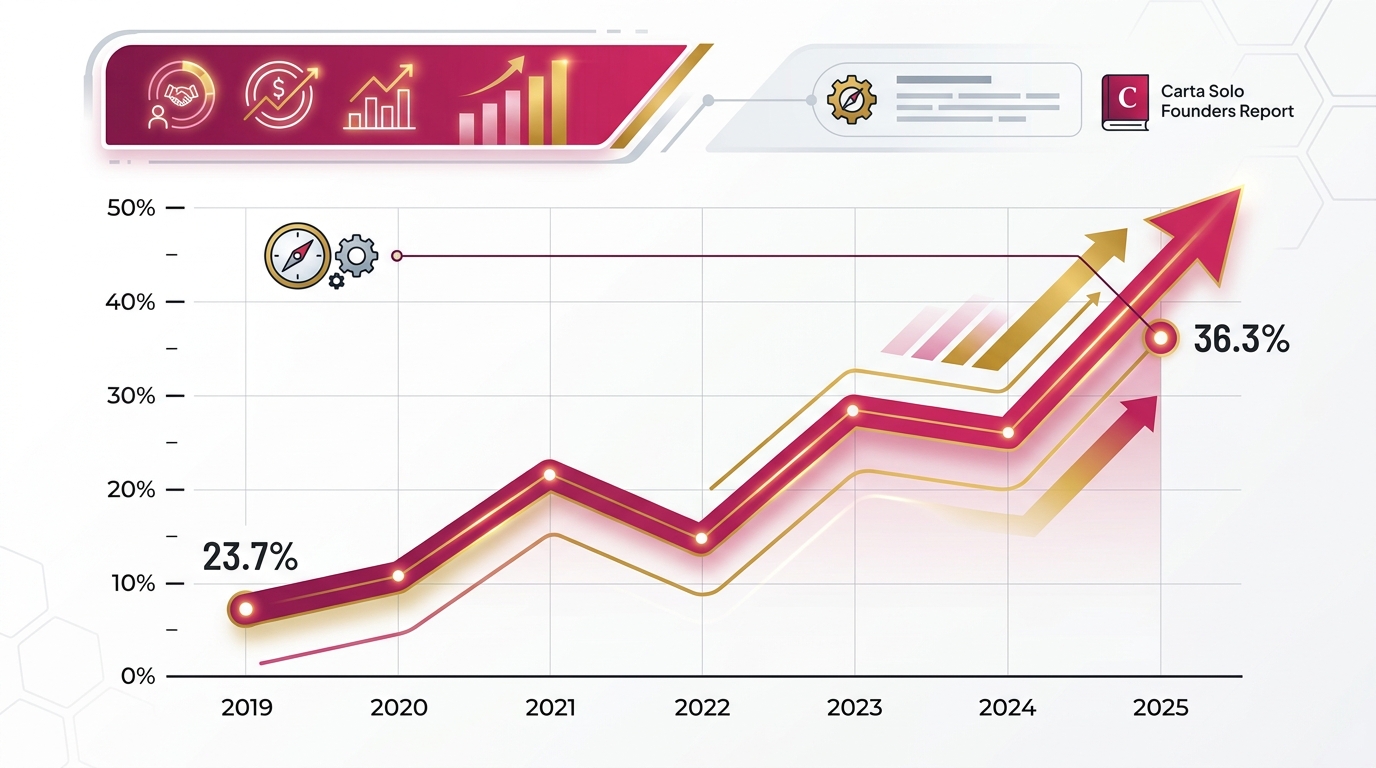
Take a look at the data from Carta (a startup equity-management platform), too. The share of solo founders has gone from 23.7% in 2019 to 36.3% in 2025. About 1.5x in six years. (Carta Solo Founders Report)
On top of that, 77% of solopreneurs become profitable in their first year. About half start with initial capital of $5,000 (about ¥750,000) or less. AI tool stacks run $3,000–$12,000 per year, a massive cut compared to traditional operating costs. (Founder Reports)
This is not a story about exceptional people. “Doing it solo” has become mainstream.
To everyone running a business solo, myself included, I want to say: the 10x Founder mindset isn’t “some distant future”—it’s a framework you can use starting today.
In Japan too, the number of sole proprietors and freelancers grows every year. Look at the National Tax Agency’s tax-filing data and you can see it: the flow from side hustle to full independence isn’t slowing down. Now that the bar for “starting solo” has dropped, what’s missing isn’t tools—it’s a blueprint for how to use them. I believe the 10x Founder concept can serve as the foundation of that blueprint.
Don’t Try to 10x. Find Ten Things to Stop Doing
So, concretely, what do you do?
When I applied Bussgang’s concept to my own business, here’s what I noticed. “Listing ten things to stop” is overwhelmingly faster than “looking for a way to 10x.”
The average solopreneur wastes 23 hours per week. That’s 92 hours per month. It’s a reference figure based on PrometAI’s research, but 92 hours is basically “another full-time worker.”
In other words, we’re chaining an invisible “second you” to busywork.
The 10x Founder mindset is about freeing those 92 hours. You don’t start with “what should I 10x”—you start with “which 92 hours should I zero out.”
Bussgang talks about something called an “Executive Copilot.” AI integrates internal data, market trends, and risk information, then hands you “decision-ready material.” The only thing the founder does is decide. Research, aggregation, analysis—all of it goes to AI.
I do this in my own SNS marketing client work. I used to spend three hours per client on competitor analysis. Now I hand the competitor site data to Claude, and in 30 minutes I get “only the information I need to make a decision” extracted for me. The 2.5 hours I saved go into strategy meetings with the client.
Deciding “what to hand to AI” is the first step of a 10x Founder.
A common misunderstanding is “if I leave it to AI, quality will drop.” This is half right and half wrong. If you ask AI for “the finished product,” sure, it’s underwhelming. But if you ask AI for “an 80-point draft” and you do the work of “finishing it to 100”—that’s a different game. Bussgang’s “Search, Prototype, and Learn” runs on the same idea. Rapidly validate the 80 that AI produced, then polish with human judgment. The cycle moves so fast that the result is 10x.
Let me share another example—a one-woman consultant I work with. She started having Claude write the skeleton of her proposals. She focuses only on adding the client-specific context. Time per proposal went from 4 hours to 1.5 hours, and she told me her monthly contracts doubled.
Building Your “Stop-Doing List.” A Self-Diagnostic Map
Last thing—let me hand you a recipe for the “Stop-Doing List” you can start using today.
Remember Gallagher’s sorting from the Medvi section? Code generation, ad production, voice handling → AI; branding and strategy → himself. Applying that decision axis to your work is what you’re going to do next.
Step 1: Write down everything you did last week
List every task that took 30+ minutes. Email replies, social posts, invoices, research, deck-building—all of it.
Step 2: Sort into three buckets
| Category | Definition | Examples in your work |
|---|---|---|
| A: Only I can do this | Judgment, creation, relationship-building | Client meetings, strategic decisions, planning and final review of content |
| B: Can hand to AI | Research, aggregation, drafting, routine work | Competitor analysis, social post drafts, expense entry, email reply templates, meeting minutes |
| C: Shouldn’t be doing at all | Things done out of inertia | Running social channels you don’t measure, weekly reports nobody reads, recurring meetings you keep out of habit |
Step 3: Stop one from B and one from C this week
You don’t need to change everything at once. Hand one B task to AI. Stop one C task. Just that frees up 5–10 hours a week.

For me, the first thing I put in C was “the weekly industry news roundup I used to compile.” Nobody asked me to do it, and yet I was spending two hours on it. Stopping changed nothing for the worse. Actually, I regretted it: “I could have sent a proposal to a new client with those two hours.”
What I put in B was “compiling numbers for client reports.” I was transcribing Google Analytics (a website traffic analysis tool) data into spreadsheets every month. I replaced it with an AI automation tool. Eight hours a month became 30 minutes.
10x isn’t magic. It’s the accumulated result of “stopping” and “handing off.”
By the way, this sorting isn’t a one-time exercise. Review it at least once a month. I do my own check at the start of each month: “Has anything that was B last month moved to A?” AI evolves so quickly that something that only a human could do last month can be handed to AI this month. The reverse matters too—being willing to move something back to A when “I handed it to AI, but the quality was meh.” This “updating of the sort” is what makes 10x sustainable.
Summary. 10x Isn’t About “Effort.” It’s About the Courage to Stop
The 10x Founder is a concept named by a Harvard VC, but the substance is simple. “Use AI to 10x the speed of experiments. To do that, ruthlessly stop everything humans don’t have to do.”
Medvi built $401M in revenue with $20K and 12 AI tools (and you should understand the structure including the risks). Base44 built a 300,000-user product solo and sold it for $80M. Solopreneurs are over 29.8 million, and the solo founder share has risen to 36.3%.
The numbers prove “the era of one” has arrived.
But the thing I most want to convey isn’t the numbers. It’s this: the people who can decide what to stop end up 10x-ing as a result.
I’m still nowhere near 10x myself. But ever since I started writing a “Stop-Doing List,” my use of time has demonstrably changed. The space that opened up lets me try new things. The more times you try, the more your hit rate goes up. Bussgang’s “Experimentation Machine”—I think that’s what he means.
You don’t need to aim for a perfect 10x. Just stop one thing this week. That one thing becomes your first step toward “10x.”
Read this alongside my previous piece (I’ll Show You the Full ROI on a Solopreneur’s AI Stack). Together you’ll see “what to spend on, and what to stop” as a complete picture.

女性だからこそ、AIを使いこなさなきゃって思ってる。仕事も、副業も、推し活も、旅行も、全部やりたい。人生一度きりなのに時間は足りないじゃん?だからAIに任せられることは全部任せる。浮いた時間で本当にやりたいことをやる。それがあたしのスタイル。ここにはあたしが実際にやったことをまとめてるだけ。誰かのためになったらいいなって思って書いてるよ。