AI Startups Can Launch Even with 'No Name, No Money, No Experience': Examining the Reality of the 36% Solo-Founder Era
Solo founders now make up over 36% of startups. A former burned-out engineer examines, with data, the three walls AI has torn down—and the gap it couldn't close.
What you'll learn in this article
- The key point to grasp before reading the full article
- How the issue changes the way developers should work next
- Which follow-up article is worth opening next

I call myself a “burned-out engineer.”
I joined a web development company straight out of college and wrote code. On a large project, I was overwhelmed by the brilliance of the senior engineers around me and stepped away from code entirely. I switched to customer success and spent several years with zero exposure to programming.
Back then, I had three “nothings.” No name as an engineer. No money to invest in development. No recent hands-on experience.
And yet, after encountering Cursor and Claude Code, I made a complete return to the world of code. Did you know that the number of people getting moving with these same “three nothings” is rapidly increasing right now?
According to Carta’s Solo Founders Report, the share of solo founders among all startups jumped from 23.7% in 2019 to 36.3% in the first half of 2025. More than one in three companies is now “started by a single person.”
In this article, I’ll examine—with data and real-world cases—the walls AI has torn down and the ones it hasn’t. If it makes you think “maybe I could do this too,” that’s the best outcome I could hope for.
The 36% Solo-Founder Figure Doesn’t Mean “Teams Are Unnecessary”
What Carta’s data shows is that “the conditions for starting alone are now in place.” It doesn’t say “you don’t need a team.”
Look at the trajectory. In 2017, solo founders made up 17%. That grew to 23.7% in 2019, 29% in 2023, and 36.3% in the first half of 2025. The Solo Founders report confirms the same trend.
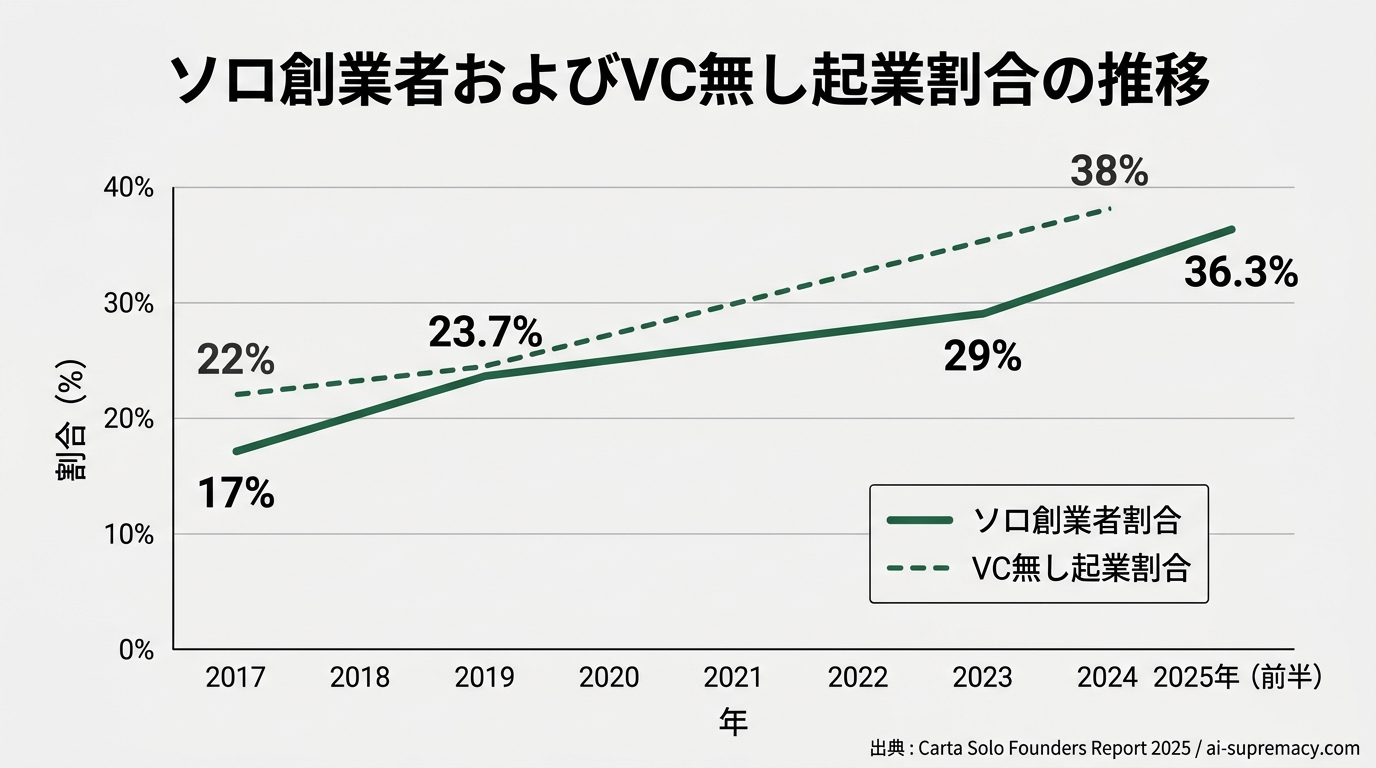
An analysis from ai-supremacy.com reports that the share of founders who start without VC money also grew from 22% in 2015 to 38% in 2024 (note: this article is secondary, citing Carta and Y Combinator data, and should be treated as a reference, not the original source). There’s no question the environment for starting without raising money is now in place.
But there’s a trap here. Only 17% of solo founders successfully raised a VC round. So while 36% of startups are solo-founded, just 17% of those have secured funding. “Being able to start” and “being able to scale” use entirely different muscles.
Coming from a CS background, I can tell you—building a product and selling a product use completely different muscles. For me personally, building tools was fun, but spreading them was vastly harder. As the bar to start has dropped, “what you design after starting” has become the deciding factor.
The Three Walls AI Has Leveled
The biggest reason the “three nothings” can now be a weapon is that AI has physically eliminated barriers to entry.
Wall 1: The Collapse of Development Costs
Lovable’s numbers say it all. According to TechCrunch, Lovable hit $200M ARR in 12 months—the fastest in software history. More than 200,000 projects are born on the platform every single day.
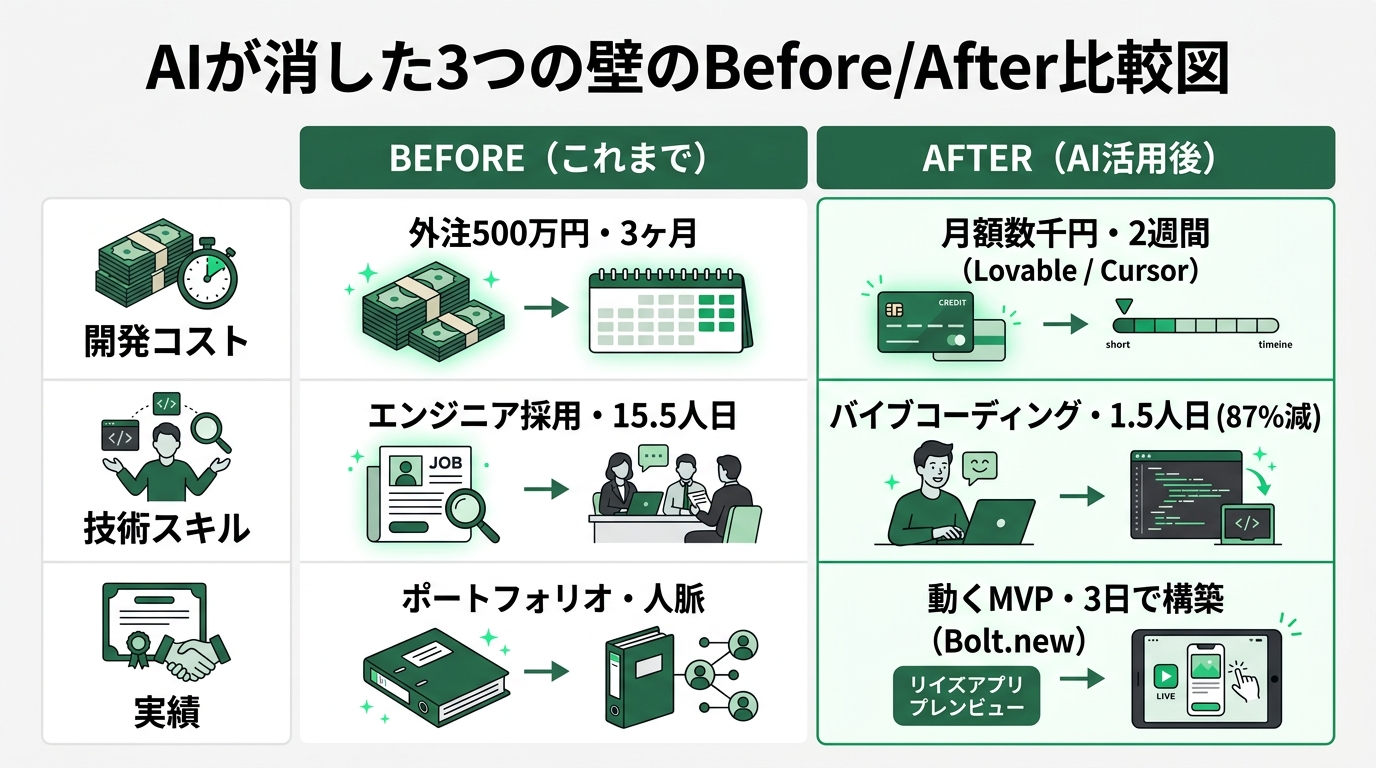
Let me break down what that means. An MVP (minimum viable product) that used to cost ¥5 million and three months to outsource is now available for a few thousand yen a month and two weeks of work. On top of that, Lovable is valued at $6.6B (roughly ¥1 trillion), with $330M (roughly ¥50 billion) raised. The fact that this much capital is flowing into “development without writing code” carries serious weight.
The development-cost wall has, for all practical purposes, vanished. Three years ago, “first, raise money” was step one of starting a company. Today, step one is “first, build the product.”
Wall 2: The Democratization of Technical Skill
The Transcosmos case introduced in a CodeZine article is emblematic. A development project that previously took 15.5 person-days was shortened to 1.5 person-days through vibe coding. That’s an 87% reduction.
They’ve also automated quality control. Five different LLMs (large language models) review the requirements document, and the process can’t move forward unless at least three approve. They call this system “VibeOps.” They’ve built a structure where junior engineers can handle upstream work.
This is genuinely game-changing. We’ve entered an era where someone “who can’t write code” can produce “quality higher than someone who can write code,” thanks to AI.
To share my own story: I typed “I want to automate the aggregation in this spreadsheet” into Claude Code, and out came a Python script. I ran it, and it actually worked. “My intent became code”—that experience was the start of everything. Maybe it’s code a professional engineer could write in five minutes. But the fact that I made it run with my own hands is irreplaceable.
Wall 3: Earning Trust from Zero Track Record
An Entrepreneur article describes a telling case. A pre-funding startup built a demo MVP in three days using Bolt.new. By showing investors that working product, they won the trust they needed.
“No track record” is no longer a handicap. Show something that works, and it becomes the track record. An MVP is more eloquent than a business card. The era of spending three months polishing a portfolio is over. “I built this today” is far more persuasive.
What AI Did Not Level
The walls have come down. That doesn’t mean everyone succeeds. Misreading this point will hurt.
What AI leveled was “the power to build.” What it didn’t level is “the power to decide what to build” and “the power to deliver what you built.” These two remain on the human side, even as AI evolves.
Lovable generates 200,000 projects a day. The vast majority will likely never see daylight. Between “being able to build” and “being used” lies a gulf that AI can’t fill.
I think back to the voices I heard thousands of times in customer success: “I want this feature.” “This part is hard to use.” “I don’t understand why it works this way.” The experience of hearing users directly is something no AI, however capable, can replace. That, I believe, is the real reason a CS-background “Gen” can write technical articles.
Three differences remain.
1. The ability to frame the problem. Can you articulate “whose pain, what pain are you solving”? You can build something technically impressive, but if it solves no one’s problem, no one uses it. What Lovable’s 200,000 projects prove isn’t “you can build”—it’s that “building something people use is a separate skill.”
Get the problem framing wrong, and a flawlessly working product ends up used by nobody. Nine out of ten failures I saw on the CS front lines came down to this. The difference between “I built it because I wanted to build it” and “I built it because someone is hurting now” decides everything.
2. Speed of judgment. Can you instantly decide “drop this,” “focus on this”? Precisely because AI generates infinite options, the power to choose is what’s tested. What I learned in CS was that “deciding what not to do is harder than deciding what to do.”
Imagine you have ten possible features you could build in Cursor. Try to build all ten and nothing gets finished. Narrowing down to “the one thing your current users need most” is what separates shipped from unshipped.
3. The power to deliver. This is the ability to design the path that puts your product in users’ hands—marketing, sales, community building. This domain remains AI’s weak spot. AI will write your code, but it won’t tell you “who should know about this product, and how.” Do you broadcast on social media? Aim for SEO traffic? Build a community and grow by word of mouth? In the end, this “design of delivery” is what most often decides success or failure.
Anthropic’s CEO Dario Amodei said the era of “one person building a $1B company” is coming. Technically, I believe it’s possible. But only for those who can decide “what to build, and to whom to deliver it”—don’t you think?
Common Patterns Among Those Who Moved with “Three Nothings”
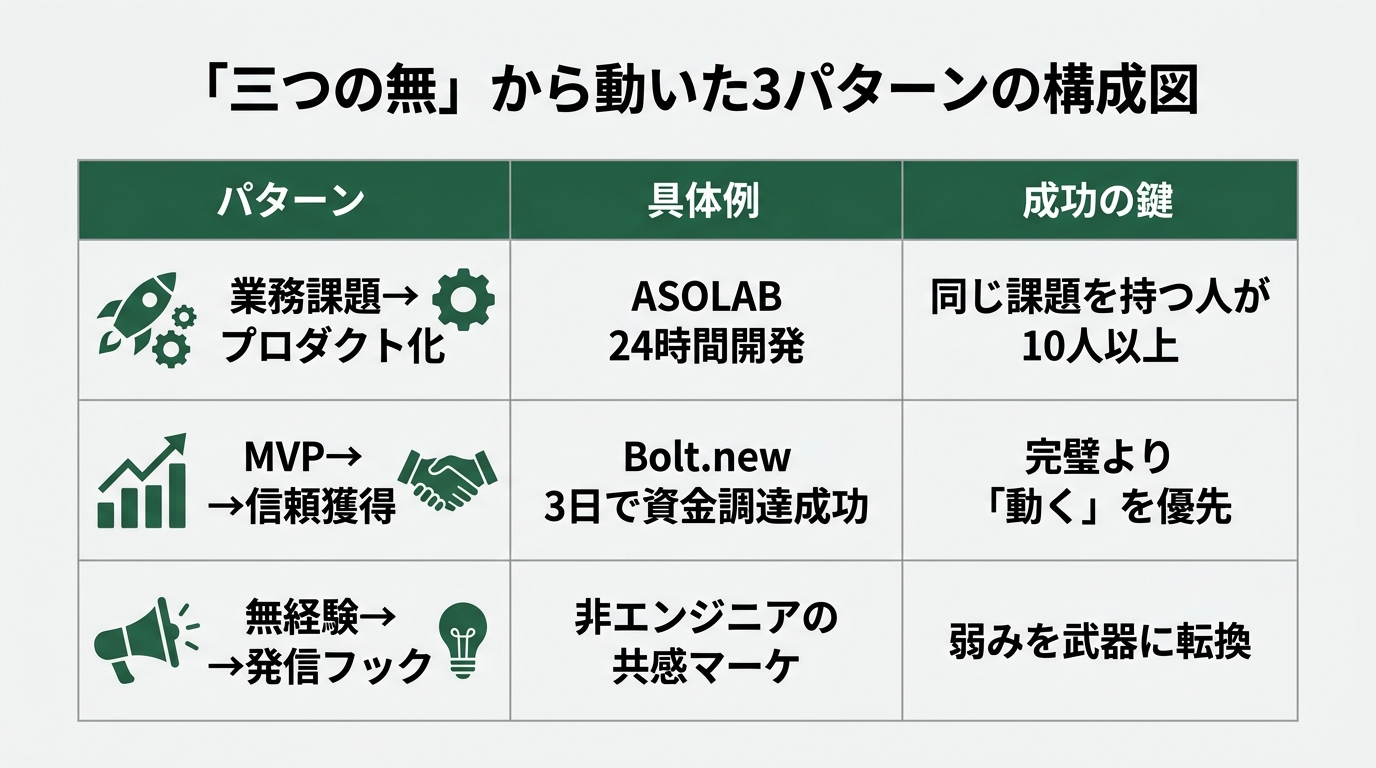
When you observe real cases, three success patterns emerge. The more “three nothings” someone had, the more they made a certain kind of lightness their weapon.
Pattern 1: Turning their own work problem directly into a product
The ASOLAB case introduced in a Uravation article makes this clear. A non-engineer staff member used vibe coding to build a file-transfer service custom-built for their company in 24 hours. They cut payments to external paid services.
“Something I’m struggling with” is the strongest possible product idea. Coming from CS, I feel this in my bones. Anyone who regularly thinks “I wish there were a tool for this” already has an idea. They just haven’t realized it.
Let me share where this trips people up. If you build “what you’re struggling with” as is, you tend to end up with a tool that only delights you. The rule is: confirm that at least ten other people share the same problem before you start building. Search X (Twitter) for things like “〇〇 inconvenient” or “〇〇 annoying” and within 10 minutes you’ll know how many people share your pain.
Pattern 2: Starting small and earning trust with something that runs
That case I mentioned earlier—“built an MVP in three days and won funding.” The key point was showing not a “finished product” but “something that runs.”
Aim for perfection and you’ll never ship. “Just build something that runs, for now”—that’s also my philosophy. A working prototype is 100 times more persuasive than a PowerPoint business plan.
The first thing I built in Cursor was an internal Slack Bot. It ran in 15 minutes. The quality was rough, but the team’s reaction was “Wait, you built this just now?” I still remember how that surprise drove my next development effort. Even imperfect, the fact that it runs has value. That “it ran in 15 minutes” experience was my doorway back into code after three years away.
Pattern 3: Turning “no experience” into a hook for distribution
“Built by a professional engineer” versus “Built by someone with no coding experience, using AI.” Which one resonates with people in the same boat? The answer is obvious. We’re in an era where a $75/month AI stack is enough to compete. “Having no experience” becomes a point of resonance for readers in the same situation.
I lived this myself. The label “burned-out engineer” is purely a weakness from a professional engineer’s perspective. But for people who’d stepped away from code, who’d given up on programming, it became a hook—“if this person could do it, maybe I can too.” A weakness, depending on whom you’re trying to reach, can flip into your greatest strength.
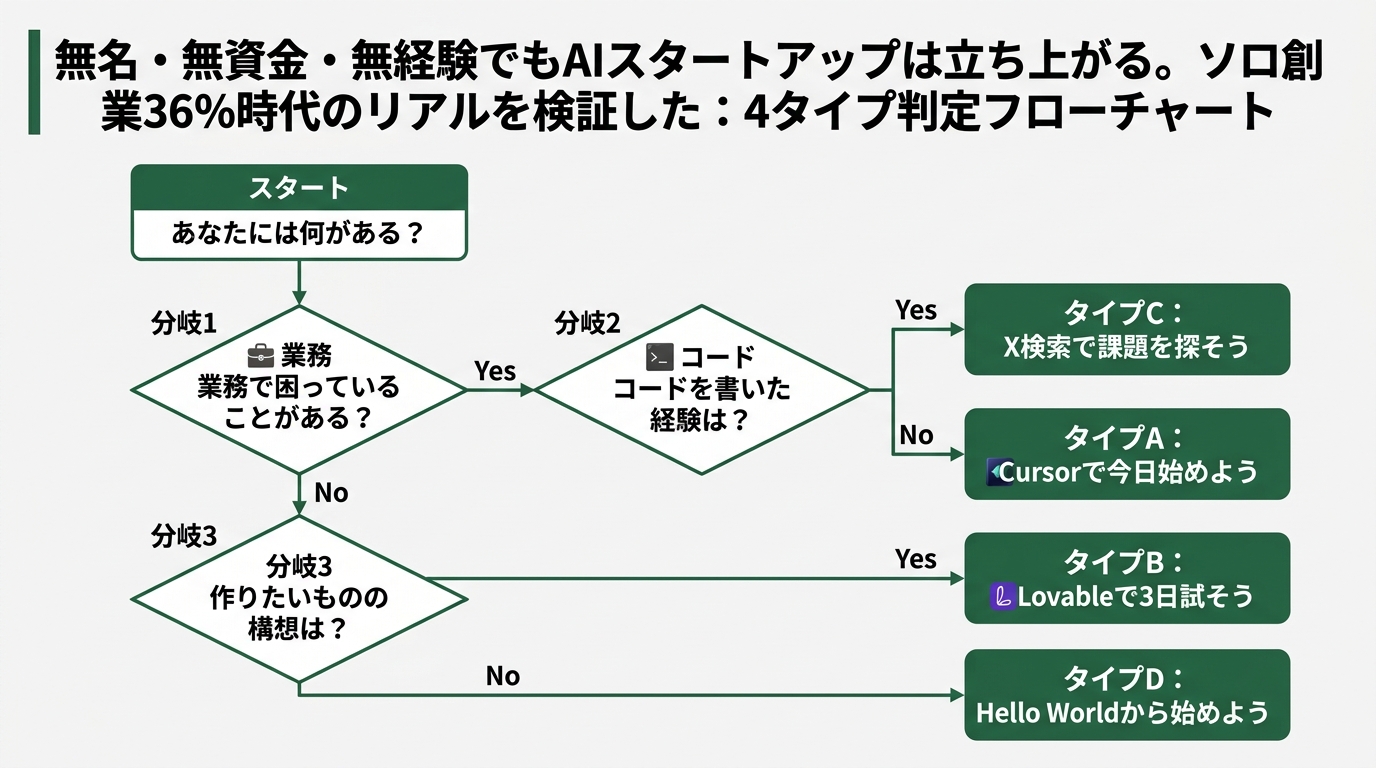
Which Type Are You? Four Ways to Leverage Your “Three Nothings”
To everyone reading this thinking “I want to try this too”: here’s a proposed first step, by type.
Type A: You can see the work problem. You only lack the technical chops.
You’re in the most advantageous position. If you know “what to build,” install Cursor and start today. Try automating just one piece of your own work first. A spreadsheet aggregation, a Slack notification bot—anything will do. The experience of “it ran” changes everything.
Concretely, just open Cursor and type “write a Python script that automates 〇〇, the thing I do every day.” My very first instruction was “a script that reads a specific Google Sheet every Monday and posts a weekly summary to Slack.” I didn’t fully understand every line of code the AI wrote. But it ran. That was enough.
Type B: You have ideas, but don’t know where to start.
It’s worth giving Lovable a three-day trial. Just type “I want a web app that does X” in Japanese, and a screen will appear. Don’t worry about polish. The fact that “I built something” should become fuel for the next step. Assume the first project will fail. Accuracy improves on the second and third tries.
If after three days you think “this isn’t it,” that’s also a success. If “the thing I want to build has become clearer,” three days were worth it.
Type C: You have the technical skill, but can’t decide what to build.
The shortcut is to start by listening to users. Try searching X (formerly Twitter) for “〇〇 inconvenient” or “〇〇 annoying.” Within ten minutes you’ll find three problems. What technical people usually lack is just “resolution on who you’re building for.”
When you find one problem your skills can solve, build a prototype that same day. When “someone looking for a solution” meets “someone who can build a solution,” products are born naturally. In CS terms, “someone who knows the user’s pain builds the product” is the strongest possible combination. If you have the skills, I’d declare without hesitation: the next step is going out into the field.
Type D: You have none of it. Only the feeling of “I want to do something.”
As a former burned-out engineer, I’ll tell you straight: that feeling is the most important asset of all. Start by installing the free version of Cursor. Display “Hello World”—that’s enough. From there, AI will run alongside you. That’s how I started.
Someone who started from nothing is now writing articles like this one. I don’t think there’s any reason you can’t. “Just the feeling” is actually the strongest asset—the moment you set a direction, AI fills in the rest. Just take that first step.
Summary: “Three Nothings” Is No Longer an Excuse
AI has fundamentally changed the barriers to entry for software development. The data proves it.
Carta’s 36% solo-founder figure isn’t a story about “you don’t need a team or money.” It’s a story about “even without a team or money, you can move first.” What you’ll need after you move, you’ll find out by moving. A working prototype beats a perfect plan. A working product beats a perfect resume. Founding a company in 2026 has become that kind of game.
After examining the true nature of the “three nothings,” I’m convinced of one thing. What AI leveled was only “the power to build.” “The power to decide what to build” and “the power to deliver” remain unequal. Whether you can write code is no longer a differentiator. What differentiates now is the eye to spot problems and the feet to deliver to users.
This is what I, the former burned-out engineer, can tell you. I don’t regret stepping away from code. The thousands of voices I heard on the CS front lines are now the foundation of every design decision I make when writing code with AI. The burnout, the career shift—it all meant something. Without those “three nothings,” the me of today wouldn’t exist. The “three nothings” aren’t weaknesses—I see them as raw stones that only become weapons when combined with AI.
No name, no money, no experience—it doesn’t matter. With AI here now, the moment you think “maybe I could” is the moment to start. The skills of the brilliant engineers I once thought I could never reach are now in your hands, through AI. Please, taste that experience for yourself.
Source Map (Tech v1 mandatory)
| Source | URL | Year | Subject | Cited figures |
|---|---|---|---|---|
| Carta Solo Founders Report | Report | 2025 | US startups | Solo founder share: 23.7% (2019) → 36.3% (2025 H1); VC funding rate 17% |
| Solo Founders Blog | Article | 2025 | US startups | Confirms solo founders exceeding 1/3 (supporting source to Carta) |
| ai-supremacy.com (secondary source) | Article | 2026 | Founders without VC | No-VC founders 22% (2015) → 38% (2024) (secondary, citing Carta/YC) |
| TechCrunch (Lovable) | Article | 2025-12 | Lovable | ARR $200M (12 months), valuation $6.6B, $330M raised |
| CodeZine (Transcosmos) | Article | 2025 | Transcosmos | 15.5 person-days → 1.5 person-days (87% reduction); 5-LLM review system |
| Entrepreneur | Article | 2026 | Solopreneurs | Monetizing with 4 AI tools; MVP built in 3 days |
| Uravation (ASOLAB) | Article | 2026 | ASOLAB | Non-engineer 24-hour development |

正直、一度エンジニアは諦めました。新卒で入った開発会社でバケモノみたいに優秀な人たちに囲まれて、「あ、私はこっち側じゃないな」って悟ったんです。その後はカスタマーサクセスに転向して10年。でもCursorとClaude Codeに出会って、全部変わりました。完璧なコードじゃなくていい。自分の仕事を自分で楽にするコードが書ければ、それでいいんですよ。週末はサウナで整いながら次に作るツールのこと考えてます。