What Is the FDE, the Unusual Role with a Salary Over $400K? A Burned-Out Ex-Engineer Digs into OpenAI's 'Forward Deployed Engineers' at MUFG
Born at Palantir and now deployed by OpenAI at MUFG, the FDE role commands salaries over $400K. We break down the secret behind it using a three-axis framework.
What you'll learn in this article
- The key point to grasp before reading the full article
- How the issue changes the way developers should work next
- Which follow-up article is worth opening next
I first learned about this role the moment a Business Journal article scrolled across my timeline.
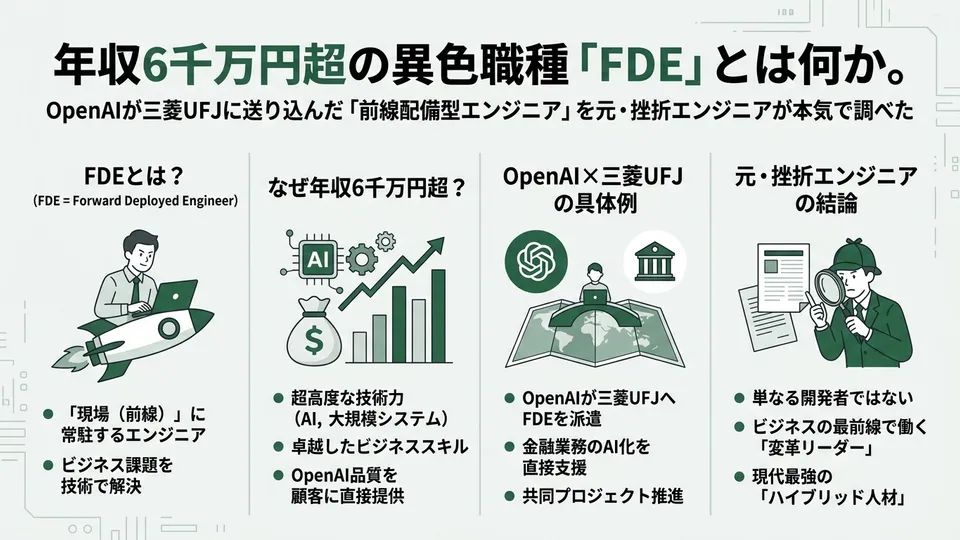
“Annual salary over 60 million yen.” I had to do a double take. And it’s an engineering role. And it’s “on-site at the client.” The same phrase used for the on-site client work I did at my first job out of college.
FDE. Forward Deployed Engineer.
It was an unfamiliar title. Looking into it, I learned that the people OpenAI deployed to Mitsubishi UFJ Financial Group hold exactly this role. An AI company stationing its people inside a bank. And the salary is several times that of a regular engineer.
As a burned-out former engineer myself, I couldn’t ignore this. I decided to seriously dig in.
The FDE’s Birthplace Was Palantir. The Role Was Born Because “You Can’t Ask a Spy”
The company that first created the FDE role was the data analytics firm Palantir. This was in the early 2010s.
Palantir was building data analytics platforms for the US intelligence community. Their customers were organizations like the CIA and NSA. The work was classified, so even if you asked what they needed, no answer would come back. There were no specifications and no requirements meetings to begin with.
Palantir’s answer was the idea of “sending engineers into the customer’s office.”
Go on-site, observe the work, find problems with your own eyes, and build a working prototype on the spot. Don’t ask the customer—understand them by spending time with them. Palantir internally called engineers who took on this role “Delta.” Later, the official outward-facing name “Forward Deployed Engineer” was adopted.
The Pragmatic Engineer newsletter shares an interesting data point. Until 2016, the number of FDEs inside Palantir exceeded the number of software engineers. There were more people going into the field than there were people building the product. FDEs were at the core of Palantir’s competitive advantage.
What struck me here was that the origin of the FDE wasn’t “technical ability” but rather “if you can’t ask, go see.” Taking the customer’s unarticulated needs, experiencing them on-site, and giving them shape. I felt that this is structurally identical to the work of Customer Success.
The FDEs OpenAI Sent to MUFG. What’s Actually Happening?
In November 2025, OpenAI and MUFG (Mitsubishi UFJ Financial Group) announced a strategic partnership. The Nikkei reported “An OpenAI Special Team for Mitsubishi UFJ.” It wasn’t just a tool rollout.
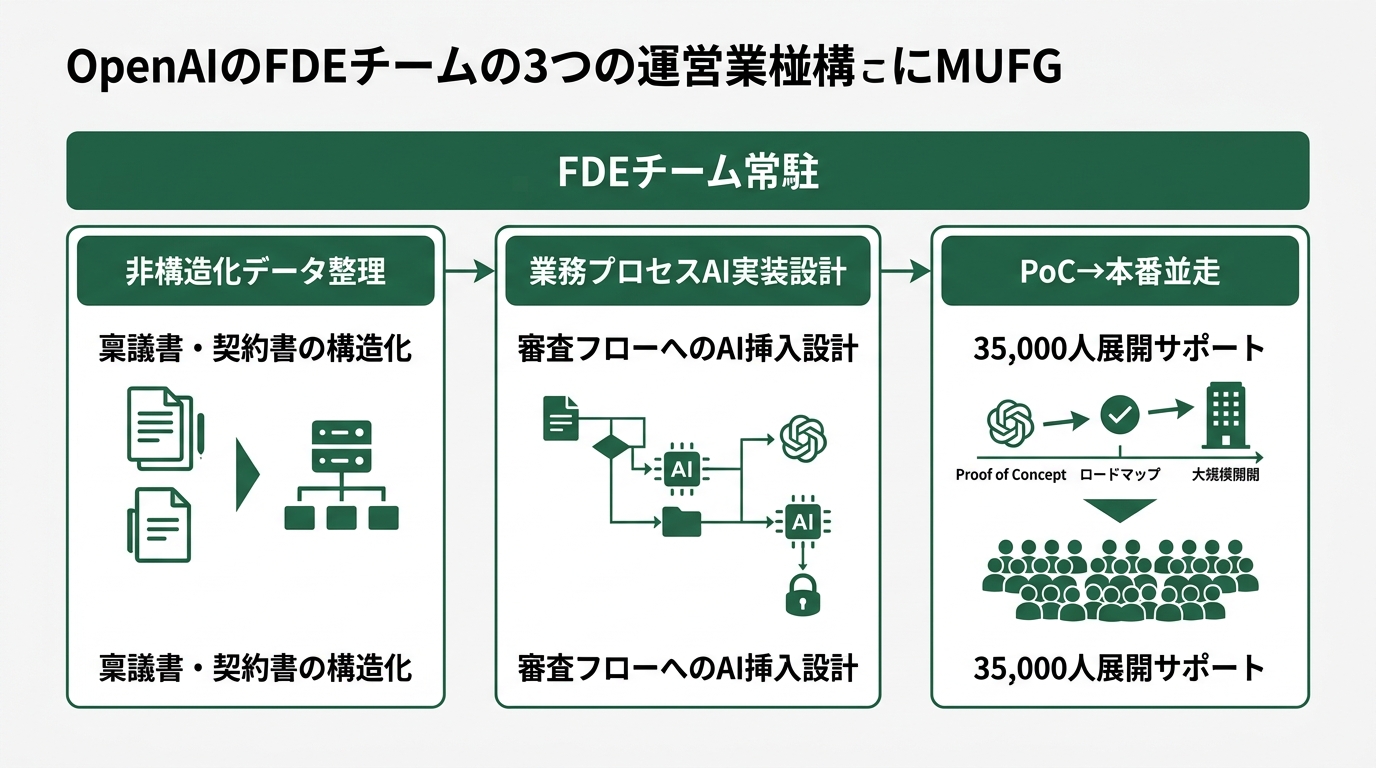
OpenAI embedded a specialist team playing an FDE-style role at MUFG. According to reporting from Nikkei xTECH, the team is handling these three areas of work.
1. Organizing Unstructured Data
Banks have an enormous amount of documentation. Approval requests, contracts, customer interaction histories. They are working to structure this “unorganized data” so AI can handle it, while learning the bank’s business workflows.
2. Designing AI Implementations Aligned with Business Processes
It doesn’t end with just deploying ChatGPT. At which stage of the loan approval process should AI assist with judgment? Which customer service flows should be automated? They are designing this together with bank employees, on the same floor.
3. Walking Side-by-Side from PoC to Production
It doesn’t stop at proof of concept (PoC). The same team is responsible from validation all the way through to the production cutover. According to MUFG’s official announcement, ChatGPT Enterprise will be deployed to all approximately 35,000 bank employees starting January 2026. The FDE team supported this company-wide rollout.
What’s worth noting here is that OpenAI didn’t stop at “providing an API.” It sent its own engineers into the customer’s workplace to deliver value by embedding in the customer’s operations. What Palantir was doing at intelligence agencies, OpenAI is recreating at a Japanese megabank.
Why Salaries Over $400K? “Three Layers of Scarcity” Set the Price
The “salary over 60 million yen” reported by Business Journal refers to the top tier in Silicon Valley. According to Levels.fyi, OpenAI senior-level base salaries range from $250,000 to $350,000. Add equity compensation of $2M+ over four years on top of that. Total annual compensation exceeds $600,000—roughly 90 million yen in Japanese yen.
What about FDE openings in Japan? According to research by renue, the median upper bound for FDE openings at Japanese companies is around 15 million yen. That’s more than double the average software engineer salary in Japan (roughly 7 million yen). At foreign-affiliated firms, Palantir Japan reportedly offers 20–40 million yen.
Why is it so high? Here is what I found by digging in: it’s “three layers of scarcity multiplying together.”
Scarcity 1: Writes Code AND Speaks Business
FDEs talk directly with the customer’s executive leadership. “This AI model has 92% inference accuracy” doesn’t land. You need to be able to translate it as “This deployment shortens the review process from 3 days to 4 hours, with projected annual cost savings of approximately X billion yen.” People who possess both the skill to write code and the skill to articulate business impact are extremely rare.
Scarcity 2: Industry Domain Knowledge
FDEs embedded at MUFG need knowledge of financial regulations and compliance. Healthcare AI? Medical device law. Manufacturing? Supply chain. General technical skill isn’t enough. People who can implement technology with an understanding of a specific industry’s “rules of the road” are an even smaller group.
Scarcity 3: Delivering Results in Ambiguity
No spec. No defined requirements. The customer themselves can’t articulate what they want. From there, you build a prototype, gather feedback, and shape it into something real. The skill set required is different from that of conventional software development.
How many people have all three layers overlapping? The answer is “very few.” That’s why the salary skyrockets.
What Does the Japanese FDE Job Market Look Like Right Now?
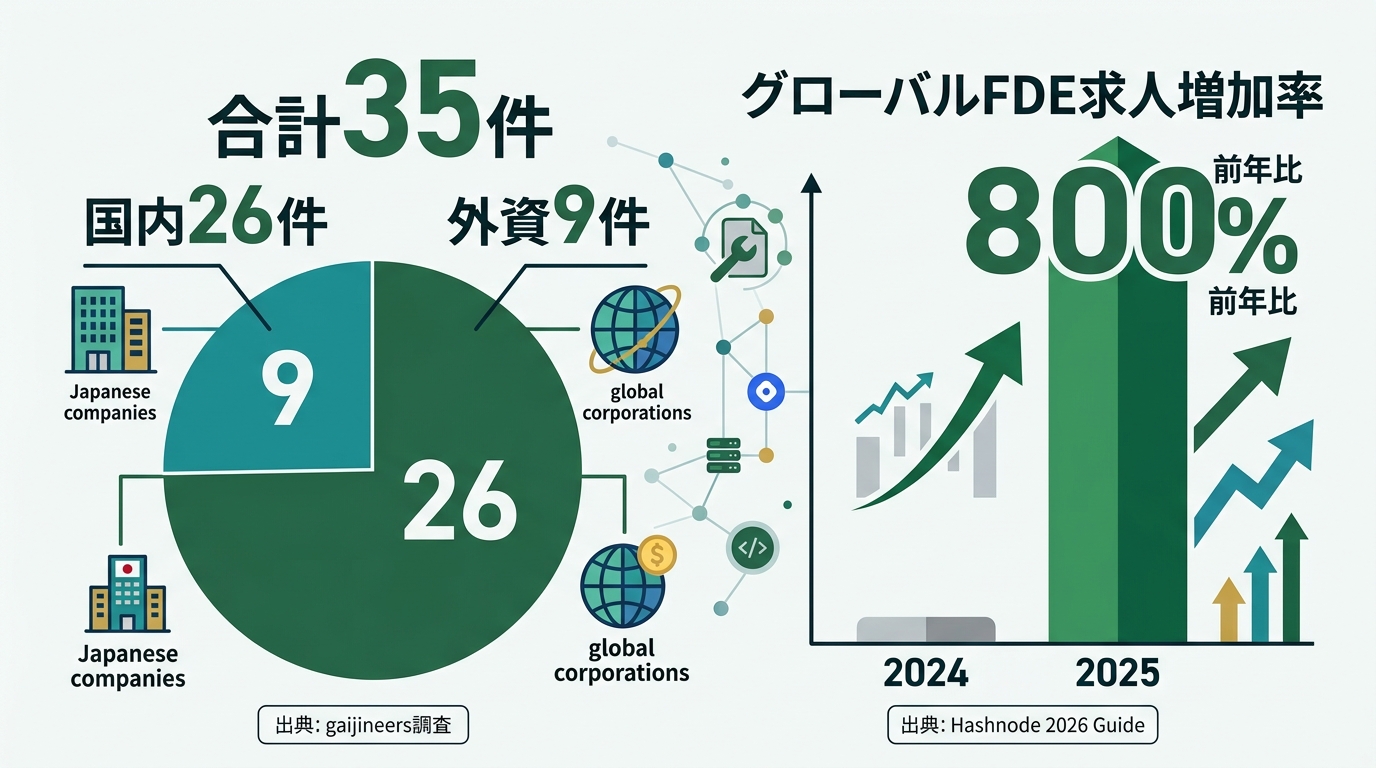
As of spring 2026, there are around 26 FDE openings in Japan. About 9 at foreign-affiliated firms. Roughly 35 in total (survey by gaijineers).
“35 openings” might sound small. In practice, it’s still a niche role. But the wind is shifting. According to the Hashnode 2026 guide, global FDE-related job listings reportedly grew by 800% year-over-year in 2025. The number of openings in Japan is also trending upward.
Who’s hiring?
- Palantir Japan: The originator of the FDE role. Salaries of 20–40 million yen
- OpenAI Japan: Placing an FDE-style specialist team via the MUFG partnership
- Domestic AI startups: Growing numbers of companies are making on-site AI deployment support a core line of business
- Consulting firms: Starting to design FDE-style roles within their AI implementation practices
What I want to highlight is the “required skills” listed in the job postings. Few openings ask for pure coding skills alone. Most postings include “customer engagement experience,” “project management experience,” and “industry knowledge” among their requirements. This is clearly different from traditional engineer job listings.
What a Burned-Out Ex-Engineer Sees as the Essence of FDE: What “Not Just Code” Really Means
From here on, I’m writing my personal take.
I used to work as an engineer. I did both frontend and backend. It was fun. But on a large-scale project, I met some seriously sharp engineers and came face to face with my own ceiling. The depth of their architecture decisions, the precision of their performance tuning. I started to wonder if I should even share the same job title.
After that I pivoted into Customer Success. I left coding behind and chose work focused on listening to users. No regrets.
When I first learned about the FDE role, the first thing I felt was, “Isn’t this the intersection of CS and engineering?”
There’s something I learned in CS work: “Customers can’t accurately articulate what they want.” This is the same problem Palantir, the origin of the FDE, faced. Ask someone at an intelligence agency “what do you want?” and you won’t get an answer. In the CS trenches too, most inquiries were of the “something’s just not working right” variety.
That’s why you go see the workplace. You observe the workflow, find and articulate the problems, and propose solutions all the way through. What FDEs do is CS work with “implementation power” added on top.
So I view the FDE role from a slightly different angle than “the evolution of the engineer.” I see it more as “the destination business-side workers can reach once they pick up technical skills.”
The spread of vibe coding gives this view real weight. With the help of AI, even someone from a CS or sales background can build a working prototype at the customer’s site. Security concerns remain, but safeguards are also starting to emerge. Now that the number of companies deploying AI agents internally is rising, the demand for FDE-style talent will only grow.
It’s not a competition on code quality. The competition is on the speed and precision of “finding the customer’s problem and solving it with something that works.” That, in the eyes of this burned-out former engineer, is the essence of the FDE.
People say the era when you don’t need to write code has arrived. I read that statement through the FDE lens. We’re shifting into an era where people who can’t write code but can “make things run” will generate the most value on the ground.
Before Asking “Can I Become an FDE?”, Do This First
It’s risky to jump at the “60 million yen” number alone. That figure is for the top tier in Silicon Valley, and it diverges significantly from the going rate in Japan.
That said, the direction the FDE role points to is worth referencing. It’s an effective framework for thinking about which of the three axes—“coding ability × business negotiation × domain knowledge”—you should start building now.
If You’re Building Coding Ability
Vibe coding is the lowest-barrier place to start. With Claude Code or Cursor, you don’t need perfect code. The speed of “building a working prototype within 24 hours” becomes the entry point to FDE-style value. According to the Pragmatic Engineer survey, Claude Code adoption has reached 46%. The practical viability of AI-assisted coding has already been proven.
If You’re Building Business Negotiation Skills
Experience in CS, sales, or consulting translates directly. The skill of “structuring a customer’s problem and proposing a solution” is at the core of the FDE role. Even without a technical background, if you have experience proposing business process improvements, you already hold one of the three axes.
If You’re Building Domain Knowledge
Finance, healthcare, manufacturing, retail. Just having 3+ years of practical experience in a specific industry raises your scarcity value as an FDE candidate. The renue survey also lists industry experience among the top requirements for FDE openings.
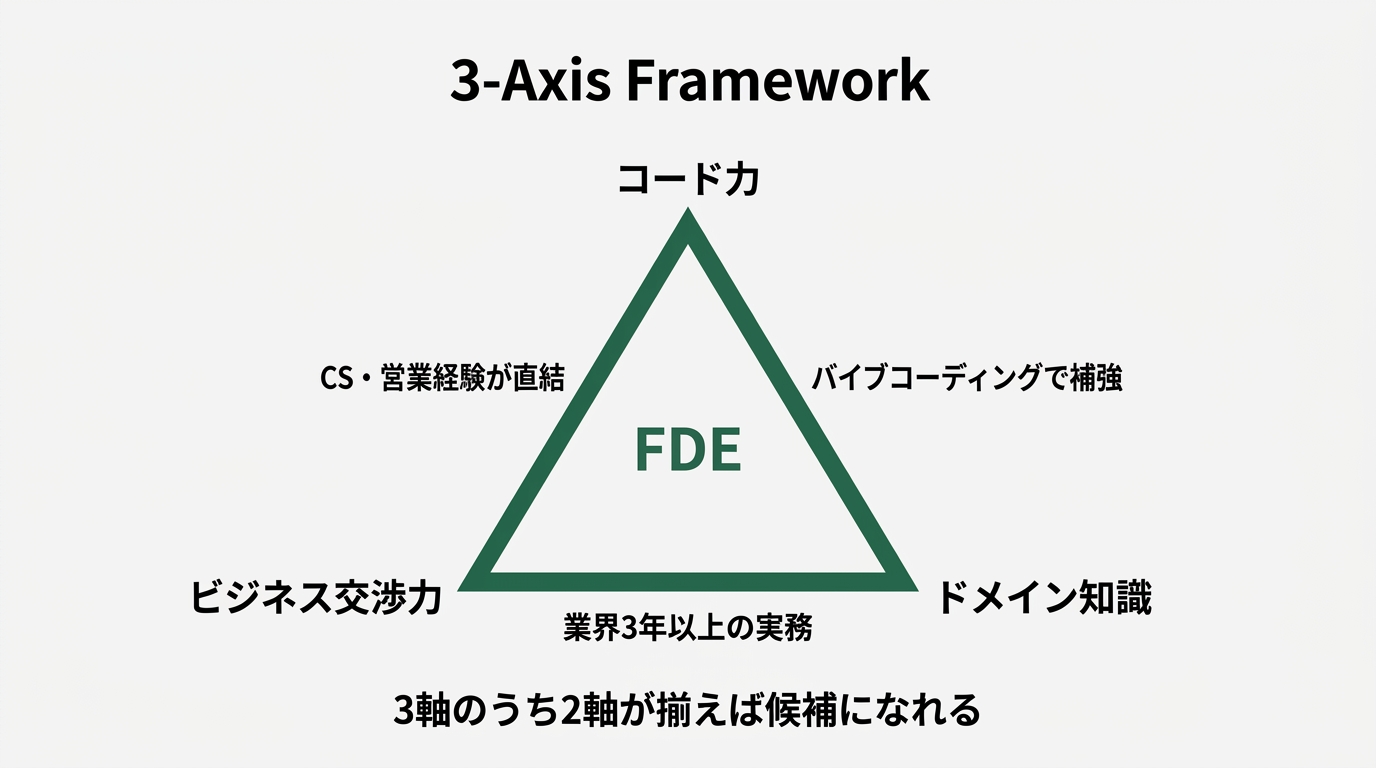
You don’t need to have all three axes from the start. If two axes are in place, you become a candidate. We’ve entered an era where the remaining axis can be filled in with AI. The fact that Anthropic released a cookbook for agents is more evidence that the skill of being “the one using AI” is starting to be valued.
Wrap-Up
The FDE role was born at Palantir out of the problem of “you can’t ask a spy.” With OpenAI sending its team to Mitsubishi UFJ, recognition is starting to spread in Japan as well.
Behind salaries over 60 million yen lies a “multiplication of three layers of scarcity.” People who can write code, talk business, and speak the language of the industry are in short supply worldwide. There are currently 35 FDE openings in Japan, but globally, listings reportedly grew by 800% year-over-year.
The reason I’m so drawn to the FDE role is that I feel it isn’t exclusively for engineers. Experience from CS listening to user voices. Track records in sales drawing out customer problems. When those business-side skills are multiplied by the power of AI, they generate enormous value. That’s the future the FDE points to.
“I can’t write code, so this has nothing to do with me.” I want exactly those people to learn about how the FDE role came to be. The Palantir engineers leapt into the field precisely because they “couldn’t ask.” Your industry knowledge and ability to understand customers will be the key that opens the next chapter of your career.
Chances are high that you already hold one of the three axes. The era of filling in the rest with AI is already here.

正直、一度エンジニアは諦めました。新卒で入った開発会社でバケモノみたいに優秀な人たちに囲まれて、「あ、私はこっち側じゃないな」って悟ったんです。その後はカスタマーサクセスに転向して10年。でもCursorとClaude Codeに出会って、全部変わりました。完璧なコードじゃなくていい。自分の仕事を自分で楽にするコードが書ければ、それでいいんですよ。週末はサウナで整いながら次に作るツールのこと考えてます。