Some Founders Move 10x Faster. Harvard Calls Them '10x Founders' — and the Secret Isn't Adding AI, It's What They Stopped Doing
Some founders move 10x faster. Harvard's '10x Founder' isn't about adding AI — it's about what they stopped doing.
What you'll learn in this article
- The key point to grasp before reading the full article
- How the issue changes practical decisions after reading
- Which follow-up article is worth opening next
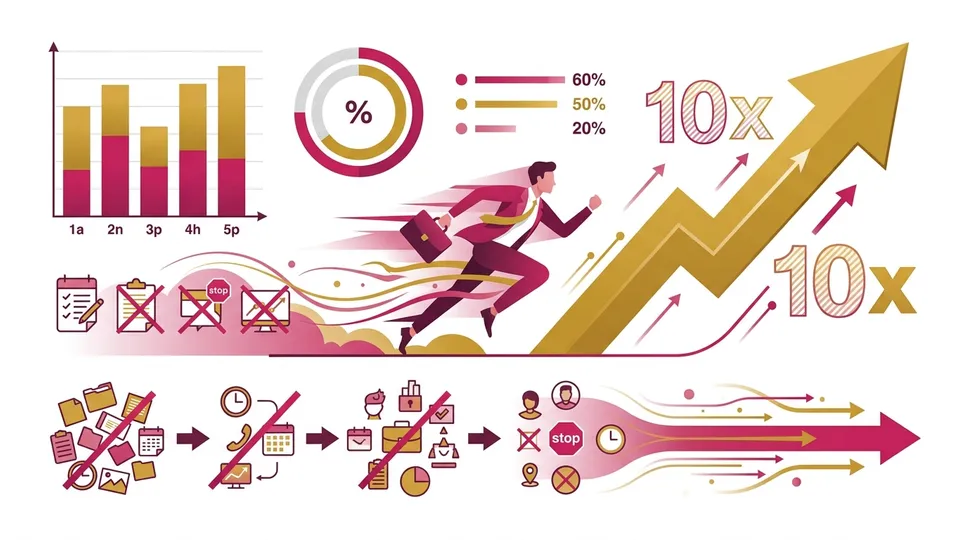
“AI makes you 10x more productive.” You hear that one a lot lately, right?
Honestly, at first I was like, “Yeah yeah, more marketing hype.” 10x? That’s just a buzzword.
But then a Harvard Business School (HBS) professor started using the term in earnest.
Jeffrey Bussgang. HBS professor and venture capitalist. He runs over $1B (about ¥150B) at Flybridge Capital Partners, with 300+ investments under his belt.
In December 2025, he declared on HBS Working Knowledge: “2026 will be the year of the ‘10x Founder.’”
10x Founder. The concept was borrowed from the engineering world’s “10x engineer” (the genius programmer who writes code for ten people). Bussgang extended it to founders in general.
But here’s the thing — what hooked me about this concept wasn’t the “10x” number. It was the fact that everyone who became 10x had something in common: things they stopped doing.
Plenty of people piled on more AI tools. But only a handful actually became 10x Founders. The difference was addition vs. subtraction.
In this article, I’ll walk you through “the subtraction that creates 10x” in three steps: data, examples, and a map. We’ll start by confirming “how much it actually moves the needle” with numbers and real cases, then by the end you’ll be able to draw your own subtraction map.
How Harvard Defines a “10x Founder”: The Point Isn’t Addition
Here’s Bussgang’s argument.
In 2025, the killer app for AI was coding. In 2026, that transformation spreads to sales, marketing, finance, customer support, and operations. As a result, founders who built AI-first workflows can now move at 10x the speed of the old guard.
In his newsletter, he writes:
AI won’t replace founders. But founders who use AI will replace founders who don’t.
What got me about that line is that it focuses on “the user’s choices,” not “AI’s capabilities.” No amount of tool benchmarking will matter. The real question is the sorting: “What do you hand to AI, and what do you keep for yourself?”
I also read Bussgang’s book The Experimentation Machine (HBS listing). He says the essence of a 10x Founder is “experiment velocity.”
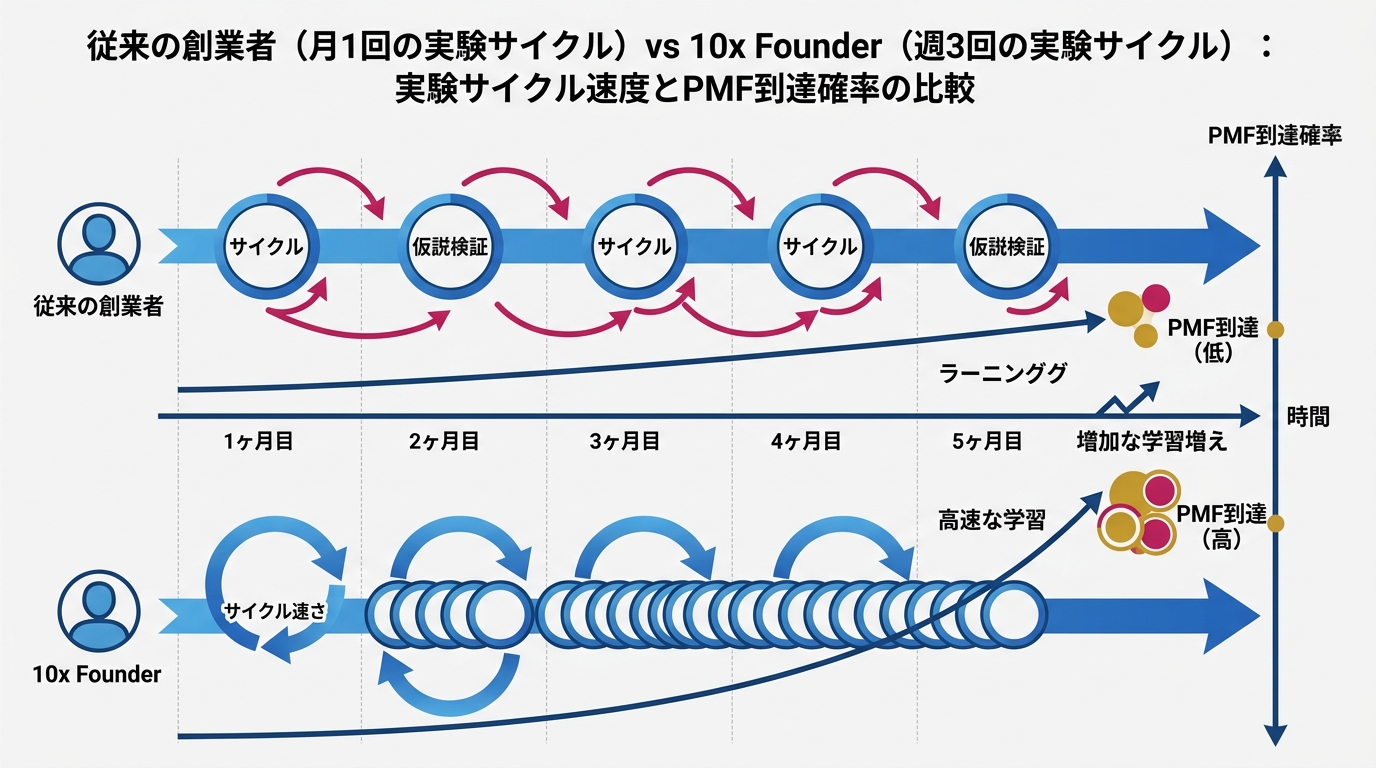
Compress the customer discovery, prototyping, and validation cycle with AI. What used to be a once-a-month experiment becomes three times a week. More at-bats means a higher probability of hitting product-market fit (the point where product meets market, or PMF).
The critical lens here is: “What did they stop doing to get faster?” To run more experiments, you have to let go of most of what you’re doing now. Not addition — subtraction. That’s the heart of “10x subtraction.”
What the Data Says About “Subtraction”: Where Do Those 5.6 Hours Come From?
For anyone who can’t quite picture what “10x” feels like, let’s look at the actual numbers.
According to a January 2026 survey by Business.com and Dialog (sample: 1,009 people working at U.S. companies with fewer than 250 employees), small-business employees save an average of 5.6 hours per week with AI. Managers save 7.2 hours; rank-and-file save 3.4 hours.
5.6 hours a week works out to about 22 hours a month, or roughly 270 hours a year. A full 11 work-days “vanished.”
What vanished was “task time.” Email replies, cleaning up meeting notes, background research, scheduling. Subtracting all of those is where the 5.6 hours come from.
The Gusto report “Main Street Meets Machine Learning” (2025, n=1,480) goes further:
- Over 80% of solopreneurs (people running a one-person business) using generative AI reported “productivity rose by more than 20%”
- 47% reported “revenue grew by more than 20%”
- And yet, only 22% use AI on a regular basis
That “22%” is the key. Nearly 80% stopped at “I tried it.” Most of the people who tried it felt the impact, but it never stuck — which means they hadn’t sorted out “what to hand over.”
An HBS academic study backs this up. The paper “The Uneven Impact of Generative AI on Entrepreneurial Performance” (2024 WP) ran a 180-day experiment with 640 Kenyan SMB owners. AI delivered weekly business-consultant-style recommendations. High performers saw a +15% lift from AI adoption. But low performers got -8% worse.
The gap wasn’t in the quality of AI’s advice. It was in the user’s ability to decide “which suggestion to pick, and how to execute it.” In other words, what makes a 10x Founder isn’t “how you use AI.” It’s “your eye for what you should be working on yourself.”
Base44 Exited for $80M in Six Months. Why Lean, Self-Driving Teams Are Surging
“Okay, I get the data. But can people actually go that far?”
They can — and they are.
Take Base44, led by Maor Shlomo. It’s a platform for building apps with AI, launched in early 2025. An 8-person team built and ran it, with marketing driven entirely through LinkedIn and X. Zero outside funding.
In six months, they acquired 250,000–300,000 users. May 2025 profit was $189,000 (about ¥28M). Then Wix acquired them for $80M (about ¥12B) (Dataconomy, 2025-06-19).
A team self-driving with AI got that far — no big org, no equity rounds. The whole “you need to hire a lot of people” premise is collapsing.
Another one. Matthew Gallagher’s Medvi — an online clinical platform for GLP-1 (weight-loss medication) telehealth. Initial investment? Just $20,000 (about ¥3M). Started with zero employees.
2025 revenue hit $401M (about ¥60B), with $1.8B (about ¥270B) projected for 2026 (PYMNTS, 2026 report). Full-time staff: Matthew and his brother. That’s it. Clinical work is outsourced, and AI (ChatGPT, Claude, Midjourney) handles content, code, and ads.
According to Carta’s Solo Founders Report 2025, the share of solo-founded startups jumped from 23.7% in 2019 to 36.3% in the first half of 2025. That’s a 53% increase.
Even more striking: 52.3% of solo-founded companies achieved a successful exit (acquisition or IPO). The old saying “solo means small” is fully a thing of the past.
The “Stopped Doing” List of 10x Founders — Including What I Stopped Myself
Here’s the meat. What did 10x people actually subtract?
A pattern emerged from multiple surveys and my own experience.
Subtraction Category 1: Producing Routine Content
Drafts of social media posts, first drafts of blog articles, newsletter rough copy. The moment people stopped writing those themselves, their productivity shot up.
I cut my weekly Instagram batch from 2.5 hours to 40 minutes after handing it to AI. I use Claude, and every time I just hand it “tone spec, target audience, banned words.” The first setup took 2 hours, but every week after that runs in 40 minutes.
I do keep “polishing in my own voice.” What you subtract is the “writing from scratch” step, not the “finishing” step. People who misunderstand this and think “AI will do it all” see quality crash.
Subtraction Category 2: Research and Information Organization
Competitive scans, market data collection, meeting transcription and summarization. These add little human-driven value. In my consulting work, I cut the research portion of client proposals from 30 minutes to 5 by handing it to Perplexity (an AI search tool).
For client meeting minutes, Otter.ai handles auto-transcription, then Claude organizes the to-dos. That combo alone vaporizes over an hour a week.
Subtraction Category 3: Scheduling and Admin
Invoice processing, task prioritization, meeting scheduling. One solo podcaster automated audio editing, scene switching, and transcription with AI and saved over 21 hours in a single season.
Templatize anything that can be templatized. Write down “the stuff I do every week,” then look for the parts that don’t require judgment. That’s where your subtraction candidates live.
Subtraction Category 4: Front-Line Customer Support
FAQ responses, ticket triage, first-touch chat replies. Hand these to AI; humans focus only on “inquiries that need judgment.” One of my consulting clients runs an e-commerce site — after they implemented this, their daily support workload dropped from 2.5 hours to 40 minutes.
Now, the flip side. What did 10x Founders absolutely refuse to let go of?
- Strategic decisions: which markets to enter, what to build
- Relationship building: trust with clients, negotiations with partners
- Final quality calls: the eye to judge “is AI’s output good enough to ship?”
Same for me. I pay ¥8,000/month for my AI stack, but client meetings and strategy proposals are non-negotiably my own work. That’s literally “the reason clients hire me.”
A “Subtraction Map” You Can Build Today: Just Sort Tasks Into Two Columns
“Okay, theory makes sense. So what do I actually stop?”
You’re going to build one map. Paper, spreadsheet, doesn’t matter. The method is simple: write out every task you’re doing right now, then sort into two columns.
Left Column: Keep (Requires Human Judgment)
- Strategic decision-making
- Direct conversations with clients and customers
- Final quality checks
- Setting the brand’s direction
Right Column: Hand to AI (Routine, Repetitive, Information Processing)
- Email drafts and replies
- Research and data collection
- Social media post drafts
- Meeting notes and summaries
- Scheduling
- Invoices and routine accounting
- FAQ and first-touch inquiries
I have my clients run this exercise too. One web designer in her 30s wrote 12 tasks in her right column. She handed just 5 of them to AI, and her monthly project count went from 3 to 7.
The key: don’t dump everything in the right column to AI at once. Try just one. If it works, then the next. That step-by-step subtraction is, paradoxically, the fastest path.
If you’re on the fence, ask: “If I stop doing this, does it impact the value I deliver to clients?” If the answer is no, it belongs in the right column.
Gusto’s survey backs this up too. Companies using AI for “strategic decision-making” are 2.8x more likely to hit 20%+ productivity gains than those that don’t. The “eye” for what to subtract is what determines the outcome.
Wrap-Up: 10x Starts with Subtracting, Not Adding
HBS professor Bussgang named the “10x Founder.” The heart of the concept isn’t using a lot of AI.
It’s identifying what you don’t need to do yourself and letting it go. Pour the recovered time into more experiments. More at-bats means a higher hit rate. That’s the structure.
The data backs it up. SMBs are subtracting 5.6 hours a week (Business.com × Dialog, January 2026 survey, n=1,009). Solo founder share surged to 36.3% (Carta 2025). Base44 exited at $80M with an 8-person team. Medvi posted $401M in revenue with 2 people.
But as that HBS experiment showed, AI isn’t a cure-all. High performers gain +15%; low performers lose 8%. The gap comes down to your judgment about “what to keep and what to release.”
That’s why your only task today is to make a subtraction map. Sort your tasks into two columns, then hand just one item from the right column to AI.
I started three years ago by handing email drafting to AI. Today, with a ¥8,000/month AI stack, I’m pulling in over 3x the revenue I earned as an employee.
The 10x secret isn’t what you added. It’s what you subtracted. What goes in your right column?
※ My previous article, “The $1.7 Trillion Solopreneur Economy,” covered the bigger picture of AI utilization. Combine it with today’s “subtraction map” and you’ll start to see how to move. Once your right column grows, the next step is “always-on operation.” Nagi’s article covers when to fully automate the work you’ve subtracted. “When Do You Graduate from AI Agent Experimentation?” — pair it with this one.
Sources
- HBS Working Knowledge: Eight Trends for 2026
- Jeffrey Bussgang: The 10x Founder
- HBS: The Experimentation Machine
- HBS: The Uneven Impact of Generative AI on Entrepreneurial Performance
- Business.com: 2026 Small Business AI Outlook Report
- Gusto: Main Street Meets Machine Learning
- Carta: Solo Founders Report 2025
- TechCrunch: Base44 sells to Wix for $80M
- PYMNTS: The One-Person Billion-Dollar Company Is Here
- How Solopreneurs Are Quietly Scaling With AI

女性だからこそ、AIを使いこなさなきゃって思ってる。仕事も、副業も、推し活も、旅行も、全部やりたい。人生一度きりなのに時間は足りないじゃん?だからAIに任せられることは全部任せる。浮いた時間で本当にやりたいことをやる。それがあたしのスタイル。ここにはあたしが実際にやったことをまとめてるだけ。誰かのためになったらいいなって思って書いてるよ。