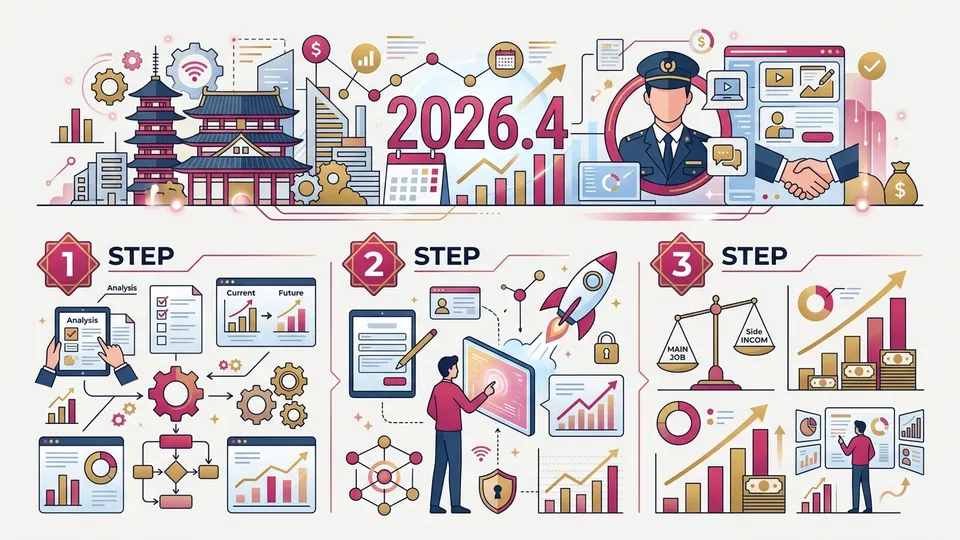
The Era of Civil Servant Side Hustles Has Arrived: 3 Steps to Combine 'Stability × Side Income' with Japan's April 2026 Reform
In April 2026, Japan eased the self-employment restrictions on national civil servants. 'Stable salary' and 'earning with your own skills' can finally coexist. Here's everything: what the reform actually says, the OK/NG boundaries, and 3 steps you can start today.
What you'll learn in this article
- The key point to grasp before reading the full article
- How the issue changes practical decisions after reading
- Which follow-up article is worth opening next
“Civil servants can’t have side jobs”—this common sense collapsed in April 2026.
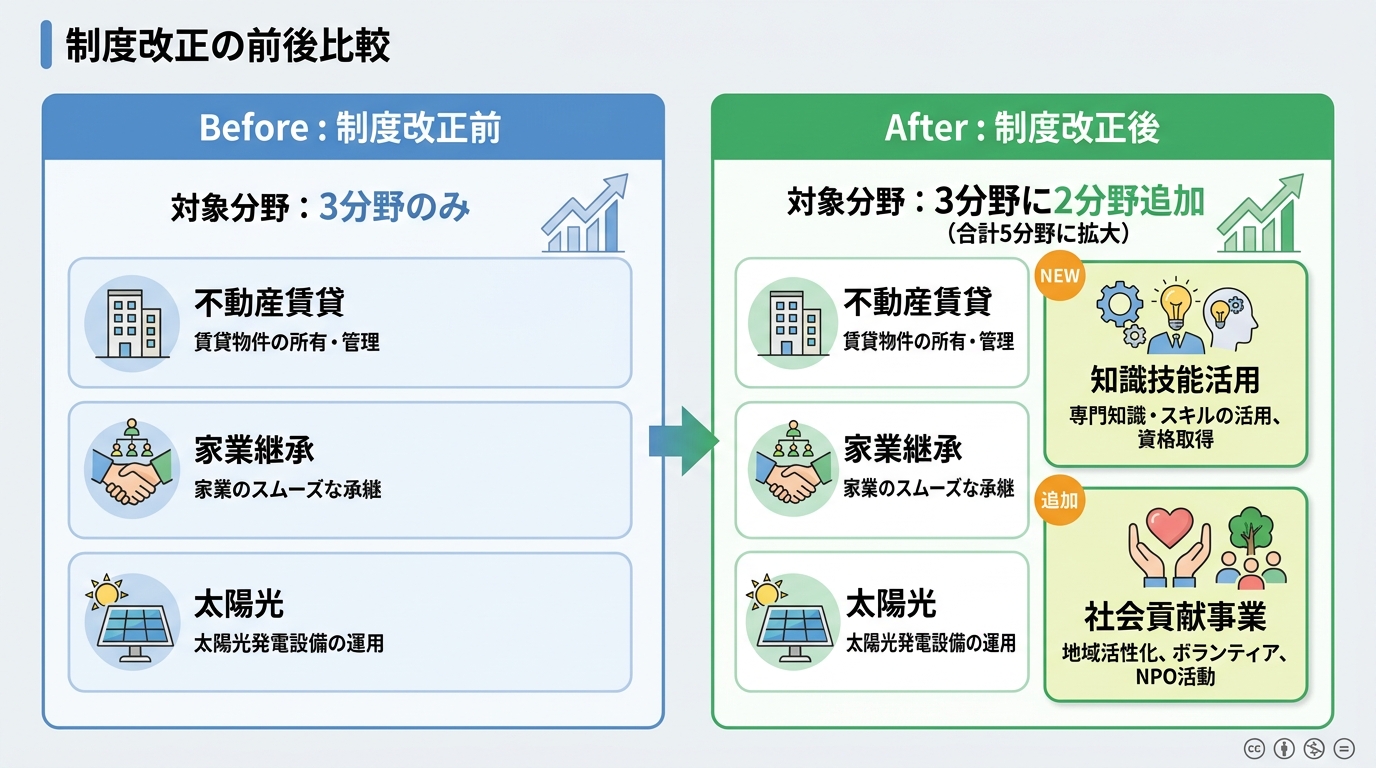
Japan’s National Personnel Authority revised the self-employment side-business rules, and now self-employment that leverages hobbies and special skills is officially OK. Real estate rental, family business succession, and solar power generation—those were the only three categories approved until now. That’s just exploded wide open.
I’ve always heard voices around me saying, “I’m a civil servant, but I want to do something with my own abilities.” Same as me back in my corporate days. There’s stability, but no discretion. You want a place where your voice reaches someone. I get that feeling—painfully.
In this article, I’ve nailed down exactly what the reform says, and then organized “what to do starting today” into 3 steps. By the time you finish reading, you’ll think, “Oh, maybe I can do this too.”
What Actually Changed in April 2026—Getting the National Personnel Authority’s Reform Right
Let me start with the facts.
On December 19, 2025, the National Personnel Authority officially announced the “Review of the Self-Employment Side-Business System” (NPA press release). It took effect on April 1, 2026.
There are two big changes.
First: “Self-employment leveraging knowledge and skills” was added to the approval scope. Selling handicrafts, running sports classes, giving art lessons. These “earning income as an extension of a hobby” activities are now officially recognized as approved side businesses.
Second: “Businesses contributing to social good” are now also included. Hosting community revitalization events, grocery shopping assistance for the elderly, programming classes for kids. If the business benefits society, the path to approval is now open even when it’s profit-oriented.
The backdrop is a survey of about 2,000 people conducted by the NPA (Nikkei). Over 30% answered “I want a side business that leverages my hobbies and special skills” and “I want a side business that contributes to society.” In other words, the voices from the field moved the system.
“Over 30% want side businesses that leverage hobbies and special skills.” That survey result didn’t surprise me. Because back when I was a corporate worker, I was thinking the exact same thing the whole time. “I want to use what I’m good at to help someone.” And now, it’s officially recognized as a system.
By the way, discussions for this reform actually started back in 2023. The surge in “civil servants interested in side jobs” driven by COVID-era remote work was a major push. Changes in the field moved the institution. It’s a textbook case of “if there’s demand, the system changes.”
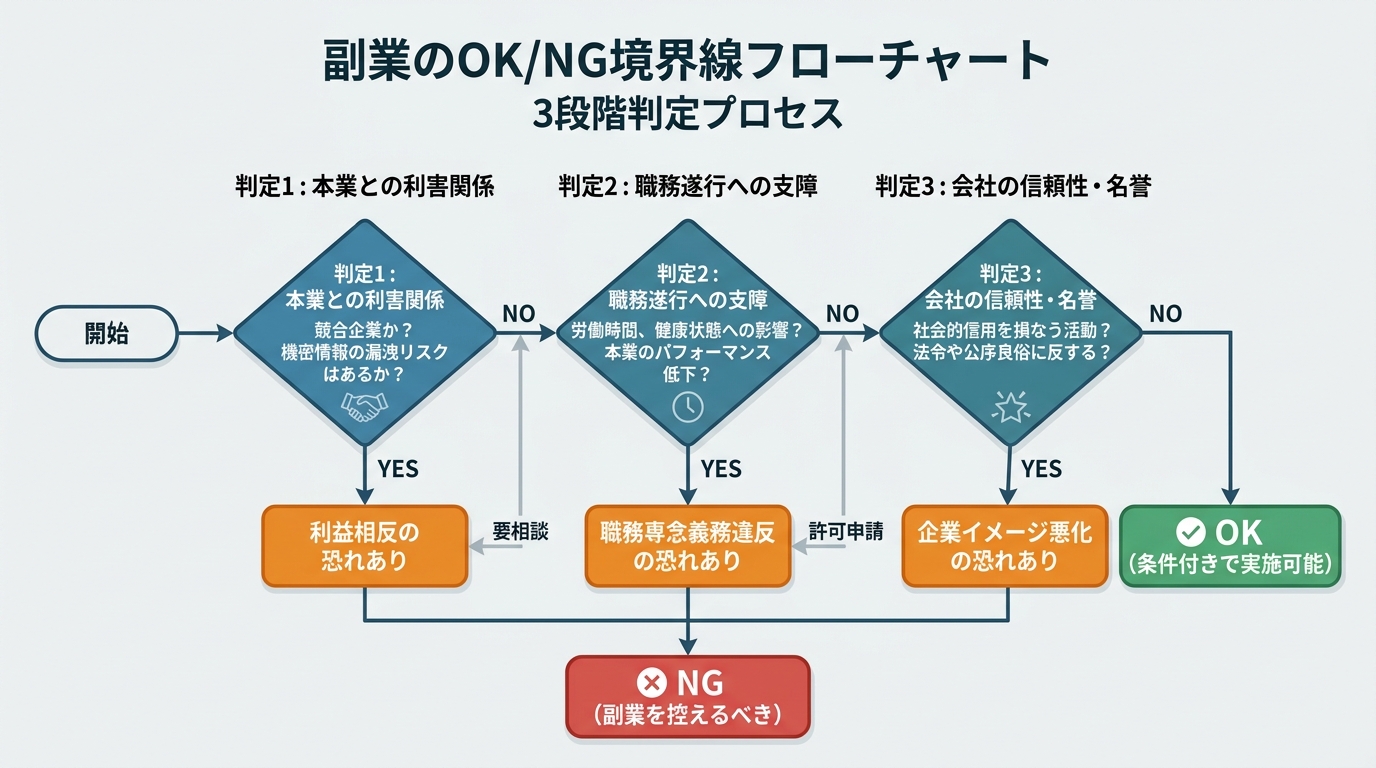
What to watch out for: it’s not like “anything goes” now. Approval has three conditions.
- No conflict of interest — no special interest relationship between your job and the business
- No impact on your duties — your main job performance doesn’t drop
- Doesn’t damage public trust — citizens won’t look at it and think, “yeah, that’s a problem”
After meeting these three conditions, you submit a business registration and a business plan. The business plan needs to cover purpose, operations, business days/hours, and projected annual revenue (NPA Q&A).
“Business plan” might sound intimidating, but really, it’s just summarizing “what, when, and how much” on one piece of paper. Totally different from a startup pitch to investors.
”OK Side Jobs” vs “NG Side Jobs”—Drawing the Line with Concrete Examples
Just talking about the system in the abstract is hard to grasp. Let me draw the boundary with concrete examples.
Examples of newly OK side jobs
- Selling handicrafts online — Handmade accessories on BASE or minne. An extension of a hobby, with low risk of conflicts of interest
- Yoga classes / sports coaching — Weekend lessons at local community centers. Also counts as social contribution
- Programming classes — Scratch classes for kids, Python intro for beginners. A great fit for civil servants with IT knowledge
- Writing / running a blog — Turning your specialized knowledge into articles. Just avoid content related to your ministry’s actual operations
- Photography / illustration — Earning income from your hobby camera or illustrations. Selling on stock photo sites can also qualify
Examples in the gray zone or likely NG
- Consulting for companies that have interests with your ministry — violates Condition 1
- Businesses big enough to eat into your work hours — 30 hours a week of side work? No way. Hits Condition 2
- Advocacy on politically sensitive topics — could damage “public trust” under Condition 3
- Becoming a board member of a corporation — still NG in principle as before. Separate from the self-employment side-business system
The key is that it has to be “self-employment.” Forms where someone else hires you (like part-time work) aren’t covered by this reform. Only running your own business counts.
One FAQ I’ll cover: “Is it OK to run a blog anonymously?” Anonymity itself isn’t NG. But writing in a way that identifies your ministry, or touching on internal information related to your duties, is out. The most realistic stance is: “I won’t mention where I work, but I can explain regulations in plain language.”
One more thing to watch—how this spreads to local governments. This reform only covers national civil servants. But Jichitai Works reports that some local governments like Kobe and Ikoma have already independently permitted side jobs. With the national government making a move, the spread to local governments will accelerate.
And this is actually the biggest opportunity. Why? Because thanks to AI, the range of businesses you can run “solo” has exploded.
Why “Now”—3 Reasons AI × Side Hustles Fit Civil Servants
“OK, the system changed. So what?” you might think.
What I want to say is: it’s no coincidence that this reform and the evolution of AI are happening at the same time.
Reason 1: AI broke down the “time wall”
The biggest bottleneck in civil servant side jobs is time. You have your main job on weekdays, plus overtime. What can you really do with a few hours on the weekend?
But here’s the thing—using AI, that premise changes.
Take blog articles. When I went independent doing SNS marketing, writing one article took me 4–5 hours. Researching, structuring, writing, editing. Now I draft with AI and rewrite it in my own voice. With 2 hours, I can produce a high-quality article.
Same with AI consulting. Hear the client’s problem, build the analytical framework with AI, draft the proposal. The prep time per consulting case has been cut in half or more.
Right now, Claude and ChatGPT are the mainstream options. Both start at around 2,000 yen/month. You can use the time saved on “client conversations” and “organizing your own unique experiences”—that’s what differentiates your content.
According to a SB Business+IT survey, AI writing pays around 5,000 yen per article. Write 8 a month and that’s 40,000 yen. Totally doable just on weekends.
Reason 2: There’s value in “translating specialized knowledge”
Civil servants actually have incredibly specialized knowledge. Law, system design, statistical analysis, budget management. But they often haven’t been trained in “explaining it to ordinary people in an accessible way.”
Bring AI into this picture, and “translating” specialized knowledge for a general audience becomes ridiculously easy.
Let me give an example. Someone working at a tax office writes a blog post on “Top 5 common mistakes in tax filing.” They already have the expert knowledge from their day job. Tell AI to “break this down for beginners,” and the draft pops out in 5 minutes. All you do is add concrete examples from your own experience.
This doesn’t trigger conflict of interest, and it’s a social contribution. It’s a pattern that clears all three conditions.
According to AI Business Japan, the hourly rate for AI consulting is around 10,000–15,000 yen (a reference figure that varies with market conditions and track record). Seven hours of consulting a month = over 100,000 yen. That’s an extra 100,000 yen on top of a civil servant’s monthly salary. That’s life-changing money.
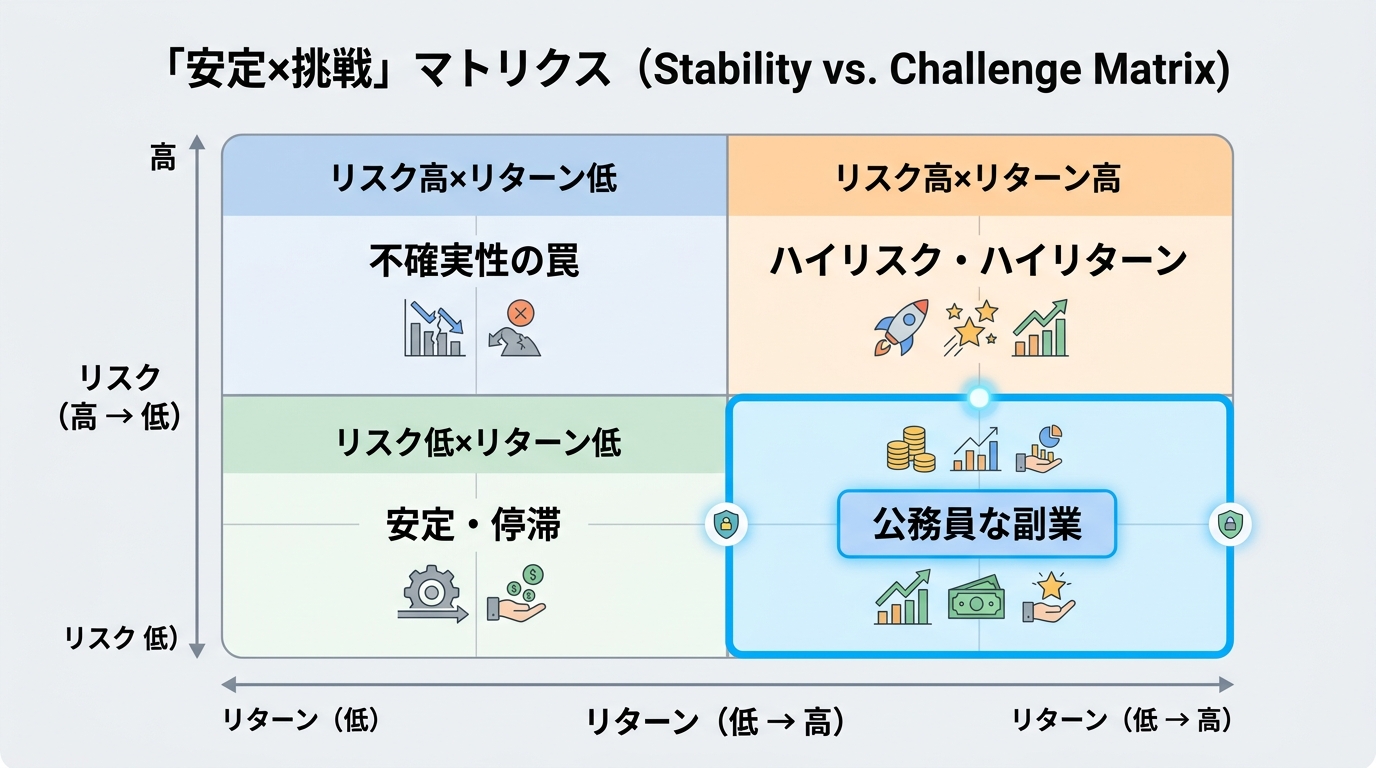
Reason 3: The strongest combo—“stability × challenge”
I’m on the side that went independent, so I’ll be honest. Going independent has risk. There were months I made zero. I know the terror of watching savings shrink.
Civil servant side jobs have nearly zero of that risk. Your main salary comes in every month. Even if the side business doesn’t work out, your life doesn’t fall apart.
This means “the bar to taking on a challenge is incredibly low.”
When I started my side hustle, I was still a corporate employee, so even if I failed, I knew I could still eat. That security became the engine for “let me just try.” Civil servants have exactly that structure.
US data, but according to SB Business+IT, about 60% of small businesses have already adopted AI tools. That’s over double the adoption rate from 2023. The barrier to AI has already come down all the way. “AI seems hard”—that was a feeling from 2 years ago.
The 3 Steps to Start Today—Turning “Someday” into “Today”
Here’s the main event. Now that you understand the system, here are the 3 steps to start moving today.
Step 1: Decide “what to earn from” in 30 minutes
If you have time to hesitate, move. That’s my ironclad rule.
What to do is simple. Open a notebook, draw these three circles.
- Knowledge/skills from your main job — legal knowledge, data analysis, document writing, project management
- Hobbies/special skills — cooking, photography, programming, English, crafts, sports
- Things AI can speed up — writing, design, data organization, research
Where these three overlap is your side hustle theme.
Let me give some concrete examples.
Pattern A: IT-track civil servant × programming hobby × AI → Programming classes for kids. Use AI to build the curriculum. Also counts as social contribution.
Pattern B: General-affairs civil servant × document-writing skill × AI → A blog on “how to write grant applications” for small businesses. AI drafts the articles. Translation of specialized knowledge.
Pattern C: Welfare-track civil servant × elder care knowledge × AI → A media site on “systems you should know about for caring for aging parents.” AI auto-generates the FAQ. High social-contribution value.
Even if you can’t decide in 30 minutes, it’s fine. “This, I guess?” is enough. You can correct course while running.
One thing I’ll add. The clients of mine who’ve kept their side hustles going longest chose what they “liked” over what they were “good at.” You can keep doing what you love even when it isn’t going well. Because you keep going, you get better. Civil servant side hustles aren’t a sprint. Choosing based on what you love is actually the more rational choice.
The first side hustle theme I picked was “SNS marketing on contract.” Honestly, it didn’t go well at first. What clients wanted and what I was good at didn’t line up. I did it for 3 months, pivoted, and switched to “SNS marketing consulting.” That’s when it took off.
People who try to make a perfect plan before starting usually never start. I guarantee it.
Step 2: Write your business plan over the weekend
Don’t let the words “business plan” intimidate you.
According to the NPA Q&A, you just need these sections.
- Purpose of the business: what you’ll do (1–2 lines)
- Operations: specific services or products
- Business days / hours: e.g., “3 hours each Saturday and Sunday”
- Products / services offered: blog articles, classes, handmade goods, etc.
- Projected annual income: 30,000–50,000 yen/month × 12 months = 360,000–600,000 yen
It fits on a single A4 sheet. 2–3 hours over the weekend is enough.
AI is useful here too. Ask ChatGPT to “create a business plan template for a civil servant side hustle,” and the boilerplate appears. Then you just fill in your specifics.
When I wrote my first business plan, it took me 3 days. AI didn’t exist. Now you can knock it out in 30 minutes. Times have changed, I tell you.
Step 3: Submit the business registration and talk to your boss
Step 3 is probably the highest psychological hurdle. “Talking to my boss about a side job? Awkward…” right?
But here’s the thing—since it’s recognized as a system, there’s no need to feel awkward.
Three keys to the conversation.
- Say “This is an official procedure based on the system” — share the premise that this isn’t personal indulgence, but a system the NPA approved
- Show the business plan first — putting “no impact on the main job” on paper makes it easier for your boss to judge
- Add “there’s a social-contribution aspect too” — for kids’ classes or community work, this leaves a positive impression on the organization
Submit the business registration to the tax office. Submit the approval application to your ministry along with the business plan. Running both at the same time goes smoothly.
Komuin no Right lays out the approval criteria. Three things: “no conflict of interest with your duties,” “outside working hours,” and “doesn’t damage public trust.” If the theme you picked in Step 1 satisfies these three, you have a high chance of approval.
One more thing: Lancers has released a service called “Lancers for Civil Servants” (Lancers press release). It’s a matching service for civil servant side gigs—proof that the regulatory tailwind is reaching private services too. If you find “self-promotion is too high a hurdle,” starting from a platform like this is a totally valid path.
The Reality of “30,000–50,000 Yen/Month”—Surviving the First Six Months
I always say “the people who actually do it win in the end,” but I won’t claim you’ll earn big from the start. That would be a lie.
Here’s a realistic sense of the numbers for the first six months.
For running a blog
- Months 1–2: Write 10 articles. Revenue near zero. But this is seed-planting time
- Months 3–4: Articles start appearing in search. AdSense revenue of a few thousand yen/month
- Months 5–6: Affiliate conversions start coming in. 10,000–30,000 yen/month
For online classes
- Month 1: List courses on Street Academy or Coconala. Start with low prices like 500 yen to build a track record
- Months 2–3: Reviews accumulate. Raise prices to 3,000–5,000 yen
- Months 4–6: Repeat customers appear. 30,000–50,000 yen/month becomes visible
For AI consulting
- Month 1: Post on SNS “Here’s what I can do.” Take 2–3 monitor-priced cases
- Months 2–3: New clients come through monitor-client word of mouth. 5,000–10,000 yen per session
- Months 4–6: Steady flow of 2–3 cases/month. 30,000–50,000 yen/month
In every pattern, the first 2 months are “seed-planting.” A lot of people give up here saying “I’m not earning anything”—but that’s too soon.
One thing I want to share: “If 3 months in and you’re at zero revenue, consider pivoting.” Pulling back isn’t failure. It’s switching to the next theme. The know-how I got from initially failing at SNS marketing became the core of my current consulting work. People who learn from failure end up the strongest.
I had 50 followers for the first 2 months when I started SNS marketing too. “Nobody’s watching me,” I thought, over and over. I kept going. In month 3, a post went viral, and from there it took off all at once.
Civil servant side hustles have one more huge advantage. “You don’t have to quit.” For freelancers, a few zero-revenue months means life falls apart. With a civil servant salary as the base, you can spend the seed-planting phase without panicking. The psychological breathing room is bigger than you’d imagine.
When I went independent, I was checking my bank balance every day. That panic distorted my judgment at times. Growing a side hustle while you have a stable income—I genuinely think that’s not luxury, it’s the smartest strategy.
Only those who keep going get results. That’s true for any side hustle.
Making AI Your “Partner”—AI Workflows for Civil Servant Side Hustles
This is Mikoto’s territory, so I can’t skip it—here are some concrete AI usage patterns.
Pattern 1: Assistant for content production
When writing a blog article, ask AI to “suggest 5 outline structures.” Use what comes out as a base, and flesh it out with your own experience and knowledge.
The key is “don’t dump it all on AI.” Text AI produces tends to be generic. Mixing in “experiences only you can write” is what makes articles land with readers.
Pattern 2: Cutting research time
Market research on your side-hustle theme. Ask AI “tell me the size and growth rate of the X market” to grab the overall picture. Then verify with official sources.
Research time gets cut by more than half, so your limited weekend hours can go into “actually building things.”
Pattern 3: Streamlining client interactions
If you’re running online classes or consulting, use AI to build templates for common questions. When inquiries come in, customize from the template.
According to a survey by EntrepreneurLoop (a reference value based on their study), 64% of solopreneurs (people running businesses alone) answered “my business wouldn’t have grown without AI.” 91% feel a major reduction in administrative work. 74% answered “I scaled the business without hiring a single person.”
Civil servant side hustles are about “how much output you can produce in limited time.” AI is the tool that maximizes that time efficiency—not using it would be a waste.
The tools you use can stay simple. Claude and Notion alone handle 80% of my work. The more tools you have, the harder management gets. “Master one tool for a month” is the fastest path to growth.
One important thing: AI isn’t a “magic wand.” It’s a tool. Humans use the tool, and without your specialized knowledge and experience, AI’s output is just generic talking points.
There are info products out there saying “use AI and earn easily,” but don’t trust that stuff. AI streamlines the work. What creates value is your own knowledge and experience. As long as you don’t get that confused, AI becomes the best partner you can ask for.
Closing—“Challenging Yourself Without Giving Up Stability”
In April 2026, the self-employment side-business restrictions for national civil servants changed. Self-employment that leverages hobbies and special skills is now officially permitted.
I’m on the side that went independent, so I always want to say “independence is the best!” But honestly, I don’t think everyone should go independent. Staying stable while building “the experience of earning with your own skills”—that’s a respectable challenge too.
Looking back, the reason I quit my company and went independent was that my voice didn’t reach anyone there. When my words first reached someone through SNS, my life changed.
Maintaining stability as a civil servant while building a place where your voice reaches—that might be a much smarter strategy than going independent. Turning stability from “shackles” into “a weapon.”
There are only 3 things to do today.
- Tentatively decide your side hustle theme in 30 minutes
- Write your business plan over the weekend
- Talk to your boss based on the system
“Someday” never comes. When I started my side hustle, I didn’t wait for the perfect timing. I decided for myself, “now is that timing.”
I started my one-person company, and I’m now in year 6. The scariest moment was the instant of taking that first step. But after taking it, I have yet to meet a single person who said, “I wish I hadn’t done that back then.”
The moment the system changed is exactly that timing. Keep the weapon of stability in hand, and try taking that first step. I’m cheering for you with everything I’ve got.

女性だからこそ、AIを使いこなさなきゃって思ってる。仕事も、副業も、推し活も、旅行も、全部やりたい。人生一度きりなのに時間は足りないじゃん?だからAIに任せられることは全部任せる。浮いた時間で本当にやりたいことをやる。それがあたしのスタイル。ここにはあたしが実際にやったことをまとめてるだけ。誰かのためになったらいいなって思って書いてるよ。