17,000 People in 10 Days: What Japanese Solopreneurs Can Steal from China's National 'One-Person AI Company' Project
Government-led 'OPCs' (One-Person AI Companies) are exploding across China. We dissect the reality—17,000 applications in Shenzhen, Suzhou's 1,000-company plan—and break down what Japanese solopreneurs should adopt and what to leave behind.
What you'll learn in this article
- The key point to grasp before reading the full article
- How the issue changes practical decisions after reading
- Which follow-up article is worth opening next
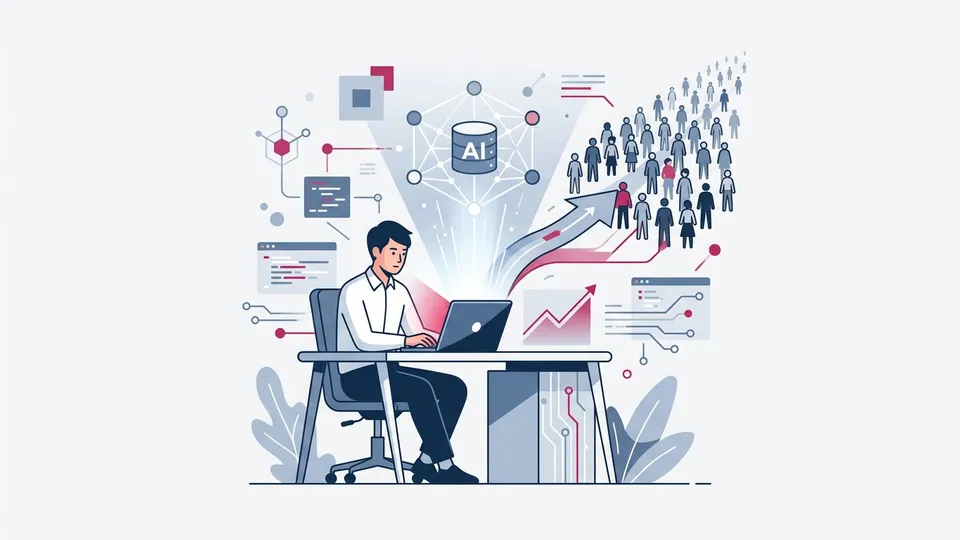
17,000 people in 10 days.
That’s not the applicant count for some job site. It’s the number reported by Rest of World’s investigation—the flood of people who rushed to register “one-person AI companies” in Shenzhen, China, over just 10 days.
Honestly, when I saw that number, I got chills. Japan has nothing close to this kind of momentum around starting a one-person company. But over in China, the state is dead serious, ordering people to “go start a business with AI, by yourself.”
If you write this off as “wow, China is something else,” you’re losing out. What can Japanese solopreneurs (people running a business solo) steal from this? And what should we absolutely not copy? I’ve sorted through it in my own way. It looks like a story about China on the surface, but it’s actually content that connects directly to your own blueprint for a solo business.
What is an OPC (One-Person Company)? The “Solo Founder” Template China Built as a National Project
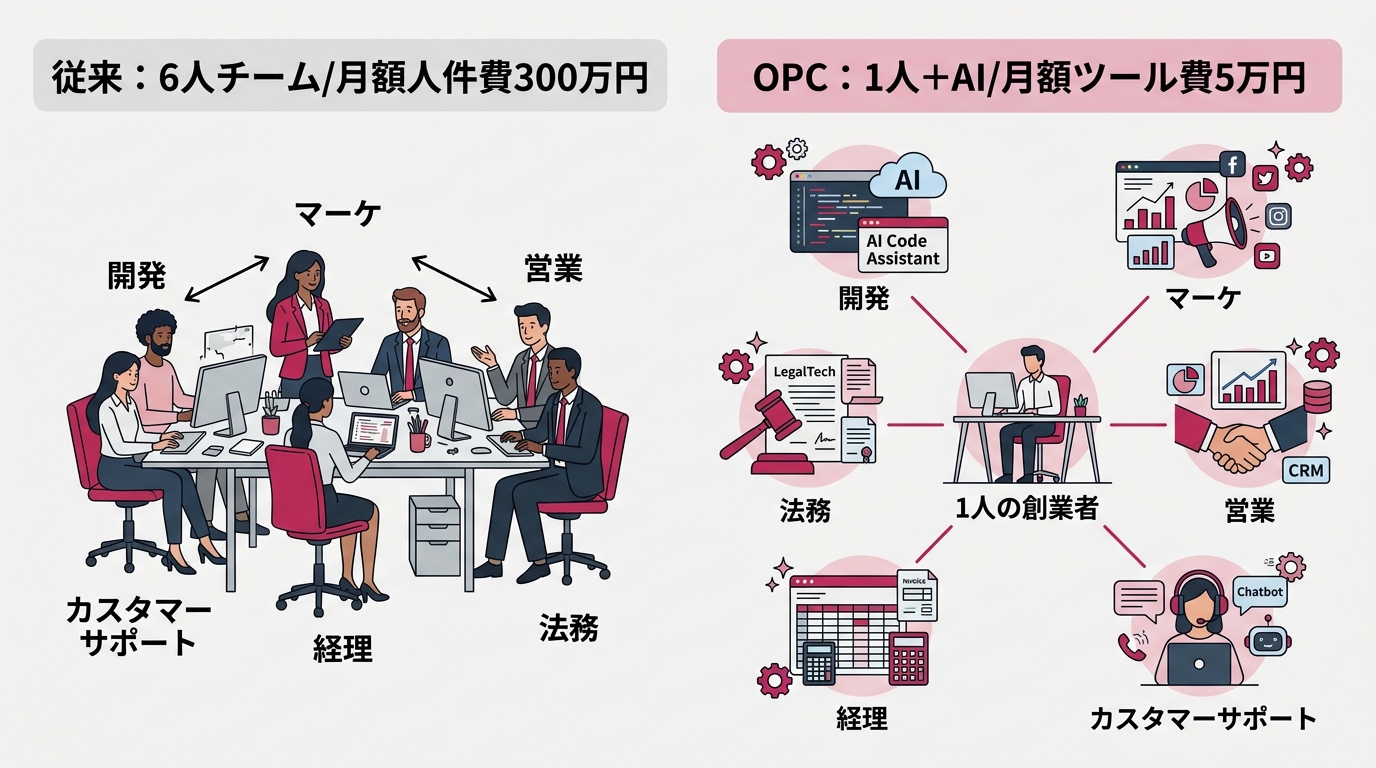
OPC stands for One-Person Company. It’s a company format where a single person runs every stage of the business by leveraging AI tools.
Development, sales, marketing, customer support, accounting. Work that used to require a team of 5 to 10 people is now handled by one person using AI agents and chatbots. That’s the basic shape of an OPC.
According to Xinhua’s reporting, OPCs have been exploding nationwide across China as of the first half of 2026. Beijing, Shanghai, Shenzhen, Suzhou, Nanjing, Hangzhou. Six major cities have all started building dedicated support hubs.
Here’s the biggest point. OPCs didn’t “just appear on their own.” The national and local governments are stacking up incentives and deliberately growing them.
In Japan, for example, when you start a one-person company, the state isn’t going to pay your rent. They don’t subsidize your cloud compute costs either. You either burn through your savings or take out a loan. That’s just how it is.
China takes the exact opposite approach. “If you want to start a company, we’ll give you the space and the money. Just build something with AI.” That’s the stance.
Behind this is the wave of mass layoffs happening across China’s tech industry. The state is waving the flag and telling the talented engineers and marketers who got pushed out of major IT companies, “Don’t go find another job—start your own company.” They’re going after unemployment relief and AI industry development with a single stone. That difference in temperature is what shows up in the 17,000 number.
In Japan, if you walk into your city hall and say “I want to start a one-person company,” the best you’re going to get is a referral to a startup support desk. Free housing and GPU subsidies? Pure fantasy. That’s the reality.
Shenzhen vs. Shanghai vs. Suzhou: Cities Battling Each Other With “Come Here Instead”
What’s fascinating about China is that cities are competing with each other over “our OPC support is more generous.”
Imagine Fukuoka, Sendai, and Sapporo fighting a “startup attraction battle” in Japan. Except the scale and seriousness are on a totally different level. Let me organize the support policies from each major city, based on Rest of World’s investigation.
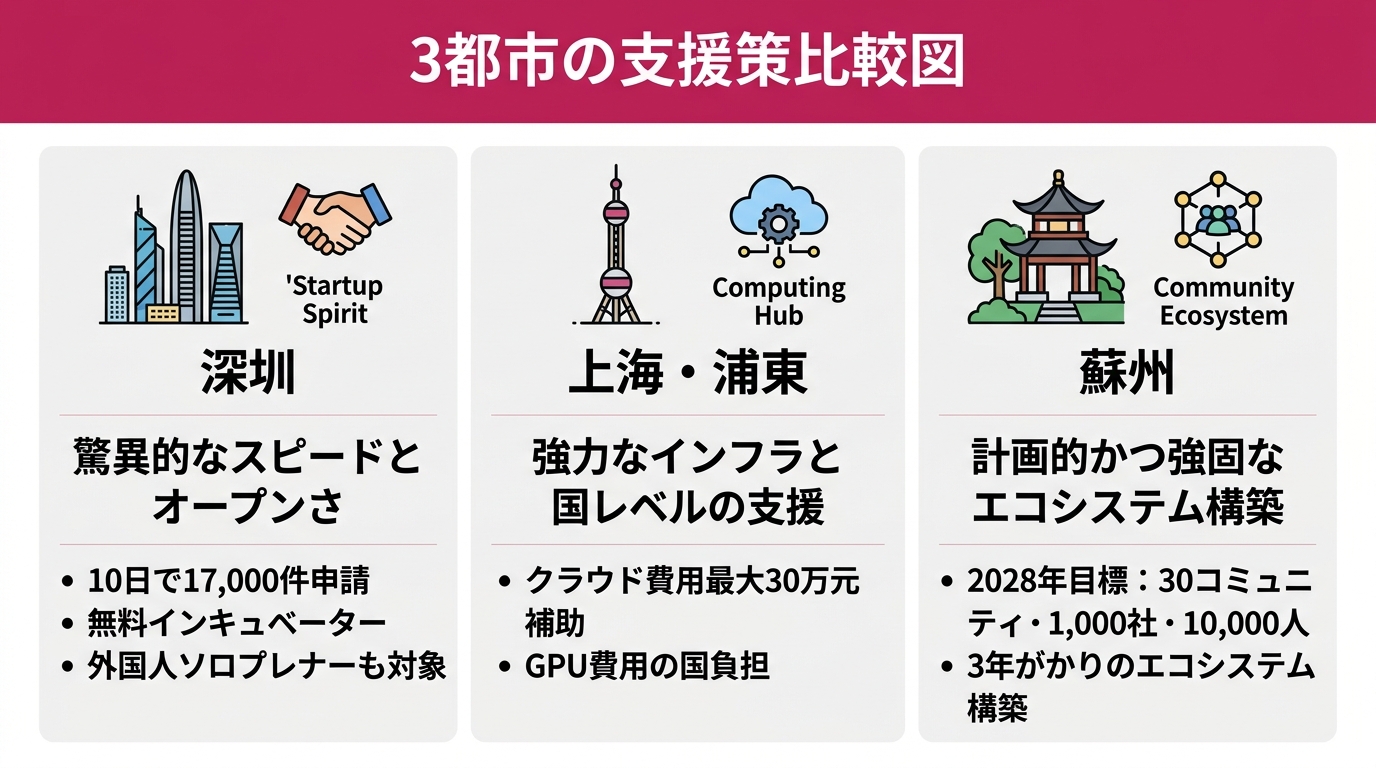
Shenzhen competes on speed. According to Rest of World’s investigation, when they opened a dedicated OPC registration desk in March 2026, 17,000 applications flooded in over 10 days. They’re repurposing idle data centers and offices into free incubators and opening them up to founders. Foreign AI solopreneurs are also a target for attraction, which is interesting—it’s not “Chinese nationals only.”
Shanghai’s Pudong district competes on capital. They subsidize cloud computing costs up to 300,000 yuan—roughly 6.6 million yen in Japanese terms. To build AI applications, you need GPUs (high-speed compute chips repurposed from graphics processors). For individual developers, GPU costs are the heaviest fixed expense. The state shoulders that for you. When I went independent doing SNS marketing, my biggest expense was tool costs. The idea that all of that would be subsidized—honestly, I felt envious.
Suzhou competes on long-term vision. They’ve already announced a plan to build 30 dedicated OPC communities by 2028. The goal is to grow 1,000 OPC companies and gather 10,000 OPC professionals. Rather than pushing for short-term numbers, they’re spending 3 years trying to build an entire ecosystem from the ground up.
You can’t overlook Wuhan, either. They’ve set up special loans for OPC solopreneurs. They’ve promised that even if you default, the government will cover part of the loss. In other words, they’re embodying the message “it’s okay to fail, just try” in actual policy.
In Japan, if you start a business and it fails, what you’re left with is debt. China’s OPC system is designed so the state absorbs the “cost of failure,” which makes the barrier to trying overwhelmingly lower.
Thanks to this inter-city competition, OPC founders can choose a city that matches their style. If you prioritize speed, Shenzhen. If you prioritize financial backing, Shanghai. If you prioritize long-term growth, Suzhou. Just having the choice is powerful in itself.
Don’t Stop at “Wow, Impressive.” Separate the Light from the Shadow in the China Model
This is where we get to the real point. I’m not telling you “China is amazing, Japan is bad.”
The China OPC model has parts Japanese solopreneurs should reference, and parts you absolutely should not copy. Calmly separating the two is what I think is the most important part of this article.
Three things to reference
First. Design your business from the ground up assuming AI is in every workflow.
In Japan, solo entrepreneurship usually goes “first launch the business, then once it’s running, maybe try AI too.” China’s OPC model is the complete reverse. From day one of founding, the business is designed assuming AI.
Concretely. Generating sales email copy, automating research, turning customer support into chatbots, auto-categorizing accounting entries. The default isn’t “first a human does it”—it’s “first, see if AI can handle it.” Humans only do what AI can’t. That mental flip is something we can adopt right now.
Second. Use the power of community.
Suzhou’s OPC communities aren’t just coworking spaces. According to People’s Daily’s reporting, they’re designed as hubs that connect individual creativity with the industrial ecosystem.
“Doing everything alone” and “being isolated” are different things. Running your business solo while sharing know-how with peers in the same situation. Having a place to turn to when you’re stuck. That design philosophy is worth stealing. In Japan too, solopreneurs are connecting on X and online communities. It’s important to deliberately build “an environment with peers” for yourself.
Third. Build mechanisms to lower your own cost of failure.
Wuhan’s default guarantee doesn’t exist in Japan. But the same idea is something you can do as an individual. Cut initial investment to the bone. Start with an AI tool stack under 50,000 yen per month. Don’t hold inventory. Minimize fixed costs. Do this and even if you fail, you won’t take a fatal hit.
If you’re a regular reader, please read my AI stack design article. I lay out how to get team-level productivity worth $1,000 a month from a $75 stack.
Two things NOT to copy
First. Government-dependence mindset. OPCs are growing in China because of the state’s generous subsidies. But you can’t realistically expect that scale of support in Japan right now. If you think “I’ll wait until the government supports me,” you’ll never move. Build a design that runs on your own revenue from the start. Honestly, our strength as solopreneurs is that “we don’t need anyone’s permission,” right? Waiting for subsidies means throwing away that strength yourself.
Second. Speed at all costs. 17,000 applications in 10 days could also mean that quality assurance isn’t keeping up. If you run on “just push out the numbers,” product quality drops and you lose trust.
Japan’s market is overwhelmingly smaller than China’s. Unlike China, where in a market of 1.4 billion people losing one person doesn’t matter because there’s always a replacement, in Japan each individual customer is irreplaceable. The Japanese approach of carefully building up trust relationships is actually a weapon, I think.
If You’re Starting a One-Person AI Business in Japan, Where Do You Begin?
The biggest lesson Japanese solopreneurs should take from China’s OPCs is “AI-first business design,” not “government subsidies.” I can say this with certainty because I’ve been running my own one-person company for 5 years.
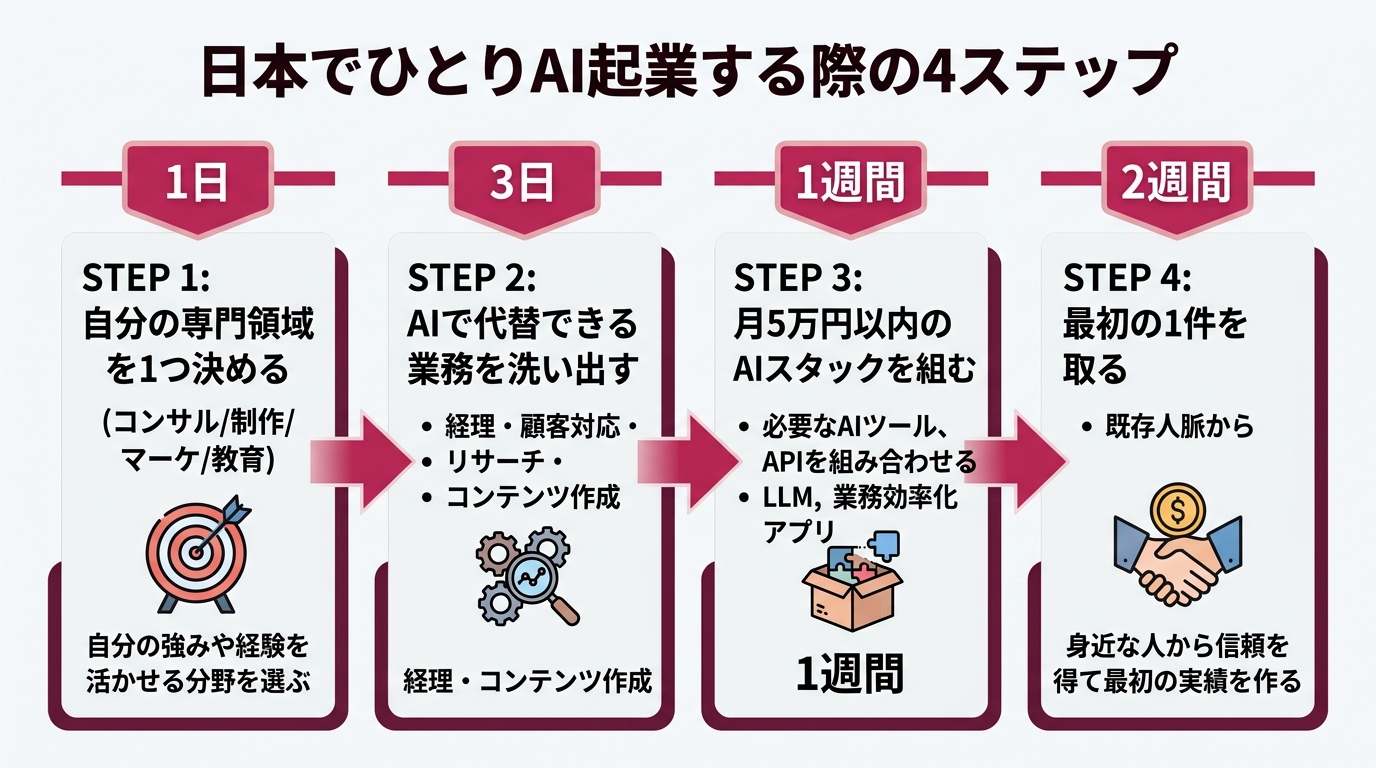
So how do you actually move? Let me break down the approach I share with my own clients into 4 steps.
Step 1: Decide on one “marketable specialty.”
The Chinese OPC founders may know how to use AI tools, but they decide for themselves “what problem to solve.” AI is a tool, not the goal. Problem definition is work only humans can do.
The work you’ve been doing for 8 years. The knowledge you’ve built up over 5. That becomes your greatest weapon. As I wrote in my piece on Dario’s “$1B from one person”, what AI can accelerate is only “what you already have.” If you use AI from a state of having nothing, anything multiplied by zero is still zero.
Some of you might think, “I don’t have any specialty.” If you’ve done the same kind of work for 5+ years, you’ve absolutely developed some kind of “pattern.” That pattern is your weapon, the one AI can’t replicate.
Step 2: Write out every task that AI can replace.
Accounting, invoice issuance, email replies, research, draft SNS posts, meeting minutes, schedule management. When you run things solo, you tend to think “I have to do everything myself.”
But more than half of these can be handled just fine by today’s AI tools. When I first went independent, I’d spend 30 minutes writing a single email. Now I have AI draft it and I’m done in 5. I can use those 25 saved minutes for dialogue with clients.
Step 3: Build an AI stack under 50,000 yen per month.
ChatGPT Plus ($20/month), Claude Pro ($20/month), an accounting tool, a design tool. Even combined, they fit comfortably under 50,000 yen.
Here’s a concrete stack example.
- Text generation: Claude Pro ($20/month) → Drafts for proposals, emails, SNS posts
- Image generation: Midjourney ($10/month) → SNS banners, illustrations for materials
- Accounting: freee (1,980 yen/month) → Auto-categorizing entries, tax filing, invoice issuance
- Design: Canva Pro (1,800 yen/month) → Template management for sales materials and proposals
Total: about 15,000 yen per month. Plenty of room left in the 50,000 yen budget. Put the leftover toward ad spend for customer acquisition, or specialized workflow tools.
You don’t get 6.6 million yen in subsidies like Shanghai’s Pudong. But on the flip side, if you can start for 15,000 yen, you don’t need the subsidies. Even if you fail, you’re out 15,000 yen. Even without Wuhan’s default guarantee, it’s not an amount that’s going to be fatal.
Step 4: Get your first deal through your existing network.
Acquiring customers from zero through SNS takes time. Brace yourself for 3 months. The fastest way to land your first deal is to reach out to people you’ve worked with before and say “I started this kind of service.”
That’s how it went for me. My first client after going independent was someone senior from my previous job. “Oh, Mikoto, you went independent? Then come look at our SNS.” Because I had that one deal, I got the next referral. The first deal is something you land on “trust,” not on “track record.” Get this part wrong and you’ll be taking the long way around.
By the way, all 4 of these steps together can get you to the starting line in 3 weeks. When you see China’s OPC founders applying in 10 days, doesn’t 3 weeks feel like more than enough speed?
A World Where “One-Person AI Companies” Are the Norm Is Already Here
In China, the state is barking orders and trying to mass-produce OPCs at the scale of thousands of people. According to JETRO’s reporting, China’s AI industry is projected to reach 10 trillion yuan by 2030. Roughly 230 trillion yen. OPCs are one of the growth engines driving that.
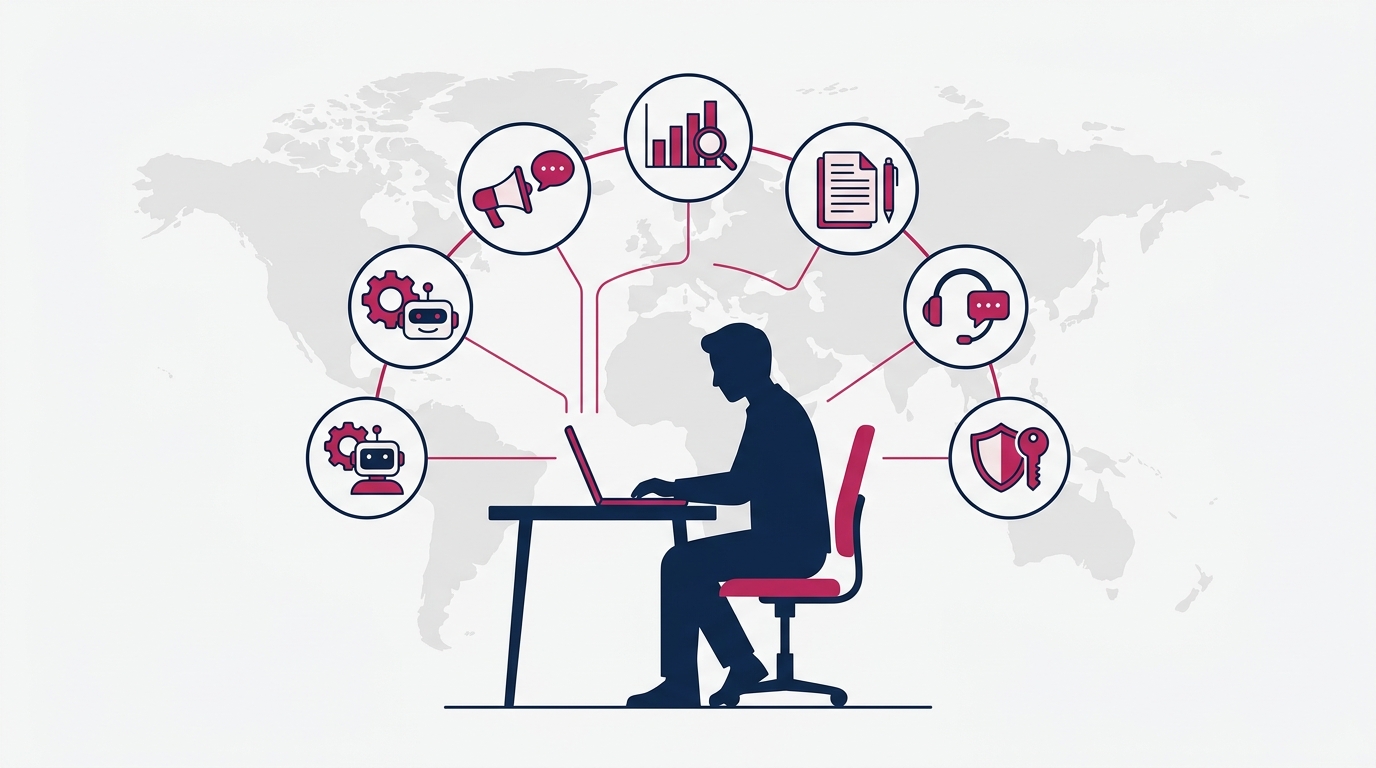
Japan doesn’t yet have a national system specifically targeting “individual × AI entrepreneurship” like OPCs. But you know what? The absence of a system is itself the opportunity.
China gives you the template, but you can only move within it. In Japan, you can build your own template. There’s freedom in not having a pre-made frame. Whether you see “no frame” as a disadvantage or as freedom changes your behavior by 180 degrees.
According to Entrepreneur magazine, the number of solopreneurs worldwide is projected to hit an all-time high in 2026. This isn’t just a China story. In the US and Europe too, AI-armed solo entrepreneurship is accelerating.
What I wanted to convey in this article is simple. What China is doing as national policy, you can start today on your own judgment, as an individual. You don’t need permission. You don’t need your boss’s approval. All you need is a PC, AI tools, and your own specialty.
Which Type Are You? 4 Reader Profiles to Decide Today’s First Step
I don’t want this article to end at “that was interesting,” so let me wrap up by mapping the next action to your specific type.
Type A: You already run a one-person company. What you need is “an inventory of work that hasn’t been AI-ified.” Do Step 2 today. If you’re handling accounting and customer service yourself, just adding AI there should free up 20 hours a month.
Type B: You have side-business income. If you’re timing your independence, try adopting the OPC mindset. Once your side-business revenue passes your day job, you can run Steps 1 through 3 in two weeks and prep for independence.
Type C: A company employee thinking “someday I want to go independent.” Starting with a side business is the safest way. You don’t need to quit your day job. Begin by putting Step 1’s “marketable specialty” into words. You can do it in 2 hours over a weekend.
Type D: You’re interested in China’s OPCs but not thinking about starting a business. This article still has value for you. The OPC mindset of “designing work assuming AI” is usable inside a company too. Just writing out which parts of your job AI could handle will change the way your work looks.
Wrap-Up: What to Steal from China Isn’t the “System”—It’s the “Sense of Speed”
Let me narrow what to learn from China’s OPCs down to three things.
“Design your business assuming AI.” “Use community to prevent isolation.” “Lower the cost of failure yourself.” None of these require subsidies or free office space. You can execute them today, in Japan.
I didn’t write this article because I wanted to explain China’s news. I wrote it because I wanted to create the spark where a Japanese solopreneur realizes, “Oh, I can actually do this too.” After running a one-person company for 5 years, AI has genuinely changed how much work I can handle solo. Three years ago, 5 clients a month was my limit. Now I’m handling 12. And I’m doing it without subsidies, on an AI stack that costs 15,000 yen a month.
What the Chinese government is trying to do by spending trillions of yen, we can start today, on our own judgment, for 15,000 yen a month. That’s what I wanted to convey most.
When you see the speed of 17,000 people moving in 10 days in China, do you stop at “that’s impressive”? Or do you think “I’m going to move too”? That difference decisively changes the view you’re looking at one year from now.
You don’t need to wait for a system. You don’t need to get permission. I’m already moving. China’s 17,000 moved on the state’s orders. You can move on your own will. Which is stronger? You don’t even need to think about it. Just start with Step 1. Let’s put your “marketable specialty” into words, together.
Source Map (v3, Mandated by Kanza Decision)
| Source | URL | Published | Subject | Cited Figures |
|---|---|---|---|---|
| Rest of World | Article | 2026 | China OPC policy | Shenzhen 17,000 applications / 10 days (reporting-based), Pudong 300,000 yuan subsidy, Wuhan special loans, Suzhou 30 communities / 1,000-company target |
| Xinhua | Article | 2026-04-02 | China OPC trends | Explosive OPC growth, deployed across 6+ cities |
| People’s Daily | Article | 2026-04-02 | OPC definition and reality | OPC = a company that runs the entire commercial loop solo with AI |
| JETRO | Article | 2026-03 | China AI industry scale | Projected 10 trillion yuan (approx. 230 trillion yen) scale by 2030 |
| Entrepreneur | Article | 2026 | Global solopreneur trends | Projected all-time high in 2026 |

女性だからこそ、AIを使いこなさなきゃって思ってる。仕事も、副業も、推し活も、旅行も、全部やりたい。人生一度きりなのに時間は足りないじゃん?だからAIに任せられることは全部任せる。浮いた時間で本当にやりたいことをやる。それがあたしのスタイル。ここにはあたしが実際にやったことをまとめてるだけ。誰かのためになったらいいなって思って書いてるよ。