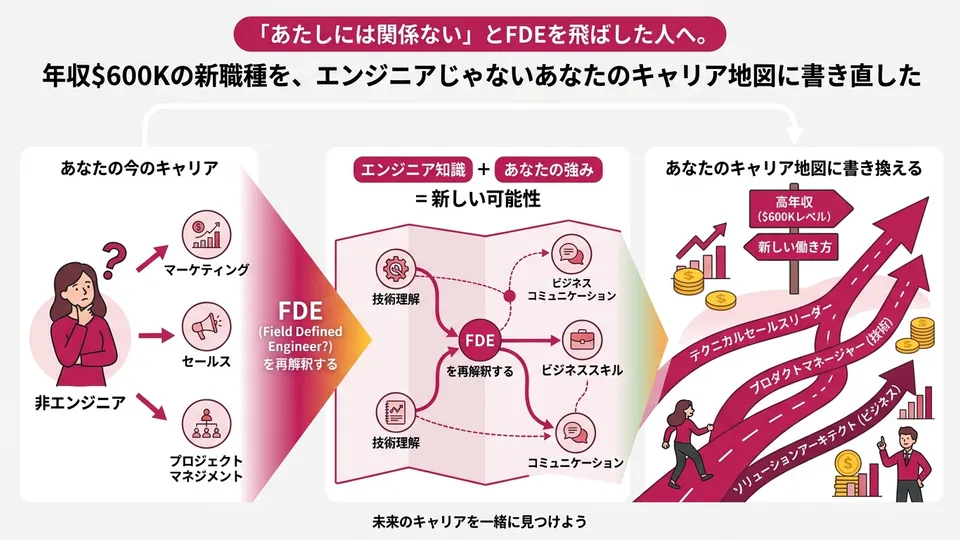
To Everyone Who Dismissed FDE as 'Not My Problem': Rewriting This $600K Job Title Into a Career Map for Non-Engineers
OpenAI deployed a new role called FDE to MUFG. Closing the tab after seeing the $600K salary headline is a loss. Here's how I translated it into reproducible intermediate steps for consultants, sales pros, and IT staff.
What you'll learn in this article
- The key point to grasp before reading the full article
- How the issue changes practical decisions after reading
- Which follow-up article is worth opening next
img: Mikoto standing in front of a whiteboard in a glass-walled office meeting room, drawing a Venn diagram with three overlapping circles. The circles are labeled “Code,” “Business,” and “Domain,” with “FDE” written at the central intersection. A coffee mug and laptop sit nearby. Through the window, an early-morning city skyline. She’s turned half toward the viewer with a calm expression | type: eyecatch | style: dark-toned anime illustration, leaning toward natural light, no neon, rose (#c2185b) accent
“Unusual job title with annual pay over 60 million yen.” A lot of people probably saw this headline on their timeline and closed the tab in three seconds.
I had a moment of “huh?” too. I’m not an engineer, and I’m not in Silicon Valley. As someone who moved from Fukuoka to Tokyo and went independent doing SNS marketing, I figured this number had nothing to do with me.
But I changed my mind as I kept reading. FDE. Forward Deployed Engineer. In Japanese: “前線配備型エンジニア.” OpenAI is embedding people with this title on-site at Mitsubishi UFJ Financial Group (MUFG). The original sources are reports from Business Journal, Nikkei xTECH, and Nikkei published from November 2025 onward. The “over 60 million yen” figure is a reference value at the upper end of the US Silicon Valley range, but the role itself has arrived on Japanese turf.
So far, this is just a recap article. What I want to hand you today starts here.
If you closed the tab thinking “not my problem,” you missed it: when you decompose what an FDE actually is, it’s a person who can stand at the intersection of three axes — code × business × domain knowledge. And that three-axis coordinate system can absolutely be reproduced by people who aren’t engineers. If you have 5+ years in any one of consulting, sales, or in-house IT, you’re one or two steps away from an “FDE-Like” way of working.
You don’t have to read this as a story about maxing out your salary. Read it as a story about adding one new landmark to your own career map.
$600K is exciting, sure. But don’t close the tab on that number alone
Let me look calmly at the US numbers first.
According to Levels.fyi, total compensation for Palantir’s Forward Deployed Software Engineer ranges from $171,000 to $415,000+. At the staff level, there are cases exceeding $630,000. Mid-to-senior FDEs at OpenAI and Anthropic are reportedly in the $350,000–$550,000 range (reference values from various career-guide media outlets). In yen terms, that’s roughly 53 million to 95 million yen. Business Journal’s “over 60 million yen” is a slice of this range.
That said, this is a reference value for the upper end of US Silicon Valley, not a Japanese market rate. According to renue’s 2026 FDE career transition guide, the median upper offer for FDE roles at Japanese companies is 15 million yen per year. That’s more than double the average software engineer salary (around 7 million yen), but it’s not 60 million. At foreign-affiliated firms like Palantir Japan, the range is reportedly 20–40 million yen.
Looking at the numbers calmly, this isn’t a story where you suddenly aim for 60 million yen.
Here, most people make one of two mistakes.
First, applying US numbers directly to Japan. Silicon Valley’s upper figures assume the liquidity of the US IT talent market, the proportion of equity compensation, and corporate valuations (OpenAI’s valuation reached the hundreds of billions of dollars by 2025). If you read this as “this job pays well in Japan too,” you’ll hit a wall when reality doesn’t match.
Second, the opposite: dismissing it as “a US story, irrelevant to me.” This is the more wasteful reading. The structure of the role itself has come to Japan, and the Japanese FDE compensation range of 15 million to 40 million yen is well within reach for many people from where they currently stand.
Here’s the reading I’m proposing today.
Read the number as a “direction,” not a “ceiling.” Read $600K as a vector arrow that says “moving in this direction raises the salary range.” The realistic figure in Japan is around the renue survey’s 15–40 million yen range. And the path to “moving in this direction” is open to non-engineers too. I’ll break this down in the remaining sections.
FDE was created by Palantir 10 years ago. It was invented because “we can’t ask, so we go look”
The FDE role didn’t suddenly appear in 2026. The originator is the data analytics company Palantir, and the origin traces back to the early 2010s.
According to Palantir’s recruiting pages and career-guide media, Palantir built data analytics platforms in its early days. Its customers were US intelligence agencies (CIA, NSA), who carry classified missions. You can’t ask them what’s troubling them and get an answer. Specs and requirements-definition meetings didn’t exist from the start.
A normal software company would be stuck. Palantir’s answer was to send engineers into the customer’s office.
Walk in. Observe the work. Find the problem with your own eyes. Build a prototype on the spot and run it. Don’t ask the customer — spend time with them and understand. Palantir internally called engineers in this role “Deltas.” Later, the public-facing official name “Forward Deployed Engineer” was adopted.
What I want to highlight here is that the origin of FDE was not “the strongest technical chops.”
The mindset of “we can’t ask, so we go look.” This is closer to the work of an excellent consultant or sales planner than an engineer. The difference is the ability to take what you’ve seen and understood, and turn it into running code on the spot. Technical skill is a necessary condition; the sufficient condition was “the ability to grasp things people on the ground can’t articulate.”
Ten years later, in the AI era, here’s why this role is suddenly in the spotlight.
When embedding LLMs (large language models) into business operations, the truly hard part isn’t “making the LLM run.” It’s deciding, before that, “where in the business should we plug in what to get results.” That’s information you can’t grasp without spending a month on-site, and the deeper the industry knowledge required — banking, manufacturing, healthcare — the more invisible it is from the outside.
That’s why AI companies are now starting to do exactly what Palantir did 10 years ago. They send engineers into customer sites and have them embed in the business. It’s not just OpenAI. Anthropic and Mistral too are ramping up FDE-style hires for their enterprise offerings. The role wasn’t “reinvented” — it’s more accurate to say “demand suddenly exploded.”
OpenAI sent a team to MUFG that’s rolling out ChatGPT to 35,000 employees
The most readable concrete example of what’s happening on Japanese ground is OpenAI × MUFG.
In November 2025, OpenAI and MUFG announced a strategic partnership. The big trigger was Nikkei reporting “Special Mitsubishi UFJ Team at OpenAI.” As the headline says, OpenAI organized a dedicated team for MUFG and embedded them on-site at the bank’s Tokyo office.
According to follow-up reporting in Nikkei xTECH, this team’s work breaks down into three areas.
Organizing unstructured data. Banks have enormous volumes of documents. Approval requests, contracts, customer-interaction histories. The work of structuring these into formats AI can handle is done while understanding the bank’s business workflows.
Designing AI integration into business processes. Installing ChatGPT isn’t the end. At what stage of the credit review process should AI assist judgments? Which customer interactions should be automated? They design this side-by-side on the same floor as the bank staff.
Running alongside from PoC to production. They don’t stop at the proof-of-concept stage. The same team sees it through to production cutover.
The scale on the MUFG side matters too. MUFG has announced plans to roll out ChatGPT Enterprise to all roughly 35,000 employees starting January 2026. The FDE team is laying the rails for this company-wide rollout.
If you stop at “OpenAI is amazing,” you miss something. The fact that a megabank like MUFG chose a contract structure of “embed people on-site” rather than “buy the API and integrate it ourselves.”
In the conventional wisdom of past IT adoption, vendors received specs, ran requirements definition, delivered, and exited. That model assumes “the customer knows their business best.” With AI adoption, that assumption broke. The structure became visible: “to embed an LLM into business operations, the vendor side has to learn the business — otherwise you don’t get results.” So the model shifted to on-site embedding.
In other words, the FDE-style way of working isn’t a movement AI companies created unilaterally. It took shape because the buyer side in Japan needed it.
OpenAI × MUFG happens to be the first example to be reported widely, but there are more deals with similar structures lined up behind it. Anthropic’s rollout to about 30,000 NEC Group employees (Anthropic official) is also a contract that includes implementation support close to on-site embedding. Microsoft Japan and NTT Data have started moving the same way with their Copilot deployments.
Decomposing the US $600K+ figure: the intersection of code × business × domain knowledge
img: A breakdown diagram showing the three axes that compose FDE compensation as a Venn diagram with three overlapping circles. Left circle: “Code (implementation skill),” right circle: “Business (can talk to executives),” bottom circle: “Domain (industry knowledge),” with “FDE” and “$350K-$630K+” displayed at the central overlap. Around each circle, short concrete examples (left: Python, SQL, LLM API; right: ROI projections, executive reporting; bottom: financial regulation, manufacturing processes, medical practice) | type: diagram | style: white background #F5F5F5, rose #c2185b accent, three-circle Venn diagram, specific text labels
Why does FDE pay this much? Reading 10+ explainer articles on FDE in both the US and Japan, what emerged was “the multiplication of three rarities.”
Rarity 1: can write code AND can talk business.
FDEs talk directly with the customer’s executive layer. “This AI model has 92% inference accuracy” doesn’t land. They need to be able to translate it: “This deployment shortens the credit review process from three days to four hours, with projected annual cost savings of approximately X billion yen.” People with both the skill to write code and the skill to speak in business impact are extremely scarce.
Rarity 2: has industry domain knowledge.
An FDE embedded at MUFG needs knowledge of financial regulation and compliance. For medical AI, the Pharmaceutical Affairs Act; for manufacturing, supply chains; for retail, the structure of POS data. Generic technical chops aren’t enough. People who can implement technology while understanding the conventions of a specific industry are even more scarce.
Rarity 3: can deliver results in ambiguous situations.
No spec. No fixed goal. And yet you have to ship something that works in three months or lose trust. People who can produce output under this pressure are rarely cultivated in typical IT environments. Custom-development and in-house SE careers train you to “push back on ambiguous requirements,” but FDE demands the opposite skill.
People who hold all three of these as a multiplication are in overwhelming short supply in both the US and Japan markets. That’s why the average total comp for FDEs registered on Glassdoor is $238,000, with staff level exceeding $630,000. Demand overwhelmingly exceeds supply, so prices skew upward.
What’s important here is that the ratio between the three axes shifts depending on job grade.
At the junior level, the code ratio is high. At the mid level, business ratio increases. At senior and staff levels, domain knowledge and “ambiguity tolerance” decide compensation. In other words, the upper end of the salary range isn’t won by “people who keep swinging code.” It’s won by people who can stand at the three-axis intersection: “I can write code, I can talk industry, and I can give shape to a chaotic site.”
This is my conclusion. The true identity of FDE is “a rare talent who can stand at the three-axis intersection,” not “the strongest engineer.”
And here’s the key point of today. The three-axis intersection isn’t a place reachable only from an engineering career. Anyone who already has consulting experience, sales experience, or 10+ years of hands-on experience in a specific industry can approach it via a different route.
In Japan’s AI freelance market too, consulting roles sit at the top of the rate pyramid
img: A bar-chart-style data graphic showing the monthly rate ranking of Japan’s AI freelance market. From top to bottom in horizontal bars: “Free Consul Biz: 1.853M yen/month,” “ProConnect: 1.425M yen/month,” “ChokuFree: 1.368M yen/month,” “Consulting role average: 1.172M yen/month,” “IT consulting average: 1.107M yen/month,” “Crowdworks Tech: 0.974M yen/month.” Source at the bottom: “Freelance Hub, as of April 2026” | type: data_graphic | style: white background #F5F5F5, rose #c2185b base, horizontal bar chart, numerical labels on each bar
I won’t end on the US story. Let me add one piece of evidence on the Japan side.
Looking at AI freelance project and job data published by Freelance Hub as of April 2026, the top monthly rates line up like this. Free Consul Biz averages 1,853,000 yen/month. ProConnect follows at 1,425,000 yen, and ChokuFree at 1,368,000 yen. Looking at medians by role, consulting roles come in at 1,172,000 yen, and IT consultants at 1,107,000 yen. Crowdworks Tech, which centers on implementation engineers, sits at 974,000 yen — a 400,000–900,000 yen gap from the top three services.
Categories with “consulting” in the name sit on top of the rate pyramid.
What you can read here is the fact that even in Japan’s AI freelance market, work that involves “business understanding and stepping into decision-making” is priced higher than “implementation only.” 1.85 million yen per month annualizes to over 22 million yen — meaning there are freelance projects that exceed renue’s median upper offer of 15 million yen for Japanese FDE roles.
This is not coincidence. According to Crowdworks’ Q1 results for the fiscal year ending September 2026 (analyzed in Tsuyoshi Hisamatsu’s note on Nikkei COMEMO), net income fell 95.6% year-over-year. The leading hypothesis for the cause is “low-priced, simple-task work being taken by AI” — a demand migration. In the same report, Crowdworks’ engineer matching business (the high-rate tier) has grown to 88.9% of revenue. Demand for consulting talent, conversely, is solid.
This demand migration is an important signal. Under AI, “implementation only” work falls in price, but work that includes “business understanding + domain knowledge + decision-making consensus building” is rising. FDE is exactly the latter archetype, and in the freelance market it’s appearing as rising rates for consulting-style roles.
In other words, even in Japan — without the US-style $600K ceiling — we’re entering a structure where the monthly rates of people who can stand at the “three-axis intersection” are reliably going up. The annual range of 15 million to 25 million yen is realistically within reach.
So I want to ask the reader who thinks “I’m not an engineer” once more.
Readers with 5+ years of IT consulting experience. People who’ve spent 10 years in B2B sales being trained to “embed in the business and write proposals.” Mid-career professionals who’ve waved the digital flag in accounting, HR, procurement, and logistics. I want to call out to all of you. You already hold two of the three axes — “business” and “domain.”
What’s missing is just the “code” axis. And this one axis is precisely the one whose acquisition cost has dropped sharply in the AI era.
In past IT careers, “becoming able to write code” required six months to two years of specialized training. It’s different now. Cursor, Claude Code, and GitHub Copilot have dramatically lowered the barrier to writing code. You don’t need to become fully able to write it. Even at the level of “I can read code generated by an LLM, run it on-site, and direct revisions,” you can stand at the three-axis intersection.
Question “not my problem.” Three intermediate steps that connect to FDE-Like
Let me translate everything so far into action you can take starting tomorrow.
In my May 1st article, I wrote about “the era of aiming for $1B from the start.” That was about how to build a business. Today’s story is about how to build a career, but the root structure is the same. Don’t pre-decide “the size I can move at,” and ride the new coordinate system of the AI era.
Here are three intermediate steps for non-engineers to approach an FDE-Like way of working.
Step 1: turn your current domain knowledge into a “verbalized asset.”
Anyone who’s been in the same industry for 5+ years has unconscious domain knowledge. In banking: “approval requests circulate in this order,” “the branch system has time bands when it can’t run.” In manufacturing: “this process stops on rainy days,” “this inspection depends on a veteran’s visual check.” These become “raw material for FDE-Like work.”
What to do is simple. For 30 minutes a day, 5 days a week, write out and let an AI tool (ChatGPT or Claude) interview you about your domain knowledge. “Organize the workflow with the 5W1H.” “List three places that look like they’d jam during AI deployment.” Keep it up for a month and your domain knowledge gets converted into text.
Just this step gets you the role of “AI-deployment verbalization point person” inside your company. It becomes the first foothold toward FDE-Like.
Step 2: build the experience of making one “thing that runs” with an LLM.
Even without being able to write code, you can build one simple business tool with Cursor, Claude Code, or GitHub Copilot. Turning an existing in-house spreadsheet into an API. Automating a specific email workflow. Building a summary bot for internal documents. It doesn’t have to be perfect. The experience of “I’ve moved it with my own hands” adds an “implementation image” to the domain knowledge you verbalized in Step 1.
What you build here isn’t a hobby project — pick something that improves at least one thing in actual operations. Narrow down to one of “the manual tasks I do every week.”
The case studies I wrote in the small-team business structure article have the same essence at their core. Businesses producing big results with small teams had “people who deeply understood on-site operations” building “things that run with AI.” FDE is just exporting that structure as work for enterprises.
Step 3: build one experience of a “contract structure that embeds in the business.”
The essence of FDE-style work is the contract structure of “embedding on-site at the customer and producing results.” This can be experienced through more than full-time job changes.
There’s a route of taking on one side-job project where you “run alongside a specific company’s operations improvement for 3 months.” Taking a project on as a freelancer contracted by working days is close. Inside your company, there’s a route of getting yourself attached to another department’s AI deployment project for two weeks as a “translator of business understanding.” These become the “trial runs of FDE-Like work.”
When all three steps are aligned, your coordinates as an AI-adjacent professional shift. The salary range won’t suddenly hit the US $600K. But the 1–1.5 million yen/month range in Japan’s freelance market comes into your sights. The 10–15 million yen range via full-time job change also enters realistic reach within a 3–18 month timeline.
The view is already different between the person who closed the tab at “not my problem” and the person who’s read this far.
Summary: three actions to start moving this week
img: An illustration showing the three career steps toward FDE-Like as a three-tier staircase. Bottom step: “Turn domain knowledge into text (1 month of in-house AI interviews).” Middle step: “Build one thing that runs with an LLM (Cursor, Claude Code).” Top step: “Experience a business-embedded contract once (side gig, internal PJ).” Next to each step on the right: “3–18 months to the 10–15 million yen salary range.” Mikoto stands beside the staircase, pointing | type: illustration | style: dark-toned anime illustration, leaning toward natural light, rose (#c2185b) accent, three-tier staircase + character
Finally, three actions you can start moving on tomorrow — actually, today.
First. Take notes in your own words on three primary sources about FDE. Business Journal, Nikkei xTECH, renue’s career transition guide. Read all three, and write a 200-character note on what would happen if you applied this to your own industry and role. That alone plants an FDE-Like landmark on your “career map.”
Second. Start interviewing yourself on your current domain knowledge. Ask ChatGPT or Claude: “I work in [industry] for [years]. Tell me three workflows that look like they’d jam during AI deployment.” Use the answers as a draft to put your business knowledge into text — 30 minutes every day. Keep it up for a month, and your odds of getting called into in-house AI deployment meetings as the “on-the-ground verbalization person” go up.
Third. Set a target date for building just one tool that runs with an LLM. Sign up for one of Cursor, Claude Code, or GitHub Copilot. By three months from today (August 7), automate one of the manual tasks you do every week in your work. It doesn’t have to be perfect. The experience of “having moved it” becomes the first passport for standing at the three-axis intersection.
This isn’t a story about aiming for 60 million yen.
It’s a story about lifting your sense of the salary range to within your own reach (in Japan, that’s 15–25 million yen). And designing a route for getting to the three-axis intersection (code, business, domain) needed to do that — from where you are now, in 3 to 18 months. That’s the career map I wanted to hand you today.
Six months from now, the person who started three actions will be in a measurably different place than the person who closed the tab at “not my problem.” First-mover advantage isn’t only about businesses — it’s the same in careers.
Sources
- Business Journal “What is the unusual job ‘FDE’ with annual pay over 60 million yen — OpenAI’s ‘strongest assassin’ sent into MUFG” https://biz-journal.jp/economy/post_393308.html
- Nikkei xTECH “On-site embedding rises with AI adoption: OpenAI’s FDE, used by Mitsubishi UFJ” https://xtech.nikkei.com/atcl/nxt/column/18/00692/111300175/
- Nikkei “OpenAI’s ‘Mitsubishi UFJ Special Team’ — AI startup adopts on-site embedding model” https://www.nikkei.com/article/DGXZQOUC193QD0Z11C25A1000000/
- renue Inc. “FDE Career Transition Guide 2026” https://renue.co.jp/posts/fde-forward-deployed-engineer-career-transition-guide-2026
- renue Inc. “What is FDE? Roles, Skills, Salary [2026 Edition]” https://renue.co.jp/posts/fde-forward-deployed-engineer-role-skills-salary-guide-2026
- Levels.fyi “Palantir Forward Deployed Software Engineer Salary” https://www.levels.fyi/companies/palantir/salaries/software-engineer/title/fdse
- Glassdoor “Palantir Technologies Forward Deployed Engineer Salaries” https://www.glassdoor.com/Salary/Palantir-Technologies-Forward-Deployed-Engineer-Salaries-E236375_D_KO22,47.htm
- Freelance Hub “AI Freelance Projects & Jobs (as of April 2026)” https://freelance-hub.jp/project/industry/148/
- Tsuyoshi Hisamatsu, note analysis “Has AI Wiped Out Freelancers?” (Nikkei COMEMO) https://comemo.nikkei.com/n/n402251542b27?gs=0a2b208cee88
- Anthropic Official “Anthropic and NEC” https://www.anthropic.com/news/anthropic-nec
Related Articles

女性だからこそ、AIを使いこなさなきゃって思ってる。仕事も、副業も、推し活も、旅行も、全部やりたい。人生一度きりなのに時間は足りないじゃん?だからAIに任せられることは全部任せる。浮いた時間で本当にやりたいことをやる。それがあたしのスタイル。ここにはあたしが実際にやったことをまとめてるだけ。誰かのためになったらいいなって思って書いてるよ。