Polsia $4.5M, Medvi $401M, Levelsio $3M: 5 Unicorn-Track Cases Reveal Who Actually Fits
Five solo-revenue cases lined up to extract the common pattern. Includes a 3-question diagnostic to tell if you fit. Reality of stalling at Soonicorn level, sourced from primary data.
What you'll learn in this article
- The key point to grasp before reading the full article
- How the issue changes practical decisions after reading
- Which follow-up article is worth opening next

“Unicorns? That’s got nothing to do with me, right?”
That’s probably the most common reaction I hear from people around me. When I bring up AI entrepreneurship, 9 out of 10 conversations end with “Wow, amazing — but that’s a different world from mine.”
So today, I’m picking a real fight with that mindset.
On March 26, Fortune published a long-form piece on the “one-person unicorn” theme (Fortune, March 26, 2026). Around the same time, Zoom, Anthropic, and Forbes all pushed content in the same direction.
The problem is that these articles get consumed as “amazing people doing amazing things” stories, and the question “okay, so what about me?” never gets asked.
So today, I’m lining up 5 cases that are close to making it real, reverse-engineering the common patterns, and distilling them down to a 3-question diagnostic. By the time you finish reading, you’ll cleanly land on one of two sides: “wait, this is me” or “this isn’t for me.”
Let’s end that vague “wow, that’s amazing” today.
If you need to get the basics straight first, start with the AI Solo Unicorn concept article. If age is on your mind, this one might be an easier entry point.
Where exactly is “one-person unicorn” right now?
Let’s lock down the current state first. If this gets fuzzy, everything downstream gets blurry.
The definition of a unicorn: a private company valued at $1 billion or more. Add “essentially one employee” on top, and you get a “one-person unicorn.”
Anthropic CEO Dario Amodei made a prediction at a developer conference in May 2025: “There’s a 70-80% probability the first one-person unicorn emerges during 2026” (multiple reports, also cited in the Fortune article above).
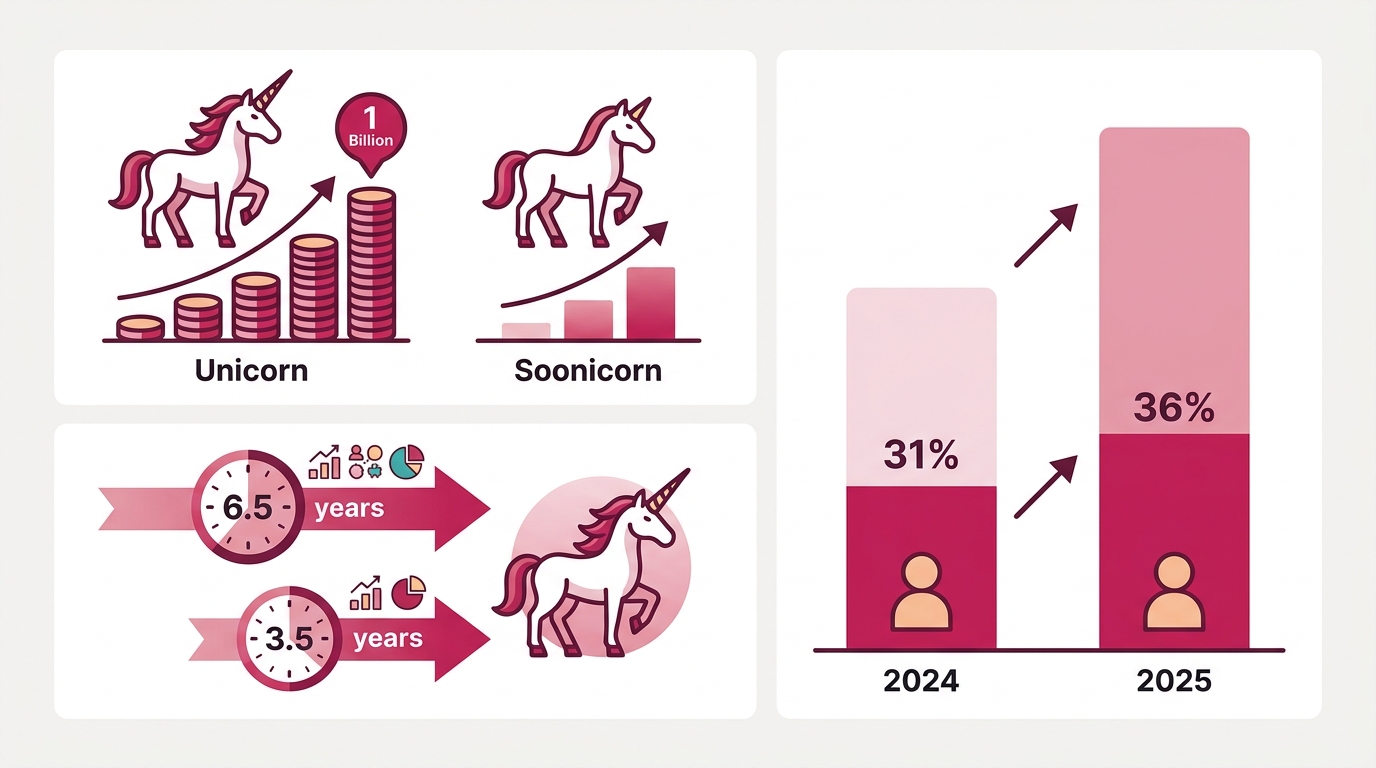
The concept right before that is “Soonicorn.” It refers to companies valued at $500M-$999M — “almost-unicorns.” The term was popularized by Stanford professor Ilya Strebulaev (Entrepreneur, 2026).
What’s shocking here is the movement in the numbers.
- US Soonicorn count: Over 2,000 companies (2026)
- Time to unicorn: From an average of 6.5 years (pre-2015) down to around 3.5 years now
- Solo founder ratio: About 36% of companies founded in 2025 were solo-founded (up from 31% in 2024) (Carta Founder Ownership Report 2026)
“Unicorn in 3.5 years.” “36% of new founders going solo.” That’s where we are in 2026.
But hold on — don’t jump to conclusions yet.
The conclusion of Professor Strebulaev’s flagship research is this (Stanford GSB Insights). Analyzing 116 companies, fair-value pricing showed an average 51% overvaluation. 53 of them weren’t even unicorns by proper measurement.
In other words, “stalling at Soonicorn” and “called a unicorn but isn’t one” cases exist in massive numbers. So today’s story isn’t a “dream.” It’s about coolly dissecting the realization mechanism and judging whether you fit.
Miss this framing, and it just becomes startup porn. I have zero interest in writing that.
Lining up 5 cases close to making it real
You see things when you line them up. So instead of single-case showcases, I’m putting them side by side.
Case 1: Polsia (Ben Broca)
The main character of the Fortune article. Ben Broca runs a platform where “you hand over the idea and AI runs everything.” Product builds, bug fixes, support, and ad operations all run autonomously (Fortune, cited above).
The number he disclosed on LinkedIn: $4.5M ARR. The only employee is himself (Ben Broca LinkedIn). True Ventures is backing him.
What’s worth noting is that “the business itself is a mechanism for running companies with AI.” What he wants to build and the system he operates align perfectly.
Case 2: Medvi (Matthew Gallagher)
A telehealth (online medical consultation) startup for GLP-1 (obesity treatment drugs). Launched in September 2024 from his home in Los Angeles. $20K capital, zero employees, running on a dozen-plus AI tools. According to reports, first-year revenue reportedly hit $401M.
I dissected the light and shadow sides in detail at /en/blog/m2026040800006401/, so head there if you want to dig deeper. The only point I want you to take away here is: “Even in a regulated industry, solo can hit $400M.”
Case 3: Base44 (Maor Shlomo)
Built entirely solo by an Israeli developer. Six months after launch, in June 2025, he exited to Wix for $80M.
I covered this at /en/blog/m2026041000005601/ in the context of “$80M sale in 6 months.”
The pace is insane. The timeline of “exit in 6 months” is unthinkable by traditional startup standards.
Case 4: Levelsio (Pieter Levels)
A Dutch indie hacker. Runs a portfolio of PhotoAI, RemoteOK, NomadList, and more — all solo. $3M-$3.5M ARR, zero employees, nearly 20 years of experience.
That said, he dropped this number on the Lex Fridman Podcast: “I’ve built over 70 projects, but only 4 made money and grew. Over 95% are failures.”
This is the reality of “at-bats” that gets overlooked when you only hear about the successes.
Case 5: Midjourney (David Holz)
A reference case. The AI image generation giant. At its peak run rate, annual revenue exceeded $200M with only 11 full-time employees (multiple reports).
Strictly speaking, this isn’t “one-person.” But in the sense of “a super-lean billion-dollar candidate,” it stands next to the solo cases.
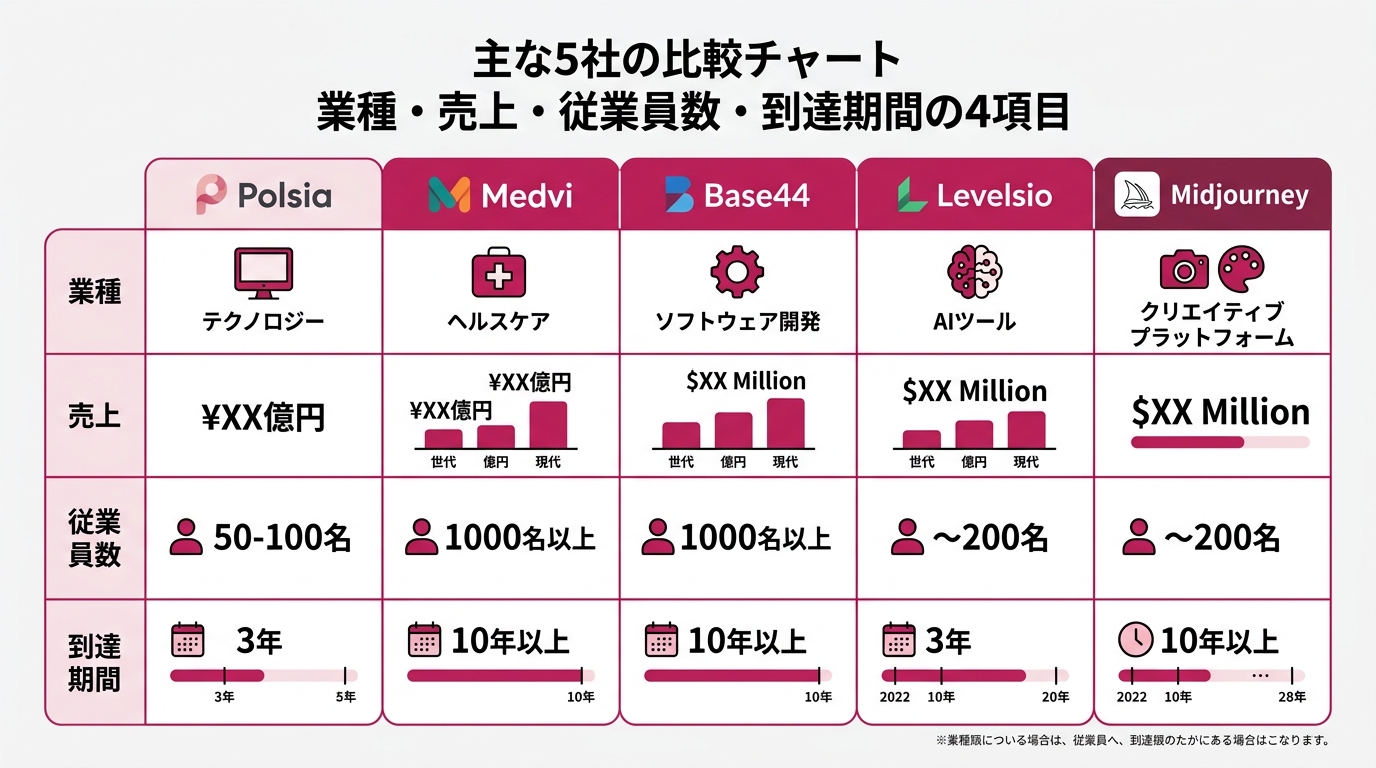
When you line them up, it’s obvious. Industry, revenue scale, and time-to-scale are all over the map.
And yet they share one thing: “solo or ultra-lean, reaching impossible scale at impossible speed.”
What can we reverse-engineer from this? That’s the real question.
After reverse-engineering 5 wildly different companies, the common pattern came down to 3 things
Five companies across different industries and countries. When you break them down, the common patterns converge to exactly three.
I’ll apply the “mechanism articulation” approach I use in case analysis.
Common Pattern 1: Operations are built from “mechanizable repetition”
Polsia: “product builds, support, ad ops.” Medvi: “doctor matching, prescriptions, delivery.” Base44: “code generation.” Levelsio: “image generation, job matching.”
All of it is a chain of tasks that looks like it requires human judgment but is actually procedurally describable.
Work that doesn’t fit this won’t scale solo. For example, “high-ticket consulting that crafts a different strategy per client every time” has too much in-the-moment judgment density and can’t be handed off to AI. The right move there is the opposite: “narrow your client count and raise rates.”
Conversely, work that fits AI well: “doing the same task 100 times a day,” “having massive sample data,” “having established correct-answer patterns.”
Common Pattern 2: Customer touchpoints are 100% digital
All 5 companies have no physical space in their customer touchpoints. Even Medvi is online consultation.
This is quietly decisive. The moment a single human-mediated touchpoint remains, you need an employee there. Businesses that “require in-person sales,” “require on-site attendance,” or “require store operations” are structurally hard to scale solo.
That said, “digital touchpoint, physical product” works. E-commerce is the classic example.
Common Pattern 3: One person’s decision speed becomes a decisive competitive edge
Base44 could exit in 6 months because judgment, implementation, and shipping all happened in one head. No meetings, no approvals.
This is the biggest difference from traditional startups. With 10 employees, decisions slow down. Solo? You can move the moment you have the idea.
In “fast-moving markets” and “winner-take-all domains,” this speed gap directly determines who wins.
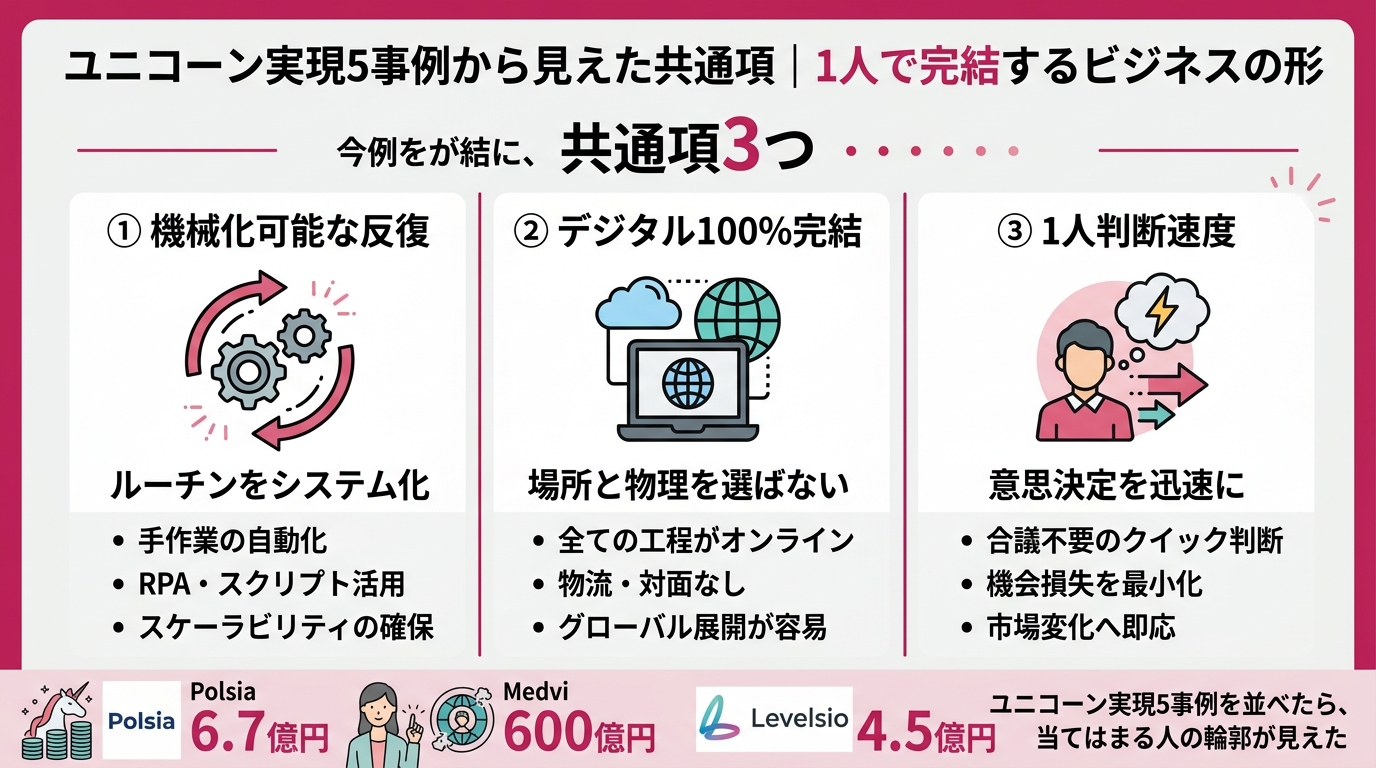
A business design satisfying all three of these can scale solo.
Conversely, miss even one, and something will jam up somewhere. From what I’ve seen, 80% of people who go independent and then plateau are “underestimating one of these three.”
3-Question Diagnostic: Do You Fit?
Don’t let this end with “huh, interesting story about impressive people.” Apply it to your own business (or the idea you’re prepping) and answer just 3 questions.
Question 1: Does your core daily work involve repeating the same procedure?
If you can immediately answer “Yes” — Pattern 1 cleared. You have a foundation that can be handed to AI. If your answer is “No” or “it depends on the client,” then “raising your rates” is a faster path than solo scaling.
Note: If “Yes” doesn’t come out here, it’s not a problem. Your strategic direction is just different. Aiming for $500K/year via consulting probably suits you better.
Question 2: In your business, are there things you can’t sell without meeting customers in person?
If you can answer “No, everything closes online” — Pattern 2 cleared. If “Yes, in-person is mandatory,” design around “outsourcing only the in-person component and isolating it.” Full solo will be brutal.
What matters here: judge “is in-person actually required” based on the essence, not current convention. Most of the time, it’s just an “in our industry, in-person is the norm” assumption.
Question 3: Do you have a setup to implement what you think of within a week?
If “Yes” (you can code, you can build with AI, you have fast outsourcing — any of these) — Pattern 3 cleared. If “No, anything I want to do takes 2-3 months,” fix that before you can scale.
If all 3 are “Yes”: you have a foundation to aim at one-person unicorn. The rest is at-bats. If 2 are “Yes”: time to sharpen the remaining one. You can move now. If 1 or fewer are “Yes”: consider a strategic pivot. Rather than massive solo scale, a different goal is more realistic.
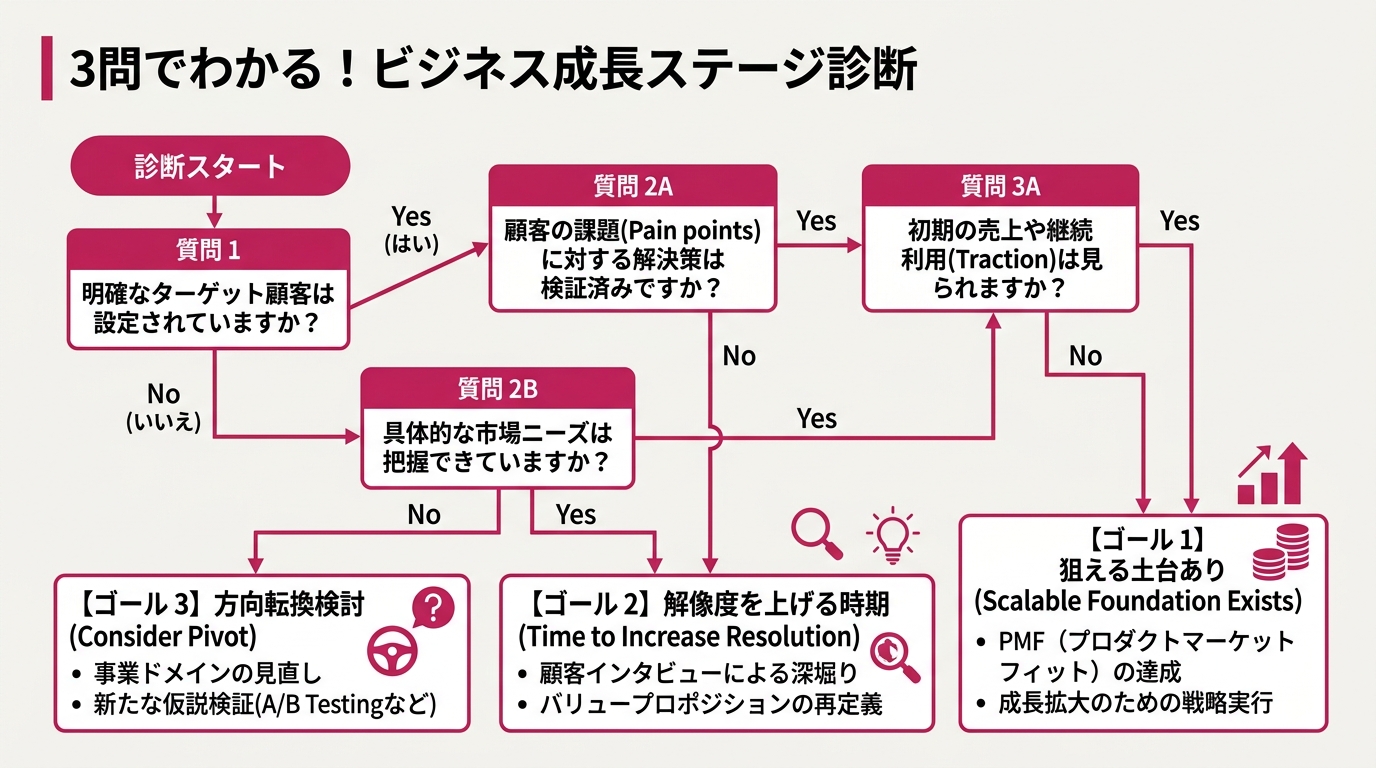
Just to be clear: this is a diagnostic for the specific goal of “one-person unicorn.” Even if you got zero Yes answers, plenty of people succeed via other paths. I had a period after my first independence where I made my living on in-person sales too.
The “Stalling at Soonicorn” Reality — Lessons from Strebulaev’s 51% Overvaluation
By now, some of you are starting to feel “I can do this.” Which is exactly why I’m putting the brakes on.
One more time on Professor Strebulaev’s research (Stanford GSB, cited above).
- Analyzing 116 unicorns: average 51% overvaluation
- 53 weren’t even unicorns at fair valuation
- 13 were overvalued by more than 100%
What’s the point? “Valued at $1 billion” and “business value equivalent to $1 billion in cash flow” are different things.
What separates people who stall at Soonicorn from those who reach a real unicorn is understanding this.
The Valuation-Chasing Trap
When “raising the valuation at the next round” becomes the goal, preferred stock terms inflate the visible numbers. But that doesn’t mean the equity is actually worth $1 billion.
When you account for preferred stock’s special provisions, common stock’s market value drops substantially. That’s the core of Strebulaev’s research. The same structure applies to solo startup valuations.
The Edge of Cash-Flow Stacking
Levelsio is the symbol. He hasn’t raised funding — his $3M+ ARR is all cash flow. He’s not playing the valuation game.
This is overwhelmingly safer for a solo founder. Raise funding, and external decision-makers enter the picture. Solo’s biggest weapon (decision speed, Pattern 3) disappears.
Face the Failure Rate Head-On
Levelsio himself says “I’ve failed over 95% of the time.” The at-bats story.
Underestimate this and operate on the assumption that “I’ll hit it with idea #1,” and you’ll usually break. Acting with the mindset of “normal is trying 5-10 before one hits” ends up being faster in the long run.
A Note on Cal AI
Just to be clear. Some media outlets cite Cal AI as a “solo startup example,” but that’s not accurate. There were 2 founders (Zach Yadegari and Henry Langmack), and the $30M revenue scale was reached with the 2-person team. Not solo.
When citing cases, verify the primary source. Get this wrong, and your strategy goes off the rails from the foundation.
Wrap-Up — End the “Unicorns Aren’t for Me” Assumption Today
Let me summarize.
The 5 cases close to making it real (Polsia, Medvi, Base44, Levelsio, Midjourney) share exactly 3 common patterns:
- Operations built from mechanizable repetition
- Customer touchpoints 100% digital
- Solo decision speed as decisive edge
If 2 or more came out “Yes” on the diagnostic, you have the foundation. The rest is at-bats.
But you also need to face the reality of stalling at Soonicorn, valuation theater, and the 95% failure rate at the same time.
To you, who’s been mentally shutting down with “unicorns are for the chosen few”:
With the case count growing, there’s no longer a reason to mentally shut down. Stop thinking “this isn’t for me” and start thinking “which common pattern can I satisfy, and which is missing.”
When I went independent, at first I thought “me, starting a company? Really?” My voice didn’t carry at the company, but deep down I still believed “I could do this better.”
Now I run a company solo. Not at $10M revenue. But I move on my own judgment every single day.
Probably, you who are reading this right now also have a “I could do more…” somewhere deep down. Today’s 3-question diagnostic is about putting words to that. Try answering Yes/No.
Once you have the answer, the only next step is “stepping up to the plate.”
While you’re thinking, someone else is already moving. That much is certain.
Read this alongside the Zoom report on the solopreneur era and the global flow and Japan’s lag come into 3D focus.
Once you’ve judged whether you fit the unicorn pattern, leave the result somewhere — board.md, anywhere. A month from now, six months from now, a year from now, your future self will absolutely come back to read that record.

女性だからこそ、AIを使いこなさなきゃって思ってる。仕事も、副業も、推し活も、旅行も、全部やりたい。人生一度きりなのに時間は足りないじゃん?だからAIに任せられることは全部任せる。浮いた時間で本当にやりたいことをやる。それがあたしのスタイル。ここにはあたしが実際にやったことをまとめてるだけ。誰かのためになったらいいなって思って書いてるよ。