Mercor Hit $10B with Three 22-Year-Olds. Antler Studied 3,512 Founders and the Real Dividing Line Wasn't Age — It Was 'What They Threw Away'
What's actually different about Gen Z founders? When you break it down with Antler's data, it's not age — it's a design principle of 'what they discarded' and 'what they had from the start.' Includes 4 steps that work for the 35-and-over crowd starting today.
What you'll learn in this article
- The key point to grasp before reading the full article
- How the issue changes practical decisions after reading
- Which follow-up article is worth opening next

“Three 22-year-olds who became billionaires.” “29 is the average age of an AI unicorn founder.” Every time numbers like these show up, I’m guessing some of you mutter the same thing I do.
“OK, but what does that actually mean for me?”
Last week, I wrote about MIT’s 2.7-million-person study showing 45 is the peak founder age. In that piece I laid out “three battlefield maps where veterans win,” and the question I got most from readers was this: “So what’s actually different about the young ones?”
Honestly, my first instinct was that ending the conversation at “age” was a waste. So I’m digging one layer deeper. Today I’m taking Antler (a major global VC firm) seriously and going into their Anatomy of Greatness report — an analysis of 3,512 founders. I’m also breaking down the underlying conditions of the Mercor trio in concrete detail. And I’m going to prove with data that the dividing line isn’t age, it’s design principles.
The way Gen Z AI unicorn founders win is a combination of “four things they discarded” and “four things they had from day one.” Not age. And that means anyone over 35 can implement it starting today.
Who the Mercor Trio Really Are — the Three Who Hit $10B at 22
Let me start with the proper nouns. When people say “the canonical Gen Z founder example,” the clearest 2026 case is Mercor (an AI hiring platform).
CEO Brendan Foody, CTO Adarsh Hiremath, and Chairman Surya Midha — at the Series C announcement in October 2025, this trio hit a $10B valuation (about ¥1.5 trillion at ¥150/$) (Mercor official, 2025-10-27). Hiremath and Midha were 22 when they became billionaires. They were reported as the world’s youngest self-made billionaires (Forbes, 2025-10-30).
Most articles file this under “lucky geniuses,” but I’m not stopping there. When you line up the underlying conditions of the three founders, a structural pattern jumps out.
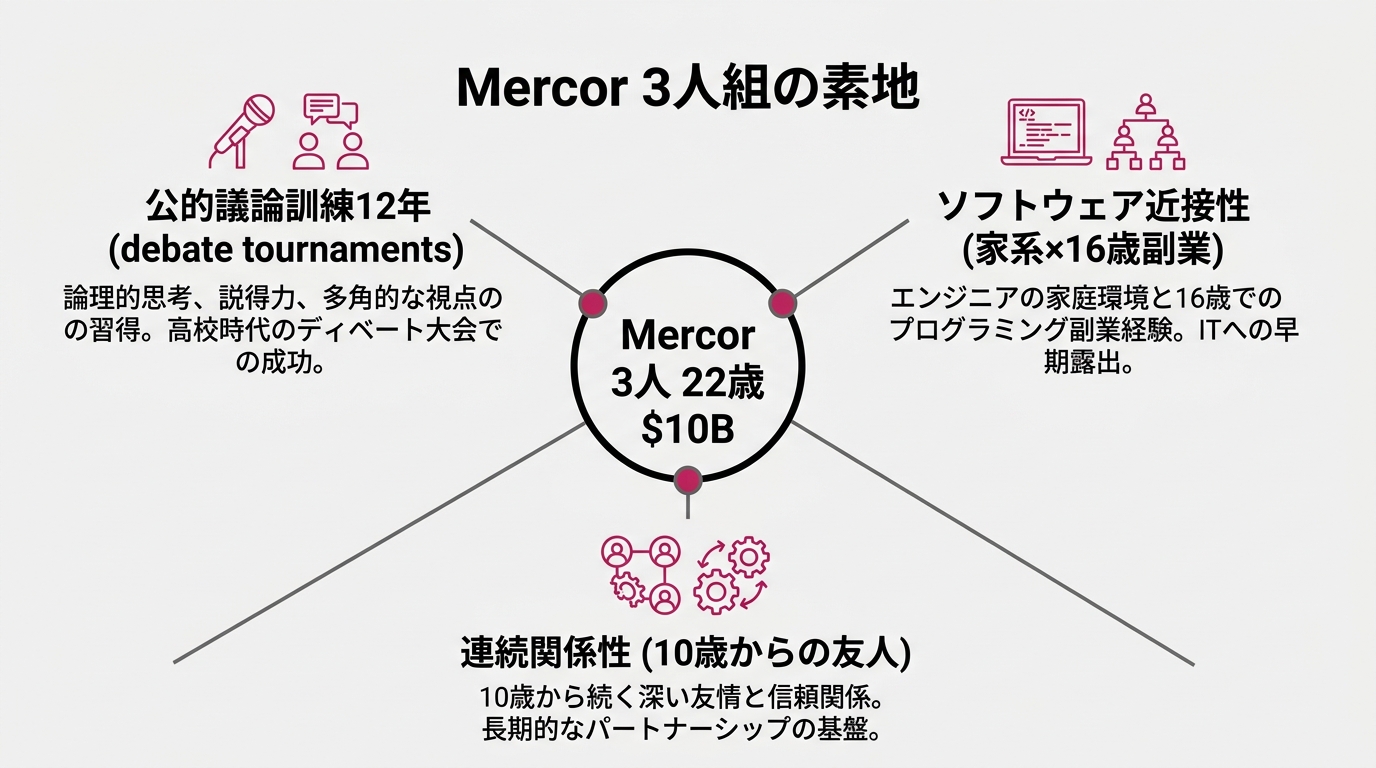
Hiremath × Midha — friends since age 10. Regulars on the debate (formal public argument) tournament circuit through middle and high school. They met Foody through a debate competition in high school. In other words, they spent more than 12 years in the same crew, training in “constructing logic and battling it out in public.”
Foody comes from two software engineer parents (mother at Meta, father runs a graphics company). At 16, he started a small side hustle helping friends pass AWS (Amazon Web Services) certification exams to qualify for promotions (channeliam.com, 2026-04-10, based on reported profiles).
Pull out what the three of them have in common, and it looks like this.
- Public argument training: 12 years of building positions, testing them in front of audiences, and revising in real time
- Engineering proximity: Through both family and side work, software was a “daily language”
- Continuous relationships: By the time they founded the company at 22, they already had a 12-year-old team
This isn’t “lucky genius.” It’s just that “the habit of running trial and argument in public,” “software being as close as the air they breathe,” and “long-term trust within the team” — all three were structurally in place by age 22.
And here’s the thing — none of this depends on being young. At 35 or 45, you can assemble these three pieces after the fact. That’s exactly what I want to drive home today.
What Antler’s “3,512 Founders” Really Reveal About the AI Unicorn “Age 29” Number
Stopping at Mercor would leave this as just one weird story. So let me widen the frame. I’m going into Antler’s Anatomy of Greatness report, published January 7, 2026 (Antler official, 2026-01-07).
The scale of this report is as follows.
- 1,629 unicorns (private companies valued over $1B)
- 3,512 founders analyzed
- 2014–2024, ten years
- Global cross-section
Here are the four key numbers (all from the official Antler report).
- AI unicorn founder average age: 40 (2020) → 29 (2024). Eleven years younger in just four years.
- Non-AI unicorn founders: 30 (2014) → 33–34 (2022–2024). Three to four years older over a decade.
- Average time to unicorn: 4.7 years for AI vs. 7 years traditional average. AI is 2.3 years faster.
- Founder profile: ~60% STEM (science, technology, engineering, math), ~40% serial entrepreneurs, ~25% immigrants, ~6% women (also confirmed by Business Standard, 2026-02-23)
Most coverage simplifies this into “yep, the Gen Z era is here.” But look at the attribute data, and the picture is more three-dimensional.
STEM 60%, serial 40%, immigrant 25%. These three numbers are variables that are independent of “age.” Meaning: before any condition like “young,” unicorn founders share a foundation of “close to technical languages, with repeated experience, and with cross-border experience.”
Remember the Mercor trio. Before being 22, they had a software-engineer family, an immigrant background (Indian-American in the US), and repeated public-argument experience. This is a story about underlying conditions, not age.
And Antler co-founder Fridtjof Berge said exactly this in a Fortune interview (Fortune, 2026-01-07).
“If you are confident, fast-working, unafraid to try things, and able to iterate quickly, the AI space right now is the best place to play. It’s a domain that demands constant iteration.”
The words used aren’t “young.” They’re fast-working and quickly iterating. The person running Antler explicitly says the dividing line is speed and iteration, not age.
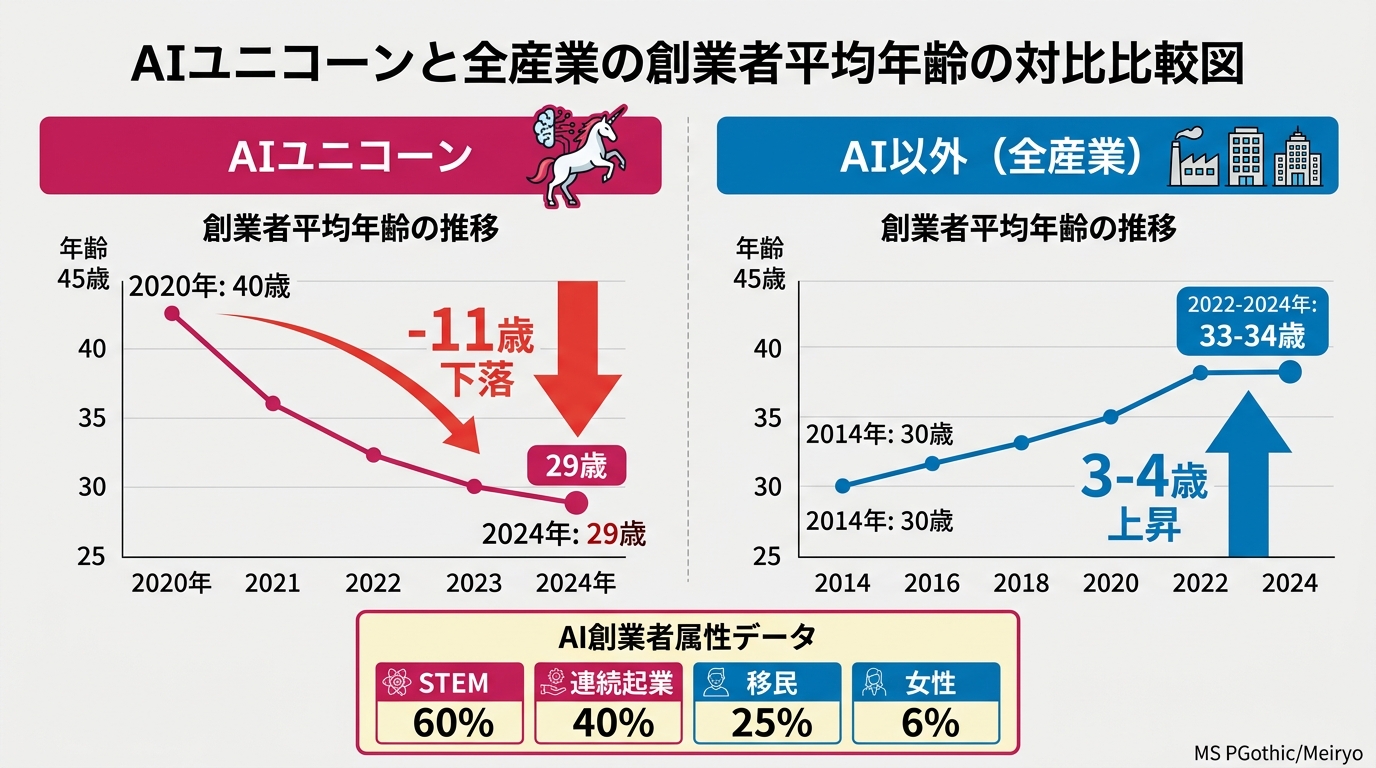
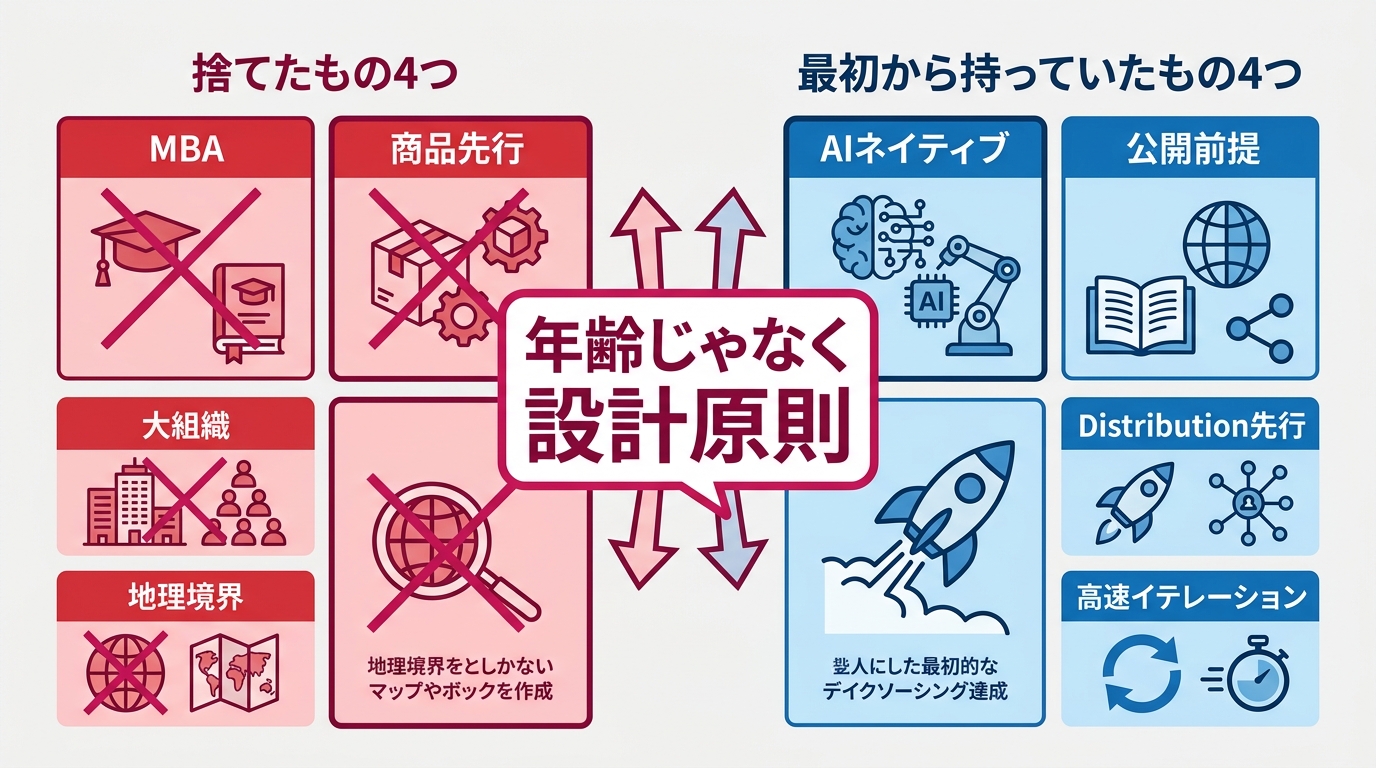
The reason AI unicorns move fast isn’t age — it’s that they have the underlying conditions to test fast and revise fast. The 4.7-year unicorn timeline is the result; the average age of 29 just reflects that the people with this foundation happened to be young. Stack the Mercor trio onto Antler’s 3,512-founder data, and the foundation breaks down into the same four things they discarded and four things they had from the start.
Design Principle 1: The Four Conventions Gen Z Founders “Threw Away”
Discarded #1: Long-term career prep (MBA, 5 years of field experience)
The traditional pre-founding assumption went: get the degree, do five years at a big company, build the network, and then strike out on your own. The Mercor trio? None of them climbed even one rung of that ladder. Hiremath and Midha got into Harvard but launched Mercor while still enrolled. Foody had been running side hustles since age 16. They never set “completing credentials as qualification” as a goal in the first place.
Discarded #2: The “build the product, then sell it” sequence
Traditional founding flow: build the product, launch, then start marketing. The Gen Z founder default is the reverse. Sell while you build, broadcast before you build. Throw hypotheses out on social (especially X/Twitter) at the concept stage and read reactions as you implement. No marketing department, no ad budget. Audience first; the product gets assembled later.
Discarded #3: The hierarchical big org
The traditional corporate assumption: bigger org = success. Gen Z AI unicorns go the opposite direction. Even at $10B, Mercor headcount is in the dozens. The Japanese solopreneur cases I covered earlier — Polsia at ¥450M, Medvi at ¥60B, Levelsio at ¥450M — all run with one to a handful of people. Before scaling the org, they use AI to compress what used to take a whole organization down to 1–3 people.
Discarded #4: Credential and geographic signals
“Working in Tokyo.” “Earning an MBA in the US.” “Holding a specific industry certification.” Traditional career signals were tied to geography and credentials. Gen Z founder behavior is borderless from Day 1. Mercor is headquartered in the US, but they were hiring across the US, India, and Europe immediately. With AI tools, language and timezone walls aren’t what they used to be. Instead of using credentials and geography as “certificates,” they show output directly.
All four of these are independent of age. At 35 or 45, you can throw them away today if you decide to. The hard part is that “what’s left after I throw them away” is invisible, and that’s scary. So next, let’s talk about what you win with after you discard — the “four defaults they had from the start.”
Design Principle 2: The Four Defaults Gen Z Founders “Had From the Start”
On the flip side of what they discarded, Gen Z founders had four defaults from day one. This is the real Gen Z advantage — and it’s perfectly possible to acquire it later.
Default #1: AI isn’t “something to learn” — it’s daily life
When ChatGPT launched (November 2022), the Mercor trio were 18. A generation in which AI walked into daily life mid-student-life. So the very framing of “how do we incorporate AI into the workflow” doesn’t exist for them. AI is air from the start. Writing code, writing prose, looking things up — every workflow is designed AI-first. That’s what “AI-native” actually means. Anyone over 35 can acquire this later by deliberately rewiring their habits.
Default #2: Public-by-default
Gen Z is the social-media generation. Putting your trial-and-error in public has been air to them since their teens. The debate (public argument) practice Midha and Hiremath have been doing since age 10 is structurally identical. Publish a position, take the rebuttal, revise immediately. Once that’s a habit, the speed of decisions when you found a company is in a different league. Most founders run a three-step process: discuss in private, decide, then publish. Gen Z founders decide while publishing.
Default #3: Distribution-first thinking (audience first, product later)
This is the flip side of Discarded #2. Instead of “make the product then sell it,” it’s “build the community of buyers first, then ship the product.” Mercor was running discussions about “AI hiring” on Twitter/X before founding, surfacing the interest of both employers and job seekers. They went into development already knowing “what features will land” before the product was even built. This has nothing to do with age — you can start today.
Default #4: A high-iteration habit
Berge’s phrase “fast-working / quickly iterating” is exactly this. The Mercor trio’s debate training has the same structure: build a position, put it in front of an audience, take the counter, revise immediately. The cycle time is dramatically shorter. In the AI era, the cost of revising a product has collapsed, so revision speed translates directly to competitive edge. When Antler points out that “AI companies hit unicorn status in 4.7 years (2.3 years faster than the traditional 7),” that’s the cumulative effect of that speed.
So to summarize:
Gen Z’s real weapon isn’t “age.” It’s the combination of AI-native × public-by-default × distribution-first × high-iteration.
And all four of these are skills and mindsets you can deliberately acquire. They’re not innate traits.
Design Principle 3: The Dividing Line Is “Speed,” Not “Age”
Now let me merge today’s argument with last week’s MIT 45-is-peak piece.
The MIT Azoulay team study (NBER posting in 2018, peer-reviewed version in American Economic Review: Insights in 2020) used US Census Bureau data to analyze 2.7 million entrepreneurs. The conclusion: “The average age of the most successful founder is 45,” and “a 50-year-old founder is roughly twice as likely to succeed as a 30-year-old” (MIT News, 2020).
Antler’s 2026 data, on the other hand, says “for AI unicorns specifically, 29 is the average.”
These two don’t contradict. They’re perfectly complementary.
- Antler study: AI domain, 4.7-year unicorn timeline, iteration-speed-driven. The fast win.
- MIT study: All industries, 2.7 million people, long-run success probability. Industry experience, network, and track record win.
“Speed” and “experience capital” are separate axes. Gen Z wins on speed; veterans win on experience capital. That means people who have both are the strongest.
Even in Antler’s data, “40% serial entrepreneurs” and “60% STEM” show that underlying conditions matter. So even in Gen Z AI, it wasn’t “experience-zero 22-year-olds” who won. They had their own version of experience capital — 12 years of debate, 6 years of AWS side hustles, software-engineer families.
The conclusion that falls out of this is simple.
If you’re 35 or older, you don’t need to discard “industry experience.” You just need to add the four design principles on top.
Five years of industry experience + AI-native habits + public-by-default + distribution-first + high iteration. That combination is structurally impossible for a 22-year-old Gen Z founder to build. They don’t have industry experience yet. So if you have industry experience, you’re positioned to build the hybrid strongest type.
The problem is, the concrete steps for retrofitting these four design principles aren’t visible.
Four Steps the 35-and-Over Crowd Can Implement Today
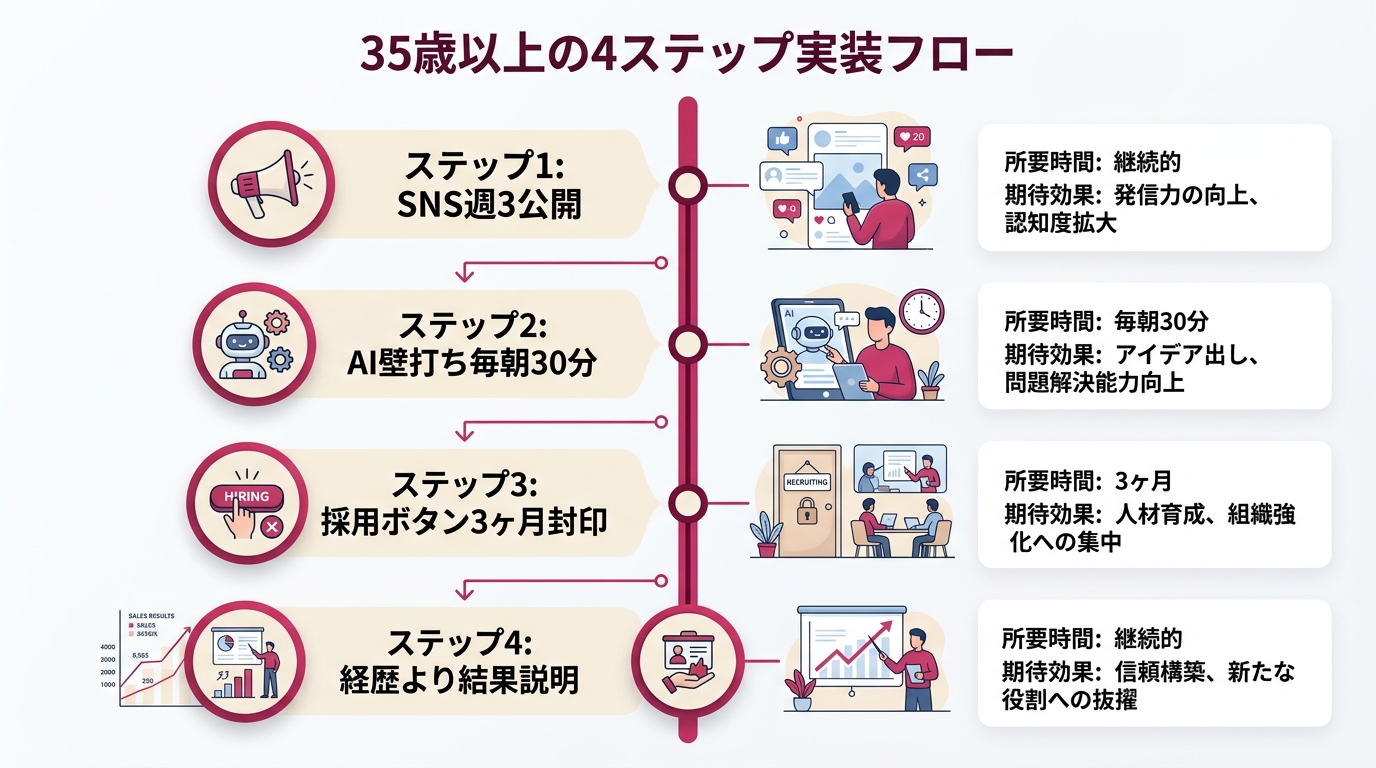
Step 1: Publish what you’re working on three times a week on social (acquire public-by-default and distribution-first at the same time)
The easiest step with the biggest payoff. Pick X/Twitter, LinkedIn, or note, and post about your actual work three times a week. The key: not “promoting the finished product” but “sharing what’s in progress.” What you tried today, where you got stuck, small discoveries. Same structural habit Midha and Hiremath have been running since age 10. Stick with it for three months and what becomes visible is something far more valuable than follower count — the people who are interested in your specific expertise.
Step 2: Make AI back-and-forth a 30-minute morning routine (acquire AI-native habits)
The framing “incorporate AI into the workflow” is itself outdated. The right move is slot 30 minutes into your morning routine. Around when you’re making coffee, hand Claude/ChatGPT “the three most important decisions for today” and have it generate three counterarguments for each. That’s it. After three weeks, AI gets promoted from “tool” to “decision-making partner.” The moment that becomes daily, the “AI-native sense” Gen Z had gets installed retroactively.
Step 3: Lock the hire button for three months and validate solo (acquire small-team thinking)
When you start a new project, the first thing to decide is the rule that you don’t hire anyone for the first three months. Redirect the hiring budget to AI tools and contract work (task-based outsourcing). This breaks the assumption that “we can’t make progress without growing the org.” Even at $10B, Mercor’s headcount is in the dozens. Japanese solopreneur cases (Polsia, Medvi, Levelsio) are all small. Validate hypotheses with the smallest team, then add people — that sequence is the Gen Z default.
Step 4: Less résumé, more results (release the credential/geography signals)
Pull out your self-introduction or pitch deck once and look at it. Reduce “graduated from X University,” “X years at X company,” “holds X certification,” and rewrite into “increased X metric by Xx,” “solved X problem in X days.” This alone shifts your output from being credential-and-geography-dependent to being results-based. It’s also easier for the reader to evaluate. From here, you start preparing to work with people anywhere in the world.
In Closing: Not “the Gen Z Era” — “the Era of People Who Adopted What Gen Z Made the Default”
Three 22-year-olds hitting a $10B valuation is genuinely an event. Antler’s number — “average AI unicorn founder age: 29” — pulled from 3,512 people, lands hard.
But if you stop at “Gen Z is taking over the world” or “this isn’t relevant to me,” you miss the actual design principle.
Let me restate what I broke down today.
- The Mercor trio’s underlying conditions: 12 years of public argument training, software proximity, continuous relationships since age 10
- The real signal in Antler’s 3,512-founder data: STEM 60%, serial 40%, immigrant 25% — patterns of underlying conditions independent of age
- Design principle “four things discarded”: MBA, product-first, big org, geographic boundaries
- Design principle “four things had”: AI-native, public-by-default, distribution-first, high iteration
- Four steps for the 35-and-over crowd: Social posts 3×/week, AI sparring 30 min/morning, lock hiring for 3 months, results over résumé
Combine this with last week’s MIT 45-is-peak piece, and you get: Industry experience × four design principles = hybrid strongest type. There’s a region 22-year-old Gen Z founders absolutely cannot copy — and that’s the region available to you over 35.
Personally, when I went independent, the first thing I threw away was the assumption that “you don’t get trusted unless you’ve worked in an org for a long time.” And the first habit I picked up was publishing what I was working on, on social. Looking back, I was unconsciously implementing “Discarded #3 × Had #2.”
Design principles don’t depend on age. Start with even one of them today. My recommendation is Step 1: post on social three times a week. Tomorrow morning, just post once. That’s the dividing line.
It isn’t “the Gen Z era.” It’s “the era of people who adopted what Gen Z made the default first.” Your turn — it’s already started today.

女性だからこそ、AIを使いこなさなきゃって思ってる。仕事も、副業も、推し活も、旅行も、全部やりたい。人生一度きりなのに時間は足りないじゃん?だからAIに任せられることは全部任せる。浮いた時間で本当にやりたいことをやる。それがあたしのスタイル。ここにはあたしが実際にやったことをまとめてるだけ。誰かのためになったらいいなって思って書いてるよ。