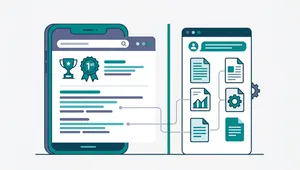
Gemini Referral Traffic Is Up 388% Year-Over-Year. 5 Things to Change This Week from Last Week's GEO Audit
Did you use last week's GEO diagnostic checklist? New data has arrived. Gemini is growing 7x faster than ChatGPT, and uncited pages are losing 61% of their CTR. Here are 5 actionable updates.
What you'll learn in this article
- What changed in AI search and content discovery
- Which metric or operating rule matters before shipping more content
- Which follow-up article expands the strategy from another angle

Did you try last week’s GEO diagnostic checklist?
If you put a conclusion at the top of your post or cleaned up your H2 headings and felt some traction — that direction is right. But this week, new data has come in.
Looking at it, the checklist alone isn’t quite enough.
The most overlooked piece is Gemini. Many people building GEO strategies have been focused on ChatGPT only — but there’s data showing Gemini referral traffic is up 388% year-over-year. That number alone is enough reason to revisit your current design.
This article uses the latest data as of March 2026 to map out what to change from last week.
GEO — Generative Engine Optimization — is the practice of optimizing your content so that generative AI systems cite it when generating answers. When ChatGPT or Gemini produces a response, it sometimes displays the URLs of pages it referenced. Getting onto that list is the goal. Where traditional SEO aims for ranking positions in search results, GEO aims to be selected as an AI’s citation candidate. If you started last week, this week’s updates let you move one level up in implementation.
LLM Traffic Up 527% — But Know the Context
Start with the data.
According to a Search Engine Land report on Semrush customer data, web traffic from LLMs increased significantly between January 2024 and May 2025 — up 527% year-over-year. In session terms, that’s a jump from 17,076 to 107,100.
That said, I want to be transparent: this data is aggregated from a specific Semrush customer segment. The portfolio skews heavily toward legal, financial, insurance, and medical sites. It’s not an industry-wide average.
If you cite the “527% increase” in your own writing, attribute it clearly — “according to Semrush’s analysis” — to avoid overgeneralization.
The direction, however, is unambiguous. ChatGPT alone went from 600 monthly visits to 22,000 — roughly 37x — between early 2024 and May 2025.
A natural question: “I can see traffic is growing, but isn’t it still small?” The answer lies in quality.
According to an upGrowth report, ChatGPT-referred conversion rates run 14.2–15.9%. Compare that to Google organic search at 2.8% — more than 5x higher. Even with lower volume, AI search traffic converts. Treating it as a second-tier opportunity means long-term missed revenue.
For those who restructured H2 headings last week: the structure you built maps directly to how easily AI systems can cite you. Your direction was right.
One more baseline to know: according to Similarweb (January 2026), ChatGPT holds 64.6% of AI search share, Gemini 22%. The assumption that “AI search = ChatGPT” was already outdated as of March 2026. The AI search landscape has shifted from one dominant player to multiple competing ones — and your strategy needs to match that.
Gemini +388% Is Being Overlooked. Watch ChatGPT Only and You’re Missing Half the Picture
Last week I recommended verifying whether ChatGPT is citing your content. This week’s addition: Gemini.
Across upGrowth’s report and several other surveys, Gemini’s referral traffic growth rate significantly outpaced ChatGPT’s +52% — a +388% figure has been cited for the September–November 2025 period. The exact numbers vary by measurement methodology, so treat these as directional signals.
The “Gemini +388%” figure is almost never discussed. Even GEO-focused blogs and explainer articles rarely mention Gemini. That’s a first-mover advantage hiding in plain sight. Knowing this alone puts you in the top 5% of content designers.
Why is Gemini growing so fast? It comes down to Google integration. Gemini is now the default assistant on Android phones. Usage on iPhone is growing through the Gemini app. The number of scenarios where it’s used as a native smartphone function is surging — and Google’s search features and Gemini’s answer functions are clearly merging. Expect its footprint to expand further within 2026.
What to do about it, concretely.
Start by checking whether Gemini is citing your site. Open Gemini (gemini.google.com) and run a search on your topic area — something close to your article. “What are effective GEO tactics in 2026?” or “How do you get started with [your topic]?” Run a few queries near your content.
Observe which sites are being cited. Look at the common characteristics: how their H2 headings are written, how long their articles are, whether they have author information. Structural tendencies will emerge.
Then check Google Search Console for AI Overview-driven impressions and clicks. If numbers are appearing, you already have Gemini-context visibility. If those numbers grew since last week, your checklist work from last week is producing results.
Last week I recommended questioning ChatGPT. Starting this week, add Gemini to that review. That single addition meaningfully raises the completeness of your GEO coverage.
img: Referral traffic flow diagram showing arrows from three AI search engines — ChatGPT, Gemini, and Perplexity — to a website, with arrows of different thickness representing relative traffic volume. Gemini arrow notably thick to indicate growth. White background (#F5F5F5), clean diagram style, business blue. | type: diagram | style: white background (#F5F5F5), traffic flow diagram, business blue
Gartner’s “Search -25%” Prediction: What’s Actually Happening
Let me accurately clarify a frequently cited piece of data.
You may have seen the claim “Y Combinator predicted search traffic down 25%.” That’s incorrect. The correct source is Gartner (announced February 19, 2024): “Search engine volume will drop 25% by end of 2026 due to AI chatbots and virtual agents.” Gartner is the world’s largest IT research firm.
What’s the actual picture as of March 2026?
Google traffic is essentially intact. Search traffic is up roughly 0.8%, and total search volume is up around 26% — moving opposite to Gartner’s prediction.
Does that mean the prediction was wrong? Here’s the key nuance: Gartner’s projected “search decline” was specific to informational queries — “what is X” and “how do I use X” type searches. Even if those decrease, shopping searches and local searches remain stable.
According to Ahrefs, ChatGPT now handles roughly 12% of Google’s search volume — but its ability to drive web traffic is still about 1/190th of Google’s. The current structure (as of March 2026) is: people research via AI, then act via Google.
What this means for your strategy: GEO should be implemented as an additional layer on top of SEO — not a replacement. You don’t need to abandon SEO for GEO. As AI search citations increase, there are more traffic opportunities that SEO alone can’t capture. Running both in parallel is the practical 2026 design.
For anyone who decided after last week’s checklist to rewrite articles from scratch for GEO: stop. In most cases, lightly adjusting the structure of existing articles is enough. “Polish existing assets to improve citation probability” is the correct 2026 framing. GEO isn’t a full renovation — it’s continuous incremental improvement.
AI Overview Citation Is Democratizing. The 76% → 38% Shift Means Individual Sites Have a Real Shot
This data appeared in last week’s diagnostic article, but it’s directly relevant to this week’s implementation decisions.
According to Ahrefs research (January–February 2026), the percentage of AI Overview citations going to the top 10 sites has dropped from 76% to 38%.
Previously, the structure was: “only major media and high-authority sites get cited.” That’s changing. Individual publishers and small-to-mid-scale sites are gaining citation opportunities.
At the same time, the downside for uncited content is also growing.
According to Seer Interactive (September 2025), content not cited in AI Overview sees CTR (click-through rate) drop 61%. Cited brands see organic search CTR rise 35% — and paid search CTR rise 91%.
“Cited” or “not cited” now produces a clear divergence in traffic. That’s the structure of the AI Overview era.
What’s changing: the conditions for being cited. Previously, domain authority dominated. Now, content structure and information density matter more.
According to Search Engine Land’s analysis, 96%+ of pages cited by AI Overview have author expertise explicitly stated. Author information has become the minimum baseline for citation.
Three specific elements matter most. First: Answer-First structure — place a direct answer to the question within the first 200 characters. Second: Expert credentials — state the author’s specialty, track record, and years of experience. Third: Regular updates — refresh content every 7–14 days.
For individual sites and small publishers, this is where you can beat large media. Many major outlets have articles with vague or absent author information. Pages that carefully document expertise are increasingly being cited over them. If you added author information after last week’s checklist, that effect may begin showing up this week.
AI Overview is becoming an open arena where anyone can be cited. The question is whether you’re participating.
img: Side-by-side bar chart comparing AI Overview citation rates for major sites vs. individual sites in 2024 and 2026. Shows top-10 site dependency dropping from 76% to 38%, with individual site portion growing. White background (#F5F5F5), clean comparison chart style. | type: comparison | style: white background (#F5F5F5), before-after bar chart, business blue
5 GEO Implementation Updates for 2026. What to Change from Last Week’s Checklist
Here are 5 updates to add to last week’s diagnostic checklist. Ranked by “ease of implementation × expected impact.” Work through them in order.
img: GEO implementation 5-update priority list. Each item shows a “Difficulty” badge and an “Expected Impact” badge. Items listed in priority order from easiest to most impactful. White background (#F5F5F5), clean list format with badges, business blue. | type: illustration | style: white background (#F5F5F5), prioritized list with badges, business blue
① Verify H2–H3 Hierarchy (increases citation probability)
Check whether H2 (heading level 2) covers broad themes and H3 covers specific examples or supporting points within each H2.
Multiple GEO-specific studies report that content with clear H2–H3 hierarchy has meaningfully higher AI citation probability — some citing figures around 2.8x. If you restructured H2 last week, this week: verify H3 coherence. Ask whether any H3 headings cover topics unrelated to their parent H2.
Example: “H2: How to Use ChatGPT” with “H3: How to Write Prompts” — coherent. But if “H3: Why AI Matters” appears under that same H2, the structure becomes harder for AI to parse. Cleaning up H3 consistency alone can raise citation probability. Open one existing article and review H2–H3 relationships. It takes 15 minutes.
② Implement JSON-LD (improves AI Overview selection rate)
JSON-LD is a way of encoding webpage information in a machine-readable format (pronounced “Jason-LD”). In WordPress, plugins like Yoast SEO or Rank Math generate it automatically.
GEO studies report meaningful improvements in AI Overview selection rates from JSON-LD implementation — some citing figures around +73%.
If you noticed last week that you haven’t implemented structured data, this weekend is worth the effort. One plugin handles the setup. Non-WordPress users: see Google’s structured data documentation — beginners can typically complete setup in 1–2 hours. After implementation, verify with Google’s Rich Results Test.
③ Add Multimodal Content (improves citation rate)
Multimodal means content that combines text, images, and video. Studies report citation rates roughly 156% higher than text-only content.
If video is difficult, start with adding diagrams or comparison tables. Set Alt Text on all images — Alt Text is the description text attached to an image, which AI systems use to understand image content.
“Articles with comparison tables” are a format AI finds easy to parse and cite. Before/after comparisons, tool specification tables, any text structured as a table — adding just one per existing article shows results. Pick one article and add one table to start.
④ Increase Entity Density (improves AI relevance recognition)
Entities are proper nouns and technical terms that AI can recognize as concepts — people’s names, company names, tool names, and domain-specific concepts all qualify.
Including 15+ entities per article is considered effective. Connecting them via knowledge graphs — structured maps of related concepts — is associated with meaningful improvements in AI relevance recognition.
Two ways to practice. First: use specific names. Instead of “AI tools in general,” write “ChatGPT 4o” or “Gemini 2.0 Flash.” Second: add internal links. If a proper noun in your article is covered on another page of your site, link to it. That internal link alone strengthens the entity connection. Start by adding 1–2 internal links to an existing article.
⑤ Update Every 7–14 Days (prevents citation decay)
According to Search Engine Land’s analysis, AI search engines recognize content that updates regularly as “fresh” and are more likely to cite it.
You don’t need to update daily. Adding one data point, one example, or one reference source every 7–14 days registers as a substantive update. If you have an article you ran through last week’s checklist, add one paragraph incorporating this article’s data. That alone counts as an update.
“Polish a little each week” is the mindset for sustainable execution. Small additions over time — not large rewrites.
Related articles in the GEO series:
- GEO fundamentals and the 3-layer structure: explained here
- Terminology guide — LLMO, AEO, GEO: explained here
- Why ranking #1 on Google doesn’t mean AI cites you: explained here
”Uncited = CTR -61%” Is the Structure Now. 3 Actions to Take This Week
Let me pull the data together.
Uncited AI Overview pages: CTR down 61%. Cited pages: organic CTR up 35%. Gemini referral traffic up 388% year-over-year, and most people still haven’t addressed it.
The gap between “people who have started moving” and “people who haven’t yet” is going to widen from here. Those who complete basic implementation this month will have a clear advantage in six months.
The first-mover window for GEO is at its widest right now.
Three actions for this week. You don’t need to do all three — pick one and execute.
Action 1: Ask Gemini About Your Topic (5 minutes)
Open Gemini (gemini.google.com) and run queries close to what you write about. “What are effective GEO tactics in 2026?” or “How do you get started with [your topic]?” Run a few.
Observe which sites are cited. Look at their structure, author information, and heading style. Write down 3 differences between those sites and your own article. That becomes your correction list for this week.
Run the same queries in ChatGPT and compare. Sites cited by both AI systems are particularly instructive — the structural features they share are high-signal.
Action 2: Strengthen Author Information (20–30 minutes)
Expert credentials are present on 96%+ of AI Overview citations. If you have an author profile page, update it this week.
Write your specialty, track record, years of experience, and specific activities. Concrete language — “GEO practitioner for 2 years, publishing 5+ articles per month” — is what helps AI classify content as expert-authored. No author page? Adding an “About the Author” section at the end of each article also works. 100–150 characters is enough: “since when,” “in what field,” and “what activities.”
Action 3: Add Answer-First to One Existing Article (10–15 minutes)
Within the first 200 characters of an existing article, add 1–2 sentences stating the article’s conclusion.
Not “this article explains X” — instead: “X is Y. This article walks through the specific steps.” Answer first, then detail. That structure alone improves how real-time AI evaluation systems handle the page.
Pick the article you ran through last week’s checklist, or your highest-traffic article if you don’t have one. Add 1–2 sentences at the top. That’s it.
Stop putting this off. All three actions fit into one weekend.
Data recap:
- LLM traffic +527% (Semrush data, skews toward specific industries — direction is clear)
- Gemini +388% (growing more than 7x faster than ChatGPT; most people haven’t addressed it)
- AI Overview citation democratizing (top-10 dependency down from 76% to 38%; real opportunity for individual sites)
- Uncited pages: CTR -61% (cited vs. uncited is now a clear traffic divergence)
- H2–H3 structure, JSON-LD, multimodal content (structural improvements directly affect citation probability)
For those who confirmed the basics with last week’s GEO diagnostic checklist: this week’s updates are your next stage.
Gemini coverage, stronger author information, JSON-LD implementation, update cadence. Deciding “do I do this or not” today is what directly shapes inbound traffic six months from now.
Let me be direct: the era where people ignoring GEO fall behind has already started.
If you used last week’s checklist, execute one action this week. Five minutes querying Gemini. Twenty minutes updating author information. Ten minutes adding an answer to your article’s opening. That accumulation is what builds a site that gets cited.
GEO isn’t a specialized technical skill. It’s the skill of being selected by AI as a trustworthy source — through structure and integrity. Only the people who do it get to the next level.

AIを使いこなせない方は、この先どんどん差がつきます。僕はAIエージェントを毎日動かして、壊して、直して、また動かしてます。そういう泥臭い実践の記録をここに書いてます。理論は他の方にお任せしました。僕は動くものを作ります。朝5時に起きてウォーキングしてからコードを書くのがルーティンです。