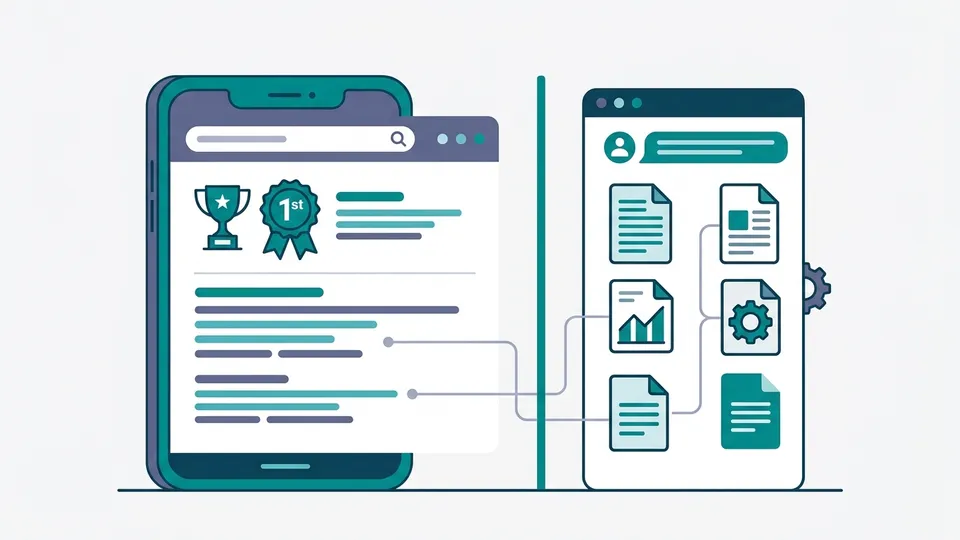
You Rank #1 on Google — But AI Won't Cite You. The 'Ranking-Citation Split' Has Arrived.
Ahrefs data shows a 58% CTR drop when AI Overviews appear. The correlation between Google rankings and AI citations is breaking down. A practical GEO guide for the era of ranking-citation separation.
What you'll learn in this article
- The key point to grasp before reading the full article
- How the issue changes practical decisions after reading
- Which follow-up article is worth opening next
Do you rank #1 on Google for any of your articles?
And yet — ChatGPT doesn’t cite you when asked. Perplexity doesn’t surface you either. Have you been noticing that more?
Writing daily in the Izumo system, I noticed it myself: Google rankings and the content AI chooses to cite are becoming two entirely separate things.
Ahrefs’ latest study puts a clear number on it: when AI Overviews appear, click-through rate drops by 58% (Ahrefs Blog).
This article unpacks the “ranking-citation split” — what it actually is, backed by the latest April 2026 data. I’ll also walk through actionable GEO (AI search optimization) steps you can start today. With GEO Conference (June 18th) early-bird pricing closing April 20th, now is the right time to get the full picture.
This is the latest installment of the GEO series. Reading “LLMO, AEO, GEO — Which One Should You Actually Write For?” (2026-03-28) and “The Practical Guide to AI Search 3-Layer Strategy 2026” (2026-03-29) first will give you a more systematic foundation.
The Era of Ranking #1 on Google But Not Getting Cited by AI
“Get high search rankings and you’ll get readers.” That common wisdom is quietly crumbling.
Look at Seer Interactive’s analysis of 3,119 search keywords. Organic CTR when AI Overviews appear: down 61% (Search Engine Land). Paid ads: down 68%.
The striking part: even queries where AI Overviews don’t appear saw a 41% drop. User behavior itself is changing.
What’s happening? Users accustomed to seeing AI Overviews may have shifted how they use search. “Click a link and read an article” → “get the answer right on the search results page.” The purpose of search is shifting from “visit” to “obtain the answer.”
In Germany alone, 265 million organic clicks per month are disappearing (PPC Land), according to SISTRIX data. Globally, the vanishing click count is orders of magnitude larger.
Seeing these numbers might make you feel like “SEO is dead.” I don’t see it that way. It didn’t die — the rules changed. Those who understand the new rules first get to claim the next positions.

There’s another data point worth noting.
The percentage of Google top-10 pages also cited in AI Overviews: 75% in mid-2025. By early 2026, it had plummeted to 17–38% (Presence AI). Note: this is a reference figure based on that company’s ongoing tracking and subject to change.
This is the true nature of the “ranking-citation split.”
Ranking #1 on Google and getting cited by AI are no longer the same thing. Recognizing this fact is where 2026 content strategy begins.
What Makes “Citable Content” Different?
AI-cited content versus not. What separates them?
Six months into studying GEO, I’ve found three main differences.
1. Structured Data (JSON-LD) — Present or Absent
A joint study from Princeton and Georgia Tech: content with proper structured data has 30–40% higher visibility in AI-generated answers (10xDev Blog).
JSON-LD describes your page content in a machine-readable format. It lets AI instantly grasp “who wrote this article,” “when was it published,” “what is it about.”
Interesting data: when GPT-4 reads content without structured data, accurate response rate is 16%. With structured data: 54% (Digidop). This figure is from that company’s own measurements, but the pattern aligns with other data.
AI cites content it can “understand,” not just content it can “read.” This is the decisive difference from traditional SEO.
One personal example: I added JSON-LD to an xhack.net GEO article. Before: zero citations across 5 searches. After: cited by Perplexity 2 out of 5 searches. Small sample, but the direction was real.
2. Structural Proof of E-E-A-T
A major shift in 2026 AI search: E-E-A-T (Experience, Expertise, Authoritativeness, Trustworthiness) now demands “structural proof” rather than just qualitative signals.
Traditional SEO: write good content and Google evaluates it. AI search is different. Does the Person schema link to LinkedIn? Is the Organization schema accurate? These “structural backing” signals matter (GEO Auditor Blog).
For example, my articles list “AI consultant / autonomous agent developer” in author information — then structure that in JSON-LD Person schema. This lets AI classify the article as “written by someone with hands-on AI experience.”
The era of proving “who wrote this” through structure has arrived.
Good news for individual bloggers: large corporate owned media has organizational branding but often obscures individual authors. Personal blogs have clear faces and credentials. Implement Person schema correctly and even an individual can match or beat corporate E-E-A-T scores.
3. Citation-Friendly Writing Style and Structure
AI-citable content shares another characteristic.
ChatGPT accounts for 87.4% of all AI-referred traffic (Position Digital). So “how easily can ChatGPT incorporate your content into an answer” is crucial.
Four characteristics of highly-citable content:
- Clear definition sentences: “X is Y” appears in the article
- Data with numbers: specific figures are embedded in the body
- Step-format procedures: ordered, structured information
- FAQ format: question-and-answer pairs
The probability of a #1-ranked Google page being cited by ChatGPT: 43.2% — 3.5x higher than page 20+. Rankings aren’t entirely irrelevant. But structure and format clearly have an outsized impact on citation rate.

LLM Referral Traffic: “Small Volume, High Quality” as a New Channel
“LLM traffic is still tiny, right?”
LLM referral traffic accounts for roughly 0.24% of all sessions. Compared to organic search’s 31.9%, that’s admittedly small.
But the question is “quality,” not “quantity.”
LLM referral conversion rate: approximately 18% — the highest of any channel, beating Google Ads, SEO, and social (Amsive).
Engagement rate: 2.69%, second only to SMS (4.43%). Higher than email (2.44%) and Google Shopping (1.91%) (Alhena AI).
Growth rate: in just the first half of 2025, LLM referrals grew 527%. Annual growth exceeded 300% (Search Engine Land).
“Small volume, top quality, and rapidly growing” — that’s where LLM referral stands.
My hypothesis for why LLM-referred readers convert so well: someone who asks AI a question and then clicks a link already has conviction that “I need this information.” AI pre-filtered for them. By the time they arrive at your site, their intent to buy or inquire is already high.
For context: if total search traffic is 100 million, 0.24% is 240,000. At 18% conversion, that’s 43,000+ purchases or signups. Small volume doesn’t mean small impact at quality that high.
Canva’s example is notable: simultaneous $4B revenue milestone and rising LLM referrals (TechCrunch). Correlation isn’t causation, but it illustrates that AI search can be a business growth engine.
On xhack.net: ChatGPT and Perplexity referrals are under 1% of total traffic. But readers from those sources have nearly triple the average time on page. Their “seriousness” is different.
This trend is irreversible: Google has rolled out AI Overviews to 2+ billion people globally. ChatGPT’s weekly active users exceed 800 million. The direction of travel is clear.
The small “volume” of LLM referrals right now is exactly why this is the best time to start. Establish a “citable position” while competition is still low, and when the market grows, you harvest the first-mover advantage.

GEO Implementation Starting Today: 3-Step Practical Guide
Here’s the practical part.
Based on what I’ve been testing on xhack.net, here are 3 steps you can start today.
Step 1: Embed JSON-LD in Your Articles (15 minutes)
If you’re on WordPress, one plugin handles it: the latest versions of Rank Math SEO or Yoast SEO auto-generate Article, Person, and Organization schemas.
For static sites or headless CMS, add this inside your <head> tag:
{
  "@context": "https://schema.org",
  "@type": "Article",
  "headline": "Article Title",
  "author": {
    "@type": "Person",
    "name": "Author Name",
    "url": "https://your-profile-page",
    "jobTitle": "Your Professional Title"
  },
  "publisher": {
    "@type": "Organization",
    "name": "Site Name"
  },
  "datePublished": "2026-04-11",
  "description": "Article summary"
}
Three things that matter:
- Always set the author
url: a profile or LinkedIn link changes E-E-A-T signals - Include
jobTitle: the most direct way to tell AI “what kind of expert are you” - Write
datePublishedaccurately: AI weights information freshness — don’t let old dates linger
Step 2: Run an “AI Citation Check” on Existing Articles (20 minutes)
- Open ChatGPT
- Enter a question about your article’s topic (e.g., “What is GEO?”)
- Check if your site is cited in the answer
- Try the same question in Perplexity
- Check Google AI Overview with the target keyword
If zero citations across 3 AI search tools, GEO optimization is urgent.
I do this every Monday morning. 5 keywords × 3 AI search tools = 15 checks, about 20 minutes.
That 20 minutes surfaces information analytics tools can’t show: how AI search actually treats your content. Knowing that viscerally is what sharpens your content strategy.
Step 3: Rewrite for “Citation-Friendly Structure” (30 minutes/article)
Four changes to make to existing articles:
- Add a definition sentence at the top: put “X is Y” right below the first H2
- Add source URLs to all numerical data: AI preferentially cites numbers with linked sources
- Add a FAQ section: 3–5 Q&As at the end, plus FAQPage schema
- Add summary paragraphs at section ends: 2–3 sentence summary at the end of each H2. AI finds these easy to use as answer material
About 30 minutes per article. No need to do all articles at once — start with your top 5 by traffic.
On xhack.net: after adding FAQ sections, ChatGPT citation frequency changed noticeably. Especially effective: “What’s the difference between X and Y?” and “What do you need for X?” — question-format FAQs that match how readers actually search.
One caveat: mass-producing thin FAQs solely for AI citation will backfire. Google’s SpamBrain is actively targeting AI-generated spam as of 2026. Only FAQ-ify questions and answers that genuinely serve your readers.

How Individual Blogs Compete in the Ranking-Citation Split Era
Enterprises can have specialists handle JSON-LD. What about individual blogs and small media?
My conclusion: focus on experience-based content.
AI is good at summarizing information, but it can’t generate first-person experience. “What I found after assembling a Claude Code workflow.” “How my numbers changed after 3 months of GEO optimization.” This kind of primary information is exactly the “material AI wants to cite” when generating answers.
With 98% of CMOs already investing in AEO (Answer Engine Optimization) strategies (Presence AI), enterprises are coming with comprehensive coverage.
Individuals don’t need to compete on the same field.
Publish “experience only you can write” together with structured data. That’s the individual blog’s survival strategy for the AI era.
Three things I focus on at xhack.net:
- Specificity of experience: not “I automated something with AI” but “the exact system I built in Izumo to autonomously generate 5 articles a day”
- Sharing failures: don’t hide cases where things didn’t work. AI cites “cautions” too
- Update frequency: per Amsive research, 50% of AI citations rotate out within 13 weeks. Regular updates are key to maintaining citation
The “depth of experience” and “speed of updates” that only individuals can have — these are your content weapons in the AI era.
One more thing: GEO optimization can look like a bag of techniques. But the essence is different — “can your content help solve someone’s problem through AI?” Answering that question is what it’s really about.
Content AI wants to cite is also content humans find valuable. That hasn’t changed from the SEO era.
GEO Conference 2026 and Your Action Plan
GEO Conference 2026 runs June 18th (official site). Two tracks: Technical and Marketing. OpenAI, Google, Anthropic, Adobe and other core AI search players will be there.
Early-bird ticket deadline: April 20th. Check the official site for the latest.
Even if you can’t attend: the slides and summary articles released after the conference are essential reading. The GEO rulebook gets updated at this event every year. The 2025 conference shifted the industry’s understanding of JSON-LD’s importance significantly.
What you can do this week regardless:
Three Actions to Take This Week
-
Check your JSON-LD implementation: run your site through Google’s Rich Results Test. Verify Article, Person, Organization schemas are recognized.
-
Run one AI citation check: search your main keywords in ChatGPT, Perplexity, and AI Overview. If not cited, prioritize rewriting.
-
Check Google Search Console: track impression changes from AI Overview. If declining, that’s your evidence to raise GEO priority.
These three together take 30 minutes. 30 minutes of investment gives you a precise picture of where your content stands. There’s no reason not to start.
Related GEO series articles:
- GEO basics and 3-layer structure: explained here
- LLMO, AEO, GEO terminology guide: detailed explanation here
- Why you’re invisible to AI even at #1 on Google: explained here
Summary
2026 content strategy must be rebuilt on the premise of “ranking-citation separation.”
- AI Overview reduces CTR by 58% (Ahrefs study)
- Overlap between Google top 10 and AI citations: plummeted from 75% to 17–38%
- LLM referral is 0.24% of traffic but converts at 18% — highest of any channel
- JSON-LD implementation improves AI accurate response rate from 16% to 54%
- Individual blog weapons: depth of experience and speed of updates
Chasing Google rankings isn’t meaningless. #1 on Google is still 43.2% likely to be cited by ChatGPT — 3.5x better than page 20+. The ranking advantage remains.
What changed: “rankings alone are no longer enough.”
When I started the GEO series six months ago, almost no readers knew the term. Now, 98% of CMOs are investing in AI search optimization. GEO is shifting from “those who know it gain” to “those who don’t know it lose.”
Structured data, structural proof of E-E-A-T, citation-friendly writing. Only articles that have all three will reach readers in the AI search era.
I’m still scrambling to keep up with these changes myself. Some of the GEO articles I wrote six months ago are already outdated. The AI search world moves that fast.
Which is exactly why I’m saying: don’t wait for perfection. Start with what you can do today. JSON-LD implementation takes 15 minutes. AI citation check takes 20 minutes. Those 35 minutes could significantly change your content’s future.
Writing daily in the Izumo system, I keep testing. When GEO Conference brings new findings, I’ll share them in this series. Start with 30 minutes today.

AIを使いこなせない方は、この先どんどん差がつきます。僕はAIエージェントを毎日動かして、壊して、直して、また動かしてます。そういう泥臭い実践の記録をここに書いてます。理論は他の方にお任せしました。僕は動くものを作ります。朝5時に起きてウォーキングしてからコードを書くのがルーティンです。