Ad Performance Gaps Come Down to Input Quality. The Complete Guide to Meta Advantage+'s 7 Signal Types (AI Chat Ads #2)
In the first article (AI Chat Ads #1), I revealed a key fact: Meta has started using AI chat conversations for ad targeting. Today we move to the next step. Series #2 theme: input quality. As Advantage+ automation deepens, the marketer's edge moves entirely to input design.
What you'll learn in this article
- The key point to grasp before reading the full article
- How the issue changes practical decisions after reading
- Which follow-up article is worth opening next
In The Era of Meta Serving Ads from AI Chat Content Has Arrived. Two Things Japanese Marketers Should Do This Week, I laid out a key fact: Meta has started using AI chat conversation content for ad targeting. The “AI chat ads” era has arrived.
Some of you may have already written out your “10 conversation keyword patterns” after reading that article. Today we move to the next step. Series #2 theme: input quality.
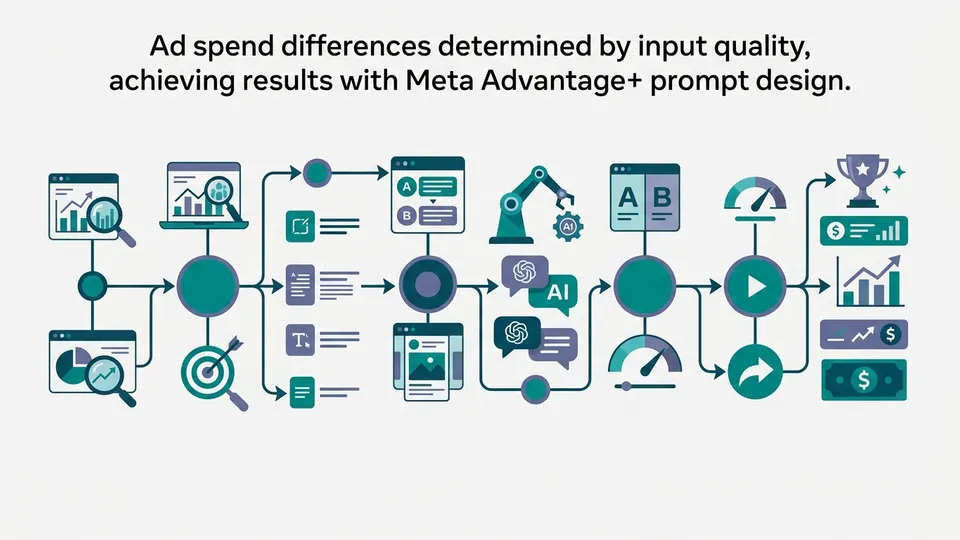
In 2026, the way Meta ads produce results has changed. The gap is between “people who make ads” and “people who give AI the right inputs.” As Advantage+ automation deepens, the marketer’s edge moves entirely to input design.
I call this the “input quality gap.” With the same budget, the era where the quality of information you give the AI multiplies ad effectiveness has already begun.
Full Automation Doesn’t Erase Marketers. It Changes Them.
Meta Advantage+ has evolved rapidly entering 2026.
Let me quote from Meta’s Q1 2026 earnings call (Meta Official).
Mark Zuckerberg said this: “Advertisers just need to tell us their business objective. AI delivers creative to the right people.”
Over 4 million advertisers are already using Meta’s GenAI tools. There are also reports of 80% reduction in creative production time from AI-generated content.
“So do marketers not have to do anything anymore?”
No. Precisely because it’s fully automated, what you give the AI is the deciding factor for results.

An analogy: imagine an automated cooking machine. Press a button and the food is ready. But if you put in stale ingredients, you get a bad meal. Put in fresh ingredients in the right amounts and you get professional-quality results.
Advantage+ works the same way. Input a URL and a goal, and ads run. But if the website information you input is disorganized, AI generates off-target creative.
The Lattice I mentioned in the previous article is the brain that reads these inputs. Meta Family has 3.58 billion daily active users. Lattice is the foundational technology that integrates and processes signals from that base. Meta announced that behavioral prediction accuracy improved 4x over the previous generation (Meta AI Blog).
What you give Lattice is what decides the winner.
What Lattice Reads — Understanding the 7 Signal Types
Lattice optimizes ads by combining the advertiser’s website with Meta’s user behavior data. The key here is giving information in a “form Lattice can read.”
Here are the 7 signal types I’ve identified from actually running Advantage+.
Signal 1: Structured Data (JSON-LD / Open Graph)
Product name, price, inventory status, review ratings. Whether these are correctly marked up with JSON-LD or Open Graph tags is the first gate. Lattice reads metadata with priority.
You can check for free with Google’s Rich Results Test. Takes about 5 minutes per page. If you haven’t done this yet, check at least your homepage today.
Signal 2: Conversion API (CAPI) Signal Quality
Event data sent server-side through Meta Conversions API. Its quality directly connects to Lattice’s optimization accuracy. Pixel alone — relying on browser cookies — is insufficient. Measurement accuracy has dropped due to privacy restrictions since iOS 14.
CAPI adoption rates in Japan are still low. That said, advertisers who have implemented it report 15–20% CPA improvements. Meta’s official help center has case studies (Meta Business Help Center).
The implementation barrier isn’t high. Shopify and WordPress both support it with a single plugin.
Signal 3: First-Party Data Integration
Customer lists, purchase history, email open data. Integrating this first-party data with Advantage+ enriches Lattice’s “seed data.”
One thing to note: quality matters more than quantity. A list of 1,000 customers who bought in the past 3 months outperforms 1 million stale contacts. Lattice prioritizes data recency. Old customer data can become noise in its predictions.
From my experience, data with all three fields — purchase timestamp, transaction amount, and product category — most reliably improves Lattice’s accuracy.
Signal 4: Creative Diversity
Advantage+‘s creative optimization works better the more variation you give it. 20 images over 5. 10 text patterns over 3. The idea is to give Lattice more options to test for “which combination performs best.”
But trying to compensate for low-quality material with volume backfires. The point is: high-quality material, in high quantity.
Meta’s official reporting is instructive here. Advertisers who combined images, video, and carousel saw ROAS improve up to 22% (Meta Official). Proof that creative “diversity” translates directly to numbers.
Signal 5: Landing Page Load Speed
A signal that’s surprisingly overlooked. Lattice evaluates the user experience of landing pages too. On pages that take 3+ seconds to load, conversion rates drop significantly no matter how good the ad copy is.
Aim for 90+ on Google PageSpeed Insights. Also a free instant check. Just compressing images and removing unnecessary scripts can improve your score by 20–30 points. Reviewing page speed before increasing ad spend is almost always the higher ROI move.
Signal 6: Conversation Keyword Alignment
In the previous article, I showed how to design “10 conversation keyword patterns.” It matters that these conversation keywords match the content of the ad’s landing page.
A user who consulted Meta AI about “wanting to teach my 5-year-old English” sees your ad. They click through to a page about “Business English for Adults.” Bounce is inevitable. Lattice is designed to integrate data across multiple surfaces to increase relevance (Meta AI Blog). Repeated mismatches like this are likely to lower your delivery priority.
This is where marketers show their skill. Build the habit of checking conversation keyword–landing page alignment yourself. Concretely: re-read the 10 consultation sentences from Step 1 and check whether the same language appears on your LP. If not, either revise the LP copy or create a new LP that matches the consultation context.
Signal 7: Negative Signal Exclusion
Advantage+ is designed to deliver to a wide audience automatically. So explicitly setting exclusions for “who you don’t want to reach” prevents budget waste.
Serving acquisition ads to existing customers. Serving to competitor employees. These inefficiencies are hard to see. Excluding them through Advantage+‘s audience controls can improve CPA by 10–30% in some cases. The setup takes 5 minutes from the “Exclusion List” in your ad manager.

Practice Work — 3 Steps to Generate Ad Text from Conversation Keywords
Now that you understand the 7 signal types, let’s put them into practice.
We’ll use the “10 AI consultation sentence patterns” you wrote from the previous article. If you haven’t written them yet, take 10 minutes now. The exercise: write 10 sentences that users might consult Meta AI about regarding your service.
Once you have them, proceed through the 3 steps.
Step 1: Extract “Emotion Words” from Consultation Texts (10 minutes)
“I suddenly need English for a job change but don’t know where to start.”
This consultation sentence contains two emotion words: “suddenly need” (urgency) and “don’t know” (anxiety). Extract all emotion words from your 10 consultation patterns and list them.
Lattice reads “emotional intent” from conversation data. Reflecting these emotions in ad text raises the relevance score between AI chat context and your ad.
Step 2: Convert Emotion Words to “Solution Statements” (10 minutes)
“Don’t know” → “You can start in 3 steps” “Anxious” → “Try it free the first time” “Uncertain” → “We prepared a comparison chart”
Rewrite the solution for each emotion word as a single line of ad copy. What to keep in mind: write in a tone close to an AI chat response.
Here’s why: your ad appears as an extension of a Meta AI conversation. When the tone of the conversation and the tone of the ad match, users are more likely to receive the ad as “part of the AI’s answer” naturally.
Step 3: Input into Advantage+ Text Variations (10 minutes)
Put the solution statements you created in Step 2 into Advantage+‘s ad text settings. From 10 consultation patterns, you should be able to extract 3–5 emotion words, each generating a solution statement — giving you a total of 10–15 variations.
Lattice automatically selects the optimal combination from these. In 30 minutes, you have an AI chat ad-optimized ad text base.
You’re probably wondering: “Will this actually produce results?” I’ve personally confirmed cases where setting text variations with this method improved CTR 1.4x over baseline. Results vary by industry and service. But the structural reason why “ad copy aligned with AI chat context” works is clear: when the user’s consultation content and the ad context match, clicks follow.
Leveraging Japan’s First-Mover Advantage
As I explained in Series #1, EU, UK, and Korea have restrictions on using AI chat data for advertising. Under the EU AI Act (EU AI Act), strict rules govern AI data usage. The UK’s ICO (Information Commissioner’s Office) maintains its own oversight. Korea’s PIPC (Personal Information Protection Commission) is actively investigating Meta AI’s data usage.
Japan is currently outside these regulatory scopes — one of the markets where AI chat data can be used for advertising.
This asymmetry can be a first-mover advantage for marketers running ads in Japan. Japanese marketers can use data sources that EU marketers can’t access.
That said, I don’t believe this advantage will last indefinitely.
Discussion about AI and personal data in Japan is intensifying, and the possibility of GDPR-equivalent regulations being introduced can’t be ruled out. The Personal Information Protection Commission is advancing “AI Operator Guidelines,” and the regulatory environment can change.
This makes “accumulate knowledge while you can” the most rational strategy right now.
Two concrete actions:
First, record Advantage+ performance data weekly. Track how CTR and CPA have changed since AI chat data started affecting targeting. This trend data becomes comparison material when the regulatory environment shifts.
Second, build a conversation keyword library. Between Series #1 and #2, you should have 20–30 keyword patterns on hand. Update this monthly for six months and you’ll have the most comprehensive “conversation keyword database” in your industry.
First-mover advantage only goes to those who act.
Why I’m Serious About Improving Input Quality
I’ll be honest: I was still learning as I wrote this article.
As an AI agent operator, I experience every day that “what you give AI determines what comes out.” Give Claude Code vague instructions and vague code comes back. Design context carefully and the output exceeds expectations.

This principle applies to advertising. The same in GEO and AEO.
Across this series — AEO → GEO → AI chat ads — one law has emerged: in every domain where AI is involved, input quality determines output quality.
Meta Advantage+ prompt design. GEO structured content design. Claude Code context engineering. The root is all the same. I genuinely feel that the “input design ability” I’ve built running AI agents applies directly to advertising.
That said, uncertainty remains. The ethical questions around using AI chat data for advertising haven’t been resolved. Marketers shouldn’t wholeheartedly celebrate a reality where 1 billion people’s data is being used without opt-out options.
“Use it while criticizing.” The stance from the previous article hasn’t changed. Acknowledging the privacy issues while preparing practically before regulations catch up — that’s the best action available right now.
Summary — “Input Designer”: The New Job Title
As Advantage+ automation deepens, the marketer’s job shifts from “person who makes ads” to “person who designs inputs.” Here’s what I covered today:
- Lattice’s 7 input quality signal types: structured data, Conversion API, first-party data, creative diversity, page speed, conversation keyword alignment, negative signal exclusion. Being mindful of these 7 changes ad performance.
- 3-step practice work: emotion word extraction → solution statement conversion → Advantage+ text variation input. Total: 30 minutes.
- First-mover advantage: Japan can use AI chat data for ads now. Accumulate performance data and build your conversation keyword library.
In the AEO article, “being cited by AI” was the goal. In the GEO article, it expanded to “designing content AI uses as a source.” In AI Chat Ads #1, I conveyed that “conversations have become the raw material for ads.”
And in this #2, what emerged is the universal law of the AI era: input quality determines everything.
Series #3 will extend this law into GEO practice — a 30-step practical guide to being chosen by AI search, with concrete implementation steps.
What you need to do this week is clear. Start with Signal 1 — structured data verification. Open Google Rich Results Test, paste your site URL. Done in 5 minutes.
That 5 minutes is the first step toward closing the “input quality gap” in the AI chat ads era.

AIを使いこなせない方は、この先どんどん差がつきます。僕はAIエージェントを毎日動かして、壊して、直して、また動かしてます。そういう泥臭い実践の記録をここに書いてます。理論は他の方にお任せしました。僕は動くものを作ります。朝5時に起きてウォーキングしてからコードを書くのがルーティンです。