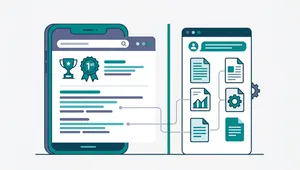
Ranking #1 on Google but Invisible to AI: A 3-Step GEO Diagnosis Backed by the 12% Overlap Data
GEO Series Part 5 (Final Chapter: Evidence-Strengthened Edition)
What you'll learn in this article
- What changed in AI search and content discovery
- Which metric or operating rule matters before shipping more content
- Which follow-up article expands the strategy from another angle

Title Candidates (3)
- “Ranking #1 on Google but Invisible to AI: A 3-Step GEO Diagnosis Backed by the 12% Overlap Data”
- “Is Your Article Being Cited by AI? Check Right Now With This 3-Step Method Using 2026’s Latest Data”
- “AI Citations and Google Search Overlap by Only 12%: The ‘13-Week Freshness Rule’ and a Diagnosis Method You Can Start Today”
GEO Series Part 5 (Final Chapter: Evidence-Strengthened Edition)
Did you know this?
A page ranked #1 on Google has only a 12% chance of being cited by AI assistants.
In other words, even if you’re winning at SEO, 88% of the time AI is ignoring you.
“Being cited by AI” and “ranking high on Google search” are nearly separate stories. Now that the concept of GEO has begun to take hold, this number is an alarm bell for everyone who creates content. GEO, by the way, stands for “Generative Engine Optimization.”
I’ve written four articles in the GEO Series so far—covering terminology, the three-layer integration strategy, traffic data, and the current state of search collapse. That said, I hadn’t yet organized a method to answer “so, where does my own site actually stand right now?”
Today, I’m answering that question directly.
I’ll share two shocking data points revealed by the latest 2026 research. And I’ve put together a 3-step process you can use right now to check whether your content is being cited by AI. As the final chapter of the GEO Series, I’ve made this a practical summary you can actually use.
Even Ranking #1 on Google, You’re Invisible to AI—What the 12% Overlap Data Means
At the frontier of GEO research, studies measuring the overlap between AI citations and Google search results have been rolling out one after another, from late 2025 into 2026.
Among them, the report from GEO analytics company Profound, released at the end of 2025, has drawn particular attention (Profound). Comparing the URLs cited by the four major AI assistants—ChatGPT, Perplexity, Gemini, and Claude—with Google’s top 10 results for the same search queries, the overlap was just 12%.
Let me make the numbers more concrete.
Say there are URLs cited by AI for 100 queries. On average, only 12 of those URLs are also among Google’s top 10 results. The remaining 88 don’t make it into Google’s top tier. In other words, they are pages selected by AI purely on GEO merit.
Why does this gap appear?
SEO optimizes for “accumulated human evaluation behavior” like backlinks, domain authority, and click-through rates. GEO, on the other hand, is judged on whether AI considers “this information trustworthy as an answer to the user.” High-authority domains are not automatically picked. A structure that directly answers the question, clarity of evidence backed by cited data, freshness of information—these are GEO’s primary evaluation axes.
SEO and GEO are playing games with different rules.

What’s important is that this is not a “concentrate on one or the other” story. SEO and GEO have different optimization axes and are two strategies that should be pursued in parallel. The assumption that “if I’m #1 on Google, I must be cited by AI too” has collapsed. First, you need to understand your site’s current status.
GEO is still a field that has just begun. The fact that 88% of content remains unoptimized means, conversely, that there is enormous room for early movers.
3 Steps to Check Whether Your Article Is Being Cited by AI
“Is there a way to check whether you’re being cited?”
There is. With just free tools, it’s done in three steps.
Step 1: Ask Major AI Assistants About Your Topic
First, ask three AI assistants: ChatGPT, Perplexity, and Claude. Use the format “Please tell me in detail about [your topic].” Perplexity automatically displays source URLs in its answers, making it the easiest to verify.
For example, you might ask, “Please tell me concrete ways to implement GEO.”
Check the list of source URLs in Perplexity’s response screen. If your site’s domain is included, you are being cited by AI. Even if it’s not included, record the domains of the URLs that are being cited. This becomes valuable information for grasping the pattern of “what kinds of sites are being cited.”
When checking with ChatGPT or Claude, URLs may not be displayed in the response. Try asking a follow-up question: “Please tell me the sources for this answer.”
Step 2: Analyze the Structure of Cited Competitor Articles
Open and read the URLs being cited in Step 1.
There are three points to observe.
- Heading structure: Is the conclusion stated at the beginning? Are H2 headings phrased as questions?
- Treatment of data: Are there statistics or numerical figures? Are source URLs clearly listed within the body text?
- Update date: Is a last-updated date clearly shown on the page? Is the content recent?
By analyzing “why was this page cited,” you can see which elements your own article has and which it lacks. This is less competitor analysis and more “reverse-engineering AI’s scoring criteria.” Think of cited pages as samples of content that AI has judged useful.
When you compare them side-by-side with your own article, the points to improve become concrete.
Step 3: Check “AI Referral Traffic” in Google Search Console
Check referrer traffic in Google Search Console.
How to check: Search Console → “Summary” → “Referring sources” → filter by domain
There are four domains to check: chatgpt.com, perplexity.ai, claude.ai, and gemini.google.com. If there is traffic from these, you are getting visits from AI citations.
However, there is an important caveat here. AI responses are, in many cases, citations without links. In other words, in most cases where AI cites you, it isn’t recorded in Search Console. Direct verification using Perplexity in Step 1 gives you the closest thing to a real-time view. Treat Search Console as a supplementary check.
Simply making this 3-step routine a weekly habit lets you track the changes in your GEO situation.

The “13-Week Wall”—50% of AI Citations Come From Articles Less Than 3 Months Old
There is another data point worth knowing in practice.
Around 50% of the content AI assistants cite consists of articles published within the past 13 weeks (about 3 months). This is data presented by SEO analytics company Position Digital in early 2026.
This “13-week wall” makes sense when you think about how AI citations work.
Generative AIs like ChatGPT and Claude have a training data cutoff (a knowledge end date). Even so, AIs like Perplexity, which combine real-time search, are constantly accessing fresh content. Many AI assistants today have adopted RAG. RAG stands for “Retrieval-Augmented Generation”—a design that references the latest web content at the time of response.
For that reason, “content that has been recently published or updated” tends to be selected for citation.
Conversely, even if an article you wrote two years ago still ranks high on Google today, its probability of being cited by AI is declining. SEO has a notion of “older articles accumulating authority.” GEO operates on roughly the opposite axis: “age lowers citation rate.”
Why “Updates” Raise Citation Rates and the Right Way to Do Them
Simply changing the “last updated date” on an existing article is meaningless. AI evaluates changes in content substance. Substantive updates—adding fresh data or examples—are required.
What to actually do:
- Replace the statistical data in the article with the latest version (outdated data is a factor that lowers credibility)
- Add an addendum section at the end as of the current moment (clearly indicate the update date in the body, e.g., “Added April 2026”)
- Reflect the update date in both meta tags and OG tags (align the dates in metadata as well)
This alone increases the chance that your article will be re-evaluated by AI’s index as “an article with new information.”
The 13-week rule demands that content creators develop a habit of “always keeping content alive.” Articles left untouched after publication gradually approach “dead content” in the AI world. Setting a monthly update cycle keeps you continually clearing the 13-week rule.
3 Structural Features of Articles That Get Cited by AI
Building on the 12% overlap data and the 13-week rule, let’s organize “the structure of articles likely to be cited by AI.”
Three patterns have emerged from GEO analytics data and from my own experience running Step 2 competitor analysis repeatedly.
Feature 1: Q&A-Style Heading Structure
What AI most easily picks up are articles with a clearly defined “question → answer” format.
When H2 headings are phrased as questions like “What is XX?” or “How do you use XX?”, AI is more likely to judge that “the answer corresponding to this heading is right below.” Structural alignment between a user’s question and the article’s headings becomes the trigger for citation.
Open up your own article today. If your headings are nominalized phrases like “About XX” or “An Explanation of XX,” simply rewriting them as “What is XX?” or “What changes when you use XX?” transforms the structure.
Feature 2: Abundant Numbers/Statistics With Source URLs in the Body
Text with concrete numbers like “12% overlap,” “527% increase,” or “13 weeks” is easier for AI to cite in its responses. That’s because it can present “evidence-backed information” as an answer to the user.
What’s important is not just the numbers but having source URLs within the body. AI is thought to treat the explicit listing of sources as a positive indicator when evaluating content credibility. The format “according to ~ (with a URL link)” is the most highly valued writing style.
The reason I’m attaching URLs to every data point in this article is itself a practice of GEO compliance.
Feature 3: Includes “Steps You Can Take Right Now”
What AI users are looking for is an executable action. Articles that include “3 steps,” “checklists,” or “concrete procedures” have higher utility as AI answers. A design that lets the reader read the article and act on it immediately aligns with GEO’s evaluation axis.
This article also deliberately adopts structures like “3 steps” and “minimum procedures.” Let me reveal here that this is an article in which the writer is actually testing GEO-optimized structures.
The Minimum Steps to Rewrite an Existing Article for GEO
If you read this far and felt “do I have to rewrite all my articles?”—rest assured.
There is a procedure to raise GEO evaluation for existing articles with minimal changes. It takes about 30 minutes per article. Improving an existing top-ranking article tends to produce results faster than writing a new one from scratch.
Step 1: Add one Q&A section (10 minutes)
Add a “Frequently Asked Questions” section at the end of the article (before the summary).
## Frequently Asked Questions

### Q. Do GEO and SEO need separate strategies?
A. Yes, they require different strategies. The reason is that AI evaluates
content using different criteria from Google. Specifically...(about 3 sentences)

### Q. How long does it take for GEO efforts to show results?
A. Structural improvements (adding Q&As, clarifying update dates) are reflected
the same day. Until they appear as AI citations...(about 3 sentences)
Simply adding this section adds one “Q&A-style” structure that performs well for AI citation.
Step 2: Replace old statistics with the latest versions (10 minutes)
Check whether any numerical data in your article needs updating. Find references to older years like “according to a 2023 study,” and replace them if a newer version of the same source has been published. Even when no new data is found, simply adding a year notation like “(as of 2025)” makes the point-in-time of the information clear.
Step 3: Clearly state the update date in the body (5 minutes)
Add a single line, “Last updated: April 2026,” at the beginning or end of the article. It’s important to write this in the body text, not just in metadata. AI parses the body text of the page. Meta tags alone may not be sufficient.
Step 4: Add one sentence as a next step (5 minutes)
At the end of the summary section, present one “thing to do today.” A concrete action instruction like “Go ask Perplexity about your topic right now and check whether your URL appears.” A design where readers can act immediately is a common trait of content likely to be cited by AI.
These four steps add GEO compliance to existing articles without a major rewrite. Prioritize articles that already rank high on Google but aren’t being cited. Reinforcing pages that win at SEO with GEO measures lets you reap both benefits simultaneously.
Related articles in the GEO Series:
- The basics of GEO optimization and the 3-layer structure are explained here
- A practical guide to the 7-item GEO checklist is available here
- The latest data on why even #1 Google rankings get ignored by AI is explained here
Summary—A Content Strategy for Fighting in the “12% World”
Let me organize what I’ve shared today.
- 12% overlap: The overlap between Google top-ranking articles and AI-cited articles is only 12%. SEO alone is not enough
- 13-week rule: 50% of AI citations come from articles less than 3 months old. Content must be kept “alive”
- 3-step diagnosis: With Perplexity, competitor analysis, and Search Console, you can check your site’s current position right now
- Structures likely to be cited: Three keys—Q&A-style headings, numbers + source URLs, and executable procedures
- Minimum rewrite: In 30 minutes, you can improve an existing article by adding a Q&A, updating statistics, clarifying the update date, and adding a next step
The core point I’ve repeated throughout the GEO Series is that “AI and Google are playing different games.” Today’s 12% data proves that different game in numbers.
Rather than being afraid, first diagnose. Just check whether your site is being cited by AI—try doing only Step 1 today. Ask Perplexity about your topic and see whether your URL comes up. That’s all it takes. Once you understand the current state, the moves become visible.
As a retrospective on this GEO Series, reading the articles below as well will deepen your understanding.
- GEO Series Part 3: Unify GEO, AEO, and LLMO Into “One Strategy”: A Practical 2026 Guide to Three-Layer Integration for AI Search
- GEO Series Part 4: 527% LLM Traffic Growth, 69% Zero-Click: The Current State of “Search Collapse” Proven by Numbers in 2026
Next time, I’ll be writing on the theme of “how to design GEO-specialized content from scratch.” This is an approach to solve, from the article-design stage, the improvement points revealed by this diagnostic process.

AIを使いこなせない方は、この先どんどん差がつきます。僕はAIエージェントを毎日動かして、壊して、直して、また動かしてます。そういう泥臭い実践の記録をここに書いてます。理論は他の方にお任せしました。僕は動くものを作ります。朝5時に起きてウォーキングしてからコードを書くのがルーティンです。