Meta Ads Quietly Transformed: Are You Running Campaigns Without Understanding Andromeda, Chat Signals, and AI Disclosure Rules?
In [the previous article](/en/blog/nagi_2026-04-07_v3/), I shared that Meta Advantage+ adoption has reached 65%. Two out of three advertisers now entrust ad operations to AI. What remains for humans?
What you'll learn in this article
- The key point to grasp before reading the full article
- How the issue changes practical decisions after reading
- Which follow-up article is worth opening next

The Meta Ads You’re Using Today Are a Different Product Than Six Months Ago
In the previous article, I shared that Meta Advantage+ adoption has reached 65%. A world where two out of three advertisers entrust ad operations to AI. The conclusion of that piece was a framework for the “three judgments” that remain for humans.
Today, I’m going a layer deeper.
65% of advertisers are using Advantage+. But probably fewer than 1 in 10 understand what’s actually happening behind the scenes. Between late 2025 and 2026, Meta simultaneously replaced three core components of its ad delivery system.
A revamped delivery algorithm called Andromeda. An expanded data source called Chat Signals. Mandatory disclosure for AI-generated creative.
I call this “the silent triple renovation.” The engine, the fuel, and the traffic rules of a moving car all changed at once. Most of the people riding in it haven’t noticed.
This article walks through the mechanics of each of these three changes. Rather than getting into technical minutiae, I’ll focus on why advertiser behavior needs to change now. Whether you read the previous “65% watershed” piece or not, you’ll walk away with understanding you can apply starting today.
What Is Andromeda? A New Delivery Engine Running 100x Faster
The algorithm behind Advantage+ that decides where your ads go. In late 2025, it was completely replaced by “Andromeda” (DigitalApplied).
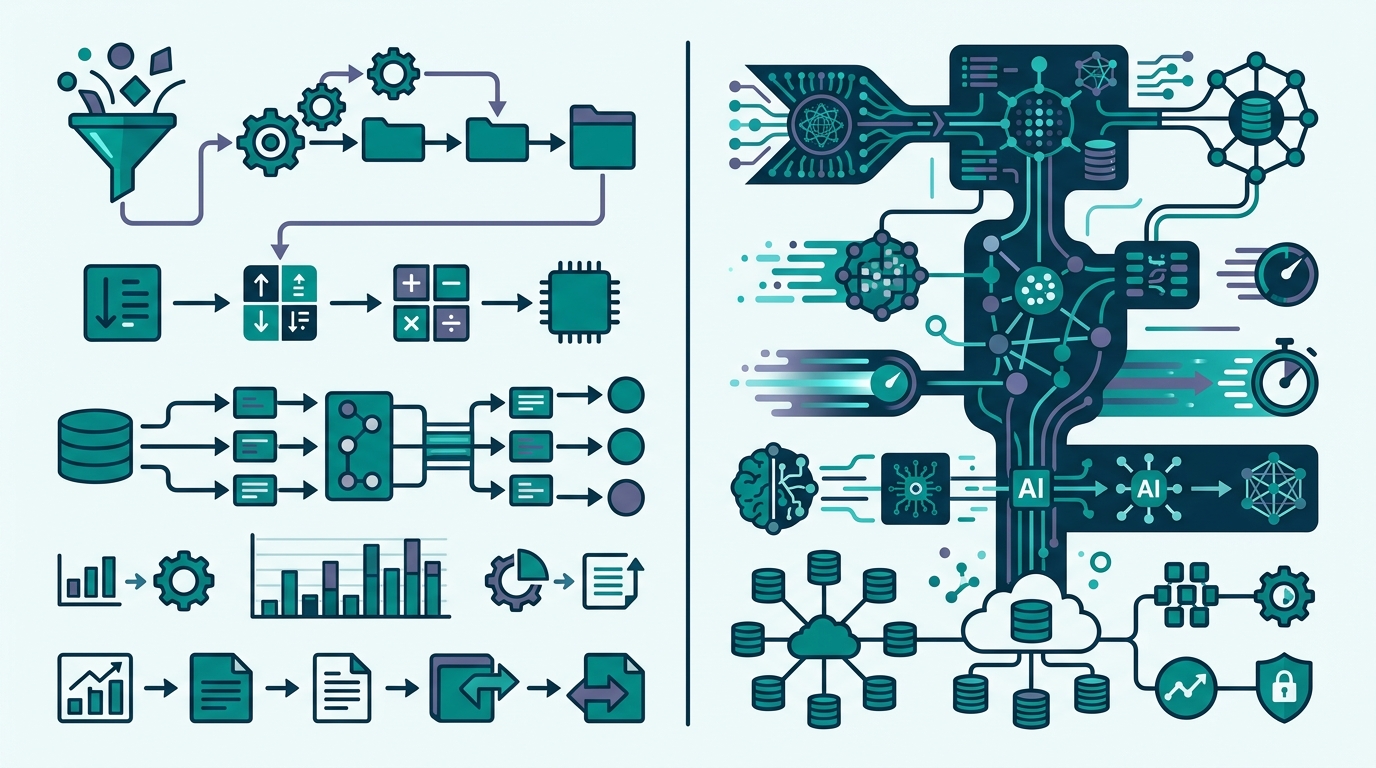
Processing speed is 100x faster than before. The number of variants (combinations of ad patterns) it can handle has expanded 10,000x (gezar.dk). NVIDIA GH200 chips, the latest AI-specific hardware, power this capability.
Numbers alone may not click. Let me explain concretely what changes.
The previous algorithm tested a few hundred audience × creative combinations per ad set. There was a limit to how many combinations could be tested within a daily budget. That’s why ad operators had to manually narrow things down with calls like “let’s focus on this segment.”
Andromeda is different. It can simultaneously evaluate millions of combinations. “25-year-old woman × Tokyo × Instagram Reels × Product A video” and “32-year-old man × Osaka × Facebook Feed × Product B still image” get compared in near real-time.
What this means: humans no longer need to narrow segments. In fact, not narrowing tends to produce better results. Andromeda automatically finds the optimal combination from a broad audience, so when humans set hypotheses to narrow the field, they actually restrict the AI’s search space.
When I first started using Advantage+, I was scared to set targeting to “automatic.” The longer your marketing career, the more you tend to believe manual narrowing yields better precision.
But when I tried it, Andromeda pulled conversions from broader audiences than my hypotheses suggested. The 30-something men I’d written off as “they won’t buy” had unexpectedly high click-through rates.
The key takeaway here: what advertisers should focus on, to leverage Andromeda’s capabilities, has changed. The skill of preparing materials that AI can easily explore now drives results more directly than the skill of narrowing targets.
Specifically, the precision of product description text, diversity in image resolution and aspect ratios, and variation in video lengths become learning material for Andromeda. The more options the AI can explore, the faster it converges on the optimal combination. The preparation cost should go into material diversity, not targeting.
The first of the “three judgments” introduced in the previous article, “choosing what to sell.” Once you understand how Andromeda works, you’ll feel even more weight behind this judgment.
What Chat Signals Really Is: AI Picking Up Purchase Intent from Conversations
If Andromeda is the engine, Chat Signals is the fuel.
Starting December 2025, user conversation content from AI chats on WhatsApp, Messenger, Instagram, and Facebook was incorporated into the Advantage+ delivery algorithm (DigitalApplied).
“Wait, they use my conversations for ads?” Some of you may be thinking this. To be precise, it’s a system that extracts “purchase intent signals” from conversations.
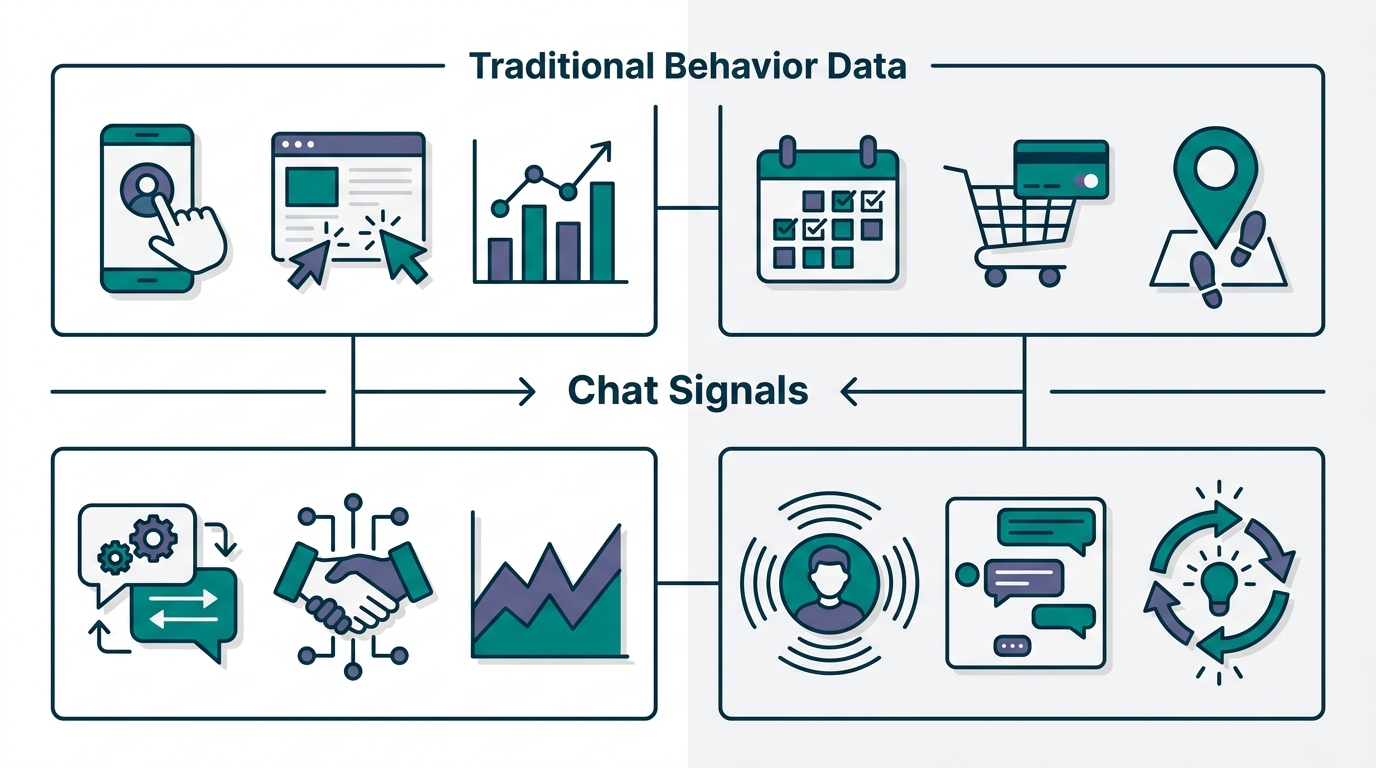
Traditional ad targeting relied on behavioral data. What pages you viewed, what you clicked, what you bought. Essentially, inference from “past behavior.”
Chat Signals captures “current interest.” For example, suppose you typed into Instagram’s AI chat, “I’m looking for an outfit to wear to my child’s school entrance ceremony.” If this signal feeds into ad delivery, you become more likely to see ads for formalwear and kids’ items.
Let me clarify the difference between behavioral and conversational data.
Behavioral data records “what was done.” Looked at shoes on an e-commerce site, added to cart, purchased. It predicts future behavior from past facts. Accuracy is high, but signals can include “just browsed without intent to buy.”
Conversational data captures “what’s being sought.” “Looking for an outfit for the entrance ceremony” is the intent at the pre-purchase stage itself. It picks up “needs that haven’t been searched yet but exist in someone’s head” — needs that behavioral data struggles to detect.
This corresponds to a more concrete mechanism for the phenomenon I wrote about in the first article of this series, where “conversational data becomes ad fuel.” Back then, I introduced it as “this trend is coming.” Now I’m sharing it as a system already in operation.
What this means for advertisers: a structure where the more AI chat conversations grow, the higher ad precision becomes. One reason Meta is rolling out AI chat features across all platforms lies here. They want to expand ad data sources.
On the other hand, privacy concerns shouldn’t be ignored. Some people will naturally feel “I don’t want my conversations used for ads.” Meta explains that individual conversation content isn’t shared with advertisers directly, but is processed as aggregated signals. Whether the explanation to users is sufficient is open to debate.
From the advertiser’s standpoint, you need to be aware Chat Signals exist and pay attention to “which signals your ads are responding to.” Make it a habit to check audience insights in the Advantage+ dashboard. By tracking changes in which segments are being served, you can indirectly grasp the impact of Chat Signals.
AI-Generated Ad Disclosure Rules: “I Didn’t Know” Won’t Cut It Anymore
The third change is a rule change.
Starting in 2026, Meta has imposed disclosure obligations on ad creative produced using AI generation tools such as Midjourney, DALL-E, and ElevenLabs (DigitalApplied).
Penalties for violation include account suspension.
A simple rule: “Don’t hide that you used AI.” But the impact on day-to-day operations is significant.
First, where the line is drawn for what counts as AI-generated can get blurry. Does using Photoshop’s AI feature to swap a background count? What about using a Canva AI template? Meta’s current guidelines target “content generated or substantially altered by AI.”
Next, how should creative auto-generated by Advantage+‘s Image-to-Video feature be treated? Do ads generated by Meta’s own tools need disclosure too? On this, Meta states “content generated by in-platform tools is automatically labeled,” so advertisers shouldn’t need to handle these individually.
The issue is the case where you upload externally created materials to Advantage+. When using product images generated with Midjourney or DALL-E in your ads, you the advertiser are obligated to set the disclosure yourself.
The specific response is three steps.
Step 1: Inventory your materials. Audit every ad creative currently running. Check whether any were created with AI generation tools. Not just images — text and voiceovers may also qualify if AI-generated.
Step 2: Document your production workflow. Build a system to record which stages use AI in future ad production. Like “background generated with Midjourney, text written by a human” — track each step. This serves both as internal documentation and as supporting material if you’re ever asked to explain.
Step 3: Configure disclosure in Ads Manager. Meta’s Ads Manager has added a labeling feature for AI-generated content. The “Creative Information” section in the ad editor now includes an AI disclosure field — just check the box for applicable ads. Takes about one minute per ad.
“Won’t disclosure tank my CTR?” This concern is natural. But for now, the impact of AI disclosure labels on CTR appears limited, according to multiple operators I’ve spoken with. Users click ads based on whether it’s useful to them, not whether it was made with AI.
The real risk is continuing to run ads without disclosure and getting your account suspended. If one account gets suspended, every ad tied to it stops. Compared to the time lost recovering and the opportunity cost, the effort of disclosure is cheap insurance.
Why All Three Moved Together: Meta Ads’ Design Philosophy for 2026
Andromeda, Chat Signals, and AI disclosure rules. Notice that these three didn’t happen separately — they moved simultaneously.
Decoding Meta’s design philosophy, one direction emerges. They’re completing ad operations automation while simultaneously moving to a market where the quality of inputs and transparency become the differentiators.
Andromeda pushes delivery automation to its limit. They’re creating a world where AI delivers better results than manual human tuning. Chat Signals expands data quality from behavioral to conversational data. It adds fuel to further boost AI’s judgment precision. And AI disclosure rules put guardrails on automation’s runaway potential, ensuring transparency.
In other words, they’re spinning automation and trust as two wheels simultaneously.
This shift carries implications beyond the ad industry. The better AI gets, the more humans are asked for “judgment” and “transparency.” This is a structural change common to AI tools across the board.
I feel the same dynamic in Claude Code, which I use regularly. The higher AI output precision goes, the more important the human-side judgments of “what to instruct” and “how to verify output” become. This isn’t a story limited to Meta ads — it’s a theme that touches everyone working alongside AI.
Recalling the three judgments from the previous article:
- Choosing what to sell: Now that Andromeda’s exploration power has scaled up, the quality of the materials you hand it directly determines outcomes
- Resolution on whom to reach: With Chat Signals adding new data, strategic-level direction-setting matters even more
- The eye that protects brand consistency: AI disclosure rules make creative management and approval flows mandatory
When you know the mechanics, the precision of your judgments rises. “Vaguely using Advantage+” and “using Advantage+ understanding Andromeda’s characteristics” produce different results from the same tool.
Now That You Understand the Mechanics, Here’s What to Do This Week
For those who’ve read this far, three actions you can take this week.
Action 1: Check your targeting “automatic” setting (5 minutes)
In your Advantage+ ad set, verify that audience targeting is set to “broad audience.” If you’re manually narrowing by age or interests, you may be restricting Andromeda’s search range. Try switching just one ad set to “automatic” and compare results over a week.
Action 2: Inventory AI-generated materials (15 minutes)
List every ad creative currently running and flag any made with AI generation tools. For matches, set the AI disclosure label in Ads Manager. Materials created with external tools are especially easy to miss — pay close attention.
Action 3: Check audience insights (10 minutes)
Open audience insights in the Advantage+ dashboard and review where ads have been delivered over the past 30 days. Due to Chat Signals, delivery may be reaching segments different from before. If delivery volume to new segments has grown, that’s a sign Chat Signals is at work. Check the conversion rate of those segments and use it as input for revisiting your strategy.
All three combined take about 30 minutes. 30 minutes of action grounded in understanding beats 30 days of operating in the dark.
Wrapping Up: Knowing the “Silent Triple Renovation” Is Your Next Move
Three changes are unfolding simultaneously behind Meta Ads.
The Andromeda delivery algorithm achieves optimization beyond human hypotheses with 100x the speed and 10,000x the variant processing of its predecessor. Chat Signals supplies new fuel in the form of user conversational data, pushing ad precision beyond what behavioral data alone could deliver. AI disclosure rules are a new rulebook demanding transparency as the trade-off for automation.
All three are things “ads will run without you knowing about them.” Open the Advantage+ dashboard and you won’t see the word Andromeda. There’s no on/off button for Chat Signals. That’s exactly why it’s a “silent renovation” — but the gap between those who know and those who don’t will only widen.
In the previous article, I used the phrase “the 65% watershed.” What I want to convey today is that the ground beneath that watershed itself has changed. Even when you’re using the same Advantage+, the mechanism under your feet is different.
When you know the mechanics, your judgments change. When your judgments change, your results change.
Try the three actions for this week. The results from trying them will surely become input for your next judgment.

AIを使いこなせない方は、この先どんどん差がつきます。僕はAIエージェントを毎日動かして、壊して、直して、また動かしてます。そういう泥臭い実践の記録をここに書いてます。理論は他の方にお任せしました。僕は動くものを作ります。朝5時に起きてウォーキングしてからコードを書くのがルーティンです。