NVIDIA Joins Forces with 16 Companies. The 'AI Agent Platform' Featuring Adobe, SAP, and Salesforce Is a Preview of Your Marketing Tools
March 2026: NVIDIA made its move.
What you'll learn in this article
- What AI agents mean in plain language and why the term matters now
- Which real-world workflow patterns are already becoming practical
- Which next article deepens pricing, rollout, or implementation context

Do You Think AI Agents Are Still a Distant Topic?
March 2026: NVIDIA made its move.
Adobe, SAP, Salesforce, ServiceNow, Siemens. Sixteen companies—names that make you think “yeah, we use that at our company”—gathered around NVIDIA. The goal was singular: to build an open-source development platform for running AI agents safely in enterprise environments.
When I read NVIDIA’s official press release, I honestly got goosebumps.
Why? Because this isn’t just a technical announcement. It felt like a signal that the underlying mechanics of the marketing tools we touch every day are about to change fundamentally.
“AI agents? That’s an engineer’s topic, right?” I get where you’re coming from. But that’s not where the essence of this announcement lies.
Here’s the question that naturally comes up: “What even is an AI agent?” In a nutshell, it’s an AI that doesn’t need step-by-step human instructions—you hand it a task, and it autonomously sees it through to completion. It’s fundamentally different from the “ask a question, get an answer” AI like ChatGPT.
Personally, I run autonomous workflows daily using Claude Code and MCP servers. I know firsthand the power of “AI that decides and acts on its own.” Research for articles, organizing data, managing tasks. Once it’s set up, it keeps running even while I’m asleep.
That same AI agent is starting to come standard inside the tools marketers use every day. That’s what we’re talking about today.
What Is the “AI Agent Platform” NVIDIA Announced?
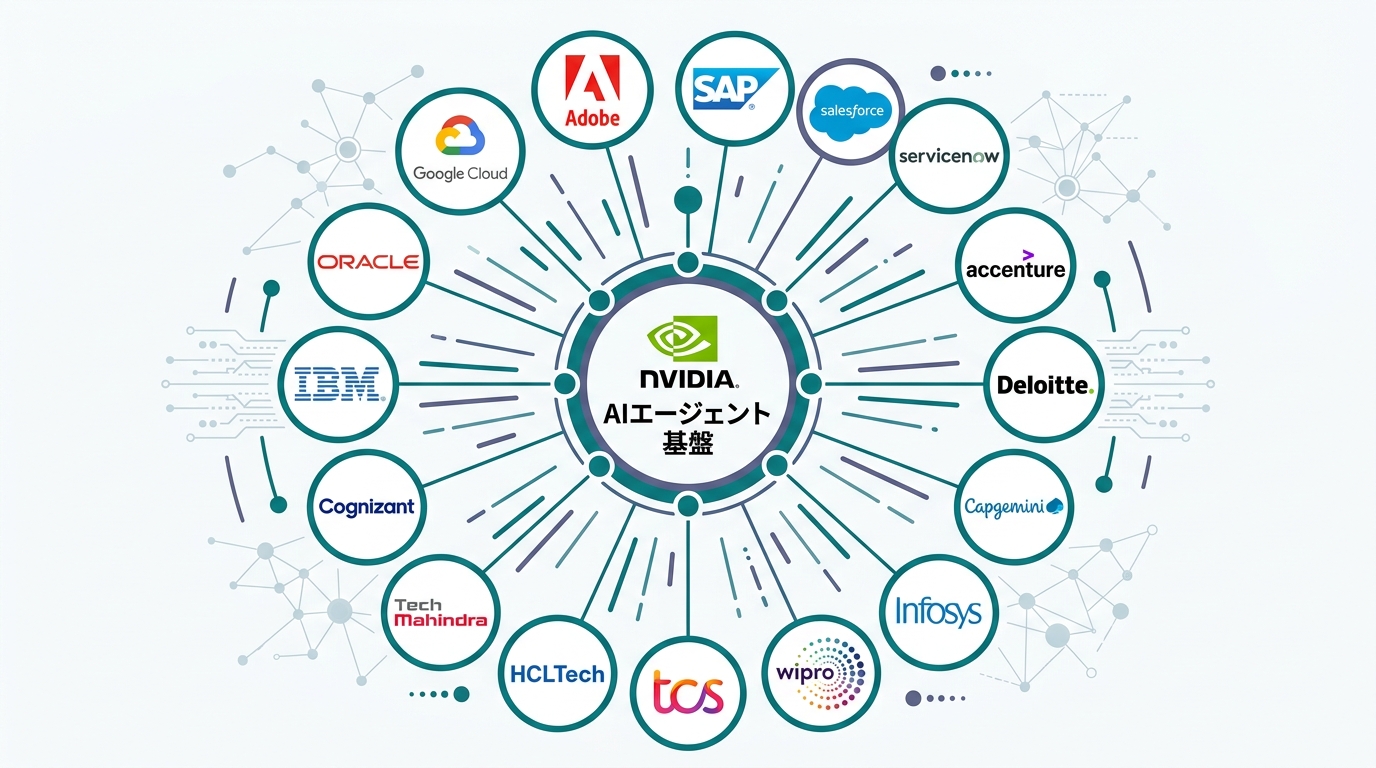
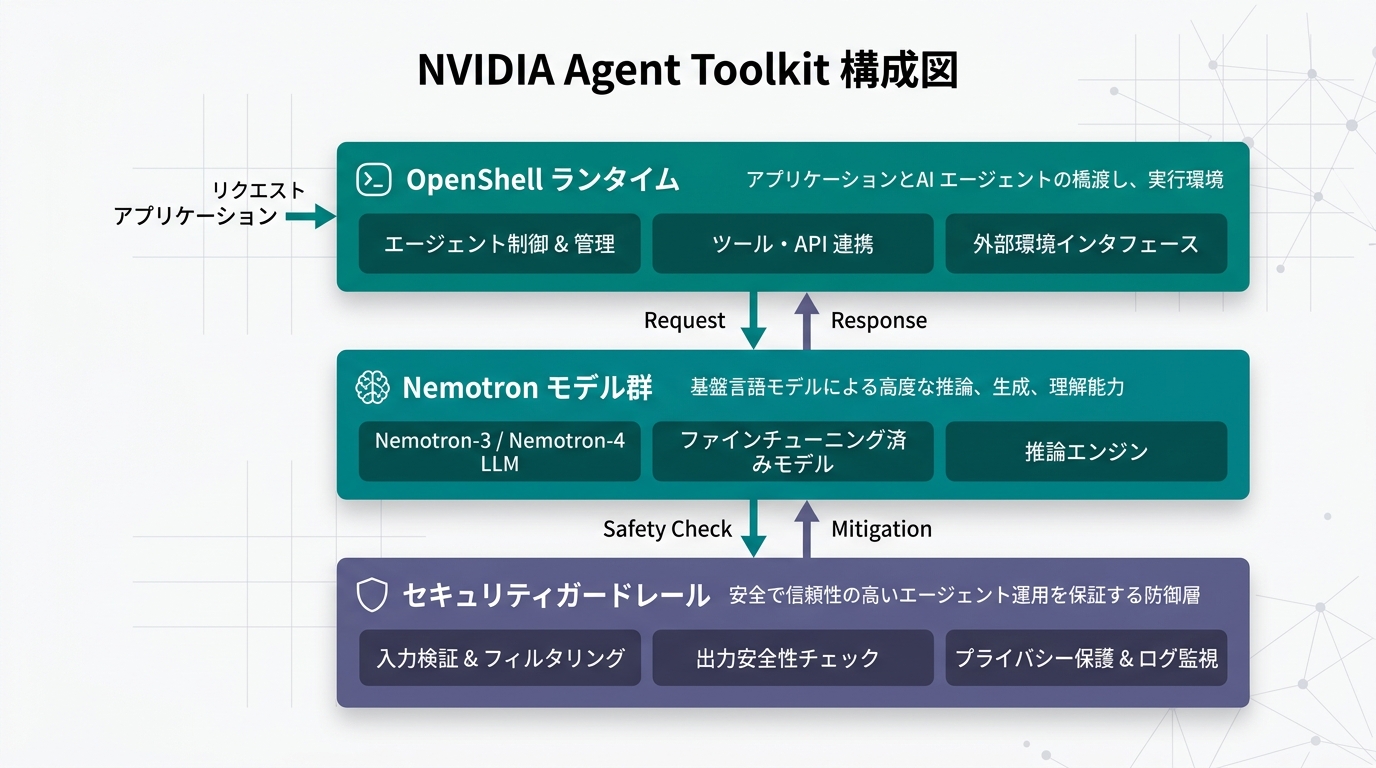
The official name is the “NVIDIA Agent Toolkit.” It was announced at GTC 2026 (NVIDIA’s annual conference).
I’ll skip the deep technical details, but here are three points marketers should grasp.
It’s open source. This isn’t technology locked to a specific company—it’s designed for anyone to use. That’s huge. Past AI-related tools have tended toward each vendor walling them off in their own proprietary platforms. This time is the opposite. It’s a posture of going out to build the industry standard.
Security is built in from the start. It includes a runtime called “NVIDIA OpenShell” that comes with policy-based security, network controls, and privacy guardrails out of the box. The design refuses to let AI agents run wild. If you’re going to use AI agents in marketing work that handles customer data, ambiguous data-handling rules are a non-starter. OpenShell lowers that barrier.
Sixteen companies announced adoption simultaneously. This is the most important point. Look at the list of participating companies.
- Adobe (creative & marketing)
- Atlassian — Jira, Confluence
- Amdocs — telecom IT
- Box (document management)
- Cadence — electronic design automation
- Cisco — networking
- Cohesity — data management
- CrowdStrike — cybersecurity
- Dassault Systèmes — manufacturing design
- IQVIA — healthcare data
- Red Hat — enterprise Linux
- SAP, Salesforce, Siemens
- ServiceNow — IT workflows
- Synopsys — semiconductor design
According to VentureBeat’s reporting, these 17 companies (16 plus NVIDIA itself) collectively touch “nearly every Fortune 500 company.”
Not one or two companies—sixteen moved at the same time. That simultaneity means the standardization of AI agents has begun across the entire industry. The chances that this technology is coming inside the SaaS your company uses are extremely high, in my view.
Why Is This a “Preview of Marketing Tools”?
Here’s where it gets relevant for marketers.
Of the 16 participating companies, try listing the ones marketers touch daily.
- Salesforce: CRM and marketing automation. Already offers an AI agent feature called Agentforce
- Adobe: Creative Cloud, Experience Cloud. From creative production to ad delivery
- SAP: The giant of ERP. Anchors order, inventory, and customer management, and is pushing AI agent support through Joule Studio
- ServiceNow: IT service management. Internal inquiry handling and workflow automation
- Atlassian: Jira, Confluence. Project management and knowledge sharing
- Box: Cloud storage. Document management and sharing
Notice it? The lineup covers nearly the entire marketing pipeline from upstream to downstream.
Let’s look at how each company is actually moving.
Salesforce is leveraging Nemotron models on top of the Agent Toolkit. It’s building AI agents for service, sales, and marketing. Employees will be able to use Slack as a conversational interface to give instructions to the agents. Type “summarize last month’s ad reports” into Slack. The agent pulls Salesforce data and generates the report. That world is already in view.
Adobe announced it’s adopting the Agent Toolkit as the foundation for its creative and marketing domain. The phrase worth noting is “long-running.” Rather than one-shot Q&A, they’re envisioning agents that autonomously handle complex tasks over hours to days.
SAP is rolling out AI agents through Joule Studio. AI is entering core business operations like order processing and inventory management. For marketers, this opens up use cases like “ad delivery that reflects inventory status in real time.”
What all this means is simple. In the near future, AI agents will ship as a default feature in the marketing tools we use. This announcement is the preview.
How Should Marketers Read Gartner’s “40%” Prediction?
Let’s back this with numbers.
According to Gartner’s prediction, by the end of 2026, 40% of enterprise apps will have task-specific AI agents embedded in them. As of 2025, it was less than 5%. An 8x jump in a single year.
Let me translate this “40%” into marketer terms.
Out of the 10 business tools you use, 4 will have AI agents inside them. That’s the world coming by the end of 2026.
Gartner also released a best-case forecast for 2035: agentic AI accounts for 30% of software revenue. That’s over $450 billion. Considering the growth from 2% in 2025, you can see the expansion speed of this space.
That said, I’m not trying to hype these numbers.
The important part is “task-specific.” AI agents are spreading not as universal tools that do everything, but as systems that act autonomously within specific, narrow tasks. Misunderstanding this skews your expectations.
For example: automated ad report generation. Lead scoring. A/B test setup for email campaigns. These are the “repeating tasks with clear rules” that will be agent-ified first.
Conversely, work like strategic planning or determining creative direction—“judgment that requires reading context”—still belongs in the human domain. What AI agents excel at is “high-speed processing of work where the steps are defined.” “Thinking that decides which direction to go” is still uniquely human.
Internalizing this distinction now is the biggest preparation a marketer can make.
Three Things Marketers Should Do This Week
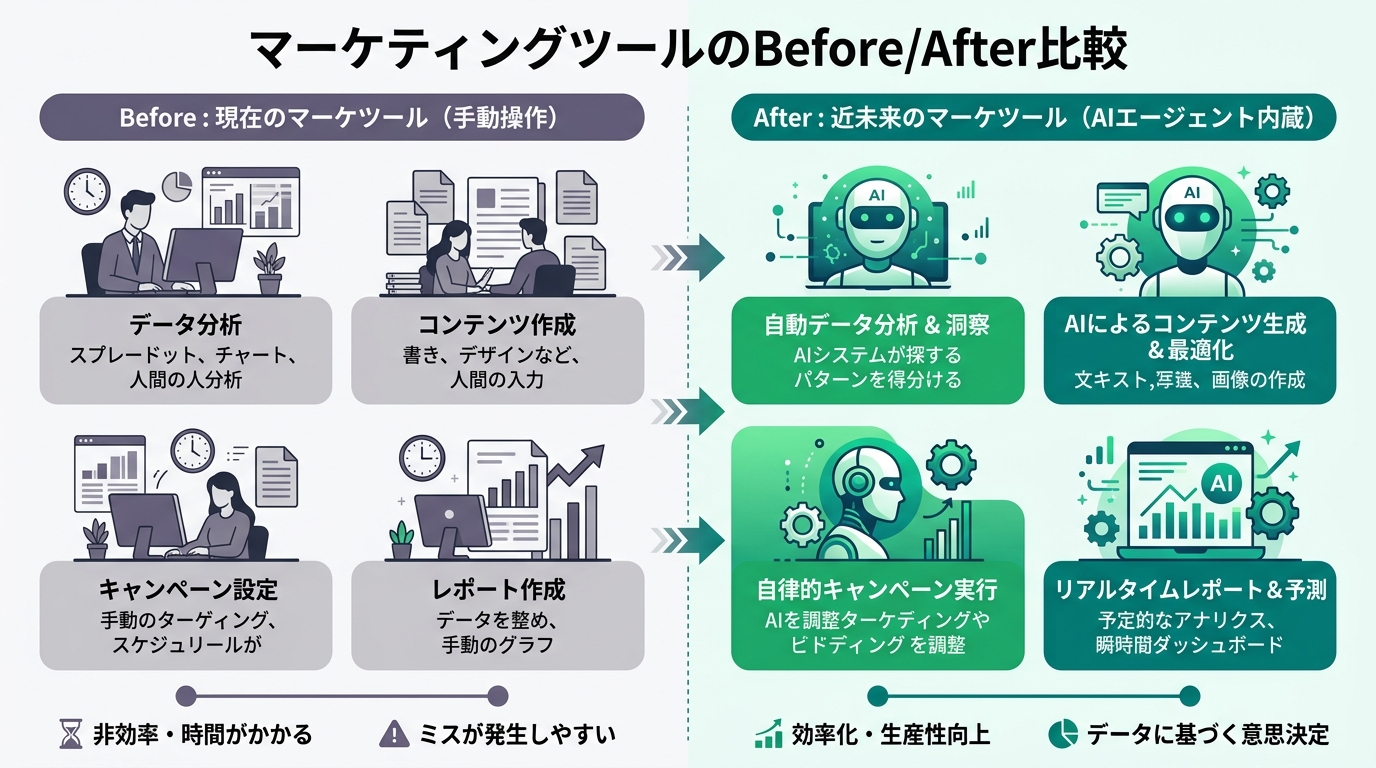
“Okay, so what should I actually do?” I hear you. Here are three concrete things you can do this week.
1. Check the AI Agent Support Status of the SaaS Your Company Uses
Salesforce, Adobe, SAP, ServiceNow, Atlassian, Box. If your company uses any of the tools on this list, check their latest AI agent–related updates.
For Salesforce, it’s “Agentforce.” For Adobe, “Adobe Sensei GenAI.” For SAP, “Joule Studio.” Just searching these keywords against your company’s plan will tell you what’s now available.
It takes about 30 minutes. That alone gives you a snapshot of where your tool stack stands on agent support.
In practice, I’ve found that often the features are already there, but no one inside the company knows. “Turns out our Salesforce already has Agentforce included” is a discovery that’s not at all rare.
If your tools aren’t on the list, don’t worry. With NVIDIA releasing the platform as open source, the number of SaaS products that will support it is only going to grow. Just knowing “we’re not supported yet” gives you material to decide your next move.
2. Write Down Three Tasks You Could Hand Off to an Agent
Look back at a week of your work and pick three tasks that meet these conditions:
- Recurring every week
- Steps are largely fixed
- Decision criteria are clear (number-based, for example)
Report creation, data extraction, email delivery setup, social media post scheduling. These are good candidates.
Why three? Because trying to agent-ify everything at once leads to giving up. Narrow it down to three first and recognize “these are the parts with room for automation.” That alone lets you act immediately when your tools roll out agent support.
To use my own example, the research phase of article writing was one. Trend information gathering, competitor article research, data organization. Since handing these three to AI agents, I genuinely feel I’ve gained two hours per day to spend on the writing itself.
3. Articulate the Difference Between AI Agents and AI Assistants
This one is a bit abstract, but it might actually be the most important.
AI assistants are “answer when asked.” You ask ChatGPT a question, you get an answer back. That’s an assistant. Passive—a human has to pull the trigger every time.
AI agents are “hand them a task, and they think it through and bring it to completion themselves.” For example, you ask: “Make three patterns of next week’s webinar acquisition email and configure delivery.” The agent analyzes past open-rate data, optimizes subject lines, and even handles segment-by-segment setup. Active, with autonomous judgment in the middle.
| Item | AI Assistant | AI Agent |
|---|---|---|
| How it works | Answers when asked | Runs autonomously to task completion |
| Judgment | Human instructs every step | Makes judgments autonomously along the way |
| Operating hours | Only while a human is operating | 24/7/365 |
| Strengths | Q&A, summarizing, translation | Automated handling of repetitive tasks |
Just being able to explain this difference to your colleagues lets you take the lead in internal AI adoption discussions. Marketers as translators of technology. That’s the role being demanded right now.
How I Personally Took NVIDIA’s Move
I’ll be honest.
I’m not without anxiety about AI agents. When instructions are vague, they sometimes return off-target results. Mid-course corrections aren’t unusual.
Even so, their processing speed on repetitive tasks isn’t comparable to a human’s, and once you set them up, they keep running through the night and on weekends. Once you’ve experienced that, you can’t go back to your old way of working.
The reason NVIDIA pulled 16 companies together to build an open platform: the call to “align the rules for running agents safely across the entire industry.” If each company implements agents in isolation, security and data governance turn into chaos. Think of it as infrastructure to prevent that.
It’s not just NVIDIA. Snowflake and OpenAI reportedly signed a major strategic partnership. Mizuho Financial Group is said to have launched an “Agent Factory” to streamline AI agent development. The flow is unmistakable: the industry as a whole is moving toward full-scale operation of AI agents.
For us marketers, this is good news. If tool vendors unify the platform, we can focus on the decision of “what to delegate and what to keep doing ourselves.”
It’s not that I’m without anxiety. I feel the same way. But standing still in anxiety doesn’t stop tools from updating on their own. Better to move first and decide “this is what I want to automate”—so when the feature actually ships, you don’t hesitate.
Wrap-Up: Only Those Who Know Move First
Let me summarize the NVIDIA × 16 company announcement.
- What happened: NVIDIA, together with 16 companies including Adobe, SAP, and Salesforce, announced an open-source AI agent development platform—the “NVIDIA Agent Toolkit”
- Why it matters: This technology will be embedded behind the tools marketers use daily. Read it as a “preview of marketing tools”
- Numerical backing: Gartner predicts 40% of enterprise apps will carry AI agents by the end of 2026 (under 5% in 2025)
- This week’s actions: (1) Check your company tools’ AI agent support, (2) Write down three tasks you want to delegate to an agent, (3) Articulate the difference between agents and assistants
Whether you read this article and stop at “huh, interesting,” or take 30 minutes this week to check your company’s tools—that difference will pay off six months from now.
AI agents aren’t magic. Their value is determined by the literacy and preparation of the people using them.
I’ll keep writing from what I’ve actually used and felt. Let’s stand on the side of those who command AI together.

AIを使いこなせない方は、この先どんどん差がつきます。僕はAIエージェントを毎日動かして、壊して、直して、また動かしてます。そういう泥臭い実践の記録をここに書いてます。理論は他の方にお任せしました。僕は動くものを作ります。朝5時に起きてウォーキングしてからコードを書くのがルーティンです。