The Map of Search Has Changed: A 2026 Practical Guide to Covering All 5 Entry Points Simultaneously with Search Everywhere Optimization
In an era when SEO alone can't reach your audience, this guide explains the concept and practical steps of Search Everywhere Optimization—a strategy that simultaneously optimizes for 5 search surfaces including ChatGPT, YouTube, social media, and Podcasts. A pre-read for the GEO Conference on April 20.
What you'll learn in this article
- The key point to grasp before reading the full article
- How the issue changes practical decisions after reading
- Which follow-up article is worth opening next

The Era When “SEO Alone Won’t Get You Found” Is Now Backed by Numbers
In 2026, search entry points have fragmented into five surfaces. Optimizing only for Google means failing to reach more than half of your readers. This isn’t a gut feeling—it’s a fact the data confirms.
Look at the Semrush portfolio analysis reported by Search Engine Land. Traffic via LLMs is up 527% year-over-year. LLMs refer to large language models like ChatGPT. Monthly inflows from AI search jumped from 600 to 22,000 in just one year.
AI search share is also expanding rapidly. According to Similarweb’s January 2026 data, ChatGPT holds 64.6% and Gemini 22%. These two alone account for 86% of the market.
Meanwhile, what’s happening on Google’s search results page? Zero-click rates have reached 69–83%. Zero-click rate refers to the percentage of searches that result in no click. For queries displaying AI Overviews, over 80% of users leave without clicking through. Even if you rank #1 on Google, the odds of not getting clicked keep rising.
The upGrowth report is also worth noting. ChatGPT’s referral traffic is up 52% year-over-year. Gemini’s growth is even more dramatic at 388% YoY. AI search conversion rates hit 14.2–15.9% on ChatGPT—far above the 2.8% from Google organic search. The numbers prove that the main battleground of search is shifting.
Personally, I’ve been writing about GEO and AEO over the past six months. GEO stands for Generative Engine Optimization. AEO stands for Answer Engine Optimization. The idea of “optimizing beyond Google” is no longer unusual.
But the number of concepts has exploded. GEO, AEO, LLMO, social search, voice search. It’s true that the question “which one should I actually focus on?” is growing louder. There’s a single framework that can tidy up this confusion. That’s Search Everywhere Optimization, which I’ll introduce today.
What Is Search Everywhere Optimization?
An integrated strategy that simultaneously optimizes every surface where users search for information. That’s Search Everywhere Optimization (SEvO). You could rephrase it as “designing a state where you get found no matter where someone searches.”
eMarketer published a report in 2026 titled “GEO and AEO: Where AI search and SEO overlap.” This report organized the concept of SEvO in detail. While traditional SEO focused on “ranking high on Google,” SEvO takes a five-surface approach.
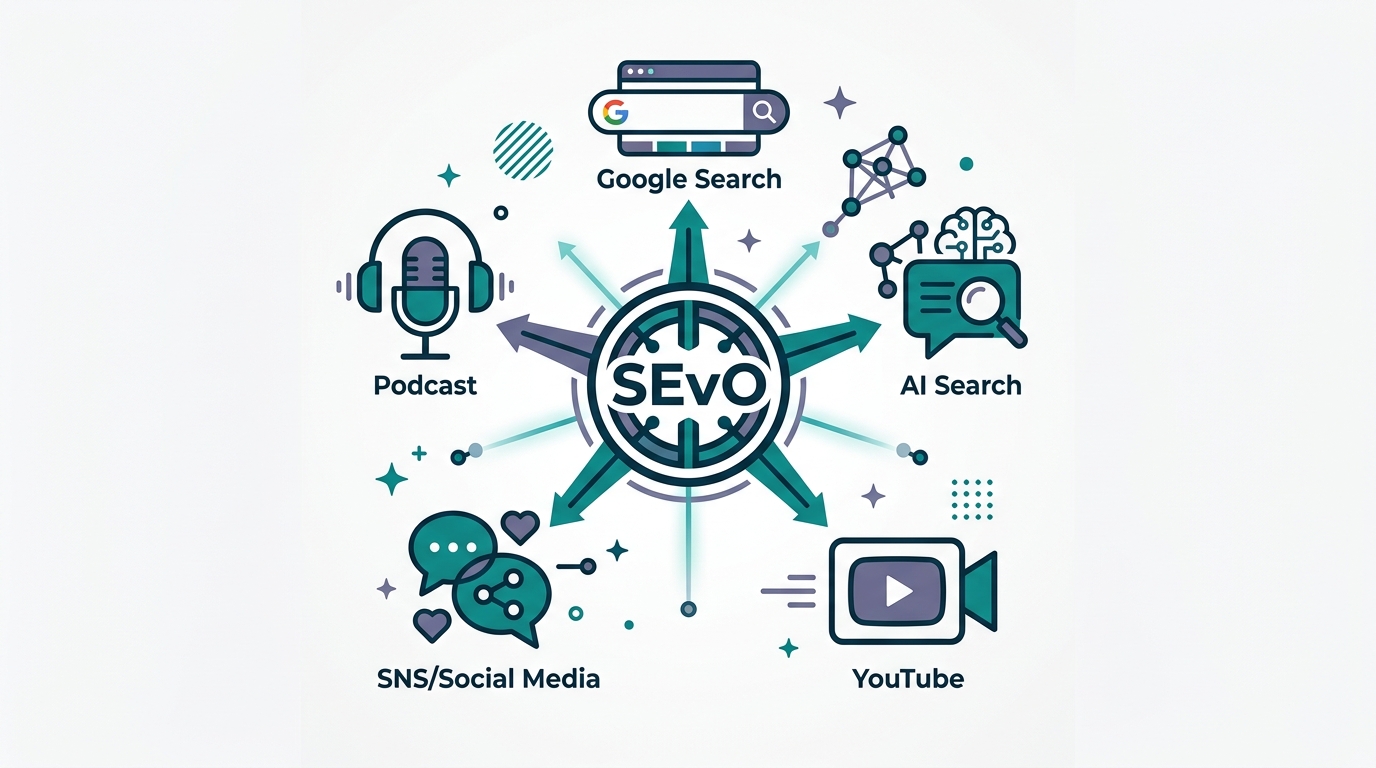
Let’s look at the five surfaces concretely.
- Traditional Search (Google/Bing): Keyword optimization, structured data, E-E-A-T
- AI Search (ChatGPT/Perplexity/Gemini): Article design that gets cited by AI
- Video Search (YouTube/TikTok): Title, description, and chapter optimization
- Social Search (Instagram/X/Reddit): Captions with keywords, engagement design
- Voice Search (Podcast/Spotify/voice assistants): Show note optimization, transcript publication
E-E-A-T refers to four elements: Experience, Expertise, Authoritativeness, and Trustworthiness. It’s a quality evaluation standard used by Google that has also become a key metric in AI search.
Ashley Liddell coined this concept in 2023. Search Engine Land also reported on it in 2026, with the view that “SEvO is replacing traditional SEO as the core of Adaptive SEO.”
Why is SEvO drawing attention now? The reason is clear: user search behavior has fragmented. People search for recipes on YouTube. They research travel destinations on Instagram. They ask ChatGPT for product comparisons. The era when search entry points were concentrated on Google is quietly ending.
You don’t need to tackle all five surfaces equally. Set priorities based on your content and target audience. This is the starting point for SEvO in practice.
The Key Points for Getting “Found” on Each of the 5 Search Surfaces
Each search surface has its own rules. SEO knowledge alone won’t cut it on some surfaces. Here’s a breakdown of each surface’s characteristics and the minimum actions you should take.
Surface 1: Traditional Search (Google)
Google’s organic search remains the largest source of traffic. Core Web Vitals (display speed metrics), structured data (JSON-LD), and E-E-A-T—these three form the foundation. Weak foundations make it harder to see results on other surfaces too.
There’s a technique I’ve repeatedly written about in my GEO articles: “place a direct answer within the first 200 characters of the opening.” This is also effective for capturing Google’s featured snippets. Start by getting your foundation in order.
Say a reader searches for “What is SEvO?” If your article’s opening succinctly answers “an integrated strategy that simultaneously optimizes 5 search surfaces,” that alone makes it easier for both Google and AI search to recognize your article as “easy to cite.”
This “answer first” design might seem obvious. But when you actually check your existing articles, many cases lack an answer to the question in the opening and exceed 200 characters with just the introduction. Start by inspecting your foundation.
Surface 2: AI Search (ChatGPT, Perplexity, Gemini)
In AI search, the battle isn’t about ranking—it’s about citation. Remember the upGrowth research I mentioned earlier. ChatGPT’s conversion rate is roughly 5x that of Google organic search. In other words, just getting cited by AI can produce results of a completely different magnitude.
There are three keys to getting cited: clear entities (proper nouns and concepts), H2-H3 hierarchical structure, and a 7–14 day content update cycle.
You might be wondering, “How do I check whether my articles are being cited by AI?” The Share of Synthesis metric I introduced in a previous GEO practical guide is helpful. It measures how much of your content is included in AI responses. Ask ChatGPT and Perplexity questions about your specialty topics, and check whether your site appears in the answers. That’s the first step.
Ahrefs research is also worth noting. The percentage of AI Overview citations concentrated among the top 10 sites has dropped from 76% to 38%. This is a sign that small and mid-sized sites now have a wider chance of being cited. This shift indicates that, as of 2024, citations were heavily concentrated among major sites. As GEO adoption spreads, quality content gets cited regardless of size.
Surface 3: Video Search (YouTube)
YouTube is sometimes called the world’s second-largest search engine. Producing articles and videos on the same theme with mutual links increases the chance of being displayed as a video carousel in Google search results.
Using the chapter function is also important. Setting timestamps for each section within a video allows users to play specific sections directly from Google search results. It’s a thoughtful design for both viewers and search engines.
Surface 4: Social Search (Instagram, X, Reddit)
According to Semrush research, over 40% of Gen Z start their searches on social media rather than Google. TikTok and Instagram have become entry points. Including keywords in post captions. Matching hashtags to search intent. These two practices alone change your social discovery rate.
Reddit deserves particular attention. There’s a growing number of cases where Google’s AI Overview cites Reddit posts as answer sources. You could call it a “two-edged” surface that works for both Google search and AI search.
Surface 5: Voice Search (Podcast, Voice Assistants)
We’ve entered an era where Podcast episodes appear in Google search results. Including summaries and key keywords in episode show notes. Publishing transcripts. Just these two actions add another search surface, which is significant.
In Japan, the Podcast market is still small, so priority may be lower. That said, search demand for audio content grows year by year. As preparation for the future, it’s worth having a show note template ready, even if just that.
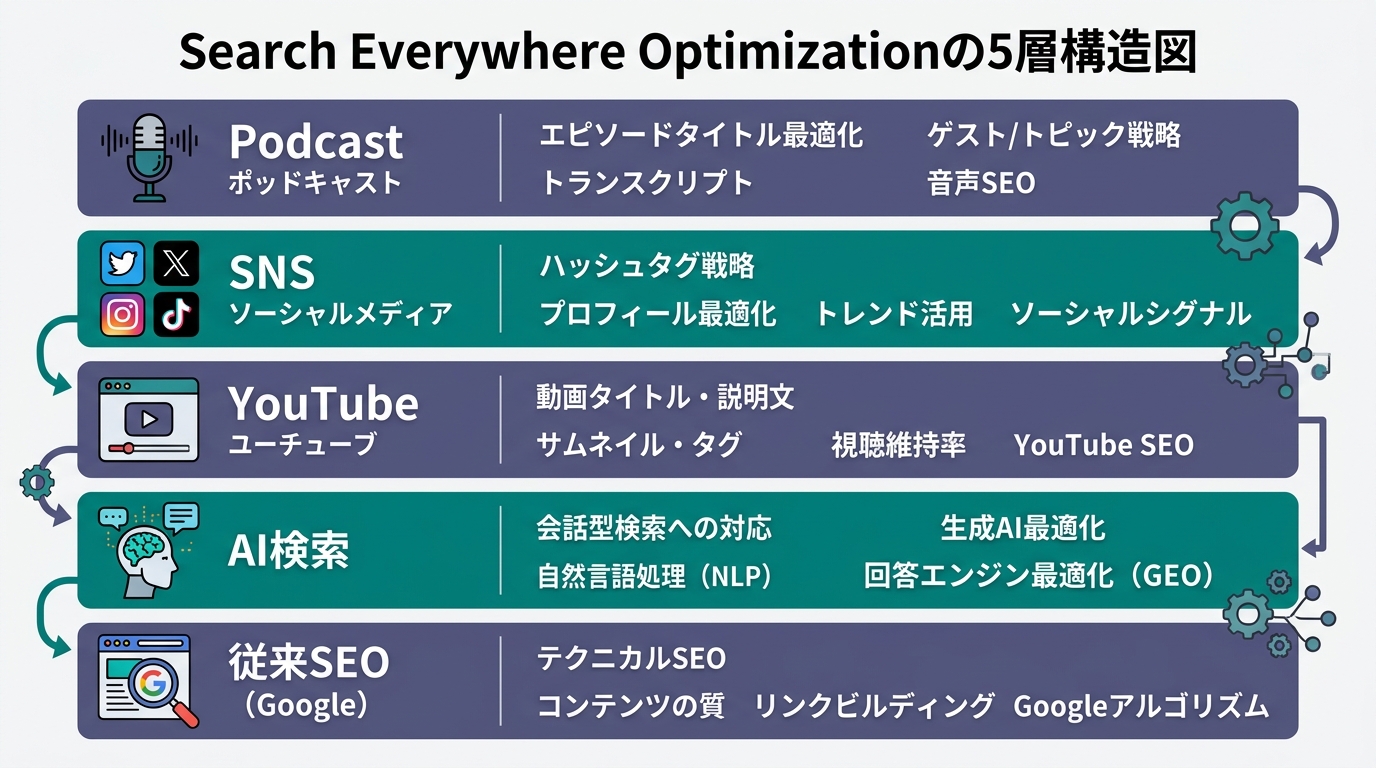
Fully Exploit the “Overlap” Between GEO and AEO
Over 70% of GEO and AEO measures overlap. Doing them separately is inefficient. Designing to make a single piece of work effective for both, by being aware of the overlap, is essential.
The eMarketer report points this out too: “GEO and AEO are distinct concepts, but the majority of practical measures overlap.” In my earlier “GEO × AEO × LLMO 3-layer Integrated Strategy” article, I summarized seven common measures.
Organized, it looks like this.
| Measure | SEO | GEO | AEO | Common Level |
|---|---|---|---|---|
| Structured data (JSON-LD) | ○ | ○ | ○ | All common |
| E-E-A-T reinforcement | ○ | ○ | ○ | All common |
| Direct answer in first 200 chars | △ | ○ | ○ | GEO/AEO common |
| FAQ structuring | ○ | ○ | ○ | All common |
| Entity clarification | △ | ○ | ○ | GEO/AEO common |
| 7-14 day update cycle | △ | ○ | △ | GEO focus |
| Multimodal (image + video) | ○ | ○ | △ | SEO/GEO common |
Numbers make the case more compelling. According to data introduced in the Search Engine Land GEO Guide 2026 edition, simply clarifying the H2-H3 hierarchical structure increases AI citation probability 2.8x. Implementing structured data improves AI Overview selection rates by 73%. The same guide also reports that connecting 15 or more entities through knowledge graphs raises citation probability by 4.8x.
Looking at the numbers alone, you might wonder “really?” But when I actually tried it on my own articles, just adding a direct answer in the first 200 characters and organizing the H2 structure changed my citation frequency on Perplexity. More important than the exact multipliers is the trend: “structured content gets cited more easily.”
At this point, it’s no longer an “extension of SEO”—it’s a level that clearly requires a different design. You don’t need to treat GEO and AEO as “separate work.” Solidifying foundational measures works for both. Then add platform-specific fine-tuning on top. This is the efficient way to advance SEvO.
A “5-Surface Checklist” to Start Tomorrow
SEvO practice begins by choosing three surfaces that are relevant to you. Trying to cover all five surfaces immediately isn’t realistic.
I myself focus on Surface 1 (Google), Surface 2 (AI search), and Surface 4 (social media) since my content is text-centered. Here’s a “this week’s to-do list” for each surface.
Surface 1: Google (estimated time: 30 minutes)
- Check whether your main articles have a direct answer to the title question in the first 200 characters
- Confirm that FAQ markup is implemented in JSON-LD
- Check Core Web Vitals with PageSpeed Insights
Surface 2: AI Search (estimated time: 45 minutes)
- Ask ChatGPT and Perplexity about your specialty topics, and check whether your site is included in the responses
- If not included, analyze the structure of competing articles that are being cited
- Add entities (proper nouns, numerical figures, source URLs) to your main articles
Surface 3: YouTube (estimated time: 20 minutes)
- Plan one short video (3–5 minutes) on the same theme as an existing article
- Create a title and description template with chapters
Surface 4: Social Media (estimated time: 15 minutes)
- Convert the main claims of your article into three captions
- Set easily-searched keywords as hashtags
Surface 5: Podcast (estimated time: 15 minutes)
- Plan one episode that explains an existing article in audio form
- Prepare a show note template (summary + keywords + links)
Even doing everything takes only about two hours. That said, Surfaces 1 and 2 alone are enough to start. Capturing AI search citations is hard without a Google SEO foundation in place. Solidify from the ground up.
The important thing here is not to try to be perfect. Execute just one item from the checklist this week. Continue that for four weeks, and four measures will be in motion. Starting small and iterating is the realistic way to advance SEvO.
Let me give one concrete example. The first thing I did was the Surface 2 check. I asked ChatGPT “GEO practical methods.” Then I could clearly see where my articles were cited and where they weren’t. The cited articles had a direct answer at the opening and clean H2 hierarchy. The non-cited ones had long introductions with conclusions buried in the latter half.
The moment I saw this difference, “the things I need to do are simple” clicked. Put the answer at the opening. Organize the heading hierarchy. Just that changes citation probability. Checking Surface 2 is the shortest route to understanding “where your content stands in AI search.”
Running three surfaces simultaneously also creates synergies. Google articles get cited and appear in AI search, then get shared on social media, bringing in new readers. Designing this cycle is the real purpose of SEvO. Don’t run the 5 surfaces separately—design with the connections in mind.
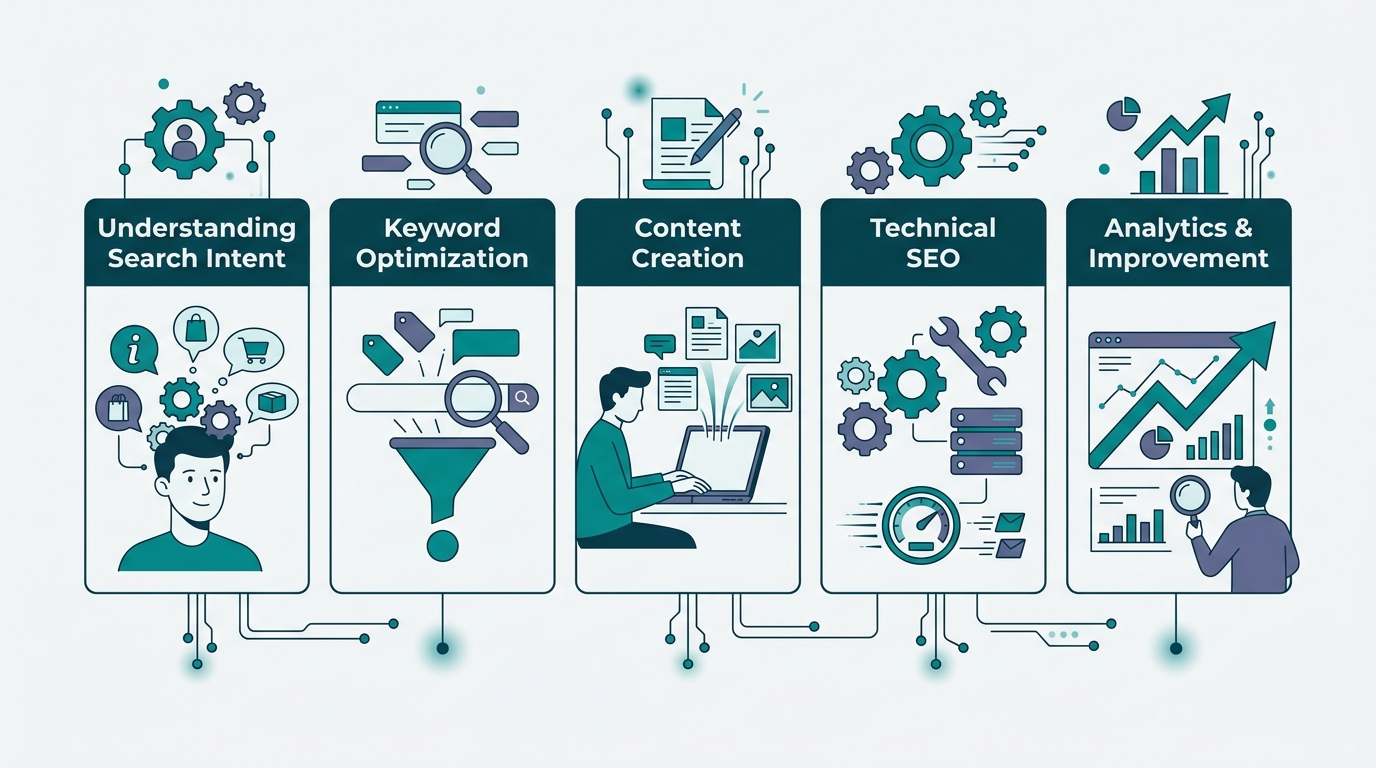
5 Discussion Points to Watch Heading into the GEO Conference on April 20
The GEO Conference will be held on April 20. As a venue gathering the latest developments in the SEvO domain, here are five discussion points to watch beforehand.
Point 1: How Far Has AI Citation “Democratization” Progressed?
I want to dig deeper into the Ahrefs data mentioned earlier. What’s behind the AI Overview citation concentration rate dropping from 76% to 38%? Is it a change in the citation algorithm, or have small and mid-sized sites advanced their GEO measures? I’m expecting the latest figures and analysis to come out at the conference.
Point 2: Standardization of Share of Synthesis
“Share of Synthesis” is establishing itself as a metric for measuring visibility in AI search. Whether its measurement guidelines will become an industry standard. If this solidifies, measuring the effectiveness of GEO measures will become significantly easier.
Point 3: Real Examples of Multimodal Optimization
Content combining text + image + video greatly improves AI citation probability. This trend has been reported in multiple cases. If specific workflows from companies actually operating this way are shared, reproducibility will increase dramatically.
Point 4: Practical Frameworks for “Search Multipolarization”
The SEvO concept is still new, and practical frameworks haven’t been established. It would help if priorities by industry and content format were discussed regarding “which surface to tackle first.” The top priority surface should change between B2B and B2C, and if that organization comes out at the conference, it would bridge to implementation.
Point 5: Application to the Japanese Market
How well can SEvO, born in English-speaking regions, be applied to Japanese-language content? In Japan, the Podcast search market is small. On the other hand, YouTube search has a relatively higher weight. If localization discussions take these differences into account, I can directly apply them to my own article design.
My ranking of priorities for the Japanese market is: Surface 1 (Google) → Surface 2 (AI search) → Surface 4 (social media) → Surface 3 (YouTube) → Surface 5 (Podcast). The image is that Surfaces 3 and 5 swap weight compared to the English-speaking world. If data verifying this hypothesis comes out at the conference, SEvO design guidelines for Japanese-language content will solidify.
After the conference, I plan to write an “SEvO Practical Edition” based on the insights gained. If you’ve grasped the big picture in this article, the practical edition should be much easier to understand. The practical edition will explain optimization steps for each surface alongside specific tools, numbers, and case studies, so keep today’s “5 entry points” concept in mind.
Summary
The era when Google was the only search entry point is over. ChatGPT, YouTube, Instagram, Podcasts. Users search for information from whichever place is convenient for them. This change won’t reverse.
Search Everywhere Optimization is the name given to the integrated framework that responds to this reality. The name might sound grand. What you actually do is surprisingly simple.
- Solidify the foundation: Google SEO fundamentals (structured data, E-E-A-T, page speed) work across all surfaces
- Be conscious of AI search: Direct answers in the first 200 characters, clear entities, 7–14 day updates
- Choose surfaces that fit you: Not all 5 surfaces—start with 3. For text-centered content, start with Surface 1 + Surface 2 + Surface 4
I’ve spent the past six months writing about GEO, AEO, and LLMO individually. Looking back, more than 70% of each measure overlapped. SEvO can be called a framework that gives a name to that overlap and organizes it as a map.
When I was learning each measure separately, I was confused about “where to start.” With the SEvO map, you can determine which measure works for which surface and where to set priorities without getting lost. Use this framework to organize before you get paralyzed by information overload.
If reading this article made you think “I see, search surfaces aren’t just one,” that’s enough as a first step. The next action is to try Surface 2 (AI search) from the checklist. Ask ChatGPT about your specialty topic, and check whether your site is cited. Start from here.
After the GEO Conference on April 20, I plan to write a practical edition based on the latest case studies from the conference. The design is that today’s “map” and next time’s “practice” together complete the full picture of SEvO.
Those who confirm “the map of search” with their own eyes can move on to the next stage. Let’s do this together.

AIを使いこなせない方は、この先どんどん差がつきます。僕はAIエージェントを毎日動かして、壊して、直して、また動かしてます。そういう泥臭い実践の記録をここに書いてます。理論は他の方にお任せしました。僕は動くものを作ります。朝5時に起きてウォーキングしてからコードを書くのがルーティンです。