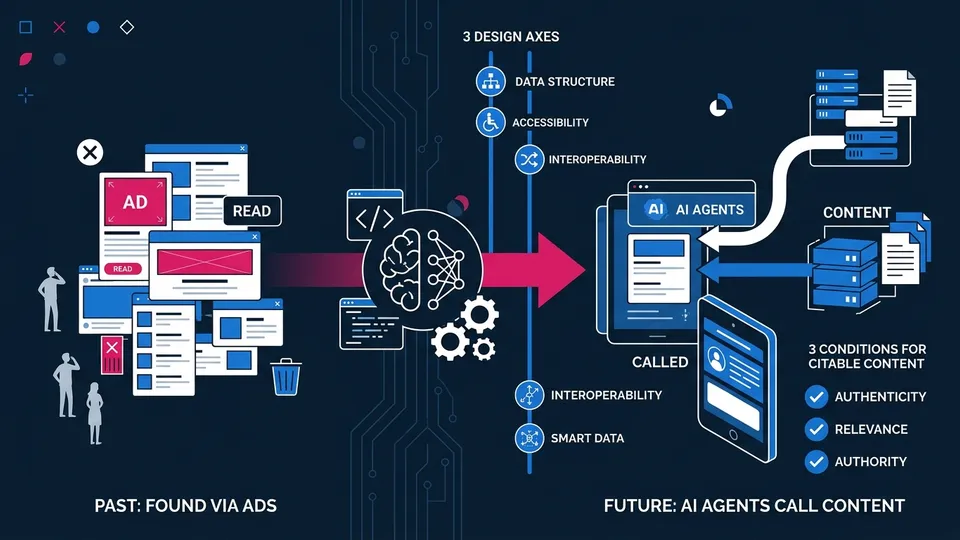
The End of 'Getting Found Through Ads' — AI Agents Are Flipping Content From 'Read' to 'Called'
AI agents don't see ads. As agent-driven purchasing scales, content shifts from 'being read' to 'being called.' AIO's 3 design axes, 3 conditions for citable content, and a practical marketing redesign.
What you'll learn in this article
- What AI agents mean in plain language and why the term matters now
- Which real-world workflow patterns are already becoming practical
- Which next article deepens pricing, rollout, or implementation context
“Do you think advertising will still exist in 5 years?”
A marketer I know asked me that last week.
It sounds like a joke. It isn’t. The debate about whether the ad-based model can survive has been heating up over the past few days. The trigger: a throwaway line from a Coinbase engineer — “If AI agents start acting as personal shoppers, who are you even showing ads to?” — spread across social media and landed in major tech outlets.
I’m watching this debate with half-serious attention and half-skeptical caution. The serious half: “the direction is right.” The cautious half: I’ve seen enough cycles to know that jumping to the extreme scenario of “advertising goes to zero” is usually wrong.
That said, one thing I’ll say with certainty: content’s role has been quietly flipping over the past year or two. Writing that was premised on “being read by humans” is shifting toward “being called by AI.” Whether you’re running ads or producing content, operating on the old premise will leave you on the wrong side of this shift six months from now.
Today I’m breaking down this “from being read to being called” transition in practical, operational terms.
The “Ad Clicks Are Going Away” Argument Is Becoming Uncomfortably Real
First, why is this debate suddenly gaining temperature?
Two direct triggers. First: the maturation of Claude Computer Use and OpenAI Operator. They can now navigate browsers and complete purchases, bookings, and sign-ups just like a human would. Second: companies have started running these systems in production. As I wrote in “AI Agents — Do You Use Them or Sell Them?”, the number of people building and selling agents as products is rising. The buying-side agents are launching at the same time.
What’s happening is a shift in the subject of purchasing behavior — from “humans” to “agents acting on behalf of humans.”
For example: I tell my agent, “Find three hotels for my trip next month and book the cheapest one.” The agent checks comparison sites on my behalf, reads reviews, verifies prices, and completes the reservation. During all of that, I haven’t glanced at a single banner ad. Retargeting ads, display ads, sponsored listings — none of them enter the agent’s field of vision.
“But you could design ads that the agent evaluates and acts on,” comes the counterargument. Google is already piloting “ad formats optimized for AI.” I broke down that development in “AI Is Now the Main Character in Shopping”.
But what I keep coming back to: agents have no obligation to serve the interests of ad buyers. The entity running an agent is the user, or the platform the user subscribes to (Anthropic, OpenAI, Google). An agent’s objective function is optimized for “user satisfaction” — not “advertiser preferences.” That structural asymmetry is fatally significant.
The most incisive point in this debate: “The advertising revenue model was built on the premise that humans see ads.” When the premise collapses, the model floats free. This isn’t a technology argument — it’s a question about the foundations of a business model.
Advertising going to zero is probably not the future. Human browsing for pleasure and the experience of stumbling across something unexpected on social media will remain. What will definitely grow: the amount of time people spend in “task processing mode” where they’re never exposed to ads. The real question for marketers is: “When total ad exposure falls by 30%, where do we go for revenue?” That’s the practical problem to solve.
From “Read” to “Called” — Content’s Role Is Quietly Flipping
Three years ago, content marketing KPIs were pageviews, time-on-page, and bounce rate. Metrics premised on humans reading content. The purpose of writing an article was “reach readers, convert them into fans, guide them toward a product or service.”
Two changes hit at the same time.
First: AI systems like AI Overview, ChatGPT, and Perplexity started taking over “human reading time.” As I wrote in “LLM Referral Traffic +527%, No-Click Rate 69%”, the number of users who click through from search results to read articles is definitively declining. What’s increasing is AI summarizing and surfacing article content directly.
Second: what I’m here to talk about today — “callouts by AI agents.” When an agent executes a task, it “calls” articles as part of its knowledge base. Not reading them — referencing them. Not summarizing — using them as supporting evidence.
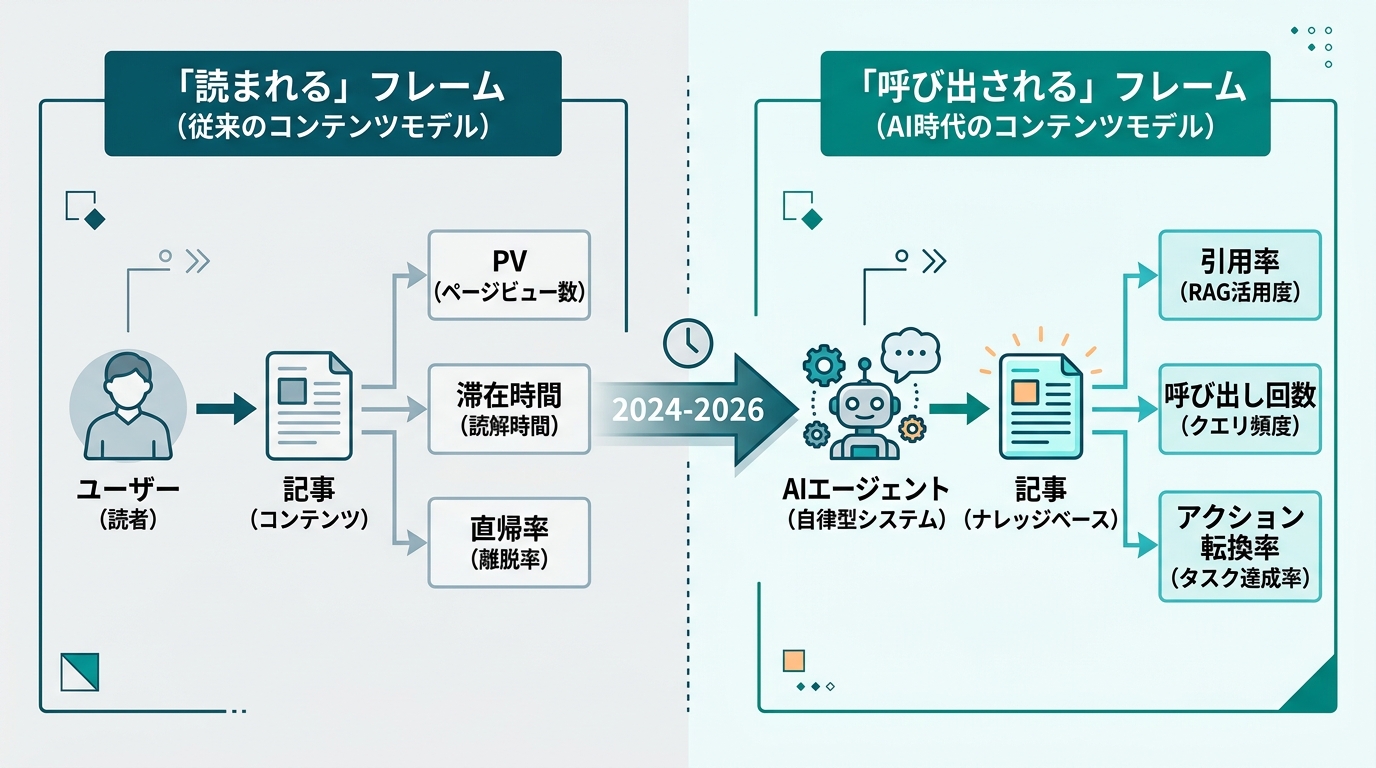
What this shift means: the KPIs for content are being rewritten.
From “proof of reading” metrics — pageviews, dwell time, bounce rate — to “proof of being used” metrics — citation rate, callout frequency, action conversion rate. Ahrefs and Semrush have already started rolling out new measurement axes like “LLM Visibility” and “AI Citation Tracking” (Ahrefs Brand Radar: https://ahrefs.com/brand-radar / Semrush AI Toolkit: https://www.semrush.com/news/385040-semrush-unveils-ai-toolkit-ai-seo-toolkit-to-help-businesses-leverage-ai-brand-perception-and-stay-ahead-in-the-evolution-of-search). SEO vendors adding new metrics is the clearest signal that the market has shifted.
In my own analytics, I’ve been seeing the change in real traffic data. Google-sourced traffic growth has slowed; referrals from ChatGPT, Claude, and Perplexity are visibly rising. What follows is my own observation (not third-party-verifiable data): some topics have more than doubled in the past three months compared to the prior period. I’ve heard similar reports from multiple other media operators.
“Called” content and “read” content are written differently. “Read” content prioritized a structure that kept readers engaged to the end. “Called” content requires a structure from which AI can easily extract key points. They’re not the same article — recognizing that is step one.
What AIO Is — 3 Design Axes That Are Fundamentally Different From SEO
AIO (AI Optimization) is the umbrella term for designing content that AI agents and generative AI will “call and cite.” You may also see it called GEO, AEO, or LLMO — as I summarized in “LLMO, AEO, GEO — Which One Should I Actually Write For?”, the terminology is contested but the substance is the same.
Here I’ll use “AIO” as the unified term and examine three design axes that distinguish it from SEO.
Design Axis 1: Optimize for Task Completion, Not Search Queries
SEO was organized around search queries. Lots of people searching “AI agent definition” → go rank for that keyword. One-to-one mapping between query and article.
AIO shifts the starting point to task completion. An agent assembles information from multiple sources to complete a task. An article isn’t “read alone” — it’s “combined with other sources.” That’s why what gets rewarded is “an article that assembles all the necessary elements to answer a specific question, within a single piece.”
Concretely: SEO’s baseline was “put the search keyword in the title.” AIO’s baseline is “declare in the first few paragraphs what question this article is the authoritative source for.”
Design Axis 2: Optimize for Information Structure, Not Narrative Flow
SEO rewarded “readable prose” and “compelling stories.” Hook at the top, build through the body, drive to action at the close.
AIO demands structure that makes it easy for AI to extract components. Specifically: (a) definition → (b) classification → (c) explanation of each element → (d) sources → (e) conclusion. A constructive, additive structure. It can feel flat as a reading experience, but it’s an article AI can easily extract key points from.
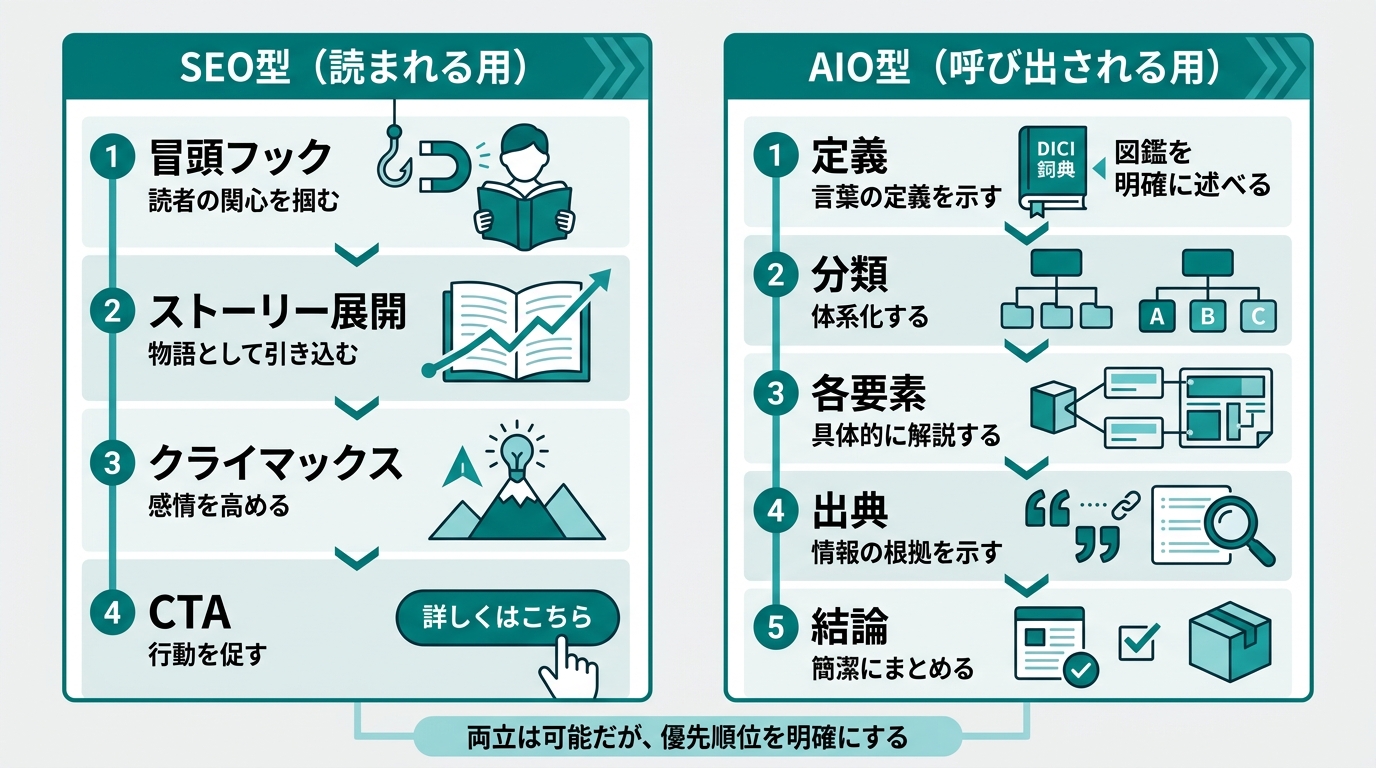
A common misread here: “AIO means writing boring articles.” Wrong. The difficulty of doing both at once has just gone up. Writing an article that’s genuinely engaging to read AND easy for AI to extract components from is the current maximum-difficulty level of content creation.
Design Axis 3: Optimize for Source Accuracy, Not Keyword Surface
SEO used to evaluate technical factors like internal links, external links, and keyword density. AIO goes more fundamental — the accuracy of information has a direct effect.
Why? Because AI, when summarizing and integrating, prioritizes “facts that are consistent across multiple sources.” If your article contains original numbers that don’t align with other sources, AI won’t cite them, or will treat them cautiously. Conversely, an article where source URLs are explicit and the same facts can be verified across multiple sources becomes “easy to use” material for AI.
This is an axis I’ve felt strongly while writing my own articles over the past few months. Citing sources, linking to specific pages, noting the year of a study, separating inference from fact. That unglamorous work maps directly onto how often AI cites your content.
3 Conditions for “Called” Content — Structure, Source Precision, Quote-Friendliness
Condition 1: One Topic per Article, Start with a Definition
The first condition for citable content is that it’s clear “what this article is a source for.” Covering multiple topics in a single article makes it harder for AI to determine “which part to use for which task.”
Declare at the top: “This article covers X.” Put the definition of X in the very first section. Those two things alone make it far easier for AI to know when to call the article.
The reason I opened this article by announcing the theme “content’s role is changing” is exactly to satisfy Condition 1. The reason the first body section opens with a definition of “from being read to being called” is the same intent.
Condition 2: All Numbers and Facts Must Include a Source URL
For AI to cite your content, numbers and facts need to be “verifiable by others.” This is subtly different from SEO’s concept of “authority.” SEO evaluated “are authoritative sites linking to you?” AIO asks “can the information in your article be cross-referenced by AI against other sources?”
Concretely: (a) include source URLs for numbers directly in the body text, (b) note the year of the study, (c) name the organization that conducted it. “According to a certain study” isn’t enough. “According to Deloitte’s 2026 Tech Trends report (source URL)” is the standard.
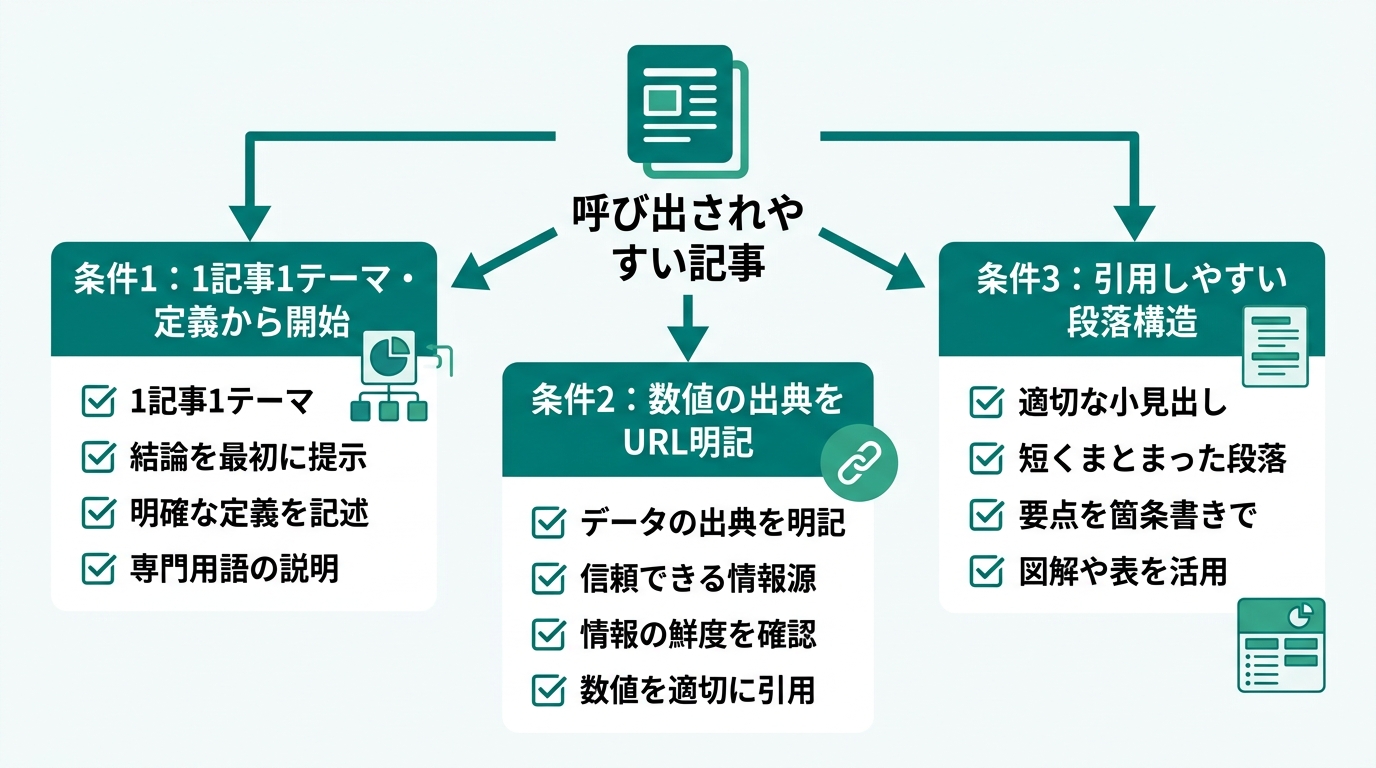
Condition 3: Make Each Paragraph Self-Contained
AI isn’t good at understanding context that requires bridging across sections. A paragraph that says “as mentioned in the previous section” loses its meaning when excerpted in isolation.
Citable content should have each paragraph and each heading section be self-sufficient in meaning. Specifically: write one paragraph immediately after a heading that summarizes what that section covers as a complete thought. Avoid “as stated earlier” and “as mentioned above” within body text. Slight redundancy is fine — from my experience, that’s the right calibration.
These 3 conditions are what I’ve been consciously practicing across my articles for the past six months. I can’t claim perfect execution. But the composition of my referral traffic has visibly shifted since I started applying them.
Redesigning Existing Marketing Strategy — The Ad/SEO/AIO Gradient
“So should I abandon ads and SEO and go all-in on AIO?” I get asked this. The answer is no.
All three have their roles, and using them along a gradient is the current optimal approach.
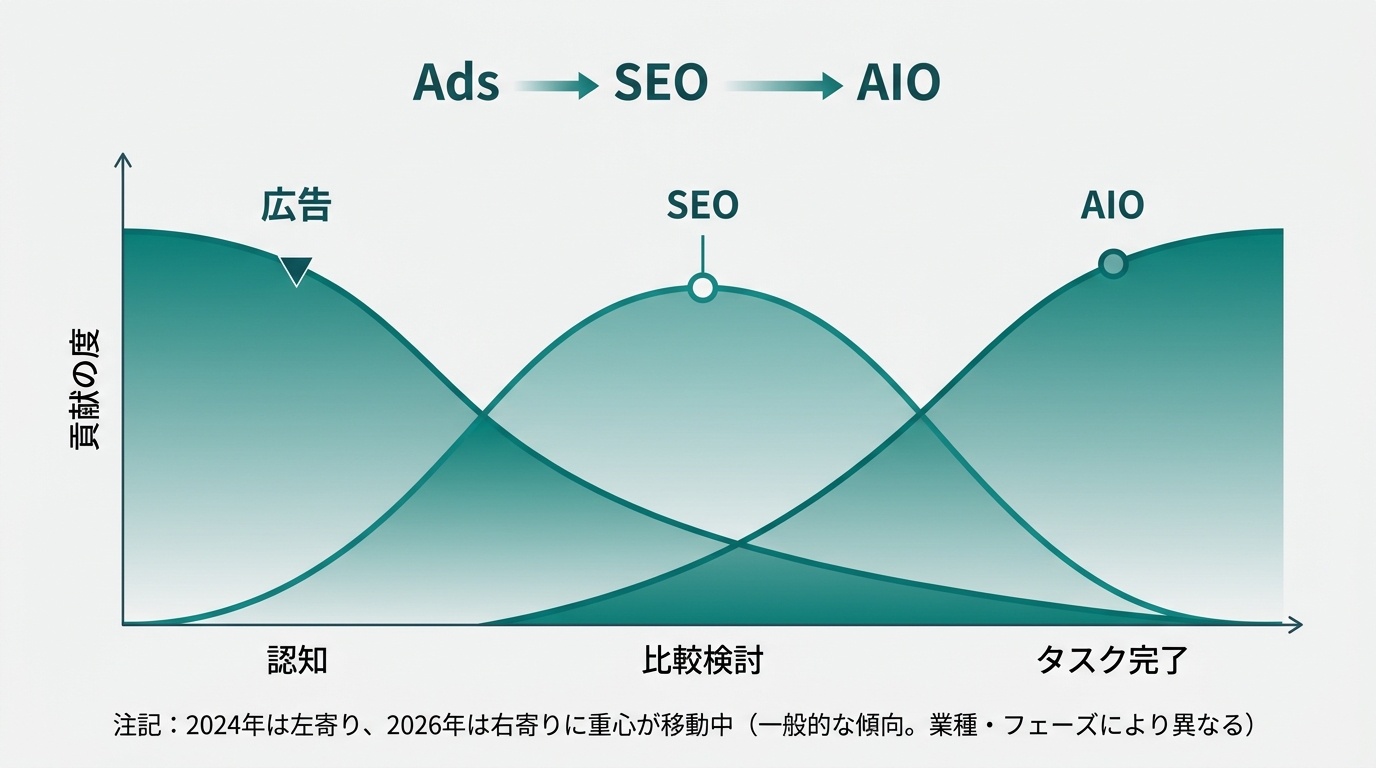
The Role of Ads: Awareness Entry Point
Reaching people who don’t know your company or product yet is still ads’ exclusive domain. Even in the AI agent era, there’s no current sign of ads disappearing at the awareness stage. If anything, “brands that haven’t built awareness won’t be cited by AI” is the dynamic — so the role of ads in building baseline awareness remains significant.
That said, the weight of awareness is clearly declining. Mentions in communities and organic word-of-mouth on social networks are signals that AI tends to treat as “real, credible brand presence.” Awareness built purely through paid ads reads as thin signal to AI.
The Role of SEO: Mid-Funnel Consideration
When someone already knows a brand but is in research and comparison mode, SEO still hits hardest. Ranking for “[competitor] vs [you]” or “[product] reviews” queries still has real value.
The change here: comparison articles aimed at “human readers” are increasingly being displaced by AI Overview, which compresses PVs. Meanwhile, comparison articles designed to “be cited by AI” are actually gaining importance. Same SEO — but the purpose of writing has changed.
The Role of AIO: The Decisive Factor at Task Completion
When an agent is actually executing a task, AIO-designed content is what directly influences it. “Contract this service.” “Buy this product.” “Use this as the factual basis for a conclusion.” These final-stage agent decisions are where AIO acts.
As I laid out in “The 2026 Marketing Map in One View”, the optimal method differs across awareness, consideration, and task completion. Running all three at full intensity is difficult — so assess which stage your business is competing in and prioritize accordingly.
(My own 2026 allocation, personal and specific to my situation. Optimal varies by industry and context.) For me, the mix is roughly SEO 40% / AIO 50% / Ads 10%. Six months ago it was SEO 70% / AIO 20% / Ads 10%. The center of gravity is definitively moving AIO-ward.
3 Axes to Activate Today — Content, Data, and Relationship Rebuilding
Axis 1: Content — Audit Existing Articles for “Definition and Sources”
If you’re moving tomorrow, start by reviewing existing articles. Does the opening declare what question this article is the authoritative source for? Do numbers and facts in the body text have source URLs? Check those two points and fill in what’s missing.
Even without time to write new articles, refining existing ones is a fast cycle. 30-minute reviews per article, 10 articles, 5 hours total. Given the potential return in AI citation, the ROI is solid.
Axis 2: Data — Build a System to Track AI-Sourced Referrals
In standard GA4 setups, traffic from ChatGPT and Claude often blends into “Direct” or “Other.” Three entry points for making it visible: (a) set up custom channel groupings for AI platform referral domains. (b) Add UTM parameters to links in your articles. (c) Trial a tracking tool like Ahrefs Brand Radar or Semrush AI Toolkit. I covered the details in “Ahrefs Evolved Into a Marketing Integration Tool”.
You can’t make decisions without data. Make “how many visits came from AI” visible for even one week. That’s Axis 2.
Axis 3: Relationships — Build the Foundation to Be Treated as a Trusted Source by AI
The final axis is relationships. AI tends to treat brands and people “mentioned across multiple sources” as trusted reference points. Inversely, information that exists only on your own site reads as weak to AI.
Concretely: (a) guest contributions to industry media, (b) joint research and co-authored content with other organizations, (c) consistent presence in communities. There’s no immediate return. But for expanding the pool of “content AI cites” in 6 to 12 months, this groundwork pays off.
Key Takeaways from This Article
- AI agents acting as personal shoppers destroys the premise of ad-based economics (humans see ads). Ads won’t go to zero, but total volume will definitely shrink.
- Content’s role is flipping from “being read” to “being called.” KPIs are shifting from pageviews and dwell time to citation rate and callout frequency.
- AIO’s 3 design axes: (1) optimize for task completion, (2) optimize for information structure, (3) optimize for source accuracy.
- 3 conditions for citable content: one topic per article starting with a definition, source URLs on all numbers, self-contained paragraph structure.
- Ads/SEO/AIO are used along a gradient. The center of gravity is moving AIO-ward. Start today with (a) auditing existing articles, (b) measuring AI-sourced referrals, (c) relationship-building as a trusted source.
“Getting found through ads” isn’t completely over yet. But the speed at which it’s heading toward over is definitively accelerating.
The difference between people who act now and people who don’t won’t be visible in six months. It shows up slowly over 1–2 years. The small refinements you can make today are the best investment in your future self.
I’m optimizing every article I write, every day, to be “more callable.” Let’s work on this together.

AIを使いこなせない方は、この先どんどん差がつきます。僕はAIエージェントを毎日動かして、壊して、直して、また動かしてます。そういう泥臭い実践の記録をここに書いてます。理論は他の方にお任せしました。僕は動くものを作ります。朝5時に起きてウォーキングしてからコードを書くのがルーティンです。