China Bet 10 Trillion Yuan on AI. Three Signals Japanese Indie Developers Should Watch This Week
China's 15th Five-Year Plan placed AI at the top of its priority areas, setting a target of a 10 trillion yuan (approx. 230 trillion yen) AI industry by 2030. Drawing on primary reporting from JETRO and analysis from research institutions, we organize three signals that Japanese engineers and indie developers should watch.
What you'll learn in this article
- The key point to grasp before reading the full article
- How the issue changes the way developers should work next
- Which follow-up article is worth opening next

In March 2026, China announced its 15th Five-Year Plan. The covered period spans the five years from 2026 to 2030.
References to AI (artificial intelligence) appear frequently throughout the planning documents. The action plan named “AI+” spans a wide range, from manufacturing to healthcare, logistics, and robotics. It’s a declaration to embed AI across every industry. The plan also sets a target of reaching a 10 trillion yuan (approx. 230 trillion yen) AI-related industry by 2030. According to JETRO’s reporting, this is the largest figure among AI industry targets the Chinese government has set in the past (reference: https://www.jetro.go.jp/biznews/2026/03/aa22ea3eb6a6db3a.html ).
I work in customer success, and on the side I do code development using AI. I’m not a professional engineer. But reading this plan, I couldn’t dismiss it as “something that doesn’t concern me.”
China’s Five-Year Plan ripples out to Japanese engineers and vibe coders. Tool choices, revenue opportunities, career design. The impact has already begun.
Combining primary reporting from JETRO and others with analysis from research institutions such as the Atlantic Council, WEF, and Brookings, I’ve organized three signals.
What Was Declared in the 15th Five-Year Plan
First, let me lay out the facts.
China’s Five-Year Plan refers to the national economic plan the government formulates every five years. The 15th is the third such plan under the Xi Jinping administration. The biggest feature this time is the clear emphasis on concentrated investment in AI, quantum computing, and semiconductors.
A note on how to read this: The descriptions below mix “facts that can be confirmed from the planning text itself” with “interpretations by experts and research institutions.” Items where I cite a source are based on primary sources. Please read analysis without citations as researchers’ viewpoints.
The Atlantic Council has analyzed the plan as “five takeaways for US policymakers” ( https://www.atlanticcouncil.org/dispatches/five-takeaways-for-us-policymakers-about-chinas-new-five-year-development-plan/ ). One of the target figures referenced in that analysis is that “the core digital economy industry will account for 12.5% of GDP.” This is China’s own target value as stated in the government’s Government Work Report, and the same figure can be confirmed in WEF’s explanatory article. Since the current estimate is around 10%, this aims for an increase of more than 2.5 percentage points over five years.
The Diplomat’s analysis article is also worth attention. It points out that this plan is not limited to China’s domestic affairs but will bring structural change to the global AI development ecosystem.
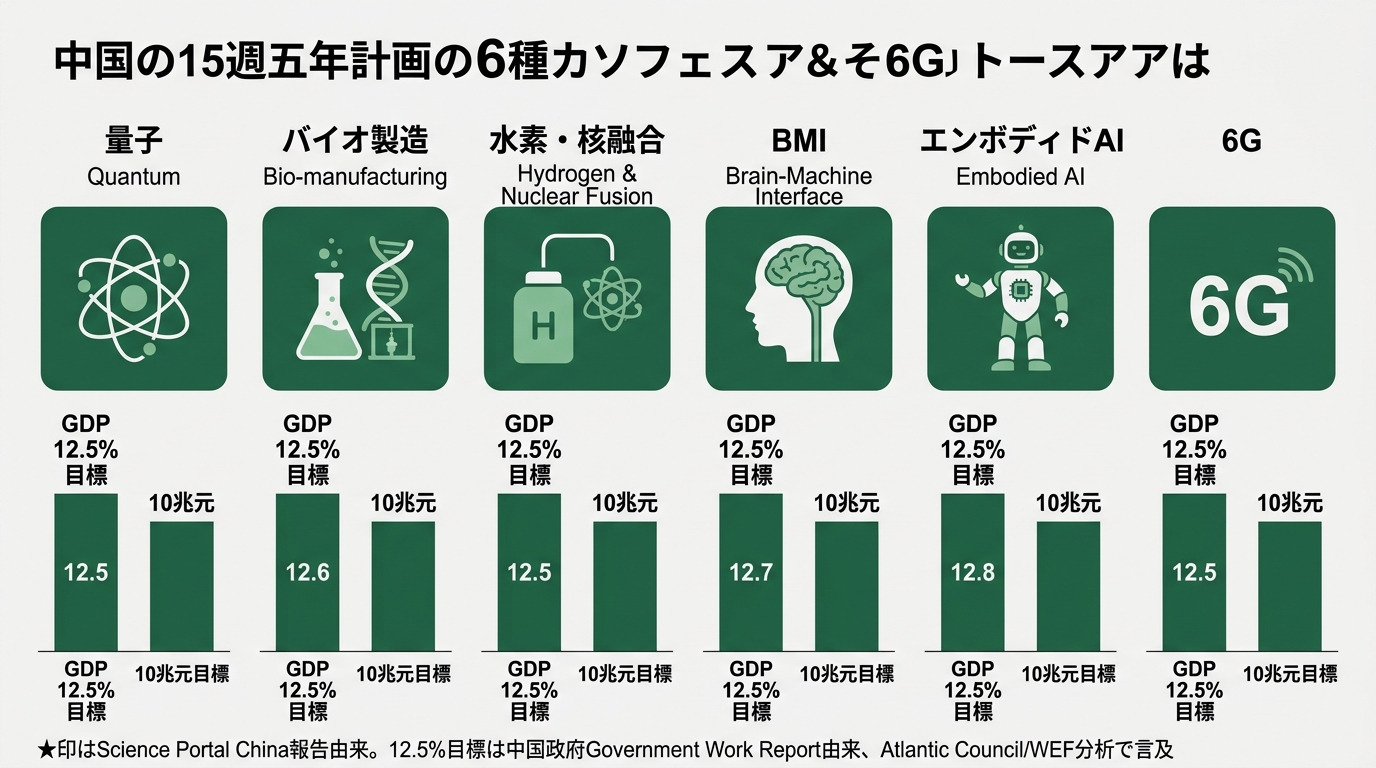
From Science Portal China’s reporting, let me organize the priority areas.
- Quantum technology
- Biomanufacturing
- Hydrogen energy and fusion energy
- Brain-machine interface (BMI, technology connecting brains and machines)
- Embodied AI (AI with a physical body, mounted on robots)
- Sixth-generation mobile communications (6G)
Two of these directly affect engineers’ daily work: “Embodied AI” and the “AI+ action plan.” The latter, in particular, is a policy to accelerate AI adoption in existing industries and is directly tied to supply and demand for software engineering work.
XenoSpectrum read the policy’s center of gravity sharply. The essence is not economic stimulus itself but rather “which industries to concentrate capital and administrative resources on.” The decision to channel funds toward AI and semiconductors even at the cost of suppressing growth rates sends a signal that Japanese indie developers cannot ignore.
Signal 1: Tool Choices Will Change. The Rise of Chinese Open-Source AI
The first signal directly connects to the tools we use every day.
Do you remember DeepSeek’s release in late 2025? It was the moment a China-born open-source LLM grabbed worldwide attention all at once. LLM stands for large language model, the foundational technology by which AI generates text. MIT Technology Review analyzed “what’s next for China’s open-source AI” in February 2026, and in April selected the same strategy as one of the top 10 AI trends.
The strategy is built into the Five-Year Plan as well.
The planning document explicitly encourages “self-reliant and controllable” open-source foundation models. Cloud hosting infrastructure for models and datasets is also a target of support. The aim is to promote sharing and collaboration among developers.
Beijing took it a step further. The “Beijing Open-Source Ecosystem Construction Implementation Plan” is an independent local government plan covering 2026–2028, a separate document from the central government’s Five-Year Plan text. It sets a target of nurturing 10 internationally influential open-source projects by 2028 and elevating five or more to a globally top-tier level. Priority allocation to the AI field is also stated explicitly.
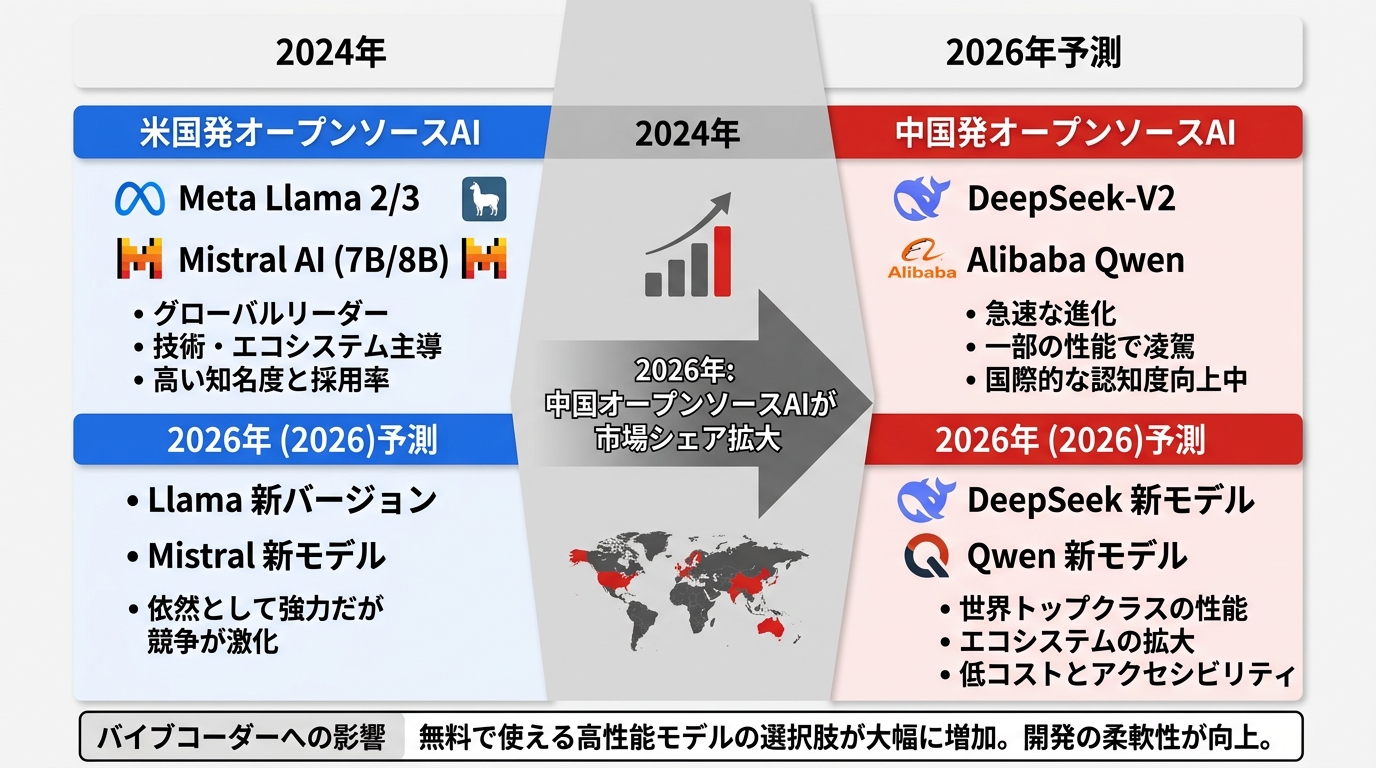
IEEE ComSoc’s technical blog offered an interesting forecast: Chinese open-source AI models will expand their share in the global market in 2026. In the context of US–China competition, RAND has published an analysis framing this as a soft power strategy through open models.
So what changes for Japanese vibe coders and indie developers?
Put simply: “the choices of free, high-performance AI models expand.”
When I started vibe coding, my options were essentially OpenAI’s GPT series or Anthropic’s Claude series. Whether I used Cursor or Claude Code, the API usage fees applied. For indie developers, monthly AI usage costs are not something you can ignore.
As China-born open-source models raise their quality, this structure starts to break down. More models can run in local environments, and the scenarios where you can develop with zero API cost expand.
There are caveats, however. The “self-reliant and controllable” phrasing the Chinese government uses signifies technological independence. Even though they’re open-source, you need to carefully verify license terms and data handling. When choosing tools, please always check license conditions and where data is sent.
Here are the two actions I took.
- Tested DeepSeek models in a local environment and compared response quality if switched in as Cursor’s backend
- Checked the license terms of China-born models on Hugging Face and listed those available for commercial use
Signal 2: The Market Will Move. Software Demand Generated by a 10 Trillion Yuan AI Industry
The second signal is the flow of money.
According to JETRO’s March 2026 reporting, the scale of China’s AI-related industry is projected to reach 10 trillion yuan by 2030 ( https://www.jetro.go.jp/biznews/2026/03/aa22ea3eb6a6db3a.html ). The World Economic Forum also points out the impact this plan will have on global trade and investment ( https://www.weforum.org/stories/2026/03/what-china-new-5-year-plan-mean-global-trade-and-investment/ ).
10 trillion yuan is an enormous figure. But for indie developers, what matters is solely “how much software is needed in that market.”
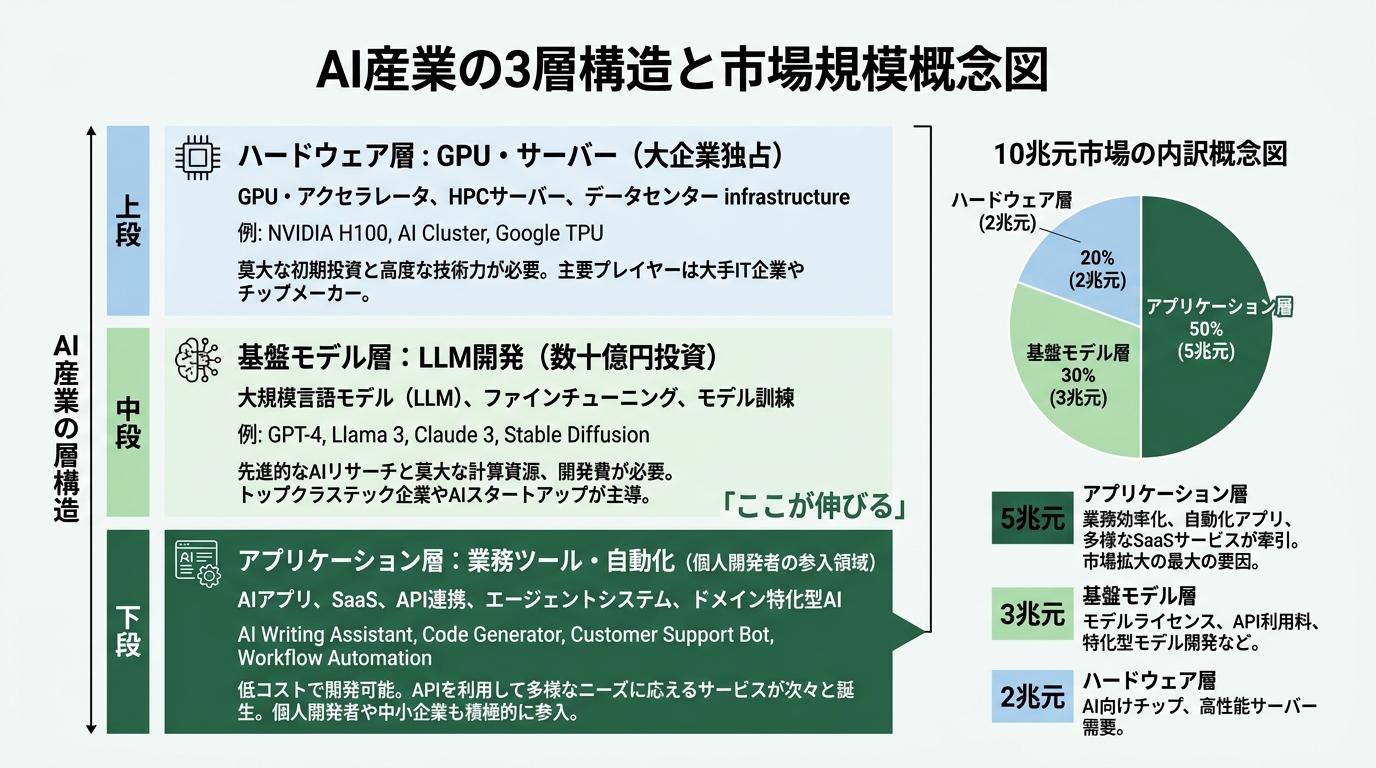
Let’s consider the AI industry’s structure. Hardware (GPUs, servers) is the domain of large corporations. Foundation model development requires investment in the billions of dollars. The application layer where AI is implemented in business is a different story. Business tools, automation scripts, data pipelines. Indie developers and freelancers can enter this layer.
Brookings’ analysis is a useful reference ( https://www.brookings.edu/articles/what-to-know-about-chinas-economic-ambitions-and-its-five-year-plan/ ). While explaining the relationship between China’s economic ambitions and the Five-Year Plan, it points out the expanding demand for “middleware” in the phase where AI’s industrial adoption accelerates. Middleware refers to the software layer that connects foundation models and users.
How can Japanese indie developers find a point of contact?
You don’t need to enter the Chinese market directly. What you should pay attention to is the “ripple effect.”
When China builds an AI industry at the 10 trillion yuan scale, companies in surrounding countries also accelerate AI adoption. To avoid falling behind in competition. Japanese companies are no exception. According to the “DX White Paper 2025” published by the IPA, only about 51% of large Japanese enterprises and about 24% of small and medium-sized enterprises have introduced AI systems into their operations (reference: https://www.ipa.go.jp/publish/wp-dx/dx-2025.html ). To close this gap, demand for business tool development and AI integration apps is expected to increase.
Because I come from a CS background, I know users’ business challenges firsthand. “I want to automate this Excel work.” “I want to control Slack notifications with conditional branching.” “I want to analyze customer data with AI.” Turning these on-the-ground voices into tools by combining them with AI — that’s my side gig.
China’s AI industry expansion will further boost demand for this kind of “ground-level business tool development.” A structure where the growth of a large market brings benefits to small tool developers, too.
I’m considering the following actions.
- List three development themes for AI-embedded business automation tools
- Verify whether designs that keep API costs down by using China-born open-source models as the backend are feasible
- Create proposal documents for solutions targeting Japanese companies lagging in AI adoption
Signal 3: The Career Map Will Change. Japan’s AI Engineer Supply-Demand Gap
The third signal concerns careers.
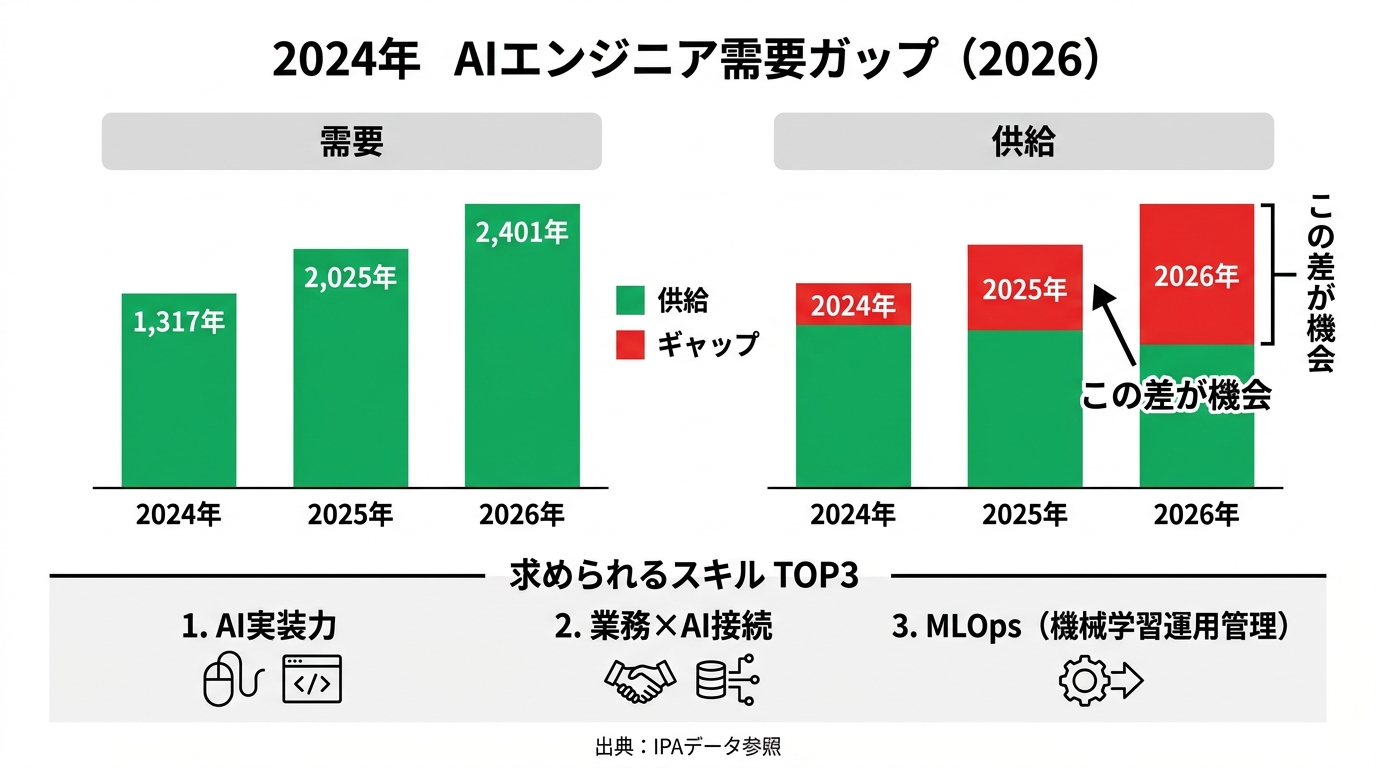
In the IPA’s “DX White Paper 2025,” the shortage of AI and data-utilization talent is continuously cited as the biggest obstacle to Japan’s DX promotion. In particular, demand for “AI engineers” and “data scientists” who can embed AI into actual business operations far exceeds supply. Le Wagon’s career coaches, after analyzing Japan’s tech job market, point out that “engineers who can integrate AI into real business operations” command the highest job-posting rates. What’s sought is not people who can build models, but people who can connect AI to existing business operations.
China’s Five-Year Plan will further accelerate this structure.
There are two reasons.
The first is the intensification of US–China AI competition. When China invests 10 trillion yuan in AI, the US makes counter-investments. This competition lifts global AI investment overall, and Japanese companies will move to secure AI talent.
The second is the wave of embodied AI. The Five-Year Plan explicitly states that “robots will be experimentally introduced in industries facing labor shortages.” Japan faces the same challenge. According to Edstellar’s survey, AI and machine learning, cloud infrastructure, and data science line up at the top of high-demand skills in Japan for 2026.
Let me share my own story here.
I’m someone who once quit being an engineer. Looking at the top-tier engineers I encountered on a large project, I realized this was a level I could never reach. Strangely, the feeling was refreshing. My strength wasn’t code quality but my ability to understand users’ challenges. From there, I shifted my career to CS.
AI arrived, and the situation completely changed.
When I started using Claude Code, I experienced code at a level I once couldn’t write being born from my own instructions. It felt as if a top-tier engineer had taken up residence inside me. The skills of those I once thought I could never match are now in my hands through AI.
China is betting 10 trillion yuan to expand its AI industry. That wave will inevitably reach Japan. When it arrives, a decisive gap will emerge between engineers who can use AI and those who can’t.
According to Metaintro’s analysis, Japan’s tech employment is being reorganized by AI and engineering talent. Traditional mid-level positions are being replaced by automation. Demand has concentrated on “senior specialists who bridge technology and business.”
For those with a CS background, it’s an opportunity. Someone who can bridge technology and business and also write code with AI’s help. This combination is a strength that specialized engineers don’t have.
Three Things I Did This Week
I’ve organized the three signals. Finally, I want to share what I actually did.
1. Took Stock of AI Model Options
Cursor, Claude Code, GitHub Copilot. I listed the models running behind the three tools I use. Then I added DeepSeek and Qwen via Ollama and compared them. Qwen is an open-source LLM from China’s Alibaba, and Ollama is a tool for running LLMs in local environments.
The result was clear. Local models’ quality is “sufficient for simple script generation.” For complex refactoring and design decisions, Claude Code is overwhelmingly stronger. I confirmed that using them selectively is the right answer.
# Minimal commands to try a local model with Ollama
# First, install Ollama (https://ollama.ai)
# Then pull a model
# ollama pull deepseek-coder-v2:latest

import subprocess

def ask_local_model(prompt):
    """Function to ask a question to the local DeepSeek model"""
    result = subprocess.run(
        ["ollama", "run", "deepseek-coder-v2:latest", prompt],
        capture_output=True,
        text=True
    )
    return result.stdout

# Example usage
response = ask_local_model("Write a function in Python to read a CSV file")
print(response)
2. Checked 30 Job Postings for AI Engineers in Japan
I searched Indeed Japan and Green with the keywords “AI engineer,” “generative AI,” and “Claude.” Here are the trends I saw from 30 listings.
- Salary range: 6 to 12 million yen is the main band. Many listings with “AI implementation experience” exceed 8 million yen
- Required skills: Python is a must. Combined with “business understanding” and “requirements definition”
- Surprisingly rare: paper-reading ability and model development experience. Greater emphasis on “the ability to use” than “the ability to build”
Practical experience with vibe coding directly translates into this “ability to use.” We’ve entered an era where the experience of giving instructions to AI to build business tools is also valued in the job market.
3. Organized the Impact of the Five-Year Plan Across Three Time Horizons
| Time Horizon | Impact | Indie Developer Actions |
|---|---|---|
| Within 6 months | Expansion of China-born open-source model options | Periodically assess local LLM quality |
| 1–2 years | Acceleration of AI adoption in Japanese companies (competitive pressure) | Stockpile business automation tool development themes |
| 3–5 years | Widening of the AI engineer supply-demand gap | Accumulate AI implementation skills in your portfolio |
What this exercise revealed is the fact that “there’s no need to rush and change anything, but the direction is set.” The direction indicated by China’s Five-Year Plan and the direction indicated by Japan’s AI talent demand align. The value of people who can use AI will steadily rise over the next five years.
Summary
China’s 15th Five-Year Plan set a target of a 10 trillion yuan (approx. 230 trillion yen) AI industry. It declared integration across all industries as the “AI+ action plan” and codified national support for open-source AI.
There are three signals Japanese engineers and indie developers should watch.
The first is the shift in tool choices. China-born open-source AI models have raised their quality, expanding the range of options that can be used locally and free of charge. By using them selectively after confirming licenses and data handling, you can keep costs down.
The second is market expansion. Growth at the 10 trillion yuan scale accelerates AI adoption in surrounding countries. Japanese companies’ AI adoption rate still has plenty of room to grow, and demand for business tool development is expected to rise.
The third is structural change in careers. The intensification of US–China AI competition pushes up global AI investment, and demand for engineers who can embed AI into business operations is surging in Japan as well. A turning point has arrived where “the ability to use” is valued more than “the ability to build.”
I’m not a professional engineer. I’m someone who got frustrated and once stepped away from code. But thanks to AI, I can write code again. Whether China bets 10 trillion yuan or the US makes counter-investments, what indie developers do is simple. Move your hands and build something that works. That accumulation will be the foundation five years from now.
The links to primary sources are below. Please confirm them with your own eyes.
- JETRO “AI Industry Heading to 10 Trillion Yuan Scale by 2030”: https://www.jetro.go.jp/biznews/2026/03/aa22ea3eb6a6db3a.html
- Atlantic Council “Five Takeaways”: https://www.atlanticcouncil.org/dispatches/five-takeaways-for-us-policymakers-about-chinas-new-five-year-development-plan/
- The Diplomat “Global Implications”: https://thediplomat.com/2026/03/the-global-implications-of-chinas-5-year-plan-ai-ambitions/
- Science Portal China “15th Five-Year Plan Launch”: https://spap.jst.go.jp/china/news/260301/topic_5_03.html
- XenoSpectrum “A Realist Analysis”: https://xenospectrum.com/china-tech-self-reliance-plan
- MIT Technology Review “China’s Open-Source AI Strategy”: https://www.technologyreview.com/2026/04/21/1135658/china-open-source-models-ai-artificial-intelligence/
- World Economic Forum “Global Impact of the Five-Year Plan”: https://www.weforum.org/stories/2026/03/what-china-new-5-year-plan-mean-global-trade-and-investment/
- Brookings “China’s Economic Ambitions”: https://www.brookings.edu/articles/what-to-know-about-chinas-economic-ambitions-and-its-five-year-plan/
- IPA “DX White Paper 2025”: https://www.ipa.go.jp/publish/wp-dx/dx-2025.html
I hope you’ll also check out related articles on vibe coding.

正直、一度エンジニアは諦めました。新卒で入った開発会社でバケモノみたいに優秀な人たちに囲まれて、「あ、私はこっち側じゃないな」って悟ったんです。その後はカスタマーサクセスに転向して10年。でもCursorとClaude Codeに出会って、全部変わりました。完璧なコードじゃなくていい。自分の仕事を自分で楽にするコードが書ければ、それでいいんですよ。週末はサウナで整いながら次に作るツールのこと考えてます。