I Read Both Gartner's and Deloitte's 2026 Tech Predictions—Here's Which You Should Read First
A comparison of Gartner's and Deloitte's 2026 tech prediction reports. From 10 items vs 5 items, three points of agreement and two key divergences—organized for Japanese engineers who need to know what to read now.
What you'll learn in this article
- The key point to grasp before reading the full article
- How the issue changes the way developers should work next
- Which follow-up article is worth opening next
Two Major Reports Are Out—But They Say Different Things
Gartner and Deloitte. When reading the future of technology, you can’t avoid these two names.
Gartner is an IT research firm headquartered in Connecticut, USA. It releases its “Top Strategic Technology Trends” once a year, and this is its 16th edition. Deloitte is the world’s largest accounting firm group, and has been publishing “Tech Trends” for 17 years.
Both 2026 editions are now out.
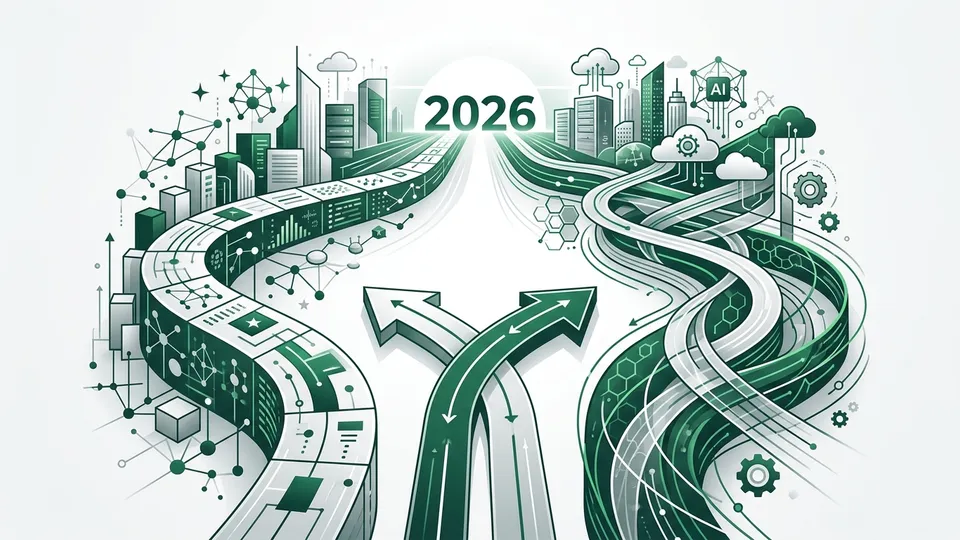
Gartner lists 10 items. Deloitte lists 5. Just by the numbers, there’s a 2x gap. But once you read in depth, the two firms’ views align completely in three areas. At the same time, two decisive divergences also become clear.
I come from a CS background and work in customer success. Honestly, I don’t have time to read full English research reports. So I wanted criteria for “which one to read first.”
I’m sure many people feel the same. As of April 2026, you can hardly find a Japanese article that compares these two major reports head-on. There are quick-take articles like Publickey, but no comparative analysis yet. So I wrote one.
Grasp Gartner’s 10 Items in 3 Minutes
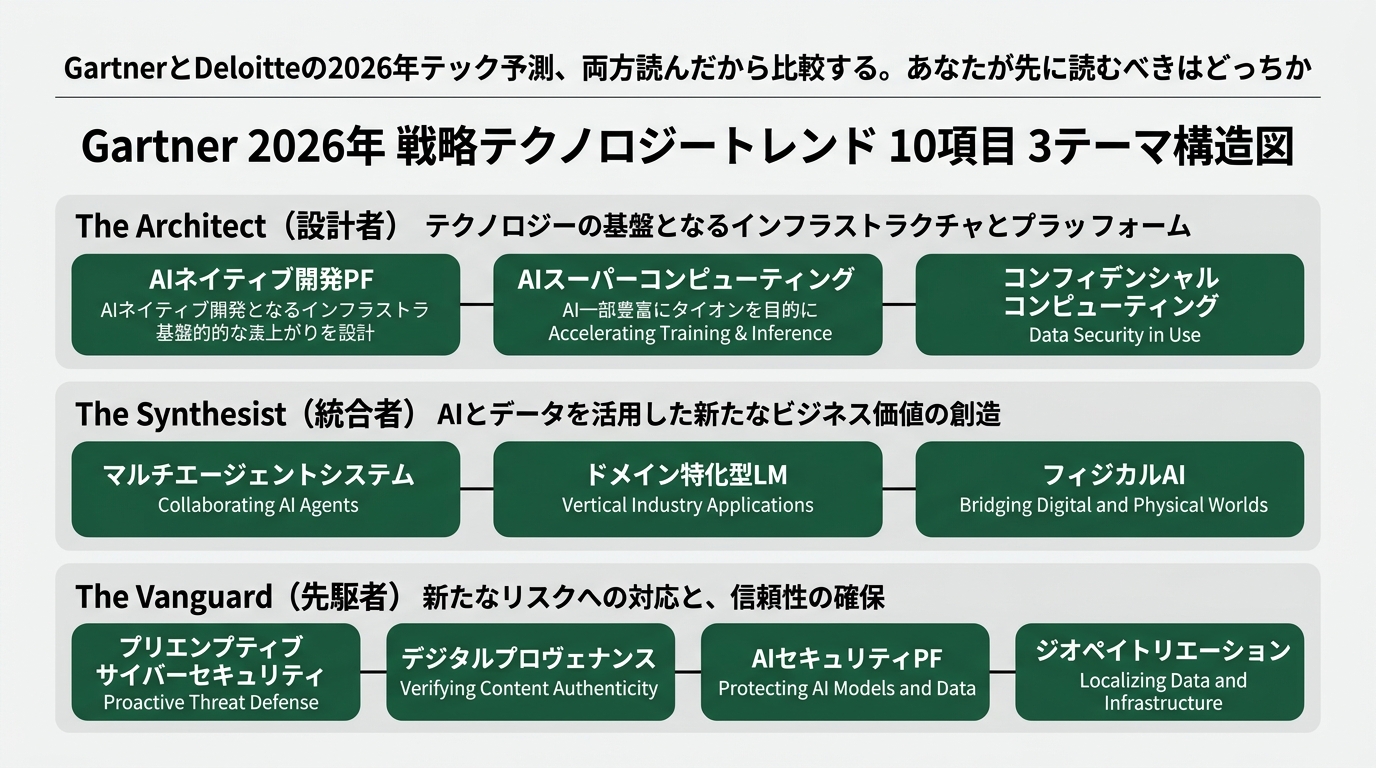
In October 2025, Gartner announced its 10 Strategic Technology Trends for 2026. They are sorted into three themes.
Theme 1: The Architect
This category covers foundational technologies. It contains 3 items: AI-Native Development Platforms, AI Supercomputing, and Confidential Computing.
Confidential computing refers to technology that processes sensitive data while keeping it encrypted. Gartner predicts that by 2029, more than 75% of operations processed on untrusted infrastructure will be protected by this technology. Considering the current reality of cloud environments where your data sits next to other people’s, that number means a lot.
Theme 2: The Synthesist
This category shows new combinations of technology, and it also has 3 items: Multi-Agent Systems, Domain-Specific Language Models, and Physical AI.
A multi-agent system is a setup where multiple AI agents work together to execute tasks. Instead of having a single AI do everything, the design philosophy is to divide roles. Physical AI refers to embedding AI in robots and drones.
There’s a notable prediction here. Gartner expects that by 2028, more than half of generative AI models used by enterprises will be domain-specific. General-purpose models alone can’t meet industry-specific accuracy requirements. The tipping point is approaching where models tuned for specialized fields like healthcare, legal, and finance become mainstream.
Theme 3: The Vanguard
This is 4 items covering reliability, governance, and security: Preemptive Cybersecurity, Digital Provenance, AI Security Platforms, and Geopatriation.
Preemptive cybersecurity refers to methods that prevent attacks before they happen, rather than dealing with them after the fact. Digital provenance is technology that verifies the origin of software and data. SBOMs (Software Bills of Materials) and digital watermarks fall into this category. Geopatriation is the trend of returning data to clouds within one’s own country in response to geopolitical risk.
One number to pick up here. 40% of enterprise apps will feature task-specific AI agents by the end of 2026. At the start of 2025, the figure was below 5%. This sharp ramp-up is also covered in a previous article.
What the 10 items have in common is that they look “5 years ahead.” Many of Gartner’s predictions are aimed at 2028–2029. It’s a report that shows where to take a position, more than what to do right now.
Grasp Deloitte’s 5 Items in 3 Minutes
In January 2026, Deloitte released its 17th edition of Tech Trends 2026. The message running through the entire report: “The era of AI experimentation is over. We’ve entered the era of implementation.” Against Gartner’s 10 items, Deloitte narrows it down to 5.
1. Physical AI and Robotics
The fusion of AI and robots moves from niche to mainstream. According to UBS forecasts, workplace humanoid robots will reach 2 million units by 2035. The market is expected to grow to $30–50 billion. Costs are dropping while performance rises in parallel, and the technology is spreading from warehouses and factories into retail and healthcare.
2. The Agentic AI Workforce
Deloitte calls this the “silicon workforce”. A world where the human “carbon-based” workforce coexists with the AI “silicon-based” workforce.
But the reality is harsh. Only 11% of companies are running agentic AI (AI that judges and acts autonomously) in production. 35% of companies haven’t even drafted a strategic roadmap. 42% answered they are “in the middle of building a roadmap.” There’s a giant chasm between “want to” and “doing it.”
3. The AI Infrastructure Reckoning
According to multiple industry estimates Deloitte cites, AI inference costs have dropped sharply over the past two years. But some companies that have scaled to production are receiving bills running into tens of millions of dollars per month. The cost structures of the experimentation stage and the production stage are fundamentally different. Even if the per-token price drops, total spend rises if the volume of processing explodes.
4. The Tech Organization Transformation
In the AI era, the structure, governance, and leadership of tech organizations need redesigning. Just adopting tools is not enough. To embed AI in an organization, the organization’s design philosophy itself has to change.
5. AI and Cybersecurity
AI expands the attack surface of security while also strengthening defense. The balance between innovation and risk has been elevated to a strategic priority at the executive level.
What characterizes Deloitte is that it speaks on a “this quarter to next quarter” timeline. Not 5-year-ahead positioning, but the question of what to implement this quarter.
Three Points of Agreement: What Both Said Is “Definitely Coming”
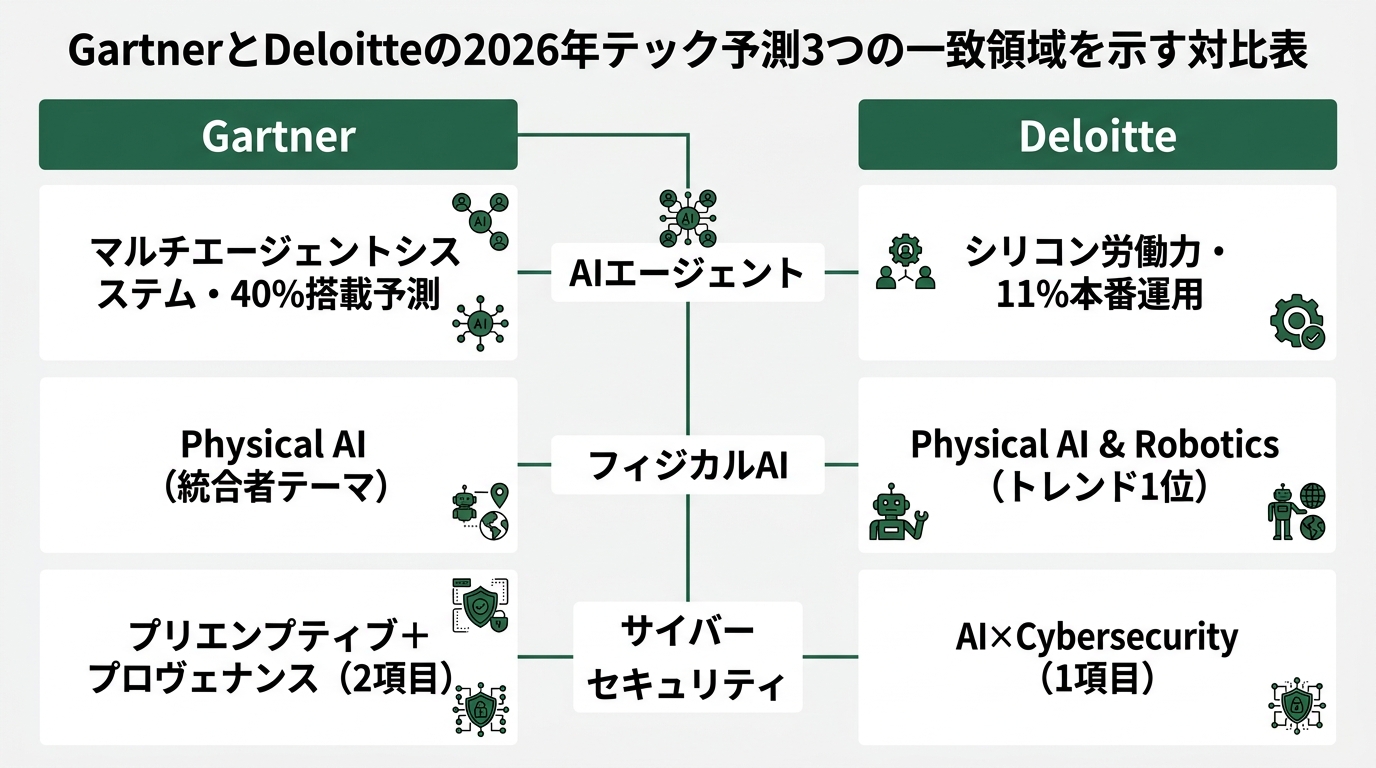
When you place the two reports side by side, the views align completely in three areas.
Agreement 1: AI Agents Take Center Stage
Gartner placed multi-agent systems at the core of its trends. Deloitte goes as far as organizational theory with its “silicon workforce.” The angles differ but the conclusion is the same. AI agents are the biggest tech theme of 2026.
The numbers also point in the same direction. Gartner predicts “40% of enterprise apps will have AI agents.” This doesn’t contradict Deloitte’s current state of “11% in production.” The gap between potential and reality is exactly what starts to close in 2026. Both share that recognition.
Gartner has also shown additional predictions in multiple public research reports. Numbers like “15% of day-to-day decision-making will be autonomously handled by agentic AI by 2028” or warnings that “40% of agentic AI projects will fail by 2027.” Showing both expectation and reality is honest, I’d say.
What I feel as I develop with Claude Code is that agent-like behavior is already part of daily life. The distance between the “agentic AI” big-firm reports talk about and the CLI agents individual developers use every day is shorter than you’d think.
Agreement 2: Physical AI Goes Live
Gartner placed physical AI under The Synthesist theme. Deloitte put it as the first item among trends. AI integrated into robots, drones, and smart devices is entering the commercial stage. The two firms agreed on that view.
Software developers tend to think “robots aren’t relevant to me.” But the software layer of physical AI is built from a combination of cloud APIs and edge inference. It’s also a domain where backend design skills shine.
Agreement 3: Cybersecurity Gets Redesigned With AI as the Premise
Gartner devoted two of its items to preemptive cybersecurity and digital provenance. Deloitte also dedicates one of its 5 items to AI × security. How do you guarantee the authenticity of AI-generated code and images? The two firms answered this question simultaneously.
How do you secure code written through vibe coding? I’ve grappled with this question many times myself. The fact that two major research firms simultaneously cited security as a key item is not unrelated to individual developers either.
Two Divergences: They’re Looking at Different Time Horizons
The “divergences” behind the agreement are where the real reading value lies.
Divergence 1: Gartner-Only — Post-Quantum Cryptography and Geopatriation
Gartner’s 10 items include technologies Deloitte doesn’t cover. Post-quantum cryptography and geopatriation.
Post-quantum cryptography refers to encryption that even the computational power of quantum computers can’t break. The currently dominant RSA encryption could be cracked once quantum computers reach practical use. This technology prepares for that risk. Geopatriation refers to the trend of pulling data back from global public clouds to infrastructure within one’s own country.
These aren’t “technologies that affect revenue right now.” They are themes you should know about now to prepare for 5 years from now. These two items, sitting at the intersection of geopolitics and technology, neatly demonstrate that Gartner is “a report for strategists.”
For individual developers, quantum computers may sound like a distant story. But NIST (the U.S. National Institute of Standards and Technology) is already advancing post-quantum cryptography standardization. The timing for libraries to switch over is closer than you’d think.
Divergence 2: Deloitte-Only — AI Infrastructure Costs and Organizational Transformation
Two items appear in Deloitte but not Gartner: “AI Infrastructure Reckoning” and “Tech Organization Transformation.”
Even as AI inference costs drop sharply, costs in production explode. Only Deloitte tackled this contradiction head-on. The cost-structure difference between experimental and production environments isn’t someone else’s problem for individual developers. You build a prototype on pay-per-use APIs, and the moment users grow, costs jump. It’s a problem you can’t avoid when thinking about AI stack design.
The other item, “organizational transformation,” is about people, not tools. How do you redesign tech organizations for the AI era? The same structural issue lies behind Japanese IT companies starting to change engineer education. It makes sense why Deloitte raised this as “a this-quarter implementation issue.”
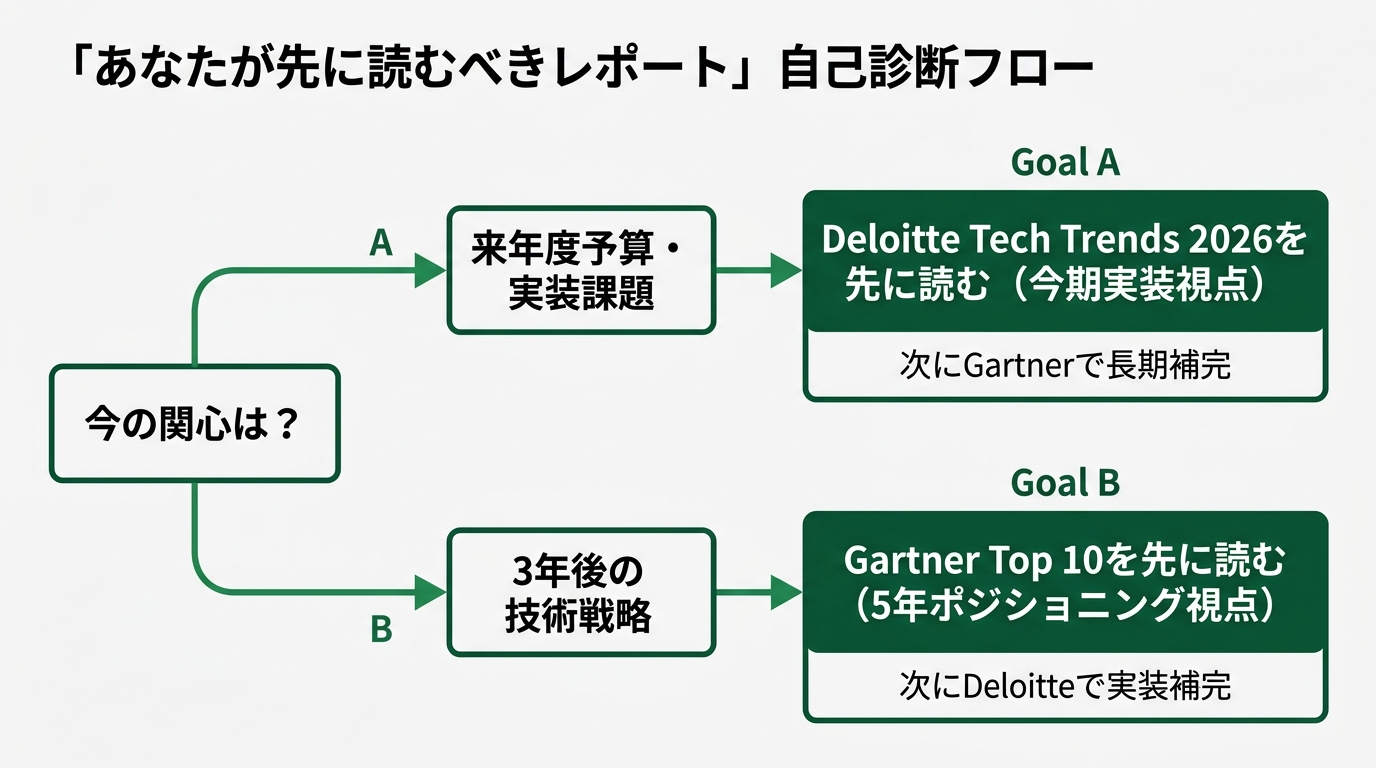
What this divergence means is clear. Gartner asks “where should you be 5 years from now,” while Deloitte asks “what should you implement this quarter.” Neither is right or wrong. It’s a question of reading order.
Self-Diagnosis: Which Should You Read First?
Now that you understand the differences between the two major reports, let’s decide which comes first for you. Try answering these three questions.
Q1: Is your current focus “next year’s budget planning” or “tech strategy 3 years out”?
If it’s next year’s budget planning, read Deloitte first. It contains specific discussion of AI infrastructure cost structure and organizational restructuring. If it’s tech strategy 3 years out, read Gartner first. You’ll find long-term themes like post-quantum cryptography and geopatriation.
Q2: Is your position closer to “executive/management” or “development/implementation”?
If you’re using it for a strategy meeting aimed at the C-suite or CTO, Gartner’s 3-theme structure is easier to use. The 10 items are organized into 3 categories, so you can show the whole picture on one slide. If you’re translating it into a roadmap for your dev team, Deloitte’s 5 items are concrete and easier to act on.
Q3: Do you have time to read full English reports?
Gartner has 10 items. If you can read it all, it has the highest coverage. If you don’t have time, starting from Deloitte’s 5 items is more efficient. Once you’ve absorbed the 5 items, reading Gartner makes the positioning of long-term themes easier to grasp.
Let me share my own answer. As someone with a CS background working as a side-job engineer, I read Deloitte first. The reason: “AI Infrastructure Reckoning” was exactly the issue I was facing. I had an experience where an API cost design mistake tripled my monthly bill versus what I expected. Reading Deloitte’s report and learning that this wasn’t my personal failure but an industry-wide structural issue meant a lot.
Reading Gartner after that complements your long-term view. Post-quantum cryptography and geopatriation aren’t relevant to today’s or tomorrow’s code. But just keeping “security design 5 years out” in the back of your mind changes the criteria you use for tech choices.
Wrap-Up
I compared the 2026 tech predictions from Gartner and Deloitte, the two major research firms.
The three agreements were clear. AI agents, physical AI, and cybersecurity. The “are these coming?” debate is over for these three areas. The fact that two independent research firms simultaneously elevated them to key items confirms them as locked-in themes for 2026.
Two divergences also emerged. Gartner’s “post-quantum cryptography and geopatriation” is 5-year-ahead positioning. Deloitte’s “AI infrastructure costs and organizational transformation” is this quarter’s implementation issue. They differ only in time horizon; both observations are on point.
The criterion for reading order is simple. If you’re facing implementation issues right now, start with Deloitte. If you’re crafting medium- to long-term strategy, Gartner comes first. Both reports are publicly available for free, so eventually I want you to read both. Since there are almost no comparison articles in Japanese in this area, even if you’re not strong in English, AI translation is enough to make sense of them.
I’m a former-failed engineer. Reports like these in English—I once didn’t even have the energy to read them. But once I tried reading them with AI translation, they were packed with information directly tied to my own code design decisions. Authoritative reports aren’t just for experts.
Information I had walked past saying “it’s in English” or “it looks hard” was actually the closest to my work. Realizing that was the biggest takeaway from this comparison. Read Gartner to hold a 5-year map; use Deloitte to decide this week’s step. The engineer who can run that cycle will move fastest in 2026.

正直、一度エンジニアは諦めました。新卒で入った開発会社でバケモノみたいに優秀な人たちに囲まれて、「あ、私はこっち側じゃないな」って悟ったんです。その後はカスタマーサクセスに転向して10年。でもCursorとClaude Codeに出会って、全部変わりました。完璧なコードじゃなくていい。自分の仕事を自分で楽にするコードが書ければ、それでいいんですよ。週末はサウナで整いながら次に作るツールのこと考えてます。