The Day Vibe Coding Became Corporate Training: Why GMO Pepabo's '10,000 Lines a Day' Goal Hit Different for a Former Burned-Out Engineer
GMO Pepabo adopted Vibe Coding in its new-hire engineering training, targeting 10,000 AI-generated lines per day. A former burned-out engineer breaks down what it means when a personal hack becomes the industry's new baseline.
What you'll learn in this article
- The key point to grasp before reading the full article
- How the issue changes the way developers should work next
- Which follow-up article is worth opening next

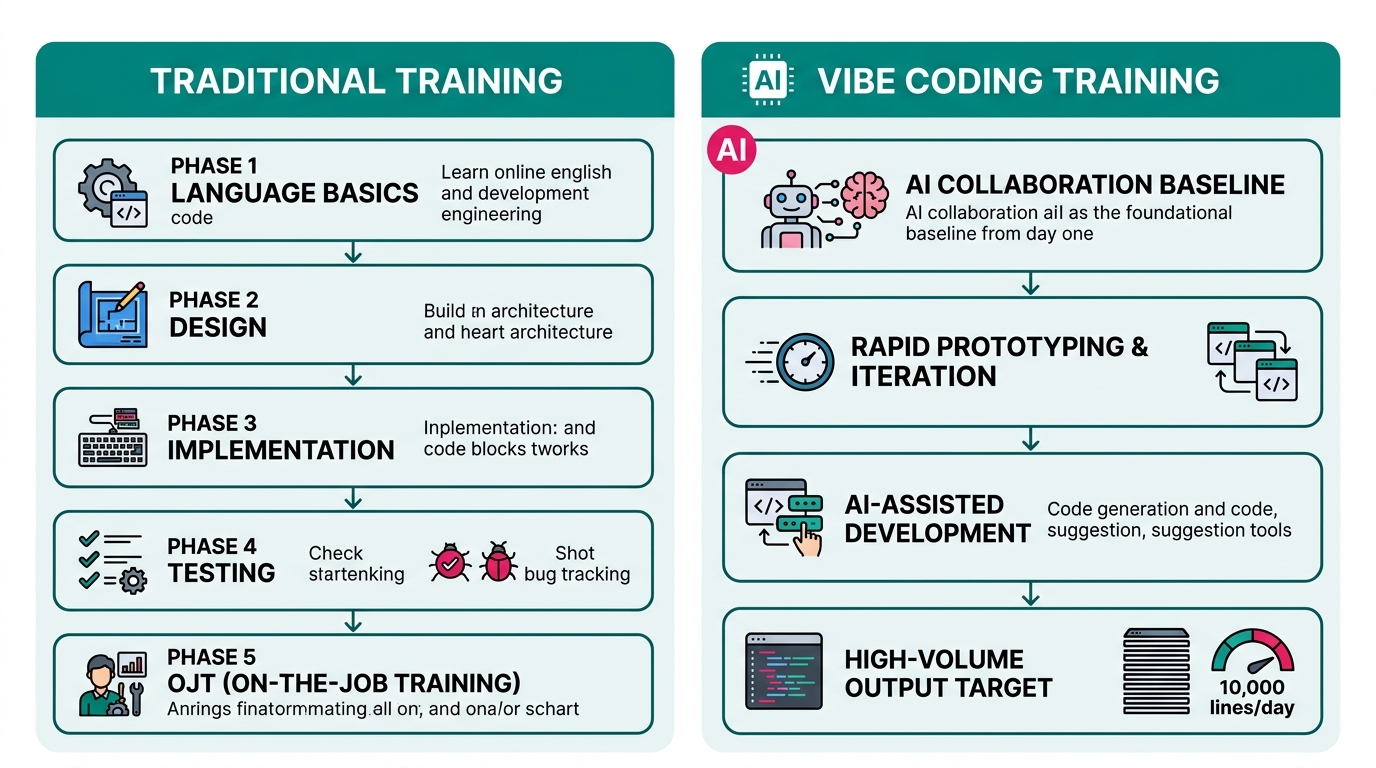
GMO Pepabo adopted Vibe Coding as the foundation of its new-hire engineering training.
The goal: 10,000 lines of code per day.
When I read the ASCII.jp article reporting on the training curriculum, I couldn’t look away from my screen for a while.
Ten thousand lines.
On a good day of personal projects, generating 1,000 lines in collaboration with AI feels like I accomplished something. GMO Pepabo is setting ten times that as the starting point for new graduates. This isn’t a story about individual tool adoption anymore.
For those who haven’t heard the term “Vibe Coding” before: it’s a style of programming where you write code by conversing with AI. You tell the AI what you want to build, it generates the code, and you guide it through refinements. Fundamentally different from the traditional approach of writing every line yourself.
It started spreading among individual developers around 2024, tooling matured in 2025 — and in 2026, GMO Pepabo incorporated it into corporate new-hire training.
Here’s what that transition means, from the perspective of someone who once tried and failed to become an engineer.
The Decision GMO Pepabo Actually Made
GMO Pepabo runs a wide range of services in Japan — WordPress hosting, handmade goods marketplaces, and doujin event support. They employ a large number of engineers. A serious development shop, in other words. And they put Vibe Coding into new-hire training.
According to ASCII.jp’s coverage, the training target is “10,000 lines of code generated per day.” Not handwritten — the concept is reaching that level of output by maximizing AI collaboration.
Why does this number matter? In conventional engineering, even a skilled developer writing at full concentration was said to produce a few hundred lines per day — top talent pushing maybe a thousand. GMO Pepabo has positioned ten times that as the training baseline.
This is not about “AI as a helpful tool.” It’s about engineering style designed from the ground up with AI as a core collaborator. The difference isn’t small. Treating AI as “a supplementary tool you’re allowed to use” versus “integrating AI as the primary driver of code generation” produces entirely different skill development trajectories. GMO Pepabo chose the latter.
For the curriculum details, I’d encourage reading the ASCII.jp article directly: “目指せ1日1万行のコード生成 GMOペパボは新卒研修から『Vibe Coding』を教える.” Reading the primary source gives you a clearer sense of the training design intent.
How Fast a “Personal Hack” Becomes Corporate Standard
My first reaction to the GMO Pepabo announcement: “Already?”
I started using what would be called Vibe Coding in earnest in the second half of 2024. I combined Cursor (an AI-powered code editor) with Claude Code (a conversational AI agent) and began building my own work tools. It felt like a hobby at first — something to experiment with in the gaps between actual work.
That became a corporate new-hire training program within about a year and a half.
This pace is genuinely unusual compared to how IT technologies have historically spread. Cloud computing took 5–7 years to move from personal tool to corporate training standard. DevOps took more than 7 years from concept to systematic onboarding programs. Vibe Coding spread at the individual level in 2024, entered corporate training in 2026. Two years.
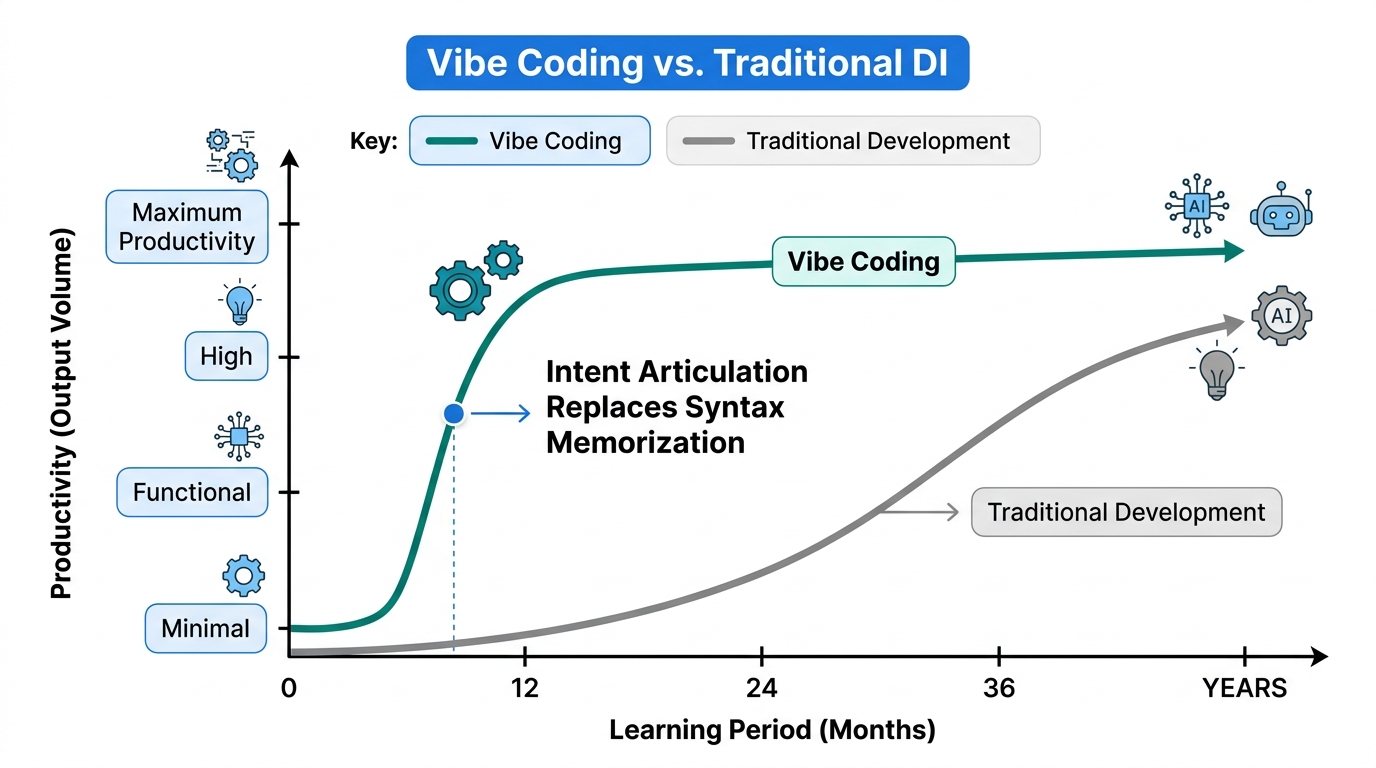
Why so fast? The answer is simple: low learning cost.
Traditional technologies required years of study to master — programming language syntax, architectural design patterns, debugging methodologies. Vibe Coding dramatically lowered this barrier by putting AI conversation at the center. Tell it what you want to build, and it generates the code. The ability to articulate your intent has become more important than the ability to write the code.
“Articulating intent” is a problem-organization skill, not a programming skill. For people who’ve spent years structuring business problems or putting customer needs into words, this is their wheelhouse. Which is exactly why it can work as a training starting point.
What “80% AI-Generated” Actually Signals
Around the same time as the GMO Pepabo news, another number caught my eye.
Japanese startup PeopleX disclosed in PR TIMES that 80% of their source code was written by AI. Tools: a combination of Cursor and v0 (a frontend-specialized AI coding tool). Dramatically reduced development costs while accelerating product delivery, they reported.
GMO Pepabo (major IT company) targeting 10,000 lines in training, PeopleX (startup) reporting 80% AI-generated code — both emerging at the same time. That’s a signal.
Large enterprise and startup, both sides moving toward AI coding simultaneously. If it were only one side, you could file it under “interesting edge case.” Two independent organizations moving in the same direction means this isn’t a specific company’s strategy. It’s a structural shift across the industry.
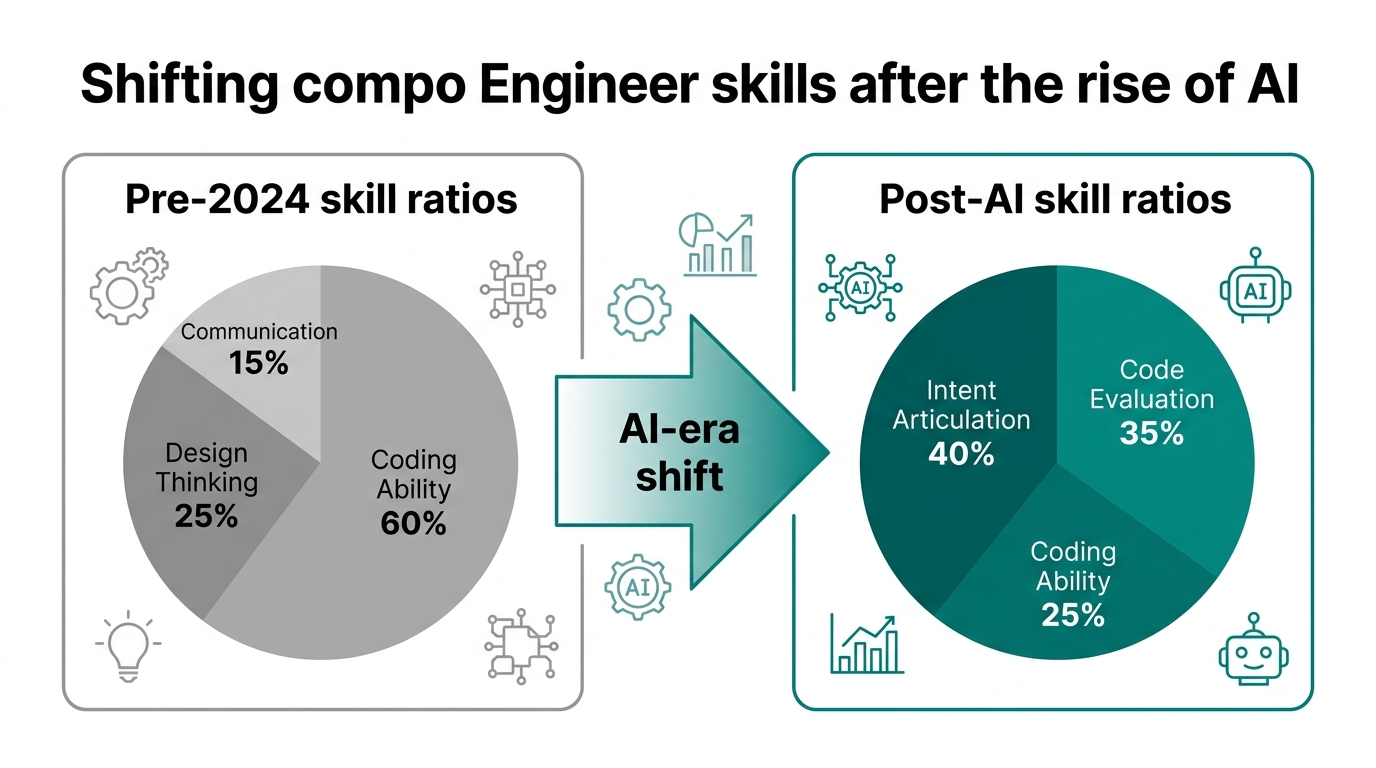
If AI is writing most of the code, what does the engineer do? Looking at GMO Pepabo’s training design, the answer is visible: understand what AI generated, verify it behaves as intended, issue correction instructions when something’s off. The skill being built from day one is “evaluation and judgment.”
Not the ability to write code, but the ability to read code, assess it, and communicate intent precisely. That’s the skill set that’s now in demand.
For a broader look at how AI coding tools reshaped the landscape for non-engineers, my earlier piece on what “not needing to write code” actually means covers the structural context in a way that’s readable even outside the developer community.
What I Feel as a Former Burned-Out Engineer
I used to work as an engineer. Web development, backend work — I’d touched both. Then on one large-scale project, I encountered engineers who were operating in a different dimension entirely. The sophistication of their architectural thinking, their approach to performance optimization, the elegance of their code. I asked myself whether I had the right to call myself an engineer.
After that, I transitioned to Customer Success and stepped away from code.
Until Vibe Coding came along, I never second-guessed that transition. Realizing I didn’t have the depth of aptitude for serious engineering felt like clarity, not defeat. I chose a role facing users and had no regrets.
When I saw the GMO Pepabo training news, something different landed.
The level of engineering output I couldn’t reach? Today’s training participants can access it through AI. Writing high-quality code at speed and volume — that capability has been democratized.
The feeling of “having a brilliant engineer inside me” showed up the first time I ran Cursor. A major company incorporating that into new-hire training means the feeling stopped being “one person’s unusual experience.” It got promoted to “what the industry expects as standard.”
One honest heads-up: when people start Vibe Coding, the most common first wall is “I don’t know what to ask the AI.” I hit it too. The assumption that “I need to give perfect instructions” slows down the first step.
In practice, you don’t need perfect instructions at the start. “I want to build something roughly like this” is enough. The AI produces a first draft, you look at it and say “change this part to this,” and you iterate from there. Running that loop is what Vibe Coding actually is. Starting with “something that works” is enough.
For the actual process of bringing Claude Code into an organization, Claude Code Enterprise Adoption: The First 30 Days is a detailed walkthrough that’s useful even for individual starters.
Check Which Phase You’re In
The fact that GMO Pepabo has adopted this as training means Vibe Coding is moving from “advanced technique” to “standard skill to acquire.” Here’s a 4-phase framework to locate your current position:
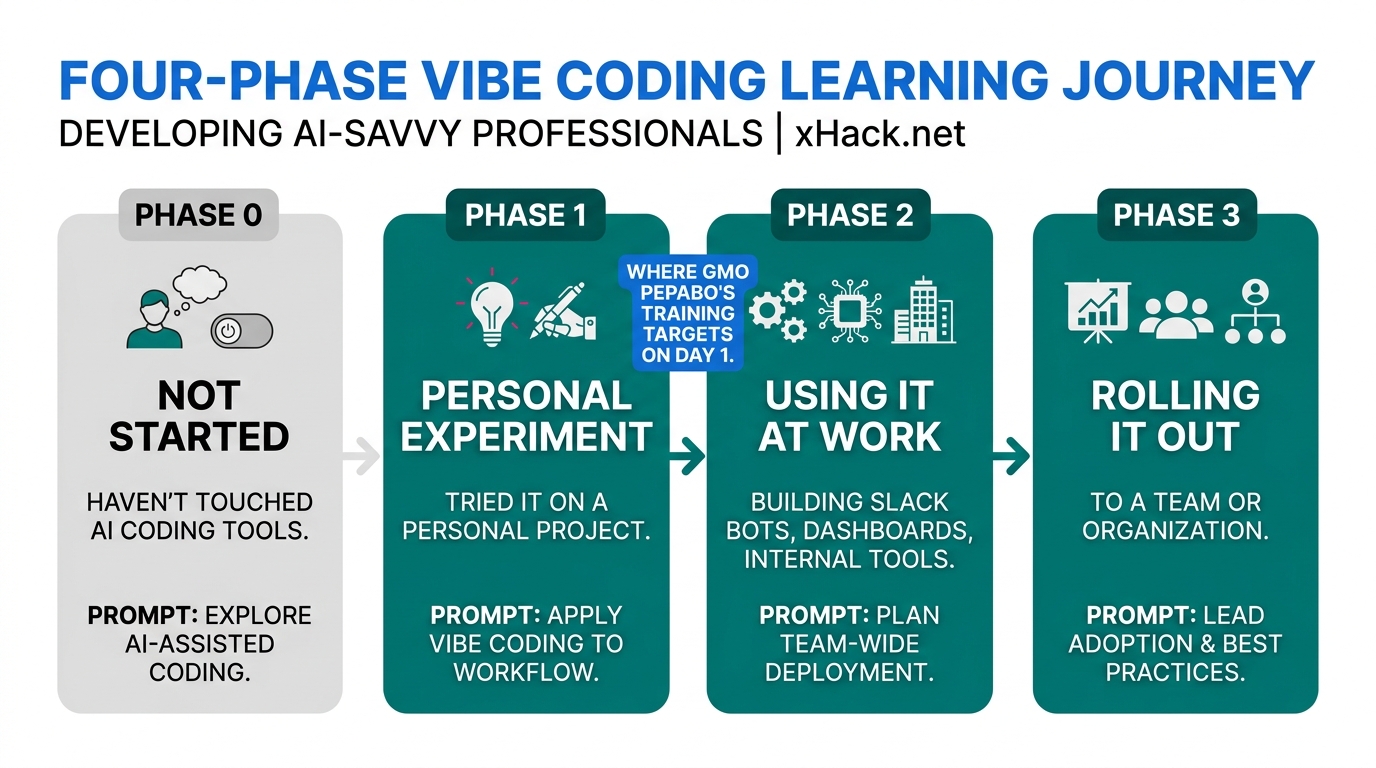
Phase 0: Haven’t tried it yet
You haven’t touched Vibe Coding or AI coding tools. You might be thinking “programming has nothing to do with me.” Today’s Vibe Coding centers on the skill of “communicating what you want to build,” not “writing code.” If you use Google Sheets for work, you can approach it with the same instincts. Start with either Cursor’s free plan or a trial of Claude Code.
Phase 1: Tried it on a personal project
You’ve built a small script or a simple webpage. You might be at “interesting, but I can’t see this in professional work.” The sticking point for people in this phase is usually the conversion problem — translating a business problem into something to build with AI.
Converting a work problem into an AI prompt requires “who does what under which conditions” — requirement definition writing. That’s not a programming skill; it’s a problem-organization skill. The “issue-structuring ability” you’ve built in Customer Success or marketing is directly applicable here.
Phase 2: Using it at work
You’ve built things like Slack bots, internal dashboards, or spreadsheet integration tools. GMO Pepabo’s training targets this phase from day one. Which means if you’re here, you’re already at the training program’s goal. The next step is sharing what you’ve built with your team.
Phase 3: Rolling it out to a team or organization
You’re running systems built through Vibe Coding across a team and measuring results. The fact that a company GMO Pepabo’s size has adopted this as training means the era of needing organizational-level adoption stories has arrived. This is the phase of scaling personal success to the organization. For the angle of embedding AI into organizational design, How I Made AI My Weapon When I Couldn’t Write Code is worth checking out.
Takeaway
GMO Pepabo incorporating Vibe Coding into new-hire training marks a phase transition — from “forward-thinking technique” to “standard to be acquired from the start.”
Vibe Coding spread among individual developers around 2024, extending the experience of “even non-coders can build products” while simultaneously carrying a reputation of “can’t work in serious dev environments” and “not suited for large organizations.” GMO Pepabo’s decision overturned that. A major domestic IT company adopted Vibe Coding as the first training experience for new engineers. This news reads like the tipping point where “personal weapon” becomes “organizational standard.” Paired with PeopleX’s “80% AI-generated” track record, the skill set demanded of engineers has clearly shifted.
Not the ability to write code, but the ability to articulate intent precisely. The ability to evaluate AI-generated code and issue correction instructions. These two capabilities are becoming the core of engineering going forward. And they’re capabilities that people who’ve spent careers organizing problems at work already hold — even without an engineering background.
What I feel as a former burned-out engineer: the reasons to start again have fallen into place.
I stepped away from code because I felt I couldn’t compete with “real engineers.” In today’s environment, the ability to converse with AI opens a path to the productivity I once thought was another dimension. That’s the kind of engineer GMO Pepabo’s training is trying to build.
The past of not being able to write code isn’t useless baggage. The experience of structuring work problems, of understanding what users feel — that becomes the foundation for giving precise instructions to AI.
Now that Vibe Coding is corporate training, the entry point has widened. Find out which phase you’re in, decide your next step. That’s enough of a start.
Sources
- ASCII.jp “目指せ1日1万行のコード生成 GMOペパボは新卒研修から『Vibe Coding』を教える” (2026)
- PR TIMES “PeopleX、ソースコードの80%をAIが書いた” (2026)
Related Articles

正直、一度エンジニアは諦めました。新卒で入った開発会社でバケモノみたいに優秀な人たちに囲まれて、「あ、私はこっち側じゃないな」って悟ったんです。その後はカスタマーサクセスに転向して10年。でもCursorとClaude Codeに出会って、全部変わりました。完璧なコードじゃなくていい。自分の仕事を自分で楽にするコードが書ければ、それでいいんですよ。週末はサウナで整いながら次に作るツールのこと考えてます。