You Don't Have to Aim for Unicorn. The Real Story of 2,000 Companies a Stanford Professor Named 'Soonicorns'
The era when 'aim for a $1B company' was the only right answer is over. From the data on 2,000+ 'Soonicorns' named by a Stanford professor, let's reverse-engineer a new goal design for solopreneurs.
What you'll learn in this article
- The key point to grasp before reading the full article
- How the issue changes practical decisions after reading
- Which follow-up article is worth opening next
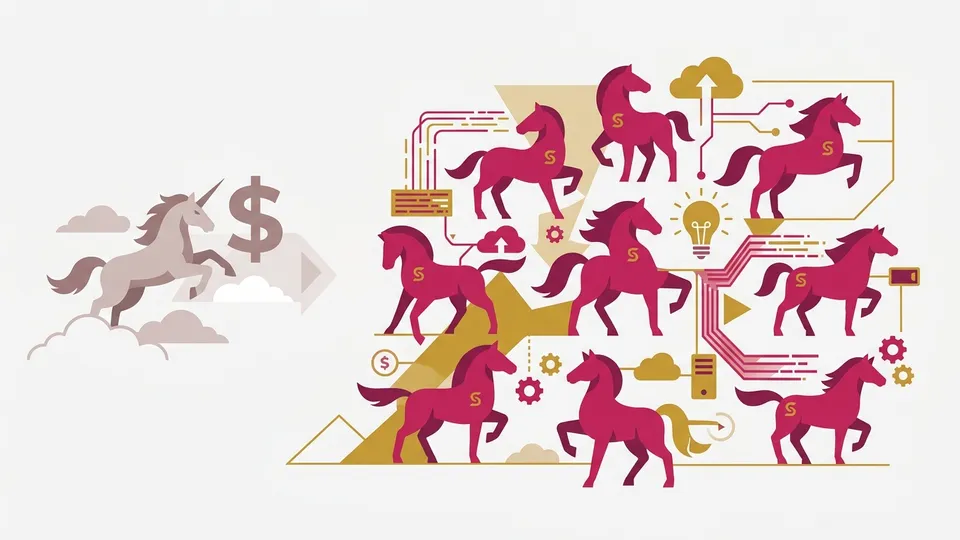
You don’t need to aim for unicorn status. The “Soonicorns” at $500M–$1B are showing us a new right answer.
Has anyone ever told you, “Let’s build a $1 billion company”? I have. In my first year after going independent, I heard it at a startup seminar. $1 billion (about ¥150 billion) on my own? It felt so disconnected from reality that, if anything, it killed my motivation.
But then, heading into 2026, the wind shifted. A Stanford professor released some fascinating data: “The companies sitting just below unicorn status have surpassed 2,000 in the US alone.” The name for them? “Soonicorns.”
The moment I learned this word, something clicked for me. “You don’t have to aim for $1 billion” finally had authoritative grounding behind it.
In my previous article, I talked about “10x founders.” The idea was that “what you stop doing” matters more than “what you make 10x bigger.” This is the sequel. “So where should you set your goal?” The answer is in Soonicorns.
The Real Story of “Soonicorns”: Why 2,000 Companies Are Jammed in the $500M–$1B Range
The “Soonicorn” (companies valued at $500M–$1B) named by a Stanford professor now numbers over 2,000 in the US alone, and “getting off just before $1B” has become a new strategy for business design.
The person who coined the term is Ilya Strebulaev, a finance professor at Stanford GSB (Stanford Graduate School of Business) and a leading authority on unicorn research.
You know that unicorns are “private companies valued at $1 billion or more.” Soonicorns are the tier below. It’s a coined word combining “soon” and “unicorn,” referring to companies in the $500M–$1B range.
It might sound like “companies that will soon become unicorns.” But Professor Strebulaev himself adds an important caveat.
“Soonicorns don’t necessarily become unicorns.” “It’s a term that captures a company’s state at a moment in time” (Entrepreneur).
This is critically important. Not “on the way to becoming a unicorn,” but “being in the $500M–$1B range as a state.” This shift in perspective hit me hard.
As of the end of 2025, US Soonicorns numbered over 2,000 (same source). The backdrop is the inflow of AI-related capital. The generative AI boom has started moving money into fields that previously had trouble attracting funding. The average time to reach unicorn status has also changed dramatically. Before 2015, it was about 6.5 years. Now it’s about 3.5 years (same source).
img: A timeline showing the change in unicorn arrival period. Before 2015 it was 6.5 years, currently 3.5 years | type: chart | style: clean infographic with two horizontal bars comparing time periods
As speed has increased, companies are massively “jammed” in the $500M–$1B zone. It spans diverse fields including fintech (financial tech), healthtech (medical tech), and clean energy. Not all of them will surpass $1B (same source).
“Failing to reach $1B” isn’t failure. “Being in the $500M–$1B range itself is one form of success.” Overseas media is covering this extensively, yet there are zero Japanese-language explainer articles. This is a mindset shift that we solopreneurs can get ahead of.
Half of Unicorns Are “All Hat, No Cattle”: What 51% Overvaluation Tells Us
Research by the same Professor Strebulaev revealed that unicorn valuations are inflated by an average of 51%, and roughly half are actually below the $1B threshold.
He recalculated the valuations of 116 unicorns using his own financial model. The results were stunning. 53 companies fell below the $1B threshold (Stanford GSB). About half were “unicorns in name only.”
Why does this happen? Let me explain the mechanism.
When VCs (venture capital, funds that invest in startups) make an investment, they use the price of the preferred shares from the latest round. They then apply that price to all outstanding shares to calculate the company’s total valuation.
But preferred shares often come with guaranteed returns at IPO (initial public offering). They also include anti-dilution provisions against down rounds (raising capital at a lower valuation than the previous round). With all this “insurance” attached, preferred shares command a higher price. Because that high price is applied to all shares, the company’s total valuation balloons.
The range of overvaluation runs from a minimum of 5% to a maximum of 188%. The average is 51%. In other words, a company called a “$1 billion unicorn” actually has a substantive value of around $500M–$600M.
img: Comparison of unicorns’ reported valuation vs. substantive value, visualizing the average 51% gap | type: chart | style: clean side-by-side bar chart with contrasting colors
Wait — isn’t $500M–$600M in the Soonicorn range?
What I want to convey is that the “$1 billion” number itself often has no substance behind it. Designing toward a $500M–$1B goal from the start would have been more honest and easier to strategize around. This research shows us just how distorted the assumptions are beneath the “just make it bigger” mindset.
What matters is designing first for “a goal that balances your life and your business.” This research proved it works at the $500M–$1B scale.
1,200 Unicorns “Can’t Move”: The 2026 Crisis
“Zombie unicorns” with strong performance but no exit number over 1,200 in the US alone. The price of growing too big has become a reality.
In March 2026, Fortune published a notable article. “Unicorns are flush with cash but can’t move.” “It’s a new startup crisis” (Fortune).
Let me break down what cap table gridlock means. A cap table is a capitalization table — a chart showing who owns how many shares.
Unicorns valued over $1B have multiple VCs on board. Each time they go through Series A, B, C, D rounds, more shareholders pile on. The problem is that each VC has different liquidation preferences. The timing of when they want returns is also all over the place. You end up with “I want to cash out in 3 years” investors sitting at the same table as “I’ll wait 10 years for an IPO” investors. There’s no way to align them.
Try to IPO, and the investors’ interests don’t match. Try to pursue M&A (mergers and acquisitions), and you can’t get unanimous consent. The result: strong performance but “no exit.” This is what’s called the “zombie unicorn” phenomenon. Over 1,200 companies in the US alone are stuck in this state.
The companies that can move, do move. 2025 unicorn M&A deals totaled 36 at $67 billion (about ¥10 trillion). A record high (Crunchbase). But 36 out of 1,200 is just 3%.
The view from the Soonicorn perspective is completely different. At the $500M–$1B stage, the shareholder structure is still simple. There are fewer investors. When you decide to “sell,” you can actually move. With AI’s evolution, even a single person can now build a $500M-scale business. We’ve entered an era where you can grow while keeping your cap table simple. Rather than growing too big to move, choosing to “get off” at the right size is, in 2026, structurally the most rational answer.
$12 Billion in 6 Months: How a Solo Developer Read the “Exit Moment” Perfectly
Maor Shlomo of Base44 pulled off an $80M (about ¥12 billion) cash sale to Wix six months after starting, as a solo developer with no VC funding. It’s the ultimate form of Soonicorn thinking.
Shlomo (31, from Israel) launched Base44 in January 2025. It’s a platform that lets you build apps using natural language.
Developing solo, he hit 250,000 users in six months. Monthly profit was $189K (about ¥28 million). The product caught the wave of “vibe coding” (a method of generating code from natural language), and his timing was perfect.
Then Wix proposed an $80M cash acquisition. Shlomo accepted (TechCrunch).
Why was it so smooth? The reason is clear. He hadn’t brought in VCs. Because his cap table was simple, the moment he decided to “sell,” his only negotiating partner was Wix. A move zombie unicorns could never make.
What if Shlomo had raised $50M from VCs? The moment he declared “I’m aiming for $1B,” the story changes. The VCs would never have allowed an $80M sale. They would have said “make it bigger, then IPO,” and he might have walked the road to zombie status.
Look at the data. Of successful company sales, 52.3% were companies with solo founders (founders who started alone) (Equidam). Meanwhile, 75% of VC-backed startups end in failure (Embroker). What’s more, the share of solo founders among new US businesses expanded from 22% in 2015 to 38% in 2024 (Equidam). “Starting alone” is no longer a minority position.
When I went independent doing SNS marketing, I didn’t take outside capital. I chose “freedom” over “speed.” Seeing the Base44 case, I’m even more convinced: the lightness of being able to get off whenever you want is the greatest weapon of a one-person company.
3 Steps to Bring Soonicorn Thinking Into “Your Business”
The core of Soonicorn thinking is “designing your goal by ‘appropriateness,’ not ‘size,’” and it’s a mindset solopreneurs earning ¥1 million a month can use right now.
“$500M–$1B has nothing to do with me.” Did you think that? Hold on.
Let me share the data. There are 29.8 million solopreneurs (people running businesses on their own) in the US. They generate $1.7 trillion (about ¥255 trillion) in economic activity. Independent workers earning over $100K (about ¥15 million) annually number 5.6 million, up 19% year over year (MBO Partners). And 49% of independent workers are already using AI tools (same source).
img: An overall picture of the solopreneur economy. A structural diagram showing how 29.8 million people support a $1.7 trillion economy | type: infographic | style: clean visualization with key stats highlighted
Almost none of these 29.8 million people are taking VC money to aim for $1B. They’re growing steadily at a size that fits them, using technology to expand their one-person businesses. That’s Soonicorn thinking itself.
Step 1: Decide upfront “at what price you’ll get off”
The order of goal design matters. Before revenue or follower counts, decide on “the landing point that satisfies you.”
Do you want to stabilize at ¥1 million monthly income? Going corporate at ¥50 million annual revenue is also legitimate. So is the path of selling the business in 5 years and moving on to what’s next. All of these are right answers. You decide. What matters is the order: “decide the goal first” rather than “start running and figure it out later.”
In my case, when I started my SNS marketing consulting, I decided “I’ll cap clients at 5 per month.” I could have taken more. But going past 5 would eat into the time I have to create my own content. That defeats the purpose, so I deliberately set a ceiling.
Base44’s Shlomo was the same. Not $1B but $80M — that’s where he “got off.” Cash in hand, off to the next challenge. Whether you can make that judgment is the heart of Soonicorn thinking.
Step 2: Keep your shareholder structure simple
The more outside capital you take, the more complex decision-making becomes. The more co-founders and investors you add, the closer you get to “I can’t sell when I want to sell.” Maintaining a state where you can decide alone — this is your greatest weapon.
Concretely: don’t give away equity (shares) when a loan would do. Build partnerships as equal contract relationships. “Don’t give away ownership” is the iron rule.
Step 3: Always be in a “sellable state”
Base44 didn’t sell in 6 months because they “tried to sell.” They sold because they “were in a sellable state.” They had profits, simple structure, and users.
The same principle works for your business. Start today by asking, “If I had to sell tomorrow, what would be missing?” Is your profit flow visible? Is your customer list organized? Are there any systems that run without you? Even if you can’t say “yes” to all three, that’s fine. Just engaging with these questions raises the quality of your business.
“Keep running while staying ready to get off at any moment.” It might sound contradictory, but this is the practical version of Soonicorn thinking.
Conclusion
What the “Soonicorn” concept taught us is that “aim for $1B” is not the only right answer.
Half of unicorns are overvalued. 1,200 companies are stuck in cap table gridlock and can’t move. Meanwhile, there’s someone who sold a company they built alone for ¥12 billion in cash.
What we solopreneurs need is not a vision for “how big to make it.” It’s a blueprint for “where to get off.” Get off at the right size, at the right time. That’s the 2026 winning pattern, in my view.
Let me recap the three steps. “Decide upfront at what price you’ll get off.” “Keep your shareholder structure simple.” “Always be in a sellable state.” Just being conscious of these three will completely transform the blueprint of your business. Instead of “I’ll think about it once I’ve grown big someday,” you can start moving from today by working backward.
To everyone who’s been feeling the pressure of building a company alone, let me say just one thing. “$1B isn’t necessary” is not running away. If that’s “the appropriate goal” for you, then that’s the strongest possible target. Your goal is yours to decide. Not some number imprinted on you at someone’s seminar.
In the previous article, I dug into “what to stop doing.” This time, “where to get off.” Next, I want to think together about “what to do after getting off.”
The winner is the one who acts. But you also decide your own exit moment. That’s the one thing you can’t ever let anyone else take from you.

女性だからこそ、AIを使いこなさなきゃって思ってる。仕事も、副業も、推し活も、旅行も、全部やりたい。人生一度きりなのに時間は足りないじゃん?だからAIに任せられることは全部任せる。浮いた時間で本当にやりたいことをやる。それがあたしのスタイル。ここにはあたしが実際にやったことをまとめてるだけ。誰かのためになったらいいなって思って書いてるよ。