You Know 'Habits Matter.' The Real Question Is Which Ones, in What Order. I Turned JPMorgan × Mark Cuban's Answers Into a Blueprint
JPMorgan asked 111 billionaires for their top 7 success habits, and Mark Cuban says 'just one is enough.' I unpack why both are right, and turn it into a habit blueprint solo founders can start using this week.
What you'll learn in this article
- The key point to grasp before reading the full article
- How the issue changes practical decisions after reading
- Which follow-up article is worth opening next
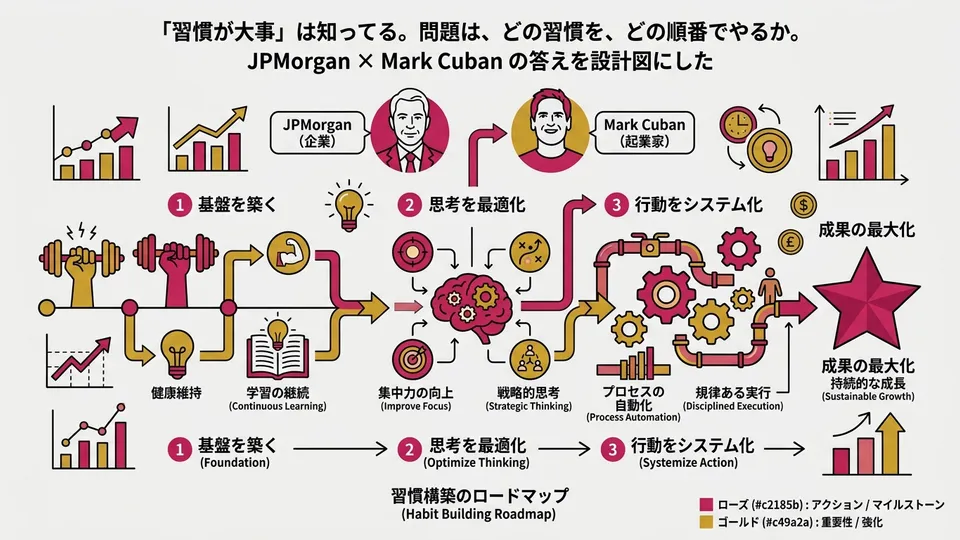

You’ve Googled “habits of successful people” before, haven’t you?
I have too. Before I went independent, back when I couldn’t speak up at the office. Every night I’d binge-read articles on “billionaire morning routines” and “the rituals of the ultra-wealthy.” Just reading them made me feel stronger, so I’d set my alarm for 5 AM, and crash out by day three. I’ve lost count of how many times I repeated that cycle.
Then something interesting dropped recently.
JPMorgan published findings from a survey of 111 of their own billionaire clients — people with combined assets exceeding $500B (about ¥75 trillion). It’s a list of the habits these people credit for their success. And in the same week, Mark Cuban told Inc.com that “you only need one habit to succeed.”
Seven vs. one. Sounds contradictory, right?
In this article, I’m going to untangle that “contradiction.” And by the time you finish reading, you’ll have one concrete action to start this week. I’ll organize everything using what I personally call the “habit blueprint” framework, so stick with me to the end.
JPMorgan Asked Billionaires Worth $500B Combined. The ‘Blueprint’ for Success Was Seven Habits
The impact of this study comes from who they asked. Not self-help authors. 111 people who actually built ¥75 trillion in combined wealth.
JPMorgan’s wealth management division released the report (Fortune). Here are the top 7 habits billionaires credit as contributing to their success:
- Reading
- Exercise
- Consistency
- Waking up early
- Prioritizing tasks
- Setting goals
- Deep thinking time
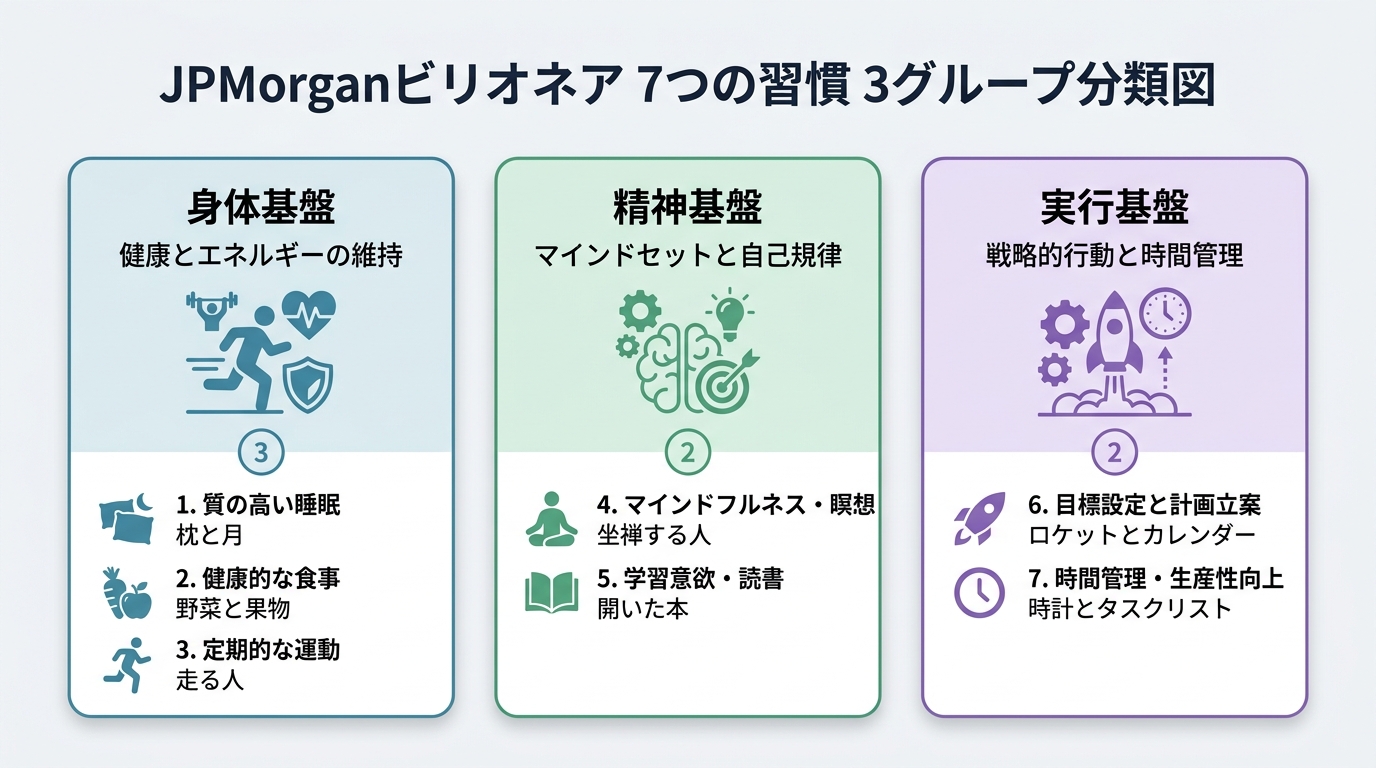
Surprised? Honestly, I was a little let down. I half-expected “AI utilization” or “cutting-edge investment strategies.” Instead, it’s reading, exercise, and waking up early.
But there’s a trap here.
If you stop at “huh, okay” and move on, you’re making the same mistake I made before going independent. The real story is the gap between “knowing” and “doing.”
The line that hit me hardest in the report came from an anonymous billionaire:
“The currency of life is time, not money. Just as you carefully consider how to spend a dollar, you should think just as carefully about how to spend an hour.”
That single sentence reveals what all 7 habits have in common. Every single one is about how to spend time. Reading, exercise, waking up early — they’re all about time allocation design. Rich people stay rich not because they’re good at managing money, but because they’re good at managing time.
There’s another interesting data point. The same survey asked about the top qualities needed for leadership. The answers: integrity, vision, and empathy. No “skills” here either. It’s all about who you are.
The AI usage data is interesting too. According to coverage of the JPMorgan report (Entrepreneur), 79% of respondents use AI in their personal lives, and 69% use it in business. So even billionaires are using AI — but AI didn’t make the “success habits” list. It’s a tool. The foundation is still those 7 habits.
Let me pause here and look at the 7 habits from the angle of “why these seven?”
What strikes me looking at the list is that not one of them is new. Not a single one.
Reading is a habit centuries old. Exercise predates agriculture itself. Same with waking up early. In 2026, when AI dominates everything, billionaires say their secret is “reading, exercise, early rising.” Why?
Here’s my read: the more digital things evolve, the more “analog foundations” become the differentiator. No matter how smart AI gets, the brain that generates ideas, the body that executes them, and the willpower to set priorities still belong to humans. The essence of the 7 habits is building those three foundations.
Looking more closely, the 7 split into 3 groups:
Physical foundation: Exercise, Waking up early Getting the body right raises the quality of thinking. “Waking up early” isn’t really about when you wake up — it’s about whether you’ve designed quiet time into your day. The billionaire’s “early rising” isn’t a brag, it’s a strategy.
Mental foundation: Reading, Deep thinking time Input and reflection as a pair. Reading is putting raw material in. Deep thinking time is processing that material. Only when both are present does good output emerge. The gap between people who only consume information and people who read and reflect widens with time.
Execution foundation: Prioritizing tasks, Setting goals, Consistency The foundation of design and continuation. Decide what to do (goals), decide what to do first (priorities), and do what you decided to do (consistency). These three form one set.
Viewed through these three groups, the seven habits start to feel “just right” rather than “too many.” It’s the minimal set needed to build all three pillars — body, mind, and execution.
What I took from this data is that there isn’t a single “new discovery.” Reading matters. Exercise is essential. Waking up early is a classic. We all know this.
The real problem is the structure of “knowing but not doing.”
Mark Cuban Said ‘One Is Enough’
Cuban, who built $5.2B (about ¥780 billion) in wealth, says the answer is one habit, not seven. “Invest in yourself.”
In an Inc.com interview (Inc.com), Cuban put it simply:
“The best investment I ever made in life was investing in myself.”
He explains it like this: with effort, you can learn almost anything. He taught himself technology and programming on his own — it took time, but he did it. That investment has paid dividends in every aspect of his life ever since.
What’s interesting is that Warren Buffett says the exact same thing. In a separate Inc.com piece (Inc.com), Buffett said “investing in yourself is something nobody can tax.”
Two billionaires independently arrived at the same conclusion. I don’t think that’s a coincidence.
Let me dig into what Cuban means by “self-investment.”
What he taught himself wasn’t just how to use a computer. In the early 1990s, before the internet was mainstream, he learned how the underlying technology actually worked, from scratch. That knowledge led to founding the IT company MicroSolutions, which evolved into Broadcast.com — the company Yahoo bought for about $5.7B in 1999.
It’s not “investing in tools.” It’s “investing in understanding.” That’s the core.
Let me share my own story for a sec.
Before I went independent in SNS marketing, what I did wasn’t “read 30 books on SNS marketing” or “wake up at 5 AM.” I managed a client’s SNS account for free. I learned in the field. Results came in, and then referrals started spreading from there.
Looking back, that was my “self-investment.” I didn’t spend money. I put all my time and effort into learning. What Cuban calls “self-investment” isn’t paying for expensive seminars. It’s using your own time to stack hands-on experience.
There’s a reason “self-investment” carries special weight for solo founders. If you’re an employee, there’s training. There’s feedback from your boss. You can ride the company’s learning system. But when you’re alone, you have to build the learning system yourself.
The people who can design how to learn in an environment where no one teaches them — those are the ones who win in the long run. I think Cuban and Buffett arrived at the same conclusion because both of them had built their own “system for learning on their own.”
The first thing I ask my clients is: “How many hours did you spend learning about your business this month?” Most answer, “I’ve been too busy with work to learn.” Cuban would say: people who don’t have time to learn are people who see learning as a cost. Once you see it as an investment, your time priorities shift.
Seven or One? The Answer Is ‘Choose by Structure’
Both JPMorgan’s seven and Cuban’s one are correct. The only difference is what layer they’re looking at.
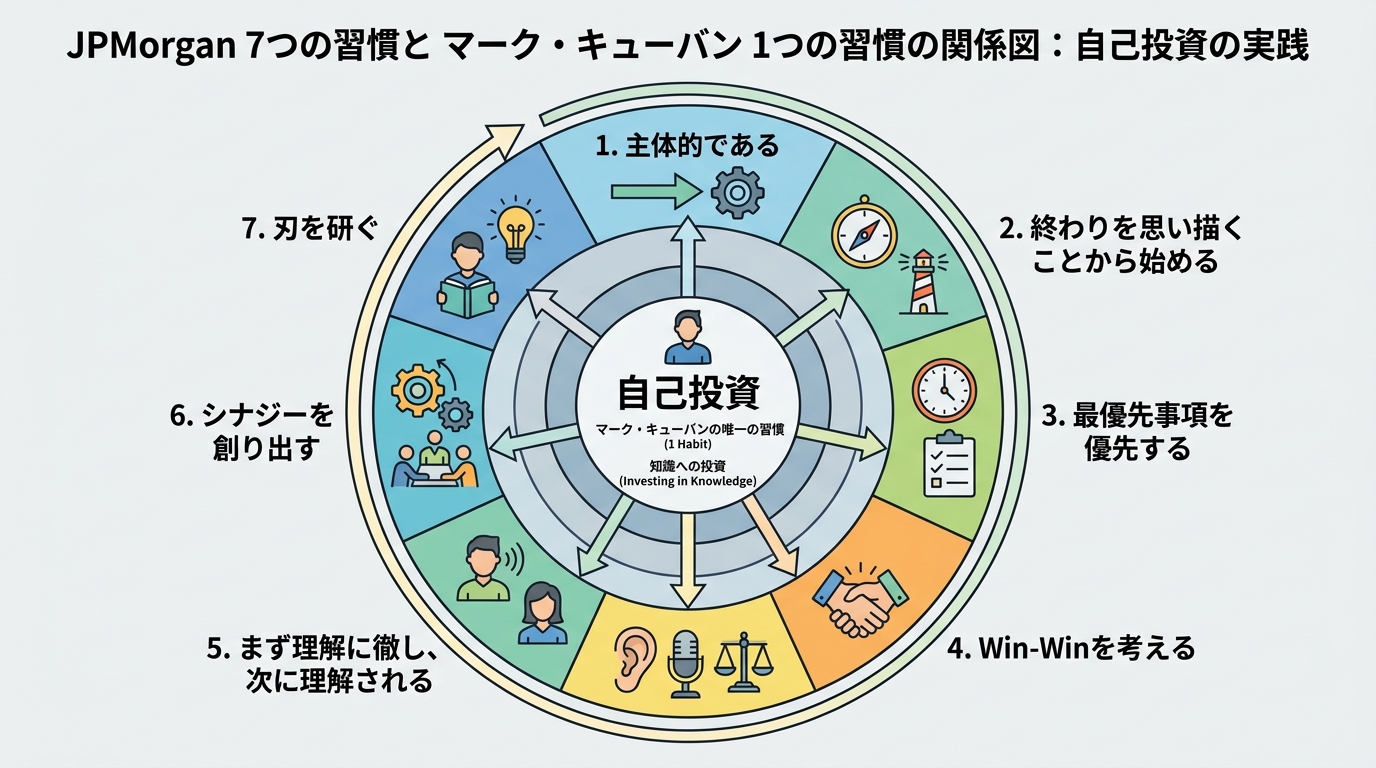
Here’s how I organize it:
Cuban’s “self-investment” is the principle. JPMorgan’s 7 are the concrete implementation. They’re saying the same thing at different resolutions.
Reading is the knowledge-input side of “self-investment.” Exercise is the physical-foundation side. Goal-setting is the direction-setting side. Every one of them is the act of growing your asset called “yourself.”
When you frame this as a “habit blueprint,” it splits into three layers:
Layer 1: Foundation (daily)
- Reading (30 minutes a day is enough)
- Exercise (a walk or yoga is fine)
- Waking up early (not “earlier” — but “at a consistent time”)
Layer 2: Design (weekly)
- Reviewing your goals
- Reorganizing task priorities
- Setting aside deep thinking time (30 minutes is enough)
Layer 3: Continuation (ongoing awareness)
- Consistency (don’t change what you’ve decided to do)
Looking at it as a 3-layer structure, the pressure of “I have to do everything” disappears. You only do 3 things daily. 3 things weekly. 1 thing to stay aware of. Not impossible at all, right?
The structure also tells you where to start. The answer: “Layer 1.”
The key here is not to start all 7 at once. What I learned in my early days going independent is how scary the “try to do everything, end up half-doing everything” pattern is. Build up one at a time, from the foundation. That’s how to use the “blueprint.”
One of my clients, a guy in his 30s preparing to go independent while still working his day job, started by trying to do “5 AM wake-up, 30-minute reading, weight training, meditation, journaling” all at once. He burned out in a week. When I narrowed him down to “just 15 minutes of reading,” he kept it up for 3 months. From there, exercise added itself naturally, and 6 months later he had 5 habits locked in.
“Just one” isn’t slacking. It’s the shortest path to habit formation.
Once Layer 1 is stable, move to Layer 2. Once Layer 2 is locked in, Layer 3 becomes something you “just notice you’re doing.” This order matters, and reversing it makes everything collapse. People who say “I’m focusing on consistency (Layer 3)” often have foundation habits (Layer 1) that are vague at best.
Self-investment works the same way. First, decide on the principle “I will invest in myself” (Cuban’s answer), then pick one specific method from the 7 (JPMorgan’s answer). Separating principle from implementation gets you out of the “I don’t know what to do” state.
Turning This Into ‘What to Do This Week’ — A Solo Founder Worksheet
Don’t let billionaire habits end at “I know about them.” This section’s goal is converting them into action for this week.
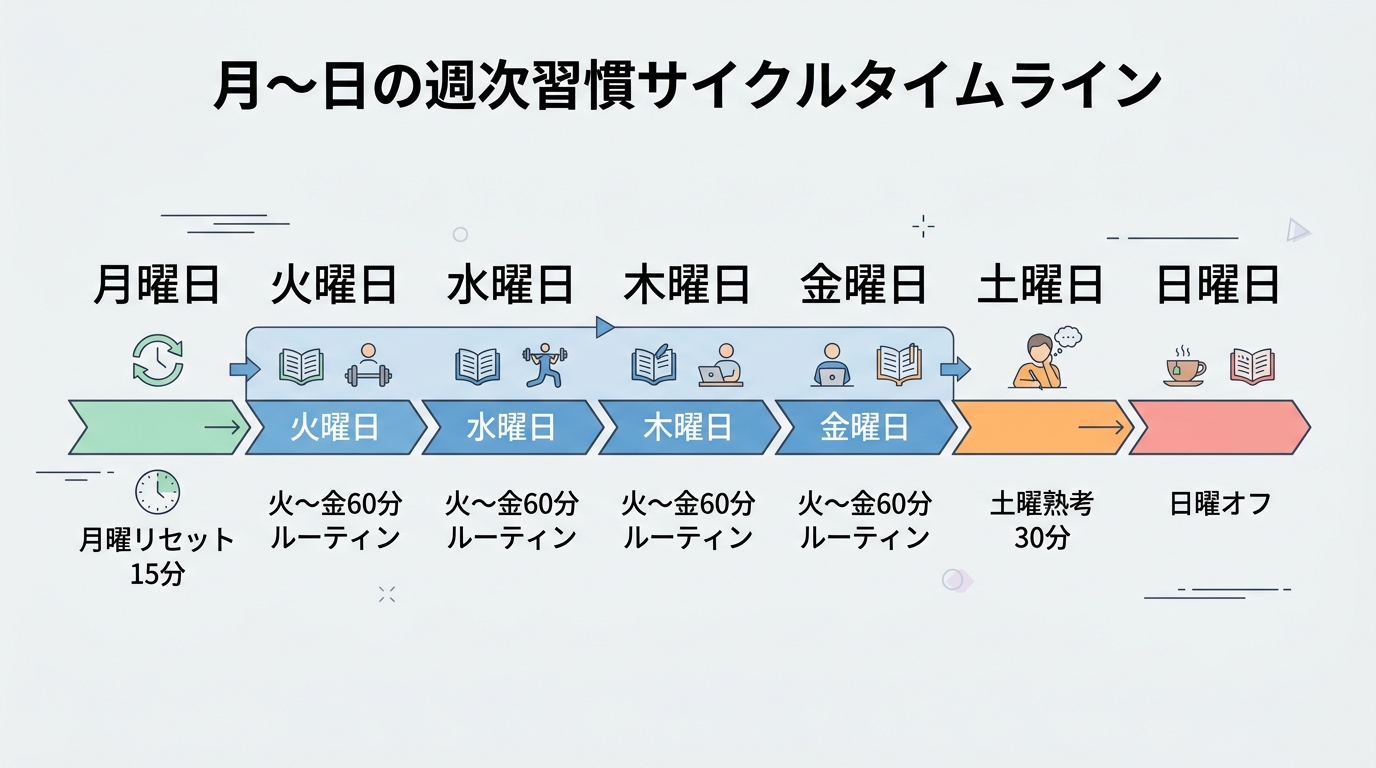
Here’s the worksheet I actually hand to my clients, simplified down. It’s about turning this into “what to do this week” for solo founders and side-hustlers.
Monday: Weekly Reset (15 minutes)
- Write down 3 things you accomplished last week
- Decide on 3 priority tasks for this week (only 3)
- Decide on 1 thing you will not do
The “thing you won’t do” is the point. The essence of billionaire-style prioritization isn’t “what to do,” but “what not to do.”
There’s a trap unique to solo founders here. As an employee, your boss narrows down your tasks for you. But alone, everything looks like “your job.” SNS, client work, accounting, self-learning. Everything looks important. That’s why actively deciding “what not to do” matters so much for solo founders.
Those 15 Monday minutes aren’t “vibes” time — they’re “design” time. The weeks I do this carefully feel completely different by Friday.
Tuesday–Friday: Daily Routine (60 minutes total)
- Morning: 15 min reading (book, newsletter, podcast — any of them)
- Midday: 30 min exercise (commuting on foot, walking at lunch — fine)
- Evening: 15 min reflection (jot down one thing you learned today)
This 60 minutes isn’t “newly carved out time” — it’s designed as redistributing time you already have. Read during your commute, walk at lunch, jot a note before bed. No new time is generated. You’re just changing how existing time is spent.
The evening 15-minute reflection often gets underrated, but think of it as a smaller version of JPMorgan’s “deep thinking time.” One line a day is enough. Writing down “I learned this today” makes the learning more likely to show up in tomorrow’s actions.
I write one line in my phone’s notes app every night. Things like “the hook in the first 3 seconds of the SNS reel was weak” or “Monday posts drove the most follower growth for the client this month.” It’s a private note, so anything goes. Build it up, and you’ve got your own personal knowledge base.
Saturday: Deep Thinking Time (30 minutes)
- Leave your phone in another room
- Write freely about “where you want to be in 3 months”
- Read it back and tentatively decide next week’s priorities
The “deep thinking time” that ranked 7th in JPMorgan’s survey. Surprisingly few people actually do this. My take is that it’s not that we’re too busy to think — it’s that we don’t design time to think, so we stay busy.
The 30 Saturday minutes pair with the Monday reset. Monday decides “what to do this week.” Saturday decides “what to do next week.” Once this cycle starts spinning, you shift from “vaguely busy” to “moving with intent.”
Sunday: Off
Do nothing. This is part of the design too. Billionaire “consistency” doesn’t mean “running at full speed every day.” It only works as a set with “rest consistently on rest days.”
Solo founders are especially weak here. My first year independent, I worked Sundays too. Result: nearly burned out at 6 months. After I built one day off per week into my design — not as “slacking off” but as “design” — my weekday performance changed visibly.
Stick with this for 3 weeks, and the cycle becomes “default.” Conversely, 3 weeks is the first wall. Week 1, you can do it. Week 2, it gets a little annoying. Week 3, you start thinking “maybe I’ll quit.” Cross that, and it becomes a habit. From what I’ve seen with my clients, the 3-week rule is pretty reliable.
In a previous article I introduced “a $75/month AI stack,” but just installing tools doesn’t raise productivity. The design of the “you” using the tools comes first. This worksheet is meant to fill in that “design of yourself” piece.
Which Type Are You? Four Categories Decide Today’s Action
The reason people can’t start a habit varies by person. Knowing your type is the first step.
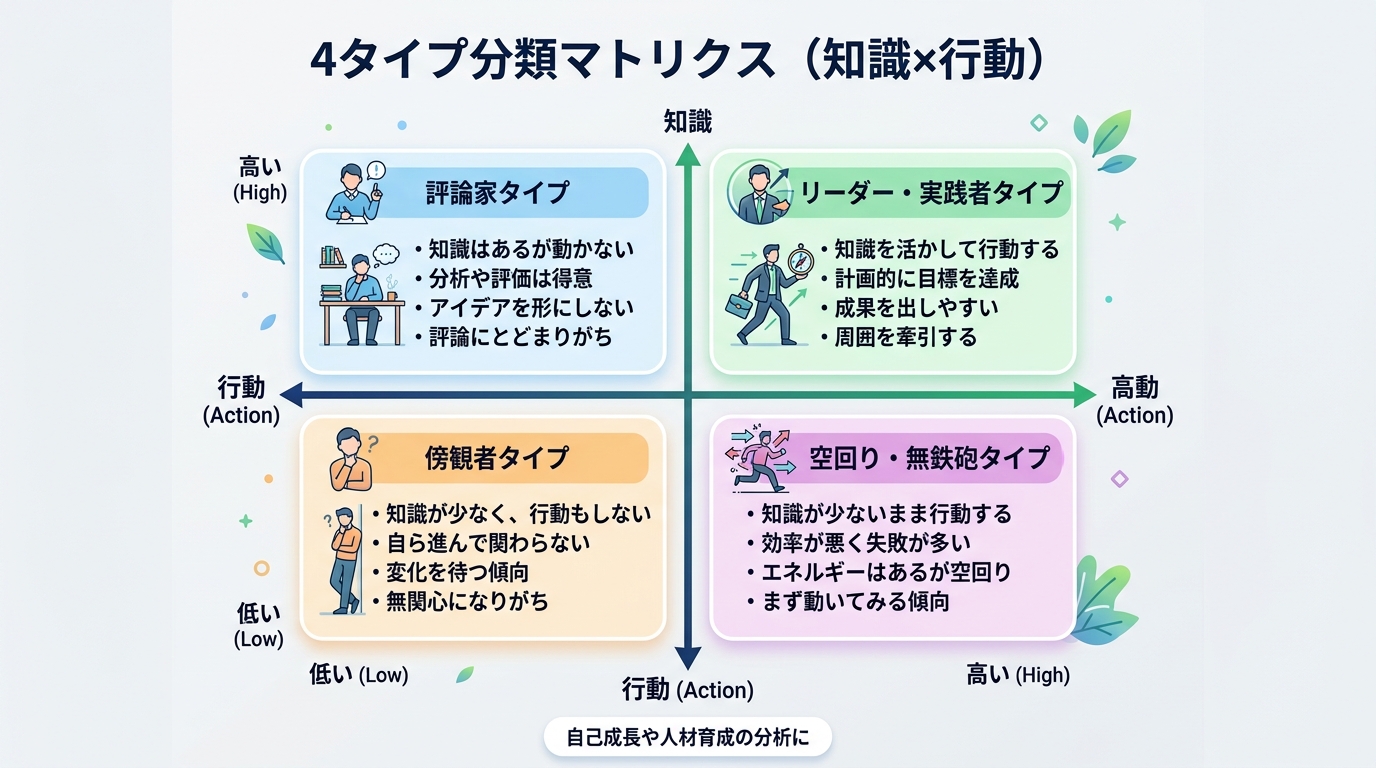
You can figure out your type with 2 questions.
Q1: In the past year, have you read 5 or more books or articles about successful people’s habits? Q2: Out of those, has any habit lasted 3+ months for you?
| Q2: Lasting | Q2: Not lasting | |
|---|---|---|
| Q1: 5 or more read | Type A | Type B |
| Q1: Fewer than 5 | Type C | Type D |
Type A “Practitioner” (Read × Lasting)
You’re already running. All this type needs is to add “deep thinking time.” JPMorgan’s 7th habit. Carve out just 30 minutes a week to check your direction while still running.
Today’s action: Block 30 minutes on next Saturday’s calendar for “thinking time.”
The trap for Type A is “inertia.” Once habits are locked in, it’s easy to forget what they’re for. That weekly 30-minute deep-thinking session becomes your compass for checking whether your direction is right.
Type B “Information Collector” (Read × Not lasting)
The most common type. I was here before I went independent. You have the knowledge. The execution doesn’t catch up. The problem for this type is “trying to do everything.” Remember Cuban’s “one is enough.”
Today’s action: Pick just one from the 7. My recommendation: “15 minutes of reading.” The lowest barrier of all.
What Type B falls into is “I’ll do it when a better method comes along” procrastination. Information gathering becomes an excuse for delay rather than preparation. What I want you to notice: any habit starts growing the moment you start it. Don’t wait for the perfect environment — do it in your current environment. That’s the only migration path from Type B to Type A.
Type C “Intuitive Player” (Haven’t read much × Lasting)
You might actually be the strongest. The type whose body moves before theory. What you’re missing is just “putting it into words.” Understanding why you’re succeeding raises reproducibility.
Today’s action: Pick one habit you’ve kept up, and post or write it on SNS or in your notes. Try to put “why it’s lasted” into one line.
Verbalization has two effects. One: you can consciously deploy your own success patterns. Two: when a slump hits, you can return to “the original pattern.” People who haven’t verbalized just quietly stop when things feel off. People who have can review “why it was working” and rebuild.
Type D “Just Getting Started” (Haven’t read much × Not lasting)
This is your starting point. Nothing to be embarrassed about. More than half my clients start here. What this type needs is not “choosing the right habit” but “the experience of trying one.”
Today’s action: Tomorrow morning, wake up 15 minutes earlier and read something you like. It doesn’t have to be a book. A news article, a business SNS account — fine. The fact that you “designed reading time” becomes your first self-investment.
There’s one thing I want to tell Type D. Not “it doesn’t have to be perfect” — but “not being perfect is correct.” For your first habit, 30% is plenty. The people who keep stacking 30% become the people who can do 70% a year later. The people who aim for 100% from day one are back at 0% in 3 days. I’ve seen this enough times to know.
One important thing to keep in mind when using this type diagnostic:
Types aren’t fixed. They migrate.
From D to C. From B to A. The speed of migration doesn’t matter. What matters is noticing that you’re migrating. I have a client who took 2 years to move from Type D to Type A. That pace is not “slow” at all. The fact that they didn’t give up for 2 years is everything.
As I wrote in my article on “10x founders”, the difference between people who can move fast and people who can’t isn’t talent. It’s a difference in “design.” I think habits are the same.
Summary
What JPMorgan’s research gave us is a list of “what to do.” What Mark Cuban gave us is the principle of “why to do it.” Combining those two is the “habit blueprint.”
Let me organize this one more time.
JPMorgan gave us “the 7 habits that build the 3 foundations of body, mind, and execution.” Mark Cuban gave us the principle that “self-investment is the root of everything.” Multiplying these two together is the “habit blueprint.”
Design in 3 layers, start with 1. Daily, you only do the 3 foundation habits (reading, exercise, waking up early). Weekly, you do the 3 design habits (goal-setting, priorities, deep thinking time). What you keep being aware of is the one called consistency. Seven in total. Looks complex, but the structure is actually simple.
There’s a reason I call it a “blueprint.” Blueprints aren’t meant to be finished in one shot. They’re meant to be revised in the field. Your “habit blueprint” doesn’t have to be perfect from the start either. You rewrite it to fit you as you use it.
You don’t need to copy billionaires’ habits verbatim. Just pick one that fits your current life, and start it this week.
The reason I was able to go independent in SNS marketing wasn’t because I had some flashy strategy. I just kept up the habit of spending 30 minutes a day studying my client’s account for 6 months. That was the start of everything.
“The one who does it wins” is my go-to phrase, but more precisely it’s: “design it, then do it — that’s how you win.”
If you, after reading this article today, start just one new action tomorrow morning, then writing this was worth it.
If the 4-type diagnostic told you which type you are, please share on SNS — “I was Type B” or “starting from Type D.” I was Type B before going independent too, so let’s build the blueprint together.
I also touch on habits in “Five Tools Are Enough”. It connects to the idea that with AI tools and habits alike, “focusing on fewer choices” matters more than “too many choices.” Worth a read alongside this one.

女性だからこそ、AIを使いこなさなきゃって思ってる。仕事も、副業も、推し活も、旅行も、全部やりたい。人生一度きりなのに時間は足りないじゃん?だからAIに任せられることは全部任せる。浮いた時間で本当にやりたいことをやる。それがあたしのスタイル。ここにはあたしが実際にやったことをまとめてるだけ。誰かのためになったらいいなって思って書いてるよ。