Record Numbers Are 'Quitting Before AI Takes Their Jobs.' I Calculated the Full Cost of 'It's Too Early'
The wave of preemptive entrepreneurship reported by CNBC. Cross-referencing 1.56 million business applications with Duke University's CFO survey to visualize the cost of staying at your company
What you'll learn in this article
- The key point to grasp before reading the full article
- How the issue changes practical decisions after reading
- Which follow-up article is worth opening next

Not “Taken Away” but “Quit First.” The New Form of Entrepreneurship CNBC Tracked
The headline of an article from CNBC (March 27, 2026) hit me hard. Translated, it reads: “Americans quitting before AI takes their jobs and starting their own businesses.” The keyword is that single word, “before.” Not “had it taken” but “quit on their own, before it was taken.” The gap between passive and active is bigger than you’d imagine.
One of the people CNBC interviewed is Travis Di Lombardi-Spicer. Former audio producer. After being passed over for a raise in January 2025, he started thinking: “This job is on the side that’s going to be replaced by AI.” He invested $40,000 (about 6 million yen) and launched Spotbookr, an AI ad analytics service. He told CNBC: “I just wanted control in my own hands.”
Another, Michelle Yeung, is a software engineer. She watched AI’s evolution every day on the development front lines. That experience led to the judgment: “While I’m still on the building side, I should have my own business.” She opened a cafe called Matcha House in New York. It’s a pivot from tech to food service, but it’s a choice that places value on the “in-person experience” that AI struggles to replace.
What these two have in common is that they quit not “because they had no choice” but “after doing the math.” Not fear, but analysis. Not passive, but selective. I want to call this “preemptive entrepreneurship.”
There’s a structure unique to the AI era behind why “preemptive entrepreneurship” works. Traditionally, the walls to quitting your job and starting a business were costs like “hiring people,” “renting an office,” and “outsourcing systems.” AI has changed all of that. One person can mass-produce content. Customer support can be automated. Accounting can be handed off to AI. In other words, the option to “quit first” has become far more realistic than before.
In yesterday’s article I compared preemptive entrepreneurship patterns across three countries. This time, I’m going to dig deeper into the American scene that CNBC explored.
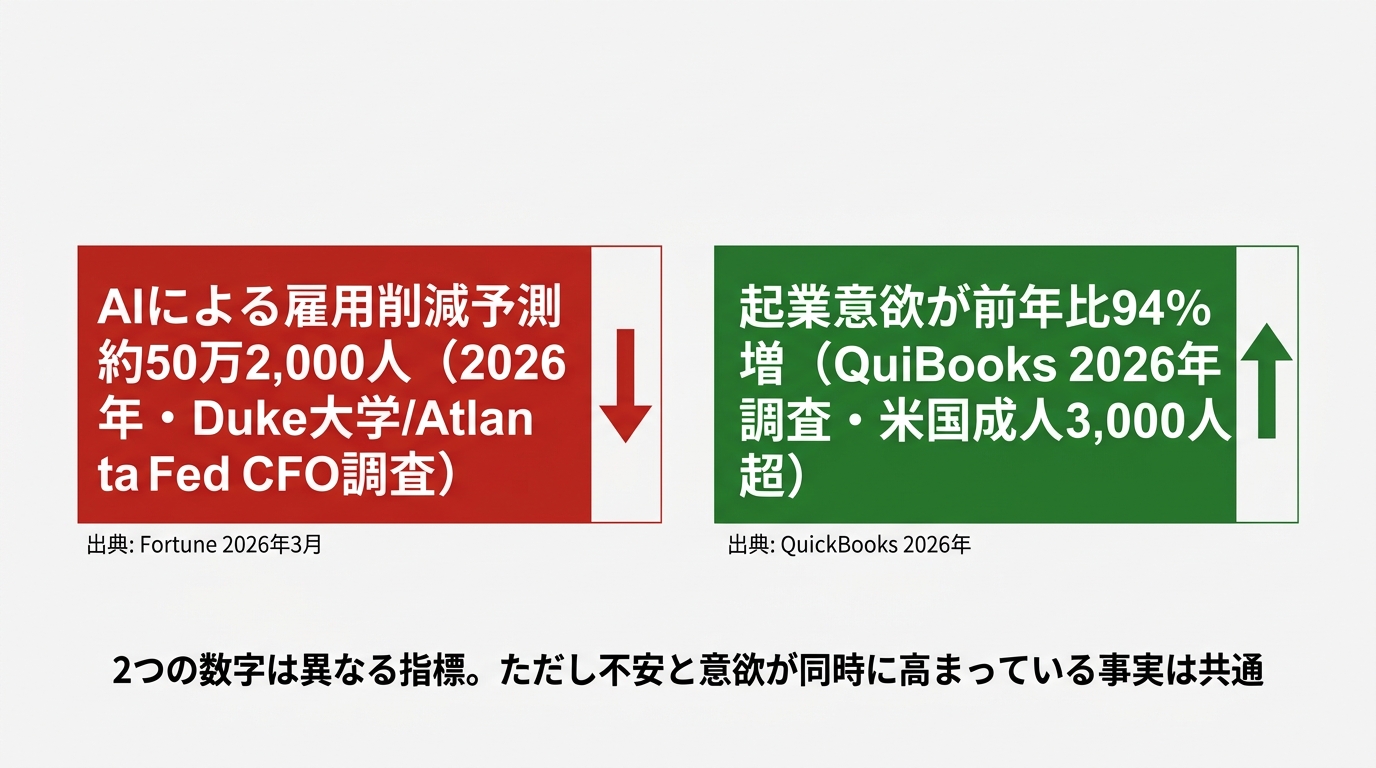
In an Era Where AI Predicts Cuts, Entrepreneurial Intent Hit an All-Time High
Let me line up two numbers.
Duke University and the Federal Reserve Bank of Atlanta surveyed 750 CFOs (Chief Financial Officers). Fortune reported it on March 24, 2026. The forecast is that approximately 502,000 jobs will be cut due to AI in 2026. That’s a 9x increase from approximately 55,000 in 2025 (per Challenger, Gray & Christmas, an employment research firm).
That said, study co-author Professor John Graham flatly states this is “not an apocalyptic scenario.” Because it’s only 0.4% of America’s total 125 million jobs. News exaggerates. Numbers are honest.
Meanwhile, what’s happening with entrepreneurial intent? Take a look at QuickBooks (Intuit)‘s 2026 entrepreneurship survey. In a survey of over 3,000 American adults, 33% answered that they “plan to start a new business or side hustle within the next 12 months.” That’s a 94% year-over-year surge.
The 94% increase isn’t a “want to” number. It’s a “have plans to” number. Not intent, but plans, doubled. That’s what matters here.
For reference, the U.S. Census Bureau’s Business Formation Statistics recorded 1.56 million EIN (Employer Identification Number) applications during the three months from November 2025 to January 2026. It’s data CNBC also cites, and it’s the highest level since 2004. However, since a Census system outage during the same period may have affected the statistics, directly tying this number to AI-driven entrepreneurship growth isn’t accurate. Please take it as the fact that “there were a lot of applications.”
The forecast of cuts and the surge in entrepreneurial intent are moving simultaneously. Behind the news of “AI is going to take our jobs,” the waterline of entrepreneurial intent is quietly rising. This is the structure underlying preemptive entrepreneurship.
The same QuickBooks survey also reveals the challenges. The results show that many respondents cited “financial anxiety” and “lack of business knowledge” as the biggest hurdles blocking them from starting a business. In other words, there’s a massive number of people in the state of “I have the motivation. I’m just scared.” Breaking down what that “scared” actually is, in numbers, is the next section.
”It’s Too Early” Is the Most Expensive Option. I Laid Out All the Switching Costs
“Okay, I get the preemptive entrepreneurship story. But the risk is too high for me.” That’s what you’re thinking, right? I was thinking exactly the same thing 5 years ago.
Then let me ask the reverse. Have you ever calculated the “cost of staying at your company”?
CNBC is reporting on a 2026 survey FlexJobs (an online job platform) conducted of over 4,000 people. 43% answered that they are “trying to change career fields (job categories) this year.” Those “considering quitting, or already have” came to 41%. That’s jumped from 33% the previous year.
That many people are feeling “this can’t continue as-is.” The problem is, hardly anyone calculates the cost of not moving while saying “it’s too early.” Let me visualize it for you.
Calculating the Cost of Leaving (Switching Cost)
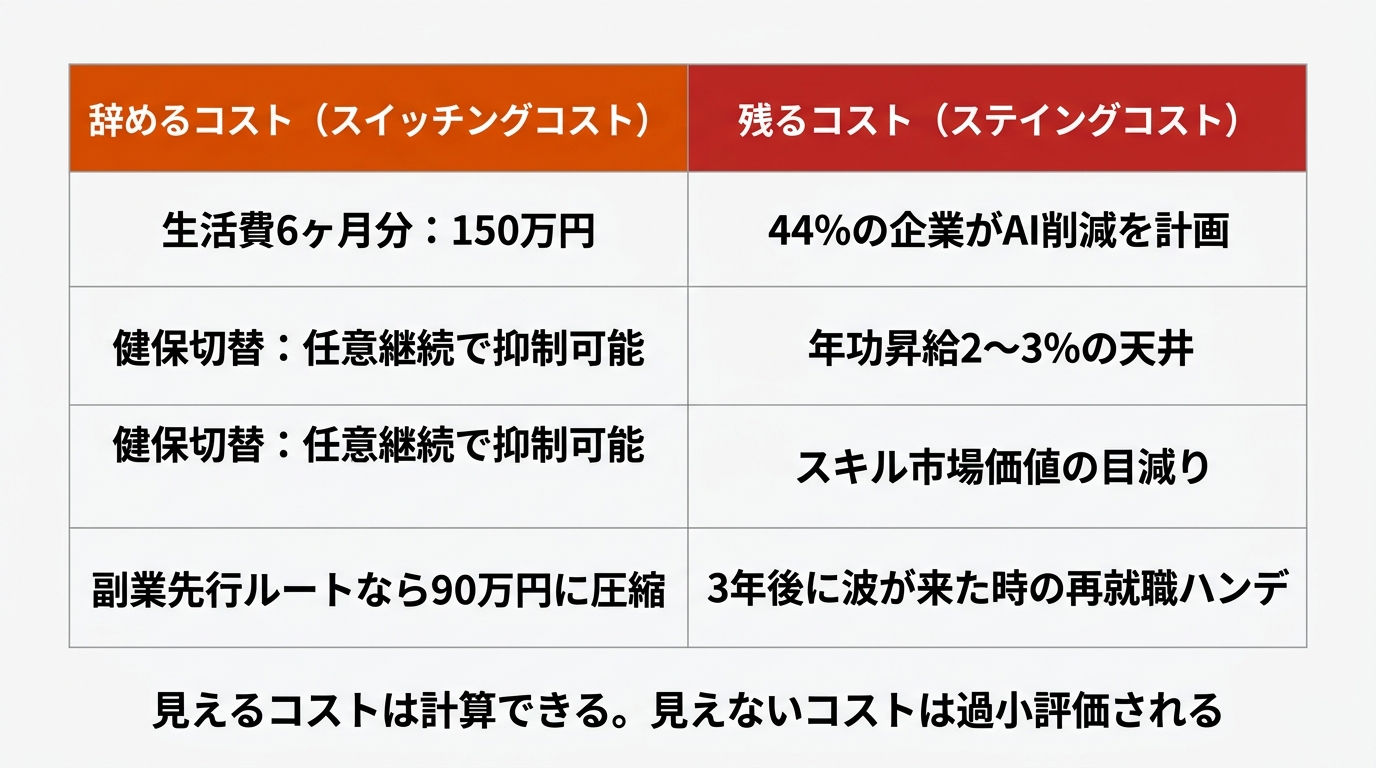
The interruption of income is the biggest wall. In Japan, the baseline before going independent is to have at least 6 months of living expenses on hand. At 250,000 yen/month, that’s 1.5 million yen. If you start a side hustle first and secure 100,000 yen/month in income before going independent, the actual risk compresses to 150,000 yen/month. That’s 900,000 yen over 6 months. Compared to Travis’s $40,000 initial investment, it’s a light number.
There’s also the switching cost for health insurance and pension. There are many cases where moving to National Health Insurance changes your monthly burden. Using “voluntary continuation” (a system that lets you stay enrolled in your former employer’s health insurance association for up to 2 years after leaving) can suppress that fluctuation. It’s a knowledge gap, not a courage gap.
Another thing easily overlooked is “time cost.” You use weekday evenings and weekends to start a side hustle and test the market. The first 3 months are a period where results are hard to see. I was also anxious for the first 2 months with 500 followers, wondering “can I really make a living off this?” But the moment I entered the third month and the format of my content started to solidify, the growth curve changed. The fork in the road is whether you can realize time cost is “investment,” not “loss.”
Calculating the Cost of Staying (Staying Cost)
Let’s return to the CFO survey reported by Fortune. CFOs who answered “we are planning AI-related staff reductions at our company” came to 44%. Including your own company, nearly half of all companies hold “the possibility of cutting people with AI someday.”
Let’s say that wave hits 3 years from now. After 3 years of “clinging to your company,” has your market value as a skill gone up? Under seniority-based pay, raises are 2-3% per year. If your current annual income is 5 million yen, that becomes 5.15-5.45 million yen in 3 years. On the other hand, if you went independent, your income ceiling depends on your action volume from year one. In my case, I exceeded 3x my employed monthly income in my second year of independence.
I want you to weigh 150,000-450,000 yen in 3-year raises against “the risk of suddenly becoming the target of an AI layoff one day.” If 44% of CFOs are planning cuts, the possibility that your company is in that 44% isn’t zero. If you can confidently say “there’s value in staying” after factoring in that risk, I think that’s the right judgment. If you can’t say it confidently, you should plant the seeds of a side hustle now.
A lot of people are convinced “if I quit, I can’t go back,” but going independent isn’t a one-way ticket. If you start from a side hustle, you can test the market while keeping the option to return as an employee.
When you do the math, the “cost of leaving” can be visualized in monetary terms, but the “cost of staying” is hard to see. What’s hard to see gets undervalued. That’s why people keep saying “it’s too early.” Invisible costs are the most expensive.
3 Things People Who Moved Preemptively Were Doing
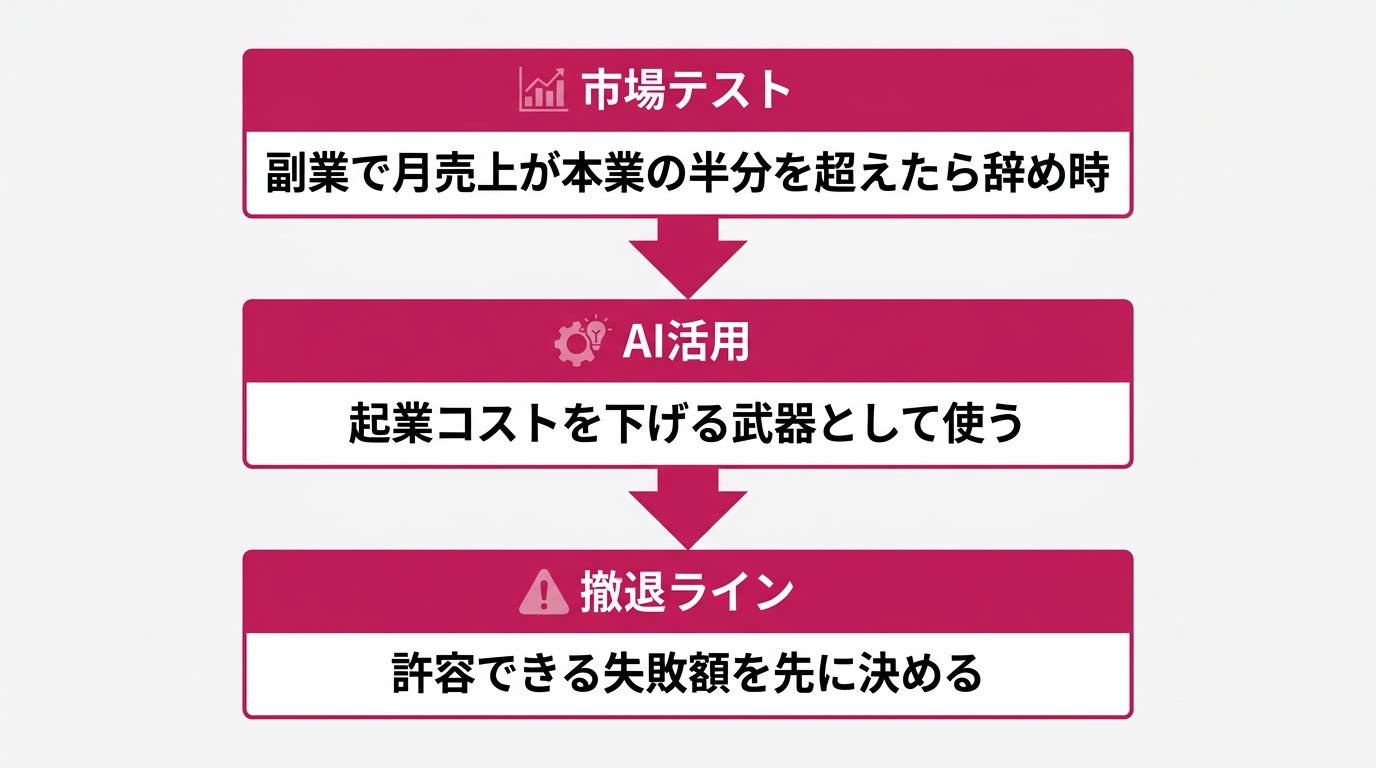
Layering the two people CNBC interviewed with my own experience, three common patterns emerge in preemptive entrepreneurship.
First: They Did a “Market Test” While Still at Their Company
Travis identified whether his audio production skills could be repurposed for AI analysis before he quit. I was more cautious — I continued posting on social media for 3 months while still employed. When my followers exceeded 5,000, I was convinced “this can become a business.” I think when your monthly side hustle revenue exceeds half of your day job, that’s the signal it’s time to quit.
Second: They Used AI as “Something That Lowers Initial Investment,” Not as “Something That Takes Jobs”
Michelle uses her engineering experience to build AI into her cafe’s operational design. She automated parts of menu development and marketing, building a system that runs with a small team from the start. Travis’s product is AI itself.
In my case, when I was handwriting consulting proposals from scratch, each one took 3 hours. After I started feeding client information and interview content to AI to generate structural drafts, it takes shape in 1 hour. Same with research — by handing collection and organization of industry data to AI, the number of clients I can handle solo has grown to 3x what it was when I was employed. Details on how to assemble your AI stack are in this article.
You can either cower thinking “AI will take my job,” or you can master it thinking “I can use AI to lower my startup cost.” Faced with the same technology, some people feel fear and some people make it their weapon. Every preemptive entrepreneur was the latter.
Third: They Moved With a “Plan With Defined Exit Lines,” Not a “Perfect Plan”
Travis’s $40,000 wasn’t his “entire fortune” — it was the amount he calculated as “I can lose this much and still recover by getting re-employed.” Before going independent, I also decided “if I don’t exceed 200,000 yen monthly income in 6 months, I’ll go back to being an employee.” It turned out I didn’t need to worry, but I could only step forward because I had an exit line.
Decide first not “what if I fail” but “what level of failure can I tolerate.” Just this changes the quality of your anxiety.
The entrepreneurs in the CNBC article were all doing these three things naturally. It’s not that they had special talent. They just thought about “what happens after quitting” in numbers, not emotions. What I want to say isn’t “quit your job right now.” It’s “make the quit/don’t quit judgment with calculation, not emotion.” Even if your calculation leads to “stay for now,” that’s a fine preemptive judgment too.
So What Do We Do Today?
Just thinking “that’s nice” after reading the preemptive entrepreneurship story changes nothing. Neither Travis nor Michelle in the CNBC article moved after reading some article. They looked at the numbers themselves, judged for themselves, and took the step forward themselves. We should be able to do the same. Let me write 3 things you can do starting today.
First: Write Out Your “Staying Cost” on Paper
Try concretely writing out what your future self will look like in 3 years at your current company. How much will your annual income rise? What’s the percentage chance AI will encroach on your work? If you thought “I don’t know,” that itself is a risk. The moment you write it out, the spell of “it’s too early” loosens. Paper or spreadsheet, either is fine. The act of writing itself is the first step from “passive” to “active.”
Second: Run an Experiment to Earn 30,000 Yen/Month From a Side Hustle
30,000 yen/month isn’t “the amount you can live on” — it’s “proof your value exists in the market.” Social media broadcasting, skill sales, consulting — anything works. Once you can earn 30,000 yen on your own, the path to 300,000 yen comes into view. My first gig was a 5,000-yen social media management contract through a friend. The amount is small. But the fact that “revenue was generated under my own name” fundamentally changes your confidence. The experience of someone putting a price on you without your company’s brand still drives me 5 years later.
Third: Decide Your Exit Line First
“If I don’t exceed 100,000 yen/month in 6 months, I’ll go back to side-hustle mode.” A decision at this level is enough. You can attack because you have an exit line. You’re scared because you don’t. The difference between preemptive entrepreneurs and you isn’t a gap in ability — it’s whether you can set this rule. I myself could only continue the unglamorous action of posting on social media every day for 3 months because I clearly held the exit line of “go back to being an employee.” It’s not that having an escape route makes you complacent — it’s that having an escape route lets you run at full speed. This is something I can say definitively from experience.
Summary
I think the wave of “preemptive entrepreneurship” CNBC reported isn’t a story that ends with America. As I wrote in yesterday’s 3-country comparison, AI’s power to change employment is moving simultaneously around the world. Japan isn’t even familiar with the term “preemptive entrepreneurship” yet, but the trend of allowing side work, enforcement of the new Freelance Protection Law, expansion of reskilling support — the environment is steadily falling into place.
The forecast of cuts and the expansion of entrepreneurial intent are moving simultaneously. What the numbers show isn’t “AI is taking jobs” — it’s the fact that “AI anxiety has triggered a surge in people trying to create their own work.”
“It’s too early” might sound safe. But as I calculated in this article, the “cost of staying” is just hard to see — it’s steadily piling up. It’s not safe because it’s invisible; it’s dangerous because it’s invisible.
5 years ago, I was also on the side that thought “it’s too early.” I held back on what I wanted to do, deferring to my boss. “After I build a bit more track record.” “After I save a bit more money.” I could manufacture infinite reasons to put it off. The day my voice first reached readers directly through social media, I regretted: “Why didn’t I move sooner?” The accumulation of those “a bit more”s was, for me, the “cost of staying.”
You don’t need qualifications to move preemptively. A perfect plan isn’t required either. What you need is to honestly calculate the “cost of staying” just once. If your calculation results in “stay for now,” that’s also a form of preemptive move. But “staying without calculating” isn’t preemptive — it’s mental shutdown.
By the time you finish reading this article, you have 2 choices. “Tonight, write out the cost of staying” or “close it after just reading.” As someone who chose the former, 5 years later, I’m here now. I think it’s your turn next.

女性だからこそ、AIを使いこなさなきゃって思ってる。仕事も、副業も、推し活も、旅行も、全部やりたい。人生一度きりなのに時間は足りないじゃん?だからAIに任せられることは全部任せる。浮いた時間で本当にやりたいことをやる。それがあたしのスタイル。ここにはあたしが実際にやったことをまとめてるだけ。誰かのためになったらいいなって思って書いてるよ。