AI Founder Average Age Crashed From 40 to 29. Do You Really Believe 'You Have to Be Young'?
Antler analyzed 1,629 companies. The average age of AI unicorn founders dropped 11 years. Here's the data showing why people in their 30s and beyond don't need to panic
What you'll learn in this article
- The key point to grasp before reading the full article
- How the issue changes practical decisions after reading
- Which follow-up article is worth opening next
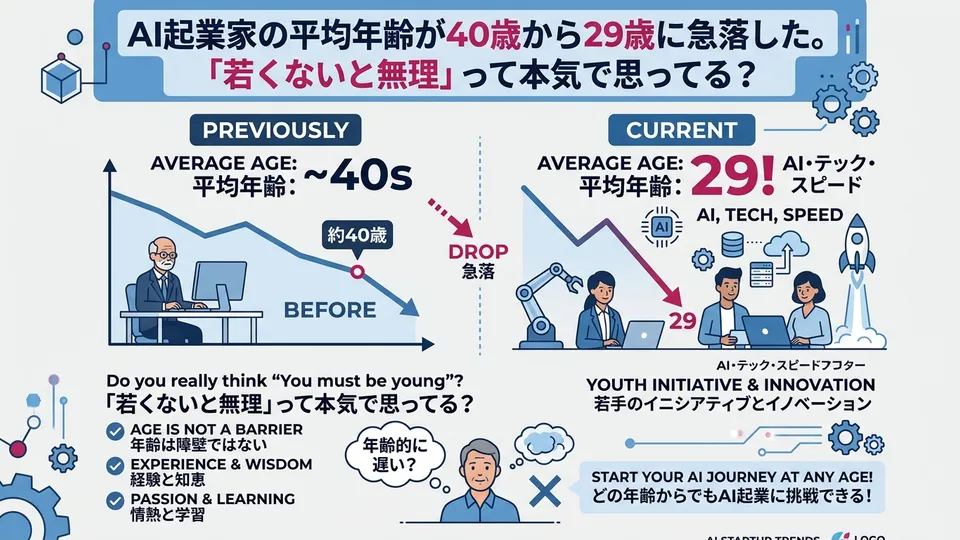
My timeline is flooded with stories about “young founders.” An 18-year-old building a $1B company. The world’s youngest billionaire at 22. Honestly, watching it stresses me out. “Am I already too late?”
But when I dug into the data, the picture changed.
Global VC giant Antler released a report covering 1,629 unicorns (private companies valued at $1B or more) and 3,512 founders. It’s true that the average age of AI unicorn founders has plummeted. But when you read what’s behind those numbers, you can see a structure that actually works as a tailwind for people in their 30s and 40s.
The Average Age of AI Unicorn Founders Dropped 11 Years
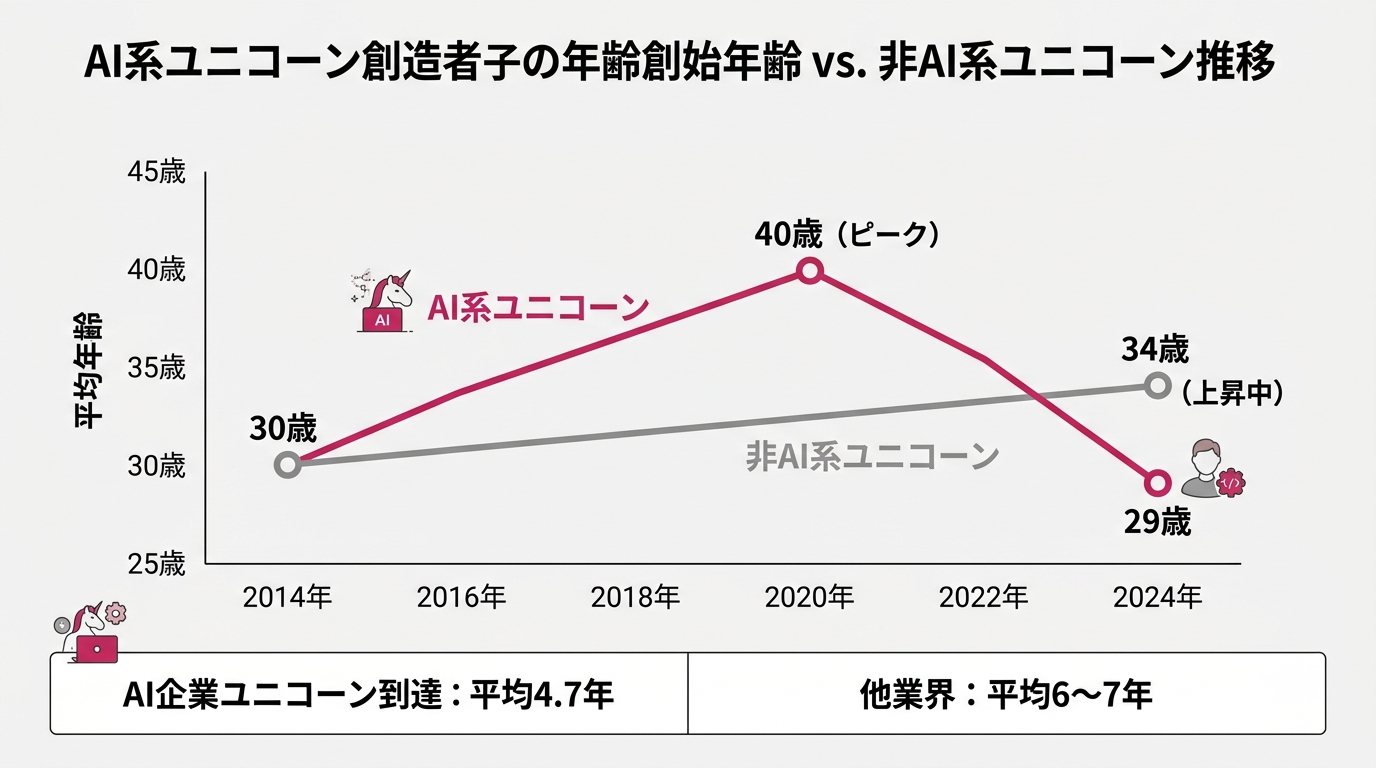
According to Fortune’s reporting, Antler’s findings hit hard. The average age of AI unicorn founders peaked at 40 in 2020. By 2024, it had fallen to 29. An 11-year drop in just four years. CNBC also gave the number major coverage.
A partner at Antler put it like this: “25 is the new 30.” We’re entering an era where Gen Z founders mass-produce unicorns. Looking at the numbers alone, it really is a shocking shift.
But here’s the thing — non-AI industries are moving in the exact opposite direction.
The average age of non-AI unicorn founders rose from 30 in 2014 to 34 in 2024. In other words, outside of AI, startup founders are actually trending toward “starting later in life.” The “youthification” is an AI-only phenomenon, not a startup-wide trend.
So why has only AI gotten younger?
The first reason is that the AI tech cycle is just too fast. People in their 20s who are touching cutting-edge tech at universities and AI labs can translate that knowledge directly into a company. The technical skills people in their 30s and 40s built up through their careers get outdated almost immediately by the pace of AI evolution.
The second reason is that the economics of scaling have changed. The SaaS (subscription software) era required capital to hire engineers and salespeople in bulk. The AI era lets small teams scale through automation. Technical skill matters more than connections or capital.
The third reason is that the speed to unicorn status is on another level. AI companies hit unicorn status in 4.7 years on average. Other industries take six to seven years. There’s structurally no time left to accumulate industry experience.
There was one more striking data point in Antler’s report. Repeat founders (those who’d started a company at least once before) made up about 40% of all unicorns. It’s not just first-time young founders winning. Four out of every ten unicorn founders are hitting it on their second or third attempt.
26% of unicorn founders are immigrants, and 81% of them are based in the US. Location, age, nationality — a completely different map of “the successful founder” is being drawn. The stereotype of “a 30-something white male engineer in Silicon Valley” is becoming a thing of the past.
A Unicorn at 18. What Aaru’s Founders Proved
The company that symbolizes this “youthification” is Aaru.
Cameron Fink and Ned Koh co-founded it at 18 and 19. Their technical co-founder John Kessler was just 15. Founded in March 2024, the company hit a $1B (about ¥150 billion) headline valuation at Series A in roughly a year and a half.
Aaru’s service deploys thousands of AI agents. It replaces traditional focus groups (small in-person consumer panels), letting you test products and pricing strategies at high speed. Multiple companies, including major enterprises, are clients.
Consumer research that used to take weeks gets done in hours by AI agents. Without human bias, accuracy is also reportedly higher. Research costs drop dramatically, putting market research — once a privilege of large corporations — within reach of individuals.
A team of teenage founders is changing how major enterprises make decisions. This is the reality of the AI era.
Combine this with the story of the 22-year-old youngest billionaire in the world I covered last time, and the trend is clear. In the AI world, “proximity to cutting-edge tech” can outweigh industry experience as a competitive edge.
Reading this far, you might think, “So you really do have to be young.” Honestly, that’s how I felt at first too. But there’s an important next chapter to this story. I want you to look at the other side of the data.
Data You Need to See Before You Buy “Young = Win”
Antler’s data is about “founders of AI unicorns.” It only shows the trend at the very top of the pyramid — companies that hit a $1B+ valuation.
Look at startup success rates overall, and the picture shifts entirely.
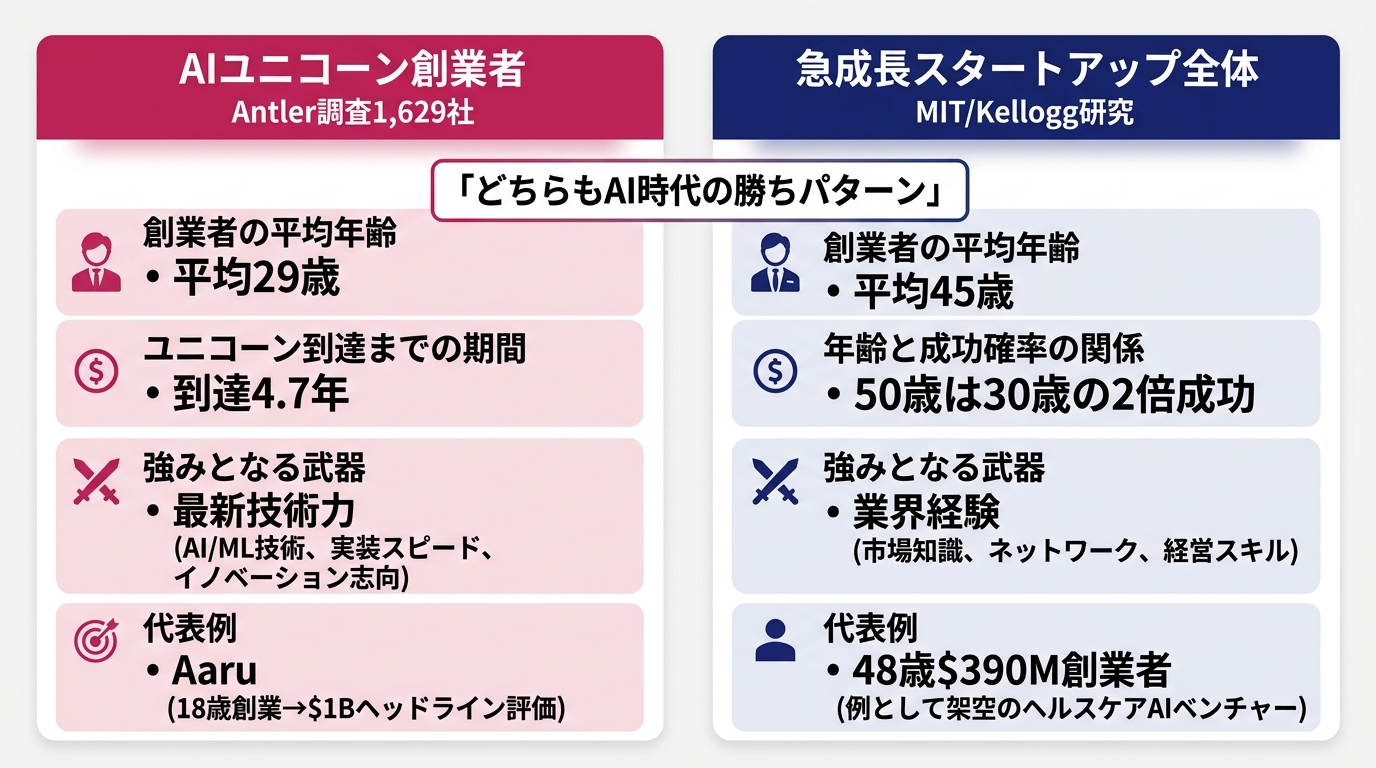
A joint study from MIT and Northwestern’s Kellogg School of Management is fascinating. It targets all high-growth startups, not just the AI unicorn tier. The average age was 45. A 50-year-old founder is twice as likely as a 30-year-old to build a high-growth company. The study used US Census data for a large-scale analysis, so the sample is highly reliable.
Founders with three or more years of hands-on experience in the same industry are roughly twice as likely to succeed. The assumption that “experience isn’t a weapon” is fully refuted by the data.
Why are experienced founders more likely to succeed? It’s simple — they know the industry’s pain points (where customers are stuck) firsthand. No matter how good the technology, if you don’t know what problem to solve, it doesn’t become a business. People with high-resolution understanding of the problem can pick the right technology.
A Fortune article from March 2026 also stuck with me. A founder who started at 48, was rejected 33 times before raising, and went on to build a $390M (about ¥58.5 billion) company. A VC apparently told him, “Taking risks past 40 is a midlife crisis.”
This founder wrote: “Experience, combined with the willingness to put yourself back in an unstable position. That combination is a competitive advantage.” I really resonated with that.
A lot of people are convinced “there are no chances after 40.” VC age bias is real. But the data says the opposite. Older founders actually have a higher probability of getting business results.
VCs look for “the potential to grow explosively in a short window.” MIT/Kellogg looks at “the probability of sustained success.” The metrics are different, so the conclusions differ. Antler covers the very top tier — unicorn founders. MIT/Kellogg covers all high-growth startups. Different populations naturally produce different answers. Neither is wrong; the rules of the game are simply plural.
It’s true that 20-somethings can hit $1B with raw technical skill. It’s equally true that 40-somethings built a $390M company on experience. There’s more than one winning pattern.
The Structural Shift: AI Redistributed the “Age Advantage”
This is where I get to my real point.
It’s not “you have to be young.” It’s not “experience wins” either. To be precise, AI has changed the very structure of how age-based advantages get distributed.
Think back to the SaaS era. Scaling required an organization. Building an organization required connections. Building connections took time. That’s why experienced founders in their 40s had the edge.
In the AI era, scaling no longer demands a large organization. Dario’s story about “$1B with one person” signaled the arrival of an era where AI leverage — not team size — decides the winner.
This isn’t a change that only benefits people in their 20s.
If anything, it’s the ultimate tailwind for solopreneurs (people running a business solo). The era when only large corporations could scale is ending. A structure has emerged where an individual armed with AI can produce output equal to a small team.
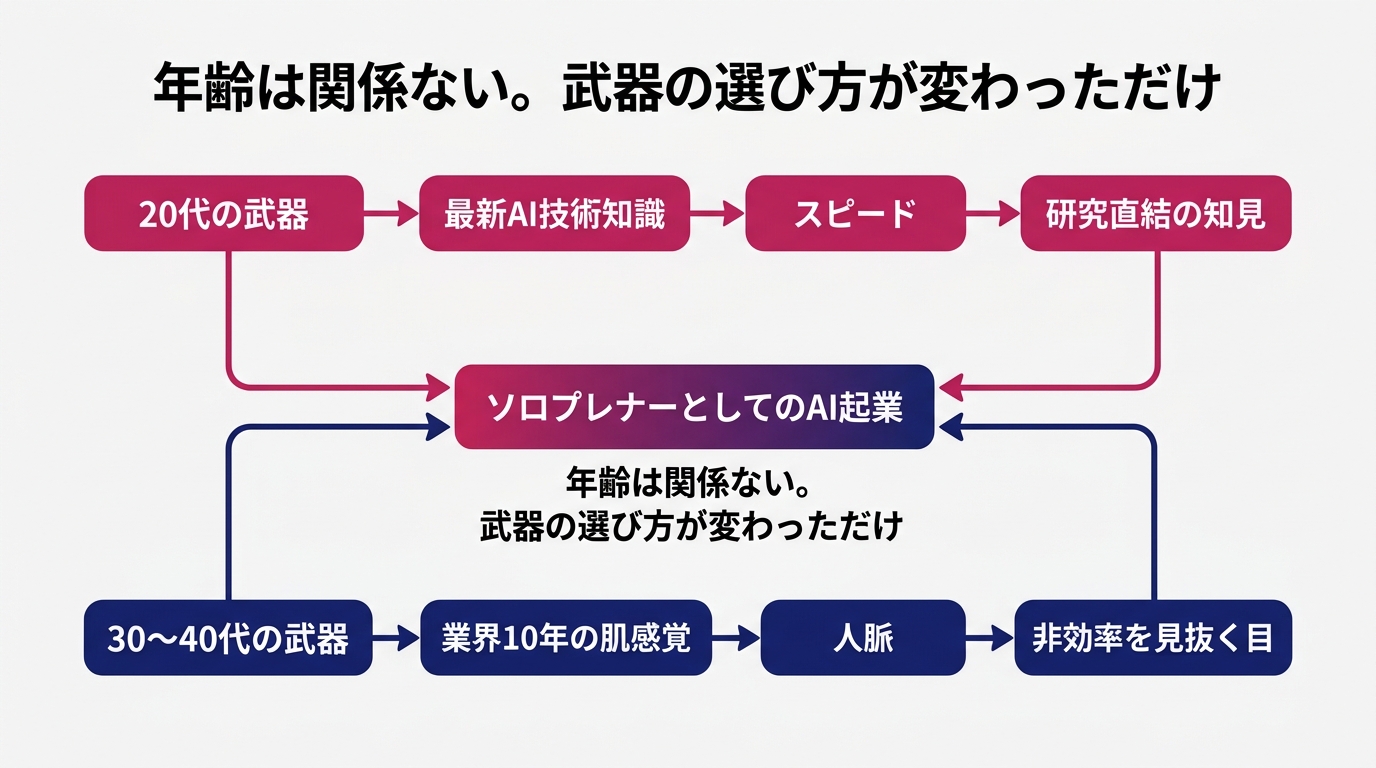
What happens when a 40-something solopreneur with 10 years in the trenches gets AI in their hands? They can multiply 20-something-level technical capability with their own industry understanding — solo. No matter how brilliant the 20-something is, without the visceral feel for the industry, they can’t make this multiplication work.
In yesterday’s article, I wrote about “a record number of people quitting before AI takes their jobs.” The conclusion of that piece was “if you’re going to move, move now.” What I want to add today is “the direction you move depends on your age.”
People in their 20s can compete head-on with technical skill. Antler’s data proves it.
People in their 30s and 40s can compete with the multiplication of “technical capability × industry experience.” MIT’s data backs that up.
This isn’t about which is better. It’s about accurately understanding your own weapon and choosing the field where it works best. The biggest waste is staying still because you think “I’m too old.” If anything, the data says “there are situations where being older is an advantage.”
3 Actions People in Their 30s and 40s Should Take Now
Now let me get concrete about what to do.
First. Take the position of being on the “user side” of AI.
You don’t need to develop the technology itself. But if you haven’t actually felt how AI changes your own work, you’re not in the conversation.
As symbolized by the AI course that drew 17,000 people in 10 days, demand for AI literacy is exploding. Among my friends, more people are integrating AI into their SNS marketing and cutting post creation time in half. Just knowing how to use it puts you light-years ahead of others your age.
This is a different kind of weapon from the “proximity to cutting-edge tech” that 20-somethings have. A 30-something who knows how to use AI is on a completely different stage from one who doesn’t.
Second. Find the intersection of “your industry × AI.”
What’s worth noting in Antler’s report is that many AI unicorns came from “AI-ifying existing industries.” Aaru itself was a service that replaced an existing business process — market research — with AI agents.
The “this part of this industry is inefficient” intuition that people in their 30s and 40s carry. That’s a weapon 20-something engineers don’t have. The moment you multiply that intuition by AI, business ideas no 20-something could come up with start to emerge.
For me, it’s SNS marketing. I’ve done it for almost 10 years, so I know firsthand “where clients get stuck.” I can see where AI should automate things because I have that experience. The kind of knowledge you can’t learn from textbooks gains huge value all at once in the AI era.
Concretely: I let AI draft post concepts, then I correct it with “this angle won’t land.” I can only make that judgment because I have 10 years of failure data in my head. AI is a tool — the one making the judgment is the human with experience.
Third. Attack with the hybrid of “speed × experience.”
AI unicorns can run to the finish line in 4.7 years because they iterate fast as a small team. People in their 30s and 40s can replicate this “speed” too.
As a solopreneur using AI tools, you can move at the same pace as a 20-something startup, solo. Add 10 years of industry knowledge to that. From what I’ve seen, this combination is the strongest competitive advantage out there.
The 48-year-old founder who got rejected 33 times and built a $390M company proved exactly the value of this multiplication. Age isn’t an excuse — used correctly, it’s the biggest weapon.
Remember the figure in Antler’s data showing “repeat founders are 40%”? That means 40% of unicorn founders failed on their first attempt and hit it on their second. The experience of failure itself is evidence of raising the success rate of the next attempt.
I’m in my late 20s myself. I have SNS marketing experience but I’m not an AI specialist. Even so, integrating AI into my work has clearly changed the quality of my client proposals. The number of accounts I can run solo has grown, and proposal prep time is down by more than half. You don’t need to deeply understand the technology — but the will to “use it” is absolutely required.
Wrapping Up
Antler’s 1,629-company analysis showed AI unicorn founders’ average age crashing from 40 to 29. Look at that number alone, and you might read it as “the era of the young.”
But MIT and Kellogg’s research puts the average age of high-growth startup founders at 45. A 50-year-old is twice as successful as a 30-year-old. The assumption that “age is a handicap” is denied by the data.
What AI changed isn’t “the value of youth.” It’s the structure of age-based advantage itself. The path of competing on technical skill in your 20s, and the path of competing on “industry experience × AI” in your 30s and 40s — both are wide open.
What matters is deciding “which path you’ll take.” Stressing over someone else’s timeline doesn’t move your own business one millimeter. If you have energy to burn on stress, trying out one AI tool is way more productive.
The one thing I want to communicate in this article is this. Instead of stressing over young founder news, take stock of your own weapon and move. If you’re in your 20s, sharpen your technical skill. If you’re 30+, multiply industry experience by AI. The action item is simple. In the end, the people who actually do something win.

女性だからこそ、AIを使いこなさなきゃって思ってる。仕事も、副業も、推し活も、旅行も、全部やりたい。人生一度きりなのに時間は足りないじゃん?だからAIに任せられることは全部任せる。浮いた時間で本当にやりたいことをやる。それがあたしのスタイル。ここにはあたしが実際にやったことをまとめてるだけ。誰かのためになったらいいなって思って書いてるよ。