The 3 Hidden Structures Behind Every Zoom Solopreneur 50 Winner
Zoom handed $30K each to 5 winners whose industries ranged from philanthropy to cake design. Dissect them one by one and the common thread isn't industry — it's three structural patterns: starts from personal pain, AI inside the product, hub for a specific profession.
What you'll learn in this article
- The key point to grasp before reading the full article
- How the issue changes practical decisions after reading
- Which follow-up article is worth opening next
In my May 5 article, I dissected the five selection criteria for Zoom Solopreneur 50 and made an educated guess at the common traits of people who make it into 50 out of 3,000 applicants. That was one week ago. On May 4, 2026, Zoom officially announced the top five winners and the $30,000 prize distribution (Zoom News).
Now that real names and business details are on the table, it’s time to check my work. My three predicted common traits — niche focus, embedded AI operations, two-way community — were about half right, half wrong.
The half I got wrong is probably the more important half for solo operators. Fortune wrote that “industries ranged from philanthropy to cake design.” (Fortune.) True — the industries are scattered. But when you dissect each of the five individually, there’s a pattern sitting underneath the industry labels. Three patterns. That’s what I’m handing over today.
“This is some foreign award story that has nothing to do with me” — I don’t buy that. The question is whether your business could be placed among those five. This week is the week to make that call.
Breaking Down Each of the 5 Businesses, One by One
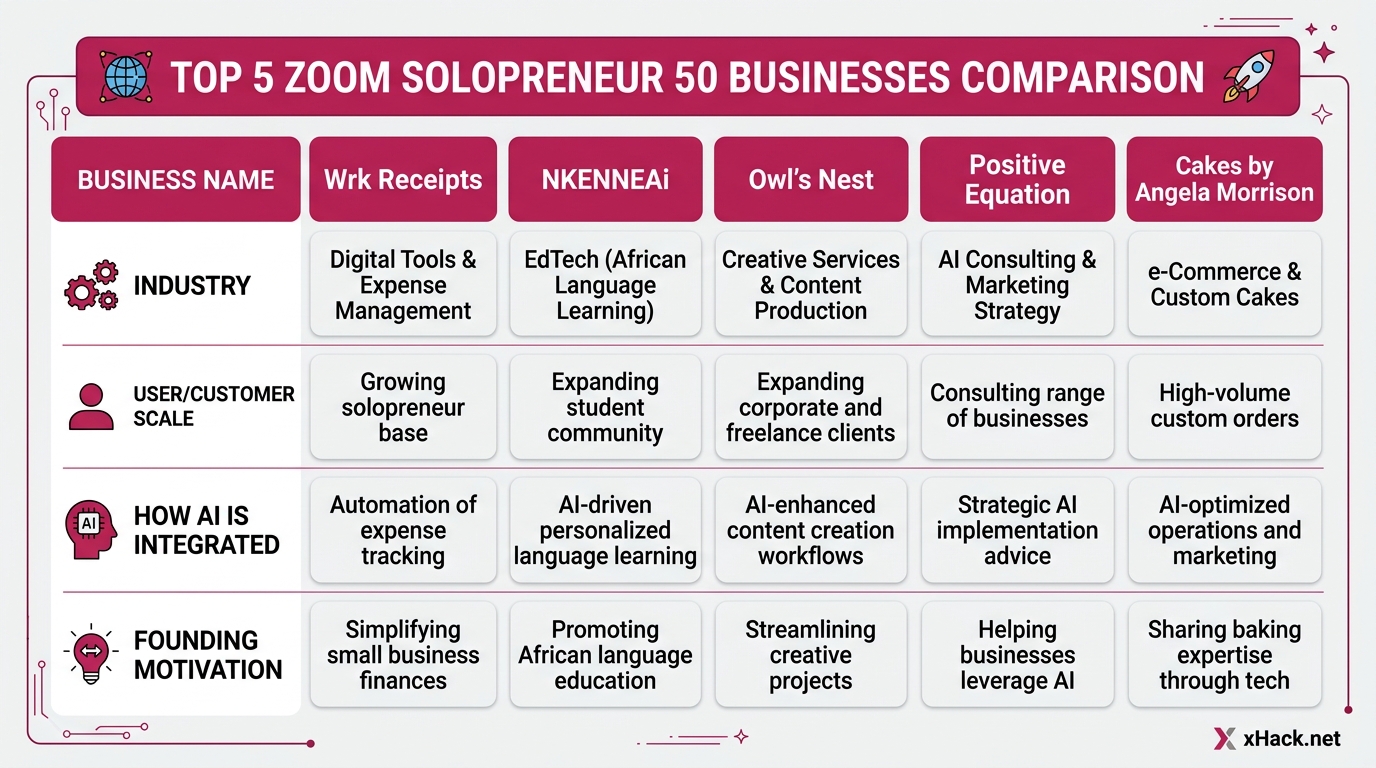
Here are the five names and business summaries. All sourced from Zoom’s official newsroom (Zoom News, 2026-05-04) and each company’s public information.
#1: Cierra Gross — Worklution Inc / Wrk Receipts
Former Googler and HR professional. After personally experiencing racial discrimination and stereotyping in the workplace, she built Wrk Receipts — an AI-powered workplace documentation platform. It now serves 20,000+ employees (Wrk Receipts official). The product bundles an AI-powered workplace rights guide, incident documentation templates, secure record storage, and access to human HR consultants in a single app.
Fully bootstrapped. No investors. 20,000+ users. Cierra described the $30K as “confirmation that my work is needed.”
#2: Michael Odokara-Okigbo — NKENNEAi
Nigerian-American. Dartmouth graduate, former singer. In 2021, he realized there was no app for learning his own mother tongue, Igbo, despite growing up in the US — and founded NKENNE. The platform now has 400,000+ users and covers Yoruba, Igbo, Hausa, Swahili, and Nigerian Pidgin (TechCabal, Jan 2026).
Building on that data and language infrastructure, he spun off NKENNEAi — an African language AI infrastructure business. In March 2026, it entered an official partnership with Nigeria’s government agency NITDA (TechCabal, Mar 2026).
#3: Derek McCracken — The Owl’s Nest
Former high school agriculture teacher in Ohio for roughly a decade. He built The Owl’s Nest to supply ready-to-use teaching materials to fellow ag teachers, sold through Teachers Pay Teachers nationally (Teachers Pay Teachers). He runs operations using AI note-capture tools to collect real-time feedback from a nationwide network of Ambassador Teachers. He plans to use the $30K to hire contract teachers and accelerate national expansion.
#4: Dana Snyder — Positive Equation
Consulting firm specializing in monthly giving program development for nonprofits. Host of the podcast “Missions to Movements.” She’s an official author with Givebutter and a listed speaker with Funraise — a hub-like presence in the industry (Funraise). She’s putting the $30K toward visibility investment for her own product, “Monthly Giving Builder.”
#5: Angela Morrison — Cakes by Angela Morrison
Custom cake design. From a home office, she used digital tools to build a global supply chain and an international client base. Selected as a model case for taking a physical, handmade product and scaling it globally through digital infrastructure.
Five businesses. HR tech, language AI, agriculture education, nonprofit marketing, cake design. Sure — “philanthropy to cake design.” But in the next section, the pattern snaps into view.
Three Patterns That Surface — Structures Deeper Than Industry
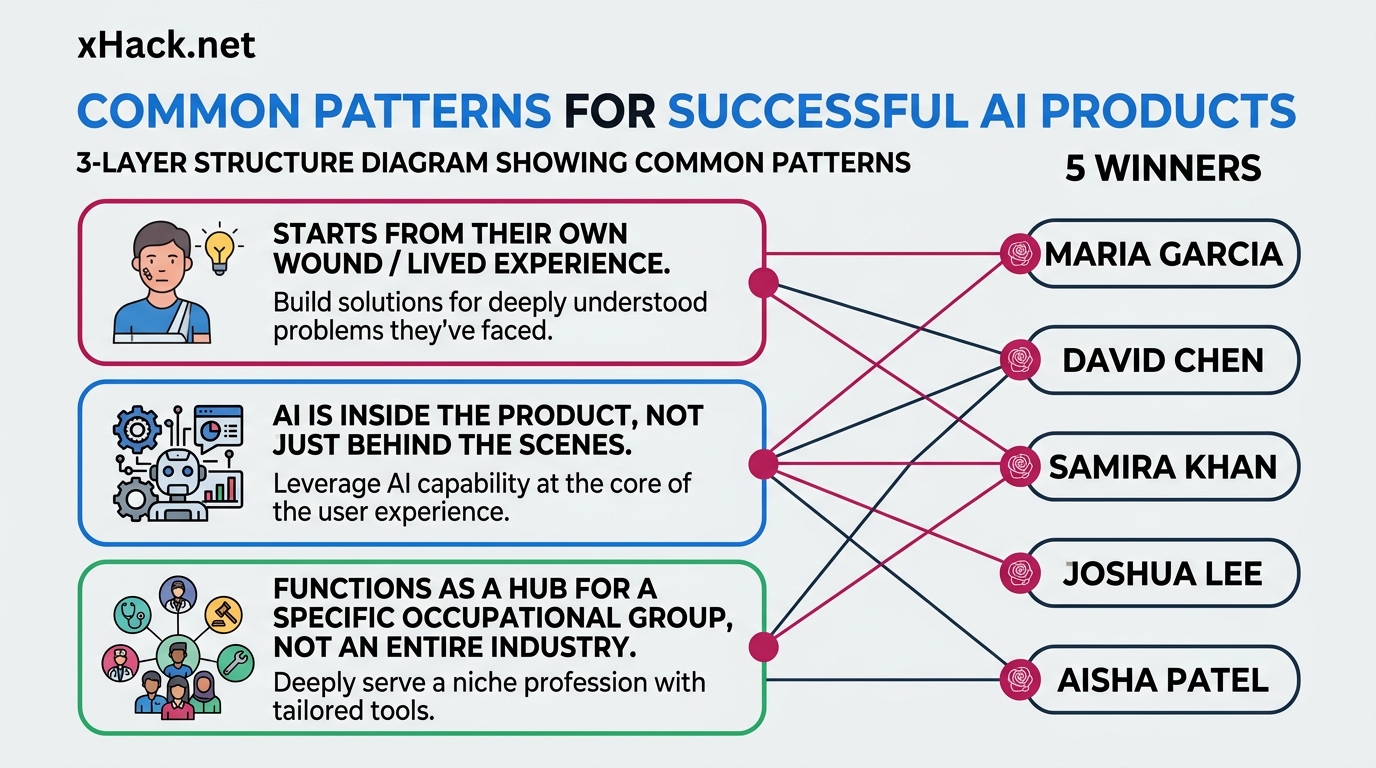
Looking at all five in sequence, three structures align across industries.
Pattern 1: “Personal pain / personal experience” is the origin
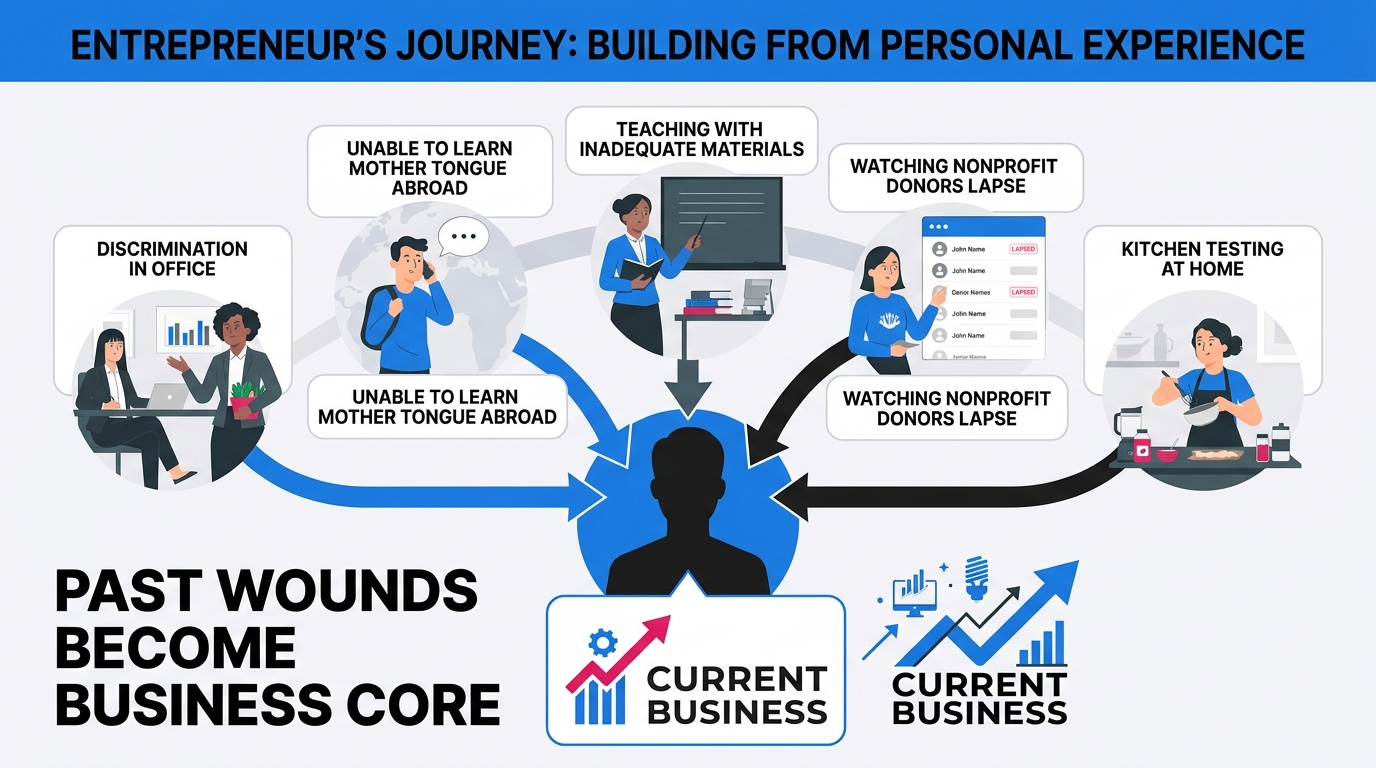
Cierra Gross experienced racial discrimination at work — that’s why Wrk Receipts exists. Michael grew up in America unable to learn his own mother tongue — that’s why NKENNE exists. Derek spent a decade in the classroom as a working agriculture teacher, and built materials because the gap was real. Dana Snyder was deep inside nonprofit marketing and built a specialty around a gap nobody else was filling: “nobody is systematically teaching monthly giving construction.” Angela started from a home kitchen and kept showing what was possible through her own example.
Most of these winners didn’t “find” a niche through market analysis. They translated a place they personally understood — as direct participants — into a business. Especially Cierra, Michael, and Derek: in all three cases, the first-person origin story is the structural core of the business.
My “niche focus” call from the May 5 article was half right. The accurate version is: niche focus rooted in something the founder lived deeply. “Monthly giving retention for small nonprofits” means something different coming from someone who watched donors drop off from inside a nonprofit operation versus someone who found it through market research. The gap shows up in criterion ④ Authenticity of founder values — and it’s wide.
Pattern 2: AI is inside the product, not just “operations efficiency”
This is the biggest message for solo operators.
Wrk Receipts’ AI isn’t back-office automation. The “workplace rights guidance” is the product itself — it’s what users touch. NKENNEAi is the same: the multilingual AI API is the product. Owl’s Nest uses “AI note capture to stay connected to the field” as the platform’s differentiating layer — it’s how Ambassador Teachers contribute in real time. Positive Equation productized “Monthly Giving Builder” in the context of AI utilization. Angela’s cake business uses digital tools to make “a handmade cake deliverable worldwide” — a product experience enabled by technology embedded in the model. Whether AI is literally inside Angela’s product in the same sense as the others is limited by what’s publicly available, but the pattern of embedding technology directly into the customer-facing experience is the same direction.
My “AI embedded in operations” prediction was again half right. The precise version is: AI is inside the product, in a place where the customer directly experiences it. Not “we automate our accounting internally.” The customer sees the AI’s effect with their own eyes.
This is the same logic from the May 3 article on VC-free $500M businesses. Founders with AI-native product design can scale without hiring people — which means they don’t need VC intervention either. That same dynamic is showing up in Zoom’s selection.
Pattern 3: Hub for a specific profession, not a whole industry
The third pattern is about community architecture.
Cierra’s community: “workers who have experienced HR violations and want to assert their rights.” Michael’s community: “individuals who want to learn African languages, plus governments and businesses that need to use them.” Derek’s community: “a nationwide network of ag teachers” — and it has an operating mechanism: Ambassador Teachers. Dana’s community: “nonprofit marketing managers,” reached through podcast, speaker appearances, and authorship in parallel. Angela’s community: a D2C setup — customers around the world who order custom cakes.
My “two-way community” call was basically right. But going one level deeper: all five have built something that functions as a hub for a specific profession or identity group. Not “solopreneur community” as a vague concept. “The place where people in [specific occupation] gather” — and it was built deliberately.
The resolution shift: from “industry” to “specific profession.” That’s the next level of niche strategy.
One Move for Solo Operators This Week — Reverse-Mapping the 3 Patterns onto the 5 Criteria
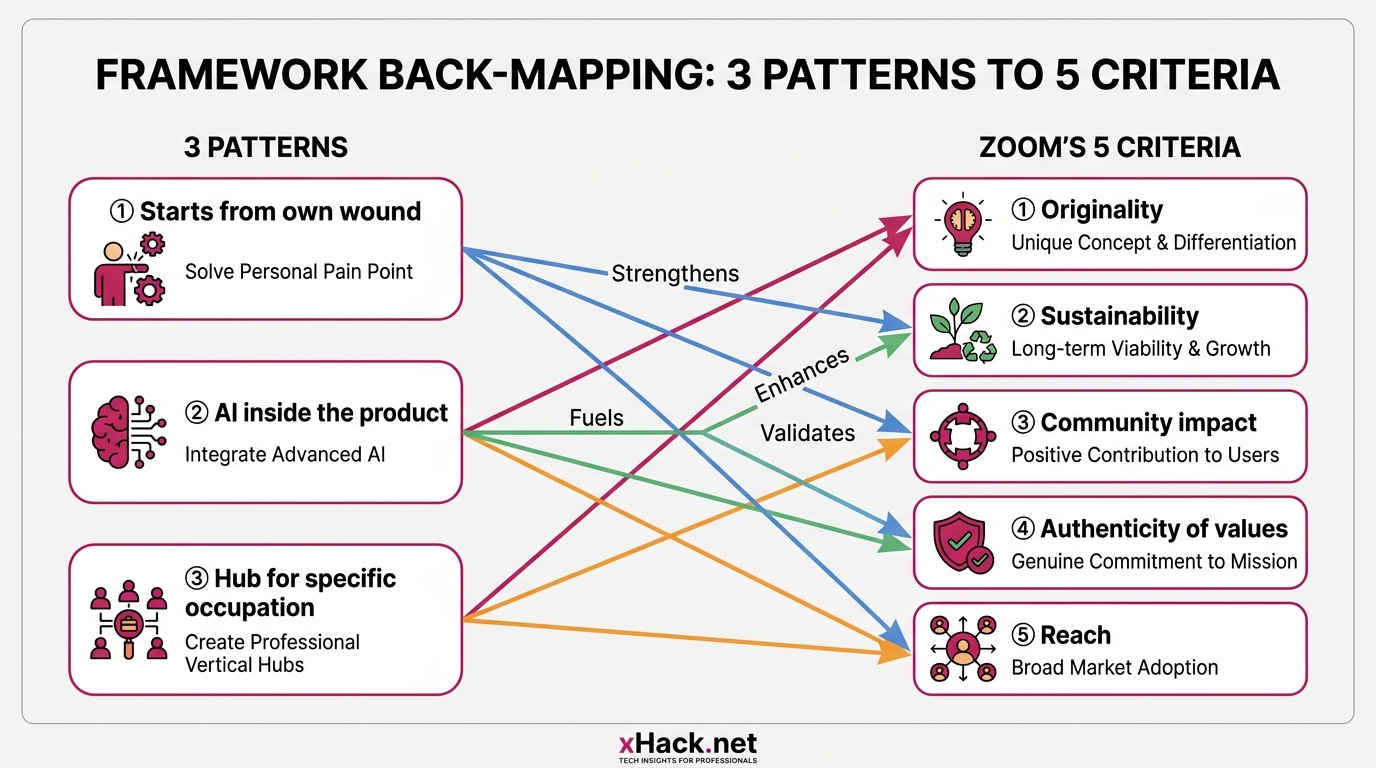
Three patterns identified. So what does a solo operator actually do this week? Three exercises. One is enough. Do one, and the shape of the other two will come into view.
Exercise 1: Write your business’s “founding wound” in one paragraph
Half an A4 page is fine. Write honestly: “What experience of mine did this business begin from?” No market-analysis language. Use the language of your own feelings and the friction you felt at the time.
If you can’t write it, you’re on the eve of a rebrand. If you can — paste that paragraph at the top of your landing page and track conversion rate changes for two weeks. Cierra Gross was selected because she could speak about her workplace discrimination experience in first person. Have that level of temperature in your own words. Once you do, Zoom’s criterion ④ Authenticity of founder values is automatically met.
Exercise 2: Build one place in your product where “AI is touchable”
Not “I use ChatGPT for efficiency.” The goal is: AI is inside what the customer receives.
Examples: if you consult, always include one page in your monthly report showing “three anomalies AI extracted from this client’s data.” If you sell physical products, insert in post-purchase follow-up “AI’s recommendation for the next product, based on your purchase history.” If you sell educational content, build a system where after purchase, “three next assignments, structured by AI based on your learning history” appear.
The key: the customer sees the AI’s impact with their own eyes. This is what creates ② Sustainability evidence — because “a product with AI inside” is harder to copy and raises repeat and retention rates. Same logic as the pricing negotiation story in the May 6 article. When AI is inside the product, there’s no reason to lower the price.
Exercise 3: Rename your business at the “specific profession” layer, not the “industry” layer
“Marketing consultant” → “Monthly giving program manager for small nonprofits.” “Web designer” → “Appointment flow designer for solo dental clinics.” “Copywriter” → “Content writer for BtoB SaaS customer success teams.”
“Industry” level (marketing, web, writing) is not enough resolution. Go down to “specific profession” level (NPO monthly giving manager, solo dental practice owner, SaaS CS manager). This directly boosts both ① Originality and ⑤ Reach in Zoom’s five criteria. Going narrow makes it dramatically more likely you get called by name within that world.
You don’t need to do all three exercises. Do one and sustain it for two weeks. If it holds, move to the next. If it doesn’t, that’s your business’s weak point surfacing — treat it as a signal to redesign that piece.
How Each Winner Plans to Use Their $30K — a Blueprint for Your Next Move
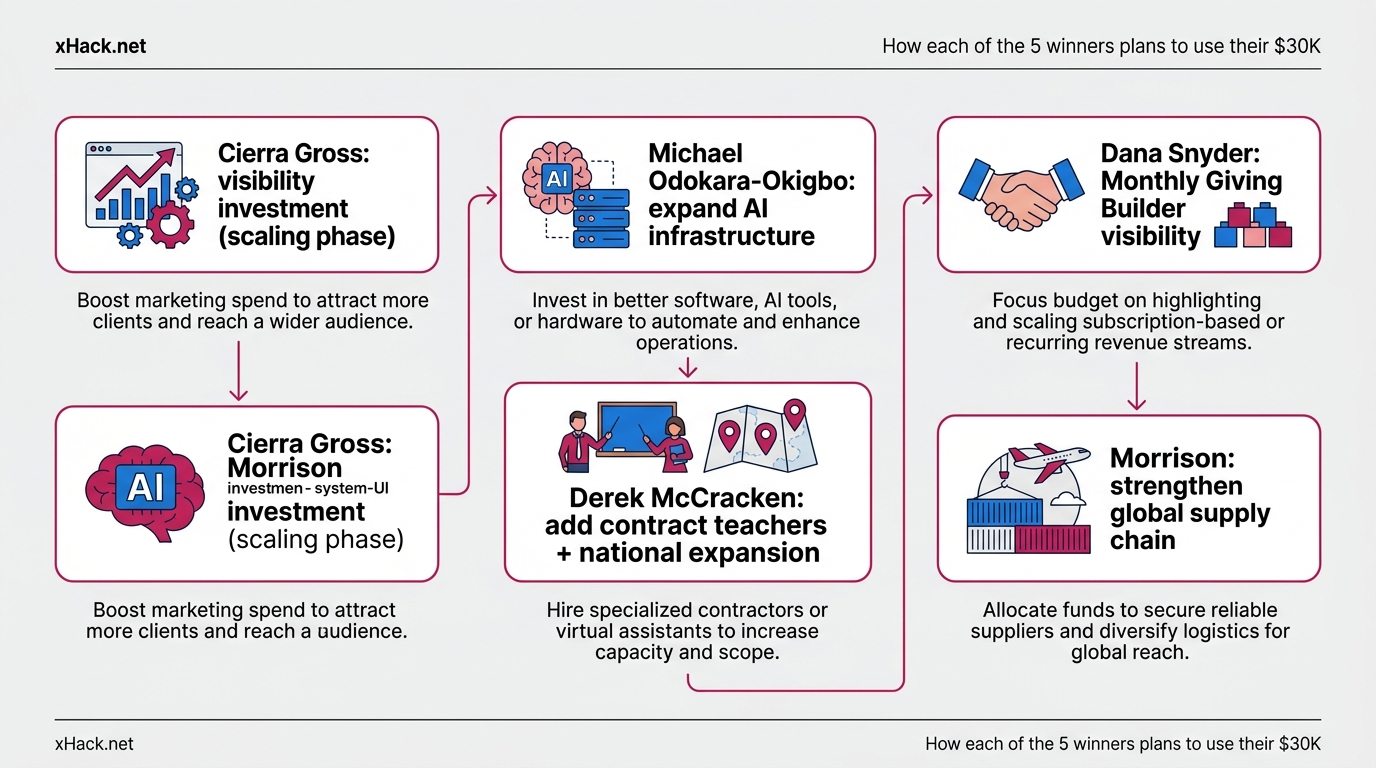
One more layer of information before I close. What each of the five winners plans to do with their $30K — that’s a blueprint for “next move” design.
Cierra Gross framed it as “visibility investment” (Wrk Receipts Press). With 20,000+ users already, what the business needs next isn’t new development — it’s more people finding out it exists. Derek: “contract teacher hires and national expansion.” Take the mechanism that’s already running, extend it by headcount and geography. Dana: “Monthly Giving Builder visibility investment” — the same pattern: making a product the industry already knows about more findable.
All five are deploying $30K not as seed capital for something new, but as an amplifier for something already moving. That’s the solo operator’s winning posture.
If you had ¥300K, ¥600K, or ¥1M in reserve cash — would you spend it on a new tool, a new venture? The answer all five winners gave is: “turn up the volume on what’s already small and working.” That’s it.
This flips the lens from the May 7 article on “what to start with AI.” Starting something is less important than amplifying something already started and moving. The five Zoom picks are people who implemented that judgment.
What specifically to amplify: three indicators. ① Products or services that have generated revenue in the past six months. ② Domains that have received repeated inquiries over the past six months. ③ Topics where someone has called you “the expert” over the past six months. The intersection of these three is what deserves amplification.
The Rewritten Notes on the 5 Criteria Will Probably Become My Longest-Lasting Asset
In the conclusion of my May 5 article, I declared: “I’ll rewrite my own business through the five criteria first — and then write an article about what that produced.” This week I actually did it.
What I found: of the three patterns, ② AI inside the product was my weakest. In my content writing and delivery flow, AI is handling execution — but it’s not yet in “a place the reader touches.” That changes this month. Specifically: I’m going to test a feature for subscribers that uses AI to re-compile past articles and deliver them in a personalized format.
The point: when you run the five criteria and three patterns against your own business, one weakness becomes visible, guaranteed. Visible means fixable. Invisible means you’ll hit the same wall every month.
Zoom Solopreneur 50 isn’t an event to go win prize money at. It’s a framework to use for surfacing one weak point in your own business — and that’s probably its most durable use.
The five winners had different industries but strikingly similar structures. Starts from personal pain. AI is inside the product. Hub for a specific profession. Businesses that meet all three are probably going to look the same in 2027 and 2028. Businesses that don’t are on the side that gets displaced as AI lowers entry barriers.
Stop overthinking and move. One of exercises 1–3 is enough. I’m fixing my own weak point this month. If someone who moves with us shows up in the second Zoom Solopreneur 50 next May — I’ll write that article when it happens. The next article worth writing decides itself at that moment.
In the end, execution wins. Those five also moved — carrying their wounds with them.
Sources
- Zoom News (2026-05-04) “Zoom Recognizes the Rise of AI-Powered Businesses of One with Inaugural Solopreneur 50” https://news.zoom.com/solopreneur-50/
- Fortune (2026-05-03) “Zoom is giving away $150K to ‘solopreneurs’ with no strings attached—as 33 million workers ditch their 9-to-5 to become their own boss” https://fortune.com/2026/05/03/zoom-giving-away-cash-150k-to-solopreneurs-entrepreneur-trends/
- Wrk Receipts Newsroom https://www.wrkreceipts.com/newsroom
- Wrk Receipts Press https://www.wrkreceipts.com/press
- TechCabal (2026-01-28) “NKENNEAi is building the language infrastructure African tech has been missing” https://techcabal.com/2026/01/28/nkenneai/
- TechCabal (2026-03-09) “Nigeria’s NITDA partners with NKENNEAi to build the infrastructure powering African language AI” https://techcabal.com/2026/03/09/nitda-partners-with-nkennea/
- Teachers Pay Teachers — The Owl’s Nest store https://www.teacherspayteachers.com/store/the-owls-nest-2115
- Funraise — Dana Snyder speaker page https://www.funraise.org/speakers/dana-bakich
- Zoom Solopreneur 50 official page https://www.zoom.com/en/audiences/solopreneurs/

女性だからこそ、AIを使いこなさなきゃって思ってる。仕事も、副業も、推し活も、旅行も、全部やりたい。人生一度きりなのに時間は足りないじゃん?だからAIに任せられることは全部任せる。浮いた時間で本当にやりたいことをやる。それがあたしのスタイル。ここにはあたしが実際にやったことをまとめてるだけ。誰かのためになったらいいなって思って書いてるよ。