Before You Say 'Reading and Waking Up Early, Again?': JPMorgan Asked 100+ Billionaires Worth Over $500B About Their '7 Habits' — I Translated It to Solo-Founder Size for the AI Era
JPMorgan asked 100+ billionaires worth over $500B about 7 habits. Boring? Then let me name the 3 whose meaning changes with AI, and re-translate them to solo-founder size
What you'll learn in this article
- The key point to grasp before reading the full article
- How the issue changes practical decisions after reading
- Which follow-up article is worth opening next

“Reading, exercise, waking up early, consistency… yeah, heard it all before.”
Honestly, that’s exactly what I thought the moment I saw the headline. “7 Habits of Successful People” — feels like the hundredth article of its kind on social media.
But this time, please read to the end before judging. Three reasons.
First, the research was conducted by JPMorgan Private Bank — one of the world’s leading private banks for the ultra-wealthy. Second, the subjects are, in the report’s official wording, “100+ Principals (the central figures in family businesses),” with combined assets of over $500B (roughly ¥75 trillion at ¥150/USD), spanning 28 countries and 15 industries. Third, buried inside is a hint about “habits whose meaning changes with AI.” That’s the part I want to translate.
The story “100 people surveyed, all said ‘reading’” isn’t boring. Precisely because it arrives wearing a boring outfit, if you don’t read it carefully, you’ll miss where the AI-era gap opens up. That’s my reading angle.
For those moving solo, building a main business out of a side hustle, or thinking about going independent — today I’m going to dissect this article and put “those billionaires” and “us small-revenue solo founders” onto the same map. Let’s try.
H2-1. Inside the JPMorgan Report — Why It’s Not a “Fluffy Success Book”
First, let’s verify the precision of the source. Skip this and we end up “just another secondhand internet article.”
The report is the “2025 Principal Discussions Report” (JPMorgan official). Published by JPMorgan Private Bank, with detailed coverage in Fortune dated December 29, 2025.
The subjects, as mentioned, are 100+ Principals with combined assets over $500B. “Principal,” in JPMorgan’s definition, means “the central figure holding the family business or wealth” — founders, successors, family business decision-makers. Spread across 28 countries and 15 industries, the design avoids both industry and regional bias.
What matters here: most “habits of billionaires” articles are surveys of social media influencers with a few thousand followers, or subjective takes from book authors. Compared to those, the strength of this primary data is on a different level. It’s a report from one of the world’s largest private banks based on hours-long interviews with their own clients.
By the way, another number that stands out in the Fortune article is the AI usage rate. According to JPMorgan Private Bank’s research, about 80% of Principals use AI in their personal lives. Business use sits at 69%. They’re using it for research, planning, legal analysis, strategy development, and more (per the Fortune 2025-12-29 article).
My approach is to read this “as a set” with the 7-habit list. The JPMorgan report doesn’t explicitly explain a “habit × AI” relationship. But when these two datasets sit in the same context, I see a “shift in meaning” for each habit. The “boring-looking list” suddenly turns three-dimensional when filtered through the AI-era context — that’s today’s main topic.
H2-2. The 7 Billionaire Habits — Full List and the Common Thread of “Intentionality with Time”
So, here’s the list. According to the Fortune article and the report’s official commentary, the seven habits billionaires cited as success factors are:
- Reading — the most-cited habit. #1
- Exercise
- Consistency
- Waking up early
- Prioritizing tasks
- Setting goals
- Deep thinking time
…Yeah, lined up as headings alone, you go “that’s what I expected.” I felt the same at first.
But here’s where it gets interesting. The dominant theme the report identified wasn’t the items themselves. It was “extreme intentionality about how time is spent.”
In other words, the 7 habits aren’t standing independently — they all branch out from one foundation: “intentionality toward time.”
This is an incredibly important perspective.
- Not “I read books,” but “I intentionally block 90 minutes at 5 AM for reading”
- Not “I exercise,” but “I intentionally book the gym Wednesday and Saturday mornings and made them non-negotiable”
- Not “I have goals,” but “I intentionally write down 3 goals per quarter and put them on a weekly review system”
The gap between “doing it” and “doing it intentionally” separates those at the top from those below them. In the solo-founder context, this hits hardest. Because we have no boss, no team — “I spent 3 hours on social media before I knew it” is a normal occurrence. If you don’t design intentionality yourself, time leaks out continuously.
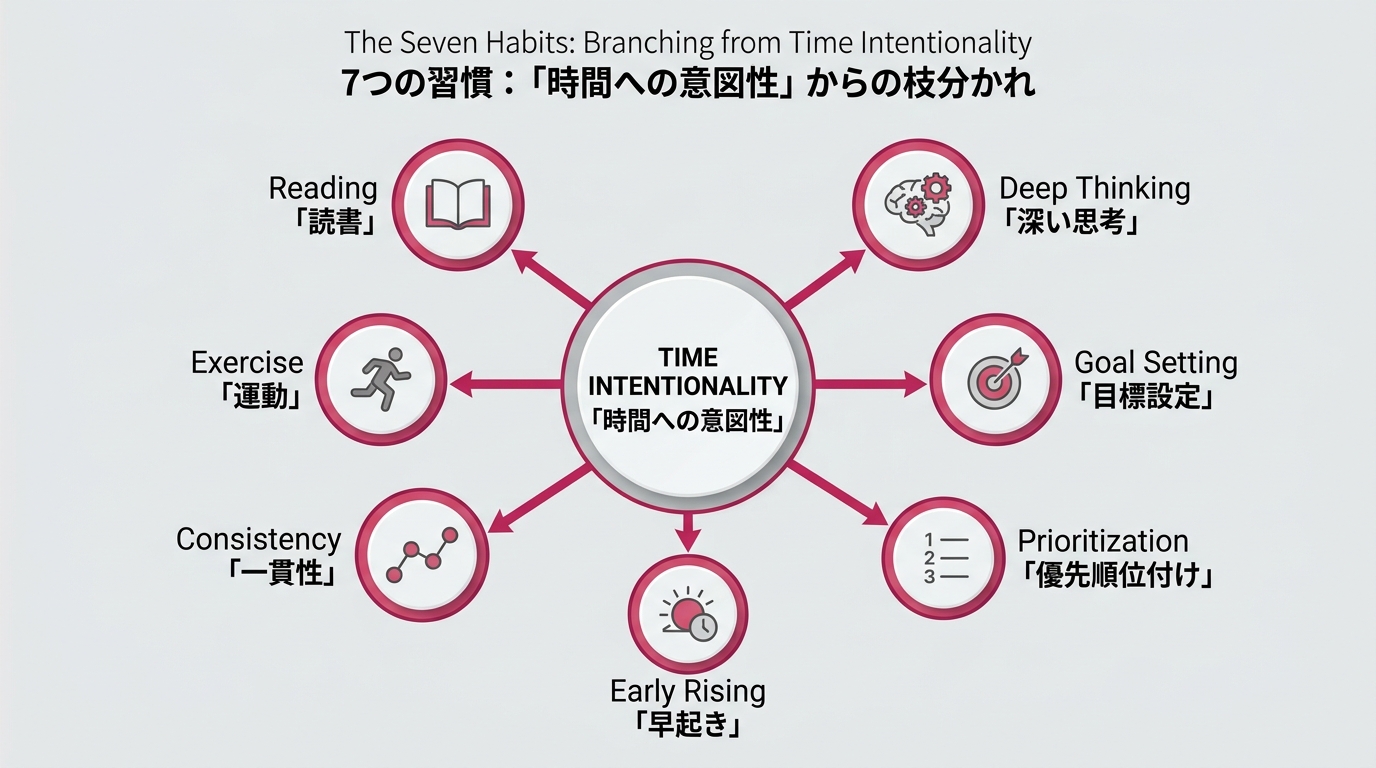
H2-3. 3 Habits Whose Meaning Changes in the AI Era — My Interpretation Frame
Here’s my main argument.
When I combine the 7 habits with the AI usage data (80% personal / 69% business), I see a 3-layer classification: “habits AI enhances,” “habits whose meaning changes with AI,” and “habits AI can’t replace.” This isn’t a classification JPMorgan’s report explicitly stated. It’s an interpretation frame I drew by placing the two datasets side by side. If it doesn’t fit, redraw your own map. But I think this is the most usable one.
Top of “Enhanced” — “Reading”
Reading, #1. At a glance, it seems unrelated to AI.
It’s not. The meaning of reading has changed with AI.
Billionaire reading isn’t reading for entertainment. It’s “information intake to raise the quality of decisions you face.” So what AI changes is this: the speed of finding books you should read, and the speed of extracting elements directly applicable to your decisions from books you’ve read — both rise exponentially.
Specifically:
- Input “Next week, I have a meeting with a manufacturing CEO,” and AI presents a summary of “manufacturing-related reports from the past 30 days”
- Have AI summarize a book you finished and extract “3 insights to use in next month’s management decisions”
- Feed AI your notes from past readings to have it objectively identify “your thinking blind spots”
Notice this: the billionaire’s reading time itself doesn’t get longer. But the decision-impact contribution per hour of reading skyrockets. Reading stays #1 as a habit, but its “effectiveness” has been transformed by AI — the top example of that category.
Top of “Meaning Changes” — “Prioritizing Tasks”
This is my favorite re-translation point.
“Prioritizing tasks,” in the old sense, meant “choosing the important ones from your to-do list.”
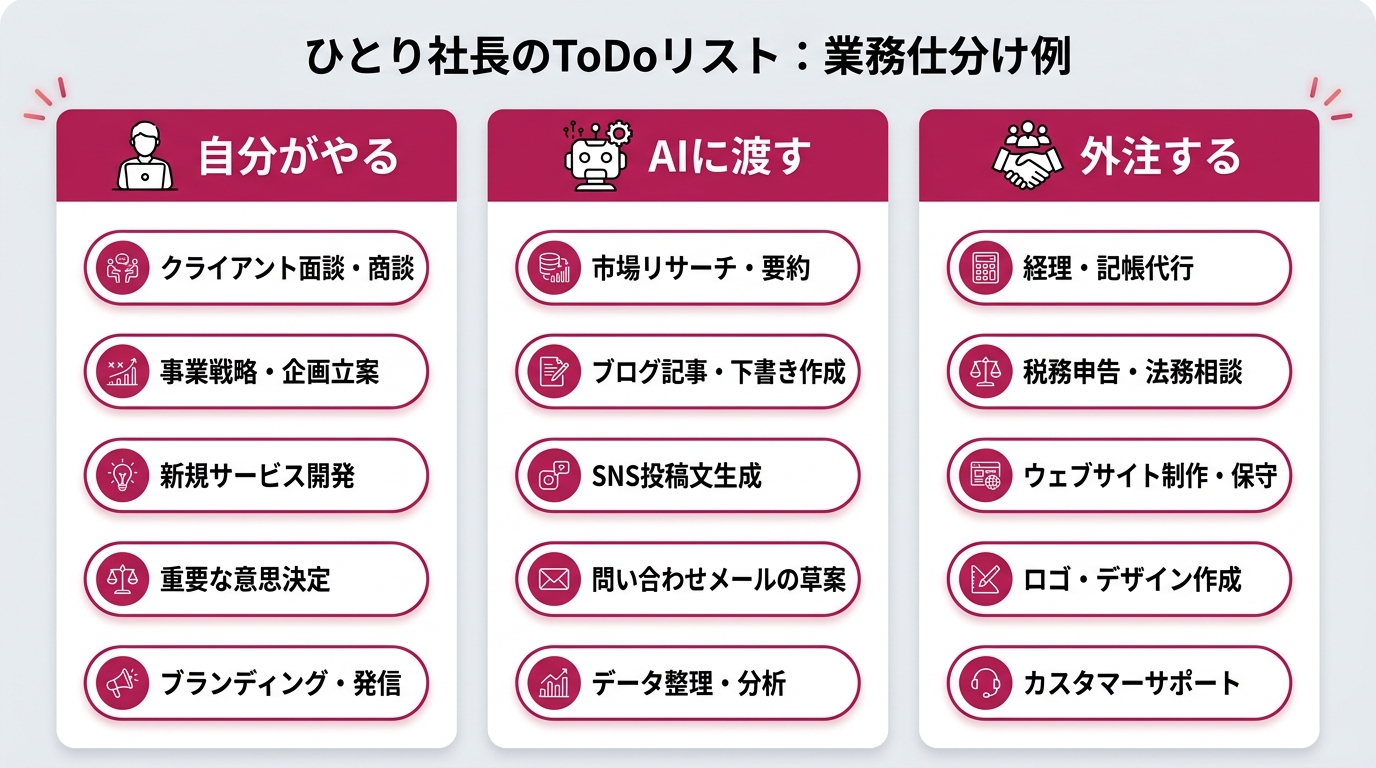
But now it’s different. It’s become the work of separating “what can be handed to AI” from “what I must judge myself.”
The fact that 69% of billionaires use AI in business means their “prioritization” has already passed through this filter. The 3-layer split — “this I do, this I hand to AI, this I outsource externally” — has become the foundation of their prioritization.
If you, the solo founder, still think “prioritization = organizing the to-do list,” that’s 2019 prioritization. 2026 prioritization is written in 3 columns: hand to AI, do yourself, outsource. This is the re-translation you can do starting today.
Top of “Irreplaceable” — “Deep Thinking Time”
Of the 7, this is the habit AI least replaces.
The reason lies in the nature of “taking responsibility for the final judgment.” Principals are moving assets exceeding $500B. The final judgment of where, when, and how to move those assets can’t be delegated to AI. The moment it’s delegated, the role of Principal disappears. So it’s inevitable that “time to think” appears on the habit list.
The same is happening in the solo-founder context. Precisely because AI has exploded the volume of decision material, “time to make the final call” has become a scarce resource. In an era when you can have AI present 20 options in 5 minutes, how do you secure “the 90 minutes of deep thinking that picks 1 from those 20”? That’s the place separating billionaires from those below them.
My take: the more AI proliferates, the more scarce “time to think without using AI” becomes. I think this is the implicit message of the JPMorgan report.
H2-4. Translation to Solo-Founder Size — 3 Implementation Steps for Today
I won’t let this end at “billionaire stories are interesting but the scale is too different from mine.” That’s my job.
Here are 3 implementation steps for tomorrow, translated to solo-founder size.
Step 1: Try a “Time Intentionality Calendar” for One Week
Super simple. Block 3 slots in Google Calendar — “Reading 90 min,” “Deep Thinking 60 min,” “Priority Design 30 min” — on the same weekday at the same time, fixed weekly.
100 billionaires answered “intentionality is the common thread.” So start by intentionally booking time blocks. Not “if I have time.” Time not on the calendar doesn’t exist — treat it that way. This has been the most effective habit since I went independent.
It’s fine if you can’t keep it some weeks at first. But continue for a month and “what I’m actually spending time on” becomes completely visible. That’s the starting line of intentionality.
Step 2: Rewrite Prioritization into a “3-Column Format”
Starting today, write your to-do list in 3 columns.
| Do Myself | Hand to AI | Outsource |
|---|---|---|
| Client meetings, strategy decisions, reading, exercise | Research, summarization, drafts, data analysis | Accounting, design, video editing |
That’s it. At first, everything will gravitate to the “Do Myself” column — that’s fine. Each week, move one item to “Hand to AI” or “Outsource.” Move 4 per month, and that’s 48 in a year. Before you know it, only “what you should actually do” remains.
Step 3: Secure “90 Minutes of Deep Thinking” Once a Week
This works the best. 90 minutes once a week with only a notebook and pen — no smartphone, no PC, no AI.
What to think about: “What was truly important last week?” “What’s the biggest decision I should face next week?” “What would the me of six months from now tell the current me?” Just these three.
In an era when AI spits out answers in 10 seconds, the market value of “90 minutes of thinking with your own head” is rising fast. Three years from now, the gap between those who can habitualize this and those who can’t will be enormous. I genuinely believe that.

H2-5. How to Tell “Doing It” from “Doing It for Show” — 3 Self-Diagnostic Questions
If you looked at the 7-habit list and thought, “Oh, I’m doing that too” — wait a moment.
Right after going independent, I was also saying “I read books,” “I exercise,” “I set goals.” But my revenue didn’t grow as much as I expected. Why? Because it was “for show.”
Here are 3 self-diagnostic questions to size up what billionaires called “intentionality” at solo-founder scale.
Question 1: Are You Measuring the Effect of That Habit?
“I read books” and “I review the insights I got from reading 3 months later” are different things.
Billionaire reading doesn’t end at the list. The report suggests many of them review their reading notes quarterly and track what got reflected in their decisions.
Your reading — are you measuring its effect? If not, it’s “for show.” Intentionality is missing.
Question 2: Can You Make the Choice to “Stop”?
If 3 years of “daily reading” hasn’t produced results, you must be able to judge whether it’s worth continuing, or whether the way you read should change.
The scary thing about billionaires is that they also have the judgment to flatly stop habits that aren’t producing effects. “The power to continue a habit” and “the judgment to quit continuing” are two sides of the same coin.
Your habit — are you continuing it even when it hasn’t produced results in 3 years? If you can’t make the call to stop, it’s inertia. Not intentionality.
Question 3: Have You Articulated That Habit to a Level You Could Teach Someone?
This is the toughest question.
Can you articulate “reading” — how to read, what time to read, how many books, where to record them, when to review them — to a level you could teach someone?
Billionaires include many business successors. Which means they need to transmit their habits to the next generation in a “reproducible form.” That’s why their level of articulation differs from a typical entrepreneur.
You, the solo founder, may eventually have a team too. Or you may already have moments to convey your methods to a side-hustle partner or client. A habit you can’t articulate is a valuable asset that exists only inside your body — ending without ever being transferred.
I’m also now documenting habits I’d been “doing on instinct” through year 3 of independence. It’s surprisingly hard. Try it and you’ll see.
H2-6. Retranslating the #1 Habit, “Reading,” with AI — My Practice
Last, let me share 3 things I’m currently doing as “AI-era reading habits.”
Once I Finish a Book, I Make AI Ask 5 Questions
Specifically, a prompt like this:
“I’m giving you my notes on this book. Then: (1) Point out 3 worldview assumptions of this book that I would disagree with. (2) Point out 2 claims in this book whose meaning shifts with AI’s arrival. (3) Cite 3 concrete actions in this book I can apply to next month’s management decisions. (4) Point out 1 blind spot in this book. (5) Recommend 3 other books with views that contradict this one.”
With this, a single book transforms from “read and done” to “5 insights directly tied to next month’s management decisions.” My reading efficiency has clearly improved compared to year 3 of independence (it’s a felt sense, but I notice it in monthly decision speed).
Have AI Update My “Books to Read” List
On the 1st of every month, I throw this at AI: “Read my articles, social posts, and meeting records from last month, and suggest 5 books I should read next month. Include reasons.”
Then AI returns reading paths I didn’t even notice myself, like: “Theme X you touched on 3 times last month doesn’t deepen without an intro to field Y, so I recommend this book.”
Not “Have AI Summarize Before Reading” — “Discuss with AI After Reading”
This is the key. Many people stop at “have AI summarize the book,” but that’s the inferior version.
The correct use is to read it yourself first, then discuss with AI. Throw at AI: “I interpreted this chapter’s argument this way — is there another interpretation?” Then your reading’s blind spots come into relief.
I think this is the implementation method for “deep thinking in the AI era” that the JPMorgan report hints at.

Summary — Don’t Let the “7 Habits” End as Boring
JPMorgan asked 100+ billionaires worth over $500B about 7 habits. Reading, exercise, consistency, waking up early, prioritizing tasks, setting goals, deep thinking time.
Just the list — boring.
But read inside, and 3 things become clear.
- The common thread is “intentionality with time.” The 7 habits aren’t independent — they all branch from one foundation: “intentionally using time.”
- Read alongside the 80%/69% AI usage rate, and the meanings shift. Reading is enhanced, prioritization is redefined, deep thinking time becomes scarce — this is my interpretation frame.
- The gap between “doing it” and “doing it for show” can be spotted with 3 questions. Effect measurement, the call to stop, the level of articulation.
We solo founders aren’t billionaires. Our assets aren’t $500B, and we don’t have JPMorgan accounts.
But “intentionality with time” is something we can implement at the same level as billionaires starting today.
Put 3 blocks on the calendar, rewrite the to-do list in 3 columns, think for 90 minutes once a week with notebook and pen. That’s it.
Probably, a year of continuing this, and the you of next year on this day will be somewhere the current me can’t imagine. I’m trusting that too, and opening my calendar tomorrow.
Winner takes all. That’s it.
Sources
- Fortune 2025-12-29 “The world’s wealthiest families adopt these 7 key habits for success, according to JPMorgan” https://fortune.com/2025/12/29/best-habits-for-success-among-billionaires-worlds-wealthiest-families-jpmorgan-report/
- Fortune “JPMorgan surveyed 100+ billionaires worth $500 billion—the No. 1 habit they share might surprise you” https://fortune.com/article/jpmorgan-billionaire-habits-success-reading-wealthy-families/
- J.P. Morgan Private Bank Principal Discussions Report (Official Portal, US) https://privatebank.jpmorgan.com/nam/en/insights/reports/principal-discussions
- J.P. Morgan Private Bank Principal Discussions Report (Official Portal, EMEA) https://privatebank.jpmorgan.com/eur/en/insights/reports/principal-discussions
Related Articles (from my past posts)
- The 3 Structures Common to the 5 People Zoom Gave $30K To — Solopreneur 50 final day dissection. Directly connected to today’s “intentionality”
- 3,000 Applicants, Only 50 Selected — Zoom Solopreneur 50 breaking news. 5 selection criteria
- Answering “So, How Much Can You Earn?” — On price-tier design
- I Split the Forbes AI 50 into 5 Patterns — Solo-founder typology in the AI era

女性だからこそ、AIを使いこなさなきゃって思ってる。仕事も、副業も、推し活も、旅行も、全部やりたい。人生一度きりなのに時間は足りないじゃん?だからAIに任せられることは全部任せる。浮いた時間で本当にやりたいことをやる。それがあたしのスタイル。ここにはあたしが実際にやったことをまとめてるだけ。誰かのためになったらいいなって思って書いてるよ。