I Split the Forbes AI 50 Into 5 Patterns — Solopreneurs Can Only Ride 2 of Them
Forbes 2026 AI 50, 50 companies with $305.6B raised, split into 5 patterns. The two to imitate: Gamma's 52-person/$100M ARR model and the industry×AI model. The other three? Sit them out.
What you'll learn in this article
- The key point to grasp before reading the full article
- How the issue changes practical decisions after reading
- Which follow-up article is worth opening next
img: Mikoto at a cafe table, sorting a printed Forbes AI 50 list with five color-coded sticky notes. Coffee in foreground, a dim window scene over her left shoulder. Her expression is focused, captured mid-motion as she places a sticky note. | type: eyecatch | style: dark-toned anime illustration, natural-light leaning, no neon, rose (#c2185b) accent
Forbes AI 50’s 2026 edition dropped in April. Fifty companies with $305.6B raised in total (about ¥45 trillion at ¥150/$). Combined market value: $750B (about ¥112.5 trillion). OpenAI and Anthropic alone account for $242.6B — roughly 80% of the whole list (PANews, April 2026).
The gap between people who see this and say “wow, impressive” and people who ask “okay, so where do I get on?” is going to widen over the next year.
I’m in the second camp. I split the 50 companies into 5 patterns and made my call: only 2 of those patterns are battlefields a solopreneur can actually ride.
The other 3? Sit them out. I say “sit them out” with conviction — because that’s how you avoid burning yourself out fighting on terrain you can’t win on. Today I’m handing you all 5 patterns plus the 5-question diagnostic that tells you exactly where you stand.
Forbes AI 50 · 2026 Is the Year of “AI Independence” — The April Tectonic Shift, Told Through 50 Companies
Forbes AI 50 is now in its 8th year. Rashi Shrivastava (the Forbes reporter who edits the AI 50) put it like this:
“This year’s list shows the AI race is no longer just about who builds the most powerful model, but who finds ways to productize AI in new and innovative ways and build sustainable businesses on top.”
Forbes itself framed the list’s theme as a shift from “AI Dominance to AI Independence” (Forbes announcement via Yahoo News, April 2026).
In my own words, what that actually means:
“The era where one giant model decides everything is over. Each company is now moving toward ‘biting in with a model in the niche where I’m strongest.’”
Until last year, AI 50 was basically a story about “how do you use OpenAI?” This year is different. Of the 50, 20 are new entries (Gamma, Cognition, Lovable, HeyGen, Krea, EliseAI, Legora, Applied Intuition, Black Forest Labs, Fal, Replit, Genspark, Chai Discovery, Cyera, ListenLabs, Physical Intelligence, ReflectionAI, Rogo, SurgeAI, SSI). And many of these newcomers are designed around “winning a specific domain.”
Read alongside the official Forbes AI 50 list (forbes.com/lists/ai50), the BigDATAwire commentary (April 21, 2026) surfaces another keyword.
BigDATAwire’s analysis: “Data has become the core of AI value.” That’s not a direct phrase from Forbes itself — it’s an industry-analysis outlet’s own reading — but when you actually examine the business structures of the 50, it lines up.
Translation: “It’s not the model itself anymore — the company that has the proprietary data to feed the model wins.” This carries a critical implication for solopreneurs. The domain data you’ve accumulated in your day job can itself be a moat.
How to leverage that comes later. First, look at the 5-pattern map.
img: 5-pattern classification matrix. Vertical axis “capital intensity” descending from large to small; horizontal axis “solopreneur entry difficulty” from easy on the left to hard on the right. A: Capital Monster (top-right, OpenAI/Anthropic), B: Top-Tier Developer Tools (top-center, Cursor/Cognition), E: Infrastructure (bottom-right, Cyera/SurgeAI), C: Industry×AI (bottom-left, EliseAI/Legora), D: Creator-Generation (top-left, Gamma/Krea/HeyGen). Five color-coded zones. C and D in green, A/B/E in red tones. | type: diagram | style: white background (#F5F5F5), rose (#c2185b) base color, modern business chart
The 5-Pattern Overview — Here’s the Full Cut of All 50 Companies
Two axes. “Capital intensity” and “solopreneur entry difficulty.” Plot the 50 against these two and you get five clean islands.
| Pattern | Representative Companies | Valuation Range | Headcount | Examples in This Article | Solopreneur Verdict |
|---|---|---|---|---|---|
| A · Capital Monster | OpenAI, Anthropic, SSI, xAI | $50B–$900B class | hundreds–thousands | 4 companies | Spectator |
| B · Top-Tier Developer Tools | Cursor, Cognition, Lovable, Replit, Genspark | $5B–$60B | 50–800 | 5 companies | Mostly spectator |
| C · Industry × AI Specialist | EliseAI, Legora, Applied Intuition, Rogo, Chai Discovery | $300M–$1B | dozens–hundreds | 5 companies | Rideable |
| D · Creator-Generation | Gamma, Krea, HeyGen, Black Forest Labs, Fal | $500M–$2B class | 8–85 (tiny) | 5 companies | Rideable |
| E · Infrastructure / Data | Cyera, SurgeAI, ListenLabs, Physical Intelligence | $500M–several B | hundreds–thousands | many | Spectator |
Let me get the difference between C and D — the two I judged “rideable” — straight up front.
C is the “weaponize your domain experience” type. If you have 5+ years of hands-on experience in real estate, law, healthcare, finance, or education, C is your battlefield. EliseAI (real estate management AI, $392M valuation) being used in 80% of large-scale rental management is proof that the kind of stickiness only domain insiders can build is real (Forbes via Yahoo News).
D is the “creative + product sense” type. If you have taste in UI/UX/content/video/design, D is winnable for you. Gamma (presentation AI, $2.1B valuation, $100M ARR with 52 people — ARR meaning Annual Recurring Revenue) started from a question as simple as “the PowerPoint replacement” (TechCrunch, November 2025).
Why I cut A, B, and E as “spectator” — that’s the next section. “Spectator” sounds negative, but narrowing the battlefield is strategy 101. Try to fight on every front and you lose on every front.
A · Capital Monsters — Sit Them Out: What $242.6B Poured Into OpenAI and Anthropic Actually Means
Numbers first.
- OpenAI: $182.6B raised cumulatively (PANews, April 2026). Annualized revenue over $25B (early 2026, per Forbes reporting).
- Anthropic: Series G in February 2026 valued at $380B. Annualized revenue jumped from $9B at end of 2025 to $30B by March 2026. 233% growth in a single quarter (TechCrunch, April 29, 2026 — reportedly negotiating a new $50B round at a $900B valuation).
- SSI (Safe Superintelligence Inc.): Ilya Sutskever’s new company. No product, research-only, valued in the billions.
- xAI: Elon Musk’s outfit. Grok hardening plus vertical integration.
At this tier, “the ability to raise capital = the essence of management.” Capital monsters are hiring “PhD-grade researchers,” “senior business development,” and “infrastructure engineers.” If you don’t fit any of those three slots, this is the spectator section.
But there’s exactly one way to use this without remaining a passive spectator.
“Rent the top players’ models cheap and bolt them onto your day job.” That’s the basic move for Patterns C and D. The $242.6B that OpenAI and Anthropic are pouring into research — you can rent the output for $20–$200 a month. I covered this last month in my piece on “$300/month in AI tool spend”, where I laid out how $300/month creates leverage that exceeds an annualized $3,600 (~¥540,000) headcount cost. Same story.
Don’t invest in the capital monster. Use it. That’s why “spectator” is fine.
While we’re here, I’ll also dispatch “B · Top-Tier Developer Tools” and “E · Infrastructure / Data.”
B · Top-Tier Developer Tools (Cursor, Cognition at $10B, Lovable hitting unicorn at $1.8B, Replit, Genspark) is a different order of technical investment. Cursor’s ARR is reportedly above $2B (cited in Wikipedia: Anysphere as early-2026 data — secondary, primary unverified). Lovable hit unicorn status in 8 months with 45 people, but headcount jumped from 146 to 871 by the end of March 2026 (AI Business Review, March 2026). They’re already in the scale-war stage. The right move here is “use them as a customer.”
E · Infrastructure / Data (Cyera, SurgeAI, ListenLabs, Physical Intelligence, ReflectionAI, Fireworks AI, etc.) is B2B long-term-contract territory. Enterprise sales and security certifications decide the game. No room for an individual operator.
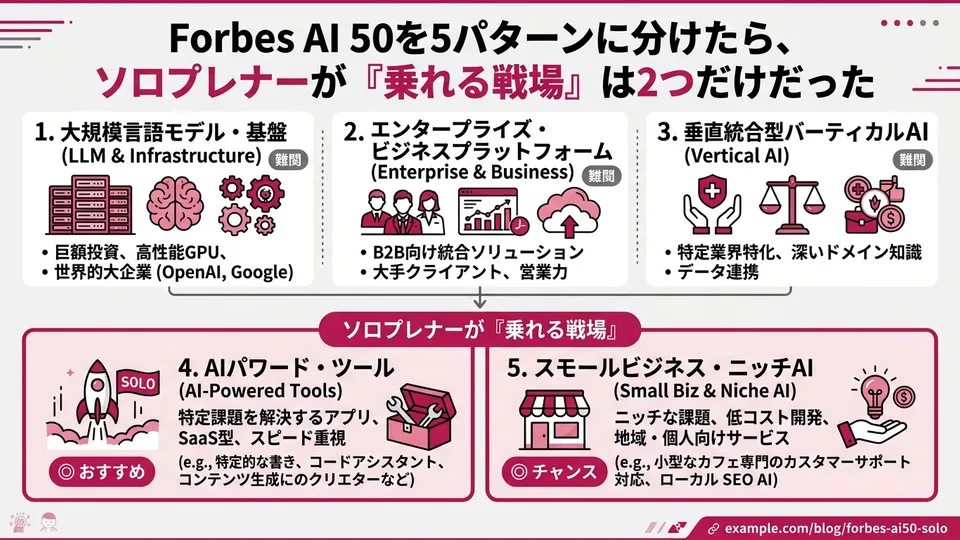
Just from the examples in this article, four A-pattern, five B-pattern, and many E-pattern companies all land in the spectator section. For all 50, see the official Forbes list. The remaining two patterns — C and D — are the rideable battlefields.
img: Flow diagram of 50 companies → split into “3 spectator patterns (A Capital Monster, B Top-Tier Developer Tools, E Infrastructure)” and “2 rideable patterns (C Industry×AI, D Creator-Generation).” Enters from the left as “Forbes AI 50 · 50 companies” and branches into two groups on the right. | type: diagram | style: white background, rose (#c2185b) base color, arrow flowchart
Imitable Pattern ① — The “Small, Fast Squad”: Dissecting Gamma’s 52-Person, $100M ARR Structure
Now the meat.
Starting with D · Creator-Generation. The headline numbers:
| Company | Founded | Headcount | ARR / Valuation | Source |
|---|---|---|---|---|
| Gamma | 2020 | 52 | $100M ARR · $2.1B valuation · profitable since 2023 | TechCrunch |
| Krea | 2022 | 85 (was 8 at one point) | 20M MAU (Monthly Active Users) · 20× revenue in 14 months | Krea official X |
| HeyGen | 2022 | — | $100M+ ARR · $500M valuation · $74M raised | Forbes AI 50 list |
| Black Forest Labs | 2024 | — | FLUX-family image generation · Stanford-affiliated researchers | Forbes AI 50 list |
Gamma first. Slide-creation AI. Locked onto a single point: “the PowerPoint replacement.” The founder thought “the first three years can be in the red,” yet they’re profitable since 2023 with 52 people. What does that signify?
“Go deep in a niche, and a small team can hit profitability.”
The opposite of Patterns A and B, where you balloon on VC money and slug it out on scale. Gamma is the real-world form of the “don’t aim for $1B from day one” mantra I’ve written about repeatedly. A design that picks “profitable + persistent” over “scale uber alles.”
Krea next. A creative suite for image/video/3D generation. Quoting numbers Krea posted on X themselves (official X, April 2026):
“Over the past 14 months we shipped 50+ major updates, grew organically to 20M users, and revenue went up 20×. Done by 8 people working out of a residential space in San Francisco.”
Eight. Eight people, 20M users. That’s the real-world math of creator-generation in 2026.
HeyGen is AI video generation. A pipeline that lets sales/marketing send “individually personalized videos” to thousands of prospects. Per the Forbes AI 50 list: $100M+ ARR, $500M valuation.
Strip out the common DNA across these three and the “rideable structure” emerges:
- The problem is narrowed to one thing: Gamma is “presentation creation,” Krea is “unifying the creative-generation workflow,” HeyGen is “video generation for sales.”
- B2C / prosumer (power users who actively adopt pro-grade tools) is the first customer: no enterprise sales required. The product is the sales motion.
- Product sense is everything: UI/UX/onboarding design is where the differentiation lives.
- Operable with a small team: $100M ARR territory reached with 8–85 people. The growth engine is word-of-mouth + SEO + social, not ad spend.
The minimum bar for a solopreneur to ride this squad: “ship one feature alone.” No-code is fine. AI wrappers are fine. With Cursor / Lovable / Replit, even non-coders can have an MVP (Minimum Viable Product) out in a few weeks.
One warning, though. If you’re about to ship “yet another AI-wrapper SaaS,” 10,000 companies are doing the exact same thing. The core of differentiation is data and community. When Krea says “8 people, 20M users,” strong community operations are doing the work in the background (an active improvement loop on Discord). Neither data nor community materializes spontaneously. The realistic source is your day job. Which is why the next pattern, C, kicks in.
Imitable Pattern ② — “Industry × AI”: How EliseAI / Legora / Applied Intuition Engineer Their Moats
C · Industry × AI Specialist. Concrete examples:
| Company | Domain | Founded | Valuation | Source |
|---|---|---|---|---|
| EliseAI | Property management + healthcare | 2017 · NY | $392M | Forbes via Yahoo News |
| Legora | Legal (Europe) | 2023 · Stockholm | $815M | same |
| Applied Intuition | Autonomous driving | 2017 · Sunnyvale | $850M raised cumulatively | same |
| Rogo | Finance | — | — | Forbes AI 50 list |
| Chai Discovery | Drug discovery | — | — | Forbes AI 50 list |
The point is that they manufacture moats with the formula “domain expertise × AI.”
Why did EliseAI capture 80% of property management? Because they had “engineers who actually understood the property manager’s workflow.” The chain from rental inquiry → showing → application → contract — knowing exactly where automation fits and where it doesn’t is a call only an industry insider can make.
Legora beat US-made legal AI in Europe by exploiting the legal-system and multilingual walls. Swedish law, German law, French law — each is different. US tools choke on language and convention; Legora pushed in with local data and local networks.
Applied Intuition does autonomous-driving simulation. The founders are ex-auto industry. They can partner with Toyota, GM, Audi, and Hyundai because they “speak car-industry language.” They aren’t selling AI. They’re selling understanding-of-the-car-industry’s-business.
Translating this for solopreneurs:
“Your day job × AI” is your entry ticket to Pattern C.
Specifically, ask yourself:
- What industry have you worked in? (real estate, healthcare, construction, retail, education, finance, agriculture, logistics, professional services, etc.)
- In that industry, what’s “tedious work everyone hates doing”? (paperwork, inquiry response, data entry, scheduling, inventory management, etc.)
- Could you build an AI tool that compresses that work from 30 minutes to 3 minutes for one person?
If question 3 is YES, you can ride Pattern C. If NO, either your industry knowledge is still shallow, or it’s not a problem AI can realistically solve.
One caution. The hardest part of entering Pattern C is “landing your first 10 customers.” That’s why Legora started in Europe, EliseAI started in 80% of large rental, Applied Intuition started with car OEMs — each began from a “specific dense customer cluster.” If you can rally 10 former colleagues / vendors / industry friends, you have the seed of Pattern C. If you can’t, networking comes first.
The strength behind this pattern traces back to BigDATAwire’s “data is the core of AI value” reading (BigDATAwire, April 21, 2026). The records you’ve generated over five years of running a real business become a proprietary asset that no AI engineer in the world can replicate.
The three companies in last month’s Polsia ¥670M / Medvi ¥60B post share the same structure — a small team attacking a specific industry with stickiness, growing valuation. Whether you make Forbes AI 50 first, or hit profitability in a niche first — that’s your call.
img: 4-tier pyramid diagram. Bottom tier label: “①Industry hands-on experience (real estate / healthcare / law / finance / education / construction etc., 5+ years)”; Tier 2: “②Discovery of tedious routine work (paperwork / inquiry response / data entry, etc.)”; Tier 3: “③AI implementation that compresses the work from 30 min to 3 min (no-code OK)”; Top: “④Acquiring the first 10 customers = moat completed”. Each tier shaded with a soft rose-gradient. Concrete examples noted in small text on each tier. | type: illustration | style: white background (#F5F5F5), rose (#c2185b) base color, 4-tier pyramid, business infographic
What the 3 Brink List Companies Reveal About “the Next On-Ramp” — Wispr Flow, Recursive Intelligence, Simile
This year’s Forbes AI 50 included a “Brink List” for the first time. A sub-list for companies “still earlier-stage but closing in on the main list with momentum.” Three representatives to note:
- Wispr Flow: Voice-input AI. Per the third-party SaaS revenue tracker GetLatka, 50 people and $10M in revenue (GetLatka. This is an independent estimate, not an official disclosure.) “Make text by speaking” — a textbook narrowed-to-one-problem Pattern D.
- Recursive Intelligence: Research on a self-recursive improvement loop between AI chips and models. On the Brink List but research-heavy — a Pattern A on-ramp candidate.
- Simile: Details limited but listed on the Brink List (multiple reports).
The point of the Brink List is to make the “AI 50 candidates for next year” visible. How many of these climb from the Brink List to the main list a year from now is a tell on where the industry is moving.
Look at Wispr Flow. 50 people, $10M ARR (close to Gamma’s early figures). A design narrowed to one point: “voice-input AI.” That’s the realistic on-ramp number for Pattern D.
The one thing solopreneurs should learn from the Brink List: “First, getting to $10M ARR is the win.” $1B is a result, not a target. Even Gamma’s 52-person / $100M ARR started as $1M ARR / 5 people.
Wrap-Up: My 5-Question Diagnostic — Pick Your Seat Today
This got long. To finish, here’s the diagnostic distilled into a checklist. Yes/No on these five questions will tell you which of the five patterns you sit in.
- Q1: Do you have 5+ years of hands-on experience in a specific industry (real estate / healthcare / law / finance / education / construction, etc.)?
- YES → Pattern C candidate (Industry × AI)
- NO → next
- Q2: Do you have taste in any of UI / UX / video / design / content production, and can you build and ship a product?
- YES → Pattern D candidate (Creator-Generation)
- NO → next
- Q3: Can you write code, do you love improving developer-facing tools, and have you read 1M+ lines of code per year?
- YES → Pattern B candidate (but the competition is brutal — go in eyes open)
- NO → next
- Q4: Are you a PhD-level researcher, or able to co-found with one?
- YES → Pattern A candidate (Capital Monster — go in eyes open)
- NO → next
- Q5: Can you do enterprise sales and shepherd security/compliance certifications across the finish line?
- YES → Pattern E candidate (Infrastructure / Data)
- NO → Spectator section — flip to supporting holders of the patterns above (consulting, ops, community management, etc.)
For most readers, Q1 or Q2 is going to be YES. That’s fine. C or D is our battlefield.
But one more question to add:
Q6: What is the one thing you’ll move today?
There’s a vast difference between tomorrow’s view from “I read the Forbes AI 50 and stopped there” and “I started moving on my industry × AI.” Today, I sent a client a message: “Pick one routine task in your industry — list it.” That’s the first step in the hunt for Pattern C seeds.
To repeat what I said in the May 3 piece “The Era of Reaching $500M–$999M With Zero VC Meetings”: scale isn’t the goal — it’s the result. Pick the seat you’re sitting in today; move one thing tomorrow. That’s enough.
I’m moving. You move too. Whoever does it wins — that hasn’t changed this year either.
Sources
- Forbes AI 50 Official List (2026 edition · 8th annual)
- PANews: OpenAI/Anthropic at 80% (April 2026)
- Forbes via Yahoo News: AI Independence (April 2026)
- BigDATAwire: Data as the core of AI value (independent analysis) (April 21, 2026)
- TechCrunch: Gamma $2.1B / $100M ARR (November 10, 2025)
- Krea Official X: 8 people, 20M MAU (April 2026)
- TechCrunch: Anthropic in $900B valuation talks (April 29, 2026)
- AI Business Review: Lovable 146→871 employees (March 2026)
- GetLatka: Wispr Flow 50 people / $10M (independent estimate)

女性だからこそ、AIを使いこなさなきゃって思ってる。仕事も、副業も、推し活も、旅行も、全部やりたい。人生一度きりなのに時間は足りないじゃん?だからAIに任せられることは全部任せる。浮いた時間で本当にやりたいことをやる。それがあたしのスタイル。ここにはあたしが実際にやったことをまとめてるだけ。誰かのためになったらいいなって思って書いてるよ。