Amazon Cut 30K, Meta 8K, Walmart 1K. While We Were Talking Soonicorn, Big Tech Was Quietly Erasing People with AI.
Next to yesterday's Soonicorn story sits another reality: Amazon 30,000. Meta 8,000. Walmart 1,000. Three companies, three different explanations, one structural truth — and a decision framework for which side solopreneurs should stand on.
What you'll learn in this article
- The key point to grasp before reading the full article
- How the issue changes practical decisions after reading
- Which follow-up article is worth opening next

Hey — did you read yesterday’s Soonicorn piece yet?
I wrote about “the era when a solo founder can reach $500M–$1B.” About how the NYT DealBook called 2026 “the year of the Soonicorn,” backed by the structural shift of 2,000+ companies queued up just below unicorn status.
While I was writing that, I was tracking another story in parallel. I deliberately left it out of yesterday’s article. Running them together would have overwhelmed readers. But today I’m writing it.
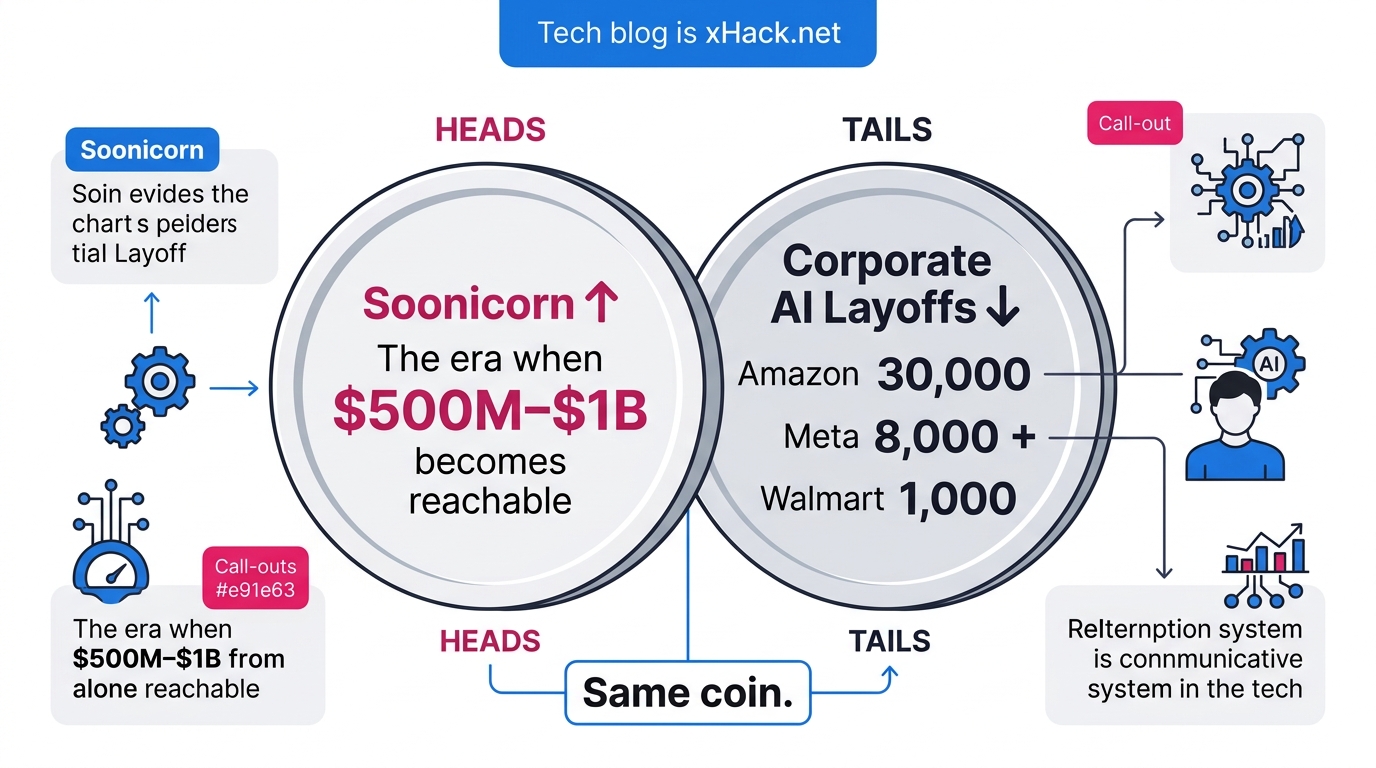
That same day, Amazon had cut 30,000 people. Meta announced it would begin laying off 8,000 employees starting May 20. Walmart issued an internal memo consolidating 1,000 tech roles onto a single platform. All of this — 2026, in quick succession.
“The era when solo founders reach $1B” and “the era when big companies erase people with AI.” These two are the same coin, flipped over. The structure that amplifies individual capability through AI, and the structure that evaporates corporate middle layers through AI, share the same root.
Today I’m breaking down the “other side” through three companies. If you read the Soonicorn piece and landed on “so what’s happening in the other world?” — this is for you. The end goal isn’t fear. It’s a decision framework: which side to stand on.
Amazon: 14,000 + 16,000 = 30,000. The Workforce Elimination That Got Rebranded as “Anti-Bureaucracy”
Starting with the numbers.
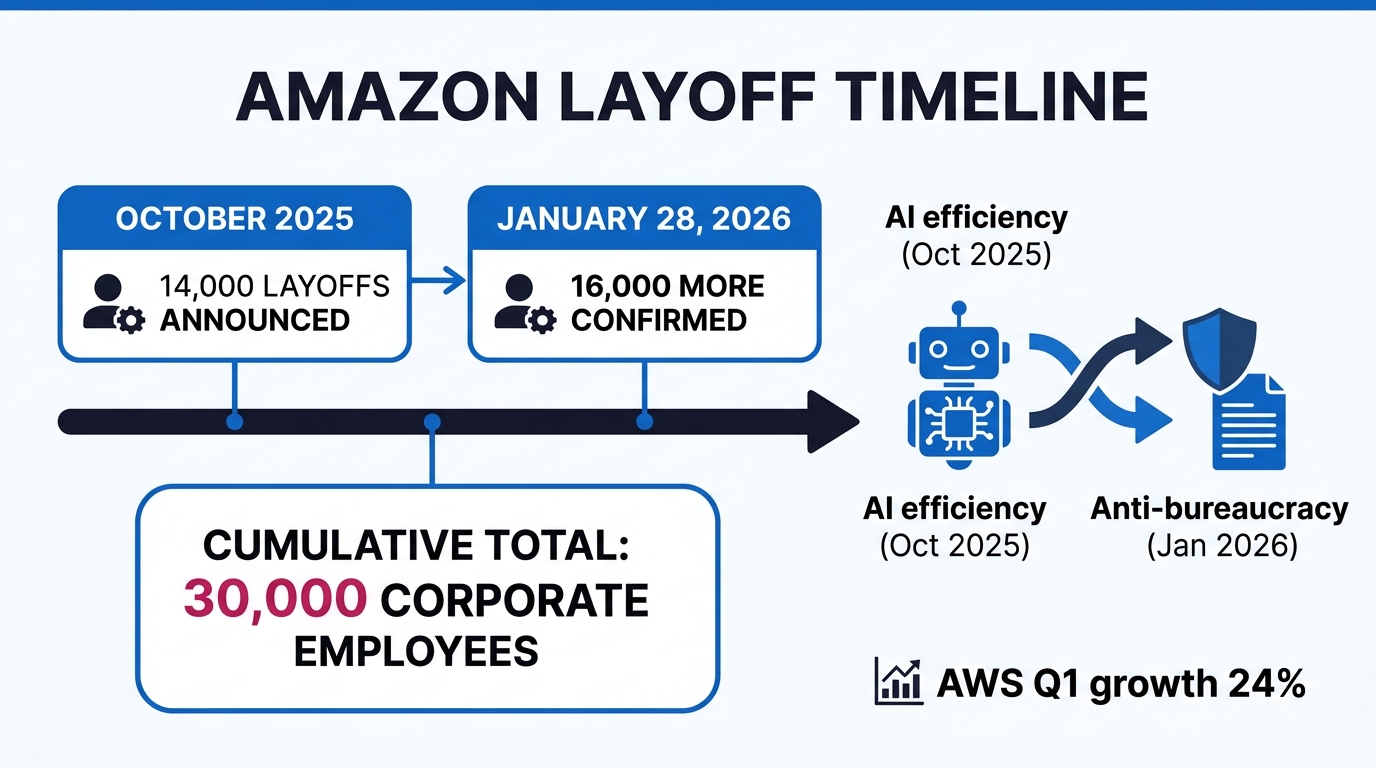
Amazon announced approximately 14,000 full-time layoffs in October 2025, then disclosed an additional ~16,000 cuts effective January 28, 2026 (CNBC, January 28, 2026; GeekWire, January 28, 2026). Total: approximately 30,000. That’s around 9% of Amazon’s corporate workforce. The largest headquarters-level layoff in company history.
Let me translate the scale. 30,000 people is roughly the entire employee count of one Japanese publicly listed company — erased by a single company in four months.
What I want you to focus on is the reframing in Amazon’s public explanation.
In October 2025, CEO Andy Jassy cited “AI-driven efficiency” as the reason. But by the January 2026 additional announcement, the frame shifted to an internal memo from SVP of HR Beth Galetti: “reducing layers, increasing ownership, and removing bureaucracy.” “Bureaucracy” moved to the front; AI moved to the background.
Why the switch? My read: two reasons.
First, investor optics. “AI replaced humans” stated plainly draws ESG scrutiny and regulatory attention. “Organizational flattening” reads to shareholders as “efficiency,” to employees as “growth opportunity.” Same facts, different label.
Second: Amazon’s AWS grew 24% in the same Q1. AWS is the platform capturing the market as enterprises adopt AI. “We’re cutting people with AI” stated openly makes it easier for customers to say “we’re using AWS to cut our people too.” A branding dilemma.
But the operational reality is honest. Business Insider reported in May 2026 that additional layoffs are continuing in Amazon’s “Selling Partner Services” unit (Storyboard18, May 2026). The 30,000 wasn’t the end.
Amazon’s lesson: “AI layoffs” or “bureaucracy reduction” — the label changes, but the number doesn’t. As a reader, what matters is tracking the numbers, not the labels.
Meta: 8,000 Starting May 20. Zuckerberg Said “One Person Can Now Do What Many Teams Did”
Next: Meta.
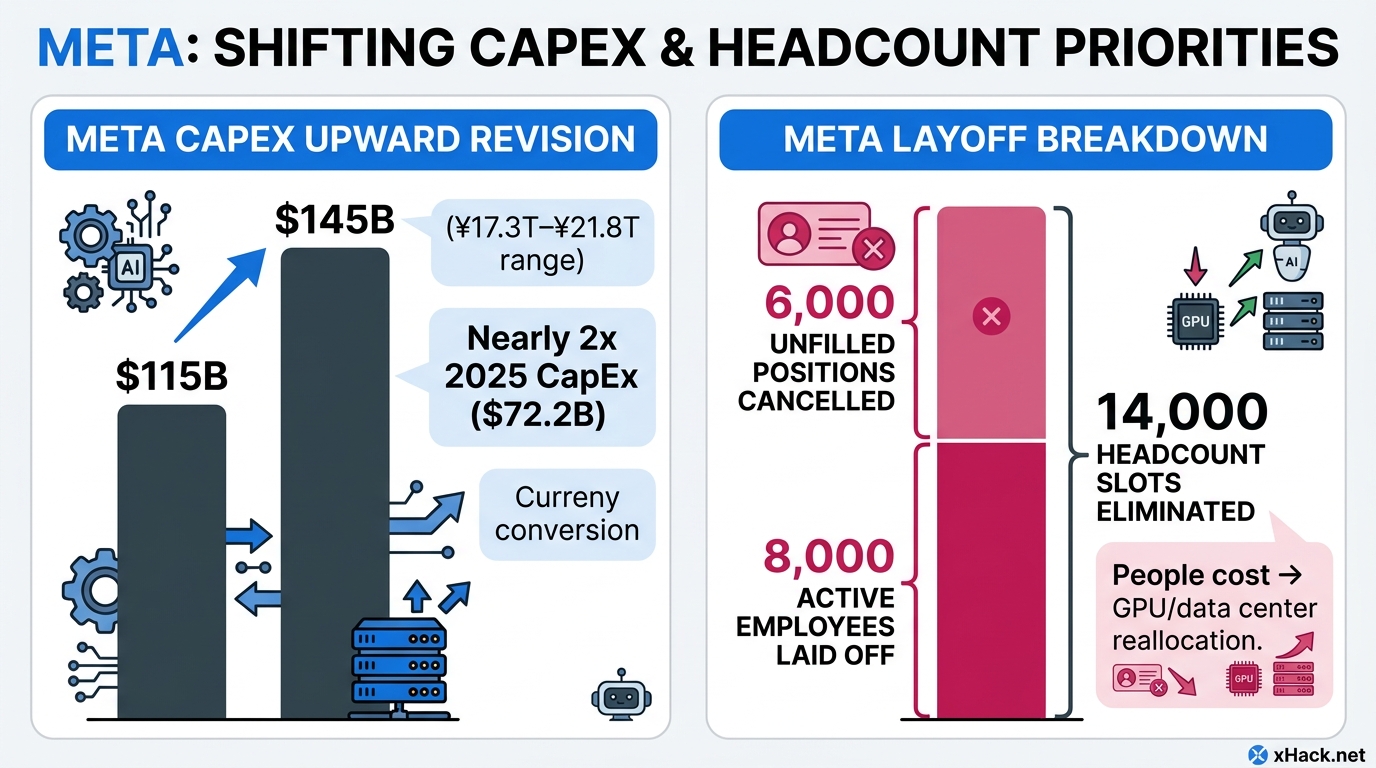
Meta announced plans to lay off approximately 8,000 people (10% of its roughly 78,865 employees) starting May 20, 2026, plus cancel 6,000 unfilled open positions (CNBC, April 23, 2026; Axios, April 23, 2026; CNN Business, April 23, 2026). Effectively 14,000 headcount slots disappearing.
The number that genuinely unsettled me was CapEx.
Meta initially guided 2026 CapEx at $115B–$135B (¥17.3T–¥20.3T). Then at the April 29 earnings call, they raised it to $125B–$145B (¥18.8T–¥21.8T) (Fortune, April 29, 2026). Nearly double 2025 CapEx of $72.2B.
Cutting 8,000 people while pouring ¥21 trillion into AI infrastructure. The structure of redirecting labor costs into data centers and GPUs is exposed here more nakedly than at almost any other company.
Mark Zuckerberg said this in an April all-hands: “Our North Star is building a place where individuals can make outsized impact” — and “what many big teams at Meta are doing can now be accomplished by a single, very talented person” (paraphrased across multiple sources including CNBC, April 23, 2026).
You can hear this as a very forward-thinking organizational philosophy. But flip it and a different picture appears. “One person can do what many teams did” inverted means “everyone except that one person is no longer necessary.”
More corroboration: Alexandr Wang, who oversees Meta’s AI division, wrote in a March 2026 internal memo that the organization needed “a much smaller and more talent-dense team” (reported via Business Insider). The 8,000-person layoff was the numerical expression of that policy.
Here’s where I want to connect this back to yesterday’s Soonicorn piece. Over there, I wrote about the structure of “solo founders reaching $1B.” What Zuckerberg is saying is structurally the same thing — expressed differently. “AI amplifies individual leverage.” The difference is only which side you’re on.
Walmart: 1,000 People. The AI-Denying Memo That Was the Most Honest About AI
Third company: Walmart.
Walmart announced the reduction or reassignment of approximately 1,000 employees in its corporate tech, design, and product divisions on May 12, 2026 (CNBC, May 13, 2026; Washington Times, May 13, 2026; Fast Company, May 13, 2026).
By numbers alone, 1,000 looks small next to Amazon’s 30,000 or Meta’s 8,000. But what makes Walmart interesting is something else entirely.
Walmart’s internal memo doesn’t cite AI as the reason.
The memo was jointly issued by Global CTO Suresh Kumar and EVP Daniel Danker (overseeing AI Acceleration, Product, and Design). It explained: “Over the past year, we consolidated organizations that had been building platforms separately for Walmart U.S., Sam’s Club, and International into a single shared platform. Combining three teams into one creates redundant roles. We’re addressing that.” (via CNBC, Reuters — summary of Walmart internal memo)
Walmart also told Business Insider’s reporters explicitly that “this is not a story of AI automation replacing employment” (Fast Company, May 13, 2026).
This is the polar opposite stance from Amazon and Meta — both of which led with AI-driven efficiency (even if they later reframed it). Walmart led with “this isn’t about AI.”
But don’t stop there. The memo that says AI isn’t the reason is the most honest about what AI actually does. That’s my read.
Here’s why. What does “consolidating three separate organizations onto one shared platform” mean technically? AI-powered recommendation, inventory, logistics, and ad systems generate precision by learning on unified, consolidated data. When data is split across three organizations, AI gets weaker. Walmart didn’t consolidate in order to use AI. They were compelled to consolidate in order to profit from AI. As a result, 1,000 tech roles that existed across three organizations became redundant. Without naming AI as the direct cause, AI-driven structural change is producing the workforce reduction all the same.
One more thing: affected employees were offered two choices — apply for a different internal position, or relocate to Bentonville (HQ, Arkansas) or Northern California. Not “we’re cutting people” but “we’re concentrating people close to the AI.” That’s the most AI-native thing in the Walmart memo.
The Same-Coin Structure Across All Three — Soonicorn Logic Running in Reverse
After laying out the numbers and logic from three companies, here’s the structure that emerges.
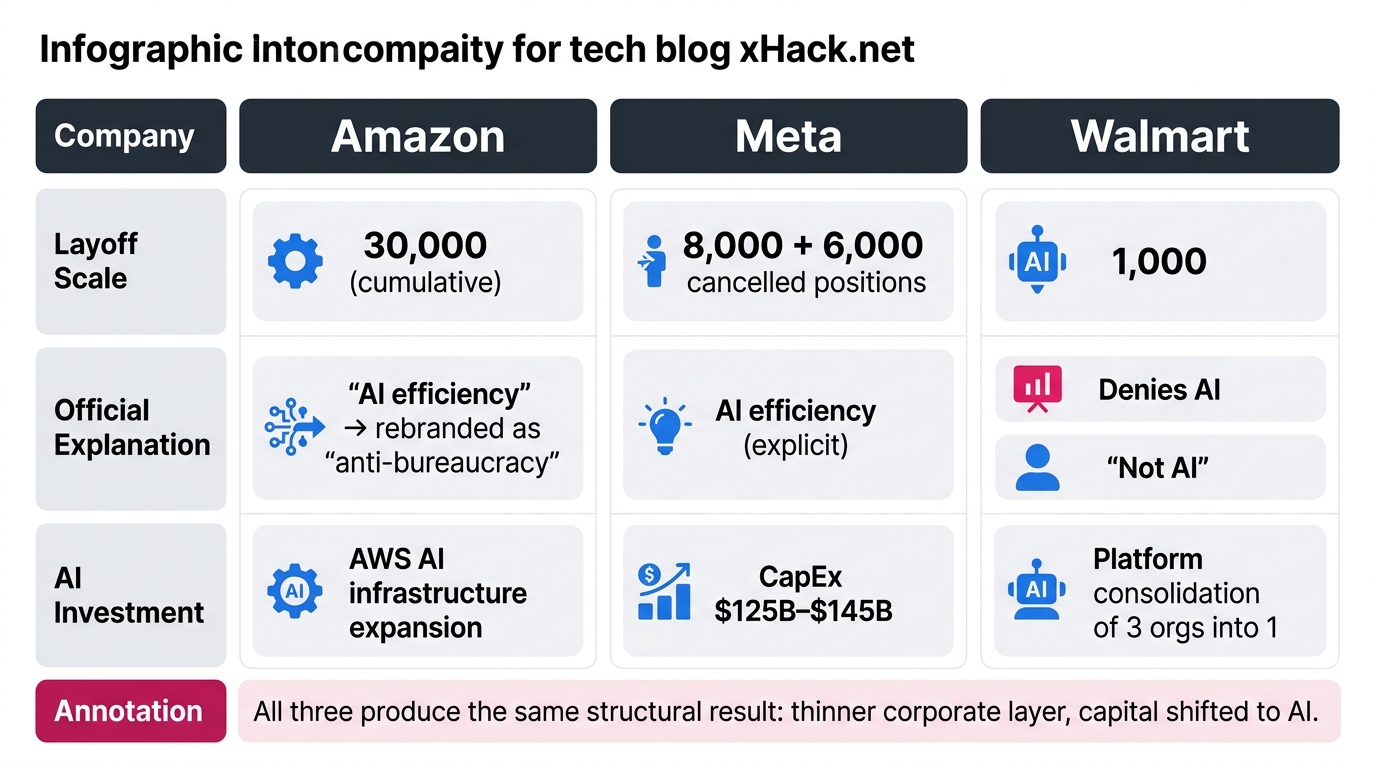
| Company | Layoff Scale | Official Explanation | AI Infrastructure Investment |
|---|---|---|---|
| Amazon | 30,000 (cumulative) | “AI efficiency” → rebranded “anti-bureaucracy” | AWS AI infrastructure expansion (undisclosed amount) |
| Meta | 8,000 + 6,000 cancelled positions | AI efficiency (explicit) | CapEx $125B–$145B (2026) |
| Walmart | 1,000 | Denies AI; cites platform consolidation | 3 orgs unified onto 1 platform |
The official explanations differ across three companies. “AI-driven.” “Bureaucracy reduction.” “Organizational consolidation.” But what’s actually happening is nearly identical:
(1) Middle management and corporate-layer headcount disappears (2) Capital gets redirected to AI infrastructure and AI engineers (3) Remaining employees are expected to “execute more with smaller teams”
And here’s the core point: (1)–(3) runs on exactly the same logic as yesterday’s Soonicorn piece — “the structure where solo founders reach $1B.”
From the solo founder’s side: “I alone run what would have previously required 10 employees — by delegating to AI. That’s why margins exceed 90%. That’s why I can reach $500M–$1B valuation.”
From the corporation’s side: “Work that needed 10 people can now be run by one person with AI. So we free up 9 people’s labor costs and redirect them into AI infrastructure.”
Both are observing the same phenomenon — “AI exponentially amplifying individual leverage” — from different angles. The coin’s face (Soonicorn) and the coin’s back (corporate AI layoffs) are not separate stories. They’re the same coin.
Does that land?
If you read yesterday’s Soonicorn piece and thought “wow, what a time to be alive” — reread it alongside today’s. If you read today’s and thought “wow, what a scary time” — same instruction. “Wow” and “scary” are just two emotional reactions to the same structure, seen from different sides. The only question is: which side are you on?
3 Actions for Solopreneurs Right Now — This Is Design, Not Escape
So what do we — solopreneurs, side-hustlers, aspiring solo founders — take away from here?
If you end this at “big companies are cutting people, how scary,” that’s pure news consumption. That means nothing. I’m proposing three actions.
1. Get on the Side That Replaces Your Own Work with AI
What Amazon, Meta, and Walmart are cutting is almost entirely “corporate middle layer” roles — product, design, tech strategy, corporate planning, parts of HR and finance. The common thread: “jobs that manage people and processes rather than building things directly.”
Conversely, what all three companies are adding: “people who directly operate AI infrastructure” and “people who build things at the front lines.” That Walmart is actively continuing to hire frontline staff (stores, warehouses) is telling.
The solopreneur translation: reduce the ratio of “managing, coordinating, administering” in your own work and increase “building, selling, directly engaging.” That’s the positioning that doesn’t disappear in the AI era.
The examples I profiled in yesterday’s Soonicorn piece were almost all doing exactly this. Building solo, selling solo, delegating management to AI.
2. Stand on the AI Infrastructure Upslope
Meta CapEx $145B. Amazon AWS 24% growth. Walmart platform consolidation. Money is visibly concentrating in AI infrastructure.
What does this mean for solopreneurs and freelancers? It means clients using AI infrastructure are multiplying rapidly. Individual developers using Cursor to build services. Consultants selling Claude-powered automation to corporations. E-commerce operators internalizing customer management with Notion. Position yourself on the side that masters AI infrastructure and sells that mastery to those who haven’t caught up.
The RBF/crowdfunding/AI-low-cost-growth framework was a story about “how money flows are changing.” Today’s story is about “where money is being directed.” Connect both and you see: “both the flow and the destination of money are tilting toward AI.”
3. Learn to Read “AI-Denying” Organizations
Walmart’s memo is important study material. Developing the ability to see that a memo saying “this isn’t about AI” is advancing AI-driven structural change dramatically sharpens your ability to read the world.
Over the next few years, many organizations and many news cycles will say “this isn’t AI-related for us” and “we’re different.” But structurally, the changes will be consequences of being pulled toward AI. Watch data flows and organizational form, not labels.
This applies to selecting freelance clients, making investment decisions, choosing where to transfer to next. “We have nothing to do with AI” — that company might be the most at-risk one. Thinking about why they feel compelled to say that reveals their competitive position.
There’s a CNBC case study showing that “people who quit before being replaced by AI” hit a 2026 record high. What they did was exactly this — while working under bosses saying “we have nothing to do with AI,” they independently concluded “this company, this role is structurally going to be eaten by AI” and moved preemptively.
Takeaway: “Wow” and “Scary” Are Just Two Reactions to the Same Structure
One final compression of today.
(1) Amazon cumulative 30,000. Meta 8,000 + 6,000 cancelled positions. Walmart 1,000. From January through May 2026, just three major companies wiped out 45,000 headcount slots.
(2) The official explanations differ (AI-driven / bureaucracy reduction / organizational consolidation). But the structure in motion is nearly identical — thinning the corporate layer and redirecting capital to AI infrastructure.
(3) This is the exact flip side of the Soonicorn logic I wrote about yesterday — “the structure where solo founders reach $1B.” Both are just observing “AI exponentially amplifying individual leverage” from different angles.
(4) Three actions for solopreneurs: “Get on the side replacing your own work with AI.” “Stand on the AI infrastructure upslope.” “Learn to read AI-denying organizations.”
If you read yesterday and thought “wow,” if you read today and thought “scary” — both reactions are valid, but stopping at either one is where it ends.
Wow and scary, placed side by side: the only choice left is which side to stand on. Are you in the corporate middle layer that gets replaced by AI, or are you the one doing the replacing? Are you the corporate middle manager at Amazon, or the Soonicorn founder?
Right now, today, you can still move to either side. But whether the same sentence can be said six months from now, a year from now, two years from now — that gets decided by what you do today.
“The ones who move win.” I write that line a lot. But I can’t think of many moments where it applies more literally than today.
Sources
- CNBC “Amazon laying off about 16,000 corporate workers in latest anti-bureaucracy push” (January 28, 2026) https://www.cnbc.com/2026/01/28/amazon-layoffs-anti-bureaucracy-ai.html
- GeekWire “Amazon confirms 16,000 more corporate job cuts, bringing total to 30,000 since October” (January 28, 2026) https://www.geekwire.com/2026/amazon-confirms-16000-more-job-cuts-bringing-total-layoffs-to-30000-since-october/
- Storyboard18 “Amazon layoffs 2026: Seller services unit hit by fresh cuts after 30,000 job losses amid AI push” (May 2026) https://www.storyboard18.com/brand-marketing/amazon-layoffs-2026-seller-services-unit-hit-by-fresh-cuts-after-30000-job-losses-amid-ai-push-98118.htm
- CNBC “Meta will cut 10% of workforce as company pushes deeper into AI” (April 23, 2026) https://www.cnbc.com/2026/04/23/meta-will-cut-10percent-of-workforce-as-it-pushes-more-into-ai.html
- Axios “Meta to lay off 8,000 as part of AI efficiency push” (April 23, 2026) https://www.axios.com/2026/04/23/meta-layoffs-ai-efficiency-push
- CNN Business “Meta to cut 10% of staff as it pours billions into AI” (April 23, 2026) https://www.cnn.com/2026/04/23/tech/meta-layoffs-10-percent-staff-ai
- Fortune “Meta just bumped its 2026 capex forecast up to as much as $145 billion” (April 29, 2026) https://fortune.com/2026/04/29/meta-zuckerberg-145-billion-ai-spending-roi/
- CNBC “Walmart cuts 1,000 roles to simplify operations, Reuters reports” (May 13, 2026) https://www.cnbc.com/2026/05/13/walmart-cuts-1000-roles-to-simplify-operations-reports.html
- Washington Times “Walmart cuts or relocates about 1,000 corporate workers in tech consolidation” (May 13, 2026) https://www.washingtontimes.com/news/2026/may/13/walmart-cuts-relocates-1000-corporate-workers-tech-consolidation/
- Fast Company “Walmart layoffs today: tech jobs cut; memo does not cite AI” (May 13, 2026) https://www.fastcompany.com/91541504/walmart-layoffs-today-tech-jobs-cut-memo-does-not-cite-ai
Related Articles
- “Forget Chasing Unicorn.” How the NYT DealBook’s Label of 2026 as “the Soonicorn Year” Quietly Rewrote the Startup Endgame
- It Wasn’t “One Person, $1.8 Billion.” The “(and His Brother)” the NYT Buried in the Headline Rewrote What Solopreneur Even Means
- JPMorgan Asked 100 Billionaires Worth $500B+ About Their “7 Habits.” I Translated Them for the Solo Founder Scale

女性だからこそ、AIを使いこなさなきゃって思ってる。仕事も、副業も、推し活も、旅行も、全部やりたい。人生一度きりなのに時間は足りないじゃん?だからAIに任せられることは全部任せる。浮いた時間で本当にやりたいことをやる。それがあたしのスタイル。ここにはあたしが実際にやったことをまとめてるだけ。誰かのためになったらいいなって思って書いてるよ。