It Wasn't 'One Man.' The NYT Buried '(and His Brother)' in the Headline — and That Parenthetical Rewrites Solo Entrepreneurship.
The $1.8B startup built 'alone' with AI turned out to be two brothers dividing the work. Following the NYT source text reveals a new thesis: the minimum viable unit for an AI-era solopreneur is 2. Written for anyone feeling the loneliness of going independent.
What you'll learn in this article
- The key point to grasp before reading the full article
- How the issue changes practical decisions after reading
- Which follow-up article is worth opening next

Hey — did you catch that NYT piece from April about “one man (and his brother) who built a $1.8 billion company”?
It probably came across your social feed framed as “built a $1B company alone with AI.” That was my first read too. Anthropic CEO Dario Amodei had just predicted a 70–80% chance that a solo-founder billion-dollar company would emerge by 2026 (Inc.), so naturally the story felt like it was proving him right.
Then in May, multiple summaries reported an additional statement attributed to Dario himself: “Two-person AI companies have already crossed $1B. Single-person companies are still in the hundreds of millions.” (Substack · Linas Beliūnas summary — based on a summary, primary statement unconfirmed.) Even as a secondhand account, this means the man who made the solo-founder prediction was saying “two people got there first.”
But here’s the actual headline: “How A.I. Helped One Man (and His Brother) Build a $1.8 Billion Company” (NYT, Apr 2, 2026, reporter: Erin Griffith. Story indexed at Techmeme).
Whether you notice the “(and His Brother)” in parentheses determines how you think about what team to build next. The moment I clocked that parenthetical, I dropped the definition of “solopreneur = one person.”
Today I’m redefining the minimum viable unit for a solopreneur in the AI era. This one’s for anyone who wants to go independent, anyone who already has and feels isolated, and anyone afraid of partnering up.
The “$1.8B Alone” Story — Actually Two Brothers Splitting the Work
Let me lay out the facts first.
The company is Medvi. Here’s the NYT sourced summary (also confirmed via Techmeme and Bens Bites):
- Founder: Matthew Gallagher, 41, based in Los Angeles
- Co-founder: His younger brother, Elliot Gallagher
- Business: “Medvi,” an online GLP-1 prescription service (GLP-1 = a class of obesity medications currently experiencing explosive demand in the US)
- Initial investment: $20,000
- Launch timeline: 2 months
- 2025 revenue (first full year): $401M
- 2026 run rate: $1.8B
- Employees: 2 — just the brothers
Most people’s eyes go straight to “two months to launch,” “$20K to $1.8B,” “2 employees.” But the number worth really examining is the meaning of “2.”
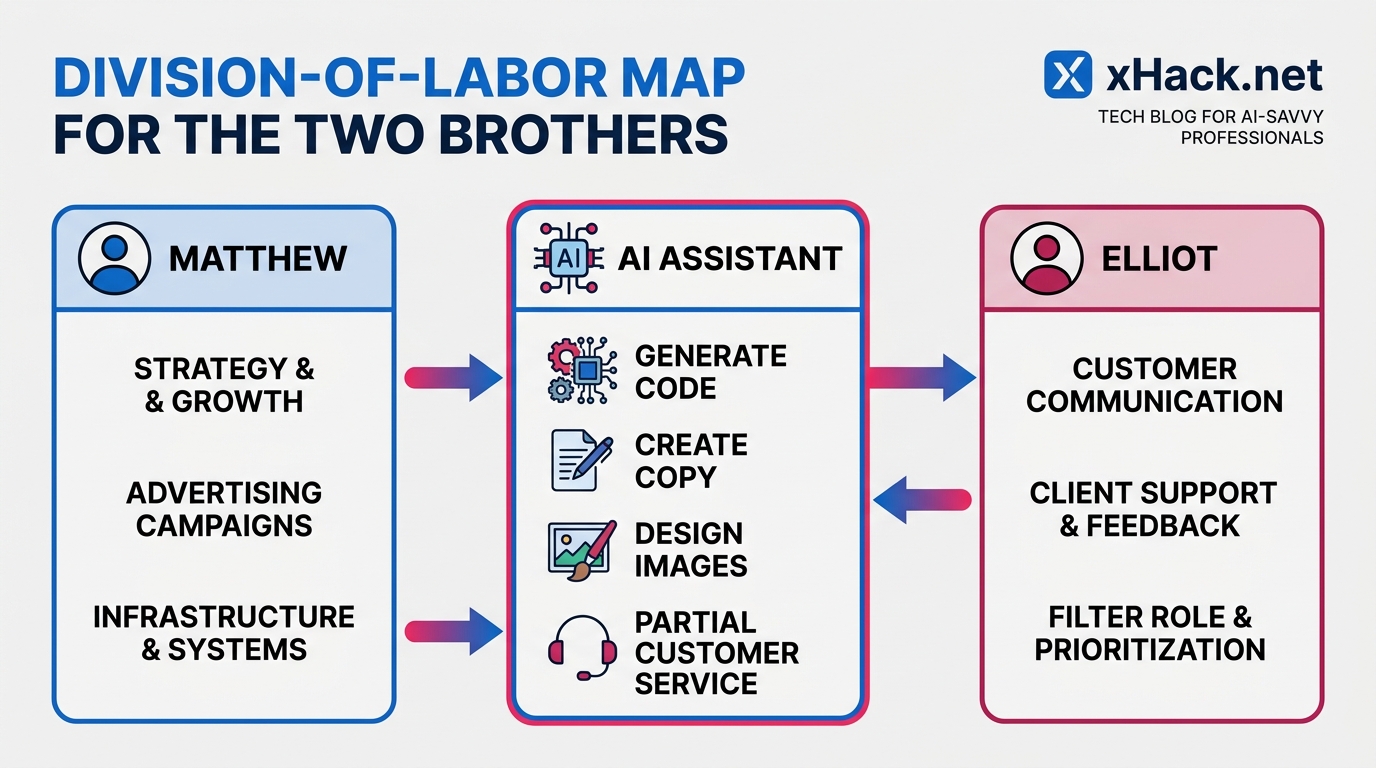
From the NYT article, Elliot himself said: “I just helped take a lot of the weight off of him.” Matthew focused on strategy, advertising, and the online infrastructure. Elliot served as the filter for customer communication.
In other words: AI couldn’t replace both “the person thinking strategy” and “the person receiving frontline feedback.” AI plus one person didn’t get them to $1.8B. Two people changed the scale entirely.
One dark footnote worth including: the week after the NYT piece ran, reports emerged that the FDA had already issued a Warning Letter to Medvi (Drug Discovery Trends). Concerns cited included AI-generated fake physician profiles and fabricated before/after images — advertising practices flagged as problematic for a medical service (Futurism). The NYT later added significant corrections and updates to the story (Futurism follow-up). The $1.8B “one man (and brother)” story has regulatory and ethical shadows behind it. I’ll come back to this.
“Solopreneur = One Person” Is an Outdated Definition
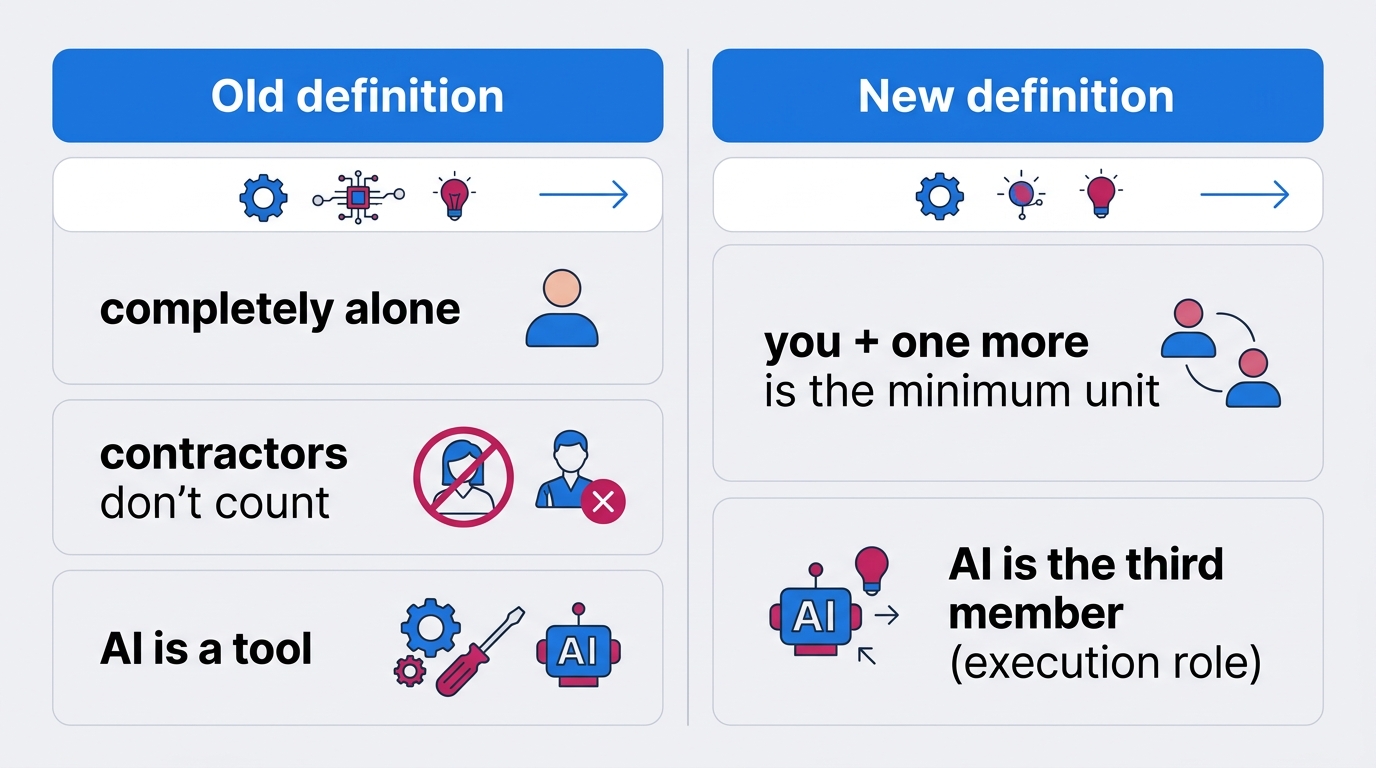
I used to think solopreneur meant completely alone. A holdover from my corporate days — “leaving an organization means not running in a pack.” Especially right after going independent. “I’m doing it solo” was a point of pride.
About two years in, it hit me. I was saying “doing it alone” but actually relying on contractors, freelancers, mentors, and friends who happened to be engineers giving me free advice — effectively assembling something like a team. Wait — this isn’t “solo.”
The Gallagher brothers were the same. They probably didn’t fully register that they “weren’t alone,” because family doesn’t tend to get counted as a “team.” And yet the NYT reporter precisely wrote “(and His Brother).” There’s something to respect in that accuracy.
When I covered Mercor (three 22-year-olds reaching $10B), I emphasized the number “3.” Look at high-growth AI-era companies, and 2–3 person micro-teams emerge as a common thread.
The reason is simple. AI can partially replace “thinking,” “building,” and “executing.” What it can’t replace is “someone to bounce decisions off” and “someone whose presence keeps you sane.” Without those, you burn out even with AI. One person changes everything.
Dario’s prediction, read carefully, says “one employee” — meaning including the founder, that’s 2 people. Misread this and you end up with a bizarre self-imposed rule: “I have to hit $1B completely alone.” Drop that constraint.
Three Reasons Brothers Made the Strongest Team
It’s probably not coincidental that NYT focused on Matthew and Elliot. Some things worked specifically because they were brothers. Here’s my read:
1. Zero decision latency
Normal startups incur meeting overhead for co-founder decisions: “Should we do this?” Brothers bypass all of it. One exchange in a chat thread and it’s done. Medvi’s two-month launch timeline wouldn’t have been possible without this near-zero decision cost.
2. Zero trust cost
Interviews, reference checks, three-month probationary periods — the costs you can’t eliminate even in the AI era. Family skips all of it. The reason Elliot immediately stepped into the “take the weight off” role is that the trust foundation was already fully built.
3. Profit-sharing negotiations disappear
This one’s surprisingly huge. Equity disputes are among the top causes of startup fallouts. With brothers, “we’ll figure it out later” is enough to keep moving. A relationship that doesn’t implode over equity even at $1.8B was already established before the business started.
…and as I write this, I’m thinking: “What do people without brothers do?”
I have a younger brother, but he has zero interest in business. When I went freelance, I had no family to partner with. So I had no choice but to build “sibling-level trust” outside of blood. Next section covers how.
Three Conditions for Building “Sibling-Level Trust” Without Blood Ties
These are the criteria I developed over three years of being independent — reverse-engineered from analyzing the Medvi brothers.
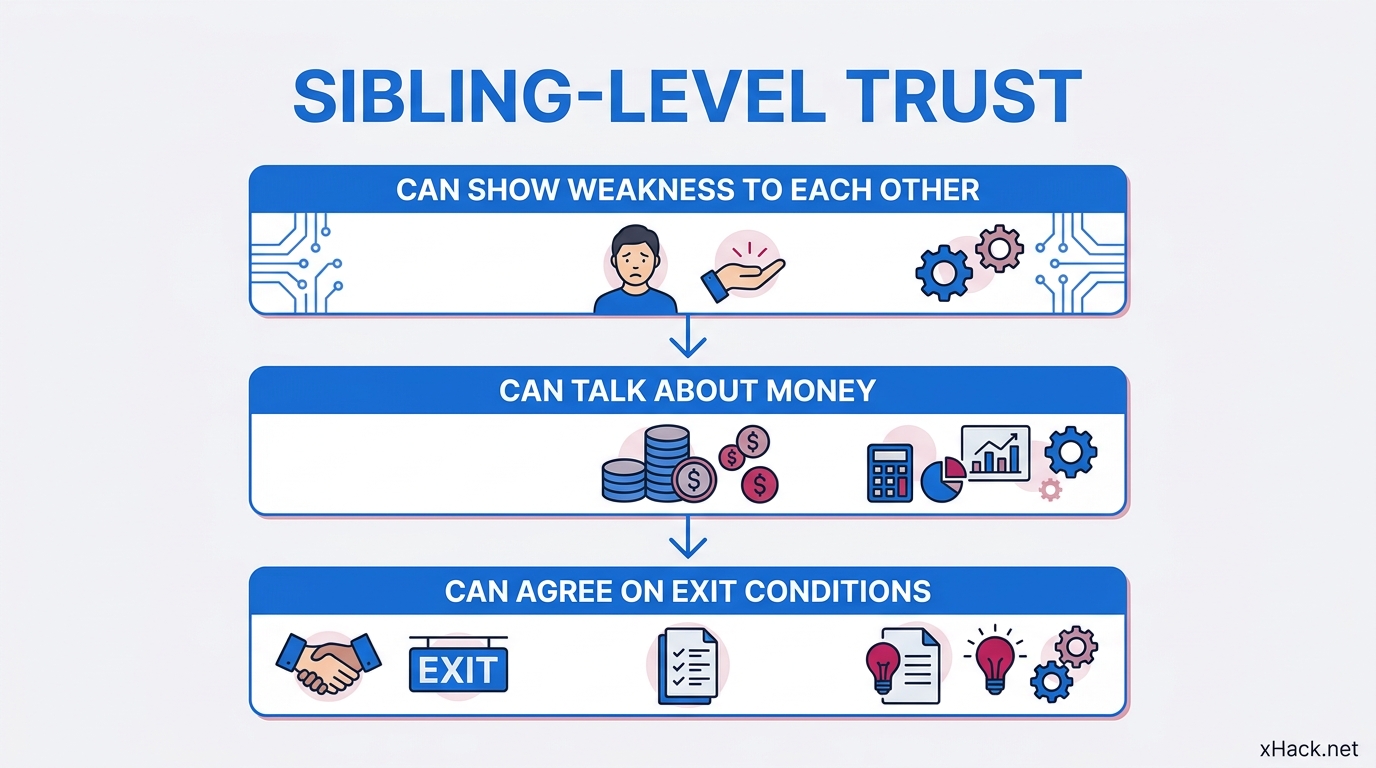
Condition 1: A relationship where you can already show weakness to each other
Brothers are strong because they don’t have to look impressive. To create this with someone new, the question is whether you can be vulnerable before the business even starts. Someone you’ve gotten drunk and complained to outlasts someone you’ve only seen in polished presentation mode.
Condition 2: You can talk money from day one
Brothers bypass the awkwardness of money conversations. When partnering with someone new, try to make one of your first three conversations about money. “How much do you need?” “Would you keep going even at a loss?” “How are you supporting your family?” The person it doesn’t feel awkward with is the person you can partner with.
Condition 3: You can agree on exit conditions from the start
Even brothers sometimes clash. But the family premise tends to make “leaving” feel unthinkable. New partnerships are the opposite. Write down “when and why we’d part ways” up front. This matters more than any operating agreement. Only partner with someone who can put that in writing.
In my piece on Zoom selecting their “Top 50 Global Solopreneurs”, all five who received $30K had something in common: they looked solo from the outside but each had a small, trusted team behind them. What Zoom valued wasn’t individual ability — it was the quality of the invisible team supporting the individual.
Don’t Justify Post-Independence Loneliness as “Just What Solo Looks Like”
This is what I most wanted to write today.
If you’re 6–12 months into being independent, listen. My first year was brutal isolation. My conversations with former colleagues drifted apart. Freelance peers started to feel like competitors. Family kept saying “settle into something stable first.”
And I made the wrong justification: “This is what it feels like to be a solopreneur.” “Solo means concentrated, which means productive.”
Neither was true. The cause was loneliness. I was performing focus while scrolling social media.
When I covered the surge in Gen-Z founders, watching how young founders gathered in communities made it clear: “powering through alone” is not a virtue. If you can’t resolve the loneliness, productivity drops. The Medvi brothers worked because the security of having each other was structural.
So to anyone feeling that post-independence loneliness: stop telling yourself “this is the solopreneur’s fate” right now. That’s rationalizing stagnation — I did it too. What you should actually do is find one person to partner with. It doesn’t have to be a co-founder. A monthly sounding board is enough.
But let me return to the Medvi shadow one more time. The FDA warning context isn’t just about scale. AI generates content fast and can deploy at volume without approval. A two-person setup making all the calls has weak compliance brakes. In regulated industries, speed comes at the cost of fragility. Choose your sector carefully. If you want to emulate Medvi, copy the clarity of role division — not the speed.
This Week’s 15-Minute Action: Map Your “Potential Partner” List
For everyone who made it this far — here’s a concrete action you can start today. Takes 15 minutes.
- Get a piece of paper or open a blank note
- Write out up to 10 people you currently have conversations with (family, friends, former colleagues, clients, gym acquaintances — all of them)
- Score each one with ✓ or ✗ on the 3 conditions:
- Can you show weakness to each other?
- Can you talk about money?
- Can you agree on exit conditions?
- If even one person has all three ✓s — invite them for coffee this week
- If no one has all three ✓s — make a plan to build “can show weakness” with someone over the next 3 months
That’s it. Just that will change your business in 6 months.
Right now in year 3 of being independent, I have 3 people I work alongside. Not co-founders. But people who check my decisions weekly. Compared to when that was zero, my decision-making speed has tripled.
Conclusion: The Minimum Viable Unit for a Solopreneur Is “2”
Now you understand why NYT wrote “One Man (and His Brother).” The AI-era solopreneur’s minimum viable unit isn’t “completely alone” — it’s “2–3 people moving together, with AI as a third member, and trust between humans.” Matthew having a brother was lucky. But there are ways to replicate the luck.
- A relationship where you can show weakness to each other
- Money conversations from day one
- Exit conditions agreed on from the start
Find someone who meets all three before you start your business — or starting from right now. That’s my proposal.
One last time: don’t justify post-independence loneliness as “the solopreneur’s fate.” Just like $1.8B had a brother behind it, your results have someone behind them too. “You don’t have to do it alone” — make that your operating assumption starting today.
You’ve got no time to hesitate, and failing isn’t that big a deal. Concretely: tonight, paper and pen, write out ten names. Just that changes your week. It changed mine from the day I did it.
Sources & References
- NYT “How A.I. Helped One Man (and His Brother) Build a $1.8 Billion Company” (Apr 2, 2026, reporter: Erin Griffith) — Techmeme summary / Bens Bites summary
- Inc. “Anthropic CEO Dario Amodei Predicts the First Billion-Dollar Solopreneur by 2026”
- Substack · Linas Beliūnas “Dario Amodei May statement: ‘2-person AI companies already over $1B’” ※ summary-based, primary statement unconfirmed
- Drug Discovery Trends “The NYT spotlighted MEDVi. The FDA had already warned…”
- Futurism “Why Is the NYT Laundering the Reputation of a Sleazy AI Startup…” / NYT corrections follow-up
Internal Links

女性だからこそ、AIを使いこなさなきゃって思ってる。仕事も、副業も、推し活も、旅行も、全部やりたい。人生一度きりなのに時間は足りないじゃん?だからAIに任せられることは全部任せる。浮いた時間で本当にやりたいことをやる。それがあたしのスタイル。ここにはあたしが実際にやったことをまとめてるだけ。誰かのためになったらいいなって思って書いてるよ。