'I Wrote 8 Articles—But Where Do I Actually Start?': Consolidating GEO, AEO, LLMO, and SEvO into a Single Priority Scoring Sheet
GEO, AEO, LLMO, SEvO. As the author of this 8-part series, I'm presenting a single scoring sheet for deciding 'what to do next' in the era of 8-front search.
What you'll learn in this article
- What changed in AI search and content discovery
- Which metric or operating rule matters before shipping more content
- Which follow-up article expands the strategy from another angle
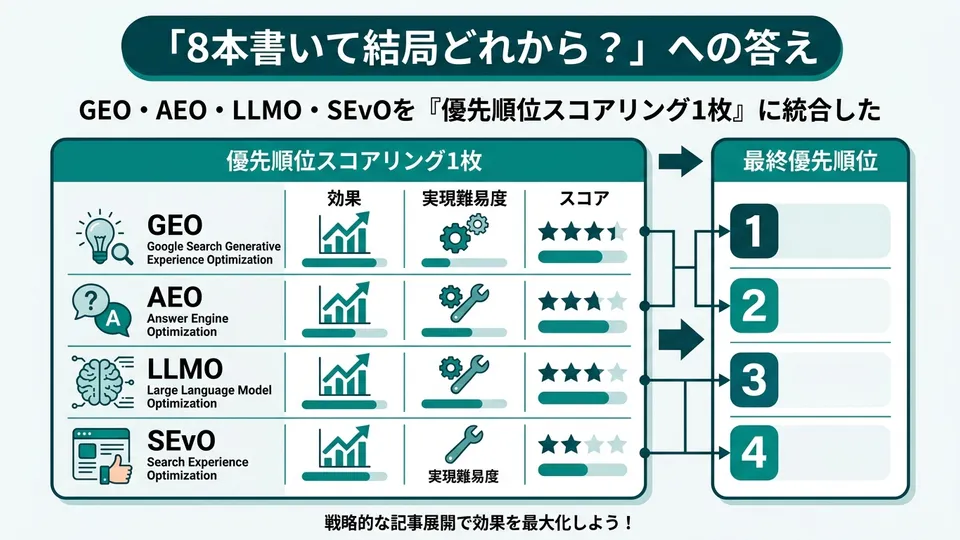
“So, where am I actually supposed to start?”
It’s been two months since I started writing the GEO series. This question lands in my inbox just about every week.
GEO (Generative Engine Optimization), AEO (Answer Engine Optimization), LLMO (Large Language Model Optimization), SEvO (Search Everywhere Optimization). I’ve sorted out the terminology across eight articles. I’ve covered the practical guide, the three-layer integration strategy, and how to handle the five entry points.
And yet this question won’t go away, for one simple reason. “There’s no time to do it all.”
Today, I’m tackling that honest concern head-on. For readers who’ve followed all eight articles, I’m presenting a single priority scoring sheet to help you decide on “the one thing to do next.” I’ll skip the theory. I’m zeroing in only on “what to start with,” not “what to do.”
I’ve written this with solo founders, solo marketers, and side-hustle bloggers in mind. My goal is that by the time you finish reading, your own scoring sheet is filled in with pen and paper.
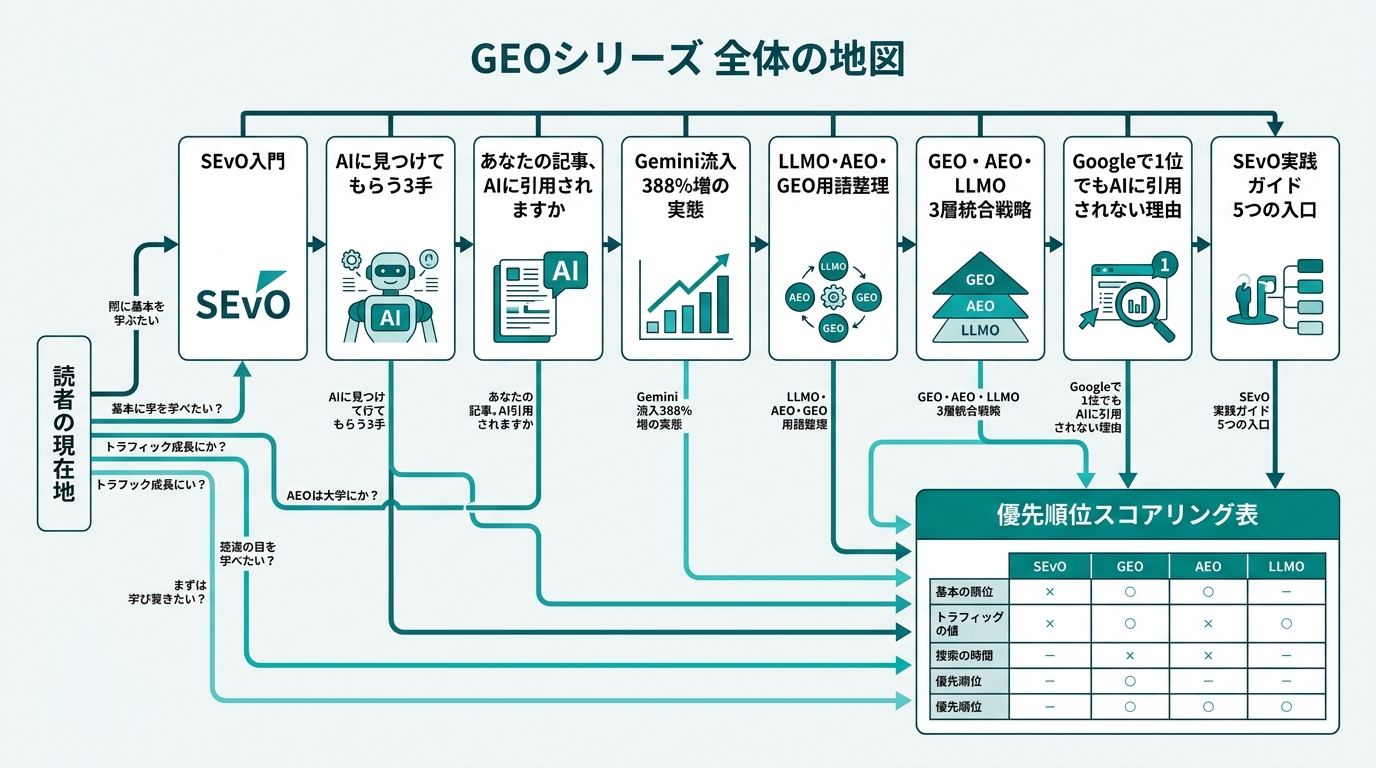
The 2026 Search Map: Why “Doing It All” Stopped Being Realistic
First, let me confirm with numbers why integration is necessary. Skip this and the foundation for setting priorities collapses.
On Google Search going zero-click, data has been reported showing “over 60% of queries are zero-click” (StatusLabs, 2026 blog post: https://statuslabs.com/blog/how-ai-search-may-reward-credibility-over-clicks ). This figure is a summary expression within their explanatory article, not the original survey instrument. Still, the trend of users completing their journey on the search results page is something multiple observation organizations continue to report.
In AI search, ChatGPT has been observed holding the largest share across multiple measurements. The numbers vary widely depending on measurement methodology and target media. Rather than focusing on absolute values, treat this as a “transition period from ChatGPT dominance to multiple players.”
Corporate movement is fast too. According to a report Google Cloud released on April 22, 2026, 52% of executives said they had already deployed AI agents in production (Google Cloud “ROI of AI: How agents help business”: https://cloud.google.com/transform/roi-of-ai-how-agents-help-business ).
Absolute numbers vary by survey. Still, the trends align.
- Google Search has shifted to a “no-click” surface
- AI search entry points have fragmented into 4–5 surfaces in just a few years
- Companies have started handing tasks over to AI agents
What many marketers run into here is the “surfaces multiplied, but people and time didn’t” problem.
For example, if you can only secure 100 hours per month, it’s impossible to address Google, ChatGPT, Perplexity, Gemini, TikTok, and YouTube with the same intensity. And yet there are tons of articles that “look at all surfaces equally.” It’s only natural that you finish reading and still don’t know where to start.
I myself published the SEvO Practical Guide (/en/blog/n2026041500007901/) with this discomfort still lingering. I could write up to “cover the five surfaces.” But the priority among the five differs by reader. I hadn’t gone deeper than that.
Today’s article goes there.
Why “Integration”—The Structure Where Individual Optimization Breaks Down
Before deciding priorities, let me share one more premise. The story that “individual optimization is already broken.”
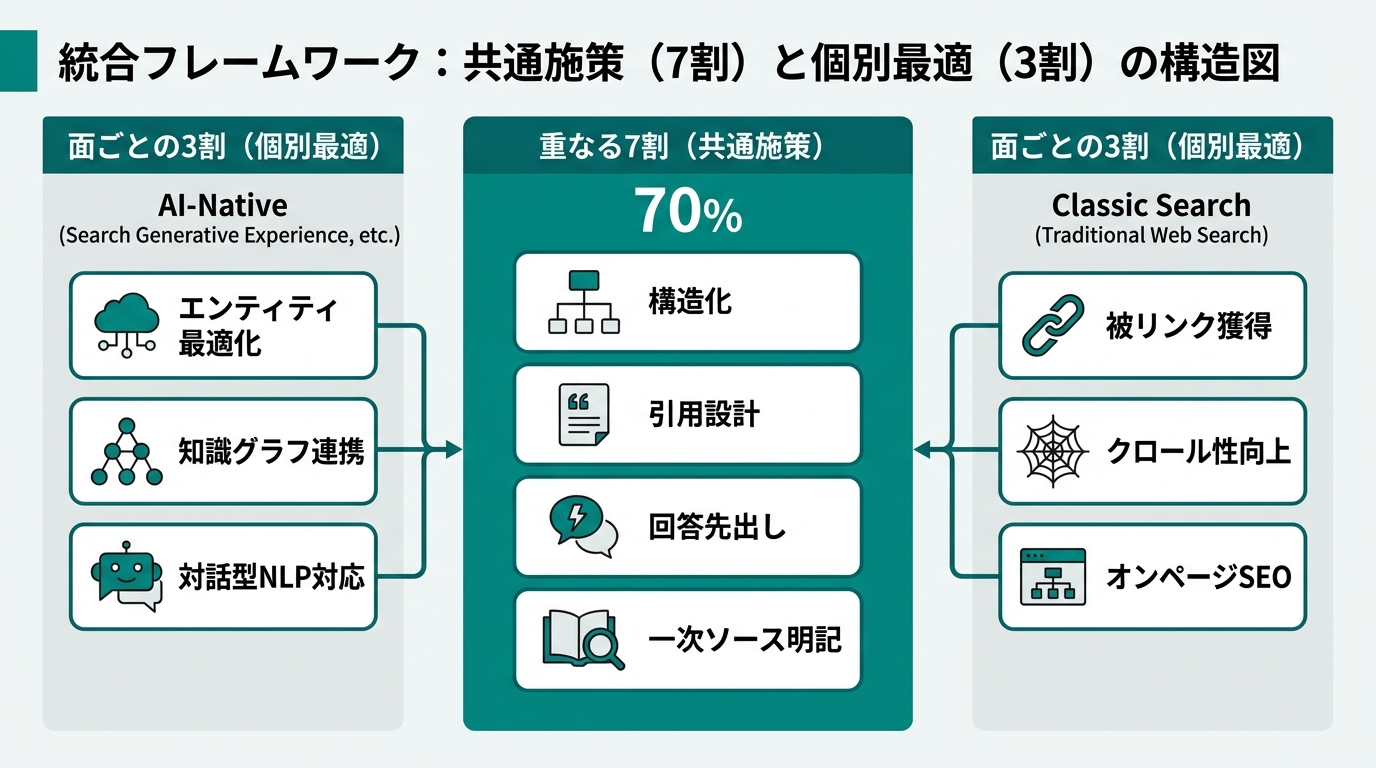
GEO, AEO, LLMO. They look like different terms, but in actual practice, the tactics overlap by more than 70%.
- Write structured content
- Clearly state sources, proper nouns, and figures
- Build paragraphs that AI can easily cite
- Place direct answers to search intent at the top
These four points come up no matter which of the three terms you start from. At the tactic level, you’re doing nearly the same things. I covered the detailed terminology in other articles (/en/blog/n2026032800002701/, /en/blog/n2026032900003001/), but since that’s not the main thread today, I’ll just state the conclusion.
The problem is operations that move the “overlapping 70%” in fragmented ways.
If you split work into a GEO lead, AEO lead, and SNS lead, you end up doing the same tactic three times. Content fractures into three subtly different versions across three surfaces, and measurement can’t be unified. “Which tactic worked on which surface” becomes unknown to anyone. This is a mistake I made myself, and I’ve watched several teams still dragging through the consequences.
The purpose of an integration framework is to “move the overlapping 70% just once.” The remaining 30% goes to surface-specific optimization. Get this “7:3 allocation philosophy” into your head ahead of time. It pays off in the priority scoring later.
The Integration Framework on One Page: A 4 × 3 Master Plan
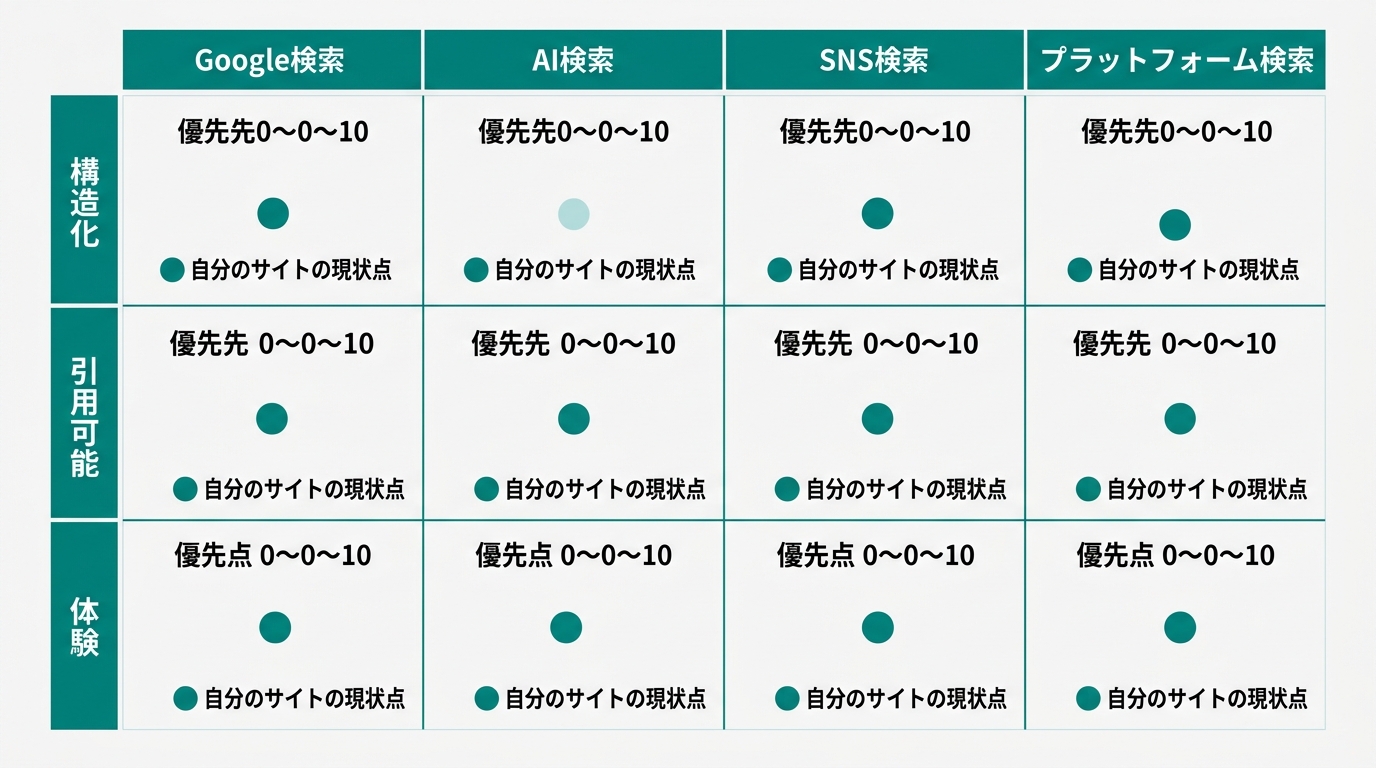
Now to the main topic. I’ve organized this 8-front search era into a “4 surfaces × 3 layers” matrix. This is the skeleton of today’s map.
4 Surfaces (horizontal axis)
- Google Search—the target of traditional SEO. Backlinks, domain strength, technical SEO
- AI Search—ChatGPT, Perplexity, Gemini, Claude. Centered on citation and summarization
- Social Search—TikTok, Instagram, X, YouTube. Search results in feed format
- Platform Search—Internal search on Amazon, Rakuten, the App Store, and specialized e-commerce sites
3 Layers (vertical axis)
- Structural Layer—is the content in a form that “machines can extract meaning from”?
- Citable Layer—does it contain “fact clusters” that AI wants to incorporate into its answers?
- Experience Layer—do human readers and viewers stay and take action?
If you try to fill all 4 × 3 = 12 cells, you’re back to “doing it all.” So in the next step, we prioritize across the 12 cells.
What’s important here is to “think in cell units.” Don’t look at “Google Search overall”—look at “Google Search × Structural Layer.” Don’t look at “AI Search overall”—look at “AI Search × Citable Layer.” Raise the granularity, and you’ll see what’s understaffed and what’s over-invested.
I once mapped my own content onto this matrix to inspect it. The result was unexpected. Google Search structuring scored close to perfect. The platform search citable layer was nearly zero, I realized. I’d thought I was working “evenly across all surfaces,” but in reality I was concentrated in three cells.
Another benefit of this matrix is that it “makes the cells you don’t need to do visible.” For instance, the official site of a medical corporation can give up on TikTok Search × Experience Layer for now. Within platform search, App Store internal search is also irrelevant. I think the hidden value of the 12-cell matrix is gaining the “courage to drop.”
The Priority Scoring Sheet: Where Should You Start Right Now?
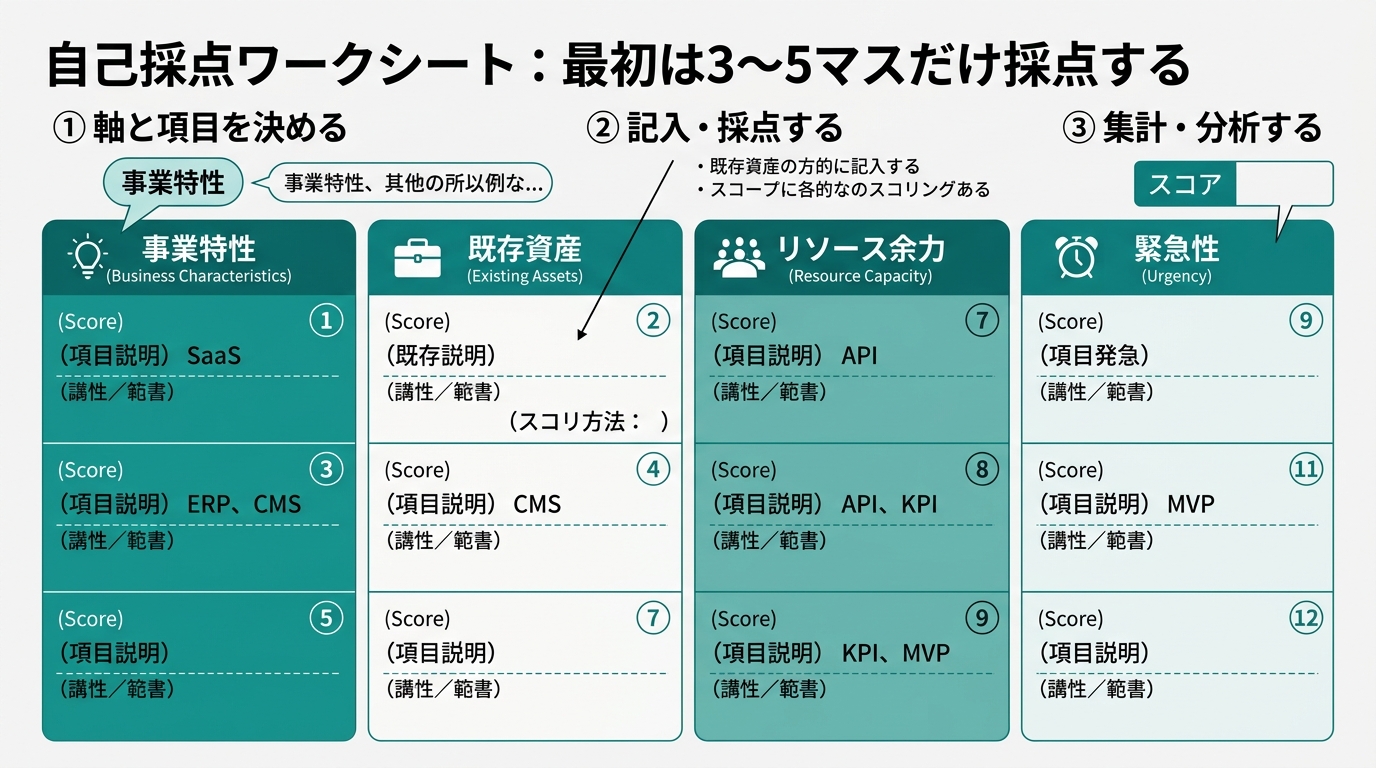
Here’s the heart of today’s piece. I’m presenting a 4-axis scoring sheet for deciding “the next cell to work on” out of the 12 cells.
Score each cell on the four axes below, then start with the cell with the highest total.
Axis 1: Business Fit Score (0–10 points) Are the readers of that cell close to your prospects? For example, it’s a stretch for a B2B SaaS to score TikTok search high. For an e-commerce business, platform search will be close to 10.
Axis 2: Existing Asset Leverage Score (0–10 points) Can you repurpose existing assets (blog articles, videos, product pages, reviews, etc.) into that cell? Low if you’re starting from scratch, high if repurposing covers it.
Axis 3: Resource Capacity Score (0–10 points) Do you have the expertise required for that cell’s tactics in-house? The bigger the outsourcing or learning cost, the lower.
Axis 4: Urgency Score (0–10 points) If you leave that cell alone, how much will the gap with competitors widen in six months? Surfaces that change fast like AI search score high; surfaces that change slowly like Google Search backlink acquisition tend to be low.
Scoring Example 1: B2B SaaS
Let me show how this actually plays out with a concrete example. Suppose you’re running an “accounting SaaS for SMBs,” and let’s score just three cells.
| Cell | Business Fit | Existing Assets | Resources | Urgency | Total |
|---|---|---|---|---|---|
| Google Search × Structural | 9 | 8 | 8 | 4 | 29 |
| AI Search × Citable | 9 | 6 | 5 | 9 | 29 |
| TikTok × Experience | 3 | 2 | 2 | 5 | 12 |
In this case, the top two cells tie. You’d hesitate over which to do first.
So introduce a fifth axis: “smallness of starting effort.” Only when there’s a tie, choose the one you can start smaller with. For Google Search × Structural, adding schema markup to existing articles is enough. AI Search × Citable requires reworking article structures and is more labor-intensive. Google Search × Structural in the first month, AI Search × Citable starting month two. That kind of sequence comes into view.
Scoring Example 2: D2C Apparel (E-commerce Business)
Let’s look at a different pattern. Suppose you’re a D2C apparel brand getting most traffic from Instagram—the result changes considerably.
| Cell | Business Fit | Existing Assets | Resources | Urgency | Total |
|---|---|---|---|---|---|
| Platform Search × Citable | 10 | 7 | 6 | 8 | 31 |
| Social Search × Experience | 9 | 9 | 7 | 7 | 32 |
| AI Search × Citable | 6 | 4 | 4 | 6 | 20 |
In this case, Social Search × Experience Layer is the first cell. Turning Instagram product pages into video, restructuring UGC, revising hashtag strategy. Since you can maximize reuse of existing image assets, the resource capacity score is also high. The AI search citable layer can wait. Just by comparing two examples, you can see that the combination of business fit and existing assets shifts priorities surprisingly much.
Scoring Example 3: Personal Blog / Solo Media
For someone running a side-hustle blog, it’s different again.
| Cell | Business Fit | Existing Assets | Resources | Urgency | Total |
|---|---|---|---|---|---|
| AI Search × Citable | 9 | 7 | 7 | 9 | 32 |
| Google Search × Structural | 8 | 8 | 6 | 5 | 27 |
| YouTube Search × Experience | 5 | 3 | 3 | 6 | 17 |
The strength of a personal blog is “agility.” You don’t need organizational consensus, so the resource capacity score runs a bit higher. On top of that, getting cited by AI search is an area where personal sites can win. “AI Search × Citable” comes out as a clear winner.
Tips for Scoring
The trick to this scoring is “don’t score every cell.” At first, you can skip surfaces that are clearly unrelated to your business. Score only the remaining 6–8 cells. This cuts the work time by more than half.
Once you’re used to it, scoring takes 10 minutes. Spend 20–30 minutes the first time deciding the “cells to drop” for your business, and subsequent rounds accelerate. Inspect every three months, and through the urgency score’s movement, you’ll see the market shifting.
Connections to Individual Tactics: Which Articles in the 8-Part Series to Read
Once scoring decides “the next cell to work on,” next is the implementation phase. Only here do we return to the individual tactical articles.
Saying “go re-read all of them” wouldn’t be honest, so let me show the cell-to-article mapping.
If Google Search × Structural Layer ranked high Entity organization and primary source citation, the foundations of GEO, are effective. I wrote about the first three GEO moves concretely in /en/blog/n2026032100000601/. Schema markup and anchor text design are what builds Google Search’s foundational strength.
If AI Search × Citable Layer ranked high /en/blog/n2026032900003001/, which lays out the three-layer integration strategy, and /en/blog/n2026041100006101/, which breaks down why even #1 on Google doesn’t get cited by AI, are directly effective. First, internalize about seven patterns for building “fact clusters.”
If Social Search × Experience Layer ranked high This is an area the series hasn’t dug into deeply yet. After surveying the five surfaces in the SEvO Practical Guide (/en/blog/n2026041500007901/), it’s time to dive into the latest research on TikTok, YouTube Shorts, and Instagram individually. The next installment of the series plans to go there.
If Platform Search × Citable Layer ranked high Amazon product pages and specialized e-commerce internal search have algorithms independent within their surface. The basic structure starts from what was covered in the SEvO debut article /en/blog/n2026032300001201/. Platform-by-platform deep dives are in preparation as separate articles.
Use this map and “the two articles to read today” out of the eight should become clear.
Month 1, Month 2, Month 3 Movement
After scoring, the question I get often is “So by when do I need to do what?” I’ll answer with my own operations example. Suppose AI Search × Citable came in #1—here’s a 3-month roadmap.
Month 1: Audit your top 10 existing pieces of content Pull the top 10 by monthly traffic from Google Search Console. Check whether each article includes three or more “fact clusters” (numbers, proper nouns, source URLs, survey years). For articles that fall short, address it not with a rewrite but with additions. Adding a 150-character “answer-first” paragraph to the opening lead is also work to bundle into this month.
Month 2: Write three new articles in “citable format” from scratch Write new articles structured for AI search from the start. Conclusion within the first 150 characters. Three or more source URLs in the body. Always one FAQ section. Include numbers and proper nouns in the title. Just this makes articles easy for ChatGPT and Perplexity to cite.
Month 3: Measurement and rewriting Use Profound or Otterly to measure “how often your site was cited on ChatGPT and Perplexity.” Compare patterns between cited and uncited articles. Of the uncited articles, additively rewrite from highest traffic down. This is when “the moves that worked” start becoming visible.
Once you can feel the rhythm of completing one cell in three months, two cells in six months and four cells in a year come into range. This is the realistic pace of “integrated operation of the 8-part series.”
Three Pitfalls of Integrated Operation: Where I Tripped Up Myself
Up to here has been the design talk. Let me share just three pitfalls I stumbled into during implementation. This is the practical info for the last page of today’s piece.
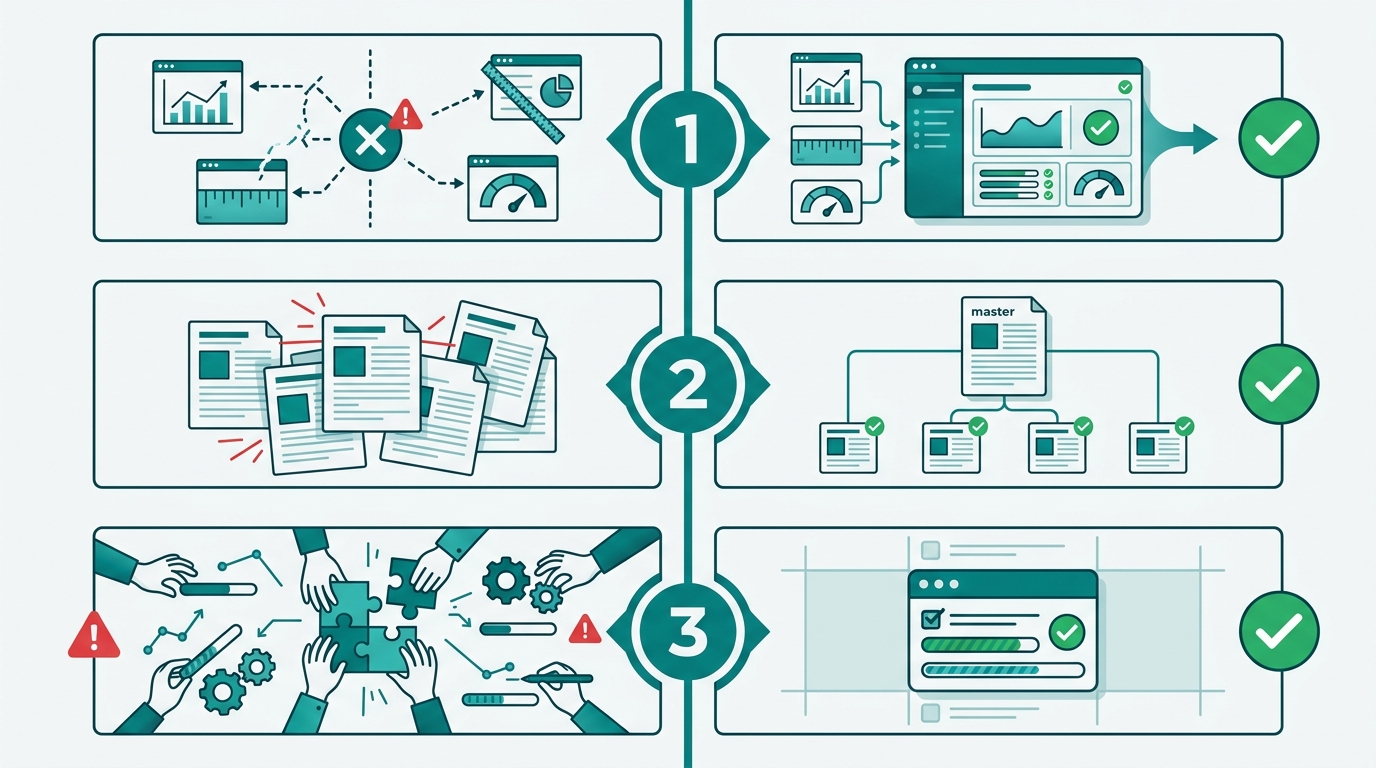
Pitfall 1: Starting Without Unifying Measurement
After putting “AI Search × Citable” at #1 on the scoring sheet, I started running tactics with momentum. Three months later, I got stuck at the effectiveness verification stage.
You can’t see citation counts on ChatGPT in Google Search Console. Same for Perplexity citations. Measurement tools are scattered across surfaces, making it extremely hard to combine them and produce ROI.
The countermeasure is simple. Before moving, write in one line “what and how I’ll measure in this cell.” AI search ranking measurement tools like Profound, Otterly, and Peec AI are coming together, so it’s safe to sign up for one before moving on the first cell. An investment of around $50 a month significantly reduces verification cost three months later.
If you’re stuck on what to measure, watch “just two metrics monthly.” For AI search: “citation count” and “traffic from cited articles.” For Google search: “ranking on target keywords” and “zero-click rate.” For social search: “search-driven views per post” and “saves.” Greedy KPIs become hollow, so stop at two metrics per cell. That’s the secret to sustaining it.
Pitfall 2: Content Cannibalization Self-Destruction
Move the “overlapping 70%” once—that’s the original philosophy of the integration framework. And yet, when separate teams move per surface, three articles with 90% identical content get born.
In reality, when this happens, your articles compete with each other in Google’s internal cannibalization. AI search creates a double disadvantage where machines hesitate over which article to cite. This phenomenon happens almost certainly in mid-sized organizations or larger, so you want to prevent it from the start.
Prevention is to set up the rule “decide on one master article per theme” first. Variations for each surface are treated as derivative content that must always link back to the master. This alone significantly reduces the chaos three months down the line.
Even for solo operations, this rule is effective. For instance, after writing five articles on a GEO theme, restructure so only the latest is the master and the remaining four bind back through internal links to the master. Don’t delete the old articles—add “see the newer article here” at the top. The structure becomes friendly to both readers and machines.
Pitfall 3: “A Little Bit of Everything”—Nothing Actually Moves
This is the most common failure pattern. After going through scoring, you put on a realist’s mask and say “let’s advance everything a bit at a time.”
I myself fell into this at first. As a result, three months later every cell was left in a half-finished state, and the budget and momentum ran out before any one of them was completed.
Don’t move the second cell before completing the first. Simple, but that’s it. Since the definition of “complete” can vary by person, just decide a deadline like “next inspection in three months.” When the deadline hits, score the next cell and move just one again. It’s mundane, but moving two cells in six months is enough.
Some may feel the rhythm of “one cell per three months” is “too slow.” Even so, completing two cells in six months produces more reliable cumulative results than touching four cells in six months and leaving them all half-done. This is what I’m currently proving in my own operations.
Conclusion: “You Don’t Have to Do It All”
This got long, but today’s main point summarizes in one line.
“The 8-part series gave you the tools. All that’s left is to decide on the ‘next cell’ for your business.”
Finally, here are five action checks for tomorrow.
- Draw the 4 × 3 = 12 cell matrix on paper (a spreadsheet works too)
- Skip surfaces clearly unrelated to your business (TikTok if B2B, etc.)
- Score the remaining 6–8 cells on four axes (10 minutes max)
- Re-read just one more time the series articles corresponding to your top 1–2 total-score cells
- Sign up for a measurement tool, then start moving the first cell
I want you to write this list on paper and post it where you’ll see it. As tactics multiply, the temptation to “maybe I should do everything” will inevitably hit you mid-way. When that happens, can you review through item 5 and stay disciplined to the one cell you decided on? That’s where it matters most.
The honest take from someone who’s written 8 articles, in one final line.
“The person who completes the one cell they decided today in three months goes farther in six months than the person with the perfect integration strategy.” This is what I’m currently proving in my own operations. Next time, I plan to write up my own 3-month inspection as it is.
The GEO series wraps up here for now. The structure of AI search will keep moving, so I’ll come back to redraw the map for the next phase. Let’s build the next map of search together.
Related Articles
- SEvO Practical Guide: Covering 5 Entry Points Simultaneously
- Combining GEO, AEO, and LLMO into “One Tactic”: A 3-Layer Integration Strategy
- LLMO, AEO, GEO—Which Should You Actually Write For? A Terminology Cleanup
- Why Even #1 on Google Doesn’t Get Cited by AI: Reading the 12% Overlap Data
- SEO Has Evolved: Introduction to SEvO (Search Everywhere Optimization)
Sources
- StatusLabs “Zero-Click Explained in the AI Search Era” (URL: https://statuslabs.com/blog/how-ai-search-may-reward-credibility-over-clicks ) *Summary article on the company’s blog. Numbers within the explanatory article, not the original survey instrument
- Google Cloud “ROI of AI: How agents help business” (URL: https://cloud.google.com/transform/roi-of-ai-how-agents-help-business ) 2026-04-22
*The figures in this article are based on materials publicly available as of April 29, 2026. For statistics that could not be verified at the primary source, expressions like “is said to be” and “there are reports that” are used to soften the claim.

AIを使いこなせない方は、この先どんどん差がつきます。僕はAIエージェントを毎日動かして、壊して、直して、また動かしてます。そういう泥臭い実践の記録をここに書いてます。理論は他の方にお任せしました。僕は動くものを作ります。朝5時に起きてウォーキングしてからコードを書くのがルーティンです。