Same Social Ads, Different Fates: Why Some Companies Win While Others Sink. The 2026 Web Marketing Inflection Point, Drawn from a 739-Person WINDOM Survey and Google's Official Predictions
In an era where the same tactics produce opposite results, what's the dividing line? Cross-referencing primary research with official forecasts to diagnose where you stand in 5 minutes.
What you'll learn in this article
- The key point to grasp before reading the full article
- How the issue changes practical decisions after reading
- Which follow-up article is worth opening next

“Should we be running social ads or not?”
This is the question I get asked most often these days. There are about as many people who should be running them as there are who shouldn’t. That’s the reality of web marketing in 2026.
In January 2026, WINDOM Inc. published a survey of 739 web marketing professionals. When I read it, I literally gasped. The #1 “most successful tactic” and the #2 “most failed tactic” were the exact same thing.
Around the same time, Google officially released five digital marketing predictions for early 2026. When you read these alongside the WINDOM survey, what counts as the “inflection point” of 2026 comes into sharp focus.
In this note, I’ll cross-reference the primary research with the official forecasts and bring it down to a 10-item checklist you can use to diagnose where your company stands in 5 minutes. This isn’t about individual tactics like GEO, AEO, LLMO, or SEvO — it’s a map one level above that. Read this as a single page that helps anyone feeling “I don’t know what’s right anymore” start moving their hands tomorrow.
⚙️ Previous in series: Integrating SEvO, GEO, AEO, and LLMO into a Single Priority Scoring Sheet. The finale of an 8-part tactics series, organizing how to choose your surfaces. This time, it’s the conversation about “once you’ve chosen the surface, what’s the inflection point at the organizational level?"
"Same Tactic, Winners and Losers” — The Inconvenient Truth from WINDOM’s 739-Person Survey
In January 2026, WINDOM Inc. released its “2026 Web Marketing Reality Survey.” This is primary data from 739 web marketing professionals, and the results have sent a quiet shockwave through the industry. Source: WINDOM 2026 Web Marketing Reality Survey.
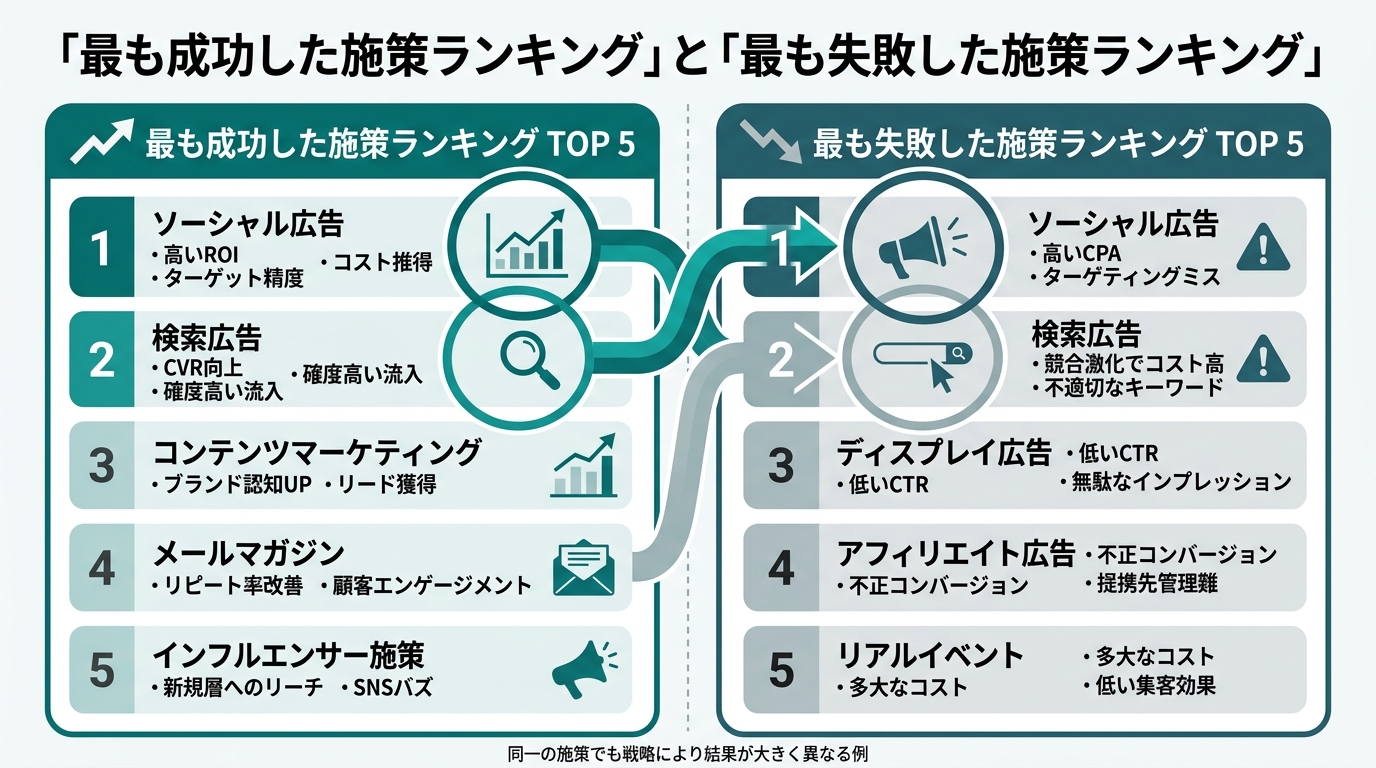
The responses to “What was your most successful tactic in the past 1–2 years?”:
- #1: Social ads — 23.0%
- #2: Search ads — 16.2%
But when the same survey asked “What was your most failed tactic in the past 1–2 years?”, the results looked like this:
- #1: Search ads — 18.5%
- #2: Social ads — 16.7%
#1 success = #2 failure, #2 success = #1 failure. The exact same two tactics are split right down the middle in evaluation. Companies that won said “this worked best.” Companies that lost said “this failed worst.”
This fact means just one thing. In 2026 web marketing, there’s no longer a “right tactic.”
Three years ago, you could say “social ads are good” or “search ads are good.” Not anymore. Because for the same tactic, there are roughly equal numbers of winners and losers.
The natural question becomes: “So what is the inflection point?” The WINDOM survey answers that one clearly too.
The Real Cause of Failure Wasn’t “Tool Selection” — The Two Main Reasons 40% Cited
The most important number in the WINDOM survey is right here. Responses to “Main reason expected results weren’t achieved”:
- #1: Weak creative/messaging — 20.3%
- #2: Strategic misalignment (target/value proposition/positioning) — 18.5%
Combined: 38.8%. Nearly 40% cited “messaging” and “strategy” — not “tool selection” — as the main reason for failure.
When I first read this, I straightened up. Why? Because this 38.8% is the territory that automation with AI cannot solve.
Strength of creative, sharpness of messaging, alignment of target/value proposition/positioning. You can have generative AI “think about” these things, but the final decision is what humans must make. Conversely, the moment a human lets go of this, the failure probability of the tactic skyrockets.
Looking at the people around me, the ones who use AI tools most skillfully are spending more time on this “upstream decision-making.” Downstream production and operation is fast. But for upstream — deciding “to whom, what, and why we’re delivering” — they don’t hand it off to AI. They hammer it out thoroughly with humans. That’s the on-the-ground feel of 2026 practice.
The natural question becomes: “How exactly do you hammer it out?” and “How does Google see this situation?” Google has answered exactly this question, in five directions.
What Google Officially Sees in 2026 — Five Shifts Read from Two Pieces of Content
In early 2026, Google released two pieces of official content. The first is “Five People at Google on 2026 Digital Marketing Predictions” (business.google.com), where five key people each discuss change from a different angle. The second is “The 2026 Outlook for Digital Advertising and Commerce” (blog.google). Sources: Google business “Five People at Google on 2026 Digital Marketing Predictions”, blog.google “The 2026 Outlook for Digital Advertising and Commerce”.
The five points below are keywords I extracted from these two pieces. They’re not direct quotes of Google’s headlines — read them as a marketing-perspective summary.
1. Prioritizing “wellbeing now” (from “Five People”) In an era of continuing uncertainty, people are starting to value present-moment experiences and mental/physical wellbeing over long-term goals. You can read a shift in advertising message design from “future gains” to “today’s peace of mind.”
2. AI-driven community co-creation (from “Five People”) This shift is symbolized by Google’s AI video generation tool “Veo 3.” The axis is moving from a model where brands tell stories one-way to one where brands create worlds together with users. That’s the direction this content points to.
3. The economic value of nostalgia (from “Five People”) Nostalgia has shifted from being merely an emotion to a major economic driver. Centered on Gen Z and millennials, campaigns that incorporate cultural elements from the past are starting to deliver results rapidly.
4. The search bar as a creative canvas (from “Five People”) The search bar is no longer “a box for typing keywords.” With the arrival of image generation features like Gemini’s “Nano Banana,” the shape of search has changed. Users are starting to express search queries as concrete images. On the company side, this means visual, concrete answer presentation is being demanded.
5. Agentic commerce becomes real (from “The Outlook for Digital Advertising and Commerce”) In 2026, autonomous commerce by AI agents is no longer a concept. A world where agents — instead of humans — intervene in the search → compare → purchase journey has begun.
The natural question is where these five shifts connect with the WINDOM survey. When you place them next to “40% cite creative and strategic misalignment,” a shared skeleton emerges.
WINDOM × Google Forecast Cross-Analysis — Three Design Principles That Work in 2026
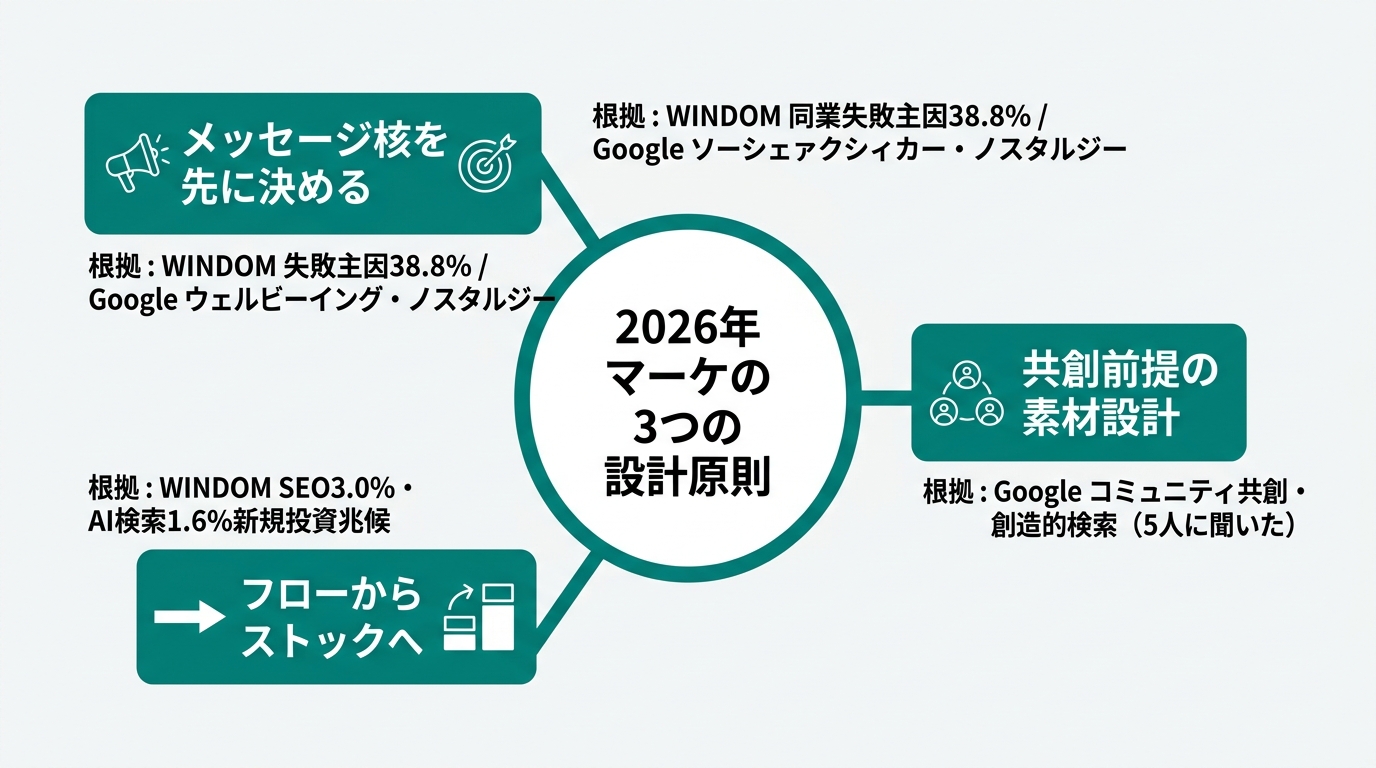
WINDOM’s primary research and Google’s official forecasts. Reading these two together reveals three design principles that “work” in 2026.
Principle 1: Decide the “Message Core” First — The Era of Input Quality Disparity
WINDOM’s “top 2 main reasons for failure = creative and positioning.” This connects directly to Google’s “wellbeing priority” and “economic nostalgia.”
Why? Because wellbeing and nostalgia are determined by “context,” not by “product.” For the same product, who responds shifts depending on whether you pitch “future savings” or “today’s peace of mind.”
If you don’t decide this at the implementation stage and try to decide it at the delivery stage, the meaning thins out the moment you hand it off to AI. The message core is something humans decide first, then hand to AI. Reverse this order and you join the 40% failure group.
Principle 2: Design Materials for Co-creation — The End of One-Way Pitches
What Google’s “community co-creation” and “creative canvas search” point to has one structural change in common. Users have been handed the “right to create” — that became the precondition of 2026.
Users generate images of your products with Gemini and assemble queries themselves. When this happens, if your company’s material design “only shows the finished product,” you can’t enter the co-creation flow. Designing materials on the assumption they’ll be reused — logos, key colors, typical scenes, supplementary assets. Opening these up to users becomes a necessary condition in 2026.
Recently, when designing CMSes with Claude Code, I’m building in “API publication of the asset library” from the start. Six months ago, this wouldn’t have crossed my mind. With co-creation as the premise, the structure itself changes.
Principle 3: From Flow to Stock — A Prescription for the 44% Not Increasing Budget
WINDOM’s “44.0% are cautious about increasing budgets in 2026.” This is also an important number. Source: WINDOM PR TIMES release.
When budgets aren’t growing, where do companies look to reallocate? In its rankings of “tactics to prioritize in 2026,” WINDOM reports that investment appetite for stock-type tactics is emerging. Specifically: SEO 3.0%, AI search optimization 1.6%, owned media operation 0.4%. These are the numbers showing up as new investment destinations.
This overlaps with what I’ve been writing in the GEO/AEO/LLMO/SEvO series. The shift from flow-type (advertising) to stock-type (search/content/AI optimization) is starting to appear in budget allocation numbers — weakly, but as a signal that can’t be ignored. Social ads at 10.0% and search ads at 8.1% still hold the top spots for prioritization, but the fact that SEO, AI search optimization, and owned media are emerging as new investment destinations is a signal not to miss.
Related past articles: How to Combine GEO, AEO, and LLMO into “One Tactic”, The Work That Comes After Meta Advantage+ “Full Automation”.
The natural question becomes: “Where does my company sit among these three principles?” Next, I’ll bring it down to a checklist you can complete in 5 minutes.
Diagnose Where You Stand in 5 Minutes — A 10-Item Checklist
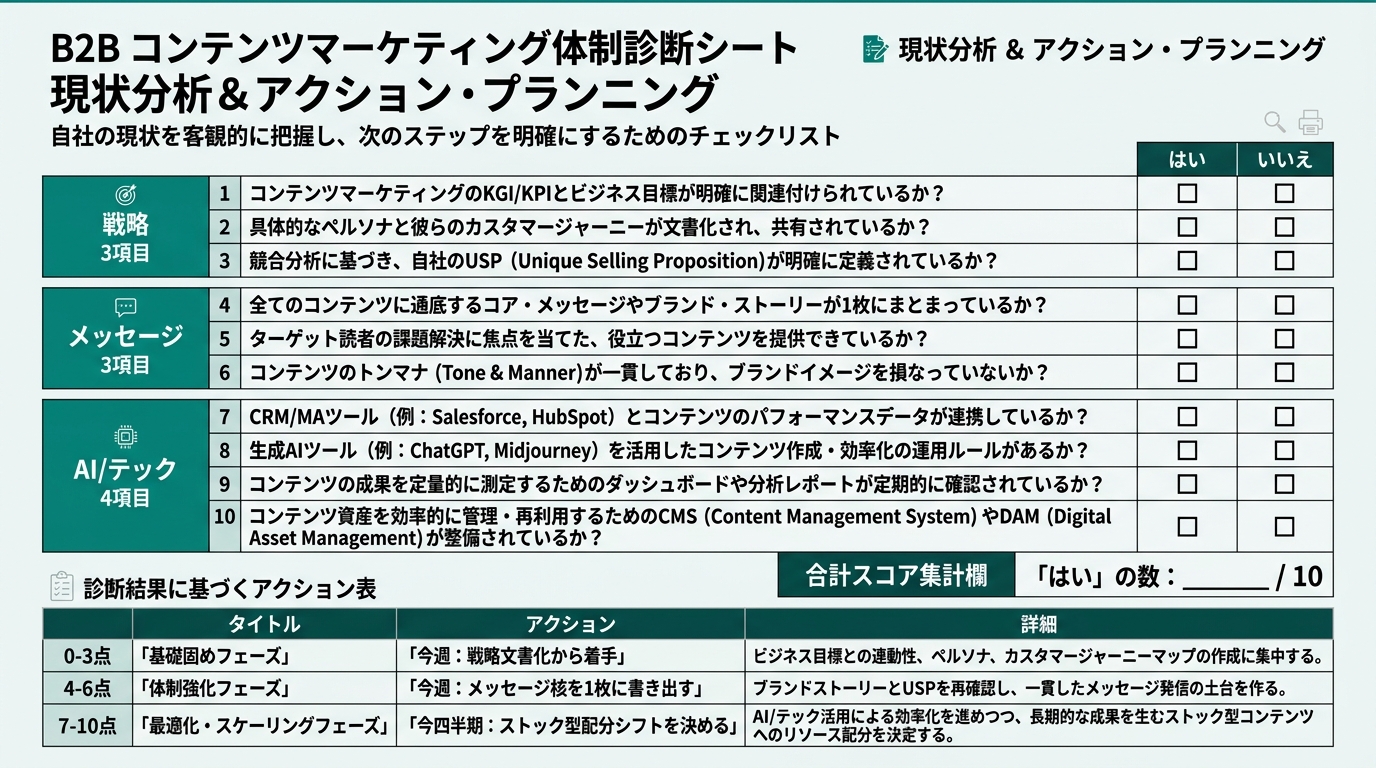
Building on the discussion so far, I’ve prepared a checklist for diagnosing where your company stands. 10 items, 5 minutes total. For each item, score 1 point for “yes” and 0 for “no” and tally up.
Strategy Layer (4 items)
- Is the target persona (who you’re delivering to) summarized in a document of one page or less?
- Can you describe your value proposition (why you’re chosen) in words that differ from competitors?
- Is the main message core for 2026 (short-term vs. long-term, anxiety relief vs. gain pitch) decided?
- Are exit criteria (numbers, deadlines) for stopping a failing tactic decided in advance for each tactic?
Messaging/Creative Layer (3 items)
- In your ads and on your site copy, is the tone (wellbeing-type vs. results-pitch type) aligned?
- On the assumption of co-creation, are your logo, main assets, and typical scenes published in a form users can reuse?
- When producing creative, is “the range humans decide” — before handing off to AI — written down explicitly?
AI/Tech Adoption Layer (3 items)
- Is the priority order for SEO/GEO/AEO/LLMO — which to tackle in what order — decided?
- Are you in a position to measure inflows from AI search (ChatGPT, Perplexity, Gemini, etc.)?
- Do you have an internal standard for judging “use vs. don’t use” for agentic commerce and AI co-creation tools?
Verdict — “What to Do This Week” by Score
| Score | Current Diagnosis | What to Do This Week |
|---|---|---|
| 0–3 points | Strategic foundation not in place | Before any tactic, document “to whom, what, and why you’re delivering.” Spend the entire first week just on this. |
| 4–6 points | You have strategy, but messaging is weak | Classic “40% failure main reason” zone from WINDOM. Rewrite your message core and material design, one page each. |
| 7–10 points | Top zone reached | The next challenge is shifting allocation to stock-type. Decide in numbers this quarter what % of flow-type budget moves to SEO/GEO/LLMO. |
I tried this on my own site. Result: 7 points. #8 (GEO priority order) was clear, but #6 and #10 were weak. Specifically, co-creation-premise material design and agentic commerce standards. Next quarter’s challenges came into view through this single diagnostic.
Three Moves for the “44% Not Increasing Budget” — How to Make It Work Without Spending More
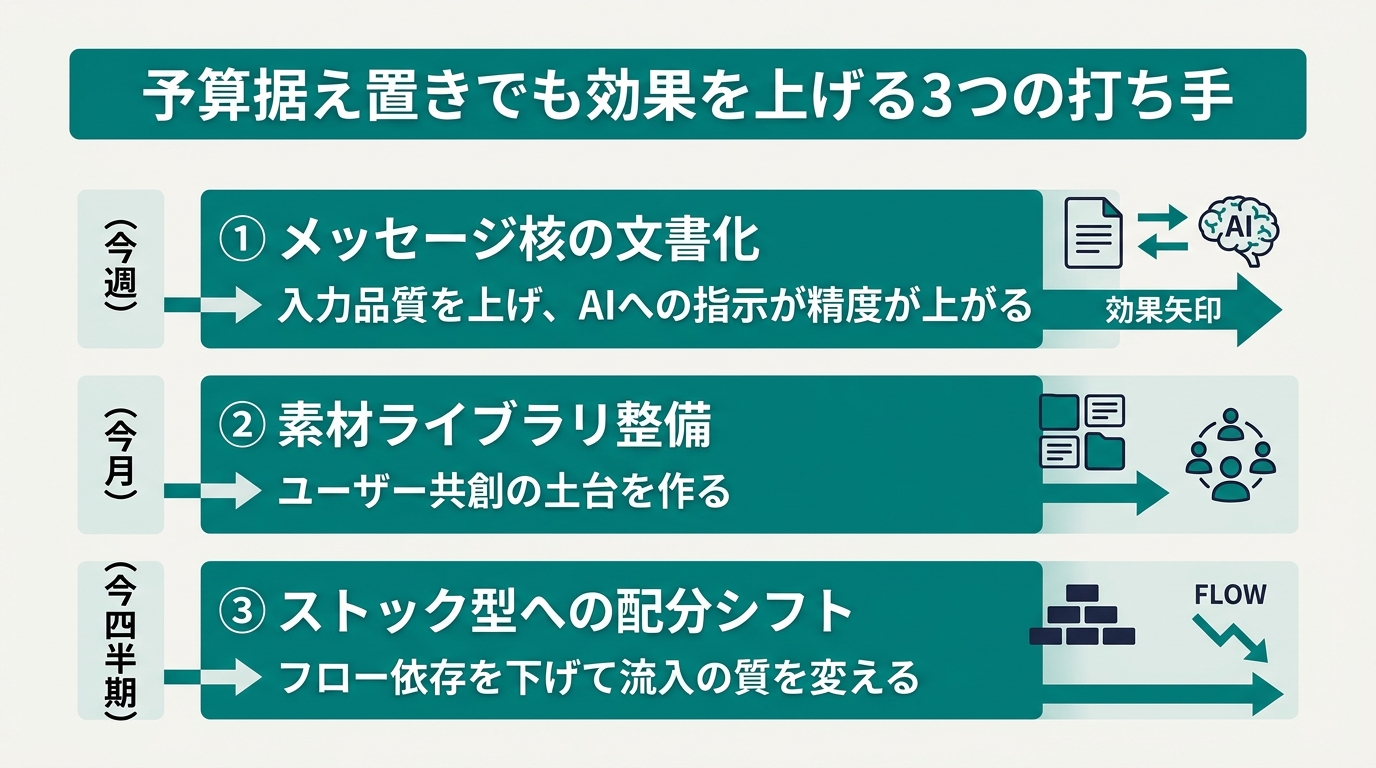
If you read this far and felt “I’m in the 44% not increasing budget,” this section is for you. There are three moves to make it work without spending more.
Move 1 (do this week): Document the message core Write 5 items on a single A4 page. One target persona, one challenge, three reasons you’re chosen, your 2026 message tone, and exit criteria as numbers. That’s it. It’s content you can write in an hour. The moment you write it, the speed of your operational decisions doubles.
Move 2 (do this month): Set up an asset library Logos, key colors, typical scene photos, product images, logo animations. Organize these in something like Dropbox into a “reusable form.” In the co-creation flow Google points to, the more a company opens up its assets, the more content users will generate on their own. This is the highest-investment move you can start with zero added cost.
Move 3 (do this quarter): Shift allocation to stock-type In WINDOM’s “want to prioritize in 2026” rankings, SEO, AI search optimization, and owned media were emerging. Move just 10% of your ad budget to stock-type. The quality of your inflows in six months will be different.
All three have nearly zero added cost. All you need is time for decision-making. This is the most cost-effective action the “44% not increasing budget” can take this week.
Conclusion — To Everyone Standing at the Inflection Point

There’s no longer a “right tactic” in 2026 web marketing.
As WINDOM’s 739-person survey proved, with the same social ads, 23.0% succeeded and 16.7% failed. With the same search ads, 16.2% succeeded while 18.5% failed. It’s not the tool that determines the result — it’s the decision-making of the user. That’s the reality of 2026.
And 40% of the main reasons for failure are “creative” and “strategic misalignment” — areas AI can’t automate. The five shifts I read from Google’s two official pieces all point in the same direction. Wellbeing, co-creation, nostalgia, creative search (from “Five People”), and agentic commerce (from “The Outlook for Digital Advertising and Commerce”) — what all five share is a structure where the quality of human-side decision-making determines the result.
Don’t let it end here. Let me make one final proposal.
Within one week from today, write a one-page message core on A4.
One target persona, one challenge, three reasons you’re chosen, 2026 tone, exit criteria. Just that. Once you finish, diagnose your company once more with the 10-item checklist above. The moment you place these two side by side, “the one action to take next week” becomes clear.
Just knowing this gets you into the top zone. Only those who decide what humans should decide — before handing off to AI — can move in the right direction at 2026’s inflection point.
Sources for This Article (Primary and Secondary)
- WINDOM 2026 Web Marketing Reality Survey (n=739): https://windom-kk.co.jp/news/978/
- WINDOM PR TIMES (2026 Web Marketing Investment Trends): https://prtimes.jp/main/html/rd/p/000000003.000176801.html
- Google business “Five People at Google on 2026 Digital Marketing Predictions”: https://business.google.com/jp/think/consumer-insights/digital-marketing-trends-2026/
- blog.google “The 2026 Outlook for Digital Advertising and Commerce”: https://blog.google/intl/ja-jp/company-news/technology/digital-advertising-commerce-2026/

AIを使いこなせない方は、この先どんどん差がつきます。僕はAIエージェントを毎日動かして、壊して、直して、また動かしてます。そういう泥臭い実践の記録をここに書いてます。理論は他の方にお任せしました。僕は動くものを作ります。朝5時に起きてウォーキングしてからコードを書くのがルーティンです。