AI Agents Shift From 'Using' to 'Selling': How Non-Coders Build Businesses—The 2026 Reality
After 'AI changes how you work' comes 'sell AI agents to build a business.' With Stripe building the sales channel and Technology Org documenting the phenomenon, the entry point for non-engineer entrepreneurship has shifted dramatically.
What you'll learn in this article
- What AI agents mean in plain language and why the term matters now
- Which real-world workflow patterns are already becoming practical
- Which next article deepens pricing, rollout, or implementation context

“I want to learn how to use AI—where do I even start?”
That’s been the question I’ve heard most often over the past six months. But entering 2026, the substance of the consultations I’m getting has quietly shifted.
“Could I build something to sell using AI agents?”—people want to stand on the selling side, not the using side. The volume spiked once Golden Week kicked in.
Right around the same time, the overseas outlet Technology Org published an article titled “Rise of Non-Technical Founders Selling AI Agents in 2026.” Source: Technology Org (2026-04-21). It’s a primary article that captures “non-coders selling AI agents as products” as an independent trend.
As a follow-up to last week’s The “I can’t code, so I can’t do this” mindset is already outdated, today I want to dig into the concrete steps for getting on the selling side. Why this phenomenon is rising now, what infrastructure has fallen into place, and where to start if you want to move—those are the three themes for today.
”Selling AI Agents” Stopped Being a One-Off Story—The 2026 Business Model Technology Org Captured
The article Technology Org published on April 21, 2026 isn’t gossip about a specific Silicon Valley company. Its significance lies in framing “non-technical founders selling AI agents as products” as a single industrial trend.
Until now, the conventional wisdom was that “building a business with AI” meant “running a service that uses AI.” Embedding ChatGPT into your own operations to streamline workflow, that kind of thing.
But the 2026 landscape has shifted by one notch. The AI agent itself is the product, and customers pay a monthly fee to that agent. The seller’s leading role isn’t implementation—it’s designing “what problem does this agent solve.”
What I think matters is that the article’s title puts “Rise of Non-Technical Founders” and “Selling” side by side. A tech outlet flatly stating “non-engineers as sellers” is a phrasing I’ve barely seen in the last several years.
Why now? Two changes are happening simultaneously. One is the buildout of sales channels—Stripe rolled out payment infrastructure from late 2025 through 2026. The other is the maturing of no-code platforms—Lovable, Bubble, and Replit reached the level where “explaining in English produces a working app.” 2026 is the year when the cost of “building” and the cost of “selling” both approached zero at the same time. Only when these two lined up did “from user to seller” become a realistic conversation.
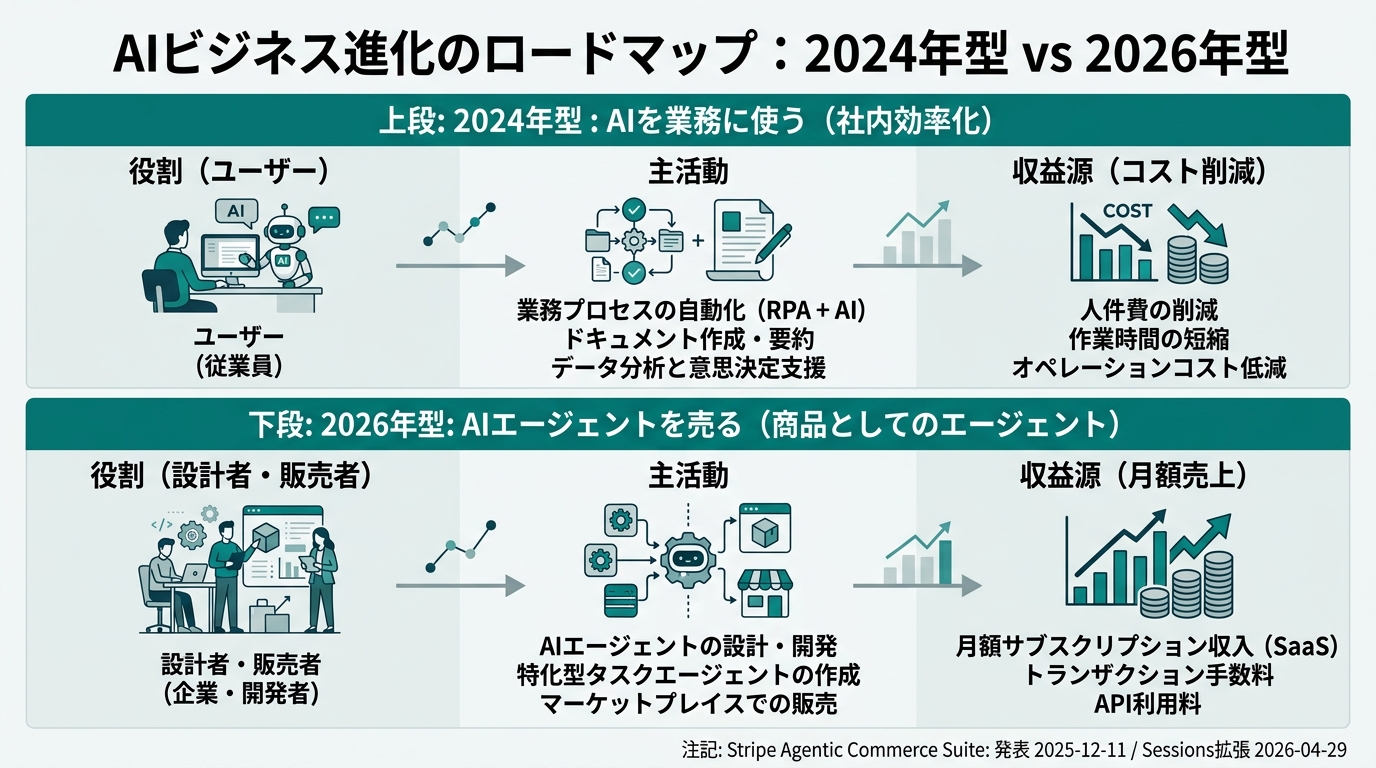
The “Sales Channel” Stripe Built—The Infrastructure for Selling Through AI Agents Is Complete
Stripe announced the “Agentic Commerce Suite” on December 11, 2025. Source: Stripe Newsroom (Agentic Commerce Suite). Feature expansions came at the Sessions conference in late April 2026, moving it firmly into the practical phase.
Here’s what’s remarkable: payment infrastructure for “selling products through AI agents” has been packaged as a single integrated product. The design lets you choose, in a few clicks from the Stripe dashboard, which AI agents to sell through. Upload your product catalog to Stripe, and a mechanism called Shared Payment Tokens kicks in. These are authentication tokens that let AI agents process payments on the user’s behalf, allowing the agent to complete the entire purchase flow.
The lineup of brands adopting this is well past the “experiment” stage. Etsy, Coach, Kate Spade, Revolve, Halara, and Abt Electronics—major retailers across the board. URBN, which owns Anthropologie, Free People, and Urban Outfitters, is already in. On the e-commerce platform side, Squarespace, Wix, WooCommerce, commercetools, and BigCommerce have all integrated.
At the 2026 Sessions conference, Stripe rolled out 288 new products and features in one shot. Source: Stripe Sessions 2026. The Collison brothers went as far as to say they’re “treating agents as economic actors”—you can feel how serious they are.
Once the sales channel side is this fleshed out, what changes? The annoying back-end of “selling AI agents as products”—payments, logistics, taxes—can be outsourced. Founders can focus on product design and customer service. Forget time spent coding; even the time spent designing payment plumbing gets eliminated. That’s the structural shift of 2026.
Three years ago, just clearing this hurdle would have burned three months of an indie developer’s time. Now it’s done in a few clicks of a dashboard. If you’re going to start moving during Golden Week, this is a shift you can’t afford to miss.
Five People Actually Selling and Earning—“Solo with Multi-Million ARR” Has Stopped Being Rare
Numbers make it real. Here are five examples of non-engineers, or small teams, running businesses on AI.
Verified cases (primary source confirmed)
| Founder / Service | Result (as of source) | Team | Source |
|---|---|---|---|
| Ben Broca / Polsia | Revenue run rate ~$4.5M, 1,100 companies managed (as of 2026-03) | Solo | Fortune (2026-03-26) |
| Danny Postma / HeadshotPro | ARR ~$3.6M | Solo | Grey Journal (2026) |
| Pieter Levels | ARR over $3M, multiple products in parallel | 0 employees | Lex Fridman Podcast |
Reference cases (secondary source)
| Founder / Service | Result (as of source) | Team | Source |
|---|---|---|---|
| Maor Shlomo / Base44 | Wix acquisition $80M Exit (2025-06), 250K users | Few people | Coverage around Lovable blog (2025-12) |
| Fathom AI (sales support for medical aesthetics) | ARR ~$300K (12 weeks, 90%+ gross margin) | Small team | Wealthy Tent (2026) |
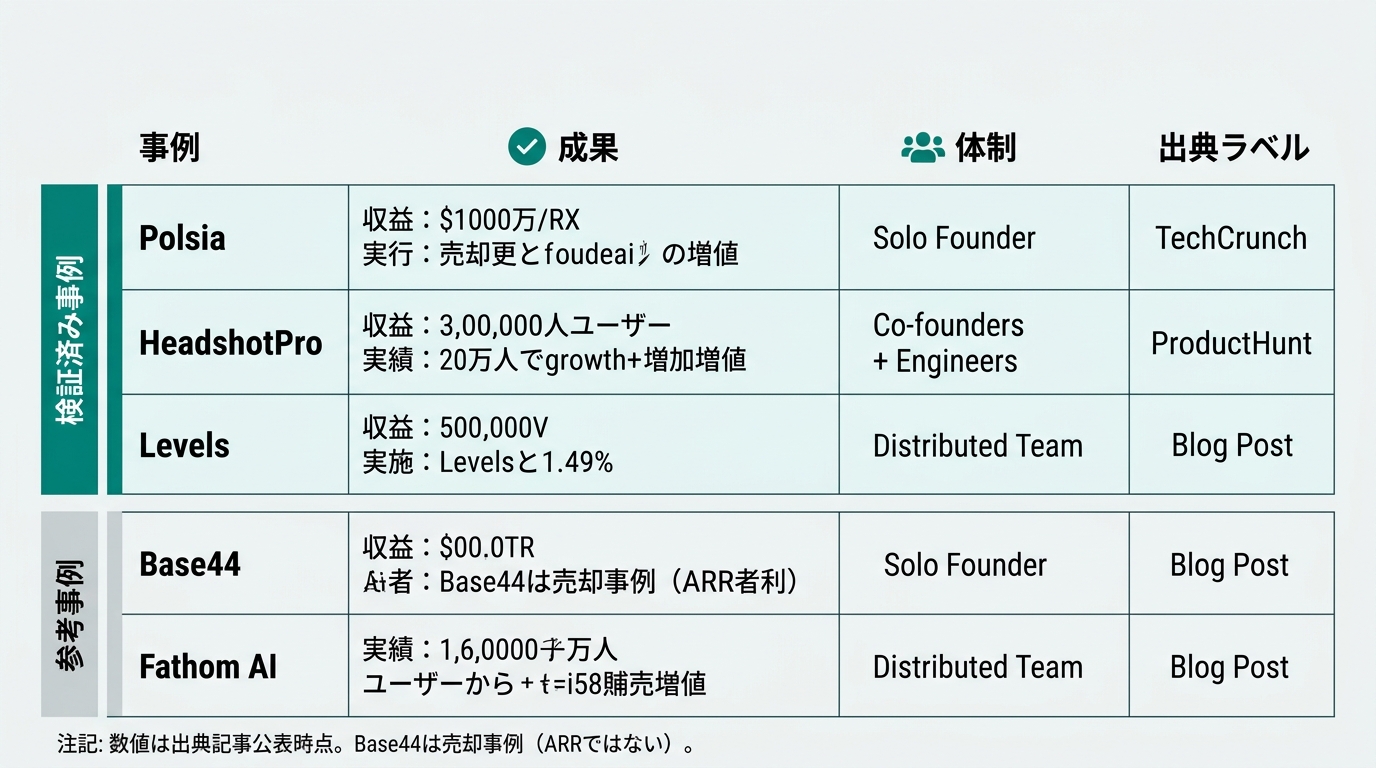
What I want to flag is that none of the five came from a “hardcore engineering” background. Pieter Levels does code, but he himself says he’s “not a proper developer.” Ben Broca was a former product manager, Maor Shlomo leans designer, Danny Postma came up as a marketer. They’re stronger at “problem framing” and “selling” than at technology.
A US Carta study found that 36.3% of startups founded in 2025 had a single founder. It was 31% in 2024 and 23.7% in 2019—1.5x in five years. Source: Carta Founder Ownership Report (the same data I cited in an April note). “Start solo and sell” has shifted from exception to mainstream.
Why “Domain Experts” Beat Technologists—The Structural Advantage of Non-Engineers
If you’ve looked at the numbers and thought “I can’t code, so this isn’t for me,” here’s what I want to say. Most of the AI agents selling right now are differentiated by the resolution of the problem they solve, not by technical skill.
The reason: anyone can now assemble the internals of an AI agent. There are no-code and low-code platforms like Lovable, Bubble, and Replit. These tools build the skeleton of an app from English instructions, letting you produce working products without programming knowledge. Lovable hit a $6.6B valuation as of December 2025, and Replit reached $144M ARR as of September 2025. Source: Lovable blog (2025-12). The cost of “building” has gotten close to zero.
Once that’s true, the contest moves to “what to build” and “who to sell to.” The strongest players here are people who deeply know a specific industry’s frontline. Fathom AI, for instance, narrowed its focus to sales support for medical aesthetic clinics and reached $300K ARR in 12 weeks. They optimized for industry-specific lead nurturing, intake, and booking flows that a generic CRM can’t capture.
To put it concretely: an AI agent built by someone who “spent 10 years at the front desk of an aesthetics clinic” comes out completely different from a generically designed one made by a technologist. “She skipped two consultations, so we should reach out three weeks later”—only someone with field experience can encode that kind of judgment into a system. Now that no-code tools have removed the “building wall,” the only remaining gap is “do you know what to build.”
What I see on the ground confirms it. The people who can sell AI agents share one trait: they can immediately answer “the most painful part of the job I’ve done for 10 years.” That’s becoming a far rarer resource than technical skill.
So where do you start? I’ve laid out the steps in the next section.
Three Steps to Become an “AI Agent Seller”—The First Move You Can Make During Golden Week
If you want to move during Golden Week, three steps is the realistic pace.
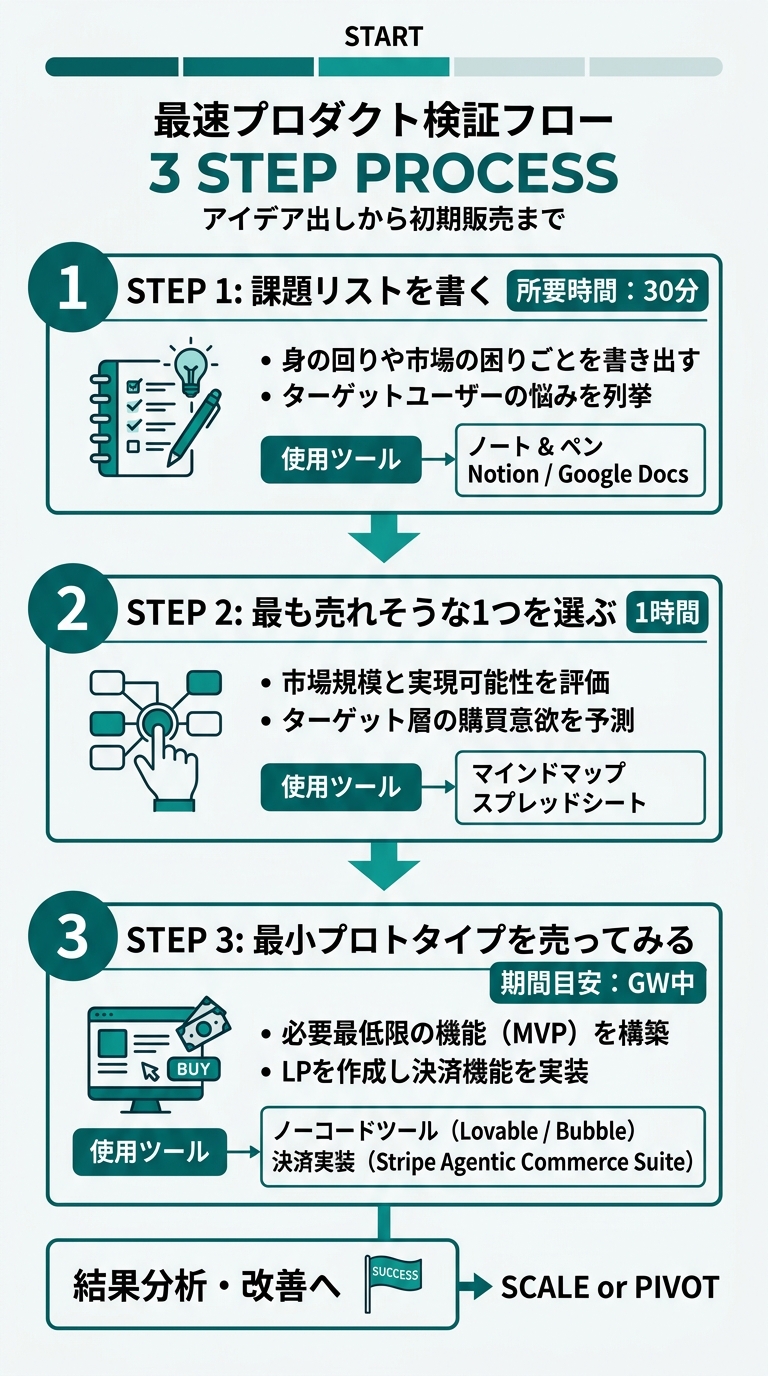
Step 1: Write the problem list (30 minutes) Write down 10 tasks at your day job that “eat up your time.” Narrow it to work that someone would pay money to have solved. “Drafting emails,” “summarizing meeting minutes,” “reconciling invoices”—anything you currently outsource to a vendor counts too.
Step 2: Pick the one most likely to sell (1 hour) Three evaluation axes. Time-to-revenue (could you charge starting next month?), repetition frequency (daily? monthly?), and willingness to pay (would you yourself pay money to have someone else do this?). Score them on these three axes and one will surface naturally.
Step 3: Sell a minimum prototype (during Golden Week) Use Lovable or Bubble to build the absolute minimum feature that solves the Step 2 problem. 40% complete is fine. Ask 5 acquaintances “would you use this for ¥3,000 a month?” If 3 say “I’d use it,” you’ve cleared the minimum bar for product viability. For the sales channel, Stripe Agentic Commerce Suite handles payment and billing setup from the dashboard. If you collect 3 “I’d use it” responses during Golden Week, you go into full execution after the holidays. That’s how you run it now.
For background reading, I’d pair this with Mikoto’s note (4/25) on age structure of AI founders and Mikoto’s note (4/17) on the economics of solo entrepreneurship—the picture sharpens considerably.
Wrap-Up—Just One Step From “Using” to “Selling”
The single step from “I want to learn how to use AI” to “I want to learn how to sell AI agents.” That’s the frame shift I’m feeling on the ground right now.
- Technology Org documented the phenomenon, and Stripe built the sales channel
- Non-engineers reaching multi-million ARR is no longer a special case
- The contest isn’t technical skill—it’s the resolution of “what problem, for whom”
- If you’re starting during Golden Week, three steps will work: write a problem list, narrow to one, sell a minimum prototype
I picked one item from my own task list last week, built a simple agent in Lovable, and showed it to three people. One said “I’d like to start using this next month.” The product doesn’t have a name yet. Still, I’m clearly seeing a different landscape than the version of myself sitting on the “using” side six months ago.
Golden Week, taking it easy at home is fine too. But carve out 30 minutes tomorrow to write the problem list. The moment you put it on paper, at least one item will jump out as “wait, this could actually sell.” Start from there—that’s enough.

AIを使いこなせない方は、この先どんどん差がつきます。僕はAIエージェントを毎日動かして、壊して、直して、また動かしてます。そういう泥臭い実践の記録をここに書いてます。理論は他の方にお任せしました。僕は動くものを作ります。朝5時に起きてウォーキングしてからコードを書くのがルーティンです。