For Those Who Only Know 'AI Agents' as a Buzzword: Reading May 2026 Through Claude's 10 Finance Agents, AWS Sales Automation, and Deloitte's 75% Forecast
You've heard the term 'AI agent,' but it hasn't reached your own work yet. From Claude's 10 finance agents, AWS's sales automation, and Deloitte's 75% forecast—three major anchors as of May 2026—we walk through definition, real examples, and how to apply them to your own work.
What you'll learn in this article
- Where pricing and adoption questions around Claude Code stand right now
- Which plan or rollout stage fits the reader's situation
- Which follow-up article to open next for setup, cost, or bigger-picture context
“So what exactly is an AI agent, anyway?”
That’s the question I’ve been asked most often over the past month or two.
Many of the people asking have used ChatGPT and Claude. They know about Gemini and Copilot too, but “what makes AI agents different” and “where do they fit into my own work” remain fuzzy—the words have run ahead of understanding.
I was the same way at first. Reading explanations like “AI that acts autonomously” never quite landed for me. It clicked the day I handed Claude Code a long-running task, did other work alongside it, and received the results. “Ah, this isn’t using—this is delegating.”
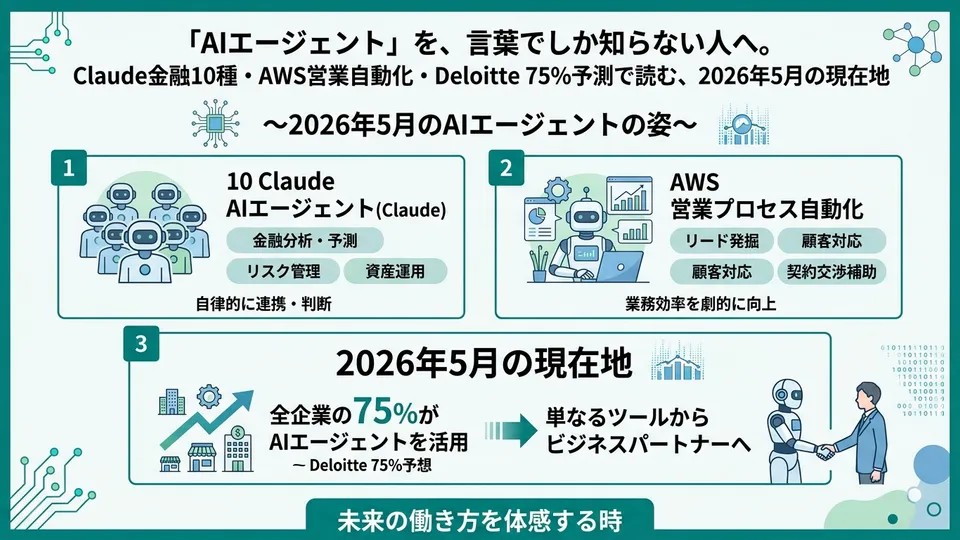
In May 2026, that “delegating” suddenly stepped onto the corporate main stage. Anthropic launched a bundle of 10 AI agents for financial institutions (Anthropic official), AWS began filling the holes left by layoffs with AI agents (eMarketer), and Deloitte forecasted that “up to 75% of enterprises will invest in Agentic AI by the end of 2026” (Deloitte Tech Trends 2026).
The gap between “those who use” and “those who get used” looks set to reach an irrecoverable place within just six months.
Today, anchored by these three developments, I’ll walk through “what AI agents are”—from definition to real-world examples to how to apply them to your own work. If by the time you finish reading, you can spot even one task in your own work where you think “yeah, this could be agent-ified,” this article has done its job.
AI Agents Are Neither “Smart Chat” Nor “Automation Scripts”—They’re a Newly Emerged Third Option in the Gap Between
Let’s start with definitions. Broadly, AI agents have three predecessors.
The first is conversational AI like ChatGPT and Claude. They’re great at answering questions, but they don’t move on their own. Ask “look up today’s weather” and they won’t open a browser for you. They’re tools that complete a back-and-forth between question and answer.
The second is automation tools like Zapier and Make. They run on fixed conditions but don’t make judgments. They quietly handle preset rule-based processes like “when an email arrives, send a Slack notification.”
AI agents sit in the gap between these two. Hand them a goal, and they make their own plan, call the tools they need, and return results. They make judgments. When stuck, they try a different approach. When done, they report back: “finished.”
For example: “Look into competitors’ price reductions last week, identify three of our products likely to be affected, and propose three response options.” Asking a conversational AI to do this requires multiple back-and-forths. An automation tool can’t even be set up for it. An AI agent receives this in a single instruction, breaks it into the necessary steps itself, browses competitor sites, reads your internal CSV, and returns a packaged output.
What I think matters here is that “the concentration of autonomy” exists on a continuum. Various products line up on a gradient from fully autonomous to fully manual. Claude Code and Cursor act fairly autonomously within the limited domain of “writing code,” but they come back to humans for confirmation on payments and production deploys. The sales agents AWS runs internally, on the other hand, are reportedly handling much longer tasks on their own.
Even though we lump them all under “AI agents,” the implementations vary widely. That’s exactly why “deciding how much of your work to delegate” is the literacy needed right now.
Breaking Down What’s Inside an AI Agent into 5 Components: Goal, Plan, Memory, Tools, Execution
After definition comes the question of internals. Splitting AI agents into five parts makes understanding much easier.
The first is “Goal.” Agents are handed a goal and start moving. Things like “draft a pitchbook (investment proposal document)” or “screen this KYC (know-your-customer) file”—requests with a certain breadth. Less a single instruction, more a mission.
The second is “Plan.” The agent receiving the goal breaks it into smaller steps. It builds its own sequence: “first gather the customer’s performance data, then pick three comparable companies, build a comparison table, and assemble a story.” This is the dividing line from conversational AI.
The third is “Memory.” More agents now have two layers: short-term memory (what was done in this session) and long-term memory (what was learned across past sessions). Claude Memory, which Anthropic launched in 2026, and Claude Code’s CLAUDE.md are exactly the mechanisms that handle this long-term memory.
The fourth is “Tools.” Agents call external tools to do work. Open a browser, manipulate Excel or PowerPoint, query an internal DB, send an email. These are called “tool calls.” Claude can now directly drive all of Excel, PowerPoint, Word, and Outlook. Anthropic’s announcement of full Microsoft 365 integration was exactly a move to broaden the toolshelf in one stroke.
The fifth is “Execution.” With plan and tools in place, the actual running phase begins. What matters here is the question “where does the human stand?” Fully delegate, insert approvals at key points, just receive the results. How you combine these three options determines the success or failure of AI agent adoption.
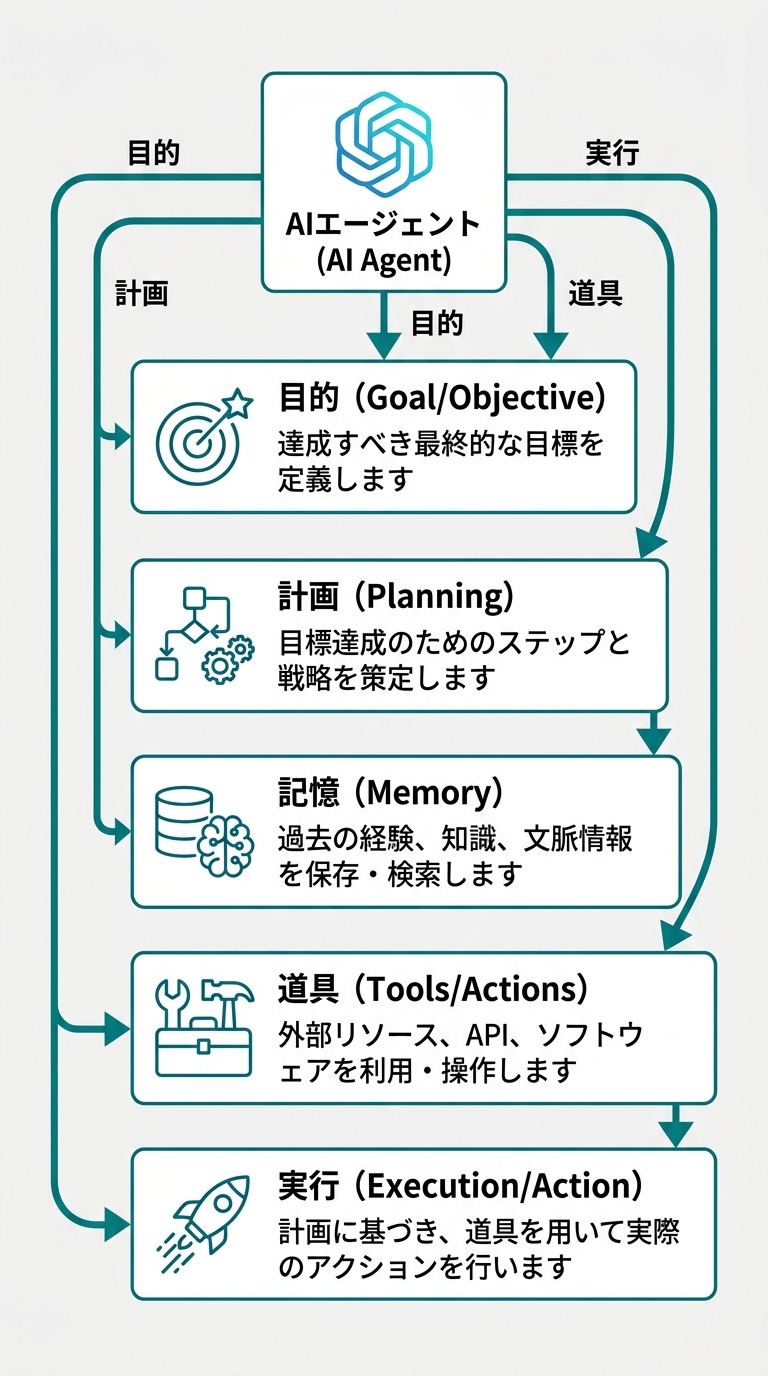
What “smart chat” has goes only as far as the entrance: “receiving a goal” and maybe “tool calls.” What “automation scripts” have is just “execution”—no plan, no memory, no judgment. AI agents are entities that bundle these five together and close them as a single piece of work.
Once you understand this far, your reading of the news shifts a level. When you hear “Claude released 10 finance-specialized agents,” it lands as: “ah, they tuned the five parts for finance tasks and shipped them as a bundle.”
Real Example 1: Anthropic’s “10 Finance Agents” Launched in May 2026—Specialty Domains Get Boxed Up in Earnest
Now into three real examples. The first is the 10 AI agents for financial institutions that Anthropic announced on May 5, 2026.
What happened? In short, Anthropic has started providing time-consuming routine work in the financial industry “pre-boxed” from the start. Where users previously instructed Claude case-by-case to “build a pitchbook,” they can now just call up the “pitch builder agent.”
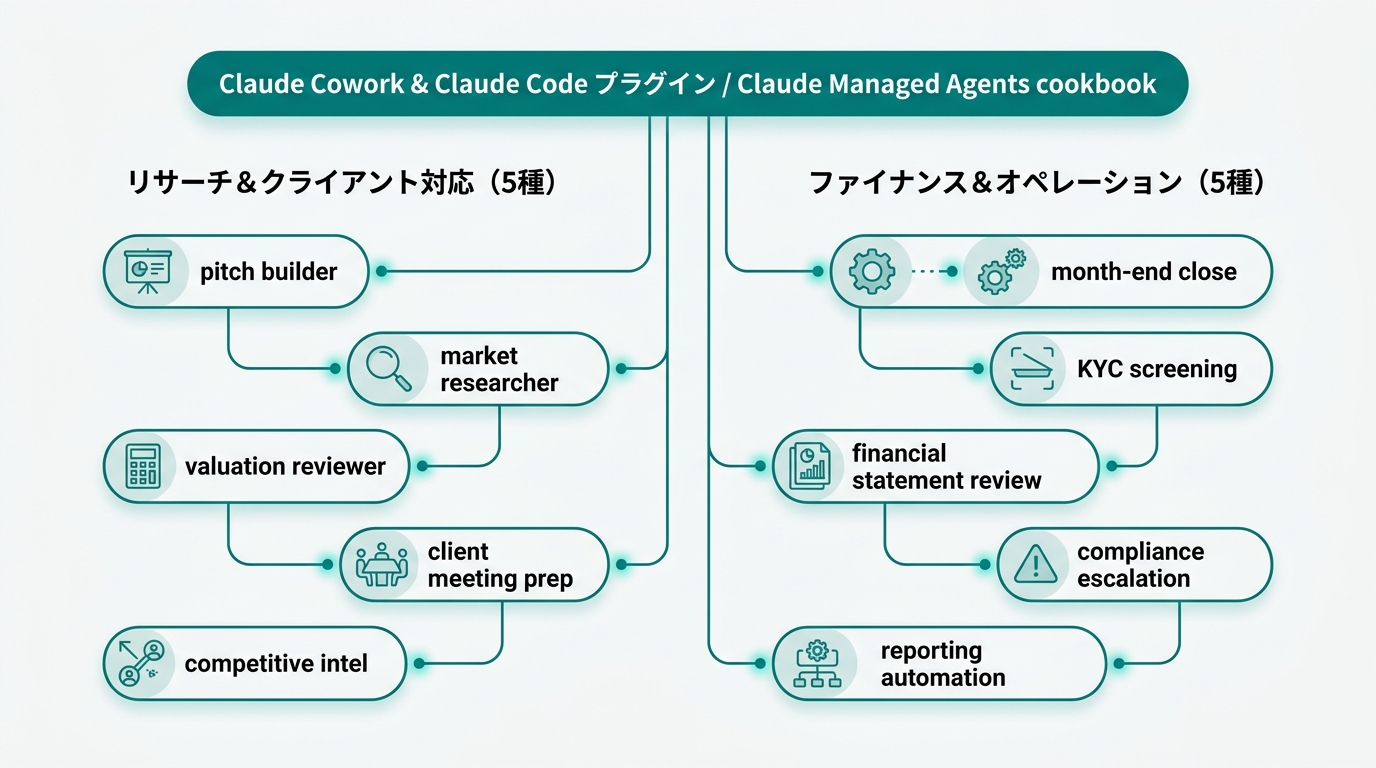
The 10 split into two groups. The first five are “Research & Client” agents, including pitch builder agent, market researcher agent, and valuation reviewer agent. The latter five are “Finance & Operations” agents, covering month-end book closing and KYC file screening—the areas where financial institutions have invested the most manual labor (TechRadar).
The delivery format is also an interesting design. Each agent is distributed both as a plugin for Claude Cowork and Claude Code, and as a cookbook (collection of implementation recipes) for Claude Managed Agents. A hybrid strategy: “plugin for teams that want to use it right away, cookbook for teams that want to customize for their own company.”
Benchmark numbers are out too. Claude Opus 4.7 scored 64.37% on Vals AI’s Finance Agent benchmark, beating GPT-5.5 (59.96%) and Gemini 3.1 Pro (59.72%) (Anthropic official). Topping a finance-task-specific benchmark is evidence Anthropic is seriously staking out the “industry-vertical agent” position.
Also impossible to overlook is the announcement of full Microsoft 365 integration. Add-ins for Excel, PowerPoint, and Word went generally available (GA), and Claude for Outlook launched in beta. A data partnership with Moody’s was announced simultaneously (Fortune). A statement of intent: “put Claude on every tool sitting on a financial institution’s desk.”
What to read here is the fact that the AI agent market has clearly shifted up a gear, from “general-purpose” to “industry-specialized.” Until now, ChatGPT and Claude were “smart partners that can be used for anything,” but going forward they’ll come pre-boxed as “teammates dedicated to your industry.” Finance went first because regulatory compliance and data are easy to gather and ROI is easy to calculate. Expect legal, healthcare, and HR to follow.
What I find most interesting in this move is the “granularity of the boxing.” Ten isn’t “one per industry” or “100 per task”—it’s an exquisite middle. Anthropic sized it so that “people in the field can call them up by work unit without having to relearn the tool.” This is a granularity worth referencing for those designing their own “industry-specific agents” too.
Real Example 2: AWS Has Started Automating “Sales Prep Work” with AI Agents—The Boundary Between Augmentation and Replacement
The second example is a more raw story.
From the end of 2025 into early 2026, Amazon executed multiple rounds of workforce reductions across the organization, including the AWS division. And during the same period, it has been launching internal AI agents one after another. eMarketer reported on this with “AWS develops AI agents to automate sales workflows after mass layoffs” (eMarketer), with The Information following up with “AWS Accelerates Internal AI Agents Following Staff Cuts” (The Information).
Some specifics on the agents in motion have surfaced. One is the “technical specialist agent.” It aggregates expertise across multiple domains like cybersecurity and networking to handle internal inquiries and customer proposals. Another is the “partner coordination agent.” It has taken over work that partner reps used to do manually—updating customer records and screening sales leads.
What’s particularly notable in eMarketer’s reporting is that automation targets are concentrated not on “sales itself” but on “sales prep and coordination work.” Lead screening, record updates, proposal document creation—this “80% of preparation” falls within the agent’s coverage. It’s more accurate to read this as a stage where, rather than “the sales role itself disappearing,” “what humans do within sales” is being redefined.
AWS itself officially explains that “the workforce reduction was not because of AI; it was a compression of management layers.” That’s the only PR answer they can give. Yet through testimony from current and former employees on the ground, multiple media outlets have heard that “the automation push looks like it’s directly filling the holes left by the cuts.”
eMarketer puts it as “Some of the roles that were eliminated have not been backfilled with humans—they’re being backfilled with software,” and that single sentence pierces the essence. Moving on from the era when this was framed as “augmentation,” at least for certain prep and coordination work, a movement of “fill it with software, not return it to humans” is actually happening.
In May 2026 as well, AWS officially announced “Amazon WorkSpaces now lets AI agents operate desktop applications (Preview)” (AWS official). It’s a feature that lets AI agents operate desktop applications on virtual desktops just like humans. The moment when infrastructure that “lets agents replace the GUI operations humans have done” came down from hyperscalers to general enterprises.
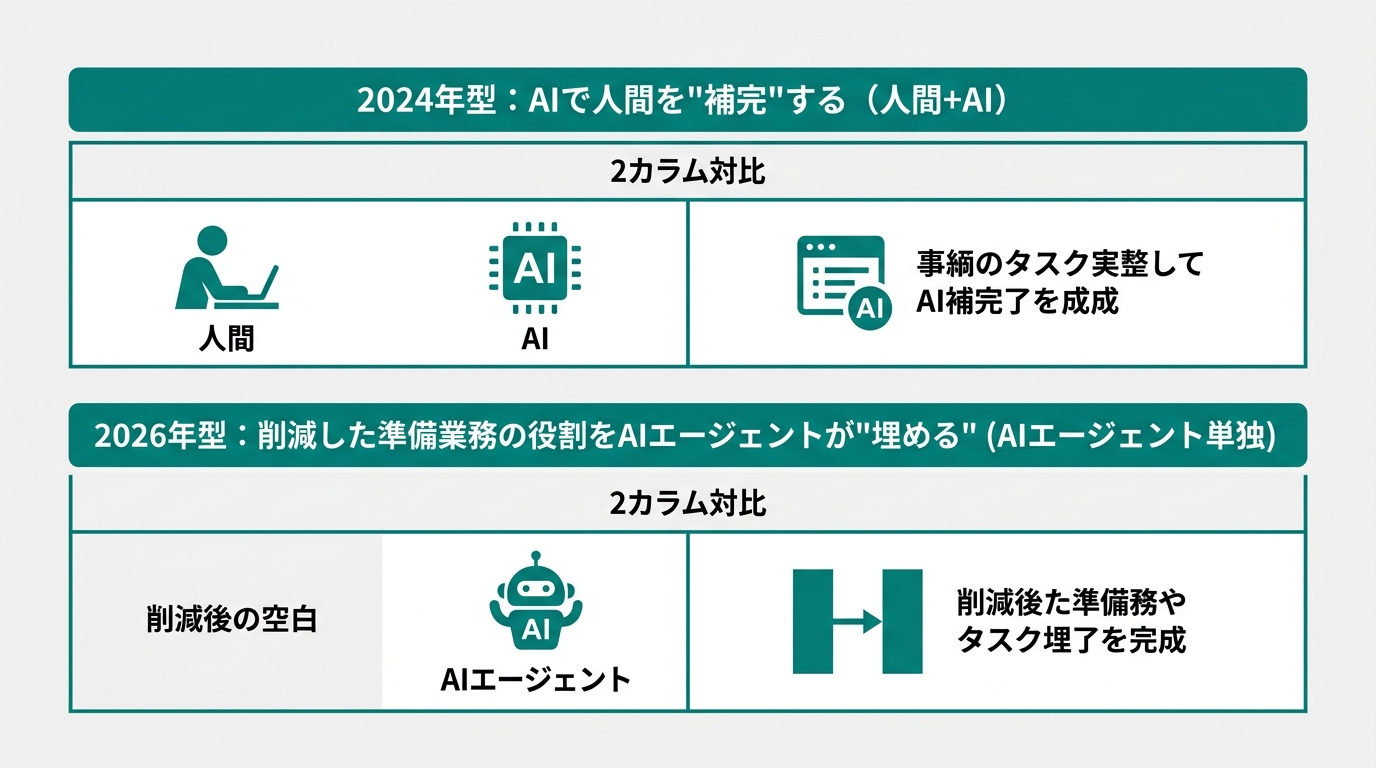
You’ll want to think “this only worked because AWS is a giant hyperscaler.” True, the funding and engineering muscle are in a different league. But the impact comes down in two stages. Stage 1: AWS’s customer enterprises (i.e., almost every mid-sized and large company) start mimicking the same pattern. Stage 2: AWS externalizes the agent mechanisms it has refined internally, in forms like Amazon WorkSpaces. Both are already in motion.
Real Example 3: The “Up to 75% Investing” World That Deloitte Tech Trends 2026 Paints—Both Market Forecast and Pitfalls
The third is a slightly more zoomed-out perspective. The future picture shown by Deloitte’s “Tech Trends 2026” press release in early 2026 and the company’s separate report “AI agents scaling faster.”
Let me start with three central numbers.
No. 1: Up to 75%. Deloitte forecasts that “by the end of 2026, up to 75% of enterprises may invest in Agentic AI” (Tech Trends 2026 Press Release). The scenario is a sharp rise in autonomous agent spending via SaaS platforms.
No. 2: 11% vs. 74%. Deloitte’s separate report “AI agents scaling faster” details that, currently, only 11% have made it to production deployment, while 30% are exploring, 38% are piloting, and 14% are preparing to deploy (Deloitte Insights). The same report also states that “by 2027, 74% are expected to use them at least moderately,” matching the directional sense of Tech Trends 2026’s “up to 75%.” What can be read from these numbers is that there’s a large valley between “interest” and “implementation.”
No. 3: $8.5B → $35B. A forecast that the global Agentic AI market will swell roughly 4x from $8.5 billion in 2026 to $35 billion in 2030. It also states there’s room to grow up to $45 billion if enterprises “orchestrate agents better” (Deloitte Insights).
Lined up, the numbers look like a rosy story. But what’s interesting about Deloitte’s report is that it simultaneously makes the “structure of failure” explicit.
The cited Gartner forecast says, “by 2027, 40% of agentic projects will fail.” The reason isn’t technology, but “trying to hand processes designed for humans to agents as-is.” Deloitte echoes the same point, repeatedly stating that “redesign, not automation, is what’s needed.”
This stings for those of us using these tools too. When you think “could this work of ours be automated by an AI agent,” in most cases the work process itself is built on the premise of human constraints. “Approval requires three sign-offs.” “Reports are bundled once a week.” “Meetings are booked in 1-hour units.” All of these are designs that assume humans will do the work.
The strengths of agents are “running 24/7,” “running in parallel,” and “running at micro granularity.” These strengths and human-premised processes don’t mesh. So many companies end up with “agents just running at the same speed as humans” even after introducing them.
Deloitte also lists specific “areas where effects come through easily.” The largest impact is in customer support. Next come supply chain management, R&D, knowledge management, and cybersecurity. The common thread: “needing to handle large volumes of requests in parallel, 24/7.” Areas that mesh straightforwardly with the agent’s strengths.
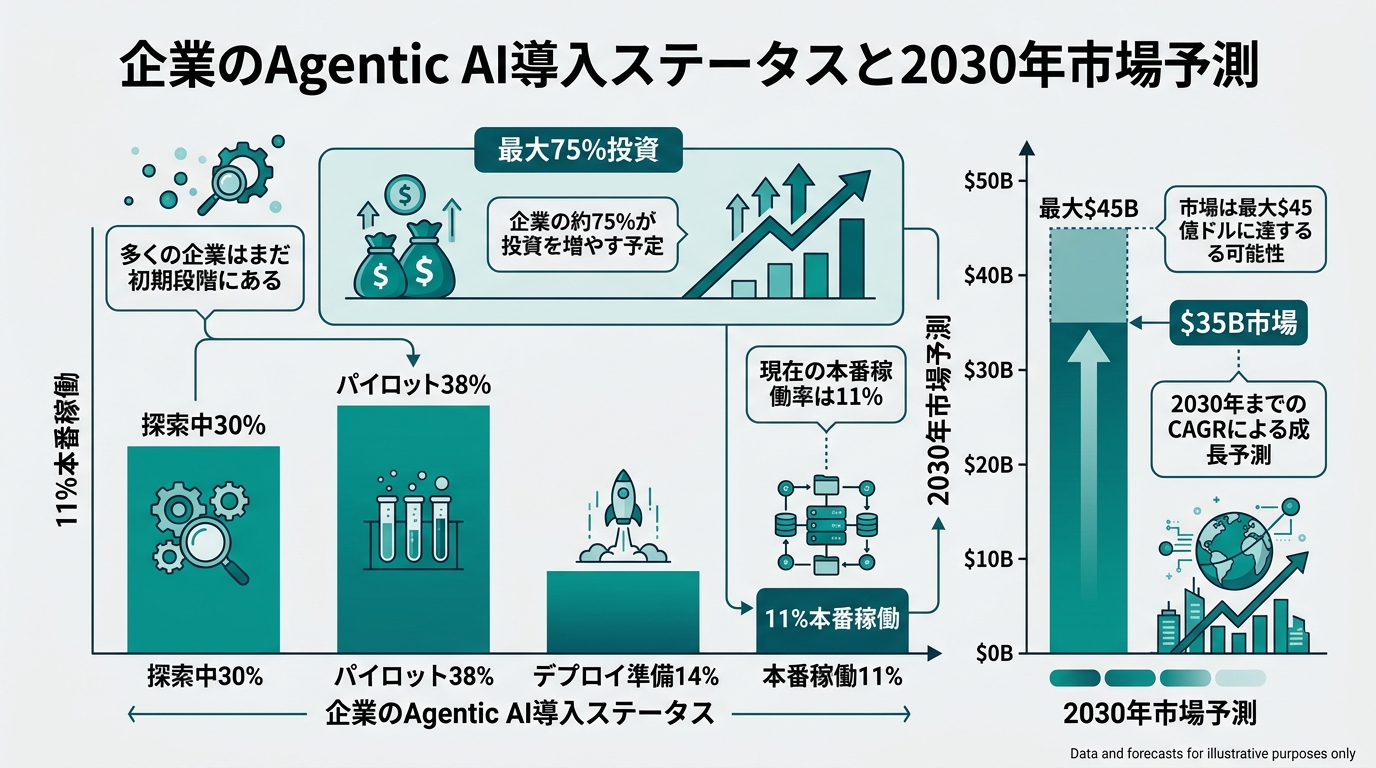
In short, what this report teaches us is two things. The tailwind that “this market will definitely grow” and the cold water that “but unless the organization side changes, half will fail.” You need to receive both at the same time.
Can You Apply It to Your Own Work? Measure Where You Stand with 5 Self-Checks
Building on the three examples above, here are five checkpoints to help you judge “where in your own work an agent fits.”
Check 1: Can the work be completed by “just handing over the goal”?
Agents are handed a goal and act on their own plan. That means it doesn’t suit work without clear boundaries—you have to be able to say “do from here to here.” Conversely, work where the person in charge has to make on-the-spot judgments every time needs “process standardization” before it can be agent-ified.
Check 2: Are the tools to be used decided?
If you can’t define the applications and databases used for the work, you can’t assemble the “toolshelf” to hand to the agent. Excel, Outlook, internal CRM, web browser—try listing them. Anthropic rushed Microsoft 365 integration because of this realistic recognition: “enterprise toolshelves are mostly already aligned around Microsoft.”
Check 3: How costly is failure?
The higher the autonomy, the larger the damage when something goes wrong. For instance, “misclassifying a lead” and “approving a payment without permission” differ by orders of magnitude in impact. The iron rule is to start in areas where the cost of failure is small. It’s no coincidence that AWS chose “technical specialist agent” and “partner coordination agent” first—these were internal-facing tasks where impact could be contained.
Check 4: Can you redesign the work process itself?
This is the core message of the Deloitte report. Handing human-premised processes as-is to agents won’t yield results. Replacing “an approval requiring three people” with “three agents approving in sequence” just makes it mechanical. It takes resolve to question “is this approval even necessary?” and “can it be done in parallel?”
Check 5: Can you design “where the human stands”?
Full autonomy makes failure scary. Full manual defeats the point of an agent. The quality of operations is determined by whether you can design the points where approvals are inserted, where results are checked, and where the final decision is left—the “human points.” Claude’s finance agents incorporating an “escalate cases for human review” design is exactly for this reason.
Going through the five, you should be able to see where in your own work you might begin. There aren’t that many tasks where all five apply. If even one or two land, that’s your entry point.
”Use → Choose → Sell”—How to Get Moving from May 2026 and Wrap-Up
Finally, let me organize how to act after reading this article in three stages.
Stage 1: As a user, just run one thing.
Specifically, hand one of your tasks to either Claude Cowork or Claude Code. Tabulating in Excel, first-pass email classification, drafting meeting minutes—any will do. Rather than “using a convenient conversational AI,” what matters is the experience of “handing over only the goal and waiting for results”, even just once. I covered Claude Code’s pricing and how to start in Answering “Claude Code’s pricing—how much does it actually cost?”, so use it as material for judging your initial investment.
Stage 2: Stand on the choosing side—start developing an eye for industry agents.
Starting with Anthropic’s 10 finance agents, industry-specific packages will keep coming for legal, healthcare, HR, sales, and customer support. Having the yardstick now for “how to evaluate the agents that come to your industry” will decide next year’s competition. Specifically, build the habit of evaluating on three axes: (a) which of the 5 components (goal, plan, memory, tools, execution) is strong, (b) is there an entry-point design with low failure cost, and (c) how deeply does it cut into existing work processes.
Stage 3: Switch to the selling side—design agents yourself.
This is the main event. As I wrote in AI Agents: From “Use” to “Sell.” The 2026 Realistic Path for Non-Coders to Build Businesses, with Stripe building out payment infrastructure and no-code platforms maturing, the environment is ready for non-engineers to launch agents as products. The format of “your business knowledge × agent” is steadily growing into one of the entry points for next-generation startups.
You don’t need to do all three stages right away. Start with stage 1. In the AI agent space, the gap between “people who have run one” and “people who haven’t” is especially large. Once you’ve run one even once, your reading of next year’s news will turn 180 degrees.
Key Takeaways from This Article
- AI agents = a third option that, when handed a goal, makes its own plan, calls tools, and returns results. Sitting in the gap between “smart chat” and “automation scripts”
- Breaking it down by 5 components (goal, plan, memory, tools, execution) changes how you read the news. Both “Claude’s 10 finance agents” and “AWS’s sales agents” are differences in how these five are combined
- The 3 major anchors of May 2026: Claude’s 10 finance agents (entering the industry-specialization phase), AWS’s automation of sales prep work (the boundary line of staff replacement starting from prep work), Deloitte’s up-to-75% forecast (market locked in / but 40% will fail)
- The largest cause of failure isn’t technology, but handing human-premised processes as-is. “Redesign,” not “automation,” is what’s needed
- If you’re going to start moving, the 3 stages are (1) use → (2) choose → (3) sell. Begin by delegating one thing.
The phrase “AI agent” is no longer “a new concept that needs explanation.” As of May 2026, the world’s majors have already started running them in-house, and industry-specific packages are coming down in bundles.
Within the next six months, the gap between “those who use” and “those who get used” will probably widen to a place we can no longer recover from. Starting today, get even one thing running. This is the best gift you can give your future self next year.
I’m trying out agents every day too. Let’s go at it together.

AIを使いこなせない方は、この先どんどん差がつきます。僕はAIエージェントを毎日動かして、壊して、直して、また動かしてます。そういう泥臭い実践の記録をここに書いてます。理論は他の方にお任せしました。僕は動くものを作ります。朝5時に起きてウォーキングしてからコードを書くのがルーティンです。