4 Months with Ahrefs Social Media Manager: An Honest Report — The Exact Line Between Users Who Can Cut a Tool and Those Who Can't
Ahrefs Social Media Manager has been live since January 2026. Should you cancel Buffer or Hootsuite? Four months of real usage reveals the precise boundary: a 4-question framework for deciding whether to consolidate your marketing stack.
What you'll learn in this article
- The key point to grasp before reading the full article
- How the issue changes practical decisions after reading
- Which follow-up article is worth opening next

“So — is Ahrefs Social Media Manager actually worth using?”
That question is what I’ve received most often over the past few weeks, from readers who found my Ahrefs launch analysis from March 30. That piece was aimed at making sense of the structural change right after the official launch. Today is the answer. Four months since the January launch — here’s the real-world feel and the decision framework.
Conclusion first. The question of whether to adopt Ahrefs Social Media Manager doesn’t get resolved by “feature comparison.” It’s an exercise in auditing your own stack — what were you actually delegating to each tool, and why?
What 4 Months of Use Revealed About Where Ahrefs Is Different
Let me be honest from the start. Ahrefs Social Media Manager, evaluated purely as “an SNS operations tool,” is not winning on feature count.
Scheduled publishing, multi-channel simultaneous posting, AI-assisted content idea generation — these have existed in Buffer and Hootsuite for years. Comparing only the publishing calendar UI, my gut feeling is that Buffer is more intuitive.
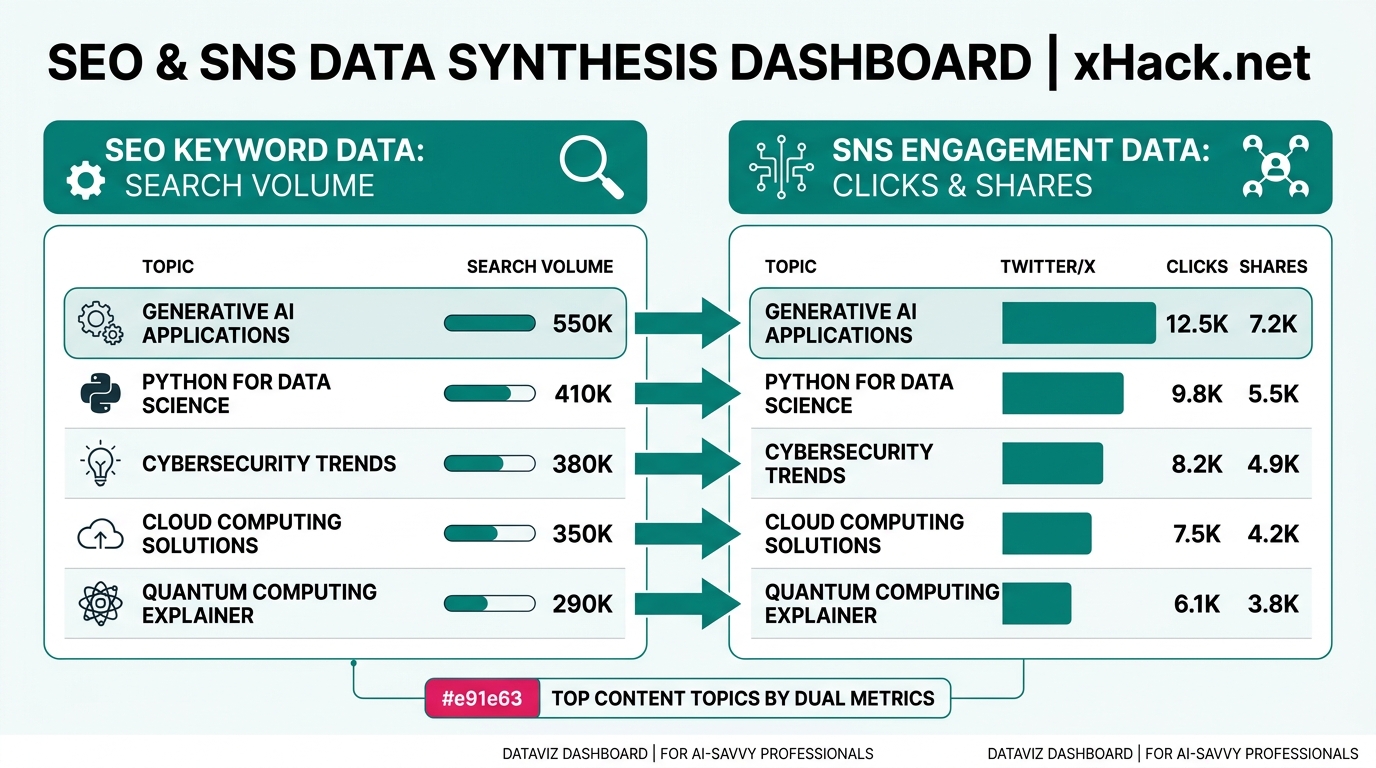
What makes Ahrefs Social Media Manager different is one thing only: SEO data and SNS data on the same screen. That’s it.
Concretely, this is what that unlocks:
“I published an article on a keyword with 1,200 monthly Google searches.” On the right side of the same screen: “Engagement on X posts about the same theme is up 1.4x month-over-month.” When I was switching between Ahrefs and an SNS tool, just placing these two numbers side by side took 5 minutes. With the integration, it’s a glance (author’s real-world usage, January–May 2026).
The gut-feel saving: 5 minutes a day. About 150 minutes a month. But what’s actually doing the work isn’t the time savings itself — it’s that I’m making more judgment calls about “whether the topics that move in SEO and the topics that move in SNS are the same or different.”
For example: GEO-related articles perform consistently across both Google search and X posts. On the other hand, “Claude Code enterprise adoption” posts get average 3x engagement versus search volume (author’s real-world data). Seeing this gap improves the decision axis for “which topic to turn into a video” and “which topic to expand to LinkedIn.”
My weekly routine changed. Monday morning, open Ahrefs’ dashboard, pull the top 10 search-traffic drivers from last week alongside the top 10 SNS engagement posts. Pick 2 overlapping themes and build them into the week’s content plan. The “what do I write next?” paralysis is nearly gone. When I was doing the same exercise across Buffer + Ahrefs in two windows, the act of switching tabs was interrupting my thinking.
But to be straight: Ahrefs Social Media Manager has gaps too. Instagram Reels analytics, X Spaces integration, TikTok support — these areas are thin or not covered as of May 2026. For the latest platform coverage, check the Ahrefs official site.
Mapping Buffer and Hootsuite Side by Side — Overlapping Features and Unique Ones
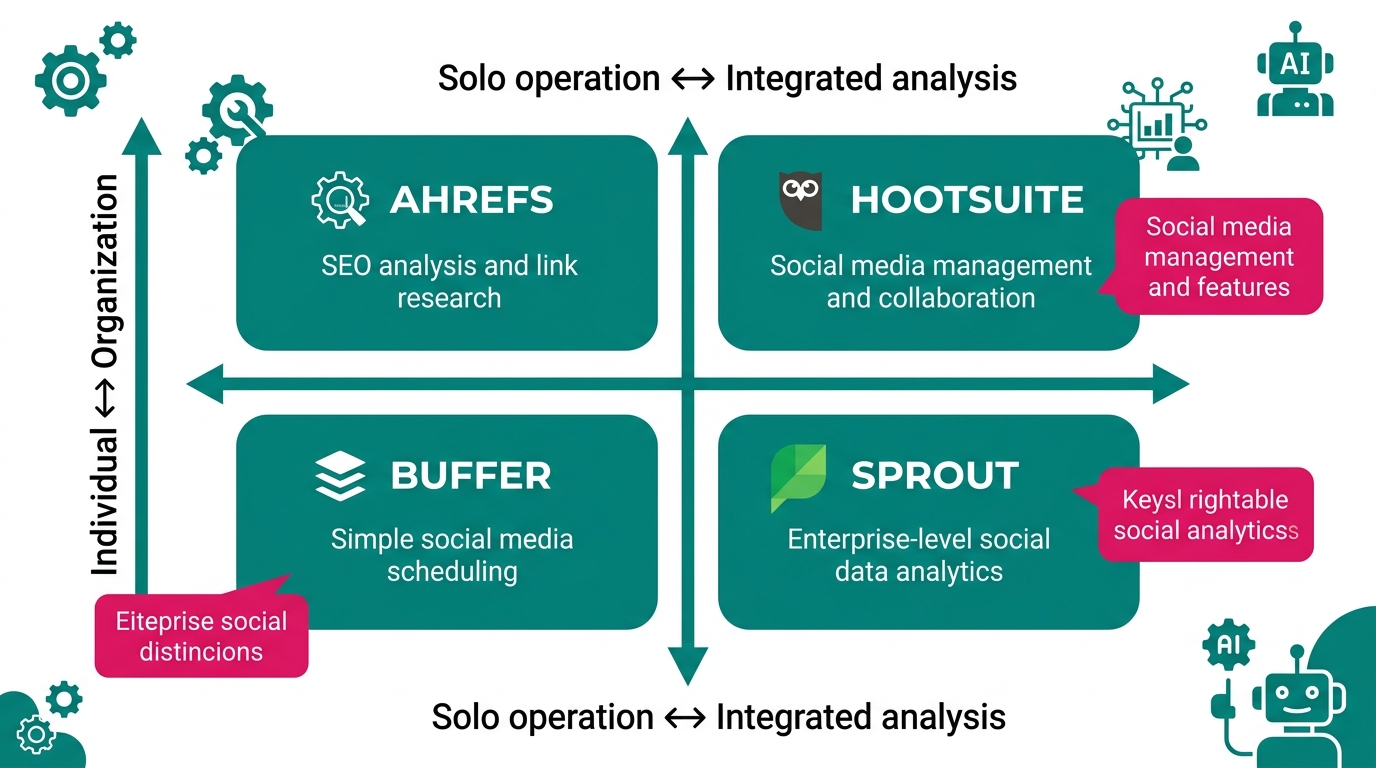
Now to the core stack question. First, where Ahrefs sits relative to the current SNS management tool market:
| Tool | Strength | Weak Spot | Solo Marketer’s Take |
|---|---|---|---|
| Ahrefs Social Media Manager | SEO/AI search data integrated with SNS analysis | TikTok / Reels depth | Best for: “people who want to design SNS from an SEO starting point” |
| Buffer | Clean UI, easy scheduled publishing | Advanced analytics | Best for: “people who just want to keep publishing consistently” |
| Hootsuite | Multi-account management, team permission separation | Relatively expensive | Best for: “multiple brands or agency workflows” |
| Sprout Social | Customer support integration, report quality | Overkill for individuals | Best for: “mid-size and larger organizations” |
The striking thing: the strengths don’t overlap.
Ahrefs Social Media Manager isn’t aimed at head-to-head competition with Buffer or Hootsuite. It occupies a distinct position — “SNS management that descended from an SEO tool.” This is an extension of the “omnichannel optimization” framing I wrote about in the March 30 piece.
Conversely, if you don’t need integrated SEO data, there’s no strong reason to choose Ahrefs Social Media Manager. A restaurant’s in-house SNS coordinator who “just wants scheduled posting and basic analytics” will find Buffer a better fit. The pricing and the use case are both simpler.
Framed this way, the decision point becomes visible. It’s not “which tool is better” — it’s “does your workflow need integrated analysis?” Ask that question and you’re done.
The Line Between “Users Who Can Cut a Tool” and “Those Who Can’t”
The question I’ve gotten most: “Can I cancel Buffer or Hootsuite and move entirely to Ahrefs Social Media Manager?”
Four months in, my answer is clean. There are users who can cut and users who can’t, and the dividing line is clear.
“Users who can cut” have three characteristics:
First: they already subscribe to Ahrefs. Ahrefs Social Media Manager is delivered as part of an Ahrefs plan. Subscribing purely for SNS management — without using it as an SEO tool — doesn’t make economic sense.
Second: they want to design SEO and SNS around the same themes. If your workflow is “write a blog post, then distribute to X, LinkedIn, and Instagram,” the integrated data hits directly.
Third: posting volume is roughly 10–20 per month. At this frequency, seamless UI matters less than data integration — the integration value wins.
“Users who can’t cut” are equally clear.
If you’re posting 5+ times per day, managing multiple brands or multiple accounts — Hootsuite’s permission separation and Buffer’s bulk scheduling UI are working for you daily. If your content is primarily video, Ahrefs’ current coverage of TikTok and Reels analytics makes it unsuitable as a standalone.
I was in the “can cut” category. My Ahrefs subscription predated this — it was already there for SEO. My posting cadence is 5–10 per week, tied to blog articles. So I canceled Buffer in March. The monthly savings were around ¥1,500 — but what I actually gained was less from the money and more from “one fewer tool in my head.”
That said, this is purely my situation. The important thing is figuring out which side you’re on. The next section gives you the framework.
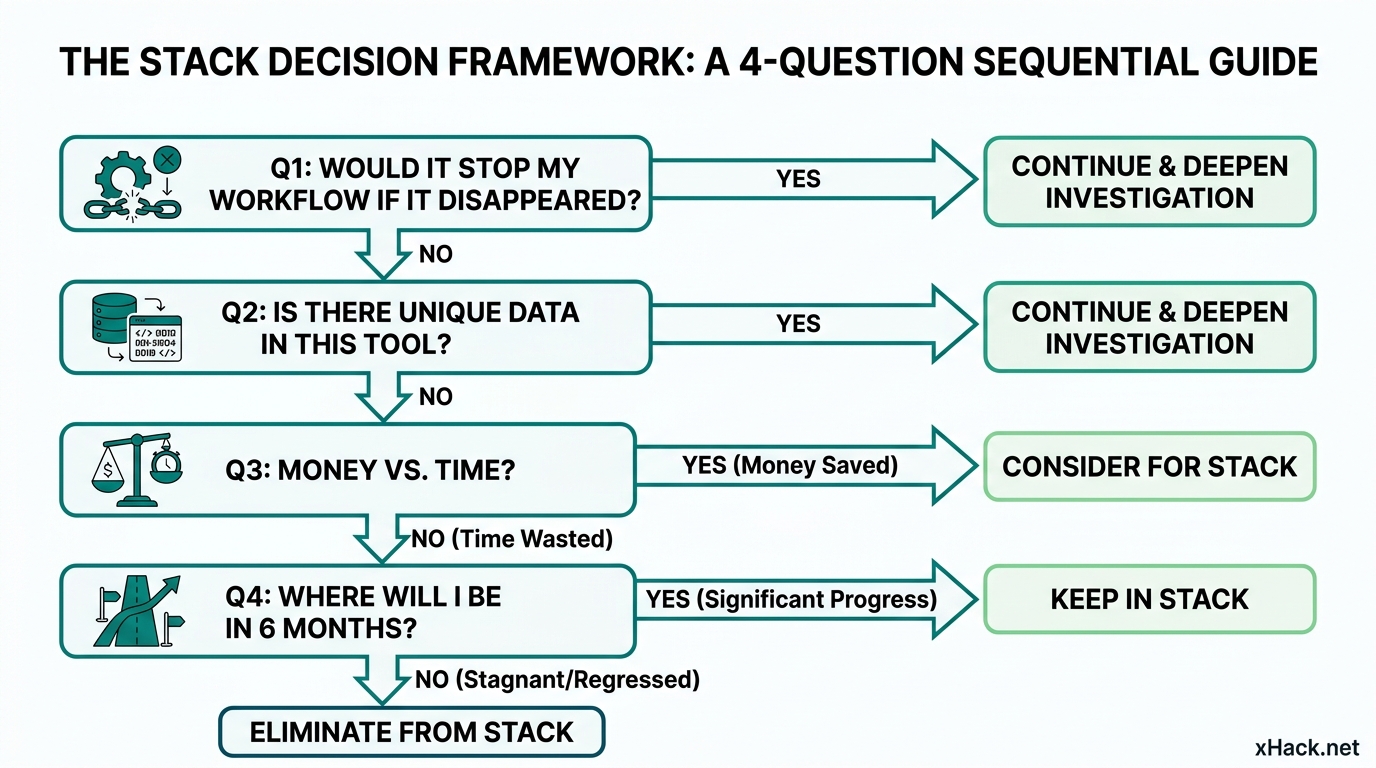
The Stack Decision Framework — 4 Questions That Decide It
When I’m unsure about a tool, I run through 4 questions. Sharing them here.
Question 1: If this tool disappeared tomorrow, what in my workflow would stop?
This is the sharpest question. If Buffer went down today — would my work actually stop? My answer was “no.” Scheduled publishing can run on Ahrefs. Historical data lives elsewhere. So I could cancel.
By contrast, if Ahrefs disappeared, my SEO analysis and keyword research would stop cold. That’s non-negotiable — no cancellation possible.
When Tool A and Tool B have overlapping features, whichever could disappear without stopping your workflow is the “cancelable candidate.” Running this same question against past Slack Pro plans, Notion AI, and multiple video editors — about half came back “actually wouldn’t stop.”
Question 2: Does that tool hold unique data that lives nowhere else?
Tools carry both “features” and “data.” Features can be substituted. Data usually can’t be migrated.
If you’ve used Buffer for 2 years, you have 2 years of engagement history in there. Cancel and it’s gone — or stranded without an export. If that history feels precious, keeping both tools running in parallel is the safer call.
Before I canceled Buffer, I exported “top 20 engagement posts from the past year” as a CSV. Fifteen minutes of work. Buffer gone — data still in my hands. Exporting before migration is near-zero-cost insurance.
Question 3: Which is larger — the money saved or the time saved?
Monthly subscriptions are a few thousand yen. But “one more login destination” is a cost measured in time.
My gut: one more daily-use tool adds 5–10 minutes of cognitive load per day. That’s 150 minutes per month. Time-value that — and it’s worth several thousand yen per month. So having two tools at “roughly the same monthly price” is often worse than consolidating into one.
Question 4: Six months from now, which tool will be more deeply embedded in your workflow?
This is the forward-looking question. Ahrefs Social Media Manager is continuing to update — there’s a real possibility of TikTok support and video analytics improvements within six months. Buffer is also evolving independently.
“Current feature comparison” isn’t the question. “Which one will I actually need six months from now?” shifts the answer sometimes.
Running these 4 questions gives you a conclusion in under 20 minutes for almost any tool decision.
3 Coexistence Patterns — Replacement, Parallel, and Hold
Once you’ve run the decision framework, three patterns emerge. Here’s how to operate each.
Pattern 1: Replacement (Ahrefs as sole SNS tool)
Cancel the existing tool, consolidate into Ahrefs Social Media Manager. Requires meeting all three “can cut” conditions above.
Implementation: try running parallel for one month first. Run SNS ops in Ahrefs, don’t touch the old tool. If your workflow holds — cancel. Canceling immediately without parallel testing risks discovering “this one thing only Buffer could do” after the fact and paying to come back.
I ran a month of parallel testing before canceling Buffer in March. There were 3 moments in week 2 where Buffer’s bulk scheduling UI made my hands stop when using Ahrefs instead. By week 3 that was gone. By week 4 Ahrefs was faster. Knowing it was a familiarity issue is what made me confident enough to cancel.
Pattern 2: Parallel (role division and coexistence)
Use Ahrefs for “analysis and strategy design.” Use the existing tool for “daily posting operations.”
Concretely: run the monthly integrated audit in Ahrefs (checking SEO/SNS theme overlap), keep daily scheduling in Buffer or Hootsuite. It may look like redundancy, but the usage frequency and purpose are different.
This pattern fits users posting 20+ times a week across multiple platforms with different tone for each. Ahrefs’ posting functionality is optimized for an analysis-first workflow — for high-volume daily publishing, Buffer is currently faster. Clean division of roles.
Pattern 3: Hold (don’t adopt now)
“Not needed yet” is a legitimate call. If you’re not investing heavily in SEO, or your posting workflow is personal brand-focused, the value of integrated analysis is thin.
Even for these users: reconsider in 6 months. Ahrefs Social Media Manager is expected to have significant feature updates through 2026. It might not fit the current you — but it might fit the you 6 months from now.
Across all three patterns, the common thread is: “no need to replace everything at once.” A marketing stack isn’t switched in a day — it’s tuned gradually with monthly audits.
Conclusion. Marketing Stacks Reward Subtraction More Than Addition
Four years of solo marketing, and the biggest shift has been in how I relate to tools.
In the beginning: every time a new tool appeared, I’d try it, subscribe, watch another login destination get added. One day I noticed I had 10+ sets of credentials, and monthly subscriptions running into the tens of thousands of yen — and still felt vaguely lost.
What 4 months with Ahrefs Social Media Manager taught me: when you think in the direction of “what can I remove” instead of “what can I add,” decisions get faster.
Three things to hold onto:
- Ahrefs Social Media Manager’s only truly unique capability is “integrating SEO and SNS data.” On every other feature metric, Buffer and Hootsuite are at parity or ahead. The adoption decision should hinge on “whether integrated analysis is what you need” — not feature count.
- “Users who can cut” have three clear conditions: existing Ahrefs subscription, SEO-SNS linked content strategy, mid-range posting frequency. All three → worth evaluating consolidation.
- The 4-question stack decision framework run monthly cuts tool selection paralysis. “What stops if it disappears,” “is there unique data,” “money vs. time,” “where in 6 months” — these four clear it up fast.
This weekend: open your subscription list and run the 4 questions. If you land on “wait, why do I have this tool again” — that’s your cancelable candidate. If you’re unsure, try not touching it for one month. If your workflow doesn’t stop, the case for canceling is nearly airtight.
When your stack gets lighter, decisions get faster. Not just fewer tools — the time you spend deciding “what next” shrinks too. That’s not a prediction. That’s what four months of living it looks like.
Sources
- Ahrefs Official: Social Media Manager
- Ahrefs Official: Pricing
- PR TIMES: Ahrefs Social Media Manager Official Launch (January 22, 2026)
- Author’s real-world data: Ahrefs Social Media Manager usage records, January–May 2026 (posting frequency, engagement comparison, migration history)
Related Articles

AIを使いこなせない方は、この先どんどん差がつきます。僕はAIエージェントを毎日動かして、壊して、直して、また動かしてます。そういう泥臭い実践の記録をここに書いてます。理論は他の方にお任せしました。僕は動くものを作ります。朝5時に起きてウォーキングしてからコードを書くのがルーティンです。