Google Marketing Live 2026: 3 Signals That Reframe AI Search Strategy
Google Marketing Live 2026 and SeoProfy's AI SEO Statistics landed the same week — two independent sources pointing the same direction. Breaking down the 3 transition signals and 3 actions for Monday.
What you'll learn in this article
- The key point to grasp before reading the full article
- How the issue changes practical decisions after reading
- Which follow-up article is worth opening next

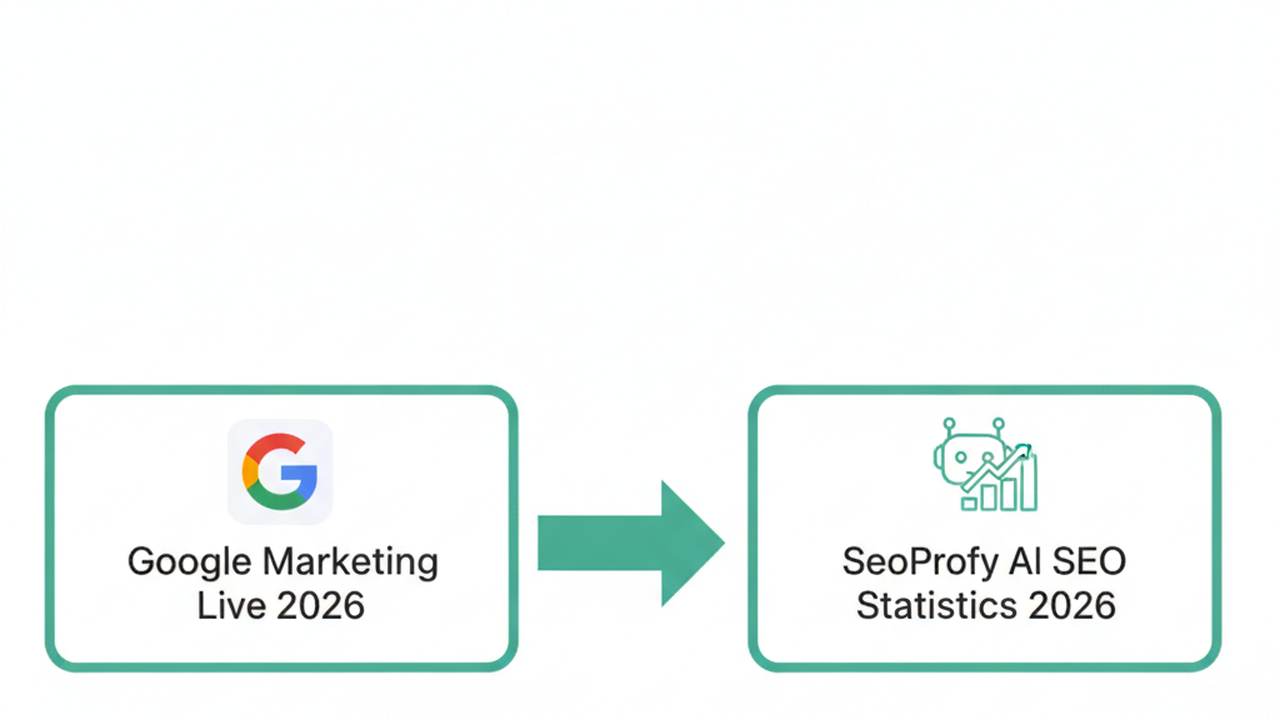
Google’s annual marketing event, Google Marketing Live 2026, was held this week. The same week, a European SEO agency called SeoProfy made a move: they published a report called “AI SEO Statistics 2026” through Yahoo Finance.
One company’s event and one company’s report, coming from different directions, pointing the same way. That was the real story of the week.
I read Search Engine Land’s special coverage on my morning walk, then went through the SeoProfy report over coffee. Put them in sequence and you notice something that had been building for three months. It’s less that Google “redefined” something, and more that industry reality quietly crossed a line.
This piece follows last week’s GEO tactics → AI Visibility frame shift. For readers already leaning forward, the goal here isn’t to consume Google’s announcements as speed news — it’s to read them as signals worth translating into the next three months of action.
Fact-labeling approach for this article
Google Marketing Live 2026 content is verified through Search Engine Land’s feature article (URL confirmed). SeoProfy 2026 report is confirmed to exist via Yahoo Finance distribution URL (confirmed). In this article, Google data is labeled “within what Search Engine Land reported” and SeoProfy data is labeled “directional trends SeoProfy organized in the 2026 edition.” Individual statistics and specific feature names can be verified at each URL. Observations and interpretations are explicitly separated.
Google Marketing Live 2026 Wasn’t Speed News — It Was a Turning Point
Google Marketing Live is Google’s annual event for communicating direction in search and advertising to marketers. For the 2026 edition, Search Engine Land published an “Everything you need to know” summary. Within what Search Engine Land reported, three topics dominated: “advertising,” “AI search,” and “Performance Max updates.”
Here’s what’s worth noticing: these three aren’t separate. Advertising, search, and Performance Max have historically been managed by different teams, different reports, different vendors. This year’s announcements aligned all three toward converging onto the same layer.
Performance Max (Google Ads’ full-funnel automated optimization campaign) was, until now, purely an advertising conversation. Based on what this year’s announcements covered, it’s now continuous with AI search behavior and link exposure within generated answers. Previously, “Performance Max performance” belonged in advertising team stand-ups. Going forward, it needs to be part of search team, SEO team, and content team meetings too.
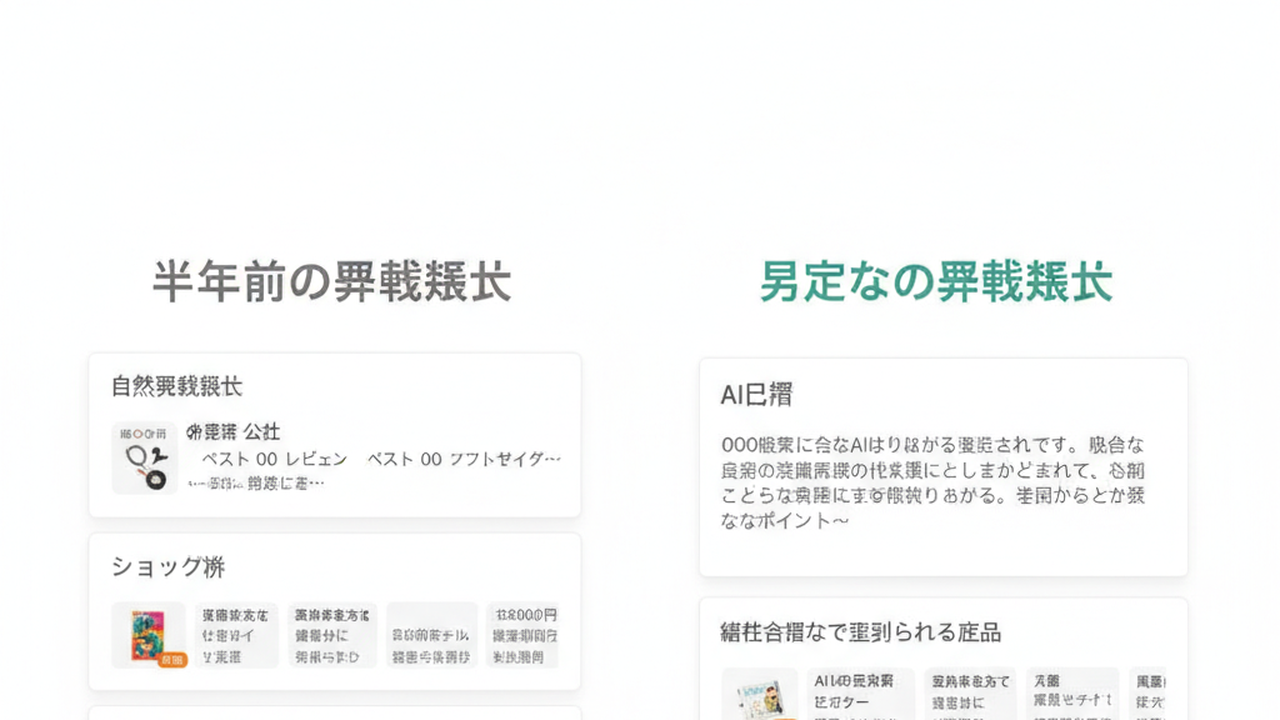
One specific scenario: a user searches “task management recommendations” on Google while looking for business software. Six months ago, the results screen showed organic top-10, Performance Max shopping placements, and standard search ads side by side.
Now it’s different. An AI answer appears at the top of the screen, and the products mentioned in that answer create first impressions before organic clicks. Whether your name is in the AI answer is becoming the entry point for both organic and paid traffic.
In my observation, the past six months have rapidly made untenable the “SEO person who doesn’t understand advertising” and the “ad operator who doesn’t understand SEO.” In my own autonomous workflow (Izumo), if the team writing SEO content and the team thinking about ad strategy aren’t in the same conversation, decisions go sideways. Google Marketing Live 2026 will be remembered as the day the official voice endorsed that change.
For those who still want “what specifically was announced” — Search Engine Land’s summary is the fastest route. This article’s goal isn’t to retrace the announcements but to translate their direction into action for the next 3 months. The gap between your organization’s readiness and the direction being signaled matters more than the announcement details.
Why SeoProfy’s “AI SEO Statistics 2026” Landed the Same Week
The same week, SeoProfy — a mid-sized European SEO agency — published “AI SEO Statistics 2026,” distributed through Yahoo Finance to English-speaking business readers. The fact that it landed on Yahoo Finance signals an intent to reach readers outside the SEO industry.
The directions this report addresses align with industry trends from the past six months: AI search adoption rates, citation bias in generated answers, effects on traditional SEO, and marketer response status across four axes. In the directional trends SeoProfy organized for the 2026 edition, there’s a clear gap between how leading companies have responded and how the rest are positioned — drawing a line between domains where early adaptation has happened and those where organizations haven’t yet moved.
As research, it’s a mid-sized agency’s survey. As a “temperature gauge for the industry’s current state,” it’s useful supplementary context.
The Yahoo Finance timing overlapping with Google Marketing Live is unlikely coincidental — aligning distribution with Google’s annual event to maximize exposure is a rational PR strategy. But the result is a week where marketers can simultaneously access “what Google released” and “what industry statistics show.” That matters.
One caution: don’t consume SeoProfy’s report as a “statistics warehouse.” Individual numbers have interpretation ranges depending on sample size and survey scope. I’ve limited my SeoProfy references in this article to directional and trend descriptions rather than direct citation of individual statistics.
What matters is that the “direction” the report is pointing and the “direction” Google Marketing Live is pointing align via independent routes. Directional convergence from multiple independent sources is far more reliable as decision material than a single-source prediction.
For thinking about statistics strategically, see “Are You Collecting Too Many AI × SEO Stats?”. Statistics alone accomplish nothing. SeoProfy’s data can be cross-referenced with Google Marketing Live’s message with just one read of the table of contents. Consuming them separately erodes the value of both.
The 3 Transition Signals Visible When You Put Them Together
Put Google Marketing Live and SeoProfy 2026 side by side and three signals emerge. For readers who’ve been moving proactively for three months, this is confirmation. For those about to start, it’s the starting map.
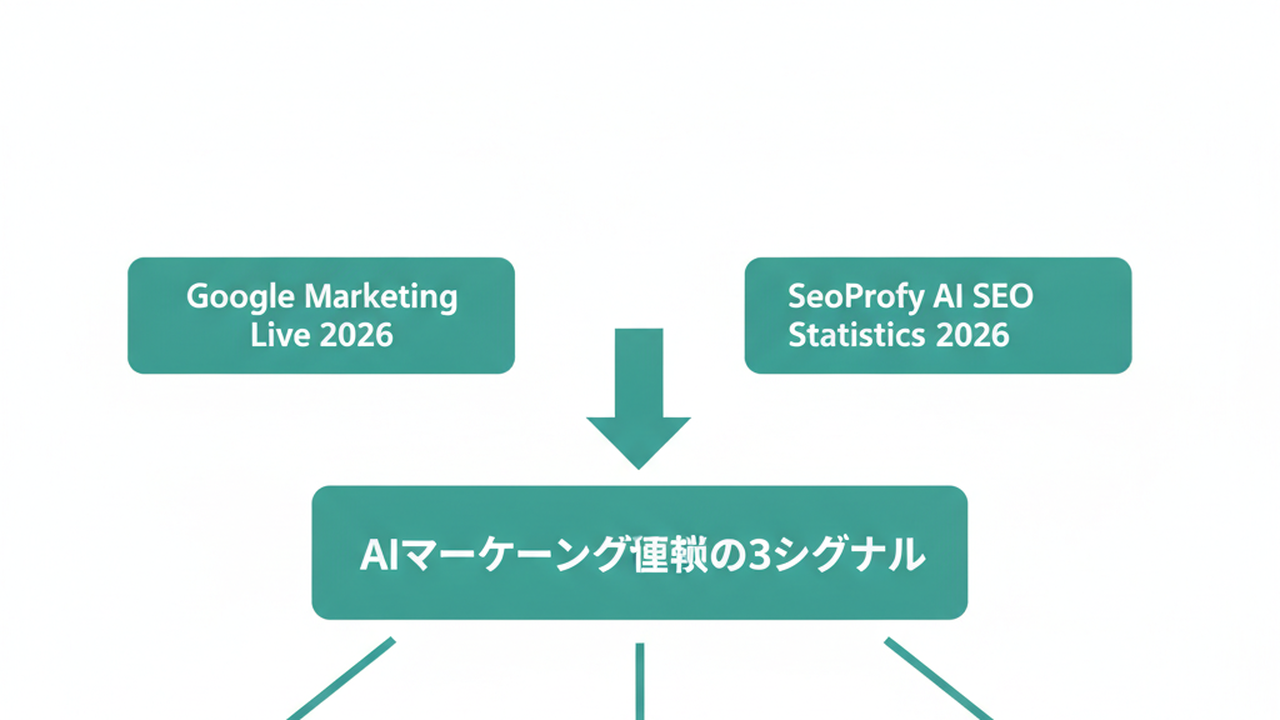
Signal 1: The share of AI search has crossed “can’t ignore” into “approaching mainstream”
Six months ago, the fraction of search queries arriving through AI answers was “non-negligible.” In the directional trends SeoProfy organized for 2026, by industry and region, some markets are approaching what could be called mainstream. This is within SeoProfy’s research scope — caution before generalizing to all markets. Google Marketing Live elevating AI search as a standalone priority topic reads as official acknowledgment of that trend. The share of your marketing work spent designing how you appear in AI answers will move significantly forward in the coming year.
Signal 2: The boundary between advertising and search is disappearing at the operational level
Performance Max updates are no longer just an advertising team conversation. Within the same campaign, search result display, citations within generated answers, and shopping placements all move together. Organizations that have put half their ad budget into Performance Max will find that their “advertising report” can no longer be called that by structure. The org chart at marketing departments and the actual operational layer separations are beginning to diverge.
Signal 3: The front line shifted from keyword design to context and quality design
Three months ago, the front line in SEO was keyword selection and internal linking. Now the question is: “What context does AI want to cite?” and “What quality comes through when it appears in a generated answer?” SeoProfy 2026’s directional findings converge on this point too. Google Marketing Live’s message is aimed at the inside of search, not the surface. Start converting time spent reviewing keyword lists into time spent on content quality and context preparation.
The Gap Between “People Who Had 3 Months of Lead Time” and “People Starting Now”
Three months ago — February 2026 — some people could already read these signals. Not because they predicted the future, but because they had the habit of looking at industry statistics every week. SeoProfy had already put out “2026 outlook” style previews in Q1. Anyone tracking weekly roundups from Search Engine Land or Search Engine Journal was seeing the same landscape.
The gap opened after reading the signals: those who acted proactively had made three preparations. First: rewriting content structure to be more easily cited in AI answers. Second: advertising team and SEO team attending each other’s stand-ups. Third: revisiting budget allocation to include Performance Max.
None of these completes in one week. Only people who had been moving incrementally over three months can read this week’s Google Marketing Live as “confirmation.”
One observation from my immediate circle: a mid-sized B2B company that started measuring its “AI answer citation rate” for its main keywords during Q1 2026 (anonymous, author’s observation). In March, the rate was low, so they shifted content writing toward “bullet points and conclusion-first structure” as their approach. Remeasuring the same metrics in May showed clear forward movement.
Whatever Google or SeoProfy says this week, their own numbers are moving — so there’s no hesitation in their decisions. That’s what “having three months of accumulation” looks like.
On the flip side, companies that have been running without tracking signals will start Monday morning at “where do we even begin?” mode. Three months’ difference shows up as a difference in deliberation time. If deliberation takes a month, the gap at six months is four months.
For those starting now: it’s not too late. A three-month gap is large, but it hasn’t become a six-month spread yet. Reading both Google Marketing Live and SeoProfy 2026 at the same time this week is the fastest catch-up. Reading only one is like viewing the landscape with one eye closed.
I personally keep time in my autonomous workflow (Izumo) to read daily search data and weekly industry reports side by side. Building the weekly habit is the hardest part at first, but after three months, Google’s and Anthropic’s announcements shift from “news to chase” to “events to confirm.” Moving from “chasing speed news” to “confirming speed news” fundamentally changes how you allocate time as a marketer.
One hour per week, looking at industry reports and your own data together. That alone raises the quality of decisions six months later.
3 Actions Starting Next Monday
After reading Google Marketing Live and SeoProfy 2026, here are 3 actions you can start on within 7 days. Don’t do all three at once. One at a time, in sequence.

Action 1: Measure your “AI answer citation rate” for main keywords
For your 10–20 main keywords, measure once how often your site is cited in Google’s AI answers. Manual or tool-based is fine. Perfect measurement isn’t needed. The goal is to have a number for “where am I right now?”
This becomes your starting point. Monthly monitoring is ideal, but for this week, one measurement is enough.
Action 2: Schedule a monthly joint meeting with the advertising team
Book a monthly “joint standing meeting” for advertising team and SEO/content team. 30 minutes is enough. Build the habit of discussing Performance Max performance, AI search behavior, and content quality improvements at the same table. This isn’t an org chart conversation — it’s a practical one.
Solo marketers: build time to compare Performance Max numbers and content numbers in the same document, monthly.
Action 3: Build one signal dashboard
Industry statistics like SeoProfy, speed news like Search Engine Land, your own search data, your own ad data. Build one dashboard where all four are visible on one screen. Notion, spreadsheet, or Looker Studio — it doesn’t matter.
The goal is to have one place where “whatever Google releases next, I can translate it into my own context.” Looking back six months later, having or not having this one page will double the speed of your decisions.
The three actions are calibrated to be completable within 7 days total. Starting from the recognition that the era of managing advertising, SEO, and AI search separately is over, each one can be started within 30 minutes. What matters most: start Action 1 the Monday morning after reading this.
For the approach to fixing gaps between tactics and results, see “When Your ‘Running Tactics’ and Your ‘Actually Working Tactics’ Don’t Match”. Reading that alongside this article will make next week’s moves even clearer.
Summary: Practicing Signal-Reading Determines the Next Six Months
Google Marketing Live 2026 will be remembered not as the day something was redefined, but as the day the official voice acknowledged a change that had been building for three months. The same week, SeoProfy’s “AI SEO Statistics 2026” came through Yahoo Finance — its role was to provide directional backing for that same change.
The three signals, restated:
- AI search share is moving from “can’t ignore” toward “approaching mainstream in leading sectors” (SeoProfy 2026 directional findings)
- The boundary between advertising and search is disappearing at the operational level
- The front line shifted from keyword design to context and quality design
Next Monday morning: measure the AI answer citation rate for one main keyword. At the start of next month, schedule a 30-minute joint session with the advertising team. This week, build one signal dashboard. Three actions, all startable within 7 days.
Having a “way of reading” that lets you translate whatever Google releases next into your own context — that’s the highest-leverage investment you can make as a marketer. Whether you let Google Marketing Live 2026 pass as speed news or use it as practice for reading signals: the next six months’ divergence is decided by how you read it this week.
If this article made you want to move: measure AI answer citation for just one keyword today. Once you measure it once, you’ll want to keep measuring. Next Monday morning, five minutes is all it takes. Take the first step toward being a marketer who reads signals.

AIを使いこなせない方は、この先どんどん差がつきます。僕はAIエージェントを毎日動かして、壊して、直して、また動かしてます。そういう泥臭い実践の記録をここに書いてます。理論は他の方にお任せしました。僕は動くものを作ります。朝5時に起きてウォーキングしてからコードを書くのがルーティンです。