115K People Believed in a 'Female Coder' Who Was Actually a Man. In the $11.22B Virtual Influencer Era, I Rebuilt My 3-Check System for Vetting Tech Sources
Two and a half years after the Coding Unicorn incident. With the virtual influencer market ballooning to roughly $11.22B, this former failed engineer rebuilt a 3-check system for spotting trustworthy tech sources.
What you'll learn in this article
- The key point to grasp before reading the full article
- How the issue changes the way developers should work next
- Which follow-up article is worth opening next
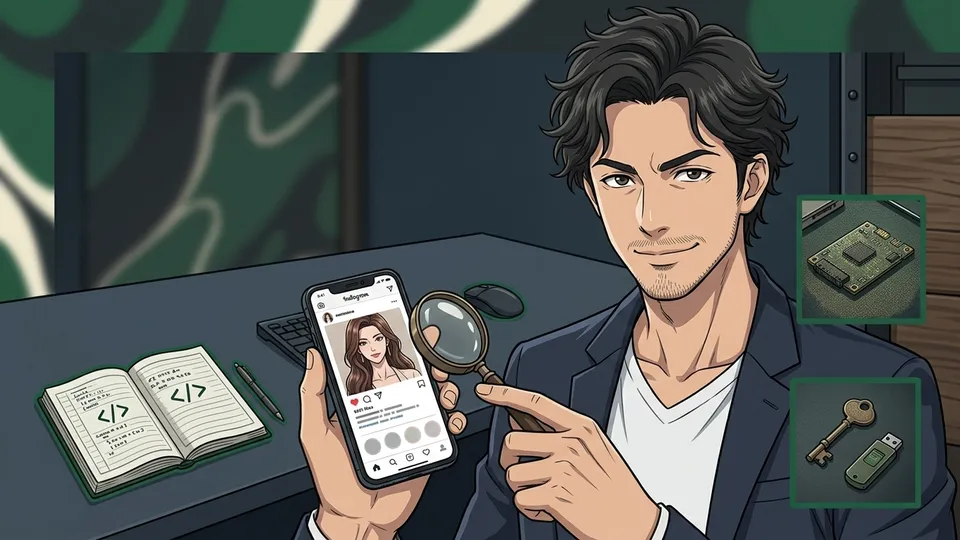
How many people remember the Instagram account “Coding Unicorn”?
Around 115,000 followers. The profile claimed to be a female programmer named “Julia.” Coding tips alternated with lifestyle posts — the classic female-engineer-influencer formula.
The person behind that account turned out to be a male tech conference founder, as 404 Media exposed in November 2023. As an incident, it’s about two and a half years old now.
So why am I writing about this now? Because the virtual influencer market has ballooned to roughly $11.22B in 2025. That incident wasn’t a one-off scandal. It was a warning sign for an era where AI avatars and “broadcasters with no one inside” become the norm.
I’m a former failed engineer with a CS (Customer Success) background. Vetting tech information sources is the foundation that makes my work and my own writing possible. So I rebuilt my approach in earnest. By the time you finish reading, you’ll have three checks you can start using on your timeline tomorrow.
The 115K People Who Believed in a ‘Female Coder’ Were Following a Man — A Recap
The protagonist of the incident is Eduards Sizovs, based in Latvia. Founder of “DevTernity,” a software developer conference.
According to 404 Media’s investigation, Sizovs effectively ran “Coding_Unicorn.” The public face was a female programmer calling herself “Julia.” The account had 115,000 followers.
Four pieces of evidence sealed the case.
1. A YouTube video. Sizovs filmed his own screen. Visible in it was the email screen for the Coding_Unicorn account.
2. A photograph. A workspace photo of the person claiming to be Julia included a browser logged into Sizovs’s account in the background.
3. IP logs. The administrator of the developer forum Lobste.rs provided IP logs. The IP that posted as Sizovs and the IP that posted as Kirsina matched.
4. Copied text. Coding_Unicorn’s Instagram captions were essentially copies of Sizovs’s LinkedIn posts.
Information from multiple sensory angles all pointed to one man. That’s the structure of the incident.
DevTernity Itself Admitted to “Auto-Generated” Fake Speakers
Just before the Coding Unicorn incident, another problem exploded at DevTernity, which Sizovs also runs. According to a follow-up by 404 Media and The Register, the speaker lineup included two fictional female speakers.
Anna Boyko (staff engineer at Coinbase). Natalie Stadler (software craftswoman at Coinbase). Neither matched any actual employee on the Coinbase side.
Sizovs himself admitted they were “demo personas” and “auto-generated.” Gergely Orosz, who publishes the Pragmatic Engineer newsletter, dug deeper. It turned out the same kind of fake female speakers had been used at the conference in both 2021 and 2022.
The conference was scheduled to begin December 7, 2023. Headline speakers withdrew one after another, and the conference was canceled. Sizovs himself posted on X (formerly Twitter) that he had “done nothing wrong to apologize for.”
That’s the factual record. The incident isn’t a standalone ethics issue. A “broadcaster with no one inside” infiltrated trust infrastructure under the banner of supporting female engineers. The incident exposed that structure.
Why I’m Bringing This Up Now, Two and a Half Years Later
“Why dig up a 2023 incident in 2026?” Some readers must be thinking that. I asked myself the same question first.
The reason is that the AI avatar / virtual influencer market has swollen beyond what I imagined.
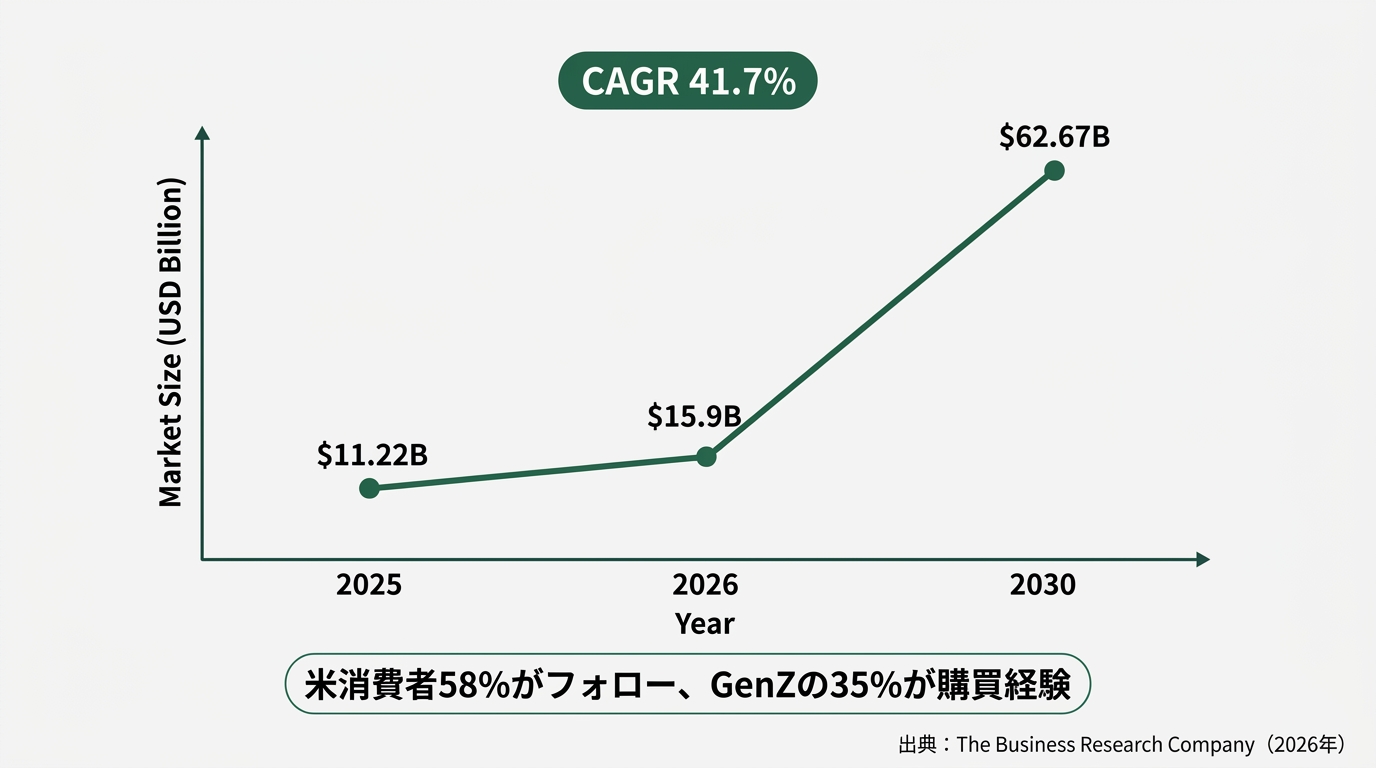
Looking at The Business Research Company’s 2026 report makes the scale clear. The global virtual influencer market is projected to reach $11.22B in 2025 and $15.9B in 2026. The CAGR (compound annual growth rate) is 41.7%. The same report predicts $62.67B by 2030.
AutoFaceless’s 2026 statistics roundup is also striking. 58% of US consumers follow at least one virtual influencer. 35% of Gen Z have purchased a product recommended by a virtual personality. There’s also data showing CMOs plan to allocate 30% of their influencer budget to virtual creators.
A representative example is Lil Miquela. A CG female avatar set to be 19 years old, launched by Trevor McFedries and Sara DeCou. She operates as a persona on Instagram. Industry media reports she earns roughly $10M annually, and in 2020 she signed with the major agency CAA.
The US FTC (Federal Trade Commission) revised its Endorsement Guides in 2023. The revised version requires virtual and AI-generated influencers to disclose just as humans do. When AI is involved in creating or augmenting endorsement content, that involvement must be made explicit.
Here’s the point. The Coding Unicorn incident raised two questions: “Who is actually inside?” and “Whose interests is this content serving?” Whether you measure by market size or by regulation, the weight of those questions grows heavier every year.
As Nagi’s article “The Map of Search Has Changed” noted, the information sources we touch daily have shifted rapidly over the past few years. “A mix of humans and AI” is now the baseline assumption. The more you use tech information for work, the more urgently you need to update your vetting criteria.
So I extracted three checks from the evidence structure of the Coding Unicorn incident. Not a perfect detector. The goal is a realistic filter you can run on your timeline starting tomorrow.
Check 1: Can You Cross-Verify Across Multiple Senses?
The biggest reason Coding Unicorn’s mask came off is simple. Different kinds of evidence — images, videos, IP logs, text — all pointed at the same person. Conversely, healthy broadcasters have the same property in the opposite direction.
Can you cross-verify a person’s existence across multiple senses? That’s Check 1.
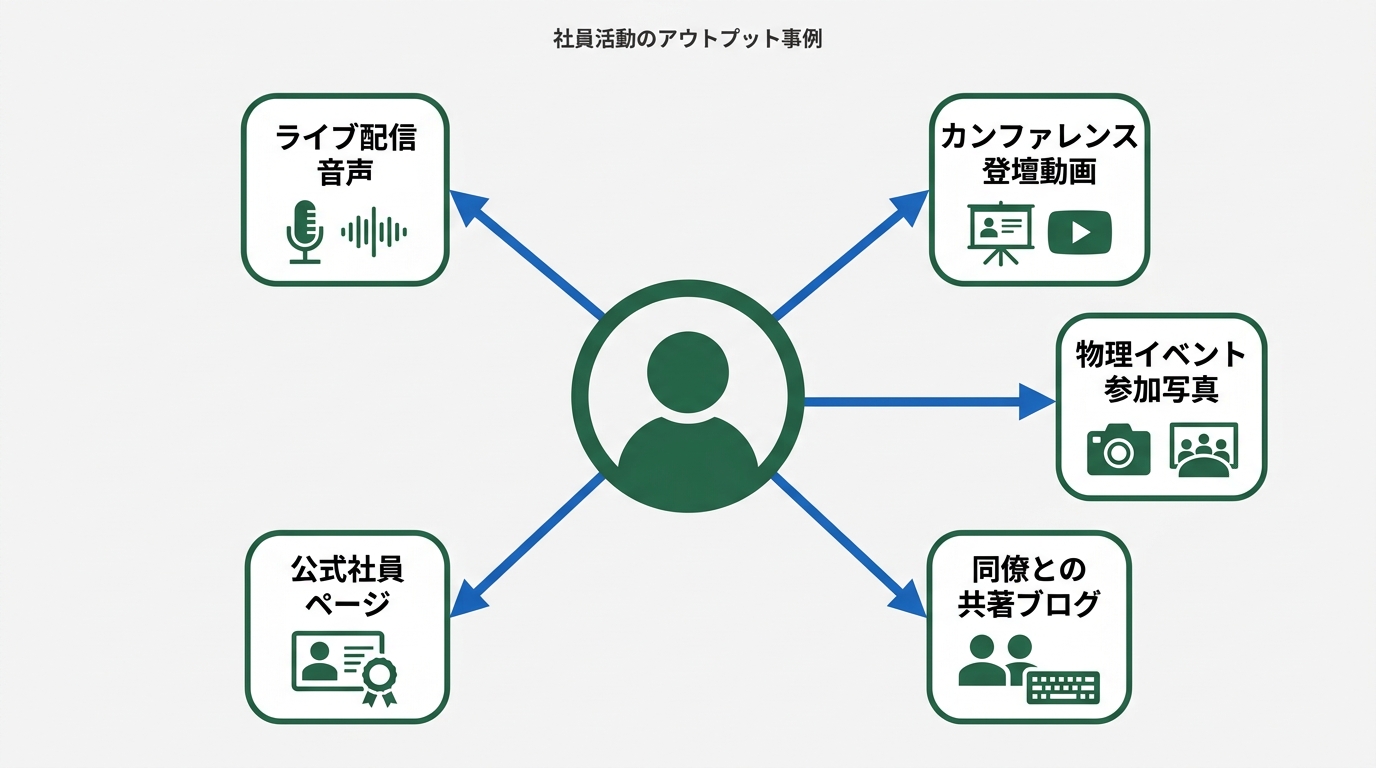
There are five concrete items to check.
Live stream audio: Does the person have a history of live streams or audio broadcasts under the same face and name? Real-time is preferable to recorded. AI-generated content has a hard time keeping up with improvised reactions to chat.
Conference talk video: Recordings are fine. It’s better if they’ve spoken at multiple conferences and the organizers are independent of each other. In Coding Unicorn’s case, the speaking engagements were almost entirely concentrated at Sizovs’s own DevTernity.
Co-authored blogs or joint talks with colleagues: Are there points of contact with other real people, not just solo broadcasts? Joint speaking schedules and photos with multiple people in them are harder for AI to fabricate alone.
Official employee page at the claimed organization: Beyond self-claims, does the person’s name appear on the official site of the organization? In Coding Unicorn’s case, “Julia” had no corresponding employee record on the official page of the company in her bio.
Traces of physical event participation: Photos from gatherings, joint event organizer credits, posts from other attendees mentioning the person. When these line up, the probability that the same person is moving outside the SNS space goes up.
You don’t need to satisfy all five. But if “none apply” to the tech information source you’re following, it’s safer to dial down the weight you give to their content.
In my own CS work, when I start following a new contact at a customer site, I’ve gotten into the habit of running these five items through my head. When you actually do it, you’ll be surprised how many “broadcasters who exist only on SNS” are out there.
Check 2: Can the Originality of Their Statements Be Verified Over Time?
The other decisive blow against Coding Unicorn was text copying. Instagram captions were copies of someone else’s LinkedIn posts. The moment originality of statements collapsed, originality of personality came under suspicion too.
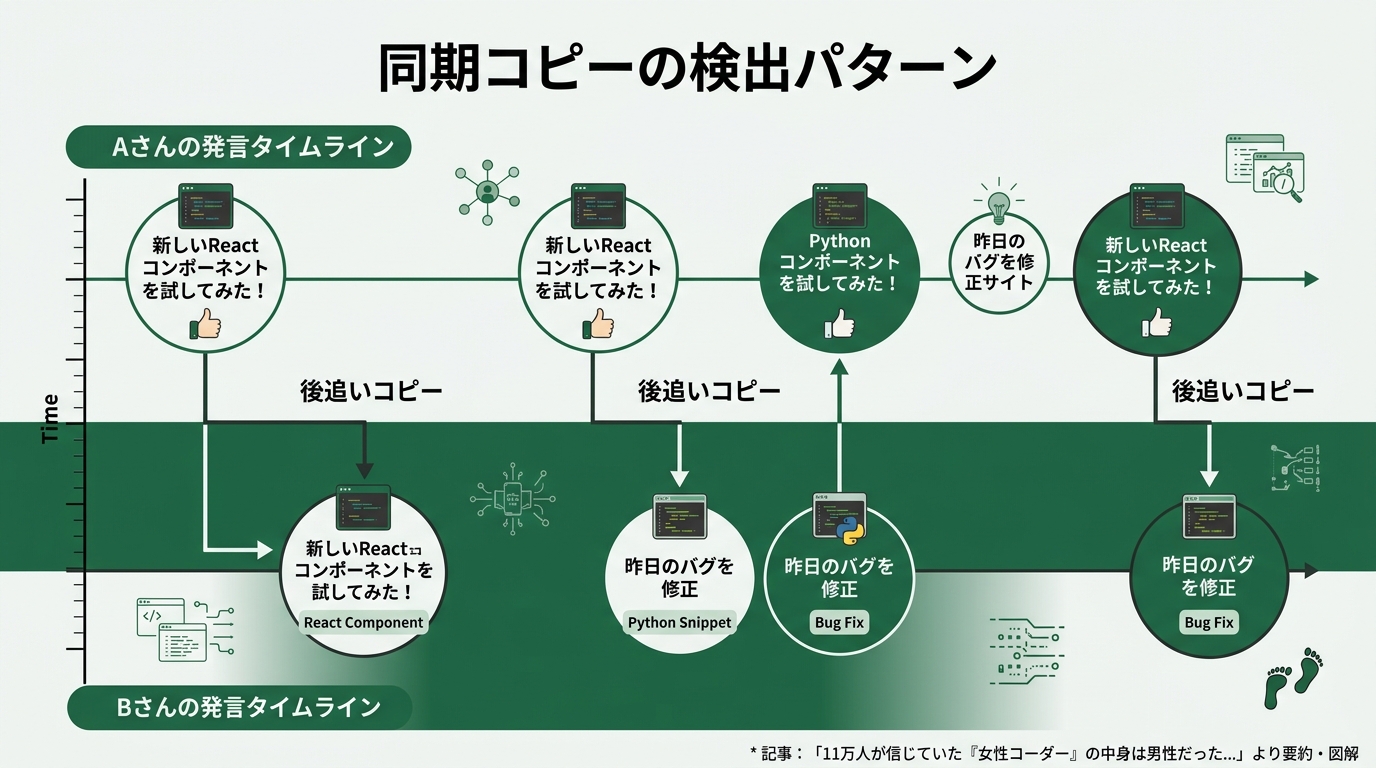
There are three observation points you can use starting tomorrow.
Observation point 1: Bias in posting times
Accounts whose content is shared tend to post the same content right after another account does. Are posts concentrated in unnatural time slots when viewed in your local timezone (for example, daily scheduled posts at 2 AM local time)? If so, the operator is likely multiple people or automated.
Observation point 2: Sudden style changes
If you’ve followed someone long-term, you’ll catch moments where the consistency of style or theme feels off. Their tweets were casual until a certain point, and then suddenly read like a business book. This too can be a sign that operations have been outsourced or that someone else’s copy has been mixed in.
Observation point 3: Detecting contradictory statements
Do past claims contradict recent ones? Coding Unicorn made a statement that “men suffer from bias just as women do.” It was a phrase that sparked debate in feminism contexts. Once you know the person inside is a male operator, the meaning of the same words flips. The weight of words changes depending on who is speaking them.
I keep these three in a simple log template in Notion. 30 seconds, one line, per broadcaster. After three months of accumulation, the three patterns above become startlingly visible.
Nagi’s article “Ranking #1 on Google but Not Cited by AI” made the same argument. Information sources cited by AI need originality. From the reader’s side, E-E-A-T (Experience, Expertise, Authoritativeness, Trustworthiness) maps onto the question “can originality be verified over time?”
Check 3: Is It Transparent Who Profits?
The DevTernity incident was fundamentally about something deeper than faking gender ratios — it was about “whose benefit was it done for.”
The more diverse Sizovs made the conference look, the easier it was to attract speakers, sponsors, and attendees. Coding Unicorn’s 115,000 followers became a direct funnel to his own conference. The flow of profit and the broadcasting structure were closed-loop, internally connected.
Healthy broadcasters keep the flow of profit visible from the outside.
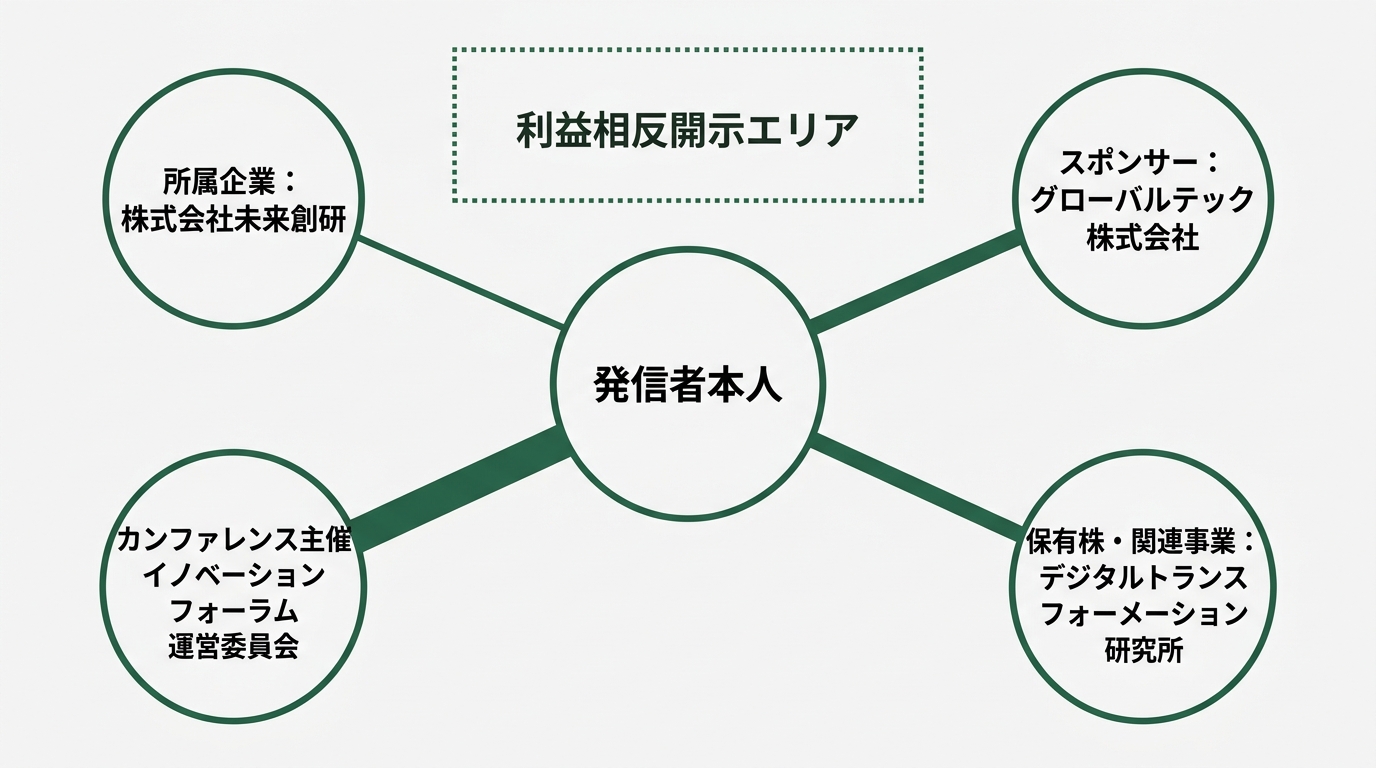
You can narrow it down to three items.
Item 1: Disclosure of sponsors and affiliations
Can you grasp the broadcaster’s sources of income from their main posts, pinned posts, or profile? The FTC’s Endorsement Guides require disclosure when there’s a financial relationship behind an endorsement, regardless of whether the endorser is human or virtual. Japan’s Consumer Affairs Agency’s stealth-marketing regulation (effective October 2023) operates on the same principle.
Item 2: Degree of involvement in the tools they recommend
Are they involved with the tools they recommend as advisors, shareholders, or angel investors on the vendor side? When you spot their name in a LinkedIn title or a past funding round announcement, build the habit of pausing. Is this “I’m glad I tried it as a regular user” content, or is this “they have to say this” content? The way you weigh it changes.
Item 3: Degree of funneling to their own conference or product
What was decisive in Coding Unicorn was that followers became a funnel to DevTernity. When you observe where a broadcaster ultimately leads their followers, the flow of profit becomes visible. If every post converges on a signup page for their own product, you should reread that content as advertising rather than introduction.
This is essentially the same as the AEO discussion in Nagi’s article “Get Found by AI Before Google”. Without understanding the broadcaster’s incentives, taking cited information at face value is risky. AEO (Answer Engine Optimization) refers to optimization for being discovered by AI.
Suppose the three items come back as “no,” “ambiguous,” or “only funnels to their own products.” It’s safer to switch to “read this as advertising” mode for that broadcaster’s opinions. I’m not saying their opinions have zero value. The conversation is about changing how you weigh them.
A Former Failed Engineer’s Honest Take — Why I Didn’t Doubt Coding Unicorn
I’ll be honest. I was likely following Coding Unicorn back in 2023.
I don’t remember clearly. But at the time, I was advancing my CS career and had finally started to revive my interest in AI. I was in a “I want to support female engineers’ content” and “I want to lightly read coding tips” mood. I had no reason to doubt the 115K-follower account flowing through my timeline.
The day the incident broke, I noticed my own blind spot. The good will of “I want to support female engineers” had loosened my verification eye.
This isn’t about Gen’s personal weakness. When we use trust infrastructure, everyone holds blind spots with similar structures. “I want to support minorities.” “I want to support beginners.” “I want to boost Japanese engineers.” All correct as sincere feelings. And precisely for that reason, they become reasons to skip verification.
The three checks aren’t tools for denying the desire to support. They’re tools for checking that what you’re supporting is real, while still wanting to support.
In my CS days, I made the mistake of “trusting too much and getting burned” with customer contacts more than once. I’ve also experienced the opposite — “doubting too much and breaking the relationship.” What I learned from both failures is that “trusting” and “verifying” don’t conflict. In fact, the people you can put verification effort into are the ones you can trust long-term.
The same goes for tech information sources on your timeline. The Coding Unicorn incident three years ago gave us permission to “spend the effort to verify.” Spending one minute confirming before supporting — that cost is cheaper today than it was three years ago.
It’s the same idea as “optimizing your information sources” from Mikoto’s article “Five Tools Are Enough”. Narrowing down to broadcasters you can trust is itself an investment in protecting your decision time.
In Closing — If You Forget the Three Checks, Just Remember This
This turned into a long article. Let me restate the three checks at the end.
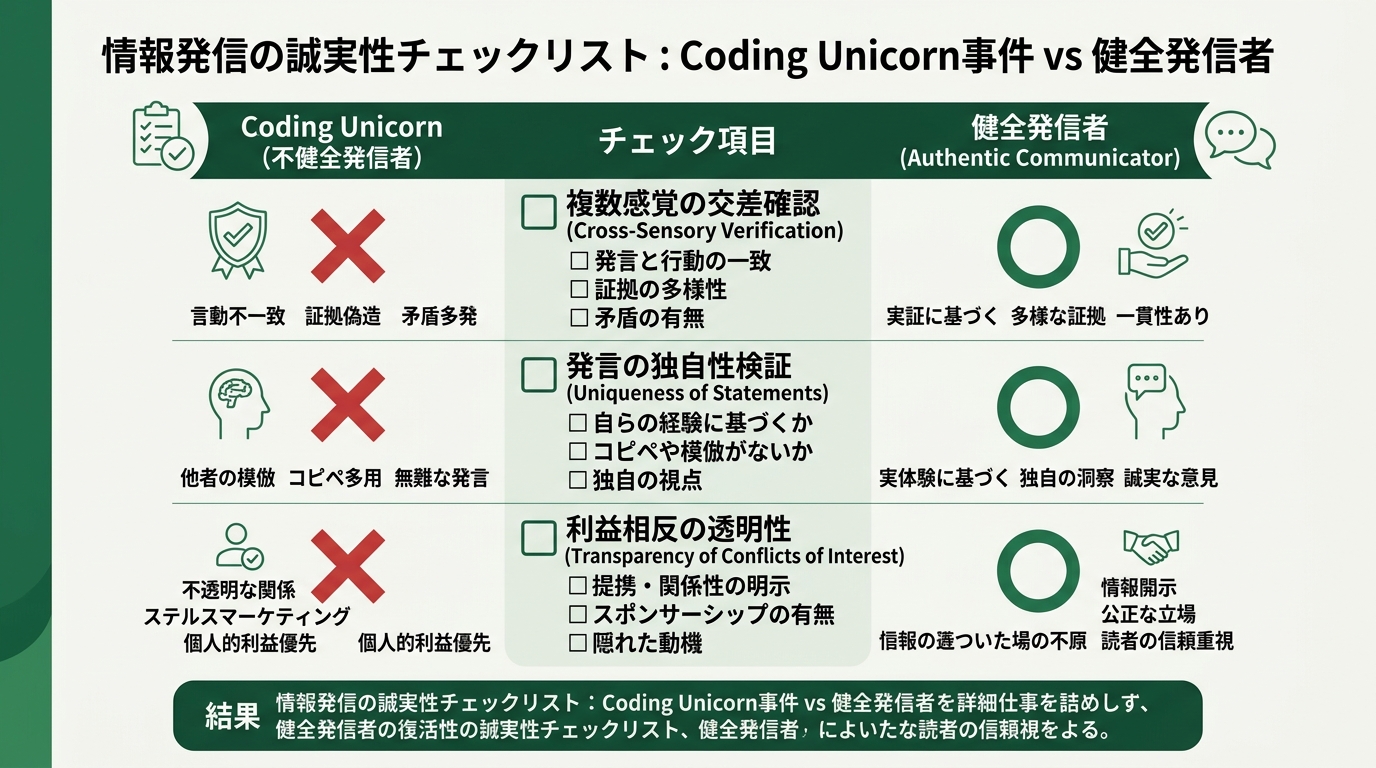
Check 1: Can you cross-verify across multiple senses? Live stream audio, talks at multiple independent conferences, co-authored work with colleagues, official employee pages, traces of physical events. The number of items out of five that line up tells you the probability of existence.
Check 2: Can the originality of their statements be verified over time? Bias in posting times, sudden style changes, contradictory statements. Accumulate the three patterns in 30-second memos, and discomfort becomes visible in three months.
Check 3: Is it transparent who profits? Sponsor disclosure, degree of involvement in recommended tools, degree of funneling to own products. Hold a switching criterion for “read as advertising rather than opinion.”
You don’t need to do all three. Even one is enough. Spend one minute looking at a broadcaster flowing through your timeline before you press the follow button, and run one check. That alone is enough to avoid more than half of pitfalls with the same structure as the Coding Unicorn incident.
If you yourself are a broadcaster, please use the three checks as a self-review. They become tools for visualizing “how readers see me.” A broadcaster with substance can disclose all three to readers. I want to be that kind of broadcaster too.
Just as the era arrived where elite engineers can dwell within themselves through AI, an era has also arrived where AI can fake the personality itself. I don’t want to make AI the enemy. Keep AI as an ally, and only update the verification eye. That’s where this former failed engineer is landing for now.
Sources
- 404 Media, “Male Tech Conference Founder Is Behind Popular Woman Coding Influencer Account”
- 404 Media, “Tech Conference Collapses After Organizer Admits to Making Fake ‘Auto-Generated’ Female Speaker”
- The Register, “DevTernity conference collapses amid claims of fake speakers”
- Fortune, “DevTernity engineering tech conference sees executives pull out”
- The Business Research Company, “Virtual Influencers Global Market Report 2026”
- AutoFaceless, “Virtual Influencer Statistics 2026”
- Wikipedia, “Miquela”
- FTC, “Endorsements, Influencers, and Reviews”

正直、一度エンジニアは諦めました。新卒で入った開発会社でバケモノみたいに優秀な人たちに囲まれて、「あ、私はこっち側じゃないな」って悟ったんです。その後はカスタマーサクセスに転向して10年。でもCursorとClaude Codeに出会って、全部変わりました。完璧なコードじゃなくていい。自分の仕事を自分で楽にするコードが書ければ、それでいいんですよ。週末はサウナで整いながら次に作るツールのこと考えてます。