The Week SpaceX Bought the Right to Acquire Cursor for $60B: I Pay $20/Month and Broke Down 3 Numbers to Redraw the Solo Developer's Map
SpaceX set a $60B buyout option on AI coding company Cursor. Breaking down the three numbers — $60B, $10B, and $1.3B — I translate this into a decision framework for solo developers from the perspective of a $20/month user.
What you'll learn in this article
- The key point to grasp before reading the full article
- How the issue changes the way developers should work next
- Which follow-up article is worth opening next
This morning, I opened Cursor as usual. The monthly subscription shown in the bottom right of the editor: $20. Probably about the cost of two coffees you buy each month.
Then news broke that SpaceX had secured “the right to buy” Cursor’s parent company for $60B (about ¥9 trillion). It was April 21, 2026. CNBC ran the first report, followed in quick succession by TechCrunch, Fortune, and Bloomberg. As I read the articles, I stared at my editor for a while, and thought:
“Behind my $20/month, there’s a ¥9 trillion price tag attached.”
What’s more, even the branching point of “buy or not” has a safety net: a “$10B (about ¥1.5 trillion) collaboration fee.” This isn’t a normal acquisition option. As a former-failed engineer, let me say this: this is “an event that redraws the AI coding map with numbers.”
In this article, I’ll break down three numbers: $60B, $10B, and $1.3B. From my perspective as a $20/month user, I’ll translate “what changes for solo developers.” For anyone who has felt that sensation of “having a master engineer dwelling inside you” even once, this event is not someone else’s problem.
Let me share the trap upfront. There’s bound to be a certain number of readers who think “a ¥9 trillion news story has nothing to do with me” and close the page. That’s the biggest waste. The moment you’re paying $20/month, you’re a character in this story. I’ve placed “3 action checks to do starting today” at the end of the article, so please read on with the assumption that you’ll scroll all the way there.
Breaking down 3 numbers: $60B, $10B, $1.3B
First, let me organize this so it doesn’t get confusing. Based on what can be confirmed in the reporting, three major numbers appear in this deal.
| Number | Meaning | Primary Source |
|---|---|---|
| $60B (about ¥9T) | Strike price for SpaceX’s right to buy Cursor (within the year) | CNBC 2026-04-21 |
| $10B (about ¥1.5T) | “Collaboration fee” if not acquired (total payment) | TechCrunch 2026-04-22 |
| $1.3B (about ¥200B) | Stock value held by 25-year-old CEO Michael Truell | Moneywise 2026-04-22 |
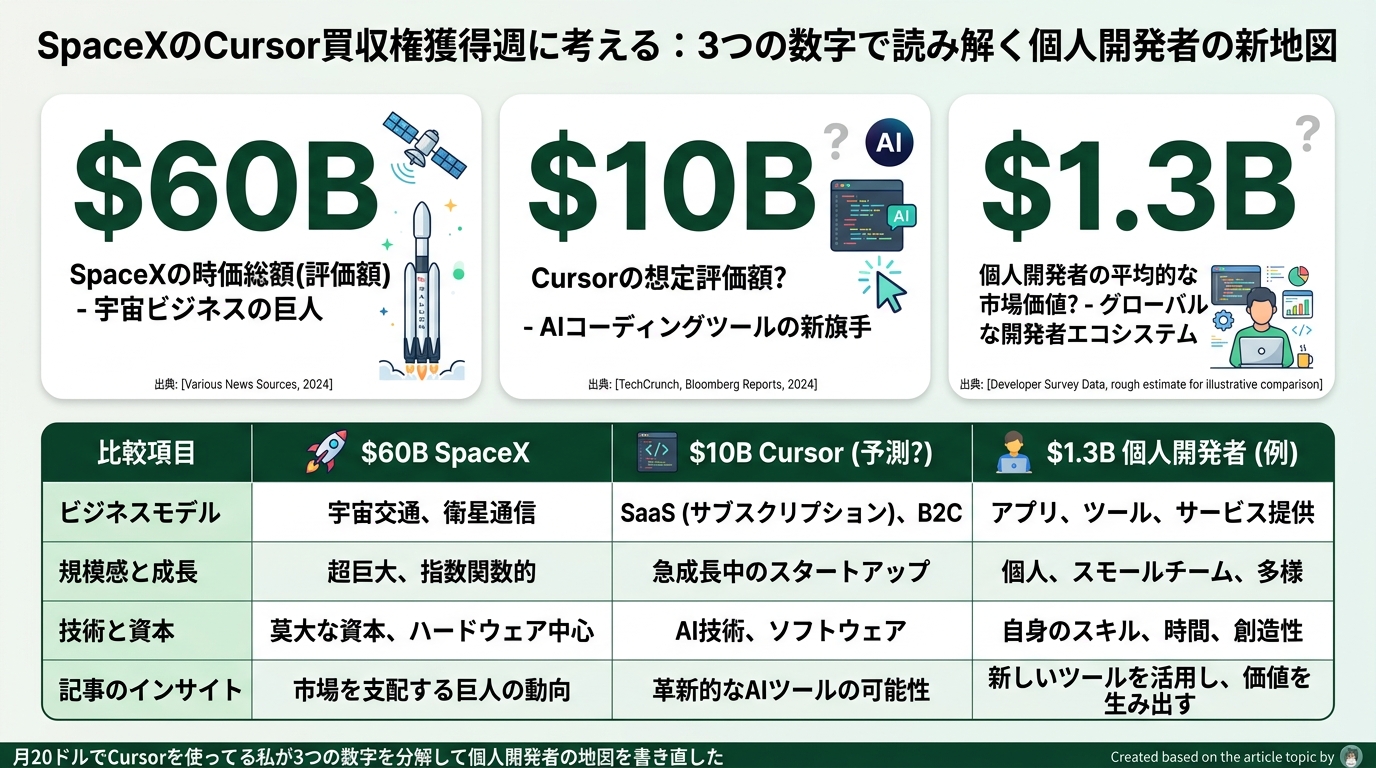
$60B is “the right to buy,” $10B is “pay even if you don’t buy”
The point is that this is not an “immediate acquisition contract.” It’s structured as “SpaceX holds the right to acquire Cursor for $60B sometime within the year.” Bloomberg’s headline put it bluntly: “SpaceX Has Deal for Right to Acquire Cursor for $60 Billion.” “Right to Acquire.” Not the “obligation” to buy, but the “right.”
What happens if they don’t buy? According to TechCrunch, SpaceX would pay Cursor “a total of $10B as compensation for collaboration.” In other words, even if SpaceX changes its mind, ¥1.5 trillion drops into Cursor’s lap.
The option of “just holding the right and not actually buying” is on the table. But this is also a sign that “the buyer is committing with serious intent to exercise the acquisition option.” The $10B is structured as something between a deposit and a fee — this is not a half-hearted partnership.
Reading this structure, I was reminded of enterprise contract negotiations from my CS days. When a buyer puts compensation on the table even for the “no-deal option,” it means management is dead serious about that project itself. Conversely, negotiations that leave the no-deal option at “zero yen” tend to end in lukewarm partnerships.
TechCrunch’s analysis piece interprets this $10B design as follows: “SpaceX placed $10B as insurance to preemptively crush the possibility of Cursor IPO-ing first or another buyer emerging.” This is serious lock-in.
Cursor turned down a $2B fundraise to choose this deal
Another interesting point is Cursor’s decision-making. Following the reports chronologically, Cursor was originally on the verge of closing “a $2B fundraising round at a $50B valuation” in the same week of April 2026. They turned that down and pivoted to SpaceX’s $60B buyout option + $10B collaboration fee (TechCrunch 2026-04-22).
Putting in $2B of fresh capital at a $50B valuation, versus moving on a $60B buyout option. Verbalized through a developer’s lens, the meaning of choosing the latter is this: “Rather than growing alone, partnering with SpaceX’s GPUs, xAI’s model development, and internal use at Tesla and others is stronger.” The 25-year-old CEO chose the path that bumps product competitiveness up another notch.
$1.3B is “the unrealized gain of the CEO of the Cursor you use”
Of the numbers Moneywise reported, this one hit me hardest. The 25-year-old CEO, Michael Truell. MIT dropout. His stock holdings are valued at $1.3B (about ¥200 billion).
The CEO of the editor I currently pay $20/month for is a 25-year-old young man with personal assets equivalent to ¥200 billion. As a member of the failed-engineers club, I read it back about five times.
Don’t misunderstand here. I didn’t feel “overwhelmed” by this number — I thought I could “translate” it. The fact that “an era where you can access a master-engineer-grade company for $20/month is moving at a ¥9 trillion scale.” That changes the judgment of someone like me who pays $20/month.
For reference, there’s a point I touched on in my earlier piece breaking down 44 Claude Code features. AI coding is a domain where the monthly cost on the “user side” and the business value on the “creator side” are massively asymmetric. $20/month is supporting a ¥9 trillion-scale operation. This is an advantageous structure for consumers.
Why was Cursor chosen by SpaceX? Three numbers proving their track record
The question “Why SpaceX?” gets resolved instantly when you look at Cursor’s track record.
Three numbers appear repeatedly in the reporting:
- 67% of Fortune 500 companies use Cursor (Fortune 2026-04-22 CEO article)
- 150 million lines of code generated daily in enterprise (same source)
- ARR (Annual Recurring Revenue) exceeded $1B at the end of 2025 (Anysphere Wikipedia)
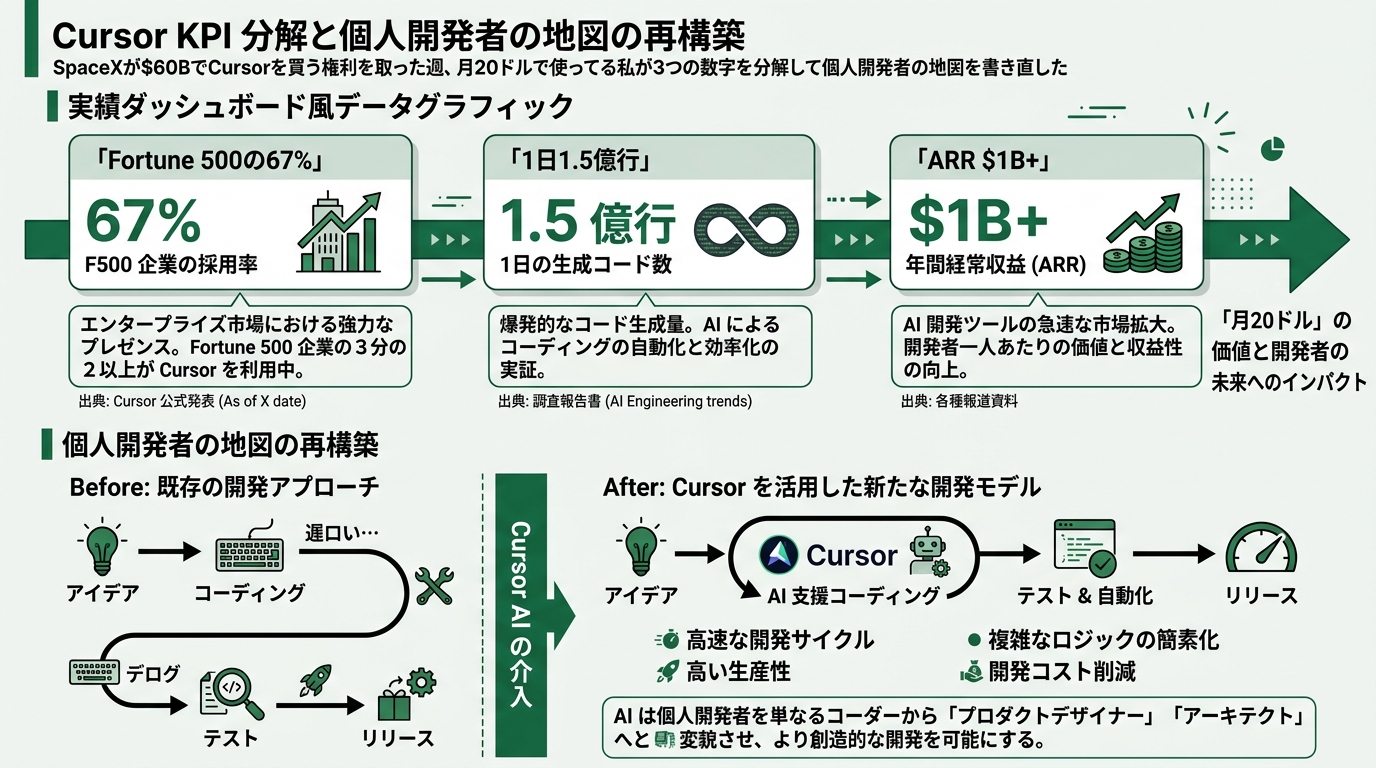
What 67% means: the “test phase is over” sign
67% of Fortune 500 companies are using Cursor. Specific names like Salesforce, Samsung, and Budweiser appeared in Fortune’s article. Fortune 500 is a ranking of large American companies. Organizations with 100 or 1,000 engineers are now incorporating Cursor into their work at a ratio of 2 out of 3.
I came up through CS (customer success). Anyone who knows enterprise sales firsthand will get this — the number 67% is “a sign that pilots are over.” Unless cases of “we’re going to stop using it after all” are overwhelmingly outnumbered by sticky deployments, this number can’t be sustained.
Let me add context for non-engineer readers. In the world of enterprise SaaS (software sold to businesses on a monthly subscription), annual and multi-year contracts dominate. Once signed, they’re not easily canceled. The number “67% of Fortune 500 are using it” is also evidence that contract cancellations rarely happen.
From my CS-era experience, if a new tool got into 5 of the top 100 companies, that was “great pre-IPO.” 20 was “industry standard candidate,” 50 hit the “industry standard” line. 67% is in the “already established as industry standard” range.
The decision criteria of tech leaders pushing Cursor in their work
I once asked a CTO friend at a major SaaS company why they chose Cursor as their internal standard. The answer had three parts.
- “Multiple model switching (Claude/GPT/Gemini) is usable in the same UI, so developers can write code without thinking about model selection.”
- “Inline completion speed feels 1.5x faster than other editor-integrated options.”
- “Permission management and logging are enterprise-grade, making audit responses easy.”
It’s chosen for “low operational overhead” rather than “features.” This is also the on-the-ground voice backing up the 67% number.
150M lines/day is “no longer human-written” scale
Through the Cursor platform, 150 million lines of code are generated daily for enterprise customers (Fortune report). Furthermore, in another report, regarding the total code generation volume across all of Cursor (including individual users), co-founder Aman Sanger revealed a stunning number. The statement was: “1 billion lines of code are accepted per day.”
Translating the scale of 1 billion lines/day looks like this. A typical software developer is said to produce 100 to 500 lines of code by hand per day, even on a good day. 1 billion lines is equivalent to 2 to 10 million people’s worth of code. That much is going out to the world via Cursor every day.
The editor I’m touching for $20/month is a massive platform where millions to 10 million developers worldwide pay the same monthly fee. There’s a strong possibility that code spit out via Cursor gets incorporated into products, which then circulates back into the apps we use.
// A casual one-liner I wrote this morning
const handleSubmit = async (data: FormData) => {
  // The moment this completion suggestion came from Cursor,
  // it became one of the 1 billion lines per day
  const response = await fetch('/api/save', {
    method: 'POST',
    body: JSON.stringify(data),
  });
  return response.json();
};
Even just 4-5 lines of code, the same patterns are being completed millions of times around the world. The scale is different.
Reading 150M lines from a “quality assurance” perspective
Let me push one step deeper here. What does the scale of 150M lines/day mean from a quality assurance perspective?
To spit out 150M lines of code daily in an enterprise environment, the AI editor side absolutely needs strong guarantees. Two of them: “not using confidential information for training” and “not leaking a company’s codebase into another company’s completions.” Cursor has rolled out multiple measures for this in their enterprise plan (Cursor for Business). The three pillars are: disabling code from model training, privacy guarantees, and SOC 2 Type II compliance.
In other words, the moment 67% of Fortune 500 are on board, they’ve passed the data governance screening. This is reassuring even for individual users. Because we $20/month users also get access to part of the infrastructure built out for enterprise.
ARR $1B is a “subscription pace of ¥150B”
ARR stands for Annual Recurring Revenue, an indicator of subscription business scale. You can think of it as monthly revenue annualized.
Cursor was reported to have exceeded ARR $1B at the end of 2025. Through the accumulation of $20/month plans and business plans, they’re booking subscription revenue of ¥150 billion per year. By normal SaaS company standards, this is a line where IPO wouldn’t be surprising.
In my earlier Vibe Coding Introduction, I wrote that there’s a moment when AI editors change from “personal tool” to “infrastructure.” That change appears clearly in the ARR $1B number.
Incidentally, Anthropic’s Claude API ARR has also been reported by industry estimates to have exceeded $1B in some periods. Cursor has become “AI infrastructure dressed up as an editor,” and even by ARR scale, it has reached a position shoulder-to-shoulder with foundational AI companies. My $20/month is hitching a ride on a business of that scale.
25-year-old CEO Michael Truell, and 3 asymmetries the failed-engineers club reads
The CEO of Anysphere, the company that develops Cursor, is Michael Truell, born in 1999, age 25. He enrolled at MIT but dropped out and founded Anysphere in 2022 with three co-founders (Fortune CEO article). Truell and the co-founders had internship experience at Google, Meta, and OpenAI. Originally, they were tackling not developer tools but mechanical engineering CAD automation.
After pivoting to AI coding, they grew it into a company with a $60B valuation in 4 years.
Let me write out 3 asymmetries I, as a member of the failed-engineers club, read from this story.
Asymmetry 1: “Speed of pivot” works better than credentials
Truell painted over the career scar of “MIT dropout” with $1.3B in held assets. What’s striking from a failed-engineer perspective is his judgment to pivot from “AI automation for mechanical engineering” to “AI automation for coding.”
When I joined a web development company as a new graduate, I thought “the choice to quit” was weakness. But Truell could probably have continued with CAD automation and become a sufficiently respected engineer. Even so, he turned the ship in the direction the market wind was blowing (AI coding). This is a combination of “the courage to quit” and “directional sense.”
Failure is also a preparation period for changing direction. I myself, precisely because I gave up on being a full-time engineer, my CS and marketing foundation now connects to AI vibe coding. Just as Truell, who gave up on CAD automation, won at coding automation, my failure also had a place where it could come alive as directional sense.
Asymmetry 2: The wall between $20/month and ¥200B becomes “paper-thin”
The CEO has personal assets of ¥200 billion, and on the user side, it’s $20/month. Originally, these two were stories from different worlds. But thinking that “decisions equivalent to ¥200 billion” are hanging on Cursor’s product quality changes the feel of $20/month.
$20/month is the amount we vote for Cursor’s development. We hold voting rights. We’re not paying $20/month because it’s cheap. It’s the access fee to “ride on the judgment of a decision-maker handling ¥200 billion.”
When this perspective shifts, the framework for choosing tools changes. Not “use it because it’s cheap” or “use it because it’s free,” but choosing based on “whose judgment do I want to ride on.” Anthropic (Claude Code), Microsoft (GitHub Copilot), Anysphere (Cursor). The three companies have different philosophies.
Asymmetry 3: In an era where 25-year-olds move ¥9 trillion, the “age wall” doesn’t work
This one is simple but heavy. A 25-year-old with personal assets of ¥200 billion. There was a period when I treated my age of 36 as a weakness. “It’s already too late.” “I can’t keep up with the young ones.” But Truell’s existence works in the opposite direction too.
“I can’t move because I’m older” doesn’t function as an excuse in the AI coding era. He’s 25, I’m 36. The gap is 11 years. But on top of an AI editor, we use the same interface. We confirm completions with the same Tab key. The age difference doesn’t translate to a difference in the precision of instructions to the AI.
Let me write this as a failed-engineer. The moment you think “it’s too late,” you stop. I’ll stick Truell’s $60B on my desktop as a symbol for not using age as a reason.
In fact, there’s an acquaintance from my CS cohort who said “I’m already over 40, so new tech is impossible for me.” He started touching Cursor and within 3 months, he built two internal tools himself. AI editors lower the age wall. The technical wall between Truell’s 25 and my 36 is thinner than I thought.

The selection framework for Cursor, Claude Code, and GitHub Copilot
How do I answer “So which one should I use after all?” in the wake of the $60B news? Let me share my framework.
| Tool | Developer | Monthly (individual plan basis) | Strengths | ”Whose judgment to ride on” |
|---|---|---|---|---|
| Cursor | Anysphere | $20 | Fast completion, multi-model switching, integrated UI | The 25-year-old CEO’s pivoting power (chosen by SpaceX) |
| Claude Code | Anthropic | $20 (Pro) to $200 (Max) | CLI-driven, long-form design, transparency of thought | Anthropic’s strong push on safety philosophy |
| GitHub Copilot | Microsoft | $10 to $39 | GitHub integration, Visual Studio integration | Microsoft’s enterprise rollout |
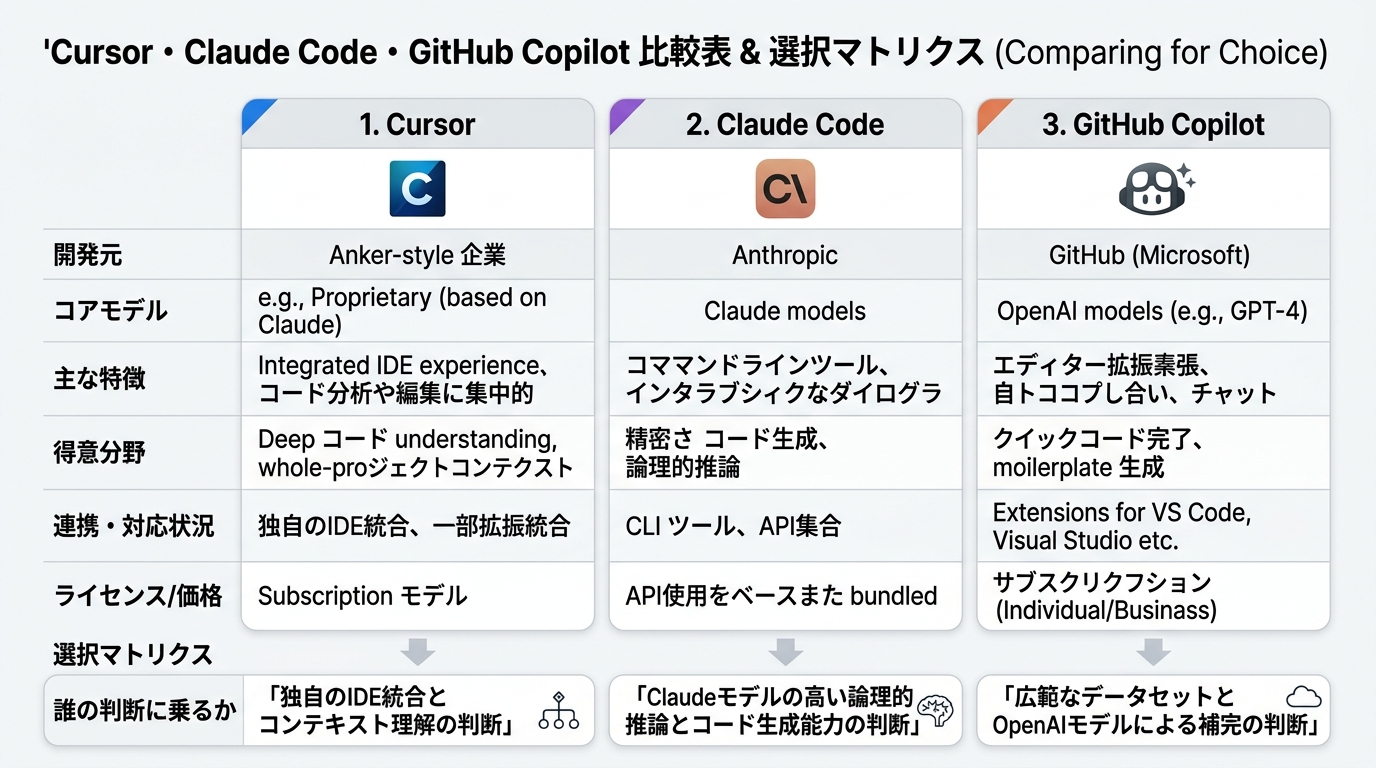
Sharing the “trap points” upfront
Having tried all three, let me write the trap points upfront.
Cursor is strong because you can switch between multiple models. You can move between Claude, GPT, and Gemini within one editor. However, there’s a trade-off between “completion speed” and “request exhaustion.” On the $20/month plan, if you throw complex instructions in succession, you’ll hit the cap. I burned 3 hours understanding the plan.
Claude Code is the type that launches from the CLI (command line). At first, you’ll be confused — “Not an editor, but a terminal?” But once you get used to it, it’s strong. When you throw long-form design instructions, it understands the structure across files and then generates code. The /loop and /schedule I wrote about in my 44 features article are stories from this world.
GitHub Copilot rides on top of existing VS Code or JetBrains. It has the lowest “adoption friction.” But the transparency of its thought process is thinner than the other two. It’s good for “let me just try it first.”
Solo developer’s judgment axis: don’t bet on one tool
My current setup is distributed across three: “Cursor for daily coding,” “Claude Code for design and long-form tasks,” “Copilot for personal projects.” I’m running it on the concept of “multiple models in parallel.”
Why distribute? Looking at this $60B event, the possibility has emerged that Cursor’s ownership moves to SpaceX. If the owner changes, the pricing structure, terms of service, and roadmap could change. If you have all your code dependent on one tool, you bear the entirety of that change risk.
As Nagi has touched on multiple times in her articles (such as 10 Major Digital Marketing Trends of 2026), the entire AI tools industry is entering a “reorganization” phase. In a reorganization phase, an operational design that uses multiple tools properly increases business continuity.
Let me write out 3 specific risk scenarios:
- Pricing structure change: Risk that after the $60B acquisition, SpaceX shifts policy to “abolish individual plans and focus on enterprise.” Possibility of not being able to use it for $20/month
- Constraints on model selection: Risk of a policy emerging that favors SpaceX/xAI’s Grok and restricts Claude/GPT selection
- Changes in data handling: Possibility of the management rules for past code history changing through terms revisions
The probability of each happening is not high right now. But knowing they “could happen” versus not knowing changes how you pay $20/month.
Realistic allocation example for solo developers
For reference, let me expose my monthly AI coding-related spending. This is just one example, and the optimal allocation changes depending on the nature of your work.
| Tool | Monthly | Use | Share of total |
|---|---|---|---|
| Cursor | $20 | Daily coding, small implementations | About 30% |
| Claude Code Pro | $20 | Design review, long-form tasks | About 30% |
| GitHub Copilot | $10 | Personal OSS projects | About 15% |
| Other (API costs, etc.) | $15 | Automation scripts | About 25% |
| Total | $65 | — | 100% |
“Using three editors in parallel for $65/month” might sound a bit luxurious. But for about the same as monthly coffee money, you can vote for three world-class AI editors. In the midst of a $60B-moving event, this is rather a reasonable unit price.
3 action checks I, as an individual user, am doing starting today
Don’t let the news end with just reading. Let me share the 3 actions I, as a $20/month payer, am doing today in response to the $60B news.
Check 1: Confirm Cursor’s export functionality
If ownership might change, I want my settings, rules, and history in a state where I can take them out anytime. Cursor has features like Settings > Export. This morning, I first checked this and backed up my config files to separate storage.
# Back up Cursor's config files just in case
# For macOS
cp -r ~/Library/Application\ Support/Cursor/User \
  ~/Documents/cursor_backup_$(date +%Y%m%d)
# This protects the entire set of config files

# For Windows (PowerShell)
Copy-Item -Path "$env:APPDATA\Cursor\User" `
  -Destination "$env:USERPROFILE\Documents\cursor_backup_$(Get-Date -Format yyyyMMdd)" `
  -Recurse
It’s done in 3 minutes. There’s no harm in doing it. If you’ve written rules per project in the “.cursor/rules” directory, include that in the backup target too. Rule definitions shared with the team are particularly painful to lose.
Check 2: Take inventory of “which models you depend on”
Within Cursor, what models do I usually use? Claude Sonnet variants? GPT variants? Gemini variants? If they’re mixed, which one am I using for which task?
In my case, I have a usage pattern like Claude for logic design, GPT for boilerplate code completion, Gemini for image processing. Writing this out reveals “what would be in trouble if Claude became unusable.” SpaceX and xAI (the AI company developing Grok) are both companies led by Elon Musk. There’s a possibility that Grok will be favored on Cursor through partnership with xAI.
Let me leave a specific inventory sheet format. Please do this in 10 minutes today.
| Task | Primary model | Alternative model | Severity if lost |
|---|---|---|---|
| Logic design | Claude Sonnet 4.6 | GPT-5 | High |
| Boilerplate completion | GPT-4o | Gemini Pro | Medium |
| Error analysis | Claude Opus 4 | GPT-5 | High |
| Image processing code | Gemini Pro | Claude | Low |
Summarize a “map of dependencies” on one page. Don’t panic when reorganization happens.
Check 3: Be conscious of $20 usage as “voting”
This may sound like a pep talk, but it’s actually important. Treat $20/month not as a “cost” but as a “vote.”
“If I’m riding on Anysphere’s judgment, I pay $20 to Cursor.” “If I’m riding on Anthropic’s safety philosophy, $20 to Claude Code.” “If I’m riding on Microsoft’s enterprise standardization, $10 to Copilot.”
Each monthly payment means you’re flowing funds in that company’s direction. In a world where $60B moves, $20/month looks like a small voice. But just as the 67% adoption rate among Fortune 500 shows, the accumulation of countless small votes generates massive numbers.
From the failed-engineers’ perspective, this is the interesting point. I, who “couldn’t become a master engineer,” can vote on the direction of the tech industry for $20/month. This is a structure that didn’t exist in the software industry 10 years ago. The SaaS monthly model handed us “industry voting rights.” The $60B news is also an event that makes us re-recognize the weight of those voting rights.
Bonus: the “light and shadow” verification I want to try with Cursor this week
Here’s a preview too. Next week, I’m planning to do verification testing where I let Cursor handle production DB operations. Recently, the incident reported by The Register where a “Cursor-Opus agent deleted a production DB” stirred the industry. The “shadow” part happening behind the $60B celebration.
Light and shadow — you can’t make a real judgment without seeing both. In the next article, I’ll honestly write about my safe operation rules and the points where I had accidents. If you go too far with the spirit of “let’s just make something that works,” your production DB disappears. This is also a topic I want to share preemptively.
Summary — $60B is the signal to redraw “the map of numbers”
Since this got long, let me leave the summary in bullet points.
- SpaceX set a $60B buyout option on Cursor. Even if they don’t buy, a $10B collaboration fee is promised
- Cursor’s track record: 67% Fortune 500 adoption, 150M lines of enterprise code per day, ARR over $1B
- 25-year-old CEO Michael Truell has personal assets equivalent to $1.3B. Read from a failed-engineer perspective, it suggests “pivoting power” and “age neutralization”
- The judgment axis for solo developers: “don’t bet on one tool,” “take inventory of dependent models,” “treat $20/month as voting”
- The $20/month Cursor can be redefined as the access fee to ride on the judgment of decision-makers moving ¥9 trillion
Lastly, a word to my fellow members of the failed-engineers club. Don’t think “the ¥9 trillion news has nothing to do with me” and close the page. The moment you’re paying $20/month, you’re one of the characters in that ¥9 trillion story.
I’d like you to try the practice of breaking down three numbers, starting from the moment you open Cursor today. The price displayed in the bottom right of your editor isn’t a cost. It’s a vote.
I’ll keep talking to Cursor today, saying “let’s just make something that works for now.” Whether $60B moves or not, my $20/month work doesn’t change. But the meaning of those $20 has definitely been rewritten.
Precisely because of failure experiences, the ability to translate between “the scale of the news” and “the scale of my own scene” grows. $60B and $20/month are not different worlds, but different scales on the same map. With the failed-engineers club’s map-reading skills, I want to turn this event into material for my own judgment.
Source list
- CNBC 2026-04-21: SpaceX says it can buy Cursor later this year for $60 billion or pay $10 billion
- TechCrunch 2026-04-22: How SpaceX preempted a $2B fundraise with a $60B buyout offer
- Fortune 2026-04-22: SpaceX strikes $60 billion deal for Cursor
- Fortune 2026-04-22: Cursor’s 25-year-old CEO Michael Truell
- Bloomberg 2026-04-21: SpaceX Has Deal for Right to Acquire Cursor for $60 Billion
- Moneywise 2026-04-22: Michael Truell MIT dropout $1.3B
- Aman Sanger on X: Cursor writes almost 1 billion lines per day
- Anysphere – Wikipedia
- Cursor for Business (privacy & SOC 2 information)
Related articles

正直、一度エンジニアは諦めました。新卒で入った開発会社でバケモノみたいに優秀な人たちに囲まれて、「あ、私はこっち側じゃないな」って悟ったんです。その後はカスタマーサクセスに転向して10年。でもCursorとClaude Codeに出会って、全部変わりました。完璧なコードじゃなくていい。自分の仕事を自分で楽にするコードが書ければ、それでいいんですよ。週末はサウナで整いながら次に作るツールのこと考えてます。